Works › Sophistical Refutations, Books I–II
Volume 2 · pp. 710–713
Tractate V. Chapters II-III
A marker with ≈ is an approximate page boundary, placed by measure of the text; the page photographs remain the authority. In the paired views, clicking a page marker brings that page into view.
CAPUT II. De epilogis dictorum in Topicis et in hoc libro toto.
Finem igitur imponere intendentes isti toti negotio quod de arte est inveniendi in Topicis et in hoc libro tradita, dicimus quod ex dictis in Topicis et in hoc libro, satis manifestum est ex quantis sive ex quot locis sophisticis, et ex qualibus (quoad formas paralogismorum) et quibus disputationibus sive generibus disputationum fiunt et generantur paralogismi: hoc enim jam in priori hujus scientiae libro determinatum est, secundum quod paralogismi ducunt ad redargutionem. Et iterum ostensum est in eodem priori libro, quomodo ostendimus falsum per paralogismos ad falsum ducentes. Et iterum in eodem determinatum est, qualiter aliquem facimus dicere et concedere id quod est extra opinionem per paralogismos ad opinabile ducentes. Amplius in eodem libro priori determinatum est ex quibus causis apparentiae et non existentiae accidit syllogismus sophisticus, et quis est ordo interrogationum, hoc est, quo ordine (quantum ad cautelas) oportet interrogare. Amplius autem in principio hujus secundi libri dictum est, et in principio primi, ad quid sunt utiles omnes hujusmodi sophisticae orationes: et in secundo jam habito hujus scientiae libro determinatum est simpliciter de omni responsione et quoad modum apparentis responsionis et quoad modum verae responsionis secundum singulas fallacias, et quomodo solvendum disputationes cautelarum, et quomodo solvendum syllogismos sophisticos qui sunt paralogismi. Et haec quae dicta sunt, sufficiant ad intentionem praesentem.
Reliquum (quantum ad epilogandum etiam ea quae sunt de eo quod est artis inventivae) dicendum de eo quod ex principio artis inventivae (quam in Topicis tradere incepimus) nobis reminiscentibus epilogaliter dicere propositum erat, breviter etiam illa epilogando, et sic finem imponere dictis quantum ad artem inventivam quae in Topicis et in Elenchorum libro determinatur.
Dicimus ergo quod in principio primi Topicorum sumpsimus sive assumpsimus nobis et proposuimus nobis invenire potestatem (hoc est, facultatem) methodi vel artis quamdam syllogisticam de proposito (hoc est, per quam possemus syllogizare ad omne probabile propositum) ex his quae arti et proposito insunt locis et considerationibus, et sunt quam probabilissima. Ex probabilibus enim opus dialecticae per se est procedere, et tentativae quae est dialectica quaedam. Quoniam autem in hoc conformatur ad eam sophistica quae procedit ex apparenter probabilibus propter sophisticae vicinitatem sive conformitatem ad dialecticam, ut ipsa dialectica interrogando et opponendo non solum possit experimentum sumere ignorantiae per modum opponendi et interrogandi (quod est officium et actus inquirentis, et quod in prima parte octavi Topicorum tradidimus) sed etiam sic dialectica quasi sciens facultas, quod in eadem parte octavi Topicorum docuimus per modum et ordinem responsionis: quia responsio opus et actus scientis. Propter hoc non tantum dictum opus octavi Topicorum negotii proposuimus orationem posse sumere (hoc est, ut per artem opponendi orationem ad propositum sumere sciamus) sed ut per artem respondendi orationem sustinentes observemus positionem nihil dicendo repugnans respondentes, velut per probabilissima dialecticae, simili modo sicut opponendo procedat ex probabilibus. Causam autem jam diximus hujus, ut scilicet dialecticus non tantum sit in dispositione actu interrogantis, sed etiam sit in forma scientis: et ideo responsionem docuimus in secunda parte octavi Topicorum. Hujus autem causam diximus esse, quod interrogatio sit signum nescienti. Propter hoc Socrates semper interrogabat, sed non respondebat: quia ex humilitate in ipsa interrogatione fatebatur se non scire: cum (ut dicit Aristoteles in libro de proprietatibus elementorum) Plato esset omni sapientia perfectus et laudatus, tamen si quid docuit, docuit quasi interrogando.
CHAPTER II. Concerning the epilogues of the things said in the Topics and in this whole book.
Therefore, intending to impose an end on this whole business which is about the art of finding handed down in the Topics and in this book, we say that from the things said in the Topics and in this book it is sufficiently manifest from how many or from how many sophistical places, and from what sorts, as to the forms of paralogisms, and by what disputations or genera of disputations paralogisms are made and generated. For this has already been determined in the prior book of this science, according as paralogisms lead to refutation. And again it was shown in the same prior book how we show the false through paralogisms leading to the false. And again in the same book it was determined in what way we make someone say and concede what is outside opinion through paralogisms leading to what is contrary to opinion. Further, in the same prior book it was determined from what causes of appearance and non-existence a sophistical syllogism happens, and what is the order of questions, that is, in what order, as to safeguards, one ought to ask. Further, in the beginning of this second book, and in the beginning of the first, it was said for what all sophistical speeches of this kind are useful. And in the second book of this science already had, it has been determined simply concerning every response, both with respect to the mode of apparent response and with respect to the mode of true response according to the individual fallacies, and how disputations of safeguards must be solved, and how sophistical syllogisms, which are paralogisms, must be solved. And let these things which have been said suffice for the present intention.
The remaining thing, as regards also epiloguing those things which concern what belongs to the inventive art, must be said concerning that which from the beginning of the inventive art, which we began to hand down in the Topics, it had been proposed by us, remembering, to say epilogically, also by epiloguing those things briefly, and thus to impose an end on the things said as regards the inventive art which is determined in the Topics and in the book of Refutations.
Therefore we say that at the beginning of the first book of the Topics we took or assumed for ourselves and proposed to ourselves to discover a power, that is, a faculty, of a certain syllogistic method or art concerning the proposed thing, that is, through which we might be able to syllogize to every probable proposed thing, from those places and considerations which belong to the art and to the proposed thing, and are as probable as possible. For the work of dialectic per se is to proceed from probabilities, and of the tentative art, which is a certain dialectic. But because in this sophistic, which proceeds from apparently probable things, is conformed to it, on account of the nearness or conformity of sophistic to dialectic, so that dialectic itself, by questioning and opposing, not only can take an experiment of ignorance through the mode of opposing and questioning, which is the office and act of the inquirer and which we handed down in the first part of the eighth book of the Topics, but also so that dialectic, as a faculty knowing, which in the same part of the eighth book of the Topics we taught through the mode and order of response; because response is the work and act of one knowing. On account of this, we proposed not only the said work of the business of the eighth book of the Topics, to be able to take a speech, that is, so that through the art of opposing we may know how to take a speech to the proposed thing, but so that through the art of responding, sustaining the speech, we may observe the position by saying nothing repugnant while responding, as though through the most probable things of dialectic, in a similar way as by opposing it proceeds from probabilities. But we have already stated the cause of this, namely so that the dialectician is not only in the disposition of one actually asking, but also is in the form of one knowing; and therefore we taught response in the second part of the eighth book of the Topics. But we said the cause of this is that interrogation is the sign of one not knowing. Because of this Socrates always asked, but did not respond, because from humility in the very questioning he confessed that he did not know; since, as Aristotle says in the book On the Properties of the Elements, although Plato was perfected and praised with every wisdom, nevertheless if he taught anything, he taught as though by questioning.
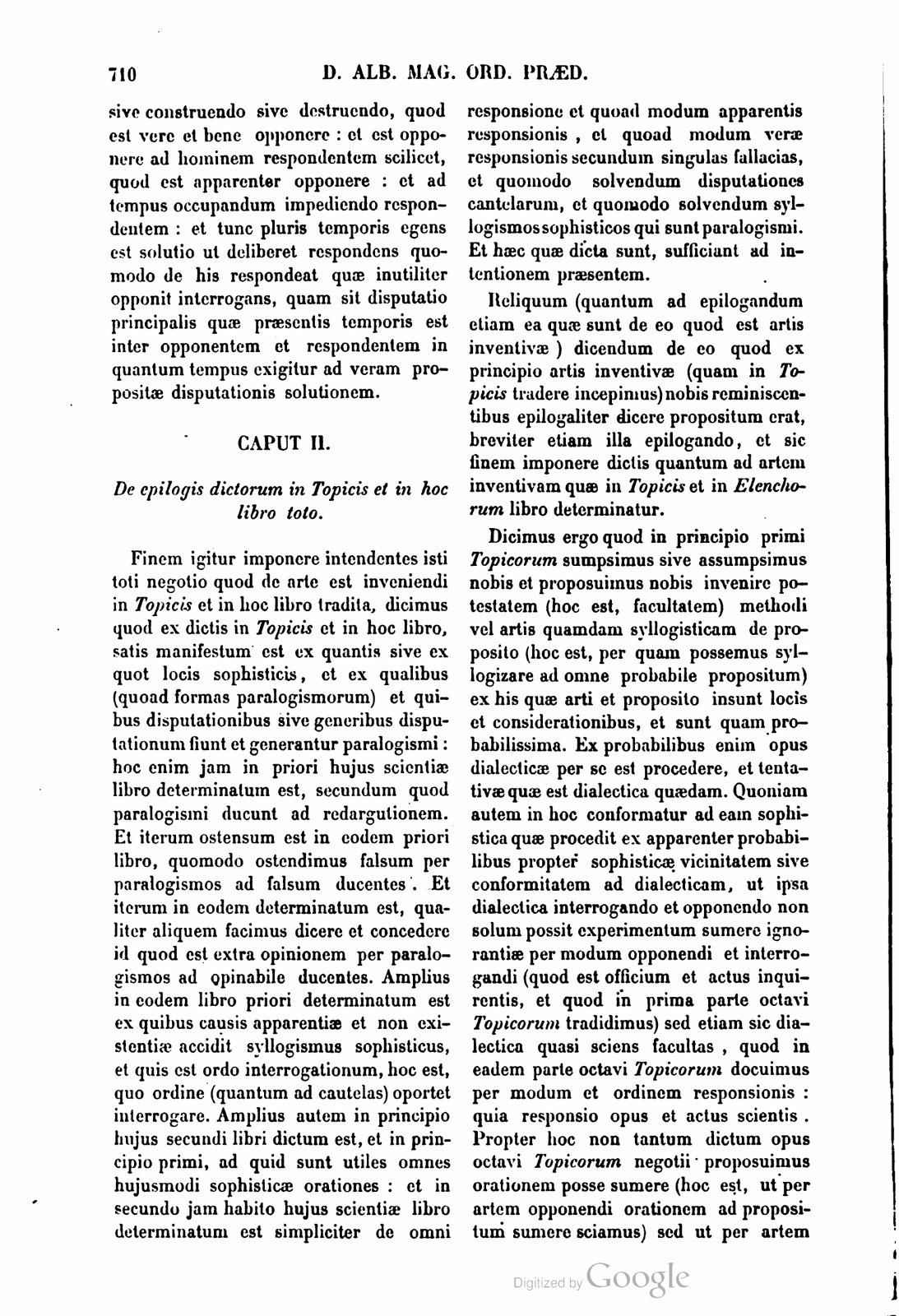
Manifestum autem est ex determinatis in prioribus (hoc est, in antecedentibus libris ante octavum Topicorum et praecipue in primo Topicorum) ad quot fines secundum exercitationem et obviationem et secundum philosophiam disciplinas, et ex quot problematibus hoc dialecticum erat negotium, et unde (hoc est, ex quibus considerationibus) idonei erimus horum, hoc est, ad illa problemata determinanda. Amplius autem in primo Elenchorum libro determinatum est, quomodo obvianda est opponentis quaestio, quantum est ex parte opponentis, et de responsionibus et solutionibus quae sunt proprie ad tales syllogismos, patefactum est in secundo hoc libro Elenchorum, et de aliis orationibus syllogisticis quaecumque sunt orationes ejusdem viae sive methodi sophisticae, ut ad falsum et inopinabile et nugationem et ad solaecismum ducentes. Praeter haec autem de paralogismis pertractavimus secundum singulas fallacias, sicut jam prius diximus. Manifestum est ergo, quoniam jam optatum habent finem sufficienter quae proposuimus de arte topica sive inventiva.
CAPUT III. Qualiter scientia logices est inventa.
Oportet autem nos non latere quod accidit circa sophisticum et totum logicum negotium, quantum ad modum inveniendi ipsum et ordinandi ipsum in artem perfectam et scientiam. Nam eorum quae inveniuntur in omnibus aliis scientiis, sive inventa sunt, quae quidem sumpta sunt ab aliis, a quibus prius elaborata sunt, a posteris particulariter augentur, qui sua prioribus inventis adjungentes sic particulariter auxerunt, et sic prima inventa ab eis successoribus priorum, qui scilicet successores postea post primos accipiunt a prioribus inventa, et addunt sua ad artis et scientiae incrementum. Quae autem in primis ex principio dictionis inveniuntur, parum valde in primis inventoribus augmentum sumere solent: quia non sunt nisi quaedam communissima, in quibus scitis parum scitur de arte. Utilius autem est plurimo illo invento quod scitur postea additum et inventum a posteris: quia hoc coarctatum est et appropriatum conclusionibus artis: et ex his fit artis et scientiae augmentum usque ad perfectionem scientiae et arti debitam. Maximum enim omnium fortasse principium est. Et dico fortasse, non quia dubium sit, sed quia non est maximum quantitate, cum sit unum ex duobus simplicissimis principiis et complexis, subjecto scilicet et praedicato: et ideo quantitate substantiae minimum est, maximum autem est potestate, quia super omnes conclusiones influunt principia: et hoc quidem dicitur ab omnibus Philosophis.
But it is manifest from the things determined in the prior things, that is, in the preceding books before the eighth book of the Topics and especially in the first book of the Topics, to how many ends according to exercise and resistance and according to the disciplines of philosophy, and from how many problems this dialectical business was, and whence, that is, from what considerations, we will be suitable for these things, that is, for determining those problems. Further, in the first book of Refutations it was determined how the opponent's question must be met, as much as is from the side of the opponent, and concerning responses and solutions which properly belong to such syllogisms it has been disclosed in this second book of Refutations, and concerning other syllogistic speeches, whatever speeches are of the same way or sophistical method, as leading to the false and to the unbelievable and to nugation and to solecism. Besides these things, we have treated of paralogisms according to the individual fallacies, as we have already said before. Therefore it is manifest that those things which we proposed concerning the topical or inventive art now sufficiently have the desired end.
CHAPTER III. In what way the science of logic was invented.
But it must not escape us what happened concerning the sophistical and the whole logical business, as to the mode of discovering it and ordering it into a perfect art and science. For of those things which are discovered in all other sciences, or have been discovered, certain things which have been taken from others, by whom they were previously elaborated, are increased particularly by later persons, who, by joining their own things to the things previously discovered, increased them particularly in this way; and so the first things discovered by those successors of the prior persons, namely successors who later after the first receive from prior persons what has been discovered, and add their own things for the increase of art and science. But the things which are discovered at first from the beginning of a discourse customarily receive very little increase among the first discoverers, because they are only certain most common things, and when these are known, little is known about the art. But much more useful than that discovery is what is known when later added and discovered by later persons, because this has been narrowed and appropriated to the conclusions of the art; and from these comes the increase of art and science up to the perfection due to the science and art. For the principle is perhaps the greatest of all. And I say perhaps, not because it is doubtful, but because it is not greatest in quantity, since it is one from the two simplest and complex principles, namely subject and predicate; and therefore it is least in quantity of substance, but greatest in power, because principles flow over all conclusions; and this indeed is said by all philosophers.
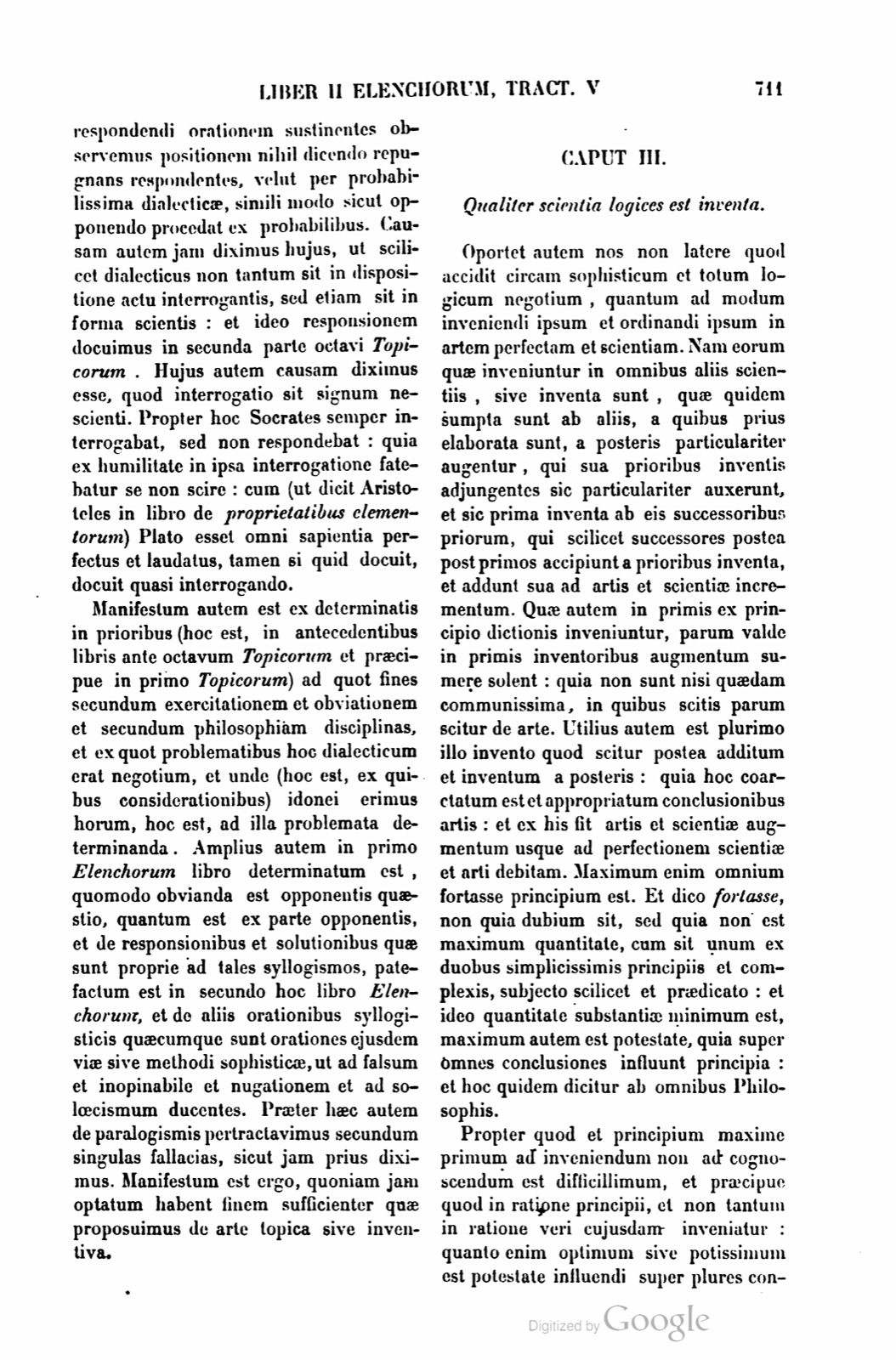
Propter quod et principium maxime primum ad inveniendum non ad cognoscendum est difficillimum, et praecipue quod in ratione principii, et non tantum in ratione veri cujusdam inveniatur: quanto enim optimum sive potissimum est potestate influendi super plures conclusiones, tanto parvissimum est magnitudine substantiae: quia ex duobus minimis est et simplicissimis praedicato et subjecto: et propter hoc difficillimum est videri quoad inventionem secundum quod influentiam habet super omnes conclusiones scientiae. Hoc principio invento facile est addere sequentia, quae jam potestate sunt in ipso principio: et ideo notitia principii influit et illuminat ad sequentium inventionem et additionem. Unde facile est sic invento principio augere reliqua ad scientiam et artem pertinentia. Et hoc probatur per hoc quod talis inventio et talis additio etiam circa rhetoricas accidit orationes. Et pene circa omnes etiam accidit iste modus augendi circa omnes alias artes et scientias: nam primi qui principia scientiarum invenerunt, omnino universaliter ad parvum quid ipsam scientiam perduxerunt. Quoniam autem successores illorum nunc sunt famosiores in scientiis quam primi, assumentes prius inventa a multis prioribus velut ex successione particulariter (hoc est, per partem et partem facta) colligentes omnium praedecessorum inventa sic auxerunt, et ad perfectam et debitam quantitatem scientias et artes deduxerunt. Sic rhetoricam auxit quidam Tisias post Coracem et alios antiquissimos rhetores quorum dicta collegit quasi avis quaedam grana. Et sic Tisias quidem auxit post priores. Thrasymachus vero auxit post Tisiam. Theodorus autem auxit ultimus post Thrasymachum. Et sic multi rhetores multas successive coordinaverunt partes. Propter quod nihil mirum si habet multum in voluminibus et quantitate haec ars, quae sic a multis adaucta est.
Sic autem a nobis non est inventa haec scientia sophistica et universaliter logica: ante nos enim hujus negotium non hoc (hoc est, pars quaedam) erat: illud autem (hoc est, alia pars) non erat perscrutatum, sive perscrutata ante nos: sed nihil omnino erat inventum a prioribus ante nos de hoc negotio. Nam quamvis eorum principiorum quae circa litigiosas sive sophisticas erant orationes, quaedam doctrina fuit in libro Platonis, qui dicitur Gorgias, eo quod ad discipulum suum Gorgiam est scriptus, tamen erat similis mercenarii, hoc est, mechanicis quibus in commutationibus utuntur mercenarii. Quidam enim docebant ediscere, hoc est, proponere orationes rhetoricas. Alii autem docebant dicere seu proponere orationes disputativas sive interrogativas et syllogisticas, non ex arte, sed in quas saepius cadere solebant utrinque et in rhetoricis et interrogativis, alternorum docentes orationes et non in communi artem tradentes. Propter quod velox quidem fuit (quia sensibilis et exemplaris) sine arte autem erat discentibus ab eis tales orationes: non enim artem dantes sive tradentes, sed potius quaedam exemplaria et particularia quae ab arte sunt erudire arbitrati sunt discentes ab eis, licet non erudierunt vere: velut si quis mechanicorum disciplinam dicat se tradere ut homines ambulantes per calceos non doleant pedes, quod facit ars sutoria. Deinde sutoriam quidem non doceat per praecepta universalia ad unum finem tendentia, neque etiam tradat artem unde (hoc est, per quam) possint inveniri talia quae ad non dolere pedes, et in ambulando non atterere pedes, sunt facientia: det autem plura omnium modorum calceamentorum extra particularia: hic enim taliter extra proferens, protulit aliquid ad utilitatem non dolendi sive non atterere pedes, artem autem secundum principia artis non tradidit.
Because of this, also, the first principle especially is most difficult for discovering, not for knowing, and especially because it is discovered in the account of a principle and not only in the account of some truth. For the more excellent or more powerful it is in the power of flowing over several conclusions, the smaller it is in magnitude of substance, because it is from two smallest and simplest things, predicate and subject; and because of this it is most difficult to be seen as to discovery according as it has influence over all conclusions of science. Once this principle has been discovered, it is easy to add the things following, which already are in power in the principle itself; and therefore knowledge of the principle flows in and illuminates for the discovery and addition of the things following. Hence, when the principle has thus been discovered, it is easy to increase the remaining things pertaining to science and art. And this is proved by the fact that such discovery and such addition also happens around rhetorical speeches. And almost around all other arts and sciences as well this mode of increasing happens; for the first persons who discovered the principles of the sciences universally brought the science itself to something small. But since their successors are now more famous in the sciences than the first persons, taking the things previously discovered by many prior persons as though by succession particularly, that is, made part by part, by collecting the discoveries of all predecessors they thus increased them and led the sciences and arts to their perfect and due quantity. Thus a certain Tisias increased rhetoric after Corax and the other most ancient rhetoricians, whose sayings he collected like a certain bird gathering grains. And so Tisias indeed increased it after the prior persons. But Thrasymachus increased it after Tisias. And Theodorus increased it last after Thrasymachus. And thus many rhetoricians successively coordinated many parts. Because of this it is no wonder if this art, which has thus been enlarged by many persons, has much in volumes and quantity.
But in this way this sophistical science and universally logic was not discovered by us. For before us the business of this was not this, that is, some part, while that, that is, another part, had not been investigated or investigated before us; but nothing at all had been discovered by prior persons before us concerning this business. For although of those principles which concerned contentious or sophistical speeches there was a certain teaching in the book of Plato which is called Gorgias, because it was written to his disciple Gorgias, nevertheless it was similar to a hired worker, that is, to mechanical men whom hired workers use in exchanges. For certain persons taught people to learn by heart, that is, to put forward rhetorical speeches. But others taught people to say or put forward disputative or interrogative and syllogistic speeches, not from art, but those into which they were most often accustomed to fall on both sides, both in rhetorical and interrogative matters, teaching alternate speeches and not handing down art in common. Because of this it was quick indeed, because sensible and exemplary, but for those learning such speeches from them it was without art. For they did not give or hand down an art, but rather certain exemplars and particulars which are from art; they thought they were instructing those learning from them, although they did not truly instruct them. It is as if one of the mechanics should say that he hands down a discipline so that men walking in shoes might not have painful feet, which the shoemaker's art accomplishes. Then, however, he does not teach shoemaking through universal precepts tending to one end, nor even hand down the art whence, that is, through which, such things can be found which are productive of not having painful feet and of not wearing down the feet while walking; but he gives many particular kinds of footwear of all modes. For one such as this, bringing forth particular things outwardly, has brought forth something for the utility of not having painful or worn feet, but he has not handed down the art according to the principles of the art.
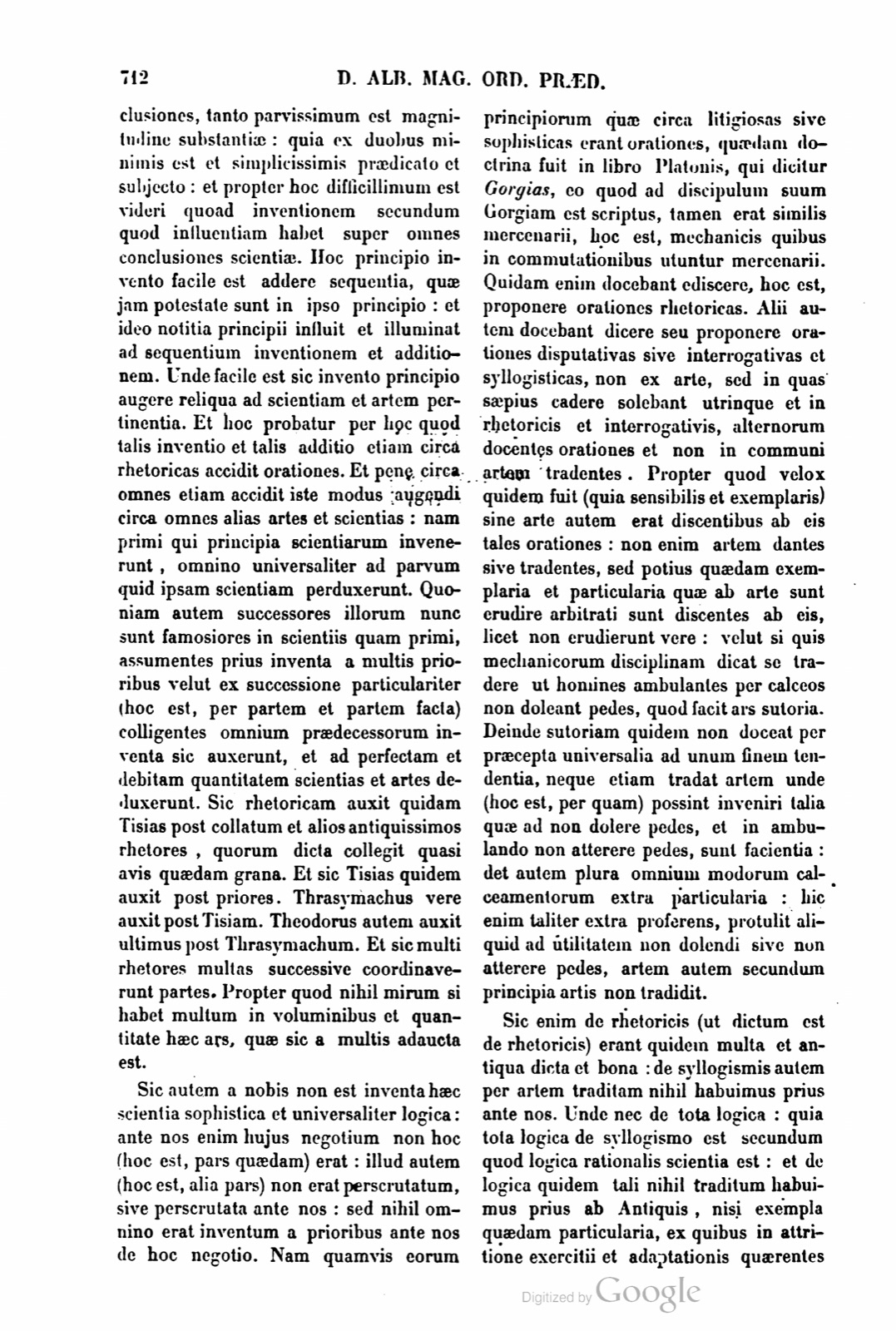
Sic enim de rhetoricis (ut dictum est de rhetoricis) erant quidem multa et antiqua dicta et bona: de syllogismis autem per artem traditam nihil habuimus prius ante nos. Unde nec de tota logica: quia tota logica de syllogismo est secundum quod logica rationalis scientia est: et de logica quidem tali nihil traditum habuimus prius ab Antiquis, nisi exempla quaedam particularia, ex quibus in attritione exercitii et adaptationis quaerentes similia ex similibus, multum tempus laboraremus sine arte quaerentes ea quae sunt artis, quod per artis compendium cito potest fieri. Si autem videtur considerantibus ea quae hic tradita sunt, quod sufficienter haec ars habeat ea omnia quae a principio erant proposita dicere de arte syllogistica, et habere super alia negotia in Gorgia et Zenone exemplariter tradita, et supra ea negotia quae ex dictione Antiquorum et posteris adaucta sunt, reliquum ex dictis relictum erit omnium vestrum qui haec quae tradita sunt legeritis, et eorum qui audierint hoc opus exponi ab aliis, de omissis quidem artis a nobis qui adjutorium nullum habuimus, tradere indultionem sive indulgentiam, inventis autem sive de inventis multas habere sive agere nobis grates.
FINIS
For thus concerning rhetorical matters, as has been said concerning rhetorical matters, there were indeed many ancient and good sayings; but concerning syllogisms through an art handed down we had nothing before us. Hence neither concerning the whole of logic, because the whole of logic concerns syllogism insofar as logic is a rational science; and concerning such logic indeed we had nothing handed down before by the ancients except certain particular examples, from which, in the wearing work of exercise and adaptation, seeking like things from like things, we would labor much time without art, seeking those things which belong to art, which can be done quickly through the compendium of art. But if it seems to those considering the things handed down here that this art sufficiently has all those things which from the beginning it had been proposed to say concerning the syllogistic art, and that it has more than the other businesses handed down exemplarily in Gorgias and Zeno, and beyond those businesses which have been enlarged from the diction of the ancients and by later persons, the remaining thing left from what has been said will belong to all of you who will have read these things which have been handed down, and to those who will have heard this work expounded by others, concerning omissions of the art by us who had no help, to grant allowance or indulgence, but concerning the things discovered, or about the discoveries, to have or to render many thanks to us.
END

If a page does not appear, its photograph has not been uploaded yet.