Works › Sophistical Refutations, Books I–II
Volume 2 · pp. 585–596
Tractate III. Chapters XV-XX
A marker with ≈ is an approximate page boundary, placed by measure of the text; the page photographs remain the authority. In the paired views, clicking a page marker brings that page into view.
communiter dicitur ad omne hujusmodi consequens, et a quo non convertitur consequentia. Propter quod in omni fallacia consequentis necessario sunt duae consequentiae. Una quidem consequentis ad antecedens, et altera conversa istius antecedentis scilicet ad consequens, quae aliquando est vera, et aliquando fallit. Et quia in illa semper incidit defectus, ideo dicitur haec fallacia consequentis et non antecedentis. Si enim sit consequentia simplex, non fallit in antecedente inferendo consequens, sed fallit in consequente ex quo creditur inferri antecedens. Ut si homo est, animal est: haec consequentia non fallit, sed conversa illius fallit, si inferatur, ergo si animal est, homo est. Si autem sit consequentia composita e contrario, tunc antecedens efficitur consequens, et tunc iterum fallit illud quod fuit antecedens, sed per negationem factum est consequens. Ut si dicatur, si homo est, animal est: ergo si non homo est, non animal est. Ibi enim proceditur a destructione antecedentis quod per negationem factum est consequens: et ideo praecipue incidit haec fallacia dum aut proceditur a destructione antecedentis, aut a positione consequentis: non enim minus commune a magis communi infertur, cum tantum potentia et non actu sit in ipso: sed magis commune infertur ex minus communi, eo quod actu est in ipso.
Si autem aliquis dicat, quod etiam ex pari infertur, et e converso, dicendum quod hoc verum est: sed ista consequentia est bona, et non inducit fallaciam. Unde patet quare haec fallacia dicatur fallacia consequentis et non antecedentis. Causa autem apparentiae in hac fallacia est identitas antecedentis cum consequente, quod vel necessario vel probabiliter vel suspicabiliter est in ipso: ex qua creditur quod sicut consequens infertur ex antecedente, ita e converso consequens inferat antecedens. Causa vero defectus sive non existentiae est diversitas consequentis ab antecedente in quo non est antecedens, nisi in potentia: et ideo non potest inferri ex ipso.
CAPUT XVI. De fallacia consequentis et modis ejus.
His ita praelibatis de fallacia secundum consequens, dicimus quod ille apparens elenchus qui est secundum consequens generaliter, quantum ad causam apparentiae fit, eo quod respondentes putant converti consequentiam consequentis ad antecedens, quae vera consequentia est, in eam quae est antecedentis ad consequens. Quod fallit frequenter: nam cum hoc antecedens, scilicet verum (quod infert consequens ex necessitate consequentiae positionis vel rei) illud sit quod est consequens ad ipsum: et ideo cum illud sit, scilicet consequens, putant ipsi respondentes et alterum quod est antecedens esse ex necessitate consequentiae antecedentis ad consequens: et hoc non est necessarium: non enim generaliter verum est, quod si posito antecedente ponitur consequens, quod etiam e converso posito consequente ponatur antecedens. Unde etiam ex hoc causa sumitur, quod ex sensu, hoc est, sensibilibus accidentibus communibus non propriis acceptis per sensum fiunt fallaciae, sive deceptiones fiunt circa opinionem componentem accidens circa subjectum.
Tales enim saepe suspicati sive opinati sunt mel esse fel, communia melli et felli accipiendo, aestimantes quod sicut ad subjectum sequitur commune accidens sive praedicatum, ita e converso ad commune praedicatum sequitur subjectum. Si enim est mel, est rubeum, hoc est, aliquid rubeum. Et putaverunt e converso sequi: si est rubeum, est mel. Sed inferebant: sed fel est rubeum: ergo fel est mel. Haec deceptio fit ideo, quia rubeus color et praedicatum commune, sequitur mel ut antecedens et subjectum. Et formatur sic paralogismus: si mel est, rubeum est: sed hoc sicut mel est rubeum, demonstrato felle: ergo fel est mel.
is commonly said of every consequent of this sort, and that from which the consequence is not converted. On account of this, in every fallacy of the consequent there are necessarily two consequences: one, indeed, of the consequent to the antecedent, and the other the converse of that, namely of the antecedent to the consequent, which is sometimes true and sometimes fails. And because the defect always occurs in that one, therefore this fallacy is called of the consequent and not of the antecedent. For if the consequence is simple, it does not fail in the antecedent by inferring the consequent, but it fails in the consequent from which the antecedent is believed to be inferred. As: if man exists, animal exists; this consequence does not fail, but its converse fails, if it is inferred, therefore if animal exists, man exists. But if the consequence is composite from the contrary, then the antecedent is made the consequent, and then again that which was the antecedent fails, but through negation it has been made the consequent. As if it is said: if man exists, animal exists; therefore if non-man exists, non-animal exists. For there one proceeds from destruction of the antecedent, which through negation has been made the consequent; and therefore this fallacy chiefly occurs when one proceeds either from destruction of the antecedent or from position of the consequent. For the less common is not inferred from the more common, since it is in it only in potency and not in act; but the more common is inferred from the less common, because it is in it in act.
But if someone says that even from an equal something is inferred, and conversely, one must say that this is true; but that consequence is good and does not introduce a fallacy. Hence it is clear why this fallacy is called the fallacy of the consequent and not of the antecedent. But the cause of appearance in this fallacy is the identity of the antecedent with the consequent, which is in it either necessarily or probably or suspicably; from this it is believed that, just as the consequent is inferred from the antecedent, so conversely the consequent infers the antecedent. But the cause of defect or of non-existence is the diversity of the consequent from the antecedent, in which the antecedent is not, except in potency; and therefore it cannot be inferred from it.
CHAPTER XVI. On the fallacy of the consequent and its modes.
With these things thus prefaced concerning the fallacy according to the consequent, we say that that apparent refutation which is according to the consequent generally, as to the cause of appearance, occurs because respondents think that the consequence of consequent to antecedent, which is a true consequence, is converted into that which is of antecedent to consequent. This frequently fails; for since this antecedent, namely the true (which infers a consequent from the necessity of consequence of position or of thing), is that which is consequent to it, therefore when that exists, namely the consequent, the respondents themselves think that the other thing, which is the antecedent, exists from the necessity of the consequence of antecedent to consequent; and this is not necessary. For it is not generally true that, if when the antecedent is posited the consequent is posited, also conversely, when the consequent is posited, the antecedent is posited. Hence from this also the cause is taken, that from sense, that is, from sensible common accidents not proper, accepted through sense, fallacies are made, or deceptions are made concerning the opinion composing an accident about a subject.
For such people have often suspected or opined that honey is gall, by accepting things common to honey and gall, judging that just as a common accident or predicate follows upon a subject, so conversely the subject follows upon a common predicate. For if it is honey, it is red, that is, something red. And they thought the converse to follow: if it is red, it is honey. But they inferred: but gall is red; therefore gall is honey. This deception is made because red color and a common predicate follow honey as antecedent and subject. And the paralogism is formed thus: if it is honey, it is red; but this, with gall pointed out, is red just as honey is; therefore gall is honey.
Et hoc est in naturalibus eodem modo: quia quoniam accidit generali consequentia per pluviam terram madidam fieri, putant e converso sequi, quod si terra madida sit, pluisse sit: et hoc non est necessarium, quia ex alia causa potest esse madida: unde consequens non de necessitate infert antecedens. Et potest sic formari paralogismus: si terra est madida, depluta est: sed perfusa aqua terra est madida: ergo est depluta. In utroque enim istorum paralogismorum est fallacia consequentis a positione consequentis, et uterque istorum fiunt in consequentia materiae necessariae.
Similiter autem in materia in quam consequentia conversa non est necessaria, sed probabilis vel suspicabilis tantum, sicut in rhetoricis demonstrationes (hoc est, probationes sive ostensiones) quae sunt secundum signa communia non propria: fiunt enim ex adjunctis praedicatis alicui subjecto, quae dicuntur a Tullio communiter accidentia: volentes enim ipsi rhetores ostendere sive probare, quoniam aliquis est adulter, illud praedicatum commune quod communiter adjunctum est adultero, sive communiter accidens est adultero, accipiunt, ut quoniam compositus est et ornatus et comptus, et saepe respicit ad uxorem alterius: aut quoniam in nocte videtur errabundus: ex quo suspicio generatur, quod sit adulter et latro. Haec autem accidentia communia pluribus subjectis quam soli adultero insunt sive accidunt, quibus non inest praedicatum conversae consequentiae, quod est adulterum esse: et ideo hoc praedicatum non de necessitate infertur ex illo. Et potest sic formari paralogismus: si aliquis est adulter, ipse est comptus et politus: sed iste est comptus et politus: ergo est adulter. Vel sic: si aliquis est fur, iste est errabundus de nocte: sed iste est errabundus de nocte: ergo est fur. Sciendum quod in his talibus, sicut dicit Boetius, locus ab adjunctis sive communiter accidentibus, quando adjuncta accipiuntur propria, quia ista sunt signa et icotae, concludit in prima figura, ut hic: quaecumque habet lac in mammillis absque confricatione mammillarum cum sale et urtica, peperit: haec sic habet lac in mammillis: ergo peperit. Dico autem absque confricatione mammillarum, quia dicit Aristoteles quod si virgini vel etiam viro habenti mammillas magnas cum sale vel urtica confricentur mammillae, lac habebit in mammillis: sed tenue erit et modicum et non sufficiens ad lactandum. Si autem sint signa et adjuncta in secunda figura quae communia sunt praedicata, ut esse pallidam, et adjunctum ad ea quae peperit, ut dicit Aristoteles in fine secundi Priorum, et solum accipiatur unum tale accidens vel adjunctum: tunc praedicatum communius erit, quam quod possit inferre subjectum: et tunc erit fallacia consequentis. Et ideo si debeat esse locus a communiter accidentibus, tunc oportet quod tale adjunctum accipiatur cum circumstantiis personae: quia cum multis talibus acceptum erit proprium, et inferet subjectum, quod solum unum adjunctum inferre non poterit: quia in his verum est, quod de diffinientibus et diffinitione dicit Aristoteles, quod scilicet partes sunt in plus, et totum in aeque: et sic arguitur in rhetoricis et in physiognomicis, et aliis scientiis demonstrativis, sicut in astronomia, et in aliis in quibus ex signis demonstratur.
Sciendum etiam quod tales consequentiae non sunt necessariae secundum necessitatem antecedentis et consequentis: quamvis satis necessariae sint ad faciendam aestimationem judicio vel suspicioni: et hoc vocatur hic consequentiae necessitas: quia, sicut dicit Boetius generaliter loquens de omni argumento, argumentum est ratio rei dubiae faciens fidem, fidem vocans quamcumque credulitatem.
Similiter autem alius modus istius fallaciae est etiam in syllogisticis, quae simpliciter syllogistica sunt et syllogistice concluduntur, sicut Melissi ratio se habet, qua mundum probat esse ingenitum et duratione infinitum, sive qua probat ipsum universum sive mundum dici infinitum, sumens probans universum esse ingenitum, hoc est, non generatum, et per consequens esse aeternum, sive infinitum secundum durationem: non enim ponit creationem: quia ponit ex nihilo nihil fieri: sed quaecumque fiunt, ponit fieri per generationem ex principio materiali: omne enim quod factum est, ponit factum esse ex principio materiali, quo indiget ad hoc quod sit aliquid. Et arguit sic: si aliquid factum est, habet principium: universum sive mundus non est factus: ergo non habet principium. Et potest sic formari paralogismus: omne quod factum est, habet principium: mundus non est factus: ergo non habet principium. Et est a destructione antecedentis, et hoc non est ex necessitate accidere: non enim necessarium est secundum consequentiam, quod si omne quod factum est, habet materiale principium, etiam e converso quidquid habet materiale principium, et ipsum sit factum. Et est instantia hujus consequentiae, velut si febris in febricitante est, calor est: et tamen non necesse est, quod si aliquis calidus est, febriat sive febricitet.
And this is in natural things in the same way; because, since by a general consequence it happens that through rain the earth becomes wet, they think conversely that if the earth is wet, it has rained; and this is not necessary, because it can be wet from another cause. Hence the consequent does not infer the antecedent of necessity. And the paralogism can be formed thus: if the earth is wet, it has been rained upon; but the earth soaked with water is wet; therefore it has been rained upon. For in each of these paralogisms there is the fallacy of the consequent from position of the consequent, and each of these is made in a consequence of necessary matter.
Similarly, however, in matter in which the converted consequence is not necessary, but only probable or suspicable, as in rhetorical demonstrations, that is, proofs or showings, which are according to common and not proper signs. For they are made from adjunct predicates to some subject, which by Tullius are called common accidents. For rhetoricians themselves, wishing to show or prove that someone is an adulterer, take that common predicate which is commonly joined to an adulterer, or is commonly accidental to an adulterer, as that he is composed, ornamented, and groomed, and often looks toward the wife of another; or that he is seen wandering at night. From this suspicion is generated that he is an adulterer and a thief. But these common accidents are in or happen to more subjects than to the adulterer alone, and in them the predicate of the converted consequence, which is being an adulterer, is not present; and therefore this predicate is not inferred of necessity from that. And the paralogism can be formed thus: if someone is an adulterer, he is groomed and polished; but this man is groomed and polished; therefore he is an adulterer. Or thus: if someone is a thief, this man is wandering at night; but this man is wandering at night; therefore he is a thief. One must know that in such things, as Boethius says, the place from adjuncts or common accidents, when the adjuncts are taken as proper, because those are signs and probabilities, concludes in the first figure, as here: whatever has milk in the breasts without rubbing of the breasts with salt and nettle has given birth; this one thus has milk in the breasts; therefore she has given birth. But I say without rubbing of the breasts because Aristotle says that if the breasts of a virgin, or even of a man having large breasts, are rubbed with salt or nettle, he or she will have milk in the breasts, but it will be thin and little and not sufficient for nursing. But if there are signs and adjuncts in the second figure which are common predicates, such as being pale, and adjunct to those who have given birth, as Aristotle says at the end of the second book of the Prior Analytics, and only one such accident or adjunct is taken, then the predicate will be more common than what could infer the subject, and then there will be the fallacy of the consequent. And therefore if there ought to be a place from common accidents, then such an adjunct must be taken with circumstances of the person, because when it is taken with many such things, it will be proper and will infer the subject, which only one adjunct will not be able to infer. For in these things what Aristotle says about defining parts and definition is true, namely that the parts are in more, and the whole is in equal; and thus one argues in rhetoricals and in physiognomics and in other demonstrative sciences, as in astronomy and in others in which demonstration is made from signs.
One must also know that such consequences are not necessary according to the necessity of antecedent and consequent, although they are sufficiently necessary for making an estimation for judgment or suspicion; and this is here called the necessity of consequence, because, as Boethius says while speaking generally of every argument, an argument is an account making faith concerning a doubtful thing, calling any credulity faith.
Similarly, however, another mode of this fallacy is also in syllogistic things, which are simply syllogistic and are concluded syllogistically, as the reasoning of Melissus has itself, by which he proves that the world is ungenerated and infinite in duration, or by which he proves the universe itself or world to be called infinite, taking as proof that the universe is unbegotten, that is, not generated, and consequently eternal, or infinite according to duration. For he does not posit creation, because he posits that nothing is made from nothing, but whatever things are made, he posits to be made through generation from a material principle; for everything that has been made, he posits to have been made from a material principle, which it needs in order that it be something. And he argues thus: if something has been made, it has a principle; the universe or world has not been made; therefore it does not have a principle. And the paralogism can be formed thus: everything that has been made has a principle; the world has not been made; therefore it does not have a principle. And it is from destruction of the antecedent, and this is not to happen of necessity; for it is not necessary according to consequence that, if everything that has been made has a material principle, also conversely whatever has a material principle itself has been made. And an instance of this consequence is as if fever is in one fevering, heat is; and nevertheless it is not necessary that, if someone is hot, he is fevering or has a fever.
Videtur tamen hoc non esse ad propositum: cum enim secundum Melissi rationem debeat ostendi, quod haec consequentia non valet, mundus non est factus, ergo non habet principium: manifestatur istam non valere, mundus habet principium, ergo est factus. Hujus autem duplex est ratio, quod scilicet peccatum consequentiae Melissi non manifestatur in se, sed in consequentia quae antecedit Melissi consequentiam. Una quidem: quia eadem est bonitas, et idem peccatum alicujus consequentiae sive argumenti et sui conversivi: et ut hoc ostendatur, manifestatur malitia consequentiae Melissi in sua conversa. Secunda autem ratio est, quod hoc fit ut innuatur, quod idem modus in substantia est arguendo a positione consequentis et a destructione antecedentis.
Ex his quae dicta sunt, patet tres esse modos fallaciae consequentis. Primus modus est cum convertitur consequentia secundum habitudines locales facta. Ut si est homo, est animal: ergo si est animal, est homo. Et est a positione consequentis. Similiter autem et hic: si non est animal, non est homo: ergo si non est homo, non est animal: haec enim consequentia etiam est a positione consequentis. Similiter et hic: si est mel, est rubeum: ergo si est rubeum, est mel: sed fel est rubeum: ergo fel est mel. Similiter hic: si pluit, terra est madida: ergo si terra est madida, pluit. In omnibus enim his putatur consequentia converti quae non convertitur: et ideo incidit peccatum secundum consequens.
Secundus modus est, quando putatur consequentia converti propter adjuncta sive circumstantias inhaerentes alicui per se: et hoc praecipue fit in rhetoricis. Ut si est adulter, est comptus. Vel si est latro, est errabundus de nocte. Ergo si est comptus, est adulter. Vel si est errabundus de nocte, est latro. Haec enim est fallacia consequentis: quia haec consequentia bona est: si est adulter, est comptus: quia adulter habet aliquam de circumstantiis adulterorum: sed non sequitur e converso: quia non est necesse si habet aliquam de circumstantiis adulteri, quod sit adulter: sicut bene sequitur, si est homo, est coloratus: sed non sequitur e converso, si est coloratus, quod sit homo. Similiter hic, si aliquis furatus est aliquid, non est illud lucratus nec accomodavit: ergo si non est lucratus nec accomodavit, furatus est.
Tertius modus est, quando quis putat consequentiam converti secundum oppositiones factam, ut est in argumentatione Melissi: ut si est factum, habet principium suae durationis (et intelligitur de facto per generationem vel artis factionem), ergo si non est factum per generationem vel artem, non habet principium: sed mundus non est factus: ergo mundus non habet principium: ergo mundus est infinitus duratione, hoc est, ab aeterno. Melissus enim peccabat secundum consequens in prima illatione: haec enim consequentia recta est: si est factum, habet principium: quia omne generatum natura vel arte, habet principium materiale: quia ex nihilo nihil fit. Sed non sequitur, si non est factum, non habet principium: quia fit argumentum a destructione antecedentis, et ponit consequentiam in ipso in contradictorie oppositis: cum in talibus semper sit ponenda consequentia e contrario. Ut si est factum, habet principium: ergo si non habet principium, non est factum. Haec est consequentia bona.
Yet this seems not to be to the point; for since according to the reasoning of Melissus it ought to be shown that this consequence is not valid, the world has not been made, therefore it does not have a principle, this one is manifested as not valid: the world has a principle, therefore it has been made. But there is a twofold reason for this, namely that the sin of Melissus's consequence is not manifested in itself, but in the consequence which precedes Melissus's consequence. One is this: because the goodness is the same and the sin is the same of any consequence or argument and of its converse; and so that this may be shown, the badness of Melissus's consequence is manifested in its converse. But the second reason is that this is done so that it may be intimated that the same mode is in substance when arguing from position of the consequent and from destruction of the antecedent.
From the things which have been said, it is clear that there are three modes of the fallacy of the consequent. The first mode is when a consequence made according to local relations is converted. As: if it is man, it is animal; therefore if it is animal, it is man. And it is from position of the consequent. Similarly also here: if it is not animal, it is not man; therefore if it is not man, it is not animal; for this consequence also is from position of the consequent. Similarly also here: if it is honey, it is red; therefore if it is red, it is honey; but gall is red; therefore gall is honey. Similarly here: if it rains, the earth is wet; therefore if the earth is wet, it rains. For in all these it is thought that a consequence is converted which is not converted, and therefore the sin according to the consequent occurs.
The second mode is when a consequence is thought to be converted because of adjuncts or circumstances inhering in something through itself; and this especially occurs in rhetoricals. As: if he is an adulterer, he is groomed. Or if he is a thief, he wanders at night. Therefore if he is groomed, he is an adulterer. Or if he wanders at night, he is a thief. For this is the fallacy of the consequent, because this consequence is good: if he is an adulterer, he is groomed, because an adulterer has some one of the circumstances of adulterers; but it does not follow conversely, because it is not necessary, if he has some one of the circumstances of an adulterer, that he is an adulterer; just as it follows well, if he is a man, he is colored, but it does not follow conversely, if he is colored, that he is a man. Similarly here: if someone has stolen something, he has not gained it nor borrowed it; therefore if he has not gained it nor borrowed it, he has stolen it.
The third mode is when someone thinks that a consequence made according to oppositions is converted, as in the argumentation of Melissus: as if it has been made, it has the principle of its duration, and it is understood of what is made through generation or through a making of art; therefore if it has not been made through generation or art, it does not have a principle. But the world has not been made; therefore the world does not have a principle; therefore the world is infinite in duration, that is, from eternity. For Melissus sinned according to the consequent in the first inference; for this consequence is right: if it has been made, it has a principle, because everything generated by nature or art has a material principle, because nothing comes from nothing. But it does not follow, if it has not been made, it does not have a principle, because an argument is made from destruction of the antecedent, and it places a consequence in itself among contradictorily opposed things, whereas in such things a consequence from the contrary must always be posited. As: if it has been made, it has a principle; therefore if it does not have a principle, it has not been made. This is a good consequence.
Et ex praedictis patet quod paulo ante dictum est, quod ubicumque est consequens, semper est duplex consequentia: quia de substantia cujuslibet paralogismi est principium motivum et principium defectus in omnibus fallaciis, tam in dictione quam extra dictionem. Cum igitur in fallacia consequentis recta consequentia sit principium motivum suae apparentiae, fallacia autem sit principium defectus sive principium non existentiae, oportet duplicem esse consequentiam ubicumque est fallacia consequentis, scilicet illam quae convertitur, et illam in quam convertitur. Unde patet quod in talibus argumentis: animal currit: ergo homo currit: ergo Socrates currit: non est sophisma consequentis, sed antecedentis.
Dicunt tamen quidam, quod duo sunt modi hujusmodi paralogizandi in fallacia consequentis: fit enim haec fallacia cum putamus consequentiam converti quae non convertitur: sed super eosdem terminos non fit nisi tribus modis: aut enim utraque consequentia est necessaria, aut altera tantum, aut neutra. Si utraque sit necessaria, tunc nulla est deceptio. Si autem una sit necessaria et altera non, tamen respondens videt unam consequentiam esse necessariam et credit etiam conversam illius esse necessariam: tunc decipitur et est primus modus consequentis a positione consequentis. Si autem neutra sit necessaria, tunc accipit unam esse probabilem, et credit propter hoc suam conversam esse probabilem: tunc decipitur, et fit secundus modus: sicut fit etiam in argumentis rhetoricis: et sic sunt duo modi fallaciae consequentis.
Et si quaeratur, quare non fiunt diversi modi penes positionem consequentis et destructionem antecedentis? Dicunt isti quod hi duo modi sunt unus modus in substantia, modo tantum differentes, ut dictum est in ante habitis.
CAPUT XVII. De praeambulis ad fallaciam secundum non causam ut causam intelligendam.
Ad intelligendum autem ea quae de fallacia secundum non causam ut causam dicenda sunt, sciendum est quod duplex est syllogismus, ut in Prioribus dictum est: est enim quidam syllogismus ostensivus, qui habet conclusionem unicam ex duabus propositionibus et tribus terminis syllogizatam: ut omnis homo est animal: Socrates est homo: ergo Socrates est animal. Syllogismus autem ad impossibile est, qui conclusum aliquid ostensive reducit syllogistice ad aliquid impossibile manifestum: et propter hoc interimitur altera praemissarum quaecumque est illa quae est causa illius impossibilis quod conclusum est: et propter hoc iste syllogismus semper habet duas conclusiones. Ut si quaeratur, si homo est asinus? Et si concedatur, quod sit asinus: syllogizetur in contrarium sic: nullus asinus est animal rationale mortale: homo est asinus: ergo homo non est animal rationale mortale. Sed hoc est falsum: ergo homo non est asinus. Et sic interempta est haec praemissa, homo est asinus. Hic enim syllogismus est in quarto primae figurae. Unde sciendum quod fallacia secundum non causam ut causam semper fit in syllogismo ad impossibile: fallacia enim secundum non causam ut causam fit quando non causa ut causa ponitur: propterea videtur sequi impossibile, cum non propter ipsam sequatur, sed etiam praeter ipsam nihilominus accidit idem impossibile. Cujus exemplum est, ut si quaeratur, an Brunellus vel quidam asinus sit homo? et si concedatur quod quidam asinus sit homo, arguitur in contrarium sic: nullus asinus est animal rationale mortale: homo est asinus: quidam asinus est homo, vel Brunellus est homo: ergo homo non est animal rationale mortale. Sed hoc est impossibile: ergo et hoc, Brunellus vel quidam asinus non est homo. In tali enim argumentatione est non causa ut causa: quia interimitur haec quae videtur esse causa impossibilis illius quod sequebatur, et non est causa ejus, haec scilicet, Brunellus sive quidam asinus est homo: sine ipsa enim ex aliis positis sequitur impossibile: et erit syllogismus in quarto primae, ut dictum est.
And from the foregoing it is clear what was said a little before, that wherever there is a consequent, there is always a double consequence, because of the substance of any paralogism there is a moving principle and a principle of defect in all fallacies, both in diction and outside diction. Therefore, since in the fallacy of the consequent the direct consequence is the moving principle of its appearance, but the fallacy is the principle of defect or principle of non-existence, there must be a double consequence wherever the fallacy of the consequent is, namely that which is converted and that into which it is converted. Hence it is clear that in such arguments as: animal runs; therefore man runs; therefore Socrates runs, there is not a sophism of the consequent, but of the antecedent.
Nevertheless some say that there are two modes of paralogizing of this kind in the fallacy of the consequent; for this fallacy is made when we think a consequence to be converted which is not converted. But over the same terms it occurs only in three ways: either each consequence is necessary, or only one, or neither. If each is necessary, then there is no deception. But if one is necessary and the other is not, yet the respondent sees one consequence to be necessary and also believes its converse to be necessary, then he is deceived and this is the first mode of the consequent from position of the consequent. But if neither is necessary, then he takes one to be probable and believes on account of this that its converse is probable; then he is deceived, and the second mode is made, as also happens in rhetorical arguments; and thus there are two modes of the fallacy of the consequent.
And if it is asked why different modes are not made according to position of the consequent and destruction of the antecedent, they say that these two modes are one mode in substance, differing only in mode, as was said in the foregoing.
CHAPTER XVII. On the preliminaries for understanding the fallacy according to non-cause as cause.
But for understanding the things which must be said about the fallacy according to non-cause as cause, one must know that a syllogism is twofold, as was said in the Prior Analytics. For there is a certain ostensive syllogism, which has a single conclusion syllogized from two propositions and three terms, as: every man is animal; Socrates is a man; therefore Socrates is animal. But a syllogism to the impossible is one which ostensively and syllogistically reduces something concluded to some manifest impossible thing; and because of this one of the premises, whichever one is the cause of that impossible thing which has been concluded, is destroyed; and because of this that syllogism always has two conclusions. As if it is asked whether a man is an ass; and if it is granted that he is an ass, let the contrary be syllogized thus: no ass is a rational mortal animal; man is an ass; therefore man is not a rational mortal animal. But this is false; therefore man is not an ass. And thus this premise is destroyed: man is an ass. For this syllogism is in the fourth mode of the first figure. Hence one must know that the fallacy according to non-cause as cause always occurs in a syllogism to the impossible; for the fallacy according to non-cause as cause occurs when a non-cause is posited as a cause. On that account the impossible seems to follow, although it does not follow because of it, but even apart from it the same impossible nevertheless happens. An example of this is as if it is asked whether Brunellus, or some ass, is a man; and if it is granted that some ass is a man, it is argued to the contrary thus: no ass is a rational mortal animal; man is an ass; some ass is a man, or Brunellus is a man; therefore man is not a rational mortal animal. But this is impossible; therefore this also: Brunellus or some ass is not a man. For in such an argumentation there is non-cause as cause, because this is destroyed which seems to be the cause of that impossible which was following, and is not its cause, namely this: Brunellus or some ass is a man; for without it the impossible follows from the other things posited, and the syllogism will be in the fourth mode of the first figure, as was said.
Cum autem secundum Aristotelem in octavo Topicorum, quaedam sit oratio falsa, eo quod ex ipsa nulla penitus sequitur conclusio, quae secundum ipsum ibidem est syllogismus apparens: alia est oratio falsa, in qua aliqua sequitur conclusio, sed non ad propositum, quae accidit in syllogismis ad impossibile: et sic videtur, quod omnes modi apparentium syllogismorum cadant sub modo primo figurae dictionis, et soli paralogismi illius fallaciae qui accidunt in syllogismis ad impossibile, cadunt sub secundo modo figurae dictionis: et sic videtur quod paralogismi istius fallaciae non sunt syllogismi apparentes, et per consequens, quod non causa ut causa non sit fallacia, cum causam apparentiae non habeat.
Sed dicendum est ad hoc, quod pro certo non causa ut causa est fallacia, et syllogismus apparens qui fit secundum ipsam. Dicitur enim syllogismus apparens dupliciter, scilicet specialiter, et generaliter. Specialiter dicitur syllogismus apparens, qui peccat contra consequentiam syllogismi ostensivi: quia hoc modo prima oratio dicitur falsa in VIII Topicorum, et hoc modo oratio falsa non comprehendit sub se syllogismos apparentes: non enim comprehendit paralogismos secundum petitionem principii, nec etiam paralogismos fallaciae secundum non causam ut causam: eo quod peccant contra quamcumque consequentiam sive cujuscumque syllogismi ostensivi. Generaliter autem dicitur syllogismus apparens, qui peccat contra quamcumque consequentiam sive cujuscumque syllogismi consequentiam: et hoc modo syllogismus apparens comprehendit sub se paralogismos omnium fallaciarum, tam in dictione quam extra dictionem: omnes enim peccant contra aliquam alicujus syllogismi consequentiam: et hoc modo paralogismi hujus loci sunt syllogismi apparentes. Peccat autem haec fallacia contra syllogismum dialecticum: quamvis enim syllogismus ostensivus sit proprie de usu dialectici ad concludendum ex probabilibus suum propositum, cum et syllogismus ad impossibile in casu sit de usu dialectici, quando scilicet ex dictis a respondente potest concludere aliquod manifeste falsum, cujus falsitati non potest objicere respondens, et sic contra syllogismum dialecticum in tali casu, de usu dialectici existentem, peccat haec fallacia.
Adhuc autem notandum, quod causa universalis decipiendi in hac fallacia secundum Aristotelem est, cum assumitur illud quod causa consequentiae non est, velut propter illud, sicut propter consequentiae causam fiat redargutio, quae causa deceptionis in omnibus est locis sophisticis sive fallaciis. In omnibus enim praemissae videntur esse causae redargutionis, et tamen non sunt causae.
Sed sciendum quod dupliciter est accipere non causam ut causam. Uno quidem modo, quod ipsa ablata et aliis adhuc remanentibus sequitur conclusio: et sic dicitur in hac fallacia non causa ut causa. Alio autem modo generaliter dicitur non causa, ex qua non sequitur conclusio, licet sequi videatur: et sic non causa sumpta ut causa conclusionis est in omnibus fallaciis: si enim sic arguitur: omnis canis est latrabile: marinum est canis: ergo marinum est latrabile. Neutra istarum propositionum est causa conclusionis: verum tamen altera istarum ablata, adhuc ex aliis residuis eadem sequitur conclusio.
But since according to Aristotle in the eighth book of the Topics, one speech is false because from it no conclusion at all follows, which according to him in the same place is an apparent syllogism; another speech is false in which some conclusion follows, but not to the proposed point, which happens in syllogisms to the impossible; and thus it seems that all modes of apparent syllogisms fall under the first mode of the figure of diction, and only the paralogisms of that fallacy which happen in syllogisms to the impossible fall under the second mode of the figure of diction. And thus it seems that the paralogisms of that fallacy are not apparent syllogisms, and consequently that non-cause as cause is not a fallacy, since it does not have a cause of appearance.
But to this it must be said that for certain non-cause as cause is a fallacy, and an apparent syllogism which is made according to it. For apparent syllogism is said in two ways, namely specially and generally. Specially, an apparent syllogism is said to be one which sins against the consequence of an ostensive syllogism; because in this way the first speech is called false in Topics VIII, and in this way false speech does not comprehend under itself apparent syllogisms, for it does not comprehend paralogisms according to begging the principle, nor also paralogisms of the fallacy according to non-cause as cause, because they sin against any consequence whatever or the consequence of any ostensive syllogism. But generally, an apparent syllogism is said to be one which sins against any consequence whatever or the consequence of any syllogism whatever; and in this way apparent syllogism comprehends under itself the paralogisms of all fallacies, both in diction and outside diction. For all sin against some consequence of some syllogism; and in this way the paralogisms of this place are apparent syllogisms. But this fallacy sins against the dialectical syllogism; for although the ostensive syllogism properly belongs to the use of the dialectician for concluding his proposed point from probabilities, since also the syllogism to the impossible is in a case of use to the dialectician, namely when from things said by the respondent he can conclude something manifestly false, against whose falsity the respondent cannot object, thus this fallacy sins against the dialectical syllogism in such a case, existing in the use of the dialectician.
Again it must be noted that the universal cause of deceiving in this fallacy, according to Aristotle, is when that which is not the cause of the consequence is assumed, as though on account of it, as on account of the cause of the consequence, the refutation is made. This cause of deception is in all sophistical places or fallacies. For in all of them the premises seem to be causes of the refutation, and nevertheless they are not causes.
But one must know that there are two ways to take non-cause as cause. In one way, such that when it has been removed and the others still remain, the conclusion follows; and thus in this fallacy it is called non-cause as cause. But in another way, non-cause is said generally, that from which a conclusion does not follow, although it seems to follow; and thus non-cause taken as cause of the conclusion is in all fallacies. For if it is argued thus: every dog is barkable; the sea-dog is a dog; therefore the sea-dog is barkable. Neither of those propositions is the cause of the conclusion; nevertheless, when one of them has been removed, the same conclusion still follows from the other remaining things.
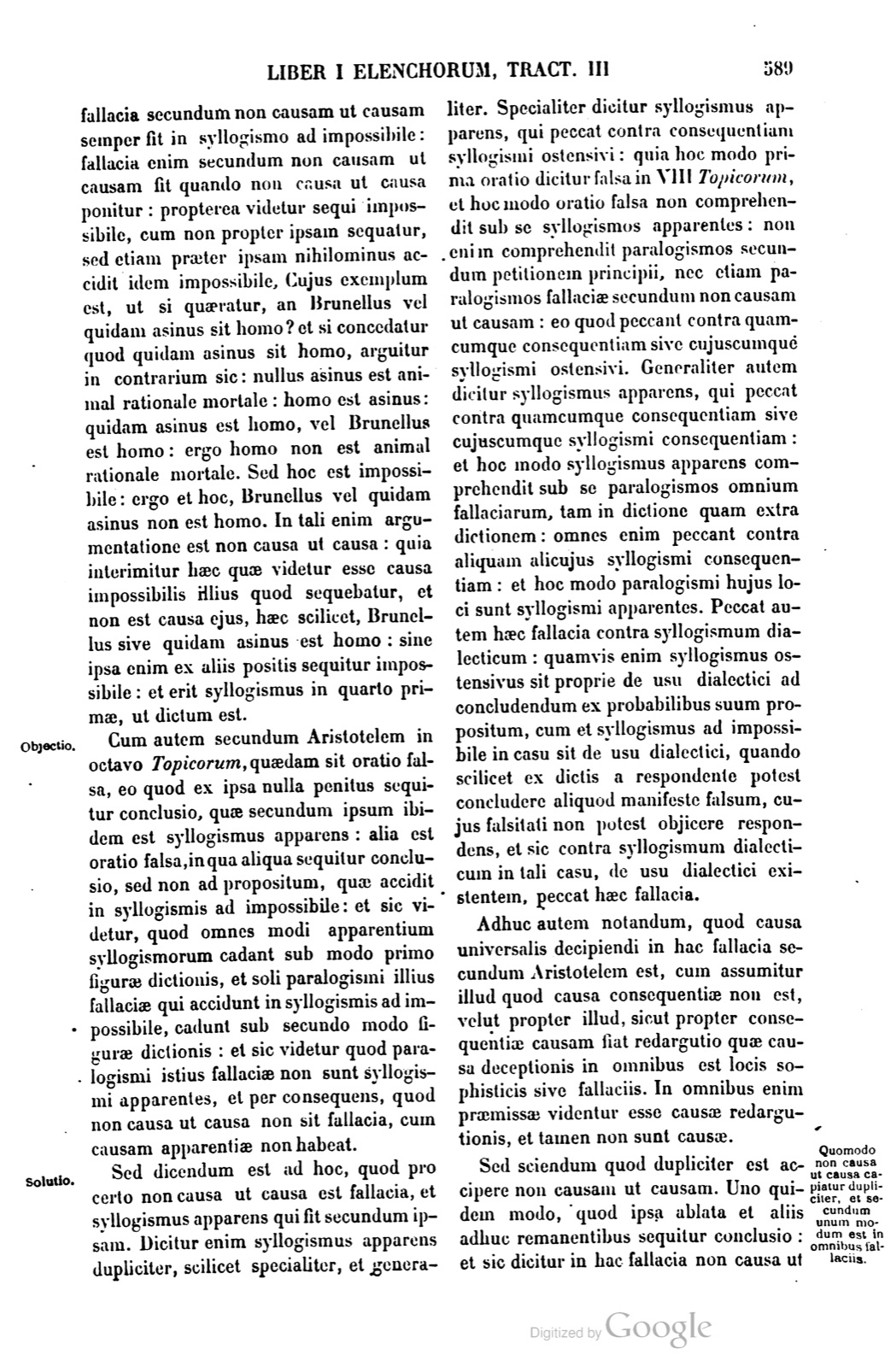
Sciendum quod fallacia ista sive locus iste sophisticus non potest accidere in syllogismis ostensivis, nec peccat contra syllogismum ostensivum, sed solum contra syllogismum ad impossibile, ut dicit Aristoteles in secundo Priorum: quia idem est non propter hoc accidere falsum, et esse non causam ut causam. Ad hoc autem intelligendum distinguendum est: quia si accipiatur propositio quae non est causa conclusionis cum propositionibus quae sunt causae conclusionis ejusdem quantum ad illationem ipsius: aut communicabit illa propositio cum praemissis quae sunt causae, in aliquo termino: aut non communicabit cum eis in aliquo termino. Si non communicabit cum eis in aliquo termino: tunc non erit fallacia et locus sophisticus, quia defuit apparens: quia quamvis illa propositio sit non causa, non tamen est non causa ut causa: quia cum nullo est ea quae sit causa: et de tali dicitur in secundo Priorum, quod est manifestior modus syllogismum accidere non propter hoc. Cujus exemplum positum in secundo Priorum est, ut si debeat ostendi haec, diameter est costae asimeter, et sumatur ab opponente oppositum hujus a respondente datum per hypothesim cum ratione Zenonis sic: diameter est costae consimeter, in quolibet stadio sunt infinita spatia: sed infinita non contingit pertransire: ergo non contingit pertransire aliquod stadium. Sed hoc est impossibile: ergo hypothesis est impossibilis, ex qua sequitur, haec scilicet, quod diameter est commensurabilis costae. In hac enim argumentatione non communicat hypothesis quae est non causa, in aliquo termino cum propositionibus quae sunt causae conclusionis: et ideo non est hic apparentia nec locus aliquis sophisticus.
Si autem propositio assumpta communicet cum his quae sunt causa conclusionis in aliquo termino, per quam communicationem videtur esse causa, hoc non potest fieri nisi altero duorum modorum: uno scilicet modo, quod per illas propositiones intenditur concludi aliquod falsum tantum directe, ita quod ibi sit status: aut ulterius intenditur procedere et concludere, scilicet ex falsitate illius conclusionis interimere aliquam positionem sive hypothesim factam a respondente prius concessam. Si quidem primo intenditur per tales propositiones concludi falsum ut ubi sistatur, hoc potest fieri duobus modis: aut enim ex reliquis propositionibus ab isto falso assumpto sequitur conclusio de necessitate consequentiae, aut non sequitur ex illis. Si non sequitur ex illis, tunc non est haec fallacia facta, sed causa quare non sequitur ex reliquis, est alia fallacia sive in dictione, sive extra dictionem. Si autem sequitur conclusio de necessitate illationis ex reliquis: tunc nulla penitus erit fallacia: quia licet sit non causa, non tamen est non causa ut causa: quia in hac fallacia consistit tota apparentia penes illam propositionem quae est non causa, quae ad consequentiam conclusionis est assumpta: et sic non est in talibus argumentis: apparentia enim in hujusmodi argumentis est necessitas consequentiae: non existentia vero est in propositione assumpta: et talis apparentia et talis non existentia causat aliquam fallaciam specialem. Si autem in tali processu intendatur conclusio falsa, et ex illius falsitate intendatur interimi aliqua hypothesis prius posita sive concessa: tunc incidit illa fallacia quae non causa vocatur: et tunc accidit illius fallaciae peccatum, non in primo argumento, sed in secundo, quando scilicet a falsa conclusione procedit, et contingit falsam esse hypothesim, ut patet in exemplo quod dat Aristoteles et sumitur de Phaedro Platonis, quod a nobis in consequenti capitulo ponetur. Unde cum pluribus modis se propositio (quae est non causa) habere non possit, et penes nullum modum potest fieri nisi penes ultimum, patet, quod non causa ut causa non potest fieri nisi in syllogismis ad impossibile: et peccat contra secundum argumentum et non contra primum, et quantum ad secundam et non contra primam.
One must know that this fallacy or this sophistical place cannot happen in ostensive syllogisms, nor does it sin against the ostensive syllogism, but only against a syllogism to the impossible, as Aristotle says in the second book of the Prior Analytics, because for the false to happen not on account of this, and for there to be non-cause as cause, are the same. But for understanding this, one must distinguish: because if a proposition which is not the cause of the conclusion is taken with the propositions which are causes of the same conclusion as to the inference of it, either that proposition will communicate with the premises which are causes in some term, or it will not communicate with them in any term. If it will not communicate with them in any term, then there will not be a fallacy and sophistical place, because the apparent thing was lacking; for although that proposition is a non-cause, nevertheless it is not a non-cause as cause, because it is with nothing that is a cause. And about such a thing it is said in the second book of the Prior Analytics that it is a more manifest mode of the syllogism happening not on account of this. The example of this, posited in the second book of the Prior Analytics, is that if this must be shown, the diameter is incommensurable with the side, and the opposite of this, given by the respondent by hypothesis, is taken by the opponent with the reasoning of Zeno thus: the diameter is commensurable with the side; in any stadium there are infinite spaces; but it is not possible to cross infinite things; therefore it is not possible to cross any stadium. But this is impossible; therefore the hypothesis from which it follows is impossible, namely this, that the diameter is commensurable with the side. For in this argumentation the hypothesis which is a non-cause does not communicate in any term with the propositions which are causes of the conclusion; and therefore there is no appearance here, nor any sophistical place.
But if the proposition assumed communicates with those things which are the cause of the conclusion in some term, through which communication it seems to be a cause, this can happen only in one of two ways: in one way, namely, that by those propositions it is intended that some false thing be concluded directly only, so that there is a stop there; or it is intended to proceed further and conclude, namely from the falsity of that conclusion to destroy some position or hypothesis made and previously granted by the respondent. If, indeed, in the first way it is intended by such propositions to conclude a false thing where one stops, this can happen in two ways: for either from the remaining propositions, after that false thing assumed, the conclusion follows by necessity of consequence, or it does not follow from them. If it does not follow from them, then this fallacy has not been made, but the cause why it does not follow from the remaining things is another fallacy, either in diction or outside diction. But if the conclusion follows by necessity of inference from the remaining things, then there will be no fallacy at all, because although it is a non-cause, nevertheless it is not a non-cause as cause. For in this fallacy the whole appearance consists with respect to that proposition which is a non-cause, which has been assumed for the consequence of the conclusion; and it is not so in such arguments. For the appearance in arguments of this kind is the necessity of consequence; but the non-existence is in the assumed proposition, and such an appearance and such a non-existence cause some special fallacy. But if in such a process a false conclusion is intended, and from the falsity of that it is intended that some hypothesis previously posited or granted be destroyed, then that fallacy which is called non-cause occurs. And then the sin of that fallacy happens not in the first argument, but in the second, namely when it proceeds from a false conclusion and it happens that the hypothesis is false, as is clear in the example which Aristotle gives and which is taken from Plato's Phaedrus, which will be set down by us in the following chapter. Hence, since the proposition which is the non-cause cannot have itself in more ways, and according to no mode can it be made except according to the last one, it is clear that non-cause as cause cannot be made except in syllogisms to the impossible, and it sins against the second argument and not against the first, and as to the second and not against the first.
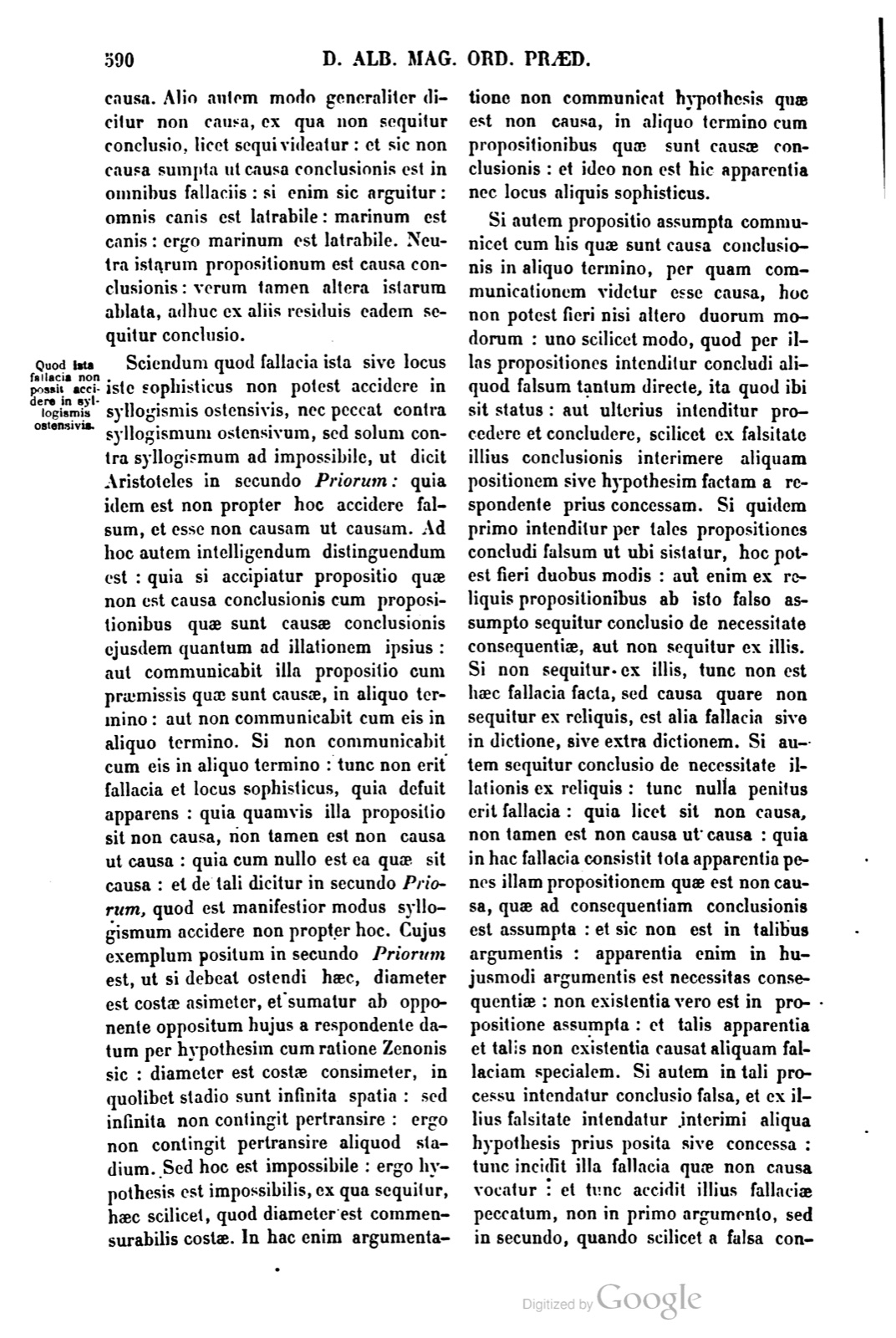
Si autem aliquis contra hoc objiciens dicat, quod non propter illud accidere est idem quod non causam ut causam esse: non propter hoc autem accidere potest incidere in syllogismis ostensivis: ergo et non causa potest accidere in syllogismis ostensivis: ergo et non causa ut causa potest accidere in syllogismis ostensivis. Probet autem quod non propter accidere, possit accidere in syllogismis ostensivis, sic: accidere aliquid quod sit non causa conclusionis tanquam ut causa, contingit dupliciter, scilicet ita ut propositio sumpta quae est non causa, communicet cum praemissis in aliquo termino: aut non. Exemplum ejus quod non communicet in aliquo termino, est sicut si dicatur: omnis homo currit: Socrates est homo: ergo Socrates currit. Exemplum autem ejus quod communicet in aliquo termino, est sicut si dicatur sic: omnis asinus est animal: omnis homo est animal: ergo omne rudibile est asinus vel animal. Manifestum est igitur, quod in istis syllogismis ostensivis contingit propositionem non causam ut causam esse, et ac si esset causa: et per consequens in syllogismis ostensivis contingit accipere non causam ut causam et incidere hanc fallaciam. Si, inquam, sic aliquis objiciat, dicendum quod verum est, quod in hoc processu in primo argumento sumitur propositio quae est non causa: sed tamen ista fallacia non habet ab hac demonstrari propter causam quae jam ante dicta est.
Causa apparentiae in hac fallacia est convenientia illius propositionis, quae non est causa in aliquo termino cum propositione, quae vere se habet ut necessaria ad illationem conclusionis: propter illam enim convenientiam putatur quod non causa sit causa illationis. Causa autem falsitatis sive non existentiae est diversitas et differentia ejusdem propositionis, quae non causa est, ad propositionem quae vere est causa illationis sive conclusionis.
CAPUT XVIII. De fallacia secundum non causam ut causam.
His habitis, facile est determinare de fallaciis secundum non causam ut causam quantum ad generalem causam deceptionis: tunc enim in his fiunt cum ad propositiones praemissas sumitur adjunctum praemissis aliquod de numero propositionum quod in veritate non est causa illationis sive conclusionis: et sic assumitur illud cum praemissis velut propter illud (sicut propter causam illationis) fiat redargutio, hoc est, falsi illatio, contra hypothesim respondentis. Accidit autem hujusmodi paralogismus sive fallacia ad impossibile syllogismis, in quibus per falsum contrarium vel contradictorium interimitur positio sive hypothesis prius conclusa per ostensionem falsitatis alicujus praemissarum: in syllogismis enim ad impossibile necessarium est semper aliquid interimere eorum quae posita sunt in syllogismo priori: et ideo necessarium est in his multiplicari propositiones inter quas latenter inducitur illa quae est non causa ut causa. Si ergo ea propositio quae est non causa ut causa, enumeretur in necessariis sive inter necessarias propositiones quae necessariae sunt ad illationem falsi, ex quo debet hypothesis respondentis interimi, sive in interrogationibus, quia propositio dialectica interrogatio est, ut determinatum est in primo Topicorum: et enumeretur inter eas in argumento ad quod accidit sive sequitur impossibile: hoc enim est argumentum secundum et non primum, quod scilicet ex falso illato destruit hypothesim, videbitur decepto respondenti saepe fieri redargutio quantum ad illationem oppositi ipsius hypothesis qua redarguitur respondens propter hoc: cum tamen non fiat propter hoc. Et sic ut causa movet ad decipiendum, et ut non causa principium est falsitatis, quia non est propter illud, fit illatio: sed eo ablato uberius sequeretur impossibile.
But if someone objecting against this says that for something to happen not on account of that is the same as being a non-cause as cause, but happening not on account of this can occur in ostensive syllogisms; therefore non-cause can also occur in ostensive syllogisms; therefore also non-cause as cause can occur in ostensive syllogisms. But let him prove that happening not on account of something can occur in ostensive syllogisms thus: for something to happen which is a non-cause of the conclusion as if it were a cause happens in two ways, namely so that the proposition taken, which is the non-cause, communicates with the premises in some term, or not. An example of what does not communicate in any term is as if it is said: every man runs; Socrates is a man; therefore Socrates runs. But an example of what communicates in some term is as if it is said thus: every ass is animal; every man is animal; therefore every brayable thing is an ass or animal. Therefore it is manifest that in these ostensive syllogisms it happens that a proposition is a non-cause as cause, and as if it were a cause; and consequently in ostensive syllogisms it happens to accept a non-cause as cause and to incur this fallacy. If, I say, someone objects thus, one must say that it is true that in this process in the first argument a proposition is taken which is a non-cause; yet nevertheless this fallacy does not have to be demonstrated from this, on account of the cause which has already been stated before.
The cause of appearance in this fallacy is the agreement in some term of that proposition which is not a cause with the proposition which truly has itself as necessary for the inference of the conclusion. For because of that agreement it is thought that the non-cause is the cause of the inference. But the cause of falsity or non-existence is the diversity and difference of the same proposition, which is a non-cause, from the proposition which truly is the cause of inference or conclusion.
CHAPTER XVIII. On the fallacy according to non-cause as cause.
Having these things, it is easy to determine concerning fallacies according to non-cause as cause as to the general cause of deception. For then these occur when, to the propositions premised, something adjunct to the premises from the number of propositions is taken, which in truth is not the cause of the inference or conclusion; and thus that is assumed with the premises as if on account of it, as on account of the cause of inference, a refutation is made, that is, an inference of the false, against the hypothesis of the respondent. But a paralogism or fallacy of this kind happens to syllogisms to the impossible, in which through a false contrary or contradictory a position or hypothesis previously concluded is destroyed through the showing of the falsity of some premises. For in syllogisms to the impossible it is always necessary to destroy something of those things which have been posited in the prior syllogism; and therefore it is necessary in these to multiply propositions, among which that one which is a non-cause as cause is latently introduced. Therefore if that proposition which is a non-cause as cause is numbered among the necessary ones, or among the necessary propositions which are necessary for the inference of the false thing from which the respondent's hypothesis must be destroyed, or in the interrogations, because a dialectical proposition is an interrogation, as was determined in the first book of the Topics; and it is numbered among them in the argument to which the impossible happens or follows, for this is the second argument and not the first, namely that from the false thing inferred it destroys the hypothesis, it will often seem to the deceived respondent that a refutation is made as to the inference of the opposite of the hypothesis itself by which the respondent is refuted on account of this, although it is not made on account of this. And thus as cause it moves toward deceiving, and as non-cause it is the principle of falsity, because the inference is not made on account of it; but when it has been removed the impossible would follow more abundantly.
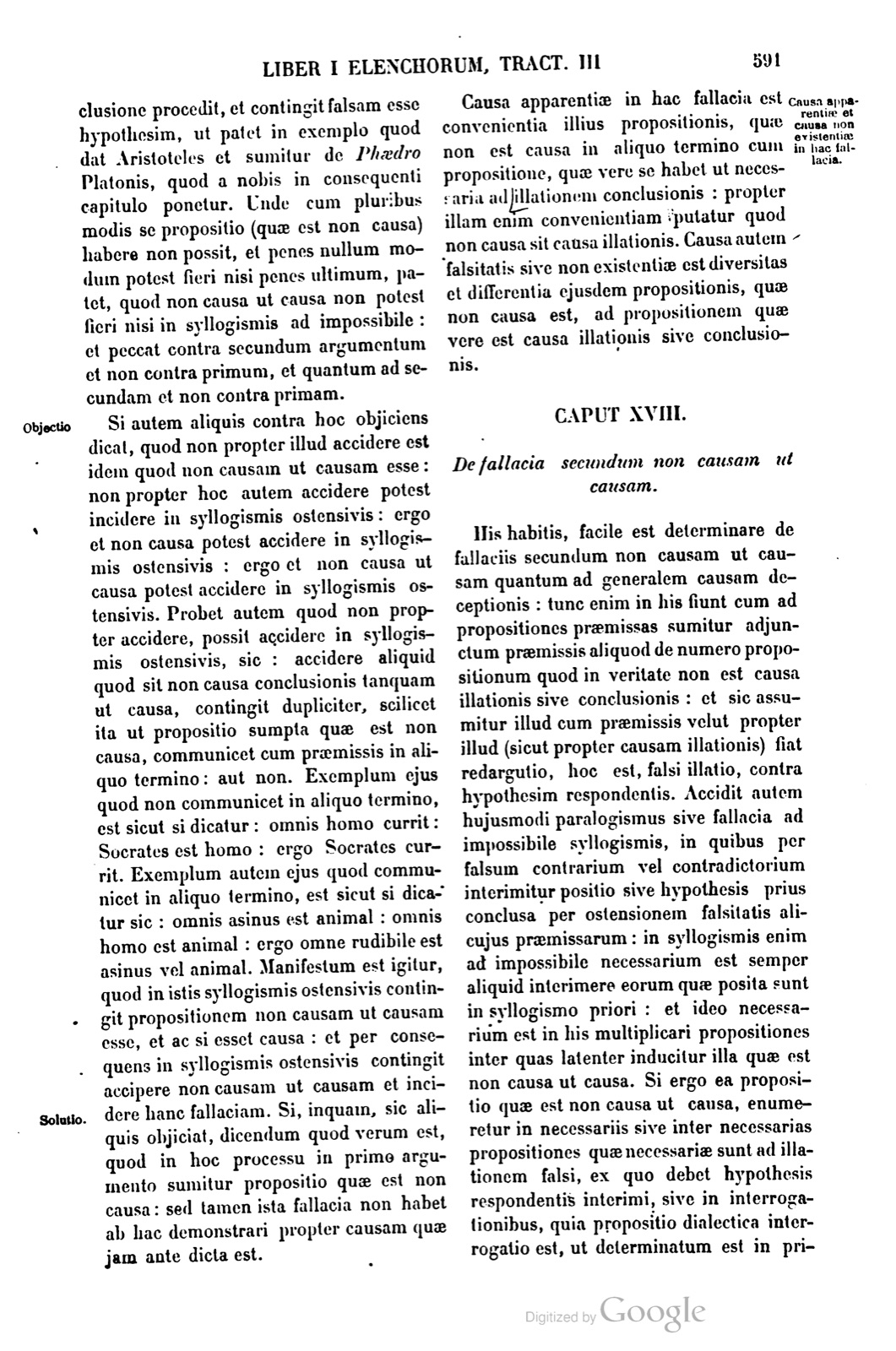
Hujus autem exemplum est, ut dicamus, quod propositum oppositi sit ostendere animam et vitam non esse idem ad concludendum falsum necessarium sumere falsas propositiones, ex quibus necessario sequitur falsum illud quo terminatur hypothesis dicens animam et vitam esse idem. Et arguitur sic: anima et vita sunt idem; sed omne quod contrariatur corruptioni, est generatio: vita autem contrariatur morti, et per consequens contrariatur corruptioni, quia mors etiam corruptio est: ergo vita est generatio, et per consequens vivere est generari. Sed hoc est falsum, quod scilicet vivere sit generari: ergo et primum falsum est, quod scilicet anima et vita sint idem. Et hoc dicit Aristoteles non eodem ordine, sed obscuriori sic: Ut quoniam, supple, sic ostenditur, quoniam anima et vita non sunt idem per oppositum falsum: nam si corruptioni generatio est contrarium generaliter, et sumantur generatio et corruptio prout sunt motus oppositi in terminis (quia penes terminos dicitur motus oppositus vel contrarius motui) tunc sequeretur, quod alicui corruptioni (quae est mors vivi sive dissolutio) erit contrarium quaedam generatio, quae non potest esse nisi vita: mors enim est corruptio, et est contrarium vitae: quare sive ergo vita erit quaedam generatio, et vivere erit generari. Hoc autem est impossibile: non ergo idem est anima et vita. Et hoc non est syllogizatum ex hac propositione: anima et vita sunt idem. Cujus probatio est, quia idem impossibile sequitur ex aliis propositionibus sumptis et praemissis, etiamsi aliquis opponentium non dicat (hoc est, non cum praemissis ponat) hanc propositionem, anima et vita sunt idem, sed solum dicat et ponat in praemissis vitam esse contrarium morti: et hanc, quod mors est corruptio, et corruptioni sit contrarium proprium generatio. Et sic haec, anima et vita sunt idem, fuit non causa illationis videlicet et non esse: quia communicat cum ista, vita et mors sunt contraria, in termino in utroque idem significante.
Patet etiam ex his, quod hujusmodi rationes non simpliciter (hoc est, in totum) sunt insyllogizatae, quia prima conclusio falsi vere syllogizata est ex praemissis falsis: sed quantum ad propositum sunt insyllogizatae, hoc est, ad hypothesim interimendam: eo quod hypothesis est impertinens ad alias propositiones assumptas: propositio autem impertinens non destruit alteram, eo quod est impertinens ad illationem. Et haec difficultas non discernendi causam veram illationis ab ea quae est non causa ut causa cum sumpta est, quia plurimum idem latet non minus ipsos interrogantes sive opponentes, quam in ipsos respondentes: et hoc est exemplum non causae ut causae.
Sunt autem in hoc exemplo propositiones multiplices quae sic distinguendae sunt: cum enim dicitur, quod mors et vita sunt contraria, distinguendum est: quia mors potest dicere motum dissolutionis animae a corpore, vel terminum dissolutionis ejusdem: et sic non est corruptio, sed tunc est corruptum esse. Primo modo mors et vita non sunt contraria: quia quod corrumpitur, quamdiu corrumpitur, adhuc vivit: contraria autem simul in eodem esse non possunt. Si autem secundo modo dicatur mors terminus dissolutionis: tunc vita et mors iterum non sunt contraria, sed opposita ut privatio et habitus: et sic omni modo ista est falsa, mors et vita sunt contraria, et est simpliciter falsa: unde etiam supra in argumentatione non debuit interimi ista, anima et vita sunt idem, sed haec, mors et vita sunt contraria.
But an example of this is that we say that the proposed point of the opposite is to show that soul and life are not the same; for concluding a necessary false thing, one must take false propositions from which that false thing necessarily follows by which the hypothesis saying that soul and life are the same is terminated. And it is argued thus: soul and life are the same; but everything which is contrary to corruption is generation; but life is contrary to death, and consequently is contrary to corruption, because death also is corruption; therefore life is generation, and consequently to live is to be generated. But this is false, namely that to live is to be generated; therefore the first thing also is false, namely that soul and life are the same. And Aristotle says this not in the same order, but more obscurely thus: As, since, supply, it is shown thus, that soul and life are not the same through the opposite false thing. For if generation is contrary to corruption generally, and generation and corruption are taken insofar as they are opposed motions in their terms, because a motion is said to be opposed or contrary to a motion with respect to the terms, then it would follow that to some corruption, which is the death of a living thing or dissolution, some generation will be contrary, which cannot be anything except life; for death is corruption and is contrary to life; wherefore, or therefore, life will be a certain generation, and to live will be to be generated. But this is impossible; therefore soul and life are not the same. And this has not been syllogized from this proposition, soul and life are the same. The proof of this is that the same impossible follows from the other propositions taken and premised, even if one of the opponents does not say, that is, does not place with the premises, this proposition, soul and life are the same, but only says and places in the premises that life is contrary to death, and this, that death is corruption, and that generation is the proper contrary to corruption. And thus this, soul and life are the same, was not the cause of the inference, namely of non-being, because it communicates with this, life and death are contraries, in a term signifying the same in each.
It is also clear from these things that reasons of this kind are not simply, that is, wholly, nonsyllogized, because the first conclusion of the false thing has truly been syllogized from false premises; but as to the proposed point they are nonsyllogized, that is, for destroying the hypothesis, because the hypothesis is impertinent to the other assumed propositions. But an impertinent proposition does not destroy the other, because it is impertinent to the inference. And this difficulty of not discerning the true cause of inference from that which is non-cause as cause, when it has been taken, because for the most part the same thing is hidden no less from the interrogators or opponents themselves than from the respondents themselves; and this is an example of non-cause as cause.
But in this example there are multiple propositions which must be distinguished thus: for when it is said that death and life are contraries, it must be distinguished, because death can mean the motion of dissolution of soul from body, or the term of that dissolution; and thus it is not corruption, but then it is to be corrupted. In the first way death and life are not contraries, because what is corrupted, so long as it is being corrupted, still lives; but contraries cannot be at the same time in the same thing. But if death is said in the second way as the term of dissolution, then life and death again are not contraries, but opposites as privation and habit; and thus in every way this is false, death and life are contraries, and it is simply false. Hence also above in the argumentation this should not have been destroyed, soul and life are the same, but this: death and life are contraries.
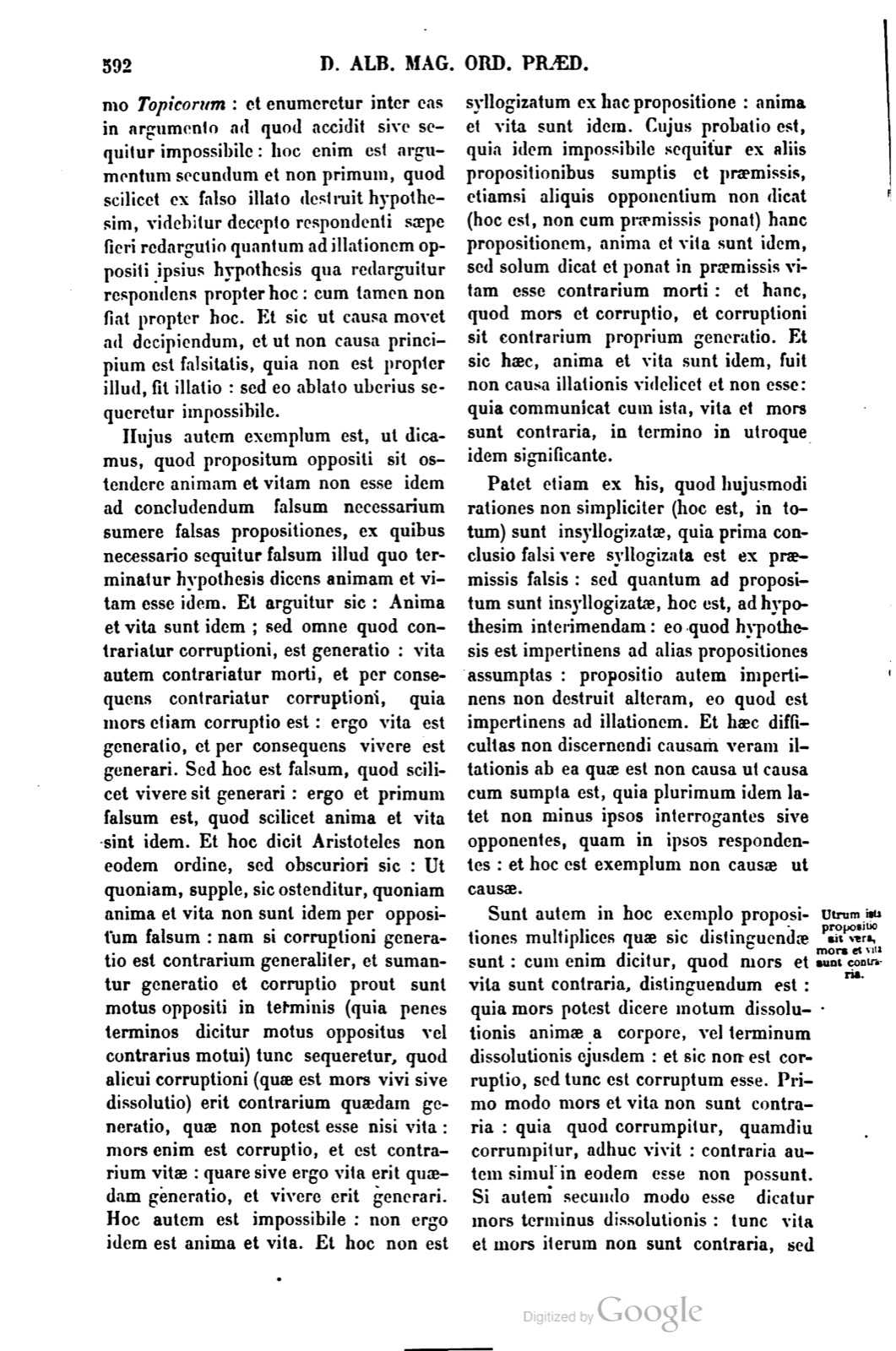
Ex post inductis autem sequitur, quod haec fallacia non accidit in syllogismo ostensivo. Unde hic: omnis homo est animal: et sol est in cancro, vel sol est major terra: ergo Socrates currit: non est fallacia secundum non causam ut causam: quia haec propositio, sol est major terra, nec est causa conclusionis, nec potest esse causa. In fallacia autem non causae ut causa, propositio quae est non causa, communicat cum ea quae est causa: et ideo potest esse causa.
Objiciet autem fortasse aliquis contra hoc dicens, quod revera in dicto exemplo duae sunt argumentationes, quarum prima est ostensiva falsi, secunda interimems hypothesim. Prima enim est haec, anima et vita sunt idem: cuilibet corruptioni contrariatur generatio: sed mors est corruptio: ergo morti contraria generatio: ergo vivere generari. Hoc est argumentum primum et est ostensivum falsi illius, quod vivere est generari. Secundum autem quod est ad interimendum hypothesim, est tale: haec conclusio, vivere est generari, est falsa et impossibilis: ergo hypothesis ex qua sequitur, scilicet quod anima et vita sunt idem, est impossibilis: et patet quod in prima argumentatione inter praemissas ponitur illa propositio quae est non causa: et sic in syllogismo ostensivo erit non causa ut causa: et non ponitur in secundo argumento: ergo non est in syllogismo ad impossibile, sed in ostensivo. Sed ad hoc secundum ea quae dicta sunt in capite anteriori, dicendum quod quamvis propositio quae est non causa ut causa, ponatur inter praemissas prioris argumentationis, quae revera ostensiva est: non tamen ab ipsa debet denominari: quia finaliter non ponitur ad primam conclusionem ostendendam, sed potius ut ex illa inferatur hypothesis per syllogismum secundum.
CAPUT XIX. De modis fallaciae secundum non causam ut causam.
Modi autem fallaciae secundum numerum formationis eorum multiplicandi sunt. Sunt autem duo modi. Unus secundum quod non causa potest communicare in aliquo termino cum propositionibus quae sunt causae conclusionis: si enim in nullo communicaret cum eis, tunc non posset esse non causa ut causa: si autem in altero communicat hypothesis sive propositio quae non est causa, cum propositionibus quae sunt causae conclusionis falsae: aut communicabit in subjecto, aut in praedicato. Et penes istas communicationes duo formantur modi paralogizandi: unus scilicet quando non causa ut causa in subjecto communicat cum propositionibus quae sunt causa, ita quod in aliqua propositionum quae sunt causae, sumatur subjectum hypothesis: et sic est unus et primus modus fallendi: sicut enim ista hypothesis, omnis lapis est animal, est supposita: ita concludatur, quod omnis homo est lapis, sic: omnis margarita est lapis: omnis homo est margarita: ergo omnis homo est lapis. Hoc est impossibile: sed non sequitur propter hypothesim: ipsa enim remota, adhuc sequitur idem impossibile. Et hunc modum ante finem secundi Priorum ponit Aristoteles in terminis generalibus ponens hanc hypothesim, omne B est A, si ergo C sumatur sub B, non quidem ut inferius sub superiori ut homo sub animali, sed ita quod in syllogismo fiat C subjectum ejus quod est B, et D sumatur sub C, ita quod fiat subjectum ejus eodem modo sicut prius, sic: omne C est B, omne D est C, sequitur quod omne D est B: quae quamvis falsa sit, non tamen falsa est vel sequitur propter hypothesim: et iste est modus primus. Et est planum illud si ponatur in terminis specialibus, quod A sit animal, B lapis, C margarita, D autem homo: tunc enim est hypothesis: omnis lapis est animal, qua supposita concluditur, omnis homo est lapis, sic: omnis margarita est lapis: omnis homo margarita: ergo omnis homo lapis. Et hoc quidem est impossibile: sed non accidit propter hypothesim.
But from the things introduced afterward it follows that this fallacy does not happen in an ostensive syllogism. Hence here: every man is animal; and the sun is in Cancer, or the sun is greater than the earth; therefore Socrates runs. This is not the fallacy according to non-cause as cause, because this proposition, the sun is greater than the earth, neither is the cause of the conclusion nor can be the cause. But in the fallacy of non-cause as cause, the proposition which is a non-cause communicates with that which is a cause; and therefore it can be a cause.
But perhaps someone will object against this, saying that in truth in the said example there are two argumentations, the first of which is ostensive of the false, the second destructive of the hypothesis. For the first is this: soul and life are the same; to any corruption generation is contrary; but death is corruption; therefore to death generation is contrary; therefore to live is to be generated. This is the first argument and is ostensive of that false thing, that to live is to be generated. But the second, which is for destroying the hypothesis, is such: this conclusion, to live is to be generated, is false and impossible; therefore the hypothesis from which it follows, namely that soul and life are the same, is impossible. And it is clear that in the first argumentation among the premises that proposition which is a non-cause is posited; and thus in an ostensive syllogism there will be non-cause as cause, and it is not posited in the second argument; therefore it is not in a syllogism to the impossible, but in an ostensive one. But to this, according to the things which were said in the preceding chapter, one must say that although the proposition which is non-cause as cause is placed among the premises of the prior argumentation, which in truth is ostensive, nevertheless it ought not be denominated from it, because it is finally not posited for showing the first conclusion, but rather so that from that the hypothesis may be inferred through the second syllogism.
CHAPTER XIX. On the modes of the fallacy according to non-cause as cause.
But the modes of the fallacy must be multiplied according to the number of their formation. And there are two modes. One is according as a non-cause can communicate in some term with the propositions which are causes of the conclusion; for if it communicated with them in nothing, then it could not be a non-cause as cause. But if the hypothesis or proposition which is not the cause communicates in one of the terms with the propositions which are causes of the false conclusion, it will communicate either in the subject or in the predicate. And according to those communications two modes of paralogizing are formed: namely one when the non-cause as cause communicates in subject with the propositions which are the cause, so that in some one of the propositions which are causes the subject of the hypothesis is taken; and thus there is one and the first mode of deceiving. For just as this hypothesis, every stone is animal, is supposed, so let it be concluded that every man is stone, thus: every pearl is stone; every man is a pearl; therefore every man is a stone. This is impossible, but it does not follow because of the hypothesis; for when it has been removed, the same impossible still follows. And Aristotle posits this mode before the end of the second book of the Prior Analytics in general terms, positing this hypothesis, every B is A; therefore, if C is taken under B, not indeed as an inferior under a superior, as man under animal, but so that in the syllogism C becomes the subject of B, and D is taken under C, so that it becomes subject to it in the same way as before, thus: every C is B; every D is C; it follows that every D is B. Although this is false, nevertheless it is not false or does not follow because of the hypothesis; and this is the first mode. And that is plain if it is posited in special terms, that A is animal, B stone, C pearl, and D man; for then the hypothesis is: every stone is animal. With this supposed, every man is concluded to be stone thus: every pearl is stone; every man is a pearl; therefore every man is a stone. And this indeed is impossible, but it does not happen because of the hypothesis.
Si autem praemissae ostendentes impossibile communicent praedicato hypothesis, sic erit secundus modus, et est exemplum tale: sit enim hypothesis sicut prius, quod omnis lapis est animal: qua supposita concludatur animal esse inanimatum, sic: omne corpus est inanimatum: omne animal est corpus: ergo omne animal est inanimatum. Haec conclusio est impossibilis: sed non sequitur ex hypothesi. Hypothesi enim remota adhuc sequitur eadem conclusio. Aristoteles autem in fine secundi Priorum ponit de hoc generales terminos, quod hypothesis sit, omne B est A, et sumatur E supra A, ita quod sit praedicatum ejus, et A subjectum, et supra E eodem modo sumatur F, ita quod F praedicetur, et E subjiciatur in syllogismo: et arguatur supposita hypothesi, sic: omne B est A, haec est hypothesis: omne E est F, omne A est E, ergo omne A est F. Haec enim conclusio falsa est: non tamen sequitur propter hypothesim: et ideo hypothesis est non causa ut causa. Et hoc planum est in terminis specialibus, sicut dictum est, si per A intelligatur animal, et per B lapis, per F vero inanimatum, per E autem corpus, et deducatur sicut paulo ante dictum est.
Sic ergo patet quod duo modi paralogizandi sunt secundum hanc fallaciam. Unus, quando syllogismus ad impossibile communicat subjecto hypothesis: et alius, quando idem syllogismus communicat cum praedicato hypothesis. Et non possunt esse plures: quia si propositio sive hypothesis communicaret cum propositionibus syllogismi ad impossibile in utroque termino, ita quod hypothesis sumatur tam subjectum quam praedicatum ab illis propositionibus quae sunt syllogismi ad impossibile: tunc non incidit haec fallacia, quia tunc ex ipsa hypothesi de necessitate sequitur falsum quod concluditur sicut ex propositionibus syllogismi. Et exemplum quidem inductum sufficit ad utrumque istorum modorum: si enim sumatur syllogismus ad impossibile penes communicationem in hoc termino, vita, tunc potest vita praedicari, et anima subjici in hypothesi: et sic destruit exemplum secundo modo: quia tunc conjungitur syllogismus ad impossibile praedicato hypothesis. Vel potest hoc quod dico, vita, subjici, et anima praedicari: et tunc respondet exemplo primo modo: quia tunc syllogismus ad impossibile conjungitur subjecto hypothesis. Sic ergo sunt duo modi secundum hanc fallaciam.
Est autem sciendum hic, quod quidam quaerunt de orationibus istis quas dicit Aristoteles non simpliciter esse insyllogizatas, si sunt quantum ad primam conclusionem vel quantum ad secundam: et dicunt quod orationes istae simpliciter insyllogizatae sint: et si debeant reduci ad formam syllogisticam, sic debent formari: omne quod contrariatur corruptioni, est generatio: vita contrariatur corruptioni, per hoc quod contrariatur morti quae est corruptio: ergo vita est generatio: ergo vivere est generari. Quod falsum est, quia quod vivit non generatur, sed generatum est jam.
Et respondent ad hoc et dicunt quod prima falsa est: dicunt enim non generationem solam corruptioni esse contrariam, sed etiam creationem per quam sicut per generationem exiit res et mutatur de non esse ad esse. Sed hoc nihil est: quia si contraria accipiantur creatio et corruptio, tunc oportet quod nata sint fieri circa idem, quod subjicibile sit creationi et corruptioni. Unde hoc quod dicunt non est physicum.
But if the premises showing the impossible communicate with the predicate of the hypothesis, thus there will be the second mode, and the example is such: let the hypothesis be as before, that every stone is animal; with this supposed let it be concluded that animal is inanimate, thus: every body is inanimate; every animal is a body; therefore every animal is inanimate. This conclusion is impossible, but it does not follow from the hypothesis. For when the hypothesis has been removed, the same conclusion still follows. But Aristotle at the end of the second book of the Prior Analytics posits general terms concerning this, that the hypothesis is, every B is A, and E is taken above A, so that it is its predicate and A the subject; and above E in the same way F is taken, so that F is predicated and E is subjected in the syllogism; and it is argued with the hypothesis supposed, thus: every B is A, this is the hypothesis; every E is F; every A is E; therefore every A is F. For this conclusion is false; nevertheless it does not follow because of the hypothesis; and therefore the hypothesis is non-cause as cause. And this is plain in special terms, as was said, if animal is understood through A, stone through B, inanimate through F, and body through E, and it is deduced as was said a little before.
Thus therefore it is clear that there are two modes of paralogizing according to this fallacy: one when the syllogism to the impossible communicates with the subject of the hypothesis, and the other when the same syllogism communicates with the predicate of the hypothesis. And there cannot be more, because if the proposition or hypothesis communicated with the propositions of the syllogism to the impossible in each term, so that the hypothesis takes both the subject and the predicate from those propositions which belong to the syllogism to the impossible, then this fallacy does not occur, because then from the hypothesis itself the false thing which is concluded follows of necessity, just as from the propositions of the syllogism. And indeed the example introduced suffices for each of these modes; for if the syllogism to the impossible is taken with respect to communication in this term, life, then life can be predicated and soul subjected in the hypothesis, and thus it destroys the example in the second mode, because then the syllogism to the impossible is joined to the predicate of the hypothesis. Or this which I say, life, can be subjected and soul predicated, and then it responds to the example in the first mode, because then the syllogism to the impossible is joined to the subject of the hypothesis. Thus therefore there are two modes according to this fallacy.
But one must know here that some ask concerning those speeches which Aristotle says are not simply syllogized, whether they are so with respect to the first conclusion or with respect to the second; and they say that those speeches are simply nonsyllogized. And if they ought to be reduced to syllogistic form, they must be formed thus: everything that is contrary to corruption is generation; life is contrary to corruption through the fact that it is contrary to death, which is corruption; therefore life is generation; therefore to live is to be generated. This is false, because what lives is not being generated, but has already been generated.
And they respond to this and say that the first is false; for they say that not generation alone is contrary to corruption, but also creation, through which, just as through generation, a thing comes forth and is changed from non-being to being. But this is nothing, because if creation and corruption are taken as contraries, then they must be apt to occur around the same thing, which can be subjected to creation and corruption. Hence what they say is not physical.
Ideo dicunt alii, quod haec est falsa, mors et vita sunt contraria: non enim haec, mors scilicet et vita opponuntur contrarie, sed ut privatio et habitus. Sed secundum hanc responsionem non vitatur, quin adhuc sequatur conclusio falsa, sic: omne quod privative opponitur corruptioni, est generatio: vita privative opponitur corruptioni, quia morti quae est corruptio: ergo vita est generatio: ergo vivere est generari. Etiam ut prius, et interimitur hypothesis.
Ideo dicunt alii, quod haec est falsa, mors est corruptio: et dicunt rationem hujus esse: quia nihil quod sequitur ut terminus et finis ex aliquo motu vel ex aliqua mutatione, potest dici motus iste vel ista mutatio, ita quod motus vel mutatio praedicetur de isto: ad generationem enim animalis sequitur vita: et ideo ipsa vita non est generatio: sicut enim ante dictum est, illud quod generatur non vivit, sed quando vivit, jam generatum est. Eodem etiam modo est de corruptione: prius enim corrumpitur animal et post corruptionem sequitur mors, et tunc est animal in corrupto esse. Cum ergo corruptio quaedam sit mutatio, ad quam sequitur mors, non potest mors esse corruptio: et ideo falsa est propositio quae dicit quod mors est corruptio: et ex ista propositione falsa cum aliis praemissis falsis sequitur conclusio falsa. Non sequitur enim, si mors et vita sunt contraria, ergo vita est generatio, nisi aut ponatur, aut intelligatur haec, mors est corruptio: et hoc est idem ei quod ante dictum est in distinctione propositionum. Unde sicut supra dictum est, istae orationes syllogizatae sunt quantum ad conclusionem primam falsam: necessario enim sequitur ex praemissis conclusio falsa, et est bonus syllogismus ostensivus ostendens falsum ex falsis: sed quantum ad secundam conclusionem: quae tamen principaliter est intenta, simpliciter sunt insyllogizatae istae orationes: non enim ex impossibili conclusione sequitur hypothesim simpliciter esse interimendam: quia hypothesis simpliciter non est causa conclusionis impossibilis: et sic quantum ad istam conclusionem quae est principaliter intenta, sunt istae orationes insyllogizatae: et sic ad propositum sive ad intentum insyllogizatae.
Attendendum etiam, quod inter consequens sive fallaciam consequentis et non causam ut causam convenientia est: primo quidem, quod sicut in fallacia consequentis semper sunt duae consequentiae, una bona, et altera mala: sic etiam in non causa ut causa duae sunt duorum argumentorum consequentiae, una bona quae est ostensiva falsi, alia mala quae ex falso est interemptiva hypothesis. Secundo in hoc, quod sicut in consequente quaedam est consequentiarum reciprocatio, ut ab antecedente ad consequens, et e converso, et ita in non causa ut causa est quaedam reciprocatio ab hypothesi ad falsum conclusum, et a falso ad hypothesis interemptionem. Sic ergo de paralogismo secundum consequens et de eis qui sunt secundum non causam ut causam determinatum sit.
CAPUT XX. De praeambulis ad syllogizandum fallaciam secundum plures interrogationes ut unam.
Ad intelligendum fallaciam secundum plures interrogationes ut unam, praenotandum est et accipiendum ex Topicis, quid sit interrogatio, et in quo differt a propositione et enuntiatione. Interrogatio enim (ut in Topicis est dictum) est propositio probabilis cum nota interrogationis proposita. Enuntiatio autem (ut in Perihermenia est dictum) est oratio enuntians aliquid de aliquo. Propositio autem (ut in primo Priorum) est oratio enuntiativa alicujus de aliquo pro altero, in ordine ad formam argumentationis et praecipue syllogismi posita secundum principium ex quo fit illatio consequentis quae est conclusio, secundum quod conclusio est medio vel mediis probata enuntiatio vel propositio. Et sic patet quod interrogatio addit supra propositionem dialecticam, quae probabilis est, modum interrogandi, et assensum respondentis supra compositionem si praedicatum insit subjecto: sicut cum dicitur, estne haec vera, currit homo? vel putasne currit homo? vel est homo animal, vel aliud aliquid tale hujusmodi.
Therefore others say that this is false, death and life are contraries; for these, namely death and life, are not opposed contrarily, but as privation and habit. But according to this response it is not avoided that the false conclusion still follows, thus: everything that is privatively opposed to corruption is generation; life is privatively opposed to corruption, because to death which is corruption; therefore life is generation; therefore to live is to be generated. Also as before, the hypothesis is destroyed.
Therefore others say that this is false, death is corruption; and they say that the reason for this is that nothing which follows as term and end from some motion or from some change can be called that motion or that change, so that motion or change is predicated of that thing. For life follows upon the generation of an animal, and therefore life itself is not generation; for as was said before, that which is generated does not live, but when it lives, it has already been generated. It is also the same way concerning corruption: for first the animal is corrupted, and after corruption death follows, and then the animal is in corrupted being. Therefore, since corruption is a certain change upon which death follows, death cannot be corruption; and therefore the proposition which says that death is corruption is false. And from that false proposition together with other false premises the false conclusion follows. For it does not follow, if death and life are contraries, therefore life is generation, unless either this is posited or understood: death is corruption. And this is the same as what was said before in the distinction of propositions. Hence, as was said above, those speeches are syllogized as to the first false conclusion, for a false conclusion follows necessarily from the premises, and it is a good ostensive syllogism showing the false from false things; but as to the second conclusion, which nevertheless is principally intended, those speeches are simply nonsyllogized. For from an impossible conclusion it does not follow that the hypothesis must simply be destroyed, because the hypothesis simply is not the cause of the impossible conclusion; and thus as to that conclusion which is principally intended, those speeches are nonsyllogized, and thus nonsyllogized as to the proposed point or to the intention.
One must also attend that between the consequent or fallacy of the consequent and non-cause as cause there is an agreement: first, that just as in the fallacy of the consequent there are always two consequences, one good and the other bad, so also in non-cause as cause there are two consequences of two arguments, one good which is ostensive of the false, the other bad which from the false is destructive of the hypothesis. Secondly in this, that just as in the consequent there is a certain reciprocation of consequences, as from antecedent to consequent and conversely, so in non-cause as cause there is a certain reciprocation from the hypothesis to the concluded false thing, and from the false to the destruction of the hypothesis. Thus therefore let it have been determined concerning the paralogism according to the consequent and concerning those which are according to non-cause as cause.
CHAPTER XX. On the preliminaries for syllogizing the fallacy according to several questions as one.
For understanding the fallacy according to several questions as one, it must be noted beforehand and accepted from the Topics what a question is, and in what it differs from a proposition and an enunciation. For a question, as was said in the Topics, is a probable proposition put forward with the mark of questioning. But an enunciation, as was said in On Interpretation, is a speech enunciating something about something. But a proposition, as in the first book of the Prior Analytics, is an enunciative speech of something about something for another, posited in order to the form of argumentation and especially of syllogism according to the principle from which the inference of the consequent is made, which is the conclusion, according as the conclusion is an enunciation or proposition proved by a middle or by middles. And thus it is clear that interrogation adds over a dialectical proposition, which is probable, the mode of questioning and the respondent's assent concerning the composition, whether the predicate is in the subject, as when it is said, is this true: man runs? or do you think man runs? or is man animal, or something else such as this?
Quae autem differentia interrogationis sit, quando nota interrogationis ponitur ad compositionem, et quando ad totam propositionem sive super consensum respondentis, in primo Topicorum satis dictum est1: si enim sic quaeratur, curritne homo? nota interrogationis ad compositionem ponitur: et talis oratio vocatur quaestio. Si autem sic dicam, putasne homo currit? nota interrogationis non ad compositionem fertur: quia ista expresse affirmant: sed nota interrogationis consensum respondentis in compositionem expectat: et ideo talis interrogatio non est quaestio, sed propositio in qua propter non necessariam inhaerentiam praedicati in subjecto quaeritur, an respondens consentiat? Quaestio igitur et conclusio, ut dicit Boetius, secundum substantiam non differt, sed modo: quia quod est in dubitatis quaestio, hoc idem probatum uno medio vel pluribus, et illatum ex illis, efficitur conclusio. Sed etiam modo non substantia differt interrogatio a propositione: quia interrogatio est propositio cum nota interrogationis cadente super totam propositionem quae non est de consensu respondentis. Sic etiam modo solo differt enuntiatio a propositione et interrogatione: quia enuntiatio simpliciter indicat vel enuntiat aliquod praedicatum de aliquo subjecto: propositio autem est eadem enuntiatio, quando sub forma argumenti primi syllogismi pro altero ponitur quod infertur secundum habitudinem principii ex isto. Unde conclusio se habet ad propositionem sicut illatum et principiatum ex illo: propositio autem se habet ad conclusionem sicut inferius et principium ipsius: enuntiatio autem substantia est propositionis et interrogationis et conclusionis sine talibus modis accepta.
His visis rememoranda sunt quae in Perihermenia de unitate et pluralitate enuntiationis dicta sunt. Dictum est enim ibi, quod simpliciter una est enuntiatio, in qua simpliciter unum de uno enuntiatur, hoc est, unum praedicatum de uno subjecto non voce tantum, sed rei veritate: quia si sufficeret unitas vocis, tunc propositio in qua subjicitur vel praedicatur nomen aequivocum, esset una simpliciter: et hoc falsum est, sicut in Perihermenia est ostensum: et ideo ad unitatem propositionis requiritur et rei unitas significata in praedicato et subjecto, et etiam quod sermo referatur ad unum, etiamsi ipse sermo sit plures, sicut patet in hac, homo est animal rationale mortale, quae una est, eo quod praedicatur unum de uno: quia rationale mortale referuntur ad simpliciter unum, quamvis plura sermone: quia sequens differentia est in praecedente sicut actus in potentia: actus autem et potentia unum et idem constituunt, et ad unum et idem referuntur.
Quamvis autem multiplex sit unitas, ut dicit Aristoteles in X primae philosophiae2, et Boetius in libro de Unitate et Uno, scilicet unitas analogiae, et unitas generis, et unitas speciei, et unitas in numero3: et haec unitas in plura dividitur, diffinitionis scilicet, et diffiniti, et indivisionis per proprium accidens: et unitas accidentis et subjecti generaliter, ut dicit Boetius, in ea in quibus non invenitur diversitas in numerando. Cum tamen dicitur, propositio vel interrogatio vel enuntiatio una, in communi sumitur ad omnes istas unitates. Unde haec est una, substantia est ens: et haec una, homo est animal: et haec una, Socrates est homo:
But what the difference of interrogation is, when the mark of questioning is placed at the composition, and when at the whole proposition or upon the respondent's consent, was sufficiently said in the first book of the Topics1. For if it is asked thus, does man run? the mark of interrogation is placed at the composition, and such a speech is called a question. But if I say thus, do you think man runs? the mark of interrogation is not borne to the composition, because those words expressly affirm; but the mark of interrogation awaits the respondent's consent into the composition. And therefore such an interrogation is not a question, but a proposition in which, because of the non-necessary inherence of the predicate in the subject, it is asked whether the respondent assents. Therefore question and conclusion, as Boethius says, do not differ according to substance, but in mode, because what in doubtful matters is a question, this same thing, proved by one middle or several and inferred from them, is made a conclusion. But interrogation also differs from proposition in mode and not in substance, because interrogation is a proposition with a mark of interrogation falling upon the whole proposition which is not about the respondent's consent. Thus also enunciation differs from proposition and interrogation in mode alone, because enunciation simply indicates or enunciates some predicate about some subject; but proposition is the same enunciation when, under the form of the first argument of a syllogism, it is posited for another thing which is inferred according to the relation of principle from this. Hence conclusion has itself toward proposition as the thing inferred and principled from it; but proposition has itself toward conclusion as inferior and its principle; but enunciation is the substance of proposition and of interrogation and of conclusion, taken without such modes.
Having seen these things, those things which were said in On Interpretation about the unity and plurality of enunciation must be recalled. For it was said there that an enunciation is simply one in which simply one thing is enunciated of one thing, that is, one predicate of one subject not only in voice, but in truth of the thing, because if unity of voice sufficed, then a proposition in which an equivocal name is subjected or predicated would be simply one; and this is false, as was shown in On Interpretation. And therefore for the unity of a proposition there are required both unity of the thing signified in the predicate and subject, and also that the discourse be referred to one thing, even if the discourse itself is several words, as is clear in this: man is a rational mortal animal, which is one, because one thing is predicated of one thing; because rational and mortal are referred to a simply one thing, although several in discourse, because the following difference is in the preceding as act in potency. But act and potency constitute one and the same thing, and are referred to one and the same thing.
But although unity is manifold, as Aristotle says in Metaphysics X2 and Boethius in the book On Unity and One, namely unity of analogy, and unity of genus, and unity of species, and unity in number3, and this unity is divided into several things, namely of definition and of the defined, and of indivision through a proper accident, and generally the unity of accident and subject, as Boethius says, in those things in which diversity in numbering is not found; nevertheless, when proposition or interrogation or enunciation is called one, it is taken commonly for all those unities. Hence this is one: substance is being; and this one: man is animal; and this one: Socrates is man:
Notes
- Perhaps he here intimates that difference which the Philosopher posits in Topics 1, chapter 3, at the end, between a dialectical proposition and a dialectical problem. (Forte innuit hic illam differentiam quam ponit Philosophus 1 Topicorum, cap. 3 in fine, inter propositionem dialecticam et problema dialecticum.) ↩
- Aristotle, in book 10 of the First Philosophy, text commentary 1. (Aristoteles, In 10 primae philosophiae, tex. com. 1.) ↩
- One in number in three ways: compare Topics 1, chapter 5. (Unum numero tripliciter: cf. 1 Topic. cap. 5.) ↩
If a page does not appear, its photograph has not been uploaded yet.