Works › Prior Analytics, Books I–II
Volume 1 · pp. 731–732
Treatise III, Chapter III
A marker with ≈ is an approximate page boundary, placed by measure of the text; the page photographs remain the authority. In the paired views, clicking a page marker brings that page into view.
CAPUT III.
De conversivis syllogismis particularibus primae figurae.
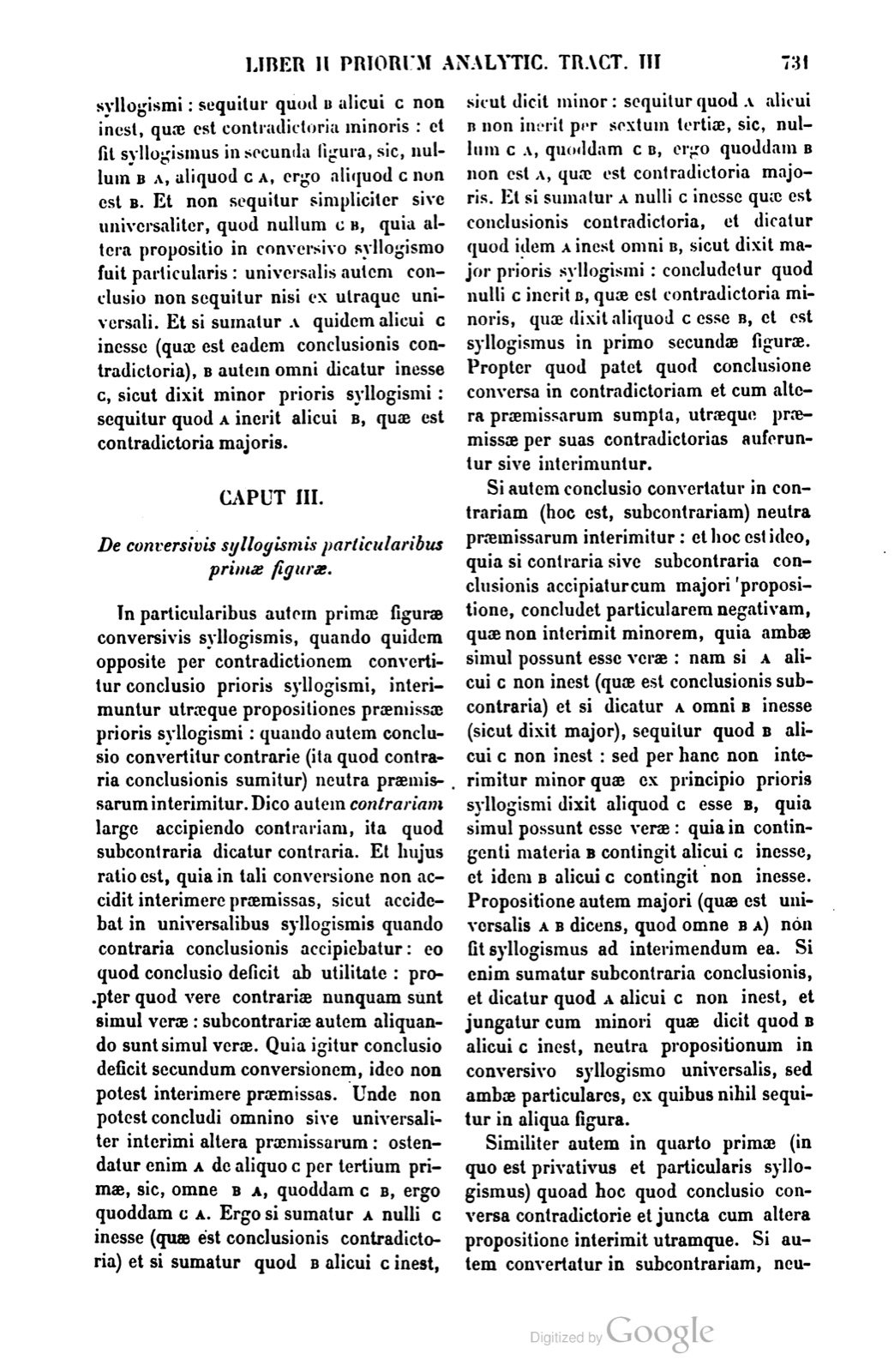
In particularibus autem primae figurae conversivis syllogismis, quando quidem opposite per contradictionem convertitur conclusio prioris syllogismi, interimuntur utraeque propositiones praemissae prioris syllogismi: quando autem conclusio convertitur contrarie (ita quod contraria conclusionis sumitur) neutra praemissarum interimitur. Dico autem contrariam large accipiendo contrariam, ita quod subcontraria dicatur contraria. Et hujus ratio est, quia in tali conversione non accidit interimere praemissas, sicut accidebat in universalibus syllogismis quando contraria conclusionis accipiebatur: eo quod conclusio deficit ab utilitate: propter quod vere contrariae nunquam sunt simul verae: subcontrariae autem aliquando sunt simul verae. Quia igitur conclusio deficit secundum conversionem, ideo non potest interimere praemissas. Unde non potest concludi omnino sive universaliter interimi altera praemissarum: ostendatur enim A de aliquo C per tertium primae, sic, omne B A, quoddam C B, ergo quoddam C A. Ergo si sumatur A nulli C inesse (quae est conclusionis contradictoria) et si sumatur quod B alicui C inest, sicut dicit minor: sequitur quod A alicui B non inerit per sextum tertiae, sic, nullum C A, quoddam C B, ergo quoddam B non est A, quae est contradictoria majoris. Et si sumatur A nulli C inesse quae est conclusionis contradictoria, et dicatur quod idem A inest omni B, sicut dixit major prioris syllogismi: concludetur quod nulli C inerit B, quae est contradictoria minoris, quae dixit aliquod C esse B, et est syllogismus in primo secundae figurae. Propter quod patet quod conclusione conversa in contradictoriam et cum altera praemissarum sumpta, utraeque praemissae per suas contradictorias auferuntur sive interimuntur.
Si autem conclusio convertatur in contrariam (hoc est, subcontrariam) neutra praemissarum interimitur: et hoc est ideo, quia si contraria sive subcontraria conclusionis accipiatur cum majori propositione, concludet particularem negativam, quae non interimit minorem, quia ambae simul possunt esse verae: nam si A alicui C non inest (quae est conclusionis subcontraria) et si dicatur A omni B inesse (sicut dixit major), sequitur quod B alicui C non inest: sed per hanc non interimitur minor quae ex principio prioris syllogismi dixit aliquod C esse B, quia simul possunt esse verae: quia in contingenti materia B contingit alicui C inesse, et idem B alicui C contingit non inesse. Propositione autem majori (quae est universalis A B dicens, quod omne B A) non fit syllogismus ad interimendum ea. Si enim sumatur subcontraria conclusionis, et dicatur quod A alicui C non inest, et jungatur cum minori quae dicit quod B alicui C inest, neutra propositionum in conversivo syllogismo universalis, sed ambae particulares, ex quibus nihil sequitur in aliqua figura.
CHAPTER III.
On Particular Conversive Syllogisms Of The First Figure.
But in particular conversive syllogisms of the first figure, when the conclusion of the prior syllogism is converted oppositely through contradiction, both premise-propositions of the prior syllogism are destroyed; but when the conclusion is converted contrarily, so that the contrary of the conclusion is taken, neither of the premises is destroyed. But I speak of the contrary while taking contrary broadly, so that the subcontrary is called contrary. And the reason for this is that in such conversion it does not happen to destroy the premises, as happened in universal syllogisms when the contrary of the conclusion was accepted, because the conclusion falls short of usefulness. On account of this, true contraries are never true at once, but subcontraries are sometimes true at once. Therefore, because the conclusion falls short according to conversion, for that reason it cannot destroy the premises. Hence it cannot be concluded that the other of the premises is destroyed wholly or universally. For let A be shown of some C through the third of the first, thus: every B is A, some C is B, therefore some C is A. Therefore if A is taken to be present in no C, which is the contradictory of the conclusion, and if it is taken that B is present in some C, as the minor says, it follows through the sixth of the third that A will not be present in some B, thus: no C is A, some C is B, therefore some B is not A, which is the contradictory of the major. And if A is taken to be present in no C, which is the contradictory of the conclusion, and it is said that the same A is present in every B, as the major of the prior syllogism said, it will be concluded that B will be present in no C, which is the contradictory of the minor, which said that some C is B; and it is a syllogism in the first of the second figure. On account of this it is clear that, when the conclusion is converted into the contradictory and is taken with one of the premises, both premises are taken away or destroyed through their contradictories.
But if the conclusion is converted into the contrary, that is, the subcontrary, neither premise is destroyed. And this is so because, if the contrary or subcontrary of the conclusion is accepted with the major proposition, it will conclude a particular negative, which does not destroy the minor, because both can be true at once. For if A is not present in some C, which is the subcontrary of the conclusion, and if A is said to be present in every B, as the major said, it follows that B is not present in some C. But through this the minor is not destroyed, which from the beginning of the prior syllogism said that some C is B, because they can be true at once; for in contingent matter B happens to be present in some C, and the same B happens not to be present in some C. But with the major proposition, which is the universal A B saying that every B is A, a syllogism is not made for destroying it. For if the subcontrary of the conclusion is taken, and it is said that A is not present in some C, and it is joined with the minor which says that B is present in some C, neither of the propositions in the conversive syllogism is universal, but both are particular, from which nothing follows in any figure.
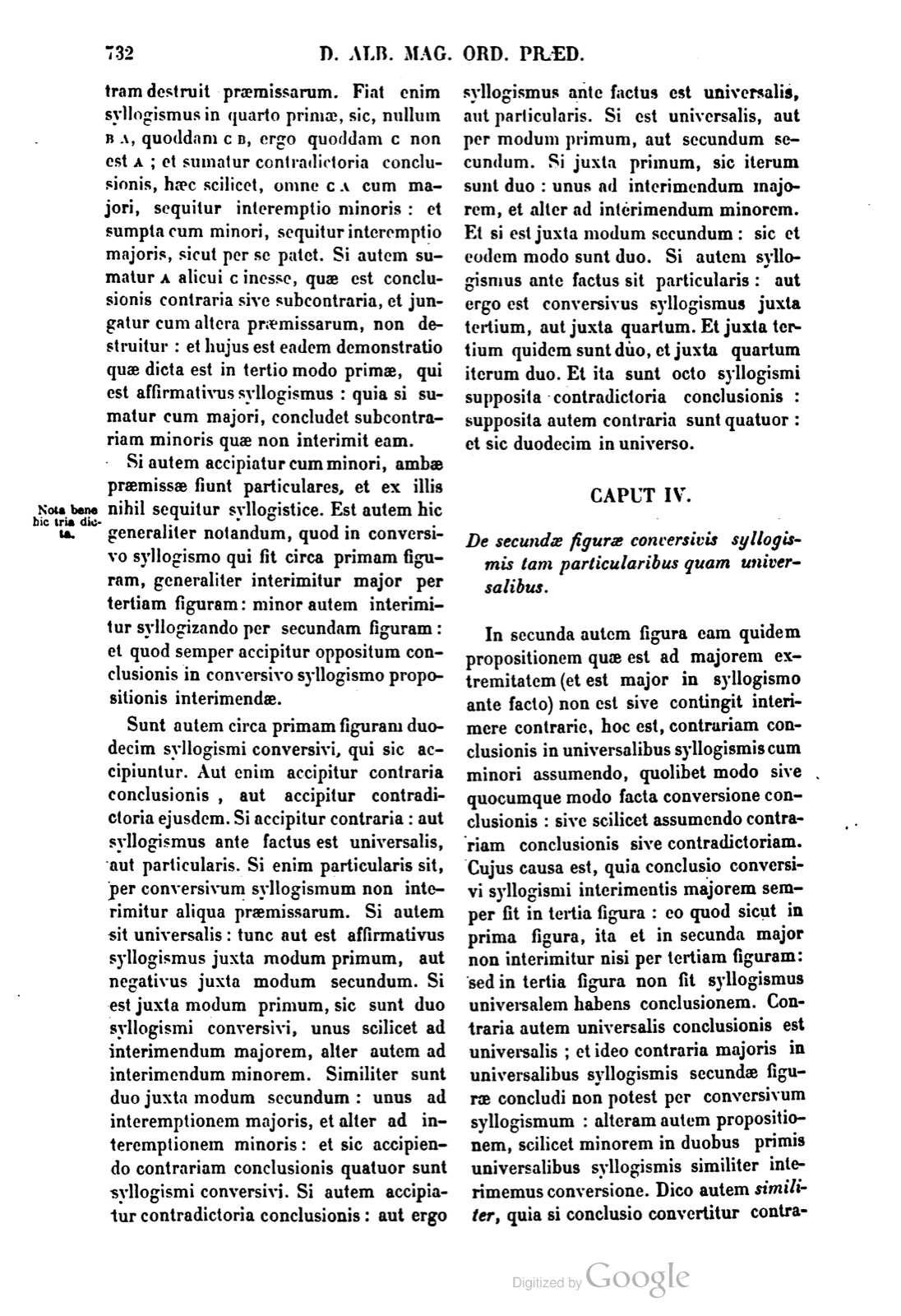
Similiter autem in quarto primae (in quo est privativus et particularis syllogismus) quoad hoc quod conclusio conversa contradictorie et juncta cum altera propositione interimit utramque. Si autem convertatur in subcontrariam, neutram destruit praemissarum. Fiat enim syllogismus in quarto primae, sic, nullum B A, quoddam C B, ergo quoddam C non est A; et sumatur contradictoria conclusionis, haec scilicet, omne C A cum majori, sequitur interemptio minoris: et sumpta cum minori, sequitur interemptio majoris, sicut per se patet. Si autem sumatur A alicui C inesse, quae est conclusionis contraria sive subcontraria, et jungatur cum altera praemissarum, non destruitur: et hujus est eadem demonstratio quae dicta est in tertio modo primae, qui est affirmativus syllogismus: quia si sumatur cum majori, concludet subcontrariam minoris quae non interimit eam. Si autem accipiatur cum minori, ambae praemissae fiunt particulares, et ex illis nihil sequitur syllogistice.
Est autem hic generaliter notandum, quod in conversivo syllogismo qui fit circa primam figuram, generaliter interimitur major per tertiam figuram: minor autem interimitur syllogizando per secundam figuram: et quod semper accipitur oppositum conclusionis in conversivo syllogismo propositionis interimendae.
Sunt autem circa primam figuram duodecim syllogismi conversivi, qui sic accipiuntur. Aut enim accipitur contraria conclusionis, aut accipitur contradictoria ejusdem. Si accipitur contraria: aut syllogismus ante factus est universalis, aut particularis. Si enim particularis sit, per conversivum syllogismum non interimitur aliqua praemissarum. Si autem sit universalis: tunc aut est affirmativus syllogismus juxta modum primum, aut negativus juxta modum secundum. Si est juxta modum primum, sic sunt duo syllogismi conversivi, unus scilicet ad interimendum majorem, alter autem ad interimendum minorem. Similiter sunt duo juxta modum secundum: unus ad interemptionem majoris, et alter ad interemptionem minoris: et sic accipiendo contrariam conclusionis quatuor sunt syllogismi conversivi. Si autem accipiatur contradictoria conclusionis: aut ergo syllogismus ante factus est universalis, aut particularis. Si est universalis, aut per modum primum, aut secundum secundum. Si juxta primum, sic iterum sunt duo: unus ad interimendum majorem, et alter ad interimendum minorem. Et si est juxta modum secundum: sic et eodem modo sunt duo. Si autem syllogismus ante factus sit particularis: aut ergo est conversivus syllogismus juxta tertium, aut juxta quartum. Et juxta tertium quidem sunt duo, et juxta quartum iterum duo. Et ita sunt octo syllogismi supposita contradictoria conclusionis: supposita autem contraria sunt quatuor: et sic duodecim in universo.
Likewise in the fourth of the first, in which there is a privative and particular syllogism, as to this, that the conclusion converted contradictorily and joined with one proposition destroys each. But if it is converted into the subcontrary, it destroys neither of the premises. For let a syllogism be made in the fourth of the first, thus: no B is A, some C is B, therefore some C is not A; and let the contradictory of the conclusion be taken, namely this, every C is A. With the major, the destruction of the minor follows; and taken with the minor, the destruction of the major follows, as is clear by itself. But if A is taken to be present in some C, which is the contrary or subcontrary of the conclusion, and it is joined with one of the premises, it is not destroyed. And the same demonstration for this is the one that was given in the third mode of the first, which is an affirmative syllogism, because if it is taken with the major, it will conclude the subcontrary of the minor, which does not destroy it. But if it is accepted with the minor, both premises become particular, and from them nothing follows syllogistically.
But here it must be generally noted that in the conversive syllogism which is made around the first figure, generally the major is destroyed through the third figure, but the minor is destroyed by syllogizing through the second figure, and that the opposite of the conclusion is always accepted in the conversive syllogism in place of the proposition to be destroyed.
But around the first figure there are twelve conversive syllogisms, which are taken thus. For either the contrary of the conclusion is accepted, or the contradictory of the same is accepted. If the contrary is accepted, either the syllogism made before is universal or particular. For if it is particular, through the conversive syllogism no premise is destroyed. But if it is universal, then either it is an affirmative syllogism according to the first mode, or a negative one according to the second mode. If it is according to the first mode, then there are two conversive syllogisms, namely one for destroying the major, and the other for destroying the minor. Similarly there are two according to the second mode, one for the destruction of the major and the other for the destruction of the minor; and thus, by accepting the contrary of the conclusion, there are four conversive syllogisms. But if the contradictory of the conclusion is accepted, then either the syllogism made before is universal or particular. If it is universal, either it is through the first mode or according to the second. If according to the first, thus again there are two: one for destroying the major and the other for destroying the minor. And if it is according to the second mode, thus and in the same way there are two. But if the syllogism made before is particular, then either the conversive syllogism is according to the third or according to the fourth. And according to the third there are indeed two, and according to the fourth again two. And so there are eight syllogisms when the contradictory of the conclusion is supposed; but when the contrary is supposed there are four; and thus there are twelve in the whole.
If a page does not appear, its photograph has not been uploaded yet.