Works › Prior Analytics, Books I–II
Volume 1 · p. 672
Chapter XIII. On the impediment that comes from definition.
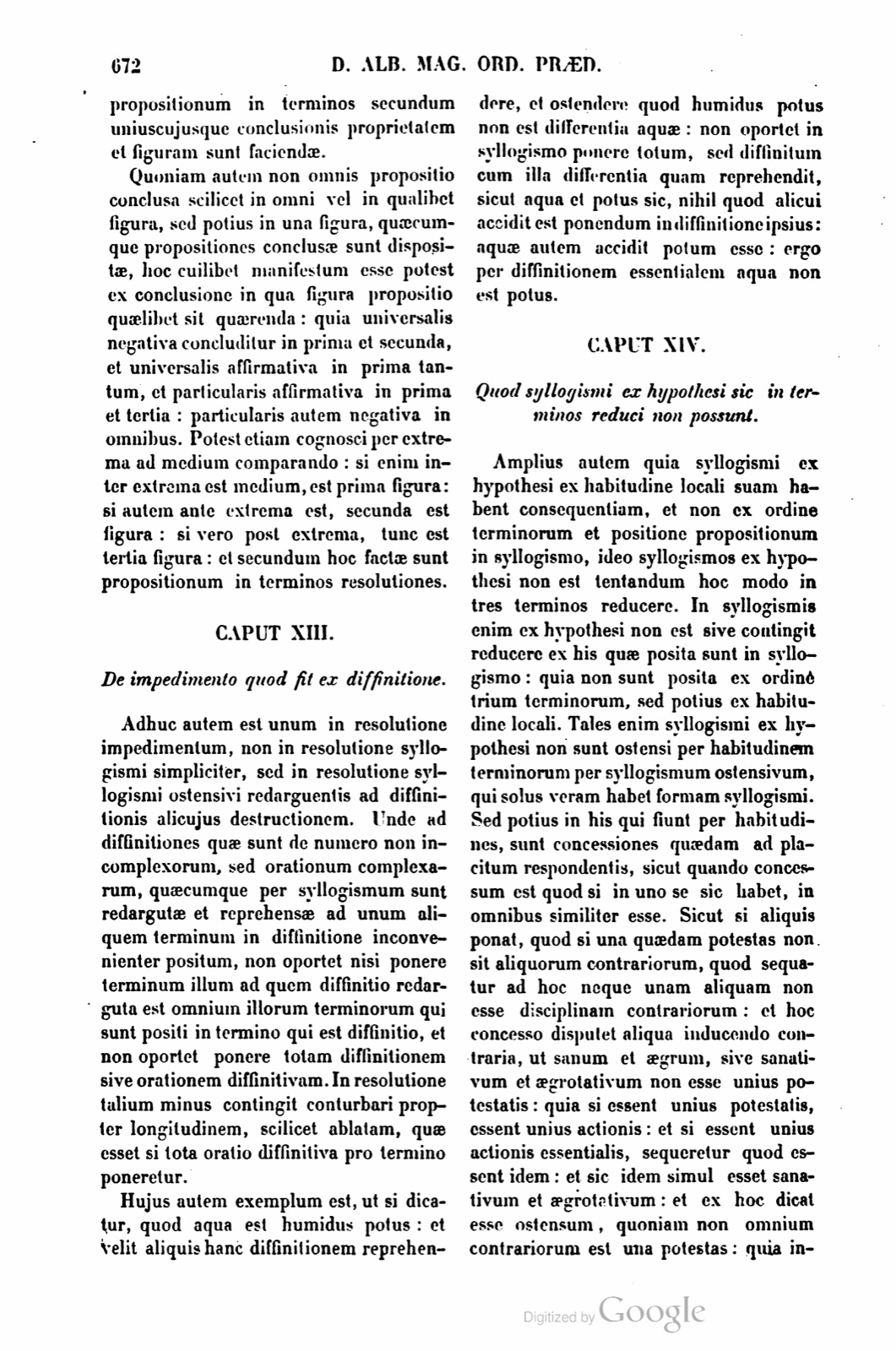
CAPUT XIII. De impedimento quod fit ex diffinitione.
Adhuc autem est unum in resolutione impedimentum, non in resolutione syllogismi simpliciter, sed in resolutione syllogismi ostensivi redarguentis ad diffinitionis alicujus destructionem. Unde ad diffinitiones quae sunt de numero non incomplexorum, sed orationum complexarum, quaecumque per syllogismum sunt redargutae et reprehensae ad unum aliquem terminum in diffinitione inconvenienter positum, non oportet nisi ponere terminum illum ad quem diffinitio redarguta est omnium illorum terminorum qui sunt positi in termino qui est diffinitio, et non oportet ponere totam diffinitionem sive orationem diffinitivam. In resolutione talium minus contingit conturbari propter longitudinem, scilicet ablatam, quae esset si tota oratio diffinitiva pro termino poneretur.
Hujus autem exemplum est, ut si dicatur, quod aqua est humidus potus: et velit aliquis hanc diffinitionem reprehendere, et ostendere quod humidus potus non est differentia aquae: non oportet in syllogismo ponere totum, sed diffinitum cum illa differentia quam reprehendit, sicut aqua et potus sic, nihil quod alicui accidit est ponendum in diffinitione ipsius: aquae autem accidit potum esse: ergo per diffinitionem essentialem aqua non est potus.
CHAPTER XIII. On the impediment that comes from definition.
Again there is one impediment in resolution, not in the resolution of a syllogism simply, but in the resolution of an ostensive syllogism refuting toward the destruction of some definition. Hence with respect to definitions which are in the number not of incomplex things, but of complex expressions, whenever they have been refuted and blamed through a syllogism with respect to some one term inconveniently posited in the definition, one need only posit that term to which the definition has been refuted, among all those terms which are posited in the term which is the definition, and one need not posit the whole definition or definitive expression. In the resolution of such things, it happens less that one is disturbed by the length, namely once it is taken away, which would be present if the whole definitive expression were posited as the term.
But the example of this is that, if it is said that water is a humid drink, and someone wishes to reprehend this definition and to show that humid drink is not the difference of water, one need not posit the whole in the syllogism, but the defined thing with that difference which he reprehends, as water and drink, thus: nothing which happens accidentally to something should be posited in its definition; but being a drink happens accidentally to water; therefore, according to essential definition, water is not drink.
If a page does not appear, its photograph has not been uploaded yet.