Works › Prior Analytics, Books I–II
Volume 1 · pp. 652–653
Treatise VII. On the reduction of syllogisms. Chapter I. For what reasons reduction must be treated, in how many ways reduction is made, and on the order of reductions.
A marker with ≈ is an approximate page boundary, placed by measure of the text; the page photographs remain the authority. In the paired views, clicking a page marker brings that page into view.
TRACTATUS VII. DE SYLLOGISMORUM REDUCTIONE.
CAPUT I. Quibus de causis tractandum est de reductione, et quot modis fit reductio: et de ordine reductionum.
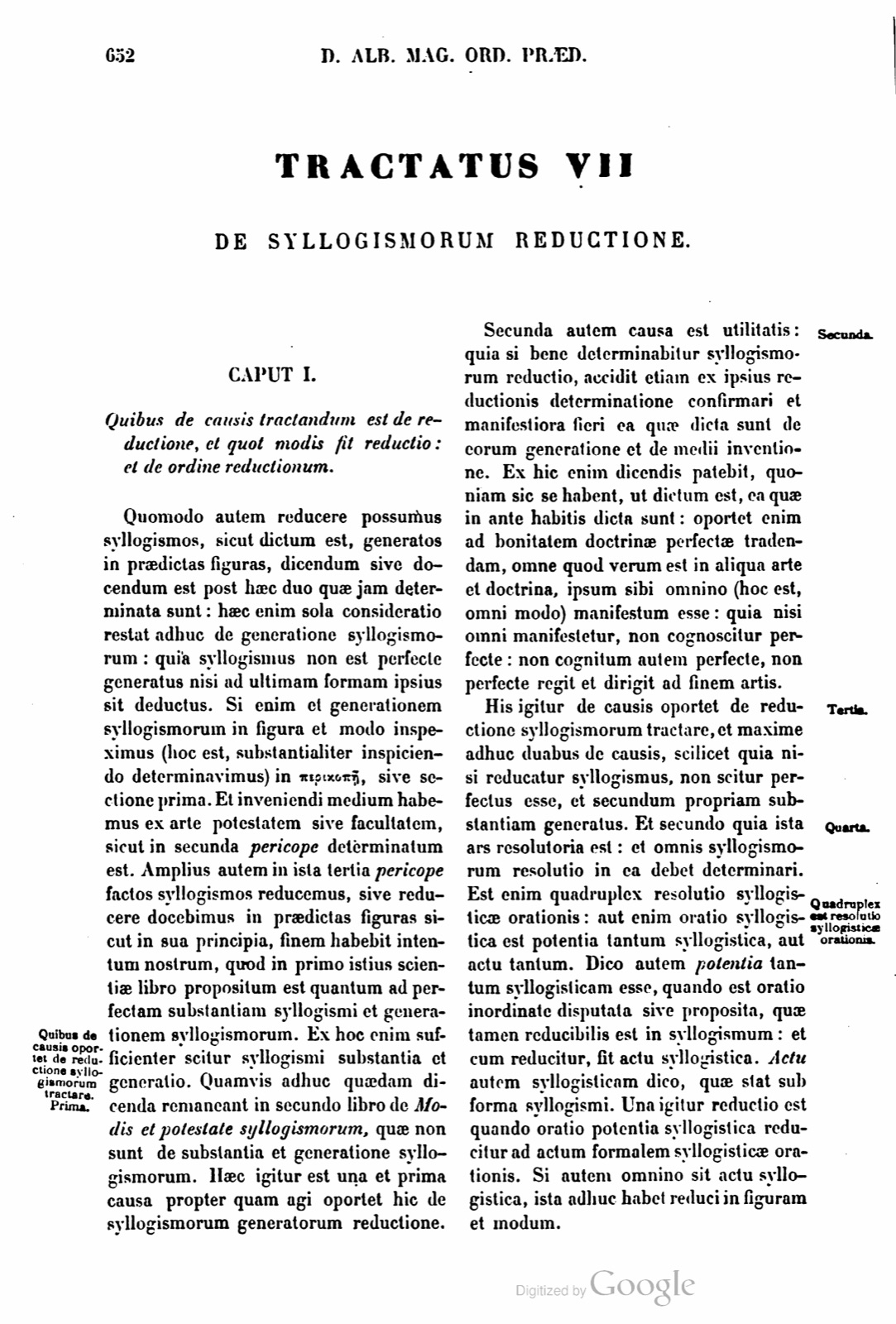
Quomodo autem reducere possumus syllogismos, sicut dictum est, generatos in praedictas figuras, dicendum sive docendum est post haec duo quae jam determinata sunt: haec enim sola consideratio restat adhuc de generatione syllogismorum: quia syllogismus non est perfecte generatus nisi ad ultimam formam ipsius sit deductus. Si enim et generationem syllogismorum in figura et modo inspeximus (hoc est, substantialiter inspiciendo determinavimus) in περικοπῇ, sive sectione prima. Et inveniendi medium habemus ex arte potestatem sive facultatem, sicut in secunda pericope determinatum est. Amplius autem in ista tertia pericope factos syllogismos reducemus, sive reducere docebimus in praedictas figuras sicut in sua principia, finem habebit intentum nostrum, quod in primo istius scientiae libro propositum est quantum ad perfectam substantiam syllogismi et generationem syllogismorum. Ex hoc enim sufficienter scitur syllogismi substantia et generatio. Quamvis adhuc quaedam dicenda remaneant in secundo libro de Modis et potestate syllogismorum, quae non sunt de substantia et generatione syllogismorum. Haec igitur est una et prima causa propter quam agi oportet hic de syllogismorum generatorum reductione.
Secunda autem causa est utilitatis: quia si bene determinabitur syllogismorum reductio, accidit etiam ex ipsius reductionis determinatione confirmari et manifestiora fieri ea quae dicta sunt de eorum generatione et de medii inventione. Ex hic enim dicendis patebit, quoniam sic se habent, ut dictum est, ea quae in ante habitis dicta sunt: oportet enim ad bonitatem doctrinae perfectae tradendam, omne quod verum est in aliqua arte et doctrina, ipsum sibi omnino (hoc est, omni modo) manifestum esse: quia nisi omni manifestetur, non cognoscitur perfecte: non cognitum autem perfecte, non perfecte regit et dirigit ad finem artis.
His igitur de causis oportet de reductione syllogismorum tractare, et maxime adhuc duabus de causis, scilicet quia nisi reducatur syllogismus, non scitur perfectus esse, et secundum propriam substantiam generatus. Et secundo quia ista ars resolutoria est: et omnis syllogismorum resolutio in ea debet determinari. Est enim quadruplex resolutio syllogisticae orationis: aut enim oratio syllogistica est potentia tantum syllogistica, aut actu tantum. Dico autem potentia tantum syllogisticam esse, quando est oratio inordinate disputata sive proposita, quae tamen reducibilis est in syllogismum: et cum reducitur, fit actu syllogistica. Actu autem syllogisticam dico, quae stat sub forma syllogismi. Una igitur reductio est quando oratio potentia syllogistica reducitur ad actum formalem syllogisticae orationis. Si autem omnino sit actu syllogistica, ista adhuc habet reduci in figuram et modum.
TREATISE VII. ON THE REDUCTION OF SYLLOGISMS.
CHAPTER I. For what reasons reduction must be treated, in how many ways reduction is made, and on the order of reductions.
But how we can reduce syllogisms, generated as has been said, into the aforesaid figures must be said or taught after these two things which have already been determined. For this consideration alone still remains concerning the generation of syllogisms, because a syllogism has not been perfectly generated unless it has been led to its final form. For if we have also inspected the generation of syllogisms in figure and mode, that is, have determined it by inspecting substantially, in the first περικοπῇ or section, and have from the art the power or faculty of finding the middle, as was determined in the second pericope, then further, in this third pericope, if we reduce made syllogisms, or teach how to reduce them, into the aforesaid figures as into their principles, our intended end, which was proposed in the first book of this science with respect to the perfect substance of a syllogism and the generation of syllogisms, will be had. For from this the substance and generation of a syllogism are sufficiently known, although certain things still remain to be said in the second book about the Modes and power of syllogisms, which are not about the substance and generation of syllogisms. This, therefore, is one and the first cause on account of which one must treat here the reduction of generated syllogisms.
But the second cause is one of usefulness, because if the reduction of syllogisms is well determined, it also happens from the determination of that reduction itself that those things which have been said about their generation and about discovery of the middle are confirmed and made more manifest. For from the things to be said here it will be clear that the things which have been said in the preceding matters have themselves as was said. For in order to hand down the goodness of perfect doctrine, everything that is true in some art and doctrine must be wholly, that is, in every way, manifest to that art and doctrine; because unless it is manifested in every way, it is not known perfectly, and what is not known perfectly does not perfectly rule and direct toward the end of the art.
For these reasons, therefore, one must treat the reduction of syllogisms, and especially for two further reasons, namely because unless a syllogism is reduced, it is not known to be perfect and generated according to its proper substance. And secondly, because this art is resolutory, and every resolution of syllogisms must be determined in it. For the resolution of syllogistic speech is fourfold: either syllogistic speech is syllogistic only in potency, or only in act. But I say that it is syllogistic only in potency when it is speech disputed or proposed without order, which nevertheless is reducible into a syllogism; and when it is reduced, it becomes actually syllogistic. But I call that actually syllogistic which stands under the form of a syllogism. Therefore one reduction is when speech syllogistic in potency is reduced to the formal act of syllogistic speech. But if it is wholly actually syllogistic, it still has to be reduced into figure and mode.
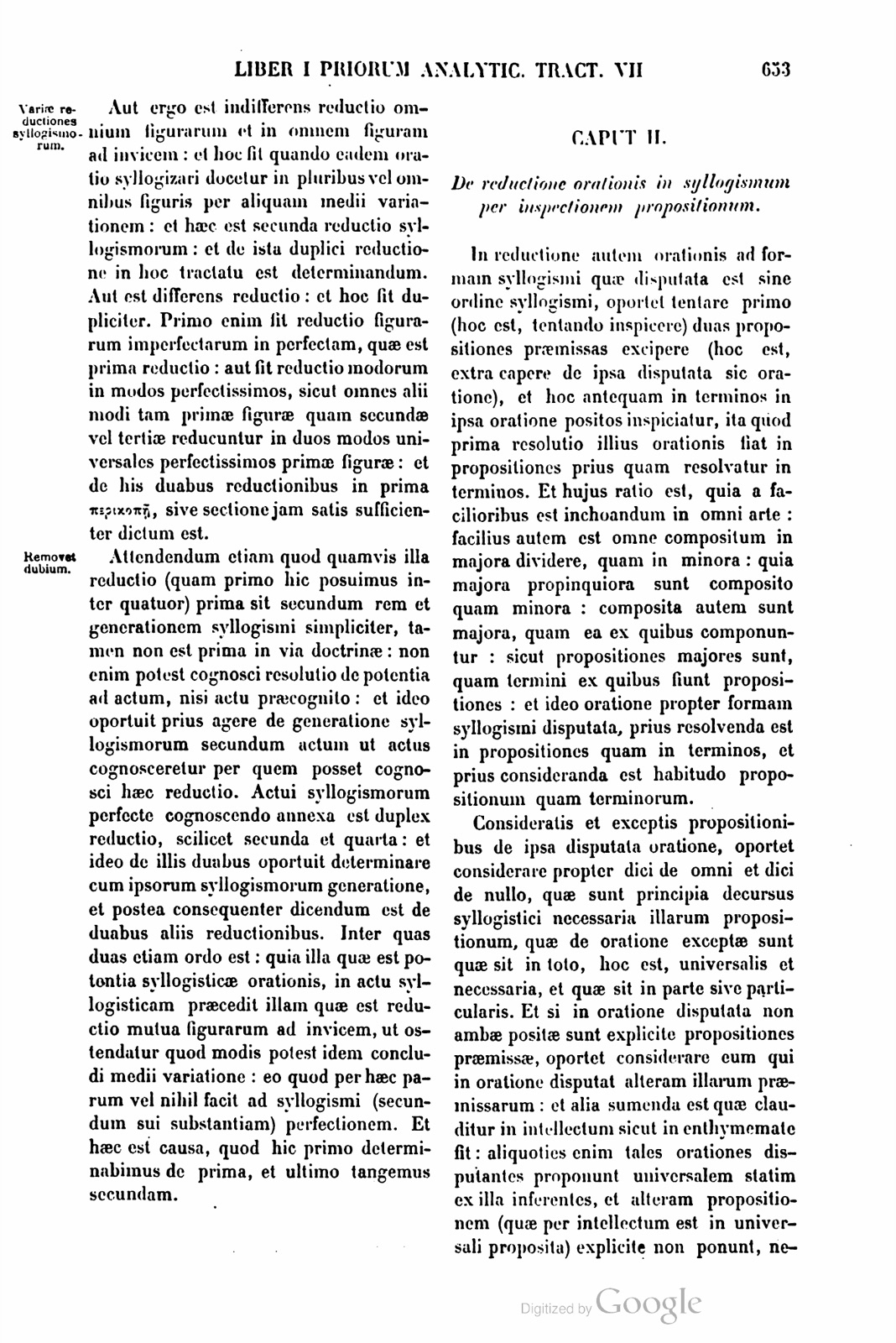
Aut ergo est indifferens reductio omnium figurarum et in omnem figuram ad invicem: et hoc fit quando eadem oratio syllogizari docetur in pluribus vel omnibus figuris per aliquam medii variationem: et haec est secunda reductio syllogismorum: et de ista duplici reductione in hoc tractatu est determinandum. Aut est differens reductio: et hoc fit dupliciter. Primo enim fit reductio figurarum imperfectarum in perfectam, quae est prima reductio: aut fit reductio modorum in modos perfectissimos, sicut omnes alii modi tam primae figurae quam secundae vel tertiae reducuntur in duos modos universales perfectissimos primae figurae: et de his duabus reductionibus in prima περικοπῇ, sive sectione jam satis sufficienter dictum est.
Attendendum etiam quod quamvis illa reductio (quam primo hic posuimus inter quatuor) prima sit secundum rem et generationem syllogismi simpliciter, tamen non est prima in via doctrinae: non enim potest cognosci resolutio de potentia ad actum, nisi actu praecognito: et ideo oportuit prius agere de generatione syllogismorum secundum actum ut actus cognosceretur per quem posset cognosci haec reductio. Actui syllogismorum perfecte cognoscendo annexa est duplex reductio, scilicet secunda et quarta: et ideo de illis duabus oportuit determinare cum ipsorum syllogismorum generatione, et postea consequenter dicendum est de duabus aliis reductionibus. Inter quas duas etiam ordo est: quia illa quae est potentia syllogisticae orationis, in actu syllogisticam praecedit illam quae est reductio mutua figurarum ad invicem, ut ostendatur quod modis potest idem concludi medii variatione: eo quod per haec parum vel nihil facit ad syllogismi (secundum sui substantiam) perfectionem. Et haec est causa, quod hic primo determinabimus de prima, et ultimo tangemus secundam.
Therefore either there is an indifferent reduction of all figures, and into every figure reciprocally; and this occurs when the same speech is taught to be syllogized in several or all figures through some variation of the middle. And this is the second reduction of syllogisms, and concerning this twofold reduction it must be determined in this treatise. Or there is a differing reduction; and this occurs in two ways. For first there is a reduction of imperfect figures into the perfect one, which is the first reduction; or there is a reduction of modes into the most perfect modes, as all other modes both of the first figure and of the second or third are reduced into the two most perfect universal modes of the first figure. And concerning these two reductions enough has already been said in the first περικοπῇ or section.
One must also attend that, although that reduction which we first posited here among the four is first according to reality and the generation of syllogism simply, nevertheless it is not first in the way of teaching. For resolution from potency to act cannot be known unless act has first been known; and therefore it was necessary first to deal with the generation of syllogisms according to act, so that the act might be known through which this reduction could be known. A twofold reduction is annexed to the act of syllogisms to be known perfectly, namely the second and the fourth; and therefore concerning those two it was necessary to determine together with the generation of those syllogisms themselves, and afterward consequently one must speak about the two other reductions. Among these two there is also an order, because that which belongs to speech syllogistic in potency precedes, in relation to actual syllogistic speech, that which is the mutual reduction of figures to one another, so that it may be shown in what modes the same thing can be concluded by variation of the middle, because through these things little or nothing is done for the perfection of the syllogism according to its substance. And this is the cause why here we shall first determine the first reduction, and last touch upon the second.
If a page does not appear, its photograph has not been uploaded yet.