Works › Prior Analytics, Books I–II
Volume 1 · pp. 644–646
Chapter VI. That it is the same with respect to inspection of the middle in syllogisms from transumption and in those which are from modal propositions, and that this art is general.
A marker with ≈ is an approximate page boundary, placed by measure of the text; the page photographs remain the authority. In the paired views, clicking a page marker brings that page into view.
CAPUT VI. Quod idem est quoad medii inspectionem in syllogismis ex transumptione, et in his qui sunt ex propositionibus modalibus, et quod generalis est ars ista.
In aliis autem syllogismis a syllogismo ad impossibile, qui etiam sunt ex hypothesi, sicut quicumque syllogismi fiunt secundum transumptionem, sive juxta locum a transumptione formati, eadem est inspectio medii. Transumptionem autem vocamus translationem a minus noto ad magis notum, vel e converso a magis noto ad minus notum. Idem etiam est quoad medii inspectionem in illis syllogismis qui fiunt secundum unam qualitatem in subjectis diversis, sicut in his qui formantur juxta locum a simili, et a minori, et a majori, et a proportione, et a casibus, et conjugationibus, et hujusmodi, non quidem in conclusionibus prioribus quae inferuntur ex talibus hypothesibus, sed in transumptis, hoc est, in his ad quas reditur ex transumptione ad propositum principale. In omnibus enim his erit consideratio eadem ad inspectionem medii quantum ad antecedentia et repugnantia. Modus autem inspectionis ad medii inventionem erit idem.
Considerare autem oportet in talibus et dividere per distinctionem quot modis fiunt syllogismi ex hypothesi, ut in quolibet differentia et species hypothesis debite sumantur antecedentia et consequentia et repugnantia. Contingit autem et alio modo a praedictis syllogizare quaedam problemata, ut si syllogizetur universale per particulare, eo quod in omnibus similiter se habeant, ut si anima unius hominis sit mortalis, inferatur, ergo anima cujuslibet hominis: et sic ex hypothesi concessa prius, concluditur universale per particularem inspectionem. Hoc autem fit, quando antecedens praedicati, et antecedens subjecti idem sint, et antecedens subjecti convertibile sit, ita quod scilicet soli et omni conveniat subjecto, concludetur universale per particulare: sicut si dicam, quod secundum superius positam terminorum institutionem, C quod est antecedens praedicati, et G quod est antecedens subjecti sint idem, et sumatur ex hypothesi quod soli E inest G, ita quod sit convertibile omni et soli conveniens, inferetur ex hoc quod alicui E inerit G, et quod omni E inerit G, et quod omni E inerit A per C quod omni A inest, et per consequens omni E inest. Et similiter infertur negativa universalis ex particulari, si sumatur D repugnans praedicati, et G scilicet antecedens subjecti idem esse, et esse haec duo convertibilia: tunc enim similiter se habebit in omnibus, et sic concludetur, quod si aliquod E non est D, quod nulli E inerit A, quia a quo removetur consequens removetur et antecedens. Manifestum est igitur quoniam in omnibus syllogismis ex hypothesi sic, ut dictum est, inspiciendum est ad medii inventionem.
Attendendum autem hic, quod transumptio dicitur duobus modis, scilicet generaliter et specialiter. Generaliter quidem transumptio est in omni eo ubi transitur de uno ad aliud: sicut a concluso non principaliter intento, ad conclusum principaliter intentum: et sic syllogismus ad impossibile est a transumptione. Dicitur etiam specialiter transumptio translatio a minus noto ad magis notum: et sic loquimur hic de transumptione et sic syllogismus ad impossibile est ab hypothesi et non a transumptione, sed est in syllogismis qui formantur juxta locos superius inductos.
CHAPTER VI. That it is the same with respect to inspection of the middle in syllogisms from transumption and in those which are from modal propositions, and that this art is general.
But in other syllogisms besides the syllogism to the impossible, which are also from hypothesis, as all syllogisms which are made according to transumption, or formed according to the topic from transumption, the inspection of the middle is the same. But we call transumption a translation from the less known to the more known, or conversely from the more known to the less known. It is also the same with respect to inspection of the middle in those syllogisms which are made according to one quality in diverse subjects, as in those which are formed according to the topic from similar, from lesser, from greater, from proportion, from cases and conjugates, and things of this sort; not indeed in the prior conclusions which are inferred from such hypotheses, but in the things transumed, that is, in those things to which one returns from transumption to the principal proposed thing. For in all these the consideration will be the same for inspection of the middle with respect to antecedents and repugnant things. But the mode of inspection for discovering the middle will be the same.
In such things, however, one must consider and divide by distinction in how many ways syllogisms from hypothesis are made, so that in each one, according to the difference and species of hypothesis, antecedents and consequents and repugnant things may be duly taken. But it also happens that certain problems are syllogized in another way than the aforesaid, as if the universal is syllogized through the particular, because they have themselves similarly in all cases, as if, if the soul of one man is mortal, it is inferred: therefore the soul of any man whatever is mortal. And thus from a hypothesis previously conceded, the universal is concluded through a particular inspection. But this is made when the antecedent of the predicate and the antecedent of the subject are the same, and the antecedent of the subject is convertible, namely so that it agrees with the subject alone and with every subject; the universal will be concluded through the particular. For example, if I say that according to the institution of terms posited above, C, which is the antecedent of the predicate, and G, which is the antecedent of the subject, are the same, and it is taken from hypothesis that G inheres in E alone, so that it is convertible, agreeing with every and only E, from this it will be inferred that G inheres in some E, and that G inheres in every E, and that A inheres in every E through C which inheres in every A, and consequently inheres in every E. And similarly a universal negative is inferred from a particular, if D, repugnant to the predicate, and G, namely the antecedent of the subject, are taken to be the same, and these two to be convertible; for then it will have itself similarly in all cases, and thus it will be concluded that, if some E is not D, A will inhere in no E, because from whatever the consequent is removed, the antecedent is also removed. Therefore it is manifest that in all syllogisms from hypothesis, as has been said, one must look to the discovery of the middle.
But one must attend here that transumption is said in two ways, namely generally and specially. Generally, transumption is in every case where passage is made from one thing to another, as from a conclusion not principally intended to a conclusion principally intended; and thus a syllogism to the impossible is from transumption. Transumption is also said specially as a transfer from the less known to the more known; and thus we speak here about transumption, and thus the syllogism to the impossible is from hypothesis and not from transumption, but is among syllogisms which are formed according to the topics introduced above.
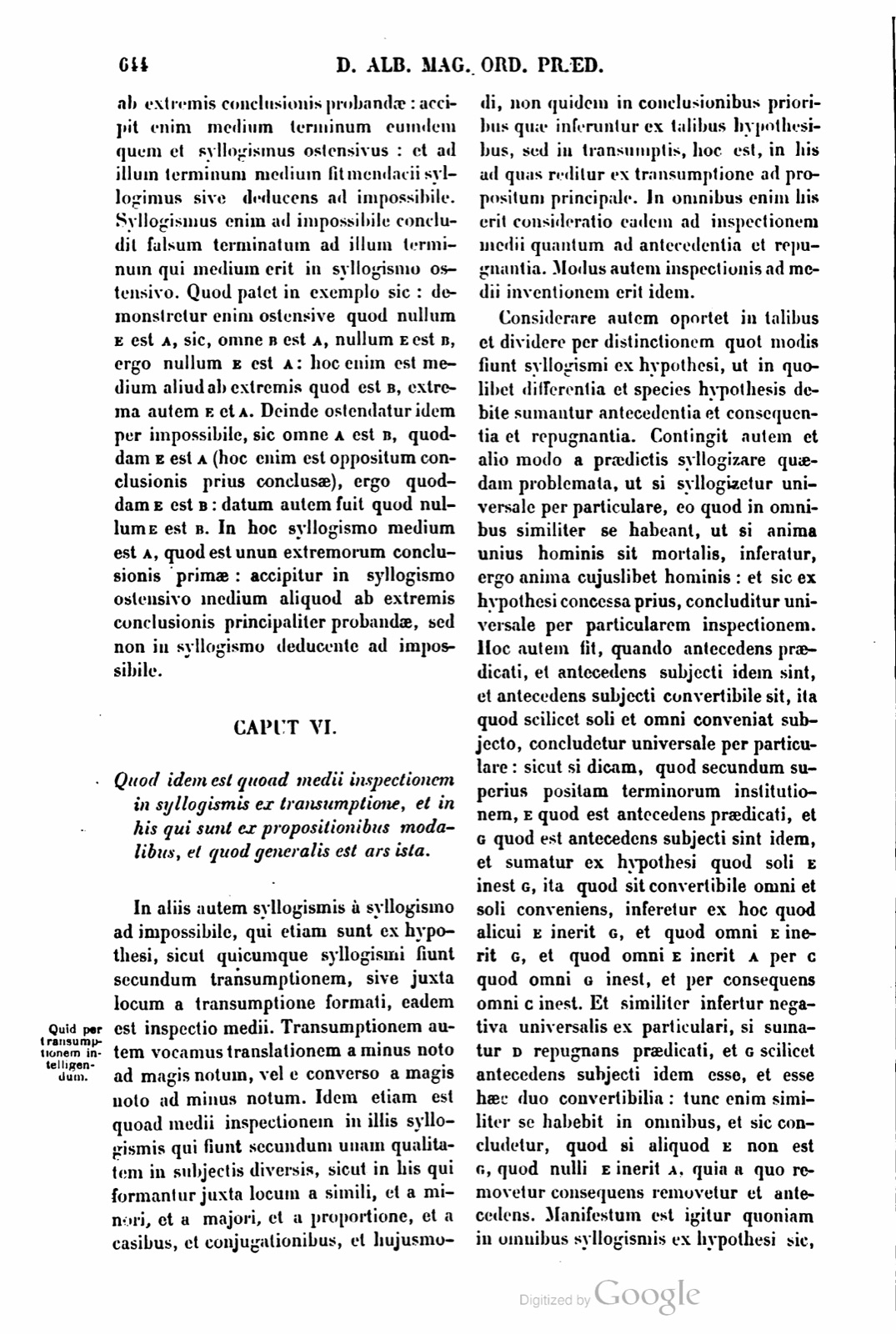
Hic tamen attendendum est quod sunt adhuc alii syllogismi, sicut ex falsis, et circularis, et conversivus, et ex oppositis, qui omnes fiunt secundum dicta superius principia in medii inspectione: quia syllogismus ex falsis ostensivus est si large extendatur nomen ostensivi, quod scilicet ostensivus dicatur omnis syllogismus qui ex duabus propositionibus unam concludit conclusionem, et ibi sistit. Similiter autem circularis ostensivus est, si unusquisque circularium syllogismorum secundum se consideretur. Conversivus autem syllogismus et syllogismus ex oppositis continentur sub syllogismo ad impossibile sive per impossibile communiter accepto: et sic patet quod in omni syllogismo eodem modo est medii inspectio.
Eodem autem modo est etiam in syllogismis qui fiunt ex propositionibus modalibus sicut in necessariis et contingentibus: nam in his erit eadem consideratio quoad medii inspectionem, et per eosdem terminos quoad antecedentia et consequentia et repugnantia erit syllogismus in ordine modalium contingentis et inesse. Quod autem idem sit in necessariis et inesse simpliciter, patet per antecedentia quae dicta sunt in generatione syllogismorum. In contingentibus autem sumendum est talia contingentia, non tantum quae insunt actuali inhaerentia, sed etiam quae non insunt, possibilia tamen sunt inesse: ostensum est enim, quoniam etiam per talia contingentia fit syllogismus de contingenti. Et similiter se habebit quantum ad medii inspectionem in omnibus aliis praedicamentis, hoc est, praedicandi modis, scilicet de necessario, et possibili, et impossibili, et vero et falso.
Ulterius autem manifestum est ex praedictis, quoniam non solum possibile est per hanc viam sive artem inspectionis medii fieri omnes syllogismos, sicut dictum est, sed etiam cum hoc manifestum est, quoniam impossibile est per aliam viam fieri aliquem syllogismorum. Ostensum est enim in praecedentibus, quod omnis syllogismus fit per aliquam trium figurarum; figuras autem tres determinatas quoad medii et extremorum ordinem non contingit per aliam viam seu artem construi seu constitui nisi per sequentia et antecedentia, quibus sequitur consequens unumquodque: ex his enim fiunt syllogismorum propositiones et sumptio medii syllogismorum: propter quod patet quod nec syllogismum universaliter possibile est fieri per alia.
Erit ergo ista quae nunc determinata est methodus in omnibus quidem syllogismis eadem et adaptanda circa philosophiam primam et circa artes rationales, sicut logicam, et rhetoricam, et circa disciplinam in scientiis disciplinabilibus quadrivii. In omnibus enim his oportet in medii inventione colligere praedicata quae insunt, et subjecta quibus insunt illa praedicata, et his collectis ut plurimis abundare: et haec et horum differentias per tres terminos considerare, antecedentium scilicet, et consequentium, et repugnantium: et destruentem quidem qui vult negativam concludere, oportet ista considerare sic, hoc est, uno modo, ad repugnantia scilicet: construentem autem qui vult propositionem affirmativam concludere, oportet considerare aliter, scilicet secundum habitudines antecedentium et consequentium: et qui vult concludere secundum rei veritatem et secundum ea quae simpliciter et actu insunt, oportet ista considerare secundum rei veritatem quae scripta est de his quae simpliciter et ex necessitate insunt. Ad dialecticos autem syllogismos faciendos oportet ista considerare ex propositionibus quae dicunt inesse secundum opinionem: quia illi fiunt ex his quae videntur omnibus vel pluribus vel sapientibus vel maxime notis.
Yet here one must attend that there are still other syllogisms, such as from falses, and the circular, and the conversive, and from opposites; all these are made according to the principles stated above in inspection of the middle. For the syllogism from falses is ostensive if the name of ostensive is extended broadly, namely so that every syllogism which from two propositions concludes one conclusion and there stops is called ostensive. Similarly the circular is ostensive if each of the circular syllogisms is considered according to itself. But the conversive syllogism and the syllogism from opposites are contained under the syllogism to the impossible or through the impossible, commonly taken; and thus it is plain that in every syllogism the inspection of the middle is in the same way.
In the same way it is also in syllogisms which are made from modal propositions, as in necessary and contingent propositions; for in these there will be the same consideration with respect to inspection of the middle, and through the same terms with respect to antecedents and consequents and repugnant things there will be a syllogism in the order of modal propositions of the contingent and of inherence. But that it is the same in necessary propositions and in simple inherence is plain through the antecedents which have been stated in the generation of syllogisms. In contingent matters, however, such contingent things must be taken, not only those which inhere by actual inherence, but also those which do not inhere and nevertheless are possible to inhere; for it has been shown that a syllogism about the contingent is also made through such contingent things. And similarly it will have itself with respect to inspection of the middle in all other predicaments, that is, modes of predicating, namely concerning the necessary, possible, impossible, true, and false.
Furthermore, from the aforesaid it is manifest not only that through this way or art of inspecting the middle it is possible for all syllogisms to be made, as has been said, but also, together with this, it is manifest that it is impossible for any syllogisms to be made through another way. For it was shown in the preceding matters that every syllogism is made through some one of the three figures; but the three figures determined with respect to the order of middle and extremes cannot be constructed or constituted through another way or art except through consequents and antecedents, to which each consequent follows. For from these are made the propositions of syllogisms and the taking of the middle of syllogisms. On account of this it is plain that it is not possible universally for a syllogism to be made through other things.
Therefore this method which has now been determined will be the same in all syllogisms and to be adapted to first philosophy and to the rational arts, such as logic and rhetoric, and to discipline in the teachable sciences of the quadrivium. For in all these, in the discovery of the middle, one must gather predicates which inhere and subjects in which those predicates inhere, and, once these are gathered, abound in very many; and one must consider these and their differences through the three terms, namely antecedents, consequents, and repugnant things. And the one destroying, who wishes to conclude a negative, must consider these things thus, that is, in one way, namely toward repugnant things; but the one constructing, who wishes to conclude an affirmative proposition, must consider otherwise, namely according to the relations of antecedents and consequents. And one who wishes to conclude according to the truth of the thing and according to those things which simply and actually inhere must consider these according to the truth of the thing which has been written about those things which simply and from necessity inhere. But for making dialectical syllogisms one must consider these things from propositions which say that something inheres according to opinion, because those are made from things which seem so to all or to many or to the wise or to the most notable.
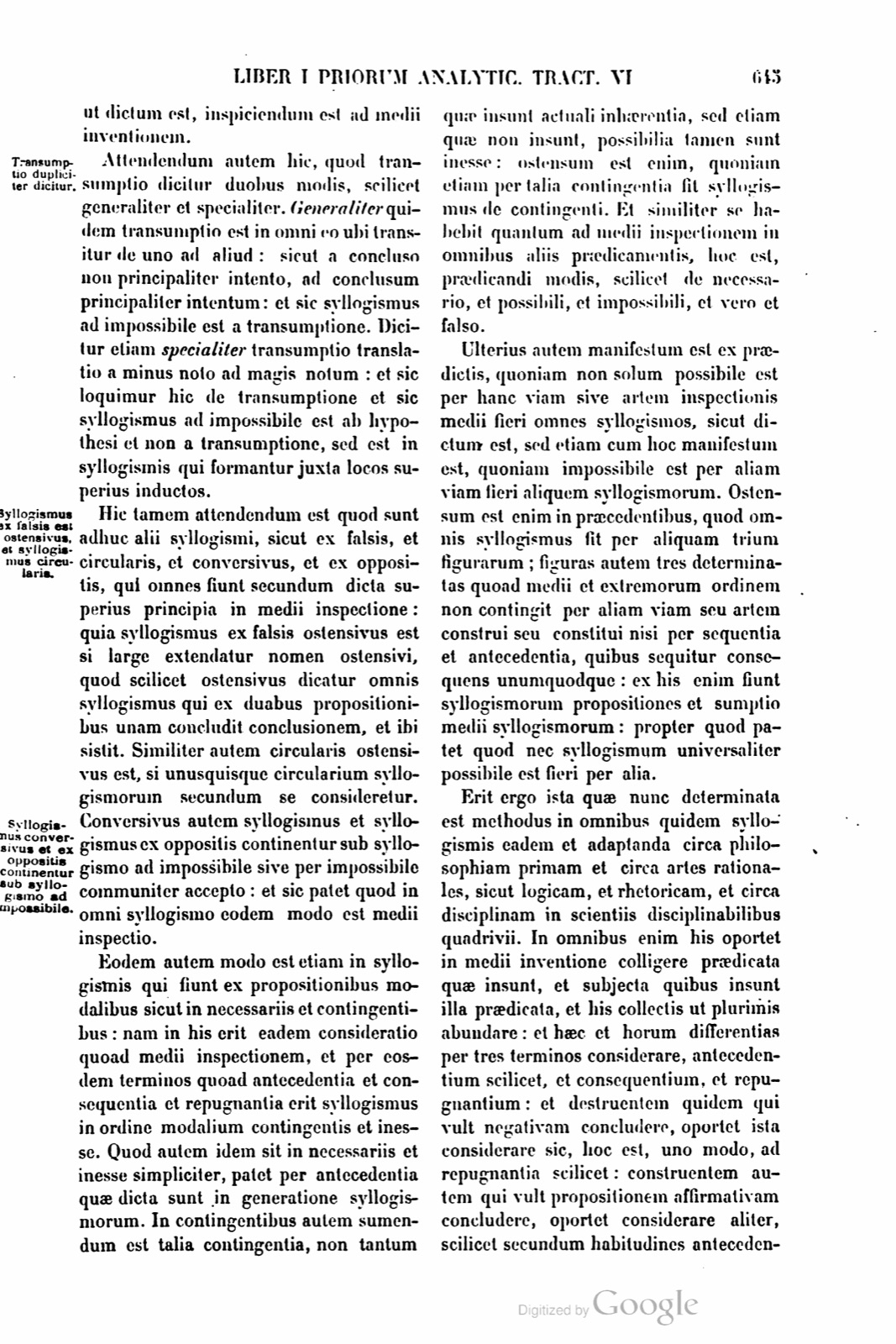
Patet igitur quod principia syllogismorum quoad formalia et materialia et medii inspectionem (universaliter quidem et in communi accipiendo) sunt quae dicta sunt: et dictum est jam quomodo se habent ad syllogismi constitutionem, et determinatum est quomodo seu ex quibus oportet ea inquirere: et hoc factum est ad vitandum dispendium quatenus in faciendo syllogismum non sit confusus noster intellectus ad omnia illa quae dicuntur vel dici possunt inspiciendo, et ut sciamus quod non est aspiciendum ad eadem quando volumus aliquid affirmative construere, et quando volumus aliqua negative destruere. Adhuc autem ut sciamus quod non aspiciendum ad eadem media, quando volumus construendo concludere de omni, universali scilicet affirmativo, et quando volumus construere de aliquo particulariter concludendo: et similiter in destruendo quando volumus destruere universaliter, quoniam ab omnibus partibus subjecti removetur praedicatum, aut quoniam particulariter removetur ab aliquibus. Sed ut gratia compendii respiciatur ad pauciora, et ad illa quae determinata sunt. Ex his enim citius et facilius medium invenitur.
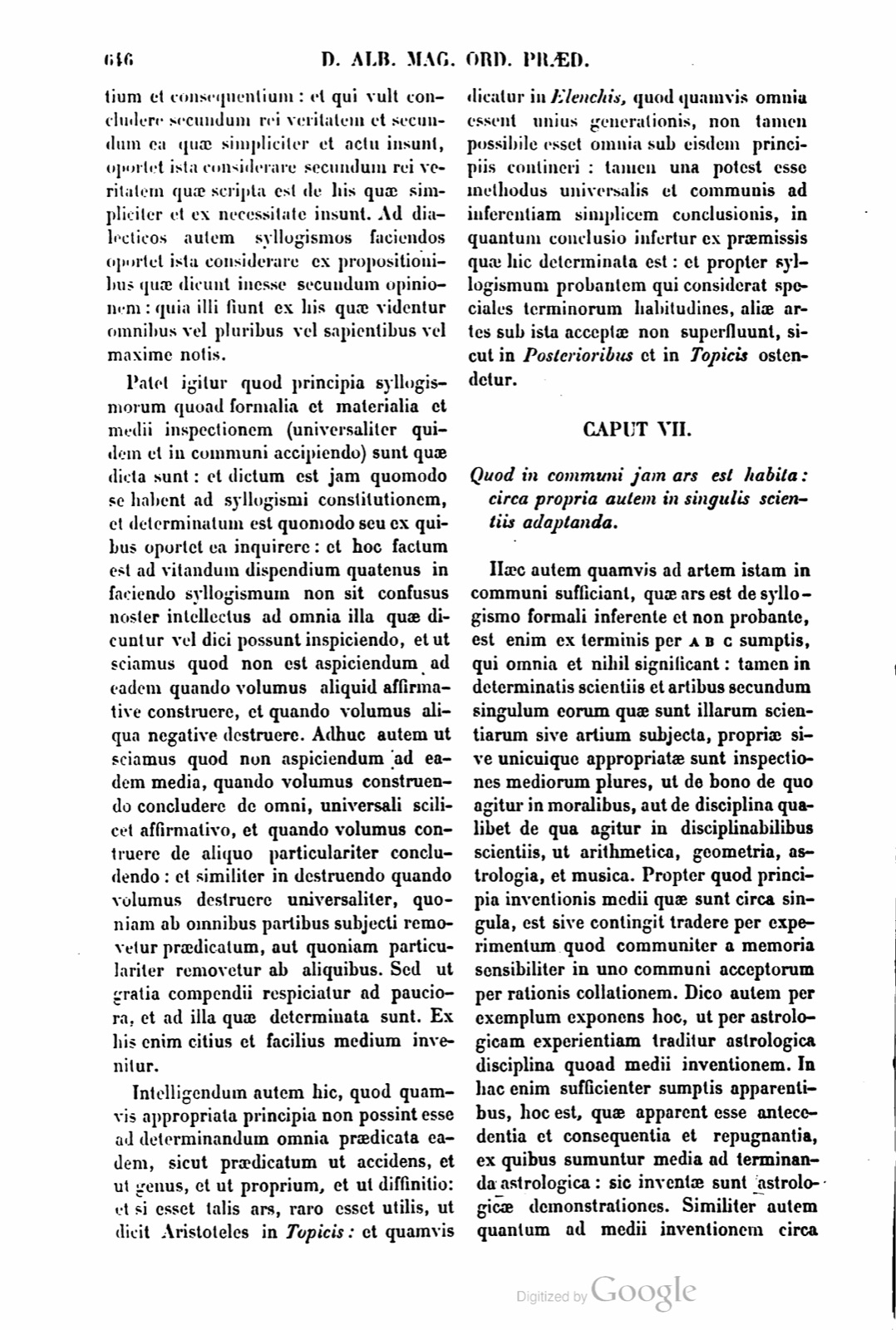
Intelligendum autem hic, quod quamvis appropriata principia non possint esse ad determinandum omnia praedicata eadem, sicut praedicatum ut accidens, et ut genus, et ut proprium, et ut diffinitio: et si esset talis ars, raro esset utilis, ut dicit Aristoteles in Topicis: et quamvis dicatur in Elenchis, quod quamvis omnia essent unius generationis, non tamen possibile esset omnia sub eisdem principiis contineri: tamen una potest esse methodus universalis et communis ad inferentiam simplicem conclusionis, in quantum conclusio infertur ex praemissis quae hic determinata est: et propter syllogismum probantem qui considerat speciales terminorum habitudines, aliae artes sub ista acceptae non superfluunt, sicut in Posterioribus et in Topicis ostendetur.
Therefore it is plain that the principles of syllogisms with respect to formal and material things and inspection of the middle, taking them universally and in common, are the things which have been stated. And it has already been said how they have themselves toward the constitution of a syllogism, and it has been determined how or from what things they must be sought; and this has been done to avoid waste, insofar as in making a syllogism our intellect may not be confused by inspecting all those things which are said or can be said, and so that we may know that one must not look to the same things when we wish to construct something affirmatively and when we wish to destroy certain things negatively. Again, also so that we may know that one must not look to the same middles when by constructing we wish to conclude of every one, namely with a universal affirmative, and when we wish to construct by concluding about some one particularly; and similarly in destroying, when we wish to destroy universally, because the predicate is removed from all parts of the subject, or because it is removed particularly from some. But this is so that for the sake of brevity we may look to fewer things and to those things which have been determined. For from these the middle is found more quickly and more easily.
But here it must be understood that, although the same appropriated principles cannot exist for determining all predicates, as predicate as accident, as genus, as proper, and as definition, and if there were such an art, it would rarely be useful, as Aristotle says in the Topics, and although it is said in the Sophistical Refutations that although all things were of one generation, nevertheless it would not be possible for all things to be contained under the same principles, nevertheless there can be one universal and common method for the simple inference of a conclusion, insofar as the conclusion is inferred from the premises which have been determined here. And because of the proving syllogism which considers the special relations of terms, the other arts accepted under this one are not superfluous, as will be shown in the Posterior Analytics and in the Topics.
If a page does not appear, its photograph has not been uploaded yet.