Works › Prior Analytics, Books I–II
Volume 1 · pp. 490–491
Chapter III. On the useless and universal conjugations of the first figure.
A marker with ≈ is an approximate page boundary, placed by measure of the text; the page photographs remain the authority. In the paired views, clicking a page marker brings that page into view.
CAPUT III. De inutilibus et universalibus conjugationibus primae figurae.
Inutiles autem conjugationes formantur juxta istas secundum diversam affirmationis et positionis complexionem, sicut paulo ante dictum est. Si enim primum quidem sive majus extremum omni quidem inest medio, medium vero nulli inest extremo, tunc major propositio erit affirmativa et minor negativa: et ex tali conjugatione nihil sequetur, et non erit syllogismus extremitatum, hoc est, in quo major extremitas de minori concludatur: neque sequetur aliquid eo quod haec sunt, hoc est, propter figuram et complexionem propositionum. Hujus autem signum est, quod contingit secundum talem complexionem primam sive majorem extremitatem, et omni et nulli inesse: et ideo semper oppositum contingit verificari cum opposito: si enim omni sequitur nulli cum eodem ipso verificatur, quod falsum est: et e converso si nulli sequitur omni, cum ipso verificatur: et si verificatur omni, verificatur et alicui, quod est contradictorium ad nulli: et si verificatur nulli, verificatur etiam alicui non, quod est contradictorium ad omni: propter quod nec particularis nec universalis sequitur conclusio ex talibus praemissis: cum enim nihil necessario sequitur per haec quae praemissa sunt, non potest fieri syllogismus, sicut patet per diffinitionem syllogismi, quae est, quod syllogismus est oratio in qua quibusdam positis aliud ex necessitate accidit.
Instando autem in tali conjugatione demonstratur in terminis: termini enim in quibus sequitur omni inesse, sunt animal, homo, equus, sic, omnis homo est animal: nullus equus est homo: ergo nullus equus est animal: et hoc falsum, quia omnis equus est animal. Termini autem in quibus sequitur nulli inesse, animal, homo, lapis, sic, omnis homo est animal: nullus lapis homo: ergo nullus lapis animal. Patet igitur quod haec est inutilis conjugatio.
Similiter autem est si ambae sint universales negativae: in his enim sequitur etiam omni et nulli inesse: et termini in quibus sequitur omni inesse, scientia, linea, medicina, sic, nulla linea scientia: nulla medicina linea: ergo nulla medicina scientia: et hoc est falsum, quia omnis medicina scientia. Termini autem in quibus sequitur nulli inesse, sunt scientia, linea, unitas, sic, nulla linea scientia: nulla unitas linea: ergo nulla unitas scientia.
CHAPTER III. On the useless and universal conjugations of the first figure.
But useless conjugations are formed alongside these according to a diverse complexion of affirmation and position, as was said a little before. For if the first, namely the greater extreme, belongs indeed to every middle, but the middle belongs to no extreme, then the major proposition will be affirmative and the minor negative; and from such a conjugation nothing will follow, and there will not be a syllogism of extremes, that is, one in which the greater extreme is concluded of the lesser; nor will anything follow from the fact that these things are so, that is, on account of the figure and the complexion of the propositions. The sign of this is that, according to such a complexion, it is possible for the first or greater extreme to belong both to every one and to no one; and therefore the opposite can always be verified with the opposite. For if "to no one" follows upon "to every one," it is verified with that very same thing, which is false; and conversely, if "to every one" follows upon "to no one," it is verified with it. And if "to every one" is verified, also "to some" is verified, which is contradictory to "to no one"; and if "to no one" is verified, also "not to some" is verified, which is contradictory to "to every one." On account of this, neither a particular nor a universal conclusion follows from such premises; for since nothing follows necessarily through these things which are premised, a syllogism cannot be made, as is clear through the definition of syllogism, which is that a syllogism is speech in which, certain things having been posited, another thing happens of necessity.
But by taking an instance in such a conjugation, it is demonstrated in terms. For the terms in which belonging to every one follows are animal, man, horse, thus: every man is animal; no horse is man; therefore no horse is animal; and this is false, because every horse is animal. But the terms in which belonging to no one follows are animal, man, stone, thus: every man is animal; no stone is man; therefore no stone is animal. It is therefore clear that this is a useless conjugation.
Similarly it is if both are universal negatives; for in these too belonging to every one and belonging to no one follow. And the terms in which belonging to every one follows are science, line, medicine, thus: no line is science; no medicine is line; therefore no medicine is science; and this is false, because every medicine is science. But the terms in which belonging to no one follows are science, line, unity, thus: no line is science; no unity is line; therefore no unity is science.
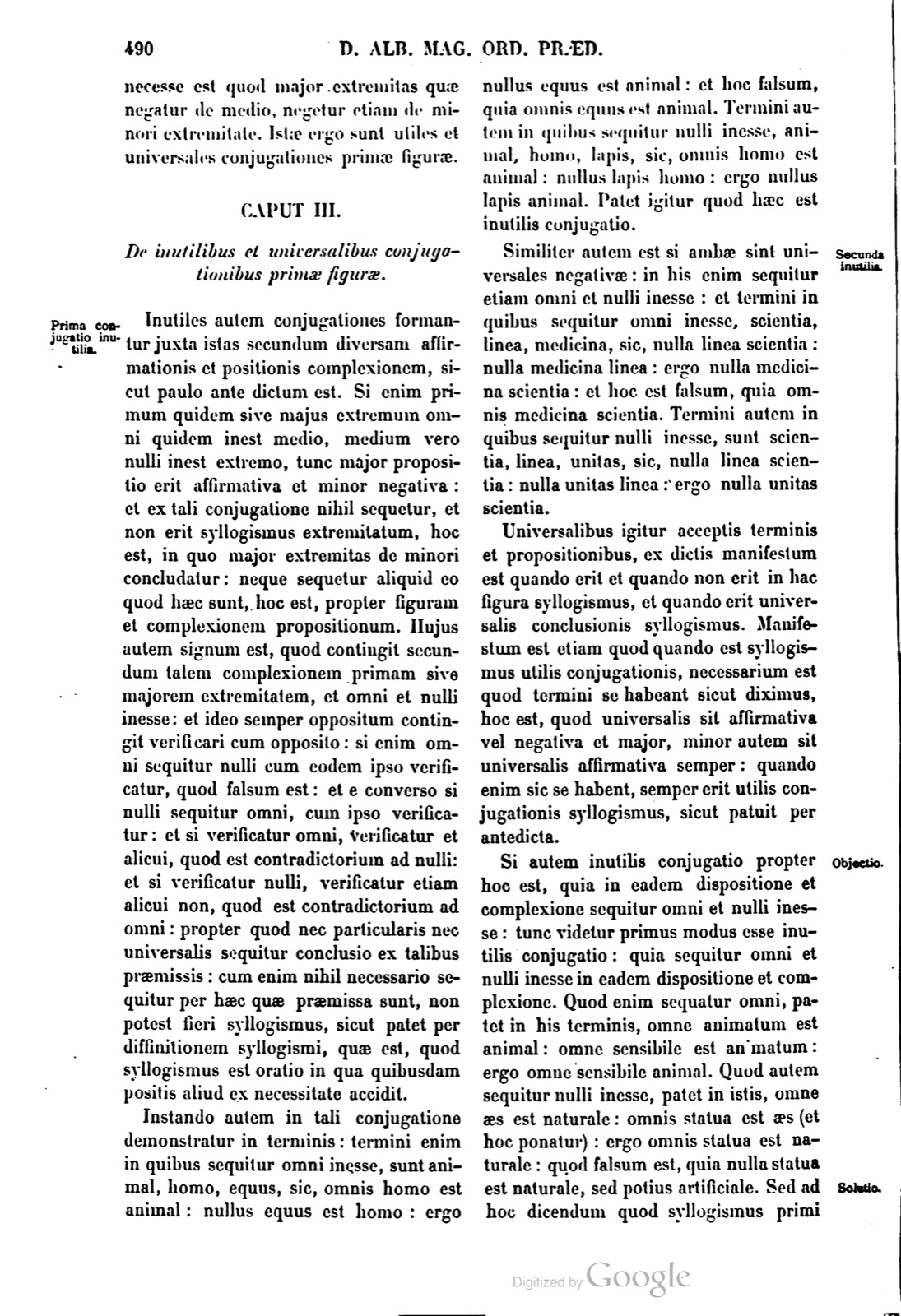
Universalibus igitur acceptis terminis et propositionibus, ex dictis manifestum est quando erit et quando non erit in hac figura syllogismus, et quando erit universalis conclusionis syllogismus. Manifestum est etiam quod quando est syllogismus utilis conjugationis, necessarium est quod termini se habeant sicut diximus, hoc est, quod universalis sit affirmativa vel negativa et major, minor autem sit universalis affirmativa semper: quando enim sic se habent, semper erit utilis conjugationis syllogismus, sicut patuit per antedicta.
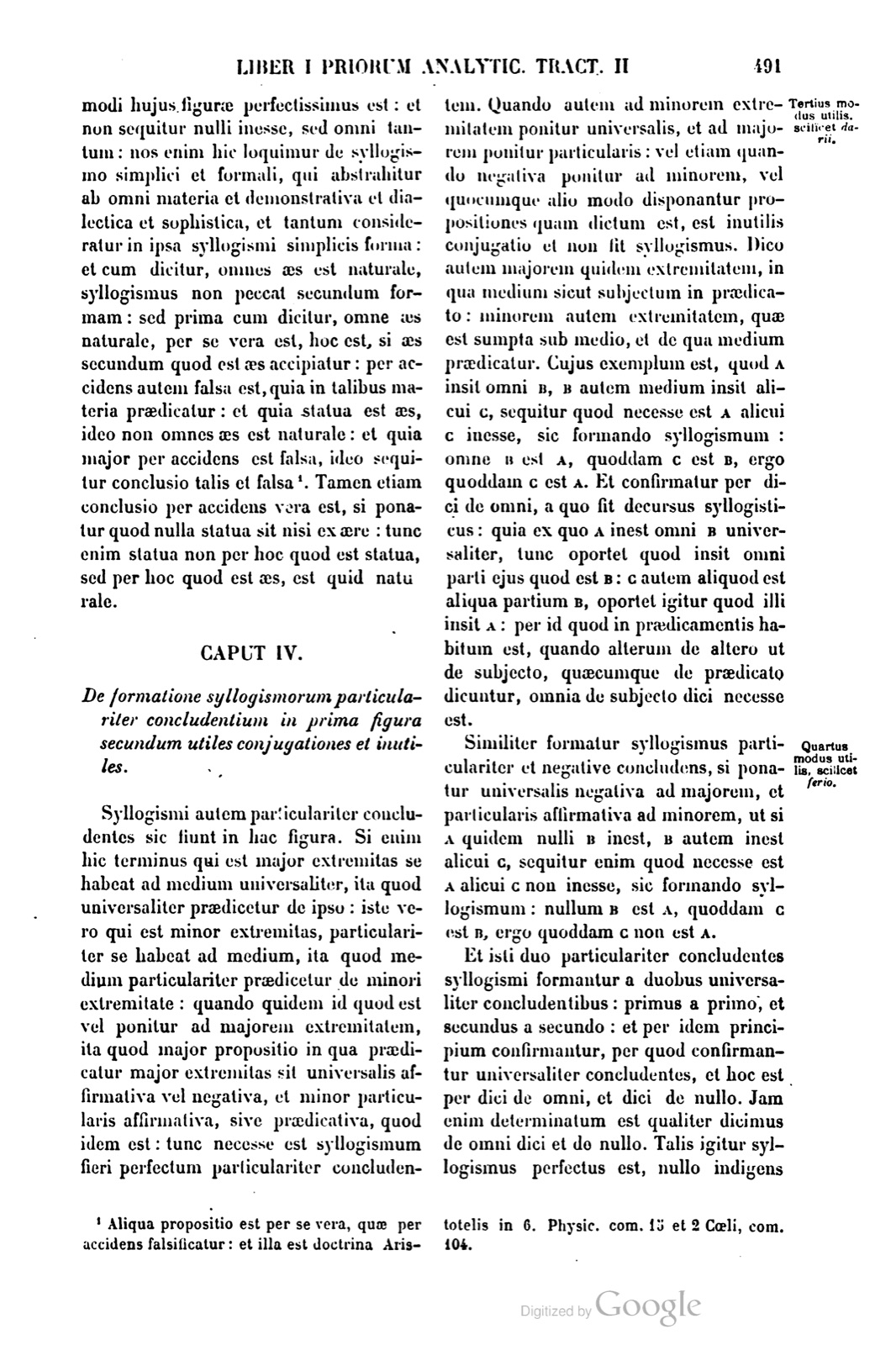
Si autem inutilis conjugatio propter hoc est, quia in eadem dispositione et complexione sequitur omni et nulli inesse: tunc videtur primus modus esse inutilis conjugatio: quia sequitur omni et nulli inesse in eadem dispositione et complexione. Quod enim sequatur omni, patet in his terminis, omne animatum est animal: omne sensibile est animatum: ergo omne sensibile animal. Quod autem sequitur nulli inesse, patet in istis, omne aes est naturale: omnis statua est aes (et hoc ponatur): ergo omnis statua est naturale: quod falsum est, quia nulla statua est naturale, sed potius artificiale. Sed ad hoc dicendum quod syllogismus primi modi hujus figurae perfectissimus est: et non sequitur nulli inesse, sed omni tantum: nos enim hic loquimur de syllogismo simplici et formali, qui abstrahitur ab omni materia et demonstrativa et dialectica et sophistica, et tantum consideratur in ipsa syllogismi simplicis forma: et cum dicitur, omne aes est naturale, syllogismus non peccat secundum formam: sed prima cum dicitur, omne aes est naturale, per se vera est, hoc est, si aes secundum quod est aes accipiatur: per accidens autem falsa est, quia in talibus materia praedicatur: et quia statua est aes, ideo non omne aes est naturale: et quia major per accidens est falsa, ideo sequitur conclusio talis et falsa1. Tamen etiam conclusio per accidens vera est, si ponatur quod nulla statua sit nisi ex aere: tunc enim statua non per hoc quod est statua, sed per hoc quod est aes, est quid naturale.
Therefore, with universal terms and propositions accepted, from what has been said it is manifest when there will be and when there will not be a syllogism in this figure, and when there will be a syllogism of universal conclusion. It is also manifest that when there is a syllogism of useful conjugation, it is necessary that the terms have themselves as we have said, that is, that the universal be affirmative or negative and major, but that the minor always be universal affirmative; for when they have themselves in this way, there will always be a syllogism of useful conjugation, as was clear through what was said before.
But if a conjugation is useless for this reason, that in the same disposition and complexion belonging to every one and belonging to no one follow, then the first mode seems to be a useless conjugation, because belonging to every one and belonging to no one follow in the same disposition and complexion. For that belonging to every one follows is clear in these terms: every animate thing is animal; every sensible thing is animate; therefore every sensible thing is animal. But that belonging to no one follows is clear in these: every bronze is natural; every statue is bronze (and let this be posited); therefore every statue is natural; which is false, because no statue is natural, but rather artificial. But to this one must say that the syllogism of the first mode of this figure is most perfect, and belonging to no one does not follow, but only belonging to every one. For here we speak of a simple and formal syllogism, which is abstracted from every matter, both demonstrative and dialectical and sophistical, and is considered only in the very form of the simple syllogism. And when it is said, "every bronze is natural," the syllogism does not sin according to form; but the first proposition, when it is said, "every bronze is natural," is true per se, that is, if bronze is taken according as it is bronze. But accidentally it is false, because in such cases the matter is predicated; and because a statue is bronze, therefore not every bronze is natural; and because the major is accidentally false, therefore such and false a conclusion follows1. Yet the conclusion is also accidentally true if it is posited that no statue exists except from bronze; for then the statue is a natural thing not through this, that it is a statue, but through this, that it is bronze.
Notes
- Some proposition is true per se, which is falsified accidentally; and that is the doctrine of Aristotle in Physics VI, comment 13, and On the Heavens II, comment 104. (Aliqua propositio est per se vera, quae per accidens falsificatur: et illa est doctrina Aristotelis in 6. Physic. com. 13 et 2 Coeli, com. 104.) ↩
If a page does not appear, its photograph has not been uploaded yet.