Works › Prior Analytics, Books I–II
Volume 1 · pp. 487–490
Chapter II. On the formation of universal syllogisms and of the useful conjugations of the first figure, and what figure is, and what the first figure is.
A marker with ≈ is an approximate page boundary, placed by measure of the text; the page photographs remain the authority. In the paired views, clicking a page marker brings that page into view.
CAPUT II. De formatione syllogismorum universalium, et utilium conjugationum primae figurae, et quid sit figura, et quid sit figura prima.
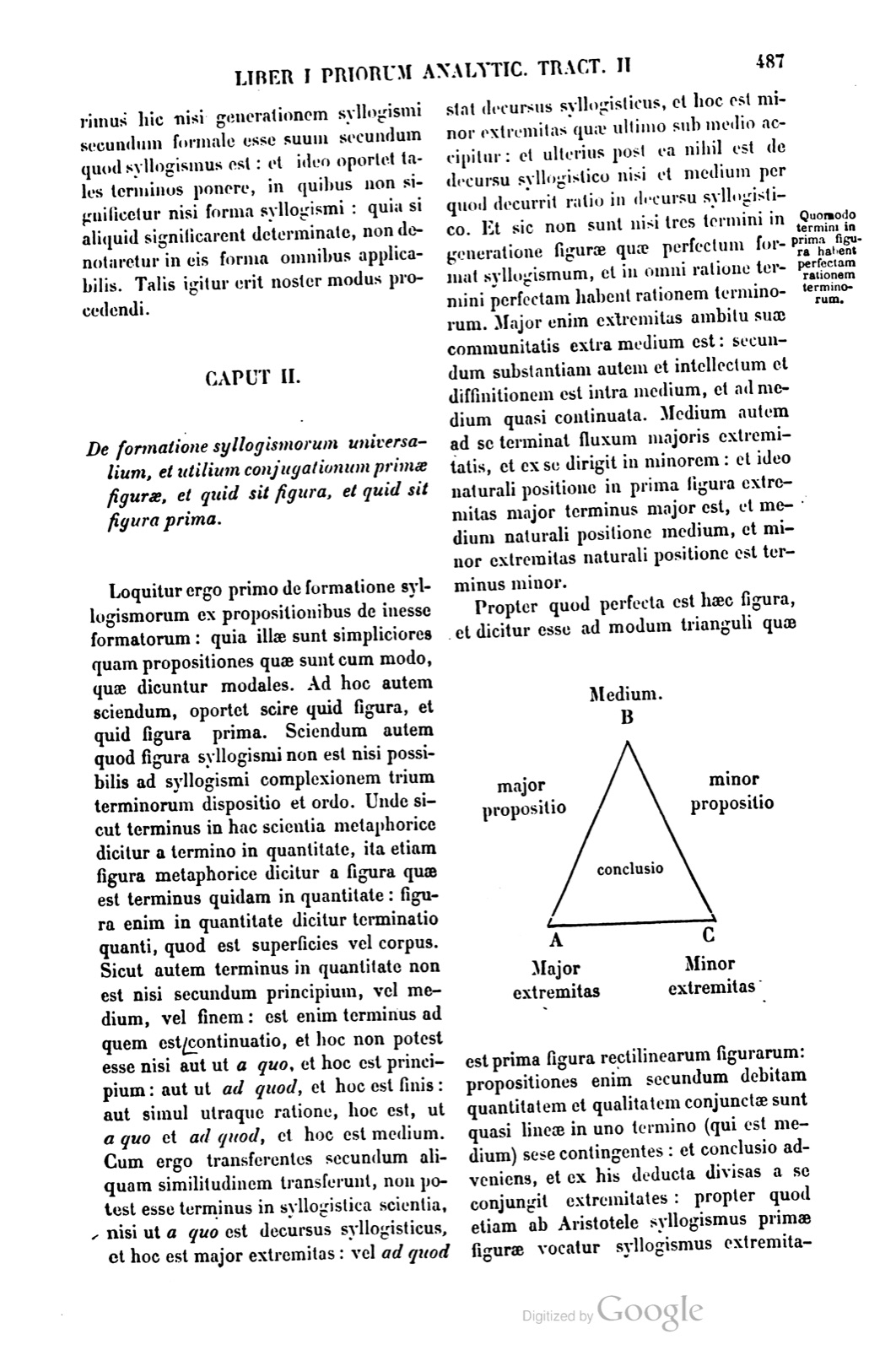
Loquitur ergo primo de formatione syllogismorum ex propositionibus de inesse formatorum: quia illae sunt simpliciores quam propositiones quae sunt cum modo, quae dicuntur modales. Ad hoc autem sciendum, oportet scire quid figura, et quid figura prima. Sciendum autem quod figura syllogismi non est nisi possibilis ad syllogismi complexionem trium terminorum dispositio et ordo. Unde sicut terminus in hac scientia metaphorice dicitur a termino in quantitate, ita etiam figura metaphorice dicitur a figura quae est terminus quidam in quantitate: figura enim in quantitate dicitur terminatio quanti, quod est superficies vel corpus. Sicut autem terminus in quantitate non est nisi secundum principium, vel medium, vel finem: est enim terminus ad quem est continuatio, et hoc non potest esse nisi aut ut a quo, et hoc est principium: aut ut ad quod, et hoc est finis: aut simul utraque ratione, hoc est, ut a quo et ad quod, et hoc est medium. Cum ergo transferentes secundum aliquam similitudinem transferunt, non potest esse terminus in syllogistica scientia, nisi ut a quo est decursus syllogisticus, et hoc est major extremitas: vel ad quod stat decursus syllogisticus, et hoc est minor extremitas quae ultimo sub medio accipitur: et ulterius post ea nihil est de decursu syllogistico nisi et medium per quod decurrit ratio in decursu syllogistico. Et sic non sunt nisi tres termini in generatione figurae quae perfectum format syllogismum, et in omni ratione termini perfectam habent rationem terminorum. Major enim extremitas ambitu suae communitatis extra medium est: secundum substantiam autem et intellectum et diffinitionem est intra medium, et ad medium quasi continuata. Medium autem ad se terminat fluxum majoris extremitatis, et ex se dirigit in minorem: et ideo naturali positione in prima figura major extremitas major est, et medium naturali positione medium, et minor extremitas naturali positione est terminus minor.
Propter quod perfecta est haec figura, et dicitur esse ad modum trianguli quae est prima figura rectilinearum figurarum: propositiones enim secundum debitam quantitatem et qualitatem conjunctae sunt quasi lineae in uno termino (qui est medium) sese contingentes: et conclusio adveniens, et ex his deducta, divisas a se conjungit extremitates: propter quod etiam ab Aristotele syllogismus primae figurae vocatur syllogismus extremitatum1. Haec igitur est figurae ratio et terminorum et similitudo translationis.
CHAPTER II. On the formation of universal syllogisms and of the useful conjugations of the first figure, and what figure is, and what the first figure is.
Therefore he first speaks about the formation of syllogisms formed from propositions of inherence, because those are simpler than propositions which are with a mode, which are called modals. But in order to know this, one must know what a figure is and what the first figure is. One must know that the figure of a syllogism is nothing except the disposition and order of three terms possible for the complexion of a syllogism. Hence just as a term in this science is said metaphorically from a term in quantity, so also figure is said metaphorically from a figure which is a certain term in quantity; for figure in quantity is called the termination of a quantum, which is a surface or a body. But just as a term in quantity exists only according to beginning, or middle, or end, for it is a term to which continuation belongs, and this cannot be except either as that from which, and this is a beginning; or as that to which, and this is an end; or with both accounts at once, that is, as that from which and that to which, and this is a middle. Therefore, since those who transfer do so according to some likeness, there cannot be a term in syllogistic science except as that from which there is syllogistic running-through, and this is the greater extreme; or as that to which the syllogistic running-through stands, and this is the lesser extreme, which is taken last under the middle; and beyond these there is nothing in the syllogistic running-through except also the middle through which reason runs through in the syllogistic running-through. And thus there are only three terms in the generation of the figure which forms a perfect syllogism, and in every account of a term they have the perfect account of terms. For the greater extreme, by the scope of its community, is outside the middle; but according to substance and understanding and definition it is within the middle and as it were continuous with the middle. But the middle terminates in itself the flow of the greater extreme, and from itself directs it into the lesser; and therefore, in natural position in the first figure, the greater extreme is the greater, the middle is middle by natural position, and the lesser extreme is the lesser term by natural position.
On account of this, this figure is perfect and is said to be after the manner of a triangle, which is the first figure of rectilinear figures: for propositions joined according to due quantity and quality are like lines touching one another in one term (which is the middle); and the conclusion, coming upon them and deduced from these, joins the extremes divided from one another; on account of which even by Aristotle the syllogism of the first figure is called the syllogism of extremes1. This, therefore, is the account of figure and of terms, and the likeness of the transference.
Si quis autem objiciat quod secundum duplicem vel multiplicem situm medii deberet prima figura in duas vel plures dividi, quia medium potest primo subjici et postea praedicari, et e contra potest primo praedicari et postea subjici: vel, ut melius dicatur, potest primo accipi major extremitas sub medio, et minor ante medium, et adhuc potest accipi secundum distantiam aequalem medium inter extrema, et secundum distantiam inaequalem: et sic septem modis disponitur medium inter extrema, ut docet Aristoteles in libro de sensu et sensato: et sic etiam inter extrema syllogistica multiplex medii dispositio multiplicem deberet facere figuram, ut videtur. Respondendum est quod medium rationis in decursu syllogistico non habet similitudinem ad medium in motu, qui est de extremo in extremum per medium, nisi in genere, in hoc scilicet, quod medium est quod est inter extrema: quia illud in decursu rationis sub alio accipitur, et aliud accipitur sub ipso: et ideo ulteriorem in hac dispositione non potest facere figurae multiplicitatem: propter quod haec figura ulterius non habet figuram, sed per dispositionem terminorum in figura complexionatur in modos. Et sic termini et propositiones sunt syllogismorum materia, termini quidem materia remota, propositiones autem propinqua, et figura forma est syllogismi remota, et modus forma syllogismi propinqua.
His autem sic determinatis, sciendum quod in tali dispositione terminorum et propositionum complexione sedecim resultant combinationes sive conjugationes secundum quantitates et qualitates propositionum provenientes. Si enim medium majori subjicitur, et de minori praedicatur: aut erunt ambae propositiones universales, aut ambae particulares, aut una universalis et altera particularis, hoc est duobus modis: quia aut major erit universalis et minor particularis, aut e converso major particularis, et minor universalis: quae sunt quatuor acceptae secundum complexionem quantitatis, quarum si per affirmationem et negationem quaelibet multiplicatur in quatuor, fiunt in universo sedecim conjugationes sic. Si enim ambae sint universales: aut erunt ambae affirmativae, aut ambae negativae, aut major affirmativa et minor negativa, aut e converso major negativa et minor affirmativa: et istae sunt quatuor conjugationes. Si autem ambae sunt particulares, iterum quatuor conjugationes resultabunt: quia aut erunt ambae affirmativae aut ambae negativae, aut major negativa et minor affirmativa, aut e converso major affirmativa et minor negativa: et sic fiunt octo conjugationes. Si autem una sit universalis et altera particularis, et major sit universalis et minor particularis, iterum resultant quatuor conjugationes: quia aut ambae affirmativae, aut ambae negativae, aut una negativa et altera affirmativa: et hoc erit duobus modis, scilicet quod major sit negativa et minor affirmativa, aut e converso: et sic fiunt duodecim conjugationes. Si autem minor sit universalis et major particularis, secundum eumdem quatuor resultabunt conjugationes secundum hoc quod vel ambae sunt affirmativae, vel ambae negativae, vel universalis affirmativa et particularis negativa, vel e converso particularis affirmativa et universalis negativa. Et sic patet quod sedecim erunt conjugationes, ex quibus quatuor erunt utiles, et duodecim inutiles.
But if someone objects that according to the twofold or manifold position of the middle the first figure ought to be divided into two or more figures, because the middle can first be subjected and afterward predicated, and conversely it can first be predicated and afterward subjected; or, to speak better, the greater extreme can first be taken under the middle and the lesser before the middle, and moreover the middle can be taken according to equal distance between the extremes and according to unequal distance; and thus the middle is disposed in seven ways among the extremes, as Aristotle teaches in the book On Sense and the Sensible; and thus also among syllogistic extremes a manifold disposition of the middle would seem to have to make a manifold figure. One must answer that the middle of reason in syllogistic running-through does not have a likeness to the middle in motion, which is from extreme to extreme through a middle, except in genus, namely in this, that the middle is what is between the extremes; because in the running-through of reason that is taken under another, and another is taken under it; and therefore in this disposition it cannot make a further multiplicity of figure. On account of this, this figure does not further have a figure, but through the disposition of terms in a figure it is complexioned into modes. And thus terms and propositions are the matter of syllogisms, terms indeed the remote matter, but propositions the proximate matter; and figure is the remote form of syllogism, and mode the proximate form of syllogism.
With these things thus determined, one must know that in such a disposition of terms and complexion of propositions sixteen combinations or conjugations result, proceeding according to the quantities and qualities of the propositions. For if the middle is subjected to the greater and predicated of the lesser, either both propositions will be universal, or both particular, or one universal and the other particular, that is, in two ways: because either the major will be universal and the minor particular, or conversely the major particular and the minor universal. These are four when taken according to the complexion of quantity; and if each of these is multiplied into four through affirmation and negation, in the whole there are sixteen conjugations in this way. For if both are universal, either both will be affirmative, or both negative, or the major affirmative and the minor negative, or conversely the major negative and the minor affirmative; and these are four conjugations. But if both are particular, again four conjugations will result, because either both will be affirmative or both negative, or the major negative and the minor affirmative, or conversely the major affirmative and the minor negative; and thus there are eight conjugations. But if one is universal and the other particular, and the major is universal and the minor particular, again four conjugations result, because either both are affirmative, or both negative, or one negative and the other affirmative; and this will be in two ways, namely that the major is negative and the minor affirmative, or conversely; and thus there are twelve conjugations. But if the minor is universal and the major particular, according to the same account four conjugations will result according as either both are affirmative, or both negative, or the universal affirmative and particular negative, or conversely the particular affirmative and universal negative. And thus it is clear that there will be sixteen conjugations, of which four will be useful and twelve useless.
Quando igitur tres termini in duabus propositionibus sic se habeant secundum positionem et ordinem ad invicem, ut et postremus qui est minor extremitas, et subjectum in minori propositione sit in toto medio: et medius secundum eamdem positionem, sit in toto primo, qui est major extremitas: et praedicatum in prima propositione sive sit, sive non sit, hoc est, sive secundum affirmationem sive secundum negationem propositionum, necesse est in dispositione tali perfectum esse syllogismum extremitatum, hoc est, qui majorem extremitatem concludit de minori extremitate. Et hoc est in prima figura, in qua medium vere medium est, et extremitates sunt vere extremitates. In aliis autem medium et extrema non habent perfectam medii et extremorum rationem: et ideo in illis figuris non perfecte fit syllogismus extremitatum. Quid autem sit in toto esse, per antecedentia est manifestum: quia in toto esse est de omni praedicari. Ponamus enim tres terminos sic dispositos, animal, homo, risibile: animal enim in toto est medio, hoc est, homine, quia universaliter de omni homine praedicatur: et homo in toto est extremo, quia homo de omni risibili praedicatur.
Et si quis objiciat quod si medium in toto sit postremo, et majus in toto sit medio, tunc ex paribus et convertibilibus nunquam fit syllogismus in prima figura, quod falsum est, cum potissima demonstrationum sit ista quae fit ex convertibilibus: et hoc patet sic syllogizando, quod omnis homo est animal rationale mortale: omne risibile homo; ergo omne risibile animal rationale mortale. Ad hoc autem jam per dicta patet solutio: quia in toto esse est de omni parte ejus praedicari: et tunc tam ex convertibilibus, quam non convertibilibus quae universaliter praedicantur, fit syllogismus. Dicunt tamen aliqui, quod duplex est praedicatum, scilicet praedicatum materiale et praedicatum formale: qualecumque enim praedicatum sit materialiter, semper formaliter praedicatum est in toto subjecto: et hoc modo etiam paria et convertibilia praedicata in quantum praedicata sunt, communiora sunt in suis subjectis. Prima autem responsio melior et magis ad propositum secundum istius scientiae proprietatem.
Therefore when three terms in two propositions have themselves in position and order to one another in such a way that both the last, which is the lesser extreme and the subject in the minor proposition, is in the whole middle, and the middle, according to the same position, is in the whole first, which is the greater extreme; and whether the predicate in the first proposition is or is not, that is, whether according to affirmation or according to negation of the propositions, in such a disposition there must be a perfect syllogism of extremes, that is, one which concludes the greater extreme of the lesser extreme. And this is in the first figure, in which the middle is truly middle and the extremes are truly extremes. But in the other figures the middle and the extremes do not have the perfect account of middle and extremes; and therefore in those figures a syllogism of extremes is not perfectly made. But what "to be in the whole" is is manifest through the preceding matters, because to be in the whole is to be predicated of every one. For let us posit three terms disposed in this way: animal, man, risible. For animal is in the whole middle, that is, in man, because it is predicated universally of every man; and man is in the whole extreme, because man is predicated of every risible.
And if someone objects that, if the middle is in the whole last and the greater is in the whole middle, then a syllogism is never made in the first figure from equals and convertibles, which is false, since the most powerful of demonstrations is the one that is made from convertibles; and this is clear by syllogizing thus: every man is a mortal rational animal; every risible is man; therefore every risible is a mortal rational animal. To this, however, the solution is now clear through what has been said, because being in the whole is being predicated of every part of it; and then a syllogism is made both from convertibles and from non-convertibles that are predicated universally. Yet some say that there is a twofold predicate, namely a material predicate and a formal predicate; for whatever the predicate may be materially, formally a predicate is always in the whole subject; and in this way even equal and convertible predicates, insofar as they are predicates, are more common in their subjects. But the first response is better and more to the point according to the proper character of this science.
Voco autem medium per metaphoram superius inductam, quod et ipsum in alio est ut majori, et aliud in ipso est ut minus: contentum enim secundum ambitum praedicationis semper minus est quam continens, et totum est in continente: hoc enim in tali figura dispositionis terminorum etiam positionis ordine fit medium, quia inter extrema secundum ambitum praedicationis constitutum. Extrema vero voco hoc quod et ipsum in alio et aliud in ipso est, hoc est, quorum unum est in alio contentum per praedicationis ambitum sicut minus extremum est in medio, et sicut majus extremum in quo est medium secundum ambitum praedicationis.
Sic autem formantur duo modi syllogismorum universalium secundum utiles conjugationes, una secundum esse affirmatum, et altera secundum esse negatum. Si enim A de omni B praedicetur, et B praedicetur de omni C, necesse est A de omni C praedicari, sic, omne B est A, omne C est B, ergo omne C est A. Et hic est modus primus confirmatus per hoc quod dicitur in Praedicamentis, quando alterum de altero praedicatur ut de subjecto, quaecumque de praedicato dicuntur, eadem de subjecto dici necesse est. In ante habitis autem prius dictum est, quomodo dicimus aliquid de omni praedicari. Similiter autem formatur syllogismus secundus secundum non esse sive secundum negativam conclusionem sic: si enim A de nullo B praedicatur, et ab eo universaliter negatur major extremitas de medio, B autem praedicatur de omni C, medium scilicet de minori extremitate, sequitur quoniam A nulli C inerit, sic, nullum B est A, omne C est B, ergo nullum C est A. Et confirmatur per eamdem quae dicta est regulam: quando enim alterum praedicatur de altero ut de subjecto, quaecumque negantur de praedicato, necesse est eadem de subjecto negari: et ideo quia medium est praedicatum consequens ad minorem extremitatem, necesse est quod major extremitas quae negatur de medio, negetur etiam de minori extremitate. Istae ergo sunt utiles et universales conjugationes primae figurae.
Now I call the middle, through the metaphor introduced above, that which is itself in another as in a greater, and another is in it as in a lesser; for what is contained according to the scope of predication is always less than what contains, and the whole is in the container. For in such a figure of the disposition of terms it becomes a middle also by the order of position, because it is constituted between the extremes according to the scope of predication. But I call extremes that of which both one itself is in another and another is in it, that is, those of which one is contained in another through the scope of predication, as the lesser extreme is in the middle, and as the greater extreme is that in which the middle is according to the scope of predication.
Thus, however, two modes of universal syllogisms are formed according to useful conjugations, one according to affirmed being and the other according to negated being. For if A is predicated of every B, and B is predicated of every C, A must be predicated of every C, thus: every B is A; every C is B; therefore every C is A. And this is the first mode, confirmed through what is said in the Categories: when one thing is predicated of another as of a subject, whatever is said of the predicate must likewise be said of the subject. But it was said earlier in what has gone before how we say that something is predicated of every one. Similarly, the second syllogism is formed according to non-being or according to a negative conclusion in this way: for if A is predicated of no B, and the greater extreme is universally denied of the middle by it, but B is predicated of every C, namely the middle of the lesser extreme, it follows that A will belong to no C, thus: no B is A; every C is B; therefore no C is A. And it is confirmed through the same rule which was stated: for when one thing is predicated of another as of a subject, whatever is denied of the predicate must likewise be denied of the subject. And therefore, because the middle is the consequent predicate with respect to the lesser extreme, it is necessary that the greater extreme which is denied of the middle also be denied of the lesser extreme. Therefore these are the useful and universal conjugations of the first figure.
Notes
- The syllogism of the first figure is also called the syllogism of extremes, because in it the extremes are concluded of one another, and they are true extremes, since in it alone there is also truly a middle; and this cause is assigned a little below in this chapter. (Dicitur etiam syllogismus primae figurae syllogismus extremitatum: quia in eo concluduntur extrema de se invicem, quae sunt vere extrema, cum in ea sola sit etiam vere medium: et haec causa assignatur parum infra in hoc capitulo.) ↩
If a page does not appear, its photograph has not been uploaded yet.