Works › On Interpretation, Books I–II
Volume 1 · pp. 451–453
Chapter VI. On The Distinction Of The Possible, And On The Difference Between The Possible And The Contingent.
A marker with ≈ is an approximate page boundary, placed by measure of the text; the page photographs remain the authority. In the paired views, clicking a page marker brings that page into view.
CAPUT VI. De distinctione possibilis, et de differentia possibilis et contingentis.
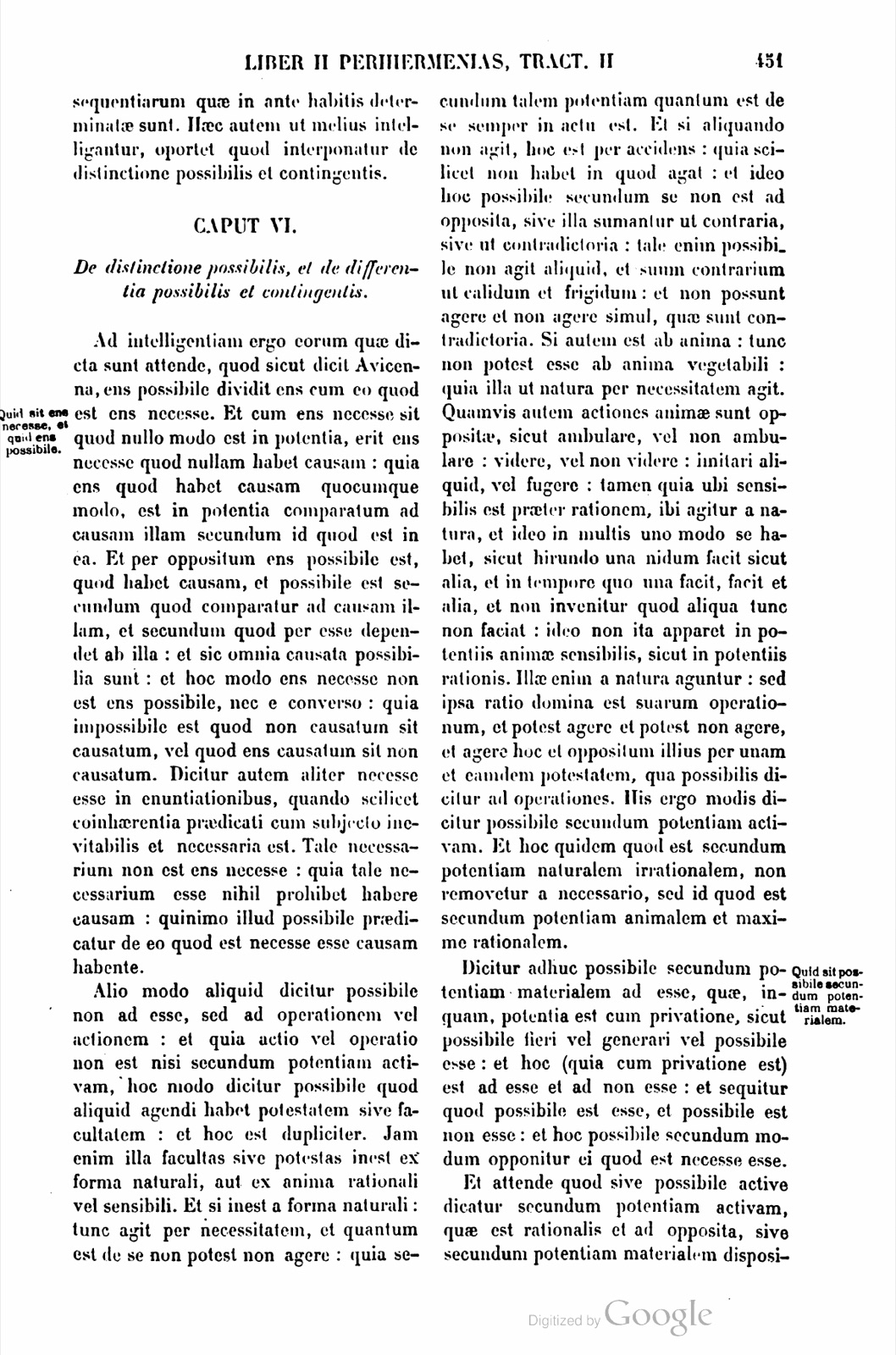
Ad intelligentiam ergo eorum quae dicta sunt attende, quod sicut dicit Avicenna, ens possibile dividit ens cum eo quod est ens necesse. Et cum ens necesse sit quod nullo modo est in potentia, erit ens necesse quod nullam habet causam: quia ens quod habet causam quocumque modo, est in potentia comparatum ad causam illam secundum id quod est in ea. Et per oppositum ens possibile est, quod habet causam, et possibile est secundum quod comparatur ad causam illam, et secundum quod per esse dependet ab illa: et sic omnia causata possibilia sunt: et hoc modo ens necesse non est ens possibile, nec e converso: quia impossibile est quod non causatum sit causatum, vel quod ens causatum sit non causatum. Dicitur autem aliter necesse esse in enuntiationibus, quando scilicet coinhaerentia praedicati cum subjecto inevitabilis et necessaria est. Tale necessarium non est ens necesse: quia tale necessarium esse nihil prohibet habere causam: quinimo illud possibile praedicatur de eo quod est necesse esse causam habente.
### Marginal Labels - 451: Quid sit ens necesse, et quid ens possibile.
Alio modo aliquid dicitur possibile non ad esse, sed ad operationem vel actionem: et quia actio vel operatio non est nisi secundum potentiam activam, hoc modo dicitur possibile quod aliquid agendi habet potestatem sive facultatem: et hoc est dupliciter. Jam enim illa facultas sive potestas inest ex forma naturali, aut ex anima rationali vel sensibili. Et si inest a forma naturali: tunc agit per necessitatem, et quantum est de se non potest non agere: quia secundum talem potentiam quantum est de se semper in actu est. Et si aliquando non agit, hoc est per accidens: quia scilicet non habet in quod agat: et ideo hoc possibile secundum se non est ad opposita, sive illa sumantur ut contraria, sive ut contradictoria: tale enim possibile non agit aliquid, et suum contrarium ut calidum et frigidum: et non possunt agere et non agere simul, quae sunt contradictoria. Si autem est ab anima: tunc non potest esse ab anima vegetabili: quia illa ut natura per necessitatem agit. Quamvis autem actiones animae sunt oppositae, sicut ambulare, vel non ambulare: videre, vel non videre: imitari aliquid, vel fugere: tamen quia ubi sensibilis est praeter rationem, ibi agitur a natura, et ideo in multis uno modo se habet, sicut hirundo una nidum facit sicut alia, et in tempore quo una facit, facit et alia, et non invenitur quod aliqua tunc non faciat: ideo non ita apparet in potentiis animae sensibilis, sicut in potentiis rationis. Illae enim a natura aguntur: sed ipsa ratio domina est suarum operationum, et potest agere et potest non agere, et agere hoc et oppositum illius per unam et eamdem potestatem, qua possibilis dicitur ad operationes. His ergo modis dicitur possibile secundum potentiam activam. Et hoc quidem quod est secundum potentiam naturalem irrationalem, non removetur a necessario, sed id quod est secundum potentiam animalem et maxime rationalem.
### Marginal Labels - 451: Quid sit possibile secundum potentiam materialem.
Dicitur adhuc possibile secundum potentiam materialem ad esse, quae, inquam, potentia est cum privatione, sicut possibile fieri vel generari vel possibile esse: et hoc (quia cum privatione est) est ad esse et ad non esse: et sequitur quod possibile est esse, et possibile est non esse: et hoc possibile secundum modum opponitur ei quod est necesse esse.
CHAPTER VI. On the distinction of the possible, and on the difference between the possible and the contingent.
Therefore, for the understanding of those things which have been said, attend that, as Avicenna says, possible being divides being with that which is necessary being. And since necessary being is that which is in no way in potency, necessary being will be what has no cause, because being which has a cause in any way is in potency compared to that cause according to that which is in it. And by opposition possible being is what has a cause, and it is possible according as it is compared to that cause and according as, through being, it depends on it; and thus all caused things are possible. And in this way necessary being is not possible being, nor conversely, because it is impossible that the uncaused be caused, or that caused being be uncaused. But necessary to be is said otherwise in enunciations, namely when the co-inherence of predicate with subject is inevitable and necessary. Such a necessary is not necessary being, because nothing prevents such necessary being from having a cause; indeed that possible is predicated of that which is necessary to be while having a cause.
### Marginal Labels - 451: What necessary being is, and what possible being is.
In another way something is called possible not with respect to being but with respect to operation or action; and because action or operation is only according to active potency, in this way that is called possible which has a power or faculty of doing something; and this is twofold. For that faculty or power already belongs either from a natural form or from a rational or sensitive soul. And if it belongs from a natural form, then it acts through necessity and, so far as it is of itself, cannot not act, because according to such a potency, so far as it is of itself, it is always in act. And if at some time it does not act, this is by accident, namely because it does not have something on which it may act; and therefore this possible, according to itself, is not toward opposites, whether those are taken as contraries or as contradictories. For such a possible does not act something and its contrary, as hot and cold; and those things which are contradictories cannot act and not act together. But if it is from soul, then it cannot be from the vegetative soul, because that acts as nature through necessity. But although the actions of sensitive soul are opposed, as to walk or not to walk, to see or not to see, to pursue something or flee, nevertheless because where the sensitive is apart from reason, there action is done by nature, and therefore in many things it has itself in one way, as one swallow makes a nest as another does, and in the time in which one makes it, another also makes it, and it is not found that any one then does not make it. Therefore it does not so appear in the potencies of the sensitive soul as in the potencies of reason. For those are acted by nature; but reason itself is mistress of its operations, and can act and can not act, and can do this and the opposite of it by one and the same power by which it is called possible with respect to operations. Therefore in these ways possible is said according to active potency. And that which is according to natural irrational potency is not removed from the necessary, but that which is according to animal potency and especially rational potency is removed.
### Marginal Labels - 451: What possible according to material potency is.
Possible is further said according to material potency toward being, which potency, I say, is with privation, as possible to come to be or to be generated or possible to be; and this, because it is with privation, is toward being and toward not-being, and it follows that it is possible to be and possible not to be. And this possible according to mode is opposed to that which is necessary to be.
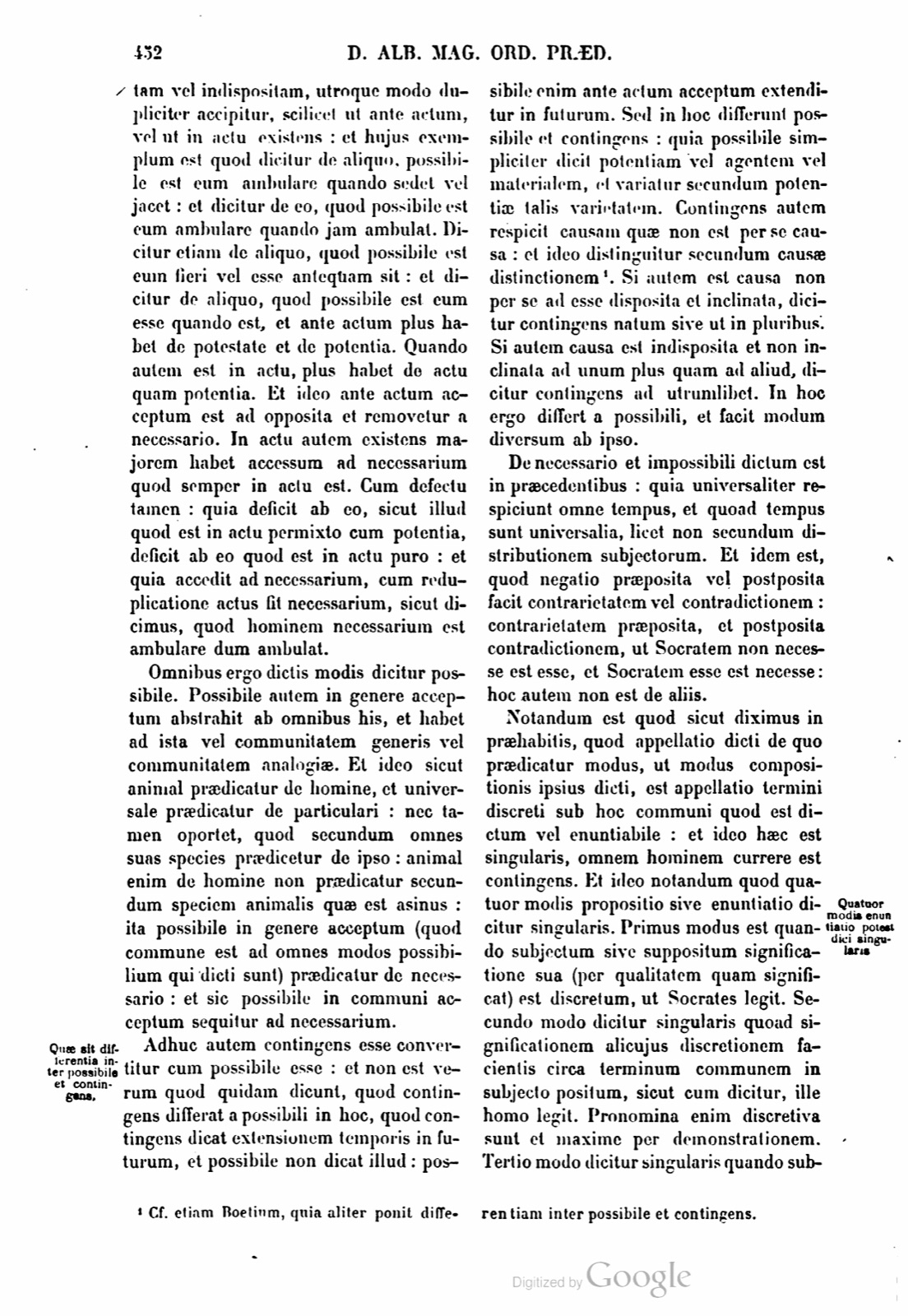
Et attende quod sive possibile active dicatur secundum potentiam activam, quae est rationalis et ad opposita, sive secundum potentiam materialem dispositam vel indispositam, utroque modo dupliciter accipitur, scilicet ut ante actum, vel ut in actu existens: et hujus exemplum est quod dicitur de aliquo, possibile est eum ambulare quando sedet vel jacet: et dicitur de eo, quod possibile est eum ambulare quando jam ambulat. Dicitur etiam de aliquo, quod possibile est eum fieri vel esse antequam sit: et dicitur de aliquo, quod possibile est cum esse quando est, et ante actum plus habet de potestate et de potentia. Quando autem est in actu, plus habet de actu quam potentia. Et ideo ante actum acceptum est ad opposita et removetur a necessario. In actu autem existens majorem habet accessum ad necessarium quod semper in actu est. Cum defectu tamen: quia deficit ab eo, sicut illud quod est in actu permixto cum potentia, deficit ab eo quod est in actu puro: et quia accedit ad necessarium, cum reduplicatione actus fit necessarium, sicut dicimus, quod hominem necessarium est ambulare dum ambulat.
Omnibus ergo dictis modis dicitur possibile. Possibile autem in genere acceptum abstrahit ab omnibus his, et habet ad ista vel communitatem generis vel communitatem analogiae. Et ideo sicut animal praedicatur de homine, et universale praedicatur de particulari: nec tamen oportet, quod secundum omnes suas species praedicetur de ipso: animal enim de homine non praedicatur secundum speciem animalis quae est asinus: ita possibile in genere acceptum (quod commune est ad omnes modos possibilium qui dicti sunt) praedicatur de necessario: et sic possibile in communi acceptum sequitur ad necessarium.
### Marginal Labels - 452: Quae sit differentia inter possibile et contingens.
Adhuc autem contingens esse convertitur cum possibile esse: et non est verum quod quidam dicunt, quod contingens differat a possibili in hoc, quod contingens dicat extensionem temporis in futurum, et possibile non dicat illud: possibile enim ante actum acceptum extenditur in futurum. Sed in hoc differunt possibile et contingens: quia possibile simpliciter dicit potentiam vel agentem vel materialem, et variatur secundum potentiae talis varietatem. Contingens autem respicit causam quae non est per se causa: et ideo distinguitur secundum causae distinctionem1. Si autem est causa non per se ad esse disposita et inclinata, dicitur contingens natum sive ut in pluribus. Si autem causa est indisposita et non inclinata ad unum plus quam ad aliud, dicitur contingens ad utrumlibet. In hoc ergo differt a possibili, et facit modum diversum ab ipso.
De necessario et impossibili dictum est in praecedentibus: quia universaliter respiciunt omne tempus, et quoad tempus sunt universalia, licet non secundum distributionem subjectorum. Et idem est, quod negatio praeposita vel postposita facit contrarietatem vel contradictionem: contrarietatem praeposita, et postposita contradictionem, ut Socratem non necesse est esse, et Socratem esse est necesse: hoc autem non est de aliis.
And attend that whether possible is said actively according to active potency, which is rational and toward opposites, or according to material potency, disposed or indisposed, in each way it is taken in two ways, namely as before act or as existing in act. And the example of this is what is said about someone: it is possible for him to walk when he sits or lies down; and it is said about him that it is possible for him to walk when he already walks. It is also said about something that it is possible for it to come to be or be before it is; and it is said about something that it is possible to be when it is. And before act it has more of power and of potency. But when it is in act, it has more of act than of potency. And therefore, taken before act, it is toward opposites and is removed from the necessary. But existing in act it has a greater access to the necessary, which is always in act. Yet with a defect, because it falls short of it, as that which is in act mixed with potency falls short of that which is in pure act; and because it approaches the necessary, with reduplication of act it becomes necessary, as we say that it is necessary for man to walk while he walks.
Therefore possible is said in all the aforesaid ways. But possible, taken in genus, abstracts from all these and has toward them either community of genus or community of analogy. And therefore, just as animal is predicated of man, and universal is predicated of particular, yet it is not necessary that according to all its species it be predicated of him, for animal is not predicated of man according to the species of animal which is ass; so possible taken in genus, which is common to all the modes of possibles that have been stated, is predicated of the necessary, and thus possible taken in common follows upon the necessary.
### Marginal Labels - 452: What the difference is between possible and contingent.
Moreover, contingent to be is converted with possible to be; and it is not true what certain persons say, that contingent differs from possible in this, that contingent states an extension of time into the future and possible does not state this. For possible taken before act is extended into the future. But possible and contingent differ in this: because possible simply states potency, either agent or material, and is varied according to the variety of such potency. But contingent looks to a cause which is not a cause per se, and therefore it is distinguished according to the distinction of the cause1. But if it is a cause not per se disposed and inclined to being, it is called contingent by nature or as in more cases. But if the cause is indisposed and not inclined to one thing more than to another, it is called contingent to either alternative. In this therefore it differs from possible and makes a mode diverse from it.
It has been said in the preceding matters about the necessary and the impossible, because they universally regard every time, and with respect to time they are universal, although not according to the distribution of subjects. And it is the same that negation put before or put after makes contrariety or contradiction: when put before, contrariety; and when put after, contradiction, as "for Socrates not to be is necessary" and "for Socrates to be is necessary." But this is not the case with the others.
### Marginal Labels - 452: Quatuor modis enuntiatio potest dici singularis.
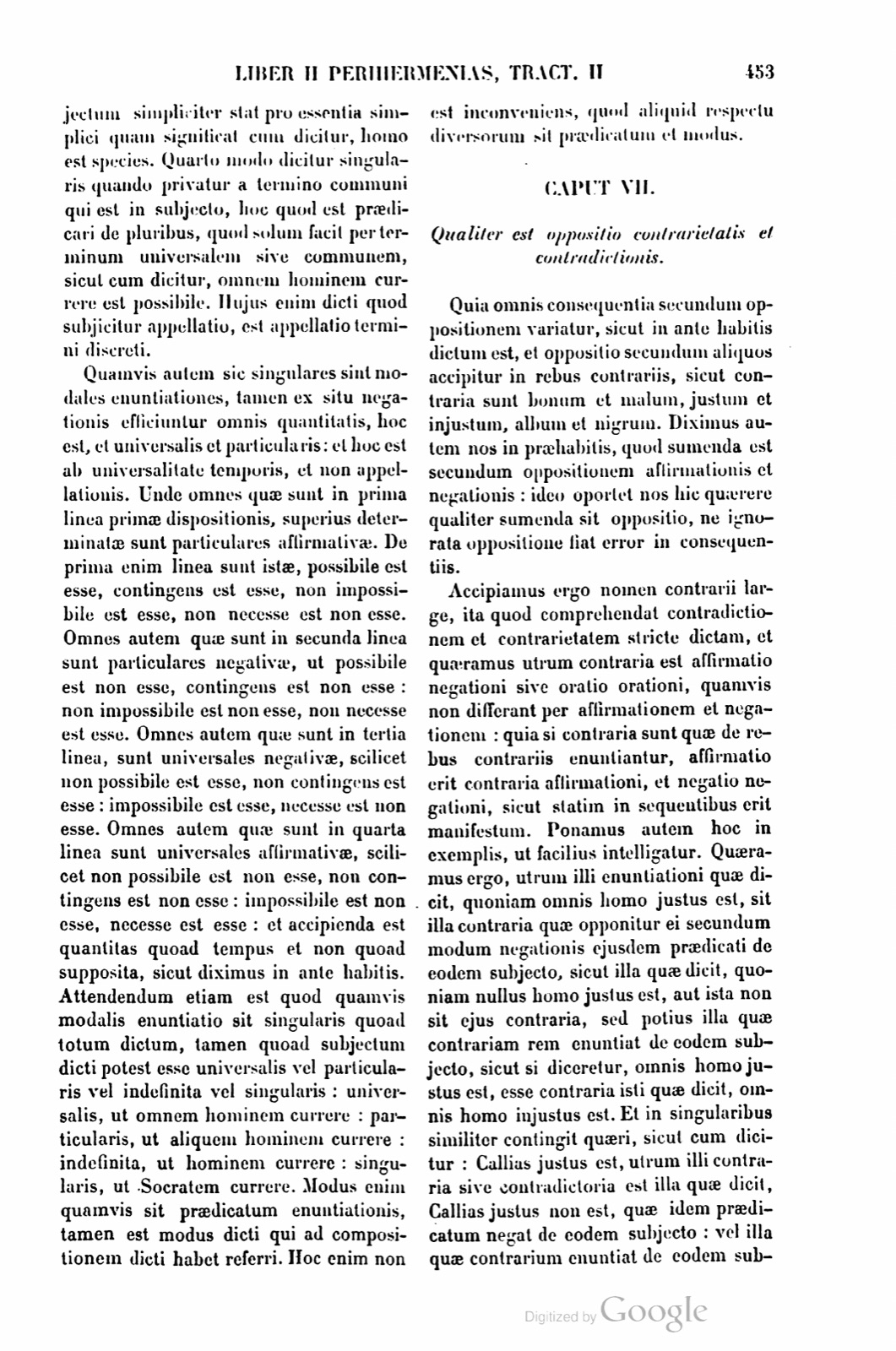
Notandum est quod sicut diximus in praehabitis, quod appellatio dicti de quo praedicatur modus, ut modus compositionis ipsius dicti, est appellatio termini discreti sub hoc communi quod est dictum vel enuntiabile: et ideo haec est singularis, omnem hominem currere est contingens. Et ideo notandum quod quatuor modis propositio sive enuntiatio dicitur singularis. Primus modus est quando subjectum sive suppositum significatione sua (per qualitatem quam significat) est discretum, ut Socrates legit. Secundo modo dicitur singularis quoad significationem alicujus discretionem facientis circa terminum communem in subjecto positum, sicut cum dicitur, ille homo legit. Pronomina enim discretiva sunt et maxime per demonstrationem. Tertio modo dicitur singularis quando subjectum simpliciter stat pro essentia simplici quam significat cum dicitur, homo est species. Quarto modo dicitur singularis quando privatur a termino communi qui est in subjecto, hoc quod est praedicari de pluribus, quod solum facit per terminum universalem sive communem, sicut cum dicitur, omnem hominem currere est possibile. Hujus enim dicti quod subjicitur appellatio, est appellatio termini discreti.
Quamvis autem sic singulares sint modales enuntiationes, tamen ex situ negationis efficiuntur omnis quantitatis, hoc est, et universalis et particularis: et hoc est ab universalitate temporis, et non appellationis. Unde omnes quae sunt in prima linea primae dispositionis, superius determinatae sunt particulares affirmativae. De prima enim linea sunt istae, possibile est esse, contingens est esse, non impossibile est esse, non necesse est non esse. Omnes autem quae sunt in secunda linea sunt particulares negativae, ut possibile est non esse, contingens est non esse: non impossibile est non esse, non necesse est esse. Omnes autem quae sunt in tertia linea, sunt universales negativae, scilicet non possibile est esse, non contingens est esse: impossibile est esse, necesse est non esse. Omnes autem quae sunt in quarta linea sunt universales affirmativae, scilicet non possibile est non esse, non contingens est non esse: impossibile est non esse, necesse est esse: et accipienda est quantitas quoad tempus et non quoad supposita, sicut diximus in ante habitis. Attendendum etiam est quod quamvis modalis enuntiatio sit singularis quoad totum dictum, tamen quoad subjectum dicti potest esse universalis vel particularis vel indefinita vel singularis: universalis, ut omnem hominem currere: particularis, ut aliquem hominem currere: indefinita, ut hominem currere: singularis, ut Socratem currere. Modus enim quamvis sit praedicatum enuntiationis, tamen est modus dicti qui ad compositionem dicti habet referri. Hoc enim non est inconveniens, quod aliquid respectu diversorum sit praedicatum et modus.
### Marginal Labels - 452: In four ways an enunciation can be called singular.
It must be noted that, as we said in the preceding matters, the appellation of the dictum of which the mode is predicated as mode of the composition of that dictum is the appellation of a discrete term under this common thing which is dictum or enunciable; and therefore this is singular: "that every man runs is contingent." And therefore it must be noted that a proposition or enunciation is called singular in four ways. The first way is when the subject or suppositum by its signification, through the quality which it signifies, is discrete, as "Socrates reads." In a second way it is called singular with respect to the signification of something causing discreteness around a common term placed in the subject, as when it is said, "that man reads." For pronouns are discretive and especially through demonstration. In a third way it is called singular when the subject simply stands for the simple essence which it signifies, as when it is said, "man is a species." In a fourth way it is called singular when from the common term which is in the subject there is deprived that which is to be predicated of many, which it does only through a universal or common term, as when it is said, "that every man runs is possible." For the appellation of this dictum which is subjected is the appellation of a discrete term.
But although modal enunciations are singular in this way, nevertheless from the position of negation they are made of every quantity, that is, both universal and particular; and this is from universality of time, and not of appellation. Hence all those which are in the first line of the first arrangement determined above are particular affirmatives. For of the first line there are these: possible to be, contingent to be, not impossible to be, not necessary not to be. But all those which are in the second line are particular negatives, as possible not to be, contingent not to be, not impossible not to be, not necessary to be. But all those which are in the third line are universal negatives, namely not possible to be, not contingent to be, impossible to be, necessary not to be. But all those which are in the fourth line are universal affirmatives, namely not possible not to be, not contingent not to be, impossible not to be, necessary to be; and quantity must be taken with respect to time and not with respect to supposita, as we said in the preceding matters. One must also attend that although a modal enunciation is singular with respect to the whole dictum, nevertheless with respect to the subject of the dictum it can be universal or particular or indefinite or singular: universal, as "that every man runs"; particular, as "that some man runs"; indefinite, as "that man runs"; singular, as "that Socrates runs." For although the mode is the predicate of the enunciation, nevertheless it is the mode of the dictum which has to be referred to the composition of the dictum. For it is not inconvenient that something with respect to diverse things be predicate and mode.
Notes
- Compare Boethius also, because he posits the difference between possible and contingent otherwise. (Cf. etiam Boetium, quia aliter ponit differentiam inter possibile et contingens.) ↩
If a page does not appear, its photograph has not been uploaded yet.