Works › On Interpretation, Books I–II
Volume 1 · pp. 448–451
Chapter V. The Doubt About The Consequence Of The Possible To Necessary Being Is Solved.
A marker with ≈ is an approximate page boundary, placed by measure of the text; the page photographs remain the authority. In the paired views, clicking a page marker brings that page into view.
CAPUT V. Solvitur dubitatio de consequentia possibilis ad necesse esse.
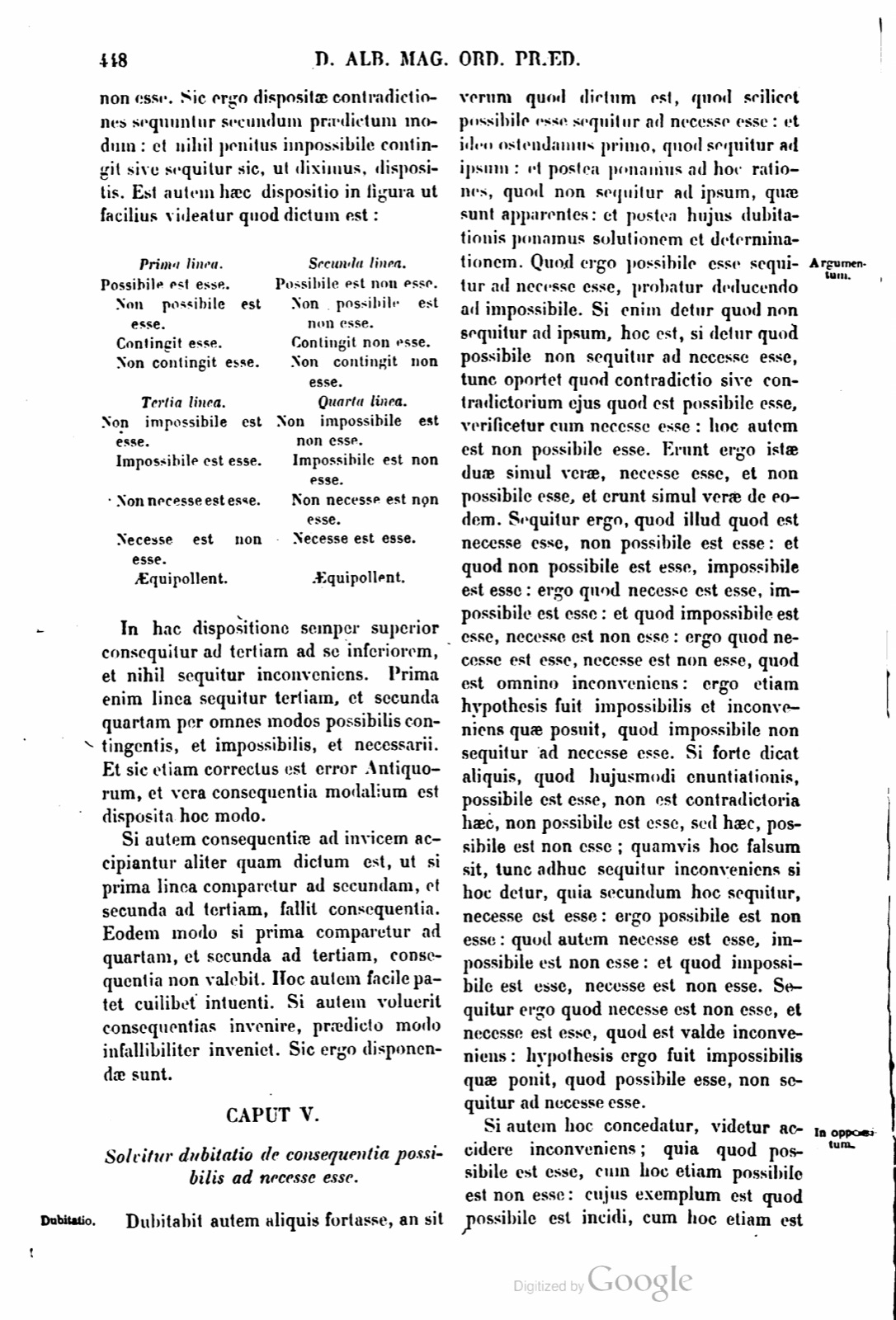
Dubitabit autem aliquis fortasse, an sit verum quod dictum est, quod scilicet possibile esse sequitur ad necesse esse: et ideo ostendamus primo, quod sequitur ad ipsum: et postea ponamus ad hoc rationes, quod non sequitur ad ipsum, quae sunt apparentes: et postea hujus dubitationis ponamus solutionem et determinationem. Quod ergo possibile esse sequitur ad necesse esse, probatur deducendo ad impossibile. Si enim detur quod non sequitur ad ipsum, hoc est, si detur quod possibile non sequitur ad necesse esse, tunc oportet quod contradictio sive contradictorium ejus quod est possibile esse, verificetur cum necesse esse: hoc autem est non possibile esse. Erunt ergo istae duae simul verae, necesse esse, et non possibile esse, et erunt simul verae de eodem. Sequitur ergo, quod illud quod est necesse esse, non possibile est esse: et quod non possibile est esse, impossibile est esse: ergo quod necesse est esse, impossibile est esse: et quod impossibile est esse, necesse est non esse: ergo quod necesse est esse, necesse est non esse, quod est omnino inconveniens: ergo etiam hypothesis fuit impossibilis et inconveniens quae posuit, quod impossibile [lege: possibile] non sequitur ad necesse esse. Si forte dicat aliquis, quod hujusmodi enuntiationis, possibile est esse, non est contradictoria haec, non possibile est esse, sed haec, possibile est non esse; quamvis hoc falsum sit, tunc adhuc sequitur inconveniens si hoc detur, quia secundum hoc sequitur, necesse est esse: ergo possibile est non esse: quod autem necesse est esse, impossibile est non esse: et quod impossibile est esse, necesse est non esse. Sequitur ergo quod necesse est non esse, et necesse est esse, quod est valde inconveniens: hypothesis ergo fuit impossibilis quae ponit, quod possibile esse, non sequitur ad necesse esse.
### Marginal Labels - 448: Dubitatio. - 448: Argumentum. - 448: In oppositum.
Si autem hoc concedatur, videtur accidere inconveniens; quia quod possibile est esse, cum hoc etiam possibile est non esse: cujus exemplum est quod possibile est incidi, cum hoc etiam est possibile non incidi: et hunc hominem possibile est ambulare, et possibile est non ambulare. Et hoc generabile possibile est esse, et possibile est non esse. Si ergo possibile esse sequatur ad necesse esse, sequitur ad id quod necesse est esse, possibile esse, et possibile non esse: ergo quod necesse est esse, possibile est non esse: quod autem possibile est non esse, non necesse est esse: ergo quod necesse est esse, non necesse est esse: et sic contradictoria erunt simul vera, quod est falsum. Omni ergo modo hypothesis est impossibilis quae dicit, quod possibile sequitur ad necesse esse. Et oportet nos respondere rationi quae videtur probare oppositum.
CHAPTER V. The doubt about the consequence of the possible to necessary being is solved.
But perhaps someone will doubt whether what has been said is true, namely that possible to be follows upon necessary to be. Therefore let us first show that it follows upon it; and afterwards let us posit, against this, the arguments which appear to show that it does not follow upon it; and afterwards let us posit the solution and determination of this doubt. Therefore that possible to be follows upon necessary to be is proved by leading to an impossibility. For if it is granted that it does not follow upon it, that is, if it is granted that possible does not follow upon necessary to be, then the contradiction or contradictory of that which is possible to be must be verified together with necessary to be; but this is not possible to be. Therefore these two will be true together: necessary to be and not possible to be; and they will be true together of the same thing. Therefore it follows that that which is necessary to be is not possible to be; and what is not possible to be is impossible to be. Therefore what is necessary to be is impossible to be; and what is impossible to be is necessary not to be. Therefore what is necessary to be is necessary not to be, which is altogether inconvenient. Therefore also the hypothesis was impossible and inconvenient which posited that impossible [read: possible] does not follow upon necessary to be. If perhaps someone says that the contradictory of this sort of enunciation, "it is possible to be," is not this, "it is not possible to be," but this, "it is possible not to be," although this is false, then still an inconvenience follows if this is granted, because according to this it follows: it is necessary to be; therefore it is possible not to be. But what is necessary to be is impossible not to be; and what is impossible to be is necessary not to be. Therefore it follows that it is necessary not to be and necessary to be, which is very inconvenient. Therefore the hypothesis which posits that possible to be does not follow upon necessary to be was impossible.
### Marginal Labels - 448: Doubt. - 448: Argument. - 448: To the opposite.
But if this is conceded, an inconvenience seems to occur, because what is possible to be is also, together with this, possible not to be; an example of which is that what is possible to be cut is, together with this, also possible not to be cut; and this man is possible to walk and possible not to walk. And this generable thing is possible to be and possible not to be. Therefore if possible to be follows upon necessary to be, then upon that which is necessary to be there follows possible to be and possible not to be. Therefore what is necessary to be is possible not to be; but what is possible not to be is not necessary to be. Therefore what is necessary to be is not necessary to be; and thus contradictories will be true together, which is false. Therefore in every way the hypothesis which says that possible follows upon necessary to be is impossible. And we must answer the argument which seems to prove the opposite.
### Marginal Labels - 449: Solutio dubii.
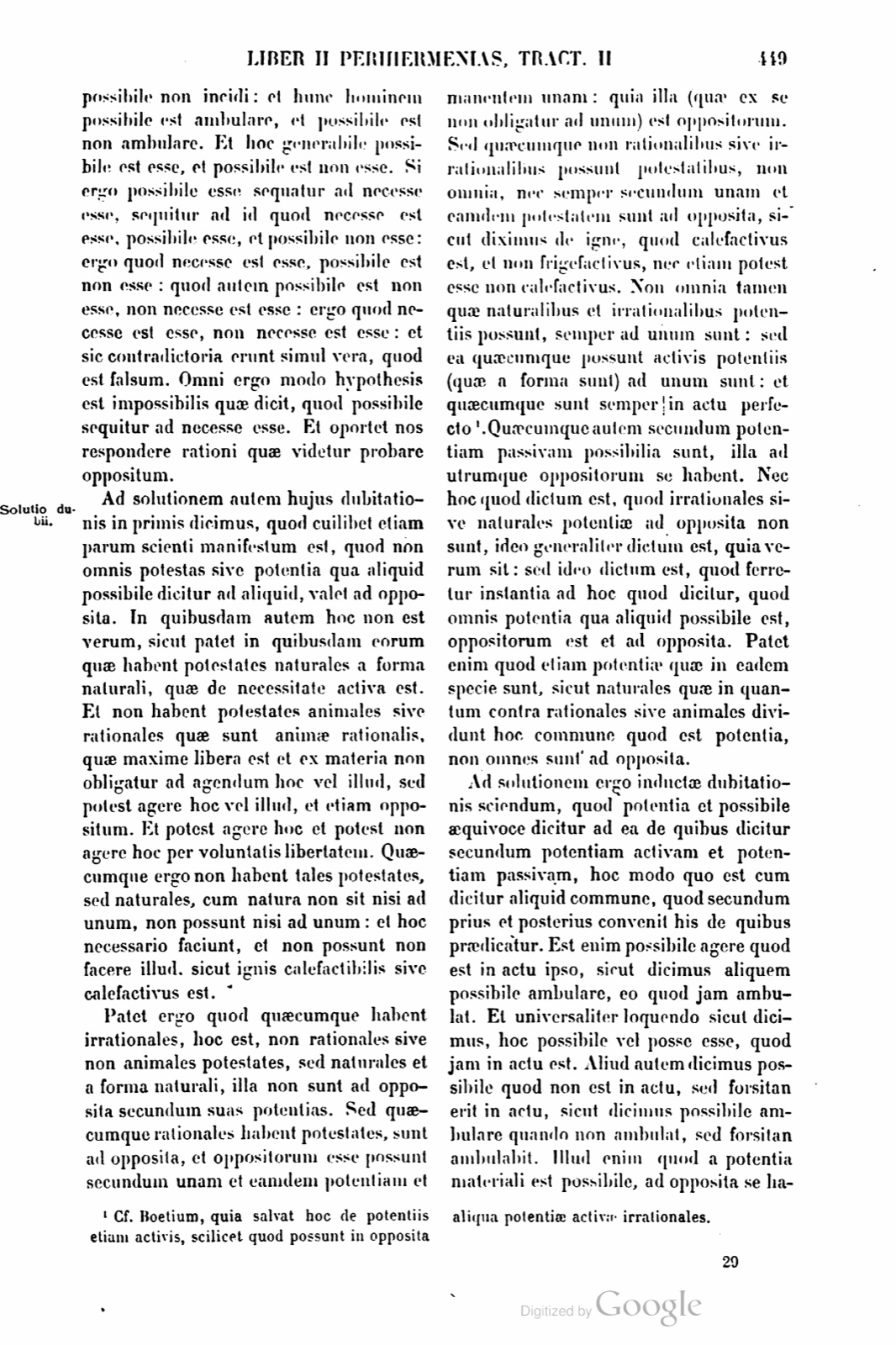
Ad solutionem autem hujus dubitationis in primis dicimus, quod cuilibet etiam parum scienti manifestum est, quod non omnis potestas sive potentia qua aliquid possibile dicitur ad aliquid, valet ad opposita. In quibusdam autem hoc non est verum, sicut patet in quibusdam eorum quae habent potestates naturales a forma naturali, quae de necessitate activa est. Et non habent potestates animales sive rationales quae sunt animae rationalis, quae maxime libera est et ex materia non obligatur ad agendum hoc vel illud, sed potest agere hoc vel illud, et etiam oppositum. Et potest agere hoc et potest non agere hoc per voluntatis libertatem. Quaecumque ergo non habent tales potestates, sed naturales, cum natura non sit nisi ad unum, non possunt nisi ad unum: et hoc necessario faciunt, et non possunt non facere illud, sicut ignis calefactibilis sive calefactivus est.
Patet ergo quod quaecumque habent irrationales, hoc est, non rationales sive non animales potestates, sed naturales et a forma naturali, illa non sunt ad opposita secundum suas potentias. Sed quaecumque rationales habent potestates, sunt ad opposita, et oppositorum esse possunt secundum unam et eamdem potentiam et manentem unam: quia illa (quae ex se non obligatur ad unum) est oppositorum. Sed quaecumque non rationalibus sive irrationalibus possunt potestatibus, non omnia, nec semper secundum unam et eamdem potestatem sunt ad opposita, sicut diximus de igne, quod calefactivus est, et non frigefactivus, nec etiam potest esse non calefactivus. Non omnia tamen quae naturalibus et irrationalibus potentiis possunt, semper ad unum sunt: sed ea quaecumque possunt activis potentiis (quae a forma sunt) ad unum sunt: et quaecumque sunt semper in actu perfecto1. Quaecumque autem secundum potentiam passivam possibilia sunt, illa ad utrumque oppositorum se habent. Nec hoc quod dictum est, quod irrationales sive naturales potentiae ad opposita non sunt, ideo generaliter dictum est, quia verum sit: sed ideo dictum est, quod ferretur instantia ad hoc quod dicitur, quod omnis potentia qua aliquid possibile est, oppositorum est et ad opposita. Patet enim quod etiam potentiae quae in eadem specie sunt, sicut naturales quae in quantum contra rationales sive animales dividunt hoc commune quod est potentia, non omnes sunt ad opposita.
### Marginal Labels - 449: Solution of the doubt.
But for the solution of this doubt we say first that it is manifest to anyone even a little knowing that not every power or potency by which something is called possible in relation to something has force for opposites. But in certain things this is not true, as is clear in certain of those things which have natural powers from a natural form, which is active of necessity. And they do not have animal or rational powers, which belong to the rational soul, which is most free and is not bound by matter to doing this or that, but can do this or that, and even the opposite. And it can do this and can not do this through freedom of will. Therefore whatever do not have such powers, but natural ones, since nature is only toward one thing, can only be toward one thing; and they do this necessarily and cannot not do that, as fire is heatable or heat-producing.
Therefore it is clear that whatever have irrational, that is, non-rational or non-animal, powers, but natural powers and from natural form, are not toward opposites according to their potencies. But whatever have rational powers are toward opposites, and can belong to opposites according to one and the same potency while it remains one, because that which of itself is not bound to one thing is of opposites. But whatever things are able by non-rational or irrational powers, not all nor always according to one and the same power are toward opposites, as we said of fire, that it is heat-producing and not cold-producing, nor can it even be non-heat-producing. Nevertheless not all things which are able by natural and irrational potencies are always toward one thing; but whatever are able by active potencies, which are from form, are toward one thing, and whatever are always in perfect act1. But whatever are possible according to passive potency are related to either of the opposites. Nor was this, which was said, that irrational or natural potencies are not toward opposites, said generally because it is true; but it was said so that an objection might be brought against this which is said, that every potency by which something is possible is of opposites and toward opposites. For it is clear that even potencies which are in the same species, such as natural potencies which, insofar as they divide this common thing which is potency against rational or animal potencies, are not all toward opposites.
Ad solutionem ergo inductae dubitationis sciendum, quod potentia et possibile aequivoce dicitur ad ea de quibus dicitur secundum potentiam activam et potentiam passivam, hoc modo quo est cum dicitur aliquid commune, quod secundum prius et posterius convenit his de quibus praedicatur. Est enim possibile agere quod est in actu ipso, sicut dicimus aliquem possibile ambulare, eo quod jam ambulat. Et universaliter loquendo sicut dicimus, hoc possibile vel posse esse, quod jam in actu est. Aliud autem dicimus possibile quod non est in actu, sed forsitan erit in actu, sicut dicimus possibile ambulare quando non ambulat, sed forsitan ambulabit. Illud enim quod a potentia materiali est possibile, ad opposita se habet: et tale possibile est in his quae mobilia sunt secundum substantiam motam, sicut generabilia et corruptibilia. Aliud vero possibile est quod est secundum potentiam activam quae in actu est, et in perpetuis et incorruptibilibus. In utrisque tamen his verum est dicere, quod utrumque eorum est possibile. Possibile enim est ambulare quod jam ambulat et possibile est ambulare quod ambulabit: et sic possibile communitate analogiae commune est ad utrumque.
Dicendum ergo quod hoc possibile quod est ante actum et non in actu, non est verum dicere de necessario, sicut probatum est. Sed hoc quod est in actu, sequitur ad necessarium, sicut a principio probatum est. Quia ergo partem subjectivam sequitur suum universale, quod ut commune genus vel analogum praedicatur de ipsa: et possibile est sicut universale ad id quod est in actu sicut necessarium, et ad id quod est ante actum, sicut possibile ad utrumlibet. Oportet ergo concedere quod possibile ut commune et universale sequatur ad necessarium, quamvis possibile non omnino, hoc est, pro omni specie possibilis sequitur ad necessarium.
Et quod plus est ex dictis habetur, quod illud quod est necesse vel non necesse est esse, principium est omnium aliorum ad hoc quod sint vel non sint; et sic oportet quod omnia alia considerentur ut consequentia ad necessarium esse vel non esse. Et secundum hoc oportet disponere consequentias secundum hunc modum: necesse est esse, non possibile est non esse: non contingens est non esse, impossibile est non esse. Sic in secunda linea necesse est non esse, non possibile est esse: non contingens est esse, impossibile est esse. In tertia vero non necesse est esse, possibile est non esse: contingit non esse, non impossibile est non esse. In quarta vero non necesse est non esse, possibile est esse: contingit esse, non impossibile est esse.
Therefore for the solution of the introduced doubt one must know that potency and possible are said equivocally in relation to those things of which they are said according to active potency and passive potency, in the way in which it is when some common thing is said which belongs according to prior and posterior to those of which it is predicated. For what is in act itself is possible to act, as we say that someone is possible to walk because he already walks. And universally speaking, as we say, this is possible or able to be, which already is in act. But we call another possible which is not in act, but perhaps will be in act, as we say it is possible to walk when he does not walk but perhaps will walk. For that which is possible from material potency is related to opposites; and such possible is in those things which are movable according to moved substance, as generable and corruptible things. But another possible is that which is according to active potency which is in act, and in perpetual and incorruptible things. Yet in each of these it is true to say that each of them is possible. For what already walks is possible to walk, and what will walk is possible to walk; and thus possible, by community of analogy, is common to each.
Therefore it must be said that this possible which is before act and not in act is not truly said of the necessary, as has been proved. But that which is in act follows upon the necessary, as was proved at the beginning. Therefore because a subjective part is followed by its universal, which is predicated of it as a common genus or an analog, and possible is as universal to that which is in act, as necessary, and to that which is before act, as possible to either alternative, therefore one must concede that possible as common and universal follows upon the necessary, although possible does not altogether, that is, according to every species of possible, follow upon the necessary.
And what is more, from what has been said it is held that that which is necessary or not necessary to be is the principle of all other things as to the fact that they are or are not; and thus all other things must be considered as consequent upon necessary being or not-being. And according to this one must arrange the consequences in this way: necessary to be, not possible not to be, not contingent not to be, impossible not to be. Thus in the second line: necessary not to be, not possible to be, not contingent to be, impossible to be. But in the third: not necessary to be, possible not to be, contingent not to be, not impossible not to be. But in the fourth: not necessary not to be, possible to be, contingent to be, not impossible to be.
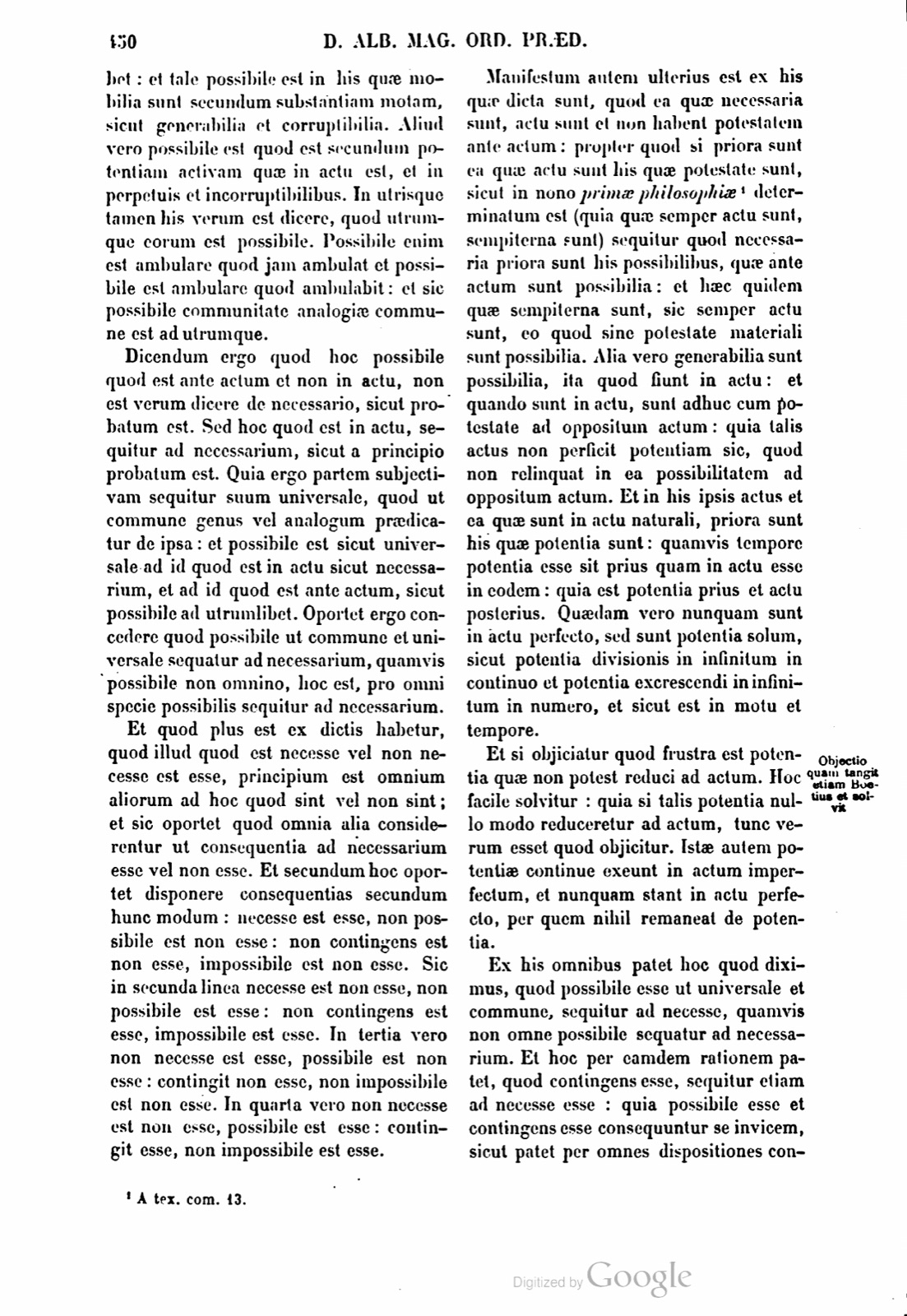
Manifestum autem ulterius est ex his quae dicta sunt, quod ea quae necessaria sunt, actu sunt et non habent potestatem ante actum: propter quod si priora sunt ea quae actu sunt his quae potestate sunt, sicut in nono primae philosophiae2 determinatum est (quia quae semper actu sunt, sempiterna sunt) sequitur quod necessaria priora sunt his possibilibus, quae ante actum sunt possibilia: et haec quidem quae sempiterna sunt, sic semper actu sunt, eo quod sine potestate materiali sunt possibilia. Alia vero generabilia sunt possibilia, ita quod fiunt in actu: et quando sunt in actu, sunt adhuc cum potestate ad oppositum actum: quia talis actus non perficit potentiam sic, quod non relinquat in ea possibilitatem ad oppositum actum. Et in his ipsis actus et ea quae sunt in actu naturali, priora sunt his quae potentia sunt: quamvis tempore potentia esse sit prius quam in actu esse in eodem: quia est potentia prius et actu posterius. Quaedam vero nunquam sunt in actu perfecto, sed sunt potentia solum, sicut potentia divisionis in infinitum in continuo et potentia excrescendi in infinitum in numero, et sicut est in motu et tempore.
### Marginal Labels - 450: Objectio quam tangit etiam Boetius et solvit.
Et si objiciatur quod frustra est potentia quae non potest reduci ad actum. Hoc facile solvitur: quia si talis potentia nullo modo reduceretur ad actum, tunc verum esset quod objicitur. Istae autem potentiae continue exeunt in actum imperfectum, et nunquam stant in actu perfecto, per quem nihil remaneat de potentia.
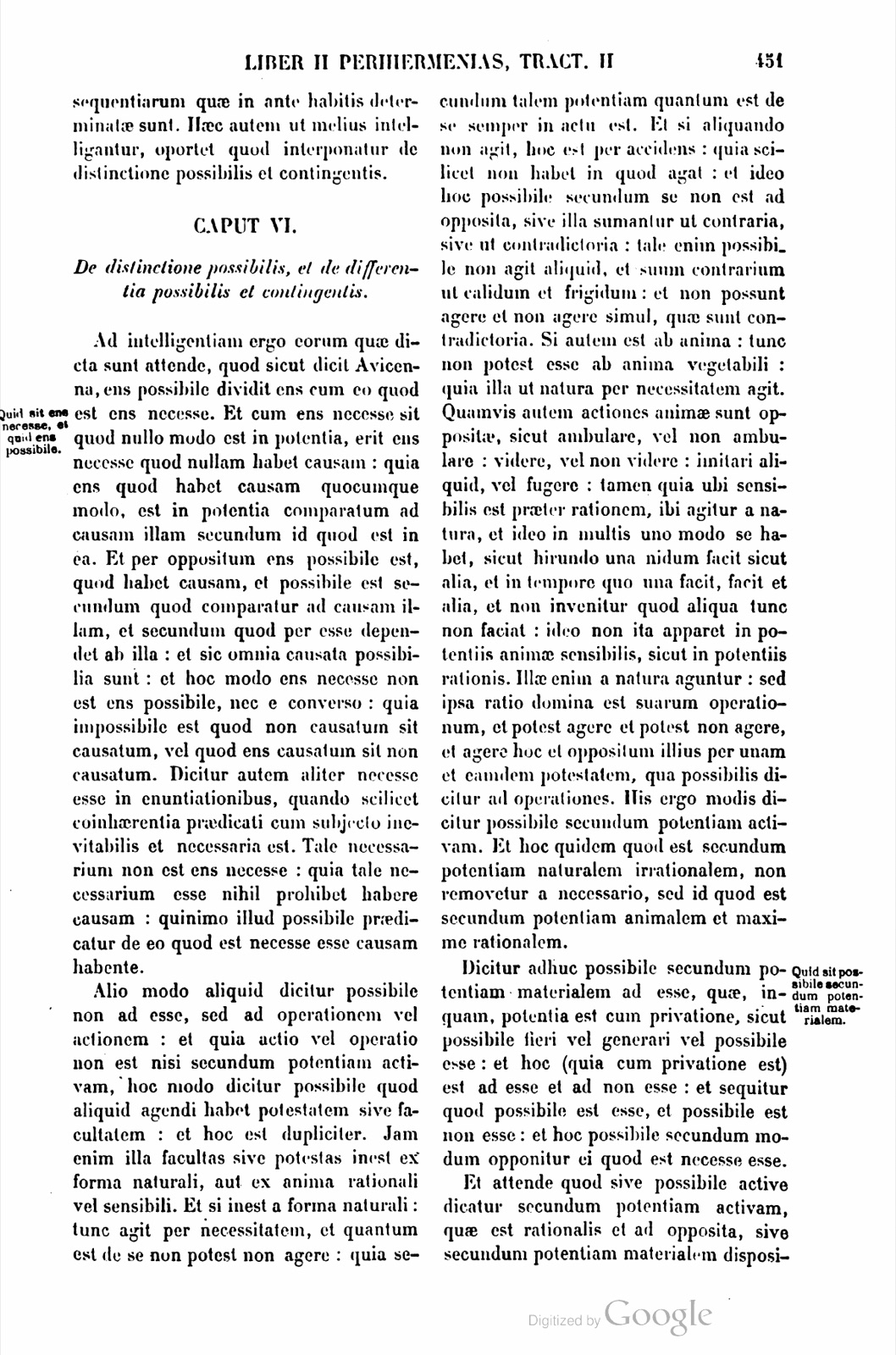
Ex his omnibus patet hoc quod diximus, quod possibile esse ut universale et commune, sequitur ad necesse, quamvis non omne possibile sequatur ad necessarium. Et hoc per eamdem rationem patet, quod contingens esse, sequitur etiam ad necesse esse: quia possibile esse et contingens esse consequuntur se invicem, sicut patet per omnes dispositiones consequentiarum quae in ante habitis determinatae sunt. Haec autem ut melius intelligantur, oportet quod interponatur de distinctione possibilis et contingentis.
But it is further manifest from what has been said that those things which are necessary are in act and do not have power before act. On account of this, if those things which are in act are prior to those which are in potency, as was determined in the ninth book of First Philosophy2, because those which are always in act are everlasting, it follows that necessary things are prior to these possible things which are possible before act; and indeed these things which are everlasting are always in act in such a way because they are possible without material power. But other generable things are possible so that they come to be in act; and when they are in act, they are still with power toward the opposite act, because such an act does not perfect the potency in such a way that it does not leave in it possibility toward the opposite act. And in these very things, act and those things which are in natural act are prior to those which are in potency, although in the same thing to be in potency is prior in time to being in act, because it is in potency earlier and in act later. But certain things are never in perfect act, but are only in potency, as the potency of division to infinity in the continuum and the potency of increase to infinity in number, and as it is in motion and time.
### Marginal Labels - 450: Objection which Boethius also touches and solves.
And if it is objected that a potency is vain which cannot be reduced to act, this is easily solved: because if such a potency were reduced to act in no way, then what is objected would be true. But those potencies continually go out into imperfect act, and never stand in perfect act, through which nothing would remain of potency.
From all these things it is clear what we have said, that possible to be as universal and common follows upon necessary, although not every possible follows upon necessary. And by the same reason this is clear, that contingent to be also follows upon necessary to be, because possible to be and contingent to be follow each other in turn, as is clear through all the arrangements of consequences which were determined in the preceding matters. But in order that these things may be better understood, one must insert a discussion about the distinction of possible and contingent.
Notes
- Compare Boethius, because he preserves this concerning even active potencies, namely that certain irrational active potencies can be toward opposites. (Cf. Boetium, quia salvat hoc de potentiis etiam activis, scilicet quod possunt in opposita aliqua potentiae activae irrationales.) ↩
- From text-commentary 13. (A tex. com. 13.) ↩
If a page does not appear, its photograph has not been uploaded yet.