Works › On Interpretation, Books I–II
Volume 1 · pp. 447–448
Chapter IV. The Error Of The Ancients Is Corrected, And The True Consequence Of Modals Is Shown.
A marker with ≈ is an approximate page boundary, placed by measure of the text; the page photographs remain the authority. In the paired views, clicking a page marker brings that page into view.
CAPUT IV. Corrigitur error Antiquorum, et ostenditur vera consequentia modalium.
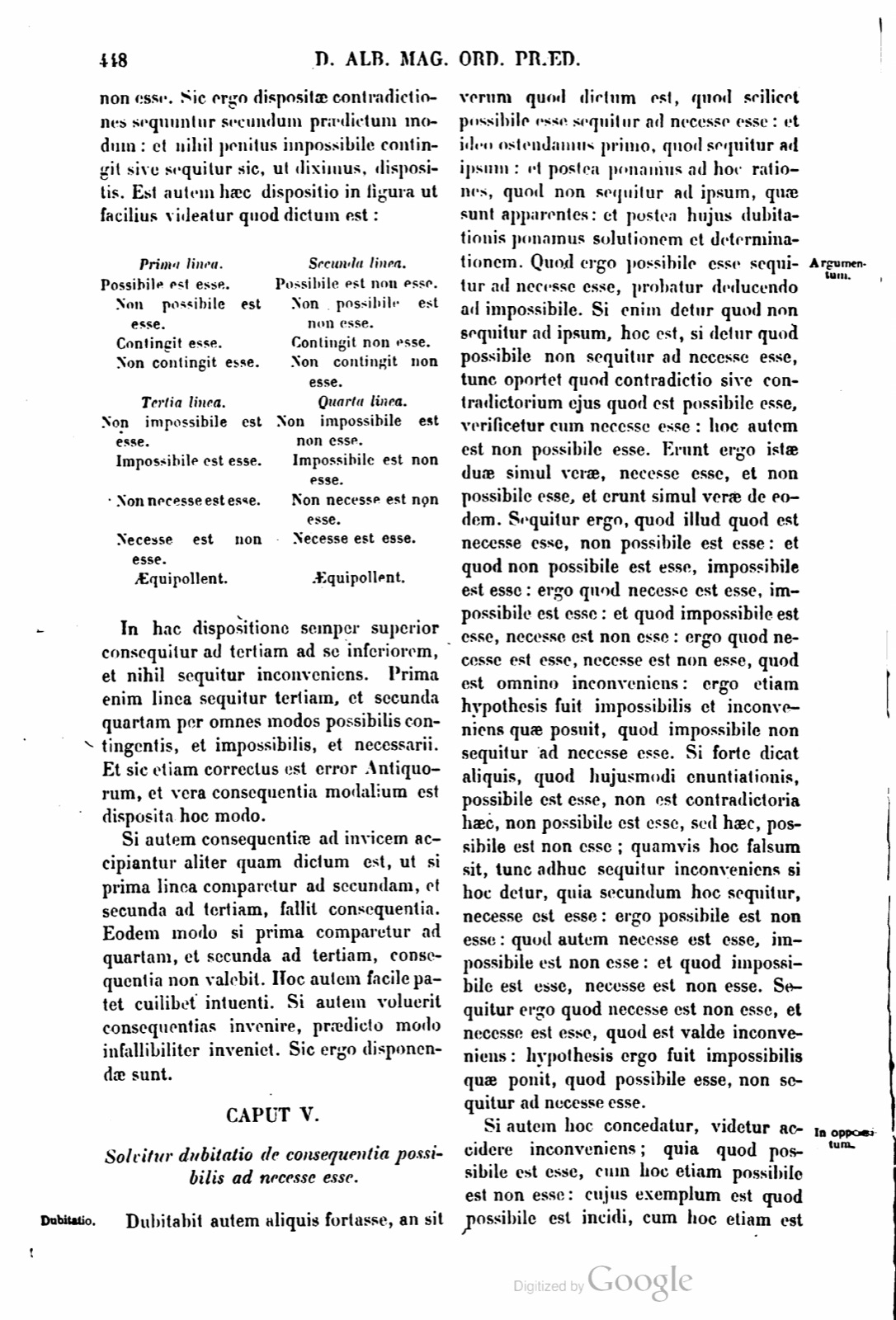
His autem habitis veram dispositionem modalium et veram consequentiam nos oportet investigare. Dicamus igitur quod necessarium esse non sequitur ad possibile esse: neque etiam ad possibile esse, sequitur necessarium non esse. Illi enim quae dicit possibile aliquid esse, utraque ista contingit accidere sive sequi, scilicet possibile esse et possibile non esse. Aliarum autem quae sunt de necessario, quaecumque vera sit, altera non erit vera: simul enim verum est aliquid possibile esse et possibile non esse. Si vero aliquid necesse est esse, non poterit non esse: et si necesse est non esse, non poterit esse: et ideo quaecumque istarum vera sit, altera non est vera. Relinquitur ergo ex his quae dicta sunt, quod ea quae dicit non necessarium non esse, sequitur ad eam quae dicit possibile esse: possibile enim esse verum est de eo quod est necesse esse, et de eo quod est non necesse esse: haec enim contradictio est ejus quae dicit aliquid necesse non esse. Haec autem quae dicit, necesse est non esse, sequitur ad hanc, non possibile est esse: illud enim quod est, non possibile est esse, sequitur ad hanc, impossibile est esse, et hanc sequitur, necesse est non esse: hujus autem negatio est, non necesse est non esse.
Sic ergo dispositae contradictiones sequuntur secundum praedictum modum: et nihil penitus impossibile contingit sive sequitur sic, ut diximus, dispositis. Est autem haec dispositio in figura ut facilius videatur quod dictum est:
CHAPTER IV. The error of the Ancients is corrected, and the true consequence of modals is shown.
But with these things held, we must investigate the true arrangement of modals and the true consequence. Therefore let us say that necessary to be does not follow upon possible to be; nor also, upon possible to be, does necessary not to be follow. For both of these can happen or follow to that which says something possible to be, namely possible to be and possible not to be. But of the others which are about the necessary, whichever is true, the other will not be true; for at the same time something is truly possible to be and possible not to be. But if something is necessary to be, it will not be able not to be; and if it is necessary not to be, it will not be able to be; and therefore whichever of those is true, the other is not true. Therefore it remains from what has been said that that which says "not necessary not to be" follows upon that which says "possible to be." For possible to be is true of that which is necessary to be and of that which is not necessary to be; for this is the contradiction of that which says something is necessary not to be. But this which says "it is necessary not to be" follows upon this, "it is not possible to be"; for that which is "it is not possible to be" follows upon this, "it is impossible to be," and this is followed by "it is necessary not to be." But its negation is "it is not necessary not to be."
Thus therefore contradictions arranged according to the aforesaid mode follow, and absolutely nothing impossible happens or follows when they are so arranged, as we said. But this arrangement is in a figure so that what has been said may be seen more easily:
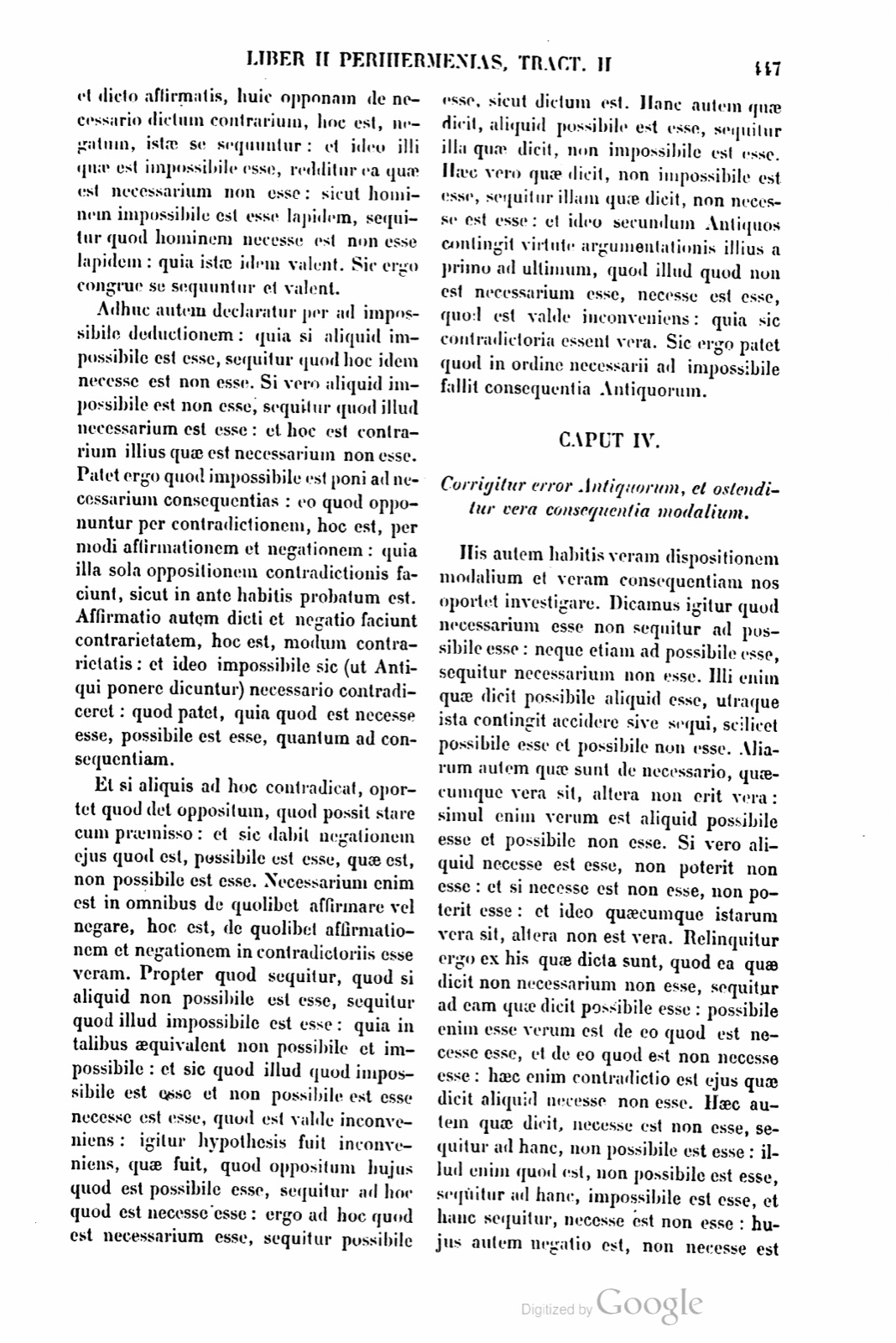
Prima linea: possibile est esse; non possibile est esse; contingit esse; non contingit esse.
Secunda linea: possibile est non esse; non possibile est non esse; contingit non esse; non contingit non esse.
Tertia linea: non impossibile est esse; impossibile est esse; non necesse est esse; necesse est non esse; aequipollent.
Quarta linea: non impossibile est non esse; impossibile est non esse; non necesse est non esse; necesse est esse; aequipollent.
In hac dispositione semper superior consequitur ad tertiam ad se inferiorem, et nihil sequitur inconveniens. Prima enim linea sequitur tertiam, et secunda quartam per omnes modos possibilis contingentis, et impossibilis, et necessarii. Et sic etiam correctus est error Antiquorum, et vera consequentia modalium est disposita hoc modo.
Si autem consequentiae ad invicem accipiantur aliter quam dictum est, ut si prima linea comparetur ad secundam, et secunda ad tertiam, fallit consequentia. Eodem modo si prima comparetur ad quartam, et secunda ad tertiam, consequentia non valebit. Hoc autem facile patet cuilibet intuenti. Si autem voluerit consequentias invenire, praedicto modo infallibiliter inveniet. Sic ergo disponendae sunt.
First line: it is possible to be; it is not possible to be; it happens to be; it does not happen to be.
Second line: it is possible not to be; it is not possible not to be; it happens not to be; it does not happen not to be.
Third line: it is not impossible to be; it is impossible to be; it is not necessary to be; it is necessary not to be; they are equivalent.
Fourth line: it is not impossible not to be; it is impossible not to be; it is not necessary not to be; it is necessary to be; they are equivalent.
In this arrangement always the superior follows upon the third beneath itself, and nothing inconvenient follows. For the first line follows the third, and the second the fourth, through all modes of possible, contingent, impossible, and necessary. And thus also the error of the Ancients has been corrected, and the true consequence of modals has been arranged in this way.
But if the consequences are taken in relation to one another otherwise than has been said, as if the first line is compared to the second and the second to the third, the consequence fails. In the same way, if the first is compared to the fourth and the second to the third, the consequence will not be valid. But this is easily clear to anyone looking. But if he wishes to find the consequences, he will find them infallibly in the aforesaid way. Thus therefore they must be arranged.
If a page does not appear, its photograph has not been uploaded yet.