Works › On Interpretation, Books I–II
Volume 1 · pp. 445–447
Chapter III. On The Consequences Of Modals According To The Opinion Of The Ancients.
A marker with ≈ is an approximate page boundary, placed by measure of the text; the page photographs remain the authority. In the paired views, clicking a page marker brings that page into view.
CAPUT III. De consequentiis modalium secundum opinionem Antiquorum.
Nunc autem post determinationem oppositionum modalium de consequentiis earum determinandum est. Quia vero quidam Antiquorum in aliquo errasse videntur circa consequentias modalium, ideo primo disponamus consequentias secundum quod Antiqui disposuerunt eas, et ostendamus quid verum et quid falsum est in consequentiis eorum, et postea disponamus consequentias secundum veritatem. Sic enim melius declarabitur quod intendimus.
Dicamus ergo quod consequentiae secundum aliquos fiunt inter modales secundum ordinem quem ponunt inter eas, ita ut sic disponantur, scilicet ut illi quae est possibile esse, statim jungatur vel subjungatur ista quae est contingit esse: contingere enim esse convertitur cum illa quae est possibile esse: et utraque istarum antecedit et sequitur ad aliam. Tertio subjungatur ea quae est, non impossibile est esse. Et his quarto loco subjunxerunt illam quae est, non necesse esse. Et has quatuor in prima linea posuerunt quasi se invicem consequentes.
### Marginal Labels - 445: Prima linea modalium.
Deinde in secunda linea posuerunt primo illam de negativo dicto, et affirmato modo, quae est, possibile non esse: et subjunxerunt illam quae est de contingenti, quae est, contingens non esse. Et illi tertio subjunxerunt illam de impossibili negato modo, quae est, non impossibile non esse. Et illi quarto subjunxerunt illam de necessario, negato modo, quae est, non necesse non esse. Similiter has in secunda linea disposuerunt.
### Marginal Labels - 445: Secunda linea.
Illi vero quae est de possibili modo negato et dicto affirmato quae est, non possibile esse, conjunxerunt istam per eumdem modum, non contingens esse: et illi conjunxerunt eam quae est de impossibili modo affirmato, et de dicto affirmato, quae est, impossibile esse: et illi subjunxerunt istam quae est de necessario modo affirmato et negato dicto, quae est, necessarium non esse. Et has quatuor in tertia linea posuerunt.
### Marginal Labels - 445: Tertia linea.
Illi vero quae est de possibili modo negato in negativo dicto, quae est, non possibile non esse, conjunxerunt de contingenti modo negato in negativo dicto, quae est, non contingit non esse. Et huic tertio, sicut consequentem subjunxerunt illam de impossibili modo affirmato et dicto negato, quae est, impossibile non esse. Et huic subjunxerunt illam de necessario modo affirmato et dicto affirmativo quae est, necessarium est esse. Et ex his quartam constituunt consequentium se lineam. Haec autem considerari facilius possunt ex subscriptione talis figurae quae sequitur:
### Marginal Labels - 445: Quarta linea.
Figura modalium, secundum quatuor lineas consequentium se:
Prima linea: possibile est esse; contingens est esse; non impossibile est esse; non necesse est esse.
Secunda linea: possibile est non esse; contingens est non esse; non impossibile est non esse; non necesse est non esse.
CHAPTER III. On the consequences of modals according to the opinion of the Ancients.
But now, after the determination of the oppositions of modals, one must determine concerning their consequences. But because some of the Ancients seem to have erred in something concerning the consequences of modals, therefore first let us arrange the consequences according as the Ancients arranged them, and let us show what is true and what is false in their consequences, and afterwards let us arrange the consequences according to truth. For in this way what we intend will be better made clear.
Therefore let us say that, according to some, consequences are made among modals according to the order which they posit among them, so that they are arranged thus: namely, that to that which is "possible to be" there is immediately joined or subordinated that which is "it happens to be"; for "to happen to be" is converted with that which is "possible to be," and each of these precedes and follows upon the other. Third, that which is "it is not impossible to be" is subordinated. And to these in the fourth place they subordinated that which is "it is not necessary to be." And these four they placed in the first line as following one another in turn.
### Marginal Labels - 445: First line of modals.
Then in the second line they first placed that about a negative dictum and an affirmed mode, which is "possible not to be"; and they subordinated that which is about the contingent, which is "contingent not to be." And to that, third, they subordinated that about the impossible with the mode denied, which is "not impossible not to be." And to that in the fourth place they subordinated that about the necessary with the mode denied, which is "not necessary not to be." Similarly they arranged these in the second line.
### Marginal Labels - 445: Second line.
But to that which is about the possible with mode denied and dictum affirmed, which is "not possible to be," they joined, by the same mode, "not contingent to be"; and to that they joined that which is about the impossible with mode affirmed and with dictum affirmed, which is "impossible to be"; and to that they subordinated that which is about the necessary with mode affirmed and dictum denied, which is "necessary not to be." And these four they placed in the third line.
### Marginal Labels - 445: Third line.
But to that which is about the possible with mode denied in a negative dictum, which is "not possible not to be," they joined that about the contingent with mode denied in a negative dictum, which is "it does not happen not to be." And to this, third, as consequent they subordinated that about the impossible with mode affirmed and dictum denied, which is "impossible not to be." And to this they subordinated that about the necessary with mode affirmed and dictum affirmative, which is "necessary to be." And from these they constitute a fourth line of things following one another. But these can be more easily considered from the subscription of such a figure which follows:
### Marginal Labels - 445: Fourth line.
Figure of modals, according to the four lines of things following one another:
First line: it is possible to be; it is contingent to be; it is not impossible to be; it is not necessary to be.
Second line: it is possible not to be; it is contingent not to be; it is not impossible not to be; it is not necessary not to be.
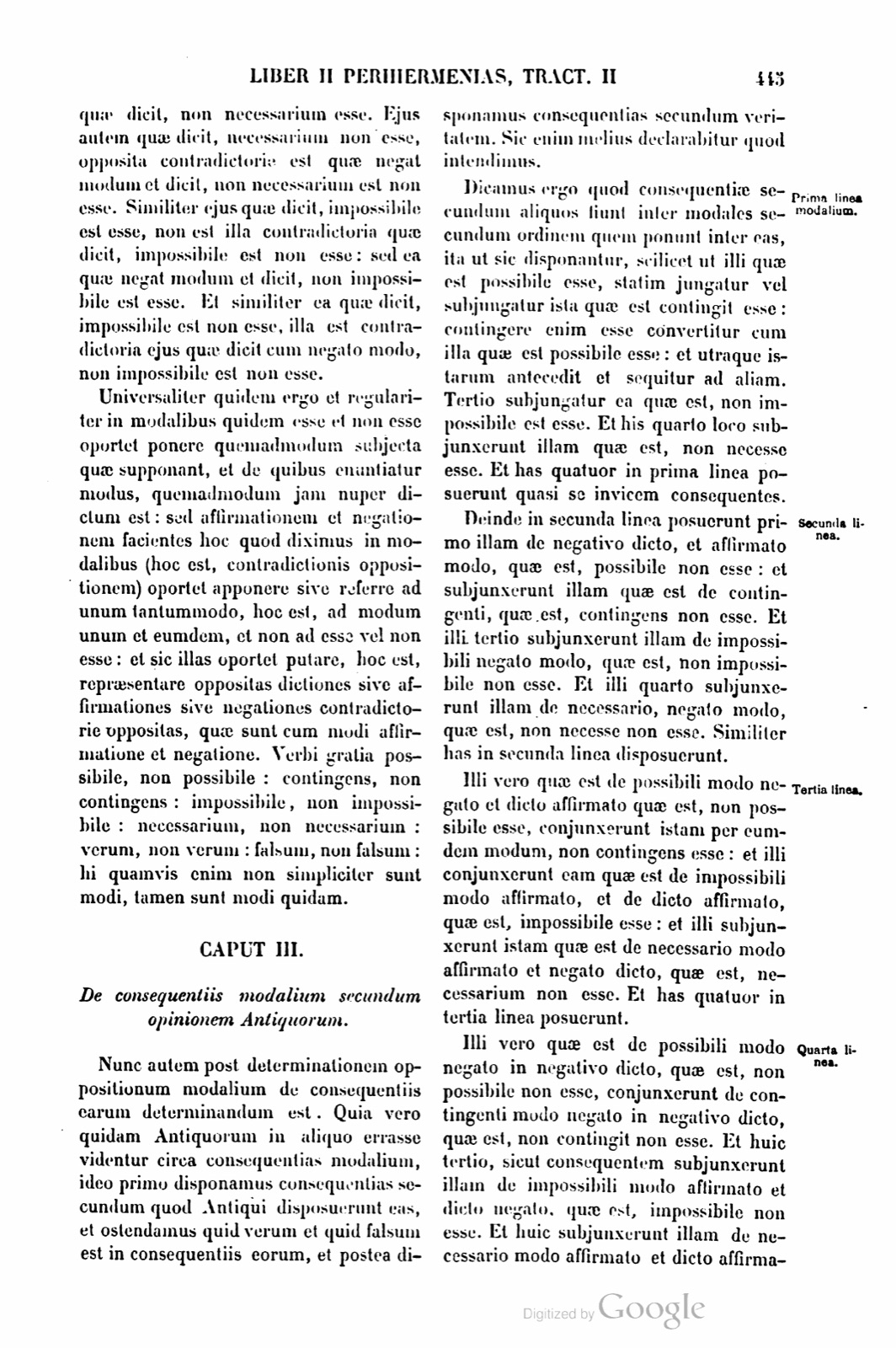
Tertia linea: non possibile est esse; non contingens est esse; impossibile est esse; necesse est non esse.
Quarta linea: non possibile est non esse; non contingens est non esse; impossibile est non esse; necesse est esse.
In hac autem dispositione videamus quid bene se habet, et quid non bene. Dicamus ergo, quod sicut dicunt impossibile et non impossibile, hoc est, impossibile affirmatum et impossibile negatum, bene sequuntur ad illud quod est contingens et possibile, et ad non contingens et non possibile, sicut dicunt Antiqui. Et sequuntur ista conversim, ita quod quaelibet earum et antecedit ad aliam et consequitur eam. Sequuntur autem se contradictorie, ita quod negatio impossibilis quae est contradictoria ad impossibile affirmatum, sequitur affirmatum possibile et contingens. Hanc enim enuntiationem possibile esse cum modo et dicto affirmatis utrisque, sequitur illa quae est de negato modo cum affirmato dicto quae est contradictoria ad hanc, impossibile est esse. Unde negatio impossibilis sequitur affirmationem possibilis et contingentis, et negationem possibilis et contingentis sequitur affirmatio impossibilis: et similiter affirmationem possibilis et contingentis sequitur negatio impossibilis. Hanc enim qua dicitur possibile esse, sequitur non impossibile esse. Et similiter illud quod dicit non possibile esse, sequitur impossibile esse. Haec enim quae dicit impossibile esse, affirmatio est. Haec autem quae dicit non possibile esse, negatio est. Diximus autem nuper, quod in talibus negatio de possibili sequitur affirmationem de impossibili, et affirmatio sequitur negationem. Hoc enim bene dictum est ab Antiquis in omnibus quatuor consequentium se lineis.
Et ut breviter dicatur in nulla linea peccatum est nisi in prima: et hoc non nisi ad quartum, scilicet de necessario. Et ideo considerandum qualiter secundum consequentiam se habeat illa quae de necessario. Hoc autem manifestum est cuilibet consideranti, quod non eodem modo se habent secundum consequentiam ut illi dixerunt. Sed potius illae quidem de modo necessitatis contrario modo sequuntur de impossibili, et non contradictorie. Contradictorie autem sumptae modales de necessario sunt extra consequentiam, et non sequuntur ad illas de impossibili. Hoc autem sic probatur. Accipiatur enim haec, necesse est non esse: illius enim negatio contradictorie non est haec, non necesse est esse. Contingit enim in eodem aliquando utrasque istas esse veras: necesse enim est hominem non esse lignum, et etiam non necesse est hominem esse lignum, quae simul de eodem sunt verae, et per consequens non sunt contradictoriae: et sic contingit utrasque simul esse veras: quia omne quod necesse est non esse, non est necesse esse.
Hujus autem causa est, quare non sequitur ista de necesse, illam de impossibili secundum dispositionem Antiquorum: quia non contradictorie, sed contrarie opponuntur: et ideo negatione postposita ad modum reducuntur, ut idem valentia et aequipollentia: enuntiatio quae est de impossibili et necessario. Et ideo impossibile esse et necessario non esse quae sunt de modis affirmatis et dictis contrario modo dispositis per affirmationem et negationem redduntur sibi per consequentiam, et idem valent per aequipollentiam. Hujus autem exemplum, ut sic dicam, impossibile est esse de modo et dicto affirmatis, huic opponam de necessario dictum contrarium, hoc est, negatum, istae se sequuntur: et ideo illi quae est impossibile esse, redditur ea quae est necessarium non esse: sicut hominem impossibile est esse lapidem, sequitur quod hominem necesse est non esse lapidem: quia istae idem valent. Sic ergo congrue se sequuntur et valent.
Third line: it is not possible to be; it is not contingent to be; it is impossible to be; it is necessary not to be.
Fourth line: it is not possible not to be; it is not contingent not to be; it is impossible not to be; it is necessary to be.
But in this arrangement let us see what has itself well and what not well. Therefore let us say that, as they say, impossible and not impossible, that is, impossible affirmed and impossible denied, follow well upon that which is contingent and possible, and upon non-contingent and non-possible, as the Ancients say. And these follow conversely, so that any of them both precedes another and follows upon it. But they follow one another contradictorily, so that the negation of impossible which is contradictory to impossible affirmed follows the affirmed possible and contingent. For that which is about denied mode with affirmed dictum, which is contradictory to this, "it is impossible to be," follows this enunciation "possible to be," with both mode and dictum affirmed. Hence the negation of impossible follows the affirmation of possible and contingent, and affirmation of impossible follows the negation of possible and contingent; and similarly negation of impossible follows affirmation of possible and contingent. For this which is said "possible to be" is followed by "not impossible to be." And similarly that which says "not possible to be" is followed by "impossible to be." For this which says "impossible to be" is an affirmation. But this which says "not possible to be" is a negation. But we said just now that in such matters the negation about the possible follows the affirmation about the impossible, and the affirmation follows the negation. For this was well said by the Ancients in all four lines of things following one another.
And, to speak briefly, in no line was there a fault except in the first, and this only with respect to the fourth, namely concerning the necessary. Therefore one must consider how that which is about the necessary has itself according to consequence. But this is manifest to anyone considering, that they do not have themselves according to consequence in the same way as those men said. Rather those which are about the mode of necessity follow from the impossible in a contrary mode, and not contradictorily. But modals about the necessary taken contradictorily are outside the consequence, and do not follow upon those about the impossible. But this is proved thus. Let this be taken: "it is necessary not to be"; for its contradictory negation is not this, "it is not necessary to be." For it happens that both of those are sometimes true of the same thing: for it is necessary that man not be wood, and also it is not necessary that man be wood; these are true together of the same thing, and consequently are not contradictory. And thus it happens that both are true together, because everything which is necessary not to be is not necessary to be.
But the cause why that proposition about the necessary does not follow that proposition about the impossible according to the arrangement of the Ancients is this: because they are opposed not contradictorily but contrarily; and therefore, with negation put after the mode, the enunciation about the impossible and the necessary are reduced as having the same force and as equivalent. And therefore "impossible to be" and "necessary not to be," which are about modes affirmed and dicta disposed in a contrary way through affirmation and negation, are rendered to each other through consequence and have the same force through equivalence. An example of this is that, as I may say, "it is impossible to be" concerning mode and dictum affirmed; to this I oppose, from the necessary, the contrary dictum, that is, the denied one. Those follow one another; and therefore to that which is "impossible to be" there is rendered that which is "necessary not to be," as "it is impossible for man to be stone" is followed by "it is necessary for man not to be stone," because these have the same force. Thus therefore they follow one another and have force fittingly.
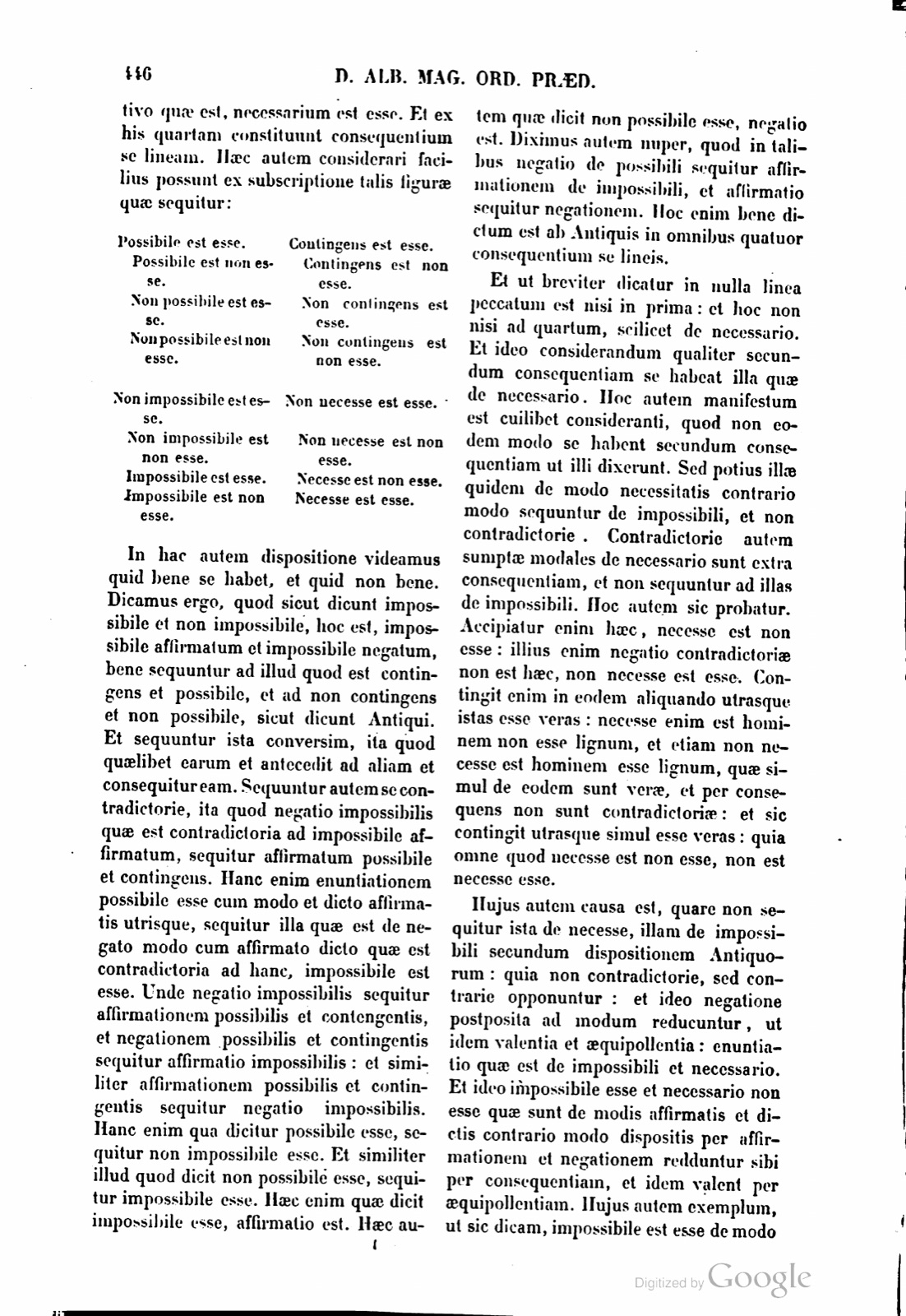
Adhuc autem declaratur per ad impossibile deductionem: quia si aliquid impossibile est esse, sequitur quod hoc idem necesse est non esse. Si vero aliquid impossibile est non esse, sequitur quod illud necessarium est esse: et hoc est contrarium illius quae est necessarium non esse. Patet ergo quod impossibile est poni ad necessarium consequentias: eo quod opponuntur per contradictionem, hoc est, per modi affirmationem et negationem: quia illa sola oppositionem contradictionis faciunt, sicut in ante habitis probatum est. Affirmatio autem dicti et negatio faciunt contrarietatem, hoc est, modum contrarietatis: et ideo impossibile sic (ut Antiqui ponere dicuntur) necessario contradiceret: quod patet, quia quod est necesse esse, possibile est esse, quantum ad consequentiam.
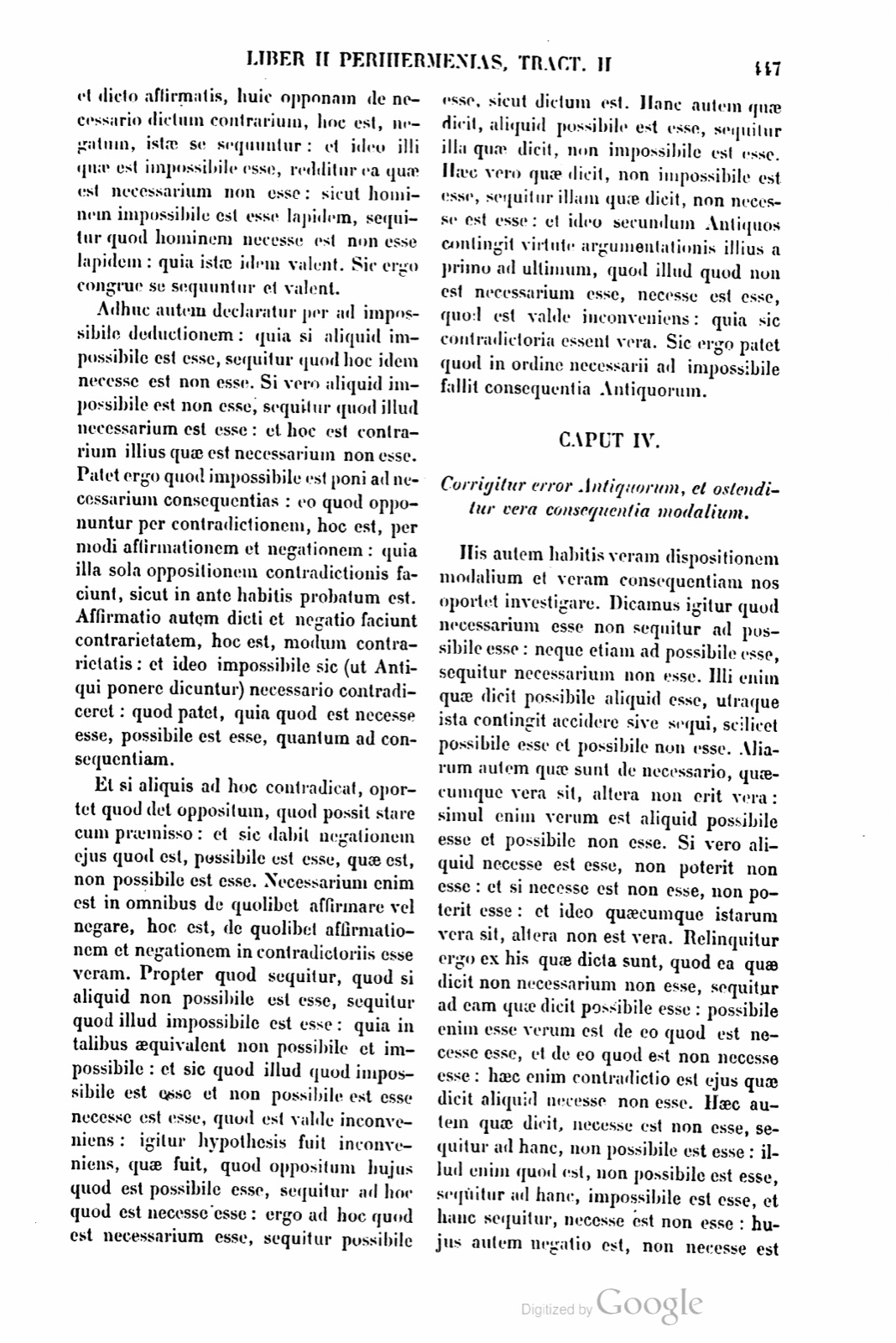
Et si aliquis ad hoc contradicat, oportet quod det oppositum, quod possit stare cum praemisso: et sic dabit negationem ejus quod est, possibile est esse, quae est, non possibile est esse. Necessarium enim est in omnibus de quolibet affirmare vel negare, hoc est, de quolibet affirmationem et negationem in contradictoriis esse veram. Propter quod sequitur, quod si aliquid non possibile est esse, sequitur quod illud impossibile est esse: quia in talibus aequivalent non possibile et impossibile: et sic quod illud quod impossibile est esse et non possibile est esse necesse est esse, quod est valde inconveniens: igitur hypothesis fuit inconveniens, quae fuit, quod oppositum hujus quod est possibile esse, sequitur ad hoc quod est necesse esse: ergo ad hoc quod est necessarium esse, sequitur possibile esse, sicut dictum est. Hanc autem quae dicit, aliquid possibile est esse, sequitur illa quae dicit, non impossibile est esse. Haec vero quae dicit, non impossibile est esse, sequitur illam quae dicit, non necesse est esse: et ideo secundum Antiquos contingit virtute argumentationis illius a primo ad ultimum, quod illud quod non est necessarium esse, necesse est esse, quod est valde inconveniens: quia sic contradictoria essent vera. Sic ergo patet quod in ordine necessarii ad impossibile fallit consequentia Antiquorum.
Moreover this is declared by reduction to the impossible, because if something is impossible to be, it follows that this same thing is necessary not to be. But if something is impossible not to be, it follows that it is necessary to be; and this is contrary to that which is "necessary not to be." Therefore it is clear that it is impossible to posit consequences from impossible to necessary on the ground that they are opposed by contradiction, that is, by affirmation and negation of the mode, because those alone make the opposition of contradiction, as was proved in the preceding matters. But affirmation and negation of the dictum make contrariety, that is, the mode of contrariety; and therefore impossible in this way, as the Ancients are said to posit it, would necessarily contradict, which is clear, because what is necessary to be is possible to be, as to consequence.
And if someone contradicts this, he must give the opposite which can stand with what was premised; and thus he will give the negation of that which is "possible to be," which is "not possible to be." For it is necessary in all things to affirm or deny of anything whatever, that is, that in contradictories the affirmation and the negation about anything whatever be true. On account of this it follows that, if something is not possible to be, it follows that it is impossible to be, because in such matters non-possible and impossible are equivalent. And thus, that what is impossible to be and not possible to be is necessary to be, is very inconvenient. Therefore the hypothesis was inconvenient, which was that the opposite of this, "possible to be," follows upon this, "necessary to be"; therefore upon this, "necessary to be," follows "possible to be," as has been said. But that which says "something is possible to be" is followed by that which says "it is not impossible to be." But this which says "it is not impossible to be" follows that which says "it is not necessary to be"; and therefore according to the Ancients, by the force of that argumentation from the first to the last, it happens that what is not necessary to be is necessary to be, which is very inconvenient, because thus contradictories would be true. Thus therefore it is clear that in the order of the necessary to the impossible the consequence of the Ancients fails.
If a page does not appear, its photograph has not been uploaded yet.