Works › On Interpretation, Books I–II
Volume 1 · pp. 442–445
Chapter II. In What Way The Opposition Of Modals Is To Be Taken.
A marker with ≈ is an approximate page boundary, placed by measure of the text; the page photographs remain the authority. In the paired views, clicking a page marker brings that page into view.
CAPUT II. Qualiter sumenda sit oppositio modalium.
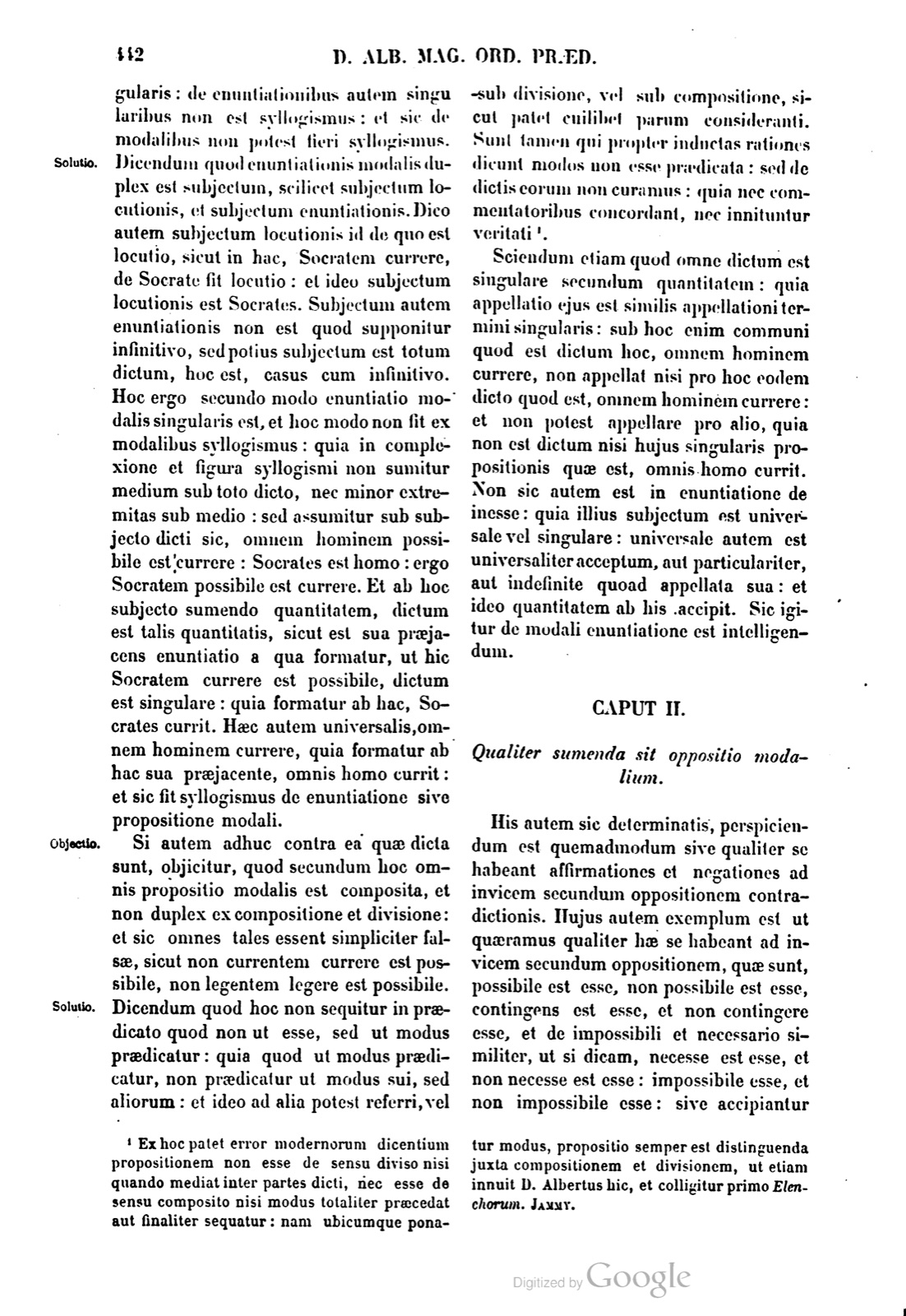
His autem sic determinatis, perspiciendum est quemadmodum sive qualiter se habeant affirmationes et negationes ad invicem secundum oppositionem contradictionis. Hujus autem exemplum est ut quaeramus qualiter hae se habeant ad invicem secundum oppositionem, quae sunt, possibile est esse, non possibile est esse, contingens est esse, et non contingere esse, et de impossibili et necessario similiter, ut si dicam, necesse est esse, et non necesse est esse: impossibile esse, et non impossibile esse: sive accipiantur cum modo nominali, sive cum modo adverbiali: hoc enim idem est secundum praesentem intentionem, ut si dicam, Socrates currit contingenter: sive dicam, Socratem currere est contingens: et sic de aliis modis sive adverbialiter, sive nominaliter accipiantur. Talium ergo enuntiationum modi sumendi sunt quantum ad oppositionem et consequentiam.
### Marginal Labels - 443: Dubitatio.
Haec enim habent aliquas speciales dubitationes, quia non similiter sumuntur oppositiones in his et in illis de inesse: nam si enuntiationum (quae complectuntur ex subjecto et praeterito [lege: praedicato] complectente) ea compositione illae contradictiones sunt sive sint sibi invicem oppositae secundum contradictionem. Quaecumque (secundum esse quod affirmatur in una, et secundum non esse quod negatur in altera) contra se invicem ex opposito disponuntur, sicut in illis quae sunt de inesse dictum est: tunc similis erit oppositio in illis quae sunt de inesse, et in modalibus: et hoc est impossibile. Hujus autem exemplum ponamus dicentes, quod in illis quae sunt de inesse ejus quod est esse hominem, opposita negatio est, non esse hominem: et non est ejus negatio propositio illa quae est esse non hominem, quia ista est affirmativa sicut prima, quamvis sit de infinito praedicato: et hoc est in illis de inesse in quibus hoc verbum est secundum adjacens praedicatur: esse enim hominem idem est quod est hominem esse. Similiter est in illis in quibus hoc verbum est est tertium adjacens: quia ejus quod est esse album hominem, sive hominem esse album negatio est non esse album hominem, sive hominem non esse album: et non illa quae dicit esse non album hominem, sive hominem esse non album: quia utraque est affirmativa, quamvis una sit de praedicato finito, et alia de praedicato infinito.
Si enim secundum hunc modum esset in modalibus oppositio sumenda, ita quod negatio ad esse (quod affirmat affirmatio) referatur, cum in contradictione semper aut dictio1 sive affirmatio aut negatio sit vera, cum falsum sit dicere hominem lignum, verum erit dicere de homine hominem non esse lignum. Si autem hoc modo est in his in quibus hoc verbum est, secundum vel tertium adjacens praedicatur: tunc etiam hoc idem verum est in enuntiationibus in quibus hoc verbum est non additur, nec ut secundum, nec ut tertium adjacens, sed aliud verbum ponitur. In his enim enuntiationibus idem (quoad modum oppositionis) faciet aliud verbum quod ponitur loco esse sine hoc verbo est, sicut patet in exemplis: ejus enim quae est, ambulat homo, sive homo ambulat, negatio contradictoria non est, ambulat non homo: sed potius illa quae dicit, non ambulat homo: nihil enim quantum ad oppositionem differt dicere hominem ambulare, et hominem esse ambulantem: sive homo ambulat, et homo est ambulans.
CHAPTER II. In what way the opposition of modals is to be taken.
But with these things thus determined, one must look into in what manner or in what way affirmations and negations are related to one another according to the opposition of contradiction. An example of this is that we ask how these are related to one another according to opposition: "it is possible to be," "it is not possible to be," "it is contingent to be," and "it is not contingent to be," and similarly concerning impossible and necessary, as if I say, "it is necessary to be" and "it is not necessary to be," "impossible to be" and "not impossible to be," whether they are taken with nominal mode or with adverbial mode; for this is the same according to the present intention, as if I say, "Socrates runs contingently," or if I say, "that Socrates runs is contingent," and so with the other modes whether they are taken adverbially or nominally. Therefore the modes of such enunciations must be taken with respect to opposition and consequence.
### Marginal Labels - 443: Doubt.
For these have certain special doubts, because oppositions are not taken similarly in these and in those about being-in. For if, of enunciations which are comprised from a subject and a past thing [read: predicate] comprising, those contradictions are in that composition, or are opposed to one another according to contradiction. Whatever things, according to being which is affirmed in one and according to not-being which is denied in the other, are disposed over against each other from the opposite, as was said in those which are about being-in, then the opposition in those which are about being-in and in modals will be similar; and this is impossible. But let us posit an example of this, saying that in those which are about being-in, of that which is "to be man," the opposed negation is "not to be man"; and its negation is not that proposition which is "to be non-man," because that is affirmative like the first, although it is about an infinite predicate. And this is in those about being-in in which this verb "is" is predicated as adjacent as second, for "to be man" is the same as "man to be." It is similar in those in which this verb "is" is adjacent as third, because of that which is "to be white man," or "man to be white," the negation is "not to be white man," or "man not to be white," and not that which says "to be non-white man," or "man to be non-white," because each is affirmative, although one is about a finite predicate and the other about an infinite predicate.
For if opposition had to be taken in modals according to this manner, so that the negation were referred to being, which the affirmation affirms, since in contradiction always either the saying1 or affirmation or the negation is true, since it is false to say "man wood," it will be true to say of man that man is not wood. But if it is in this way in those in which this verb "is" is predicated as adjacent as second or third, then this same thing is true also in enunciations in which this verb "is" is not added, neither as adjacent as second nor as adjacent as third, but another verb is placed. For in these enunciations another verb which is placed in place of being, without this verb "is," will make the same thing with respect to the mode of opposition, as is clear in examples. For of that which is "walks man," or "man walks," the contradictory negation is not "walks non-man," but rather that which says "man does not walk"; for as to opposition it differs in nothing to say "man to walk" and "man to be walking," or "man walks" and "man is walking."
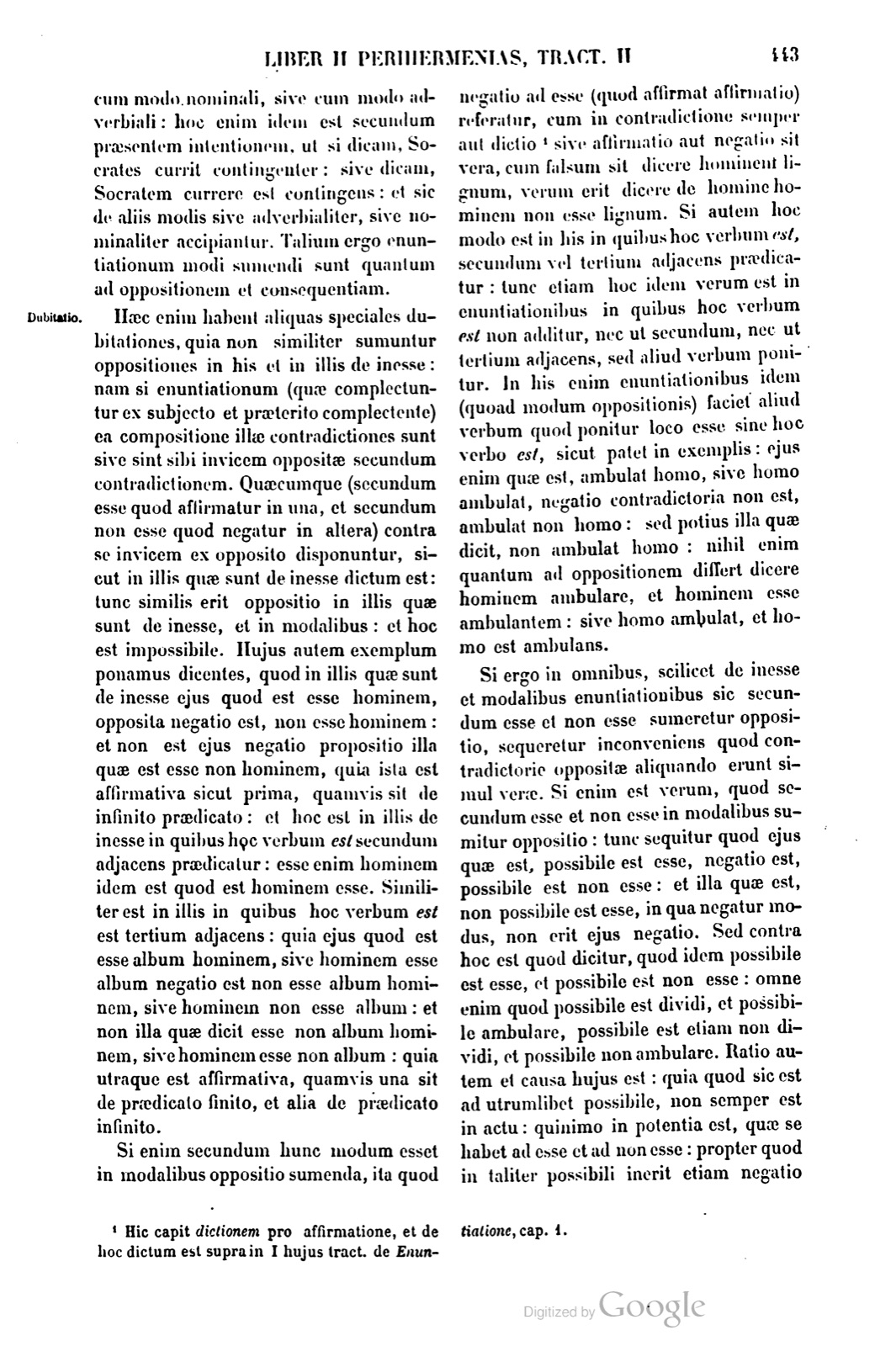
Si ergo in omnibus, scilicet de inesse et modalibus enuntiationibus sic secundum esse et non esse sumeretur oppositio, sequeretur inconveniens quod contradictorie oppositae aliquando erunt simul verae. Si enim est verum, quod secundum esse et non esse in modalibus sumitur oppositio: tunc sequitur quod ejus quae est, possibile est esse, negatio est, possibile est non esse: et illa quae est, non possibile est esse, in qua negatur modus, non erit ejus negatio. Sed contra hoc est quod dicitur, quod idem possibile est esse, et possibile est non esse: omne enim quod possibile est dividi, et possibile ambulare, possibile est etiam non dividi, et possibile non ambulare. Ratio autem et causa hujus est: quia quod sic est ad utrumlibet possibile, non semper est in actu: quinimo in potentia est, quae se habet ad esse et ad non esse: propter quod in taliter possibili inerit etiam negatio secundum potentiam intermixta: et sic quod ambulat, potest non ambulare: potest ergo illud quod est ambulabile secundum potentiam, etiam non ambulare: et illud quod sic est divisibile secundum potentiam, potest non dividi. At vero sicut in ante habitis probatum est, impossibile est quod de eodem verae sint simul oppositae affirmationes et negationes: quia si datur, contradictoria possunt esse simul vera. Non ergo illius affirmationis quae dicta est, ista est negatio quae pro ejus negatione inducta est: quia sunt simul verae quando dictum in utraque in potentia sumitur. Contingit enim secundum hoc sive sequitur, quod unum et idem vere simul dicitur et affirmatur et negatur simul de eodem, quod est impossibile: aut quod oportet negare, quod in modalibus sumatur oppositio secundum esse et non esse, et quod affirmationes et negationes contradictorie oppositae in modalibus non fiunt secundum esse et non esse: sed oportet dicere, quod fiant in talibus affirmationes et negationes oppositae, secundum hoc quod negatio refertur ad modum. Inter haec autem duo impossibilius est contradictorias esse simul veras, quam quod negatio ad modum referatur. Erit ergo magis eligendum, quod negatio ad modum referatur, quam quod contradictoria simul esse vera concedantur.
Therefore, if in all enunciations, namely about being-in and modals, opposition were taken thus according to being and not-being, an inconvenience would follow, that contradictorily opposed propositions would sometimes be true together. For if it is true that in modals opposition is taken according to being and not-being, then it follows that of that which is "it is possible to be," the negation is "it is possible not to be," and that which is "it is not possible to be," in which the mode is denied, will not be its negation. But against this is what is said, that the same thing is possible to be and possible not to be; for everything which is possible to be divided and possible to walk is also possible not to be divided and possible not to walk. But the reason and cause of this is that what is possible in this way to either alternative is not always in act; indeed it is in potency, which is related to being and to not-being. On account of this, in what is possible in such a way there will also belong a negation intermixed according to potency; and thus what walks can not walk. Therefore that which is walkable according to potency can also not walk, and that which is divisible in this way according to potency can not be divided. But as was proved in the preceding matters, it is impossible that opposed affirmations and negations should be true together of the same thing, because if this is granted, contradictories can be true together. Therefore that which was introduced as the negation of that affirmation which has been stated is not its negation, because they are true together when the dictum in each is taken in potency. For according to this it happens, or it follows, that one and the same thing is truly at the same time said, and affirmed and denied at the same time of the same thing, which is impossible; or that one must deny that in modals opposition is taken according to being and not-being, and that affirmations and negations contradictorily opposed in modals are not made according to being and not-being. Rather, one must say that in such cases opposed affirmations and negations are made according as negation is referred to the mode. But between these two things it is more impossible that contradictories be true together than that negation be referred to the mode. Therefore it will be more to be chosen that negation is referred to the mode than that contradictories are conceded to be true together.
### Marginal Labels - 444: Objectio.
Huic enim quod negatio ad modum referatur non obstat nisi hoc quod negatio ad compositionem habet referri, et modus non est compositio. Et hoc facile solvitur: quia quamvis modus non sit compositio, tamen ut dictum est, modus est compositionis: et sic negatio mediante modo refertur ad compositionem.
### Marginal Labels - 444: Solutio.
Secundum hoc ergo quod dictum est, negatio contradictoria ejus quae est, est possibile esse, sive possibile est esse, ista est quae est, non possibile esse, sive non possibile est esse. Eadem autem ratio est in ea quae est, contingens est esse: est enim illius negatio, non contingens est esse: et in aliis quoque modalibus est omnino similiter accipienda oppositio, ut in necessario et impossibili. In omnibus enim talibus modalibus fiunt oppositiones per affirmationes et negationes modi oppositi, sicut fiunt in his quae de inesse sunt oppositiones secundum esse et non esse. Oppositiones enim modorum determinantium compositionem in modalibus fiunt, sicut esse et non esse se habent in enuntiationibus de inesse: ut sicut in illis de inesse res subjectae compositioni subjectum sunt et praedicatum, ut subjectum homo, et praedicatum album: eodem modo hoc loco in modalibus fiunt subjecta enuntiationis modalis dicta, esse vel non esse significantia. Contingens vero et possibile et necessarium et impossibile sunt oppositiones determinantes dicti compositionem: propter quod praedicata sunt eo modo quo ante dictum est: et quemadmodum in illis de inesse secundum esse vel non esse contingit esse veritatem vel falsitatem, ita in istis quae sunt modales contingit esse veritatem et falsitatem secundum modorum affirmationem vel negationem.
Secundum ergo ea quae dicta sunt illius quae dicit, possibile est non esse, negatio est, non possibile est non esse. Aliae autem duae quae sunt, possibile est esse, et possibile est non esse, non sunt contrajacentes sibi invicem secundum contradictionem: quod ex hoc apparet, quia simul verae sunt, et videntur sequi ad invicem. Idem enim simul et semel possibile est esse, et possibile est non esse: sed possibile esse, et non possibile esse, nunquam sunt vel possunt esse simul verae. Istae ergo contradictorie sunt oppositae quae sumuntur secundum modi affirmationem et negationem. Similiter autem possibile est non esse, et non possibile est non esse, nunquam sunt simul verae. Hae ergo sunt oppositae per contradictionem, et istae etiam sumuntur secundum modi affirmationem et negationem. Similiter autem est in ea quae dicit, necessarium est esse: hujus enim non ea quae dicit, necessarium est non esse, contradictoria est, sed ea
### Marginal Labels - 444: Objection.
For to this, that negation be referred to the mode, nothing stands in the way except this, that negation has to be referred to composition, and mode is not composition. And this is easily solved, because although mode is not composition, nevertheless, as has been said, mode is of composition; and thus negation, by mediation of the mode, is referred to composition.
### Marginal Labels - 444: Solution.
Therefore according to this which has been said, the contradictory negation of that which is "it is possible to be," or "possible is to be," is this which is "not possible to be," or "it is not possible to be." But the same account applies in that which is "it is contingent to be," for its negation is "it is not contingent to be"; and in the other modals too opposition must be taken wholly similarly, as in necessary and impossible. For in all such modals oppositions are made through affirmations and negations of the opposed mode, just as in those which are about being-in oppositions are made according to being and not-being. For oppositions of modes determining composition in modals are made as being and not-being are related in enunciations about being-in; so that, just as in those about being-in the things subjected to composition are subject and predicate, as the subject man and the predicate white, in the same way in this place in modals the dicta signifying being or not-being become the subjects of the modal enunciation. But contingent, possible, necessary, and impossible are the oppositions determining the composition of the dictum; on account of this they are predicates in that manner which was stated before. And as in those about being-in it happens that there is truth or falsity according to being or not-being, so in these which are modal it happens that there is truth and falsity according to the affirmation or negation of the modes.
Therefore according to those things which have been said, of that which says "it is possible not to be," the negation is "it is not possible not to be." But the other two, which are "it is possible to be" and "it is possible not to be," are not set over against each other according to contradiction; this appears from the fact that they are true together and seem to follow upon each other. For the same thing at once and at the same time is possible to be and possible not to be. But "possible to be" and "not possible to be" never are or can be true together. Therefore those are contradictorily opposed which are taken according to affirmation and negation of the mode. Likewise, "it is possible not to be" and "it is not possible not to be" are never true together. Therefore these are opposed through contradiction, and these also are taken according to affirmation and negation of the mode. Likewise it is in that which says "it is necessary to be"; for its contradictory is not that which says "it is necessary not to be," but that one
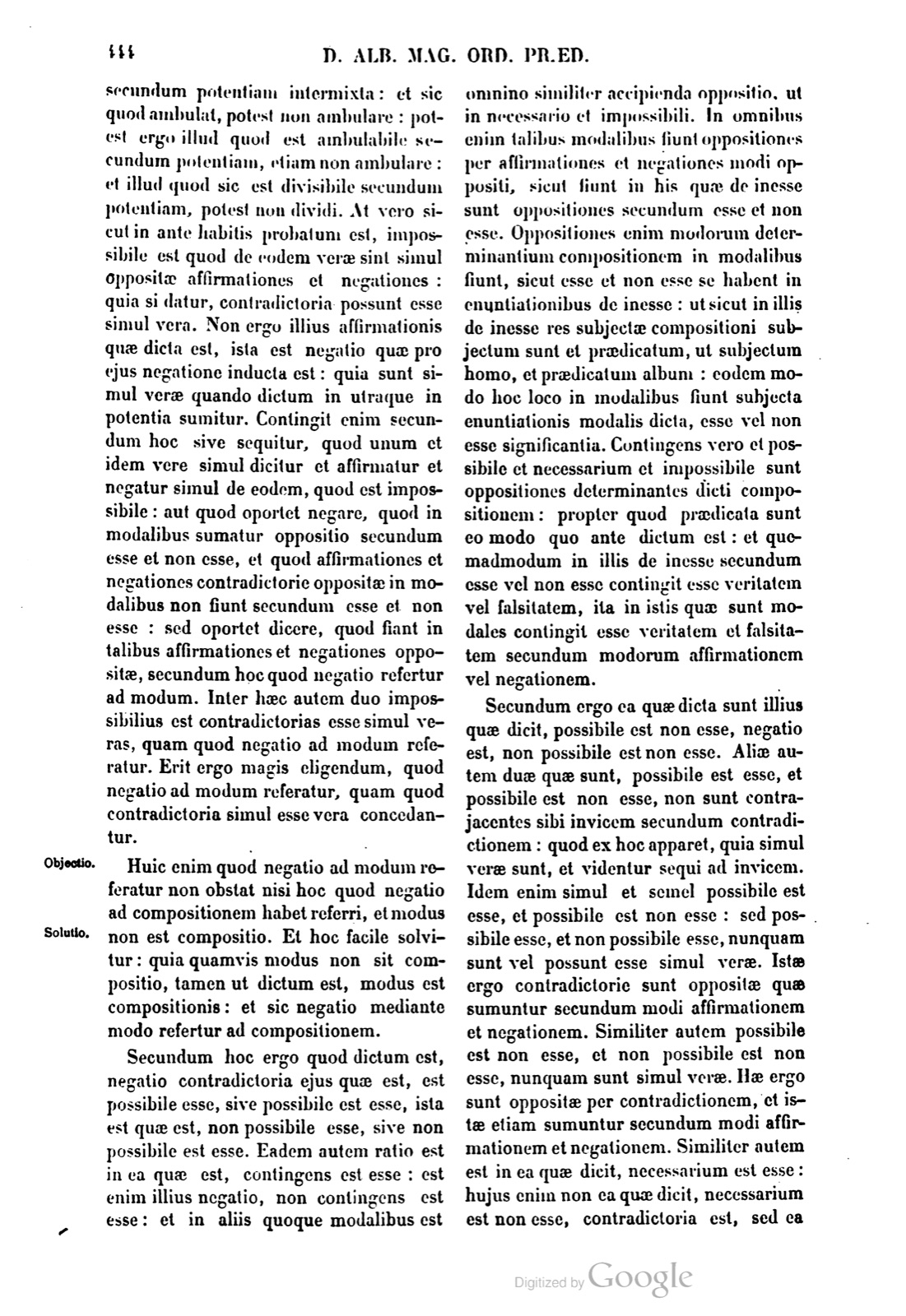
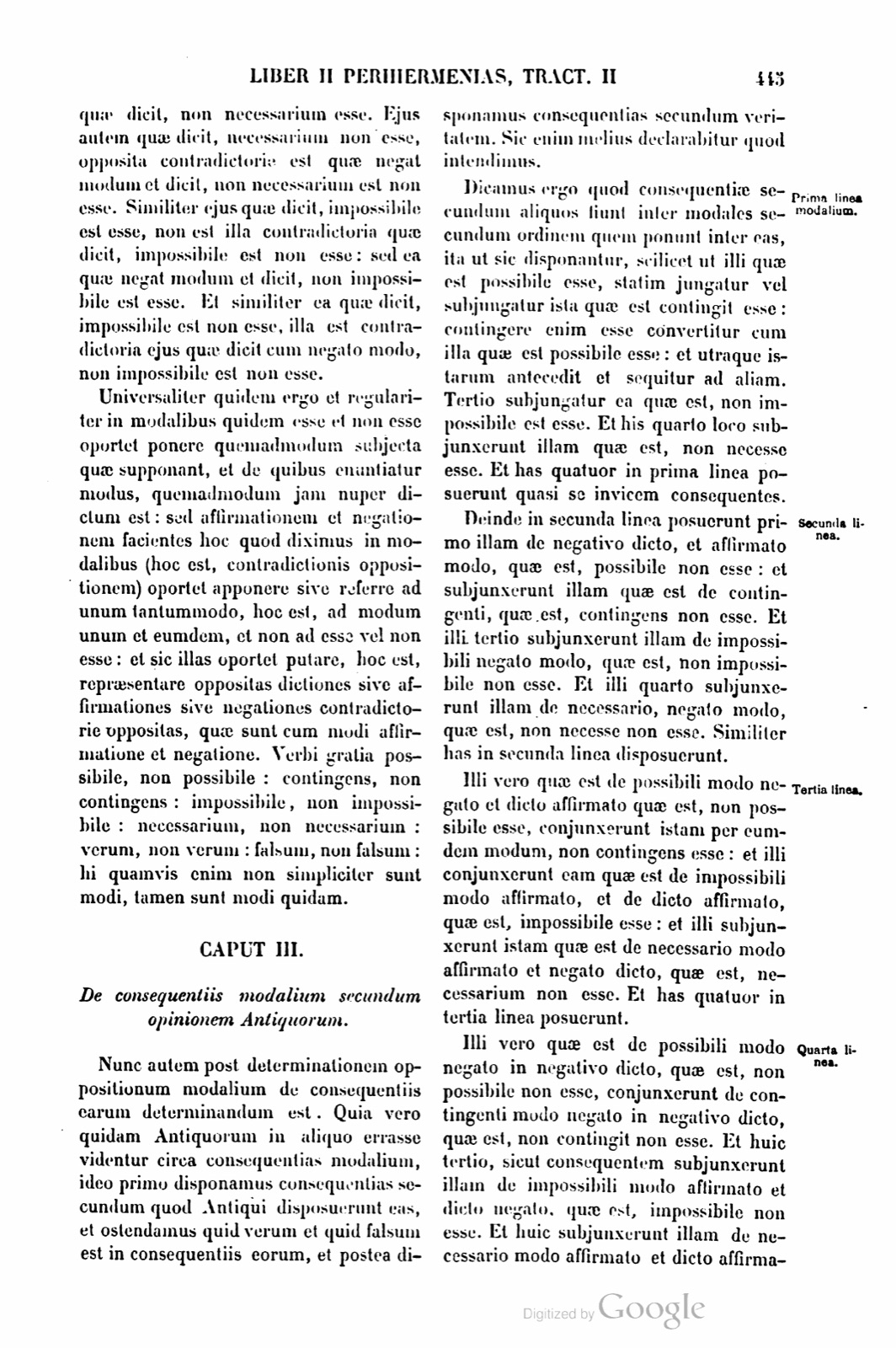
quae dicit, non necessarium esse. Ejus autem quae dicit, necessarium non esse, opposita contradictorie est quae negat modum et dicit, non necessarium est non esse. Similiter ejus quae dicit, impossibile est esse, non est illa contradictoria quae dicit, impossibile est non esse: sed ea quae negat modum et dicit, non impossibile est esse. Et similiter ea quae dicit, impossibile est non esse, illa est contradictoria ejus quae dicit cum negato modo, non impossibile est non esse.
Universaliter quidem ergo et regulariter in modalibus quidem esse et non esse oportet ponere quemadmodum subjecta quae supponant, et de quibus enuntiatur modus, quemadmodum jam nuper dictum est: sed affirmationem et negationem facientes hoc quod diximus in modalibus (hoc est, contradictionis oppositionem) oportet apponere sive referre ad unum tantummodo, hoc est, ad modum unum et eumdem, et non ad esse vel non esse: et sic illas oportet putare, hoc est, repraesentare oppositas dictiones sive affirmationes sive negationes contradictorie oppositas, quae sunt cum modi affirmatione et negatione. Verbi gratia possibile, non possibile: contingens, non contingens: impossibile, non impossibile: necessarium, non necessarium: verum, non verum: falsum, non falsum: hi quamvis enim non simpliciter sunt modi, tamen sunt modi quidam.
which says "it is not necessary to be." But of that which says "it is necessary not to be," the one contradictorily opposed is that which denies the mode and says, "it is not necessary not to be." Similarly, of that which says "it is impossible to be," the contradictory is not that which says "it is impossible not to be," but that which denies the mode and says, "it is not impossible to be." And similarly that which says "it is impossible not to be" is the contradictory of that which says with the mode denied, "it is not impossible not to be."
Therefore, universally and regularly, in modals one must posit being and not-being as subjects which suppose, and concerning which the mode is enunciated, as was just now said. But the affirmation and negation making what we have said in modals, that is, the opposition of contradiction, must be appended or referred to one thing only, that is, to one and the same mode, and not to being or not-being. And thus one must reckon them, that is, represent the opposed sayings or affirmations or negations contradictorily opposed, which are with affirmation and negation of the mode. For example: possible, not possible; contingent, not contingent; impossible, not impossible; necessary, not necessary; true, not true; false, not false. For although these last are not modes simply, nevertheless they are certain modes.
Notes
- Here he takes "diction" for affirmation, and this was said above in the first book of this treatise On Enunciation, chapter 1. (Hic capit dictionem pro affirmatione, et de hoc dictum est supra in I hujus tract. de Enuntiatione, cap. 1.) ↩
If a page does not appear, its photograph has not been uploaded yet.