Works › On Interpretation, Books I–II
Volume 1 · pp. 440–442
Treatise II. On The Consequence Of Modals. Chapter I. What Modal Enunciations Are.
A marker with ≈ is an approximate page boundary, placed by measure of the text; the page photographs remain the authority. In the paired views, clicking a page marker brings that page into view.
TRACTATUS II. DE CONSEQUENTIA MODALIUM.
CAPUT I. Quae sint modales enuntiationes.
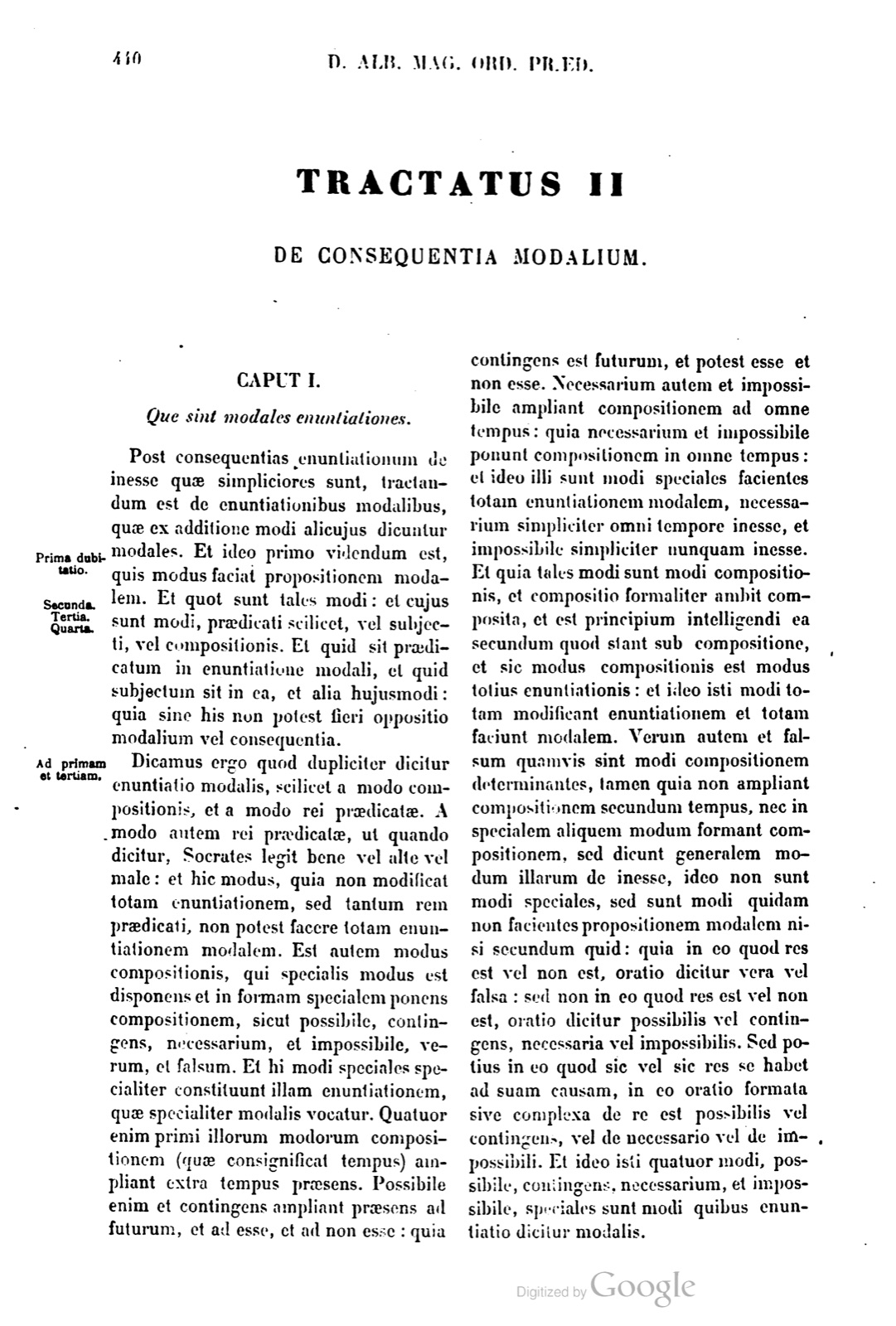
Post consequentias enuntiationum de inesse quae simpliciores sunt, tractandum est de enuntiationibus modalibus, quae ex additione modi alicujus dicuntur modales. Et ideo primo videndum est, quis modus faciat propositionem modalem. Et quot sunt tales modi: et cujus sunt modi, praedicati scilicet, vel subjecti, vel compositionis. Et quid sit praedicatum in enuntiatione modali, et quid subjectum sit in ea, et alia hujusmodi: quia sine his non potest fieri oppositio modalium vel consequentia.
### Marginal Labels - 440: Prima dubitatio. - 440: Secunda. - 440: Tertia. - 440: Quarta.
Dicamus ergo quod dupliciter dicitur enuntiatio modalis, scilicet a modo compositionis, et a modo rei praedicatae. A modo autem rei praedicatae, ut quando dicitur, Socrates legit bene vel alte vel male: et hic modus, quia non modificat totam enuntiationem, sed tantum rem praedicati, non potest facere totam enuntiationem modalem. Est autem modus compositionis, qui specialis modus est disponens et in formam specialem ponens compositionem, sicut possibile, contingens, necessarium, et impossibile, verum, et falsum. Et hi modi speciales specialiter constituunt illam enuntiationem, quae specialiter modalis vocatur. Quatuor enim primi illorum modorum compositionem (quae consignificat tempus) ampliant extra tempus praesens. Possibile enim et contingens ampliant praesens ad futurum, et ad esse, et ad non esse: quia contingens est futurum, et potest esse et non esse. Necessarium autem et impossibile ampliant compositionem ad omne tempus: quia necessarium et impossibile ponunt compositionem in omne tempus: et ideo illi sunt modi speciales facientes totam enuntiationem modalem, necessarium simpliciter omni tempore inesse, et impossibile simpliciter nunquam inesse. Et quia tales modi sunt modi compositionis, et compositio formaliter ambit composita, et est principium intelligendi ea secundum quod stant sub compositione, et sic modus compositionis est modus totius enuntiationis: et ideo isti modi totam modificant enuntiationem et totam faciunt modalem. Verum autem et falsum quamvis sint modi compositionem determinantes, tamen quia non ampliant compositionem secundum tempus, nec in specialem aliquem modum formant compositionem, sed dicunt generalem modum illarum de inesse, ideo non sunt modi speciales, sed sunt modi quidam non facientes propositionem modalem nisi secundum quid: quia in eo quod res est vel non est, oratio dicitur vera vel falsa: sed non in eo quod res est vel non est, oratio dicitur possibilis vel contingens, necessaria vel impossibilis. Sed potius in eo quod sic vel sic res se habet ad suam causam, in eo oratio formata sive complexa de re est possibilis vel contingens, vel de necessario vel de impossibili. Et ideo isti quatuor modi, possibile, contingens, necessarium, et impossibile, speciales sunt modi quibus enuntiatio dicitur modalis.
### Marginal Labels - 440: Ad primam et tertiam.
Ex hoc etiam accipitur, quod negatio quae fertur ad compositionem, non facit enuntiationem modalem: quia non ampliat eam secundum tempus, nec etiam informat modo speciali, sed simpliciter dividit ipsam in forma in qua est significata. Ex his ergo patet quod modalis enuntiatio dupliciter dicitur, scilicet generaliter et specialiter. Et generaliter quidem modalis dicitur a modo generaliter sumpto, sive sit modus praedicati, sive compositionis. Specialiter autem modalis dicitur quatuor modis qui dicti sunt: quia denominatio fit a specie, et non a genere. Ex hoc autem ulterius patet, quod enuntiatio modalis substantialiter et per sua constituentia differt ab enuntiatione de inesse simplici: quia modus est substantialis enuntiationi modali, et est substantiale constitutivum.
TREATISE II. ON THE CONSEQUENCE OF MODALS.
CHAPTER I. What modal enunciations are.
After the consequences of enunciations about being-in, which are simpler, one must treat modal enunciations, which are called modal from the addition of some mode. And therefore first one must see what mode makes a proposition modal, and how many such modes there are, and of what they are modes, namely of the predicate, or of the subject, or of the composition; and what the predicate is in a modal enunciation, and what the subject is in it, and other things of this sort, because without these there cannot be an opposition of modals or a consequence.
### Marginal Labels - 440: First doubt. - 440: Second. - 440: Third. - 440: Fourth.
Therefore let us say that a modal enunciation is said in two ways, namely from the mode of composition and from the mode of the thing predicated. But from the mode of the thing predicated, as when it is said, "Socrates reads well" or "loftily" or "badly"; and this mode, because it does not modify the whole enunciation but only the thing of the predicate, cannot make the whole enunciation modal. But a mode of composition is that which is a special mode disposing and placing composition in a special form, as possible, contingent, necessary, and impossible, true and false. And these special modes specially constitute that enunciation which is specially called modal. For the first four of those modes extend composition, which consignifies time, beyond the present time. For possible and contingent extend the present to the future, and to being, and to not-being, because the contingent is future and can be and not be. But necessary and impossible extend composition to all time, because necessary and impossible posit composition in every time; and therefore those are special modes making the whole enunciation modal: necessary, simply, to belong at every time, and impossible, simply, never to belong. And because such modes are modes of composition, and composition formally surrounds the things composed and is the principle of understanding them according as they stand under composition, and thus the mode of composition is the mode of the whole enunciation, therefore those modes modify the whole enunciation and make the whole modal. But true and false, although they are modes determining composition, nevertheless, because they do not extend composition according to time nor form composition into some special mode, but state the general mode of those about being-in, therefore they are not special modes, but are certain modes making a proposition modal only in a qualified respect. For from the fact that a thing is or is not, speech is said to be true or false; but not from the fact that a thing is or is not is speech said to be possible or contingent, necessary or impossible. Rather, from the fact that the thing is related in this way or that way to its cause, in this the speech formed or composed about the thing is possible or contingent, or about the necessary or about the impossible. And therefore these four modes, possible, contingent, necessary, and impossible, are the special modes by which an enunciation is called modal.
### Marginal Labels - 440: To the first and third.
From this it is also taken that negation which is brought to composition does not make a modal enunciation, because it does not extend it according to time, nor even inform it with a special mode, but simply divides it in the form in which it is signified. From these things, therefore, it is clear that modal enunciation is said in two ways, namely generally and specially. And generally indeed it is called modal from mode taken generally, whether it is a mode of the predicate or of the composition. But specially it is called modal in the four modes which have been stated, because denomination is made from species and not from genus. From this, moreover, it is further clear that modal enunciation differs substantially and through its constituents from a simple enunciation about being-in, because mode is substantial to a modal enunciation and is a substantial constitutive thing.
### Marginal Labels - 441: Ad secundam.
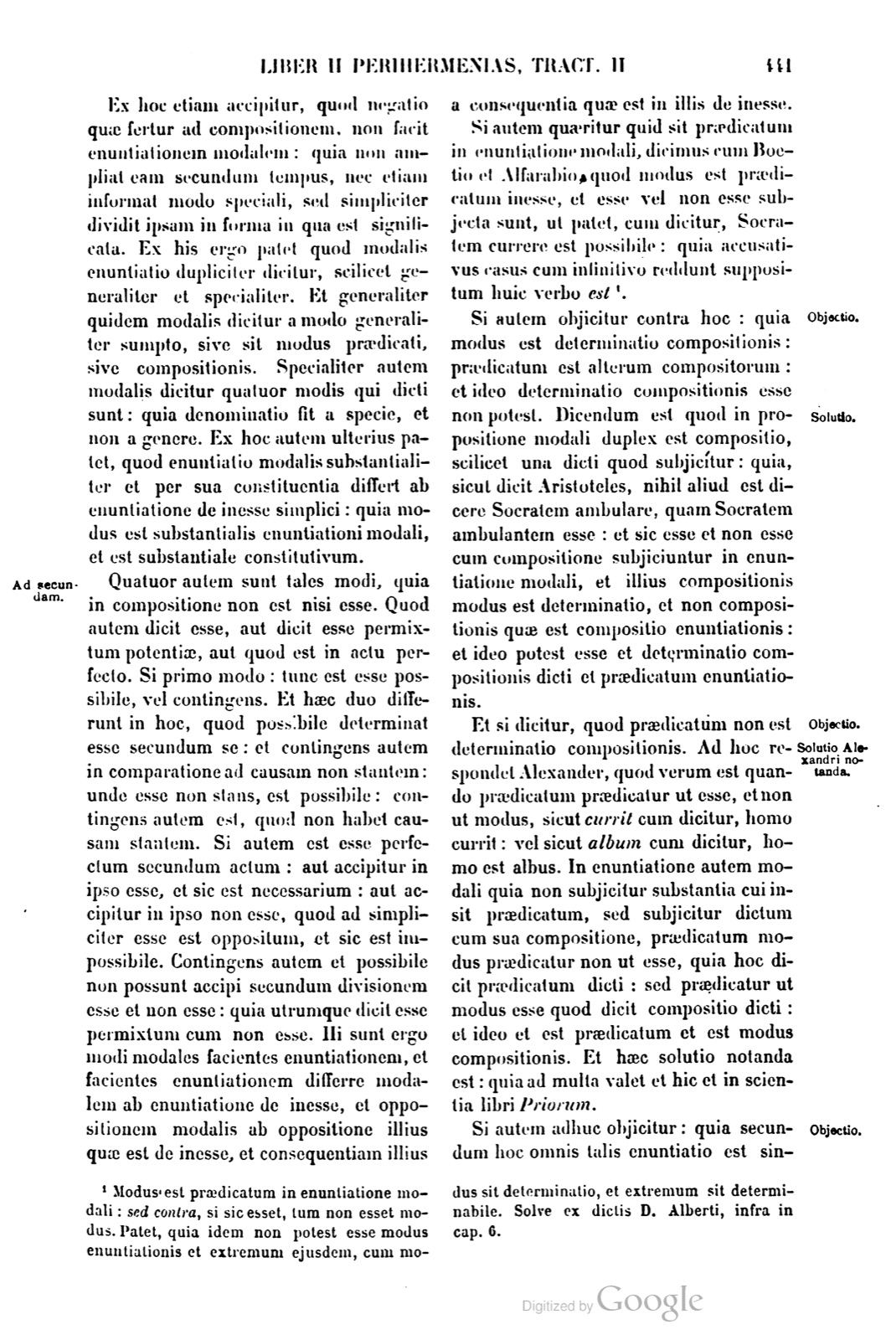
Quatuor autem sunt tales modi, quia in compositione non est nisi esse. Quod autem dicit esse, aut dicit esse permixtum potentiae, aut quod est in actu perfecto. Si primo modo: tunc est esse possibile, vel contingens. Et haec duo differunt in hoc, quod possibile determinat esse secundum se: et contingens autem in comparatione ad causam non stantem: unde esse non stans, est possibile: contingens autem est, quod non habet causam stantem. Si autem est esse perfectum secundum actum: aut accipitur in ipso esse, et sic est necessarium: aut accipitur in ipso non esse, quod ad simpliciter esse est oppositum, et sic est impossibile. Contingens autem et possibile non possunt accipi secundum divisionem esse et non esse: quia utrumque dicit esse permixtum cum non esse. Illi sunt ergo modi modales facientes enuntiationem, et facientes enuntiationem differre modalem ab enuntiatione de inesse, et oppositionem modalis ab oppositione illius quae est de inesse, et consequentiam illius a consequentia quae est in illis de inesse.
Si autem quaeritur quid sit praedicatum in enuntiatione modali, dicimus cum Boetio et Alfarabio, quod modus est praedicatum inesse, et esse vel non esse subjecta sunt, ut patet, cum dicitur, Socratem currere est possibile: quia accusativus casus cum infinitivo reddunt suppositum huic verbo est1.
### Marginal Labels - 441: Objectio.
Si autem objicitur contra hoc: quia modus est determinatio compositionis: praedicatum est alterum compositorum: et ideo determinatio compositionis esse non potest. Dicendum est quod in propositione modali duplex est compositio, scilicet una dicti quod subjicitur: quia, sicut dicit Aristoteles, nihil aliud est dicere Socratem ambulare, quam Socratem ambulantem esse: et sic esse et non esse cum compositione subjiciuntur in enuntiatione modali, et illius compositionis modus est determinatio, et non compositionis quae est compositio enuntiationis: et ideo potest esse et determinatio compositionis dicti et praedicatum enuntiationis.
### Marginal Labels - 441: Solutio. - 441: Objectio.
Et si dicitur, quod praedicatum non est determinatio compositionis. Ad hoc respondet Alexander, quod verum est quando praedicatum praedicatur ut esse, et non ut modus, sicut currit cum dicitur, homo currit: vel sicut album cum dicitur, homo est albus. In enuntiatione autem modali quia non subjicitur substantia cui insit praedicatum, sed subjicitur dictum cum sua compositione, praedicatum modus praedicatur non ut esse, quia hoc dicit praedicatum dicti: sed praedicatur ut modus esse quod dicit compositio dicti: et ideo et est praedicatum et est modus compositionis. Et haec solutio notanda est: quia ad multa valet et hic et in scientia libri Priorum.
### Marginal Labels - 441: To the second.
But there are four such modes, because in composition there is nothing except being. But that which says being either says being mixed with potency, or what is in perfect act. If in the first way, then it is possible or contingent being. And these two differ in this, that possible determines being according to itself, but contingent does so in comparison to a non-standing cause; whence non-standing being is possible, but contingent is that which does not have a standing cause. But if it is being perfected according to act, either it is taken in being itself, and thus it is necessary, or it is taken in not-being itself, which is opposed to being simply, and thus it is impossible. But contingent and possible cannot be taken according to the division of being and not-being, because each says being mixed with not-being. Therefore those are the modal modes making an enunciation, and making the modal enunciation differ from an enunciation about being-in, and the opposition of a modal from the opposition of that which is about being-in, and its consequence from the consequence which is in those about being-in.
But if it is asked what the predicate is in a modal enunciation, we say with Boethius and Alfarabius that the mode is the predicate in being-in, and being or not-being are subjects, as is clear when it is said, "that Socrates runs is possible," because the accusative case with the infinitive renders the suppositum for this verb "is"1.
### Marginal Labels - 441: Objection.
But if it is objected against this that mode is a determination of composition, while the predicate is one of the things composed, and therefore it cannot be the determination of composition: it must be said that in a modal proposition there is a twofold composition, namely one composition of the dictum which is subjected. For, as Aristotle says, to say "Socrates walking" is nothing other than to say "Socrates being walking"; and thus being and not-being, with composition, are subjected in a modal enunciation, and the mode is the determination of that composition, and not of the composition which is the composition of the enunciation. And therefore it can be both the determination of the composition of the dictum and the predicate of the enunciation.
### Marginal Labels - 441: Solution. - 441: Objection.
And if it is said that the predicate is not a determination of composition, Alexander answers to this that it is true when the predicate is predicated as being and not as a mode, as "runs" when it is said, "man runs," or as "white" when it is said, "man is white." But in a modal enunciation, because a substance in which the predicate inheres is not subjected, but the dictum with its composition is subjected, the predicate mode is predicated not as being, because this says the predicate of the dictum, but it is predicated as the mode of the being which the composition of the dictum states; and therefore it is both predicate and mode of composition. And this solution must be noted, because it is useful for many things both here and in the science of the book of the Prior Analytics.
### Marginal Labels - 441: Solutio Alexandri notanda. - 441: Objectio.
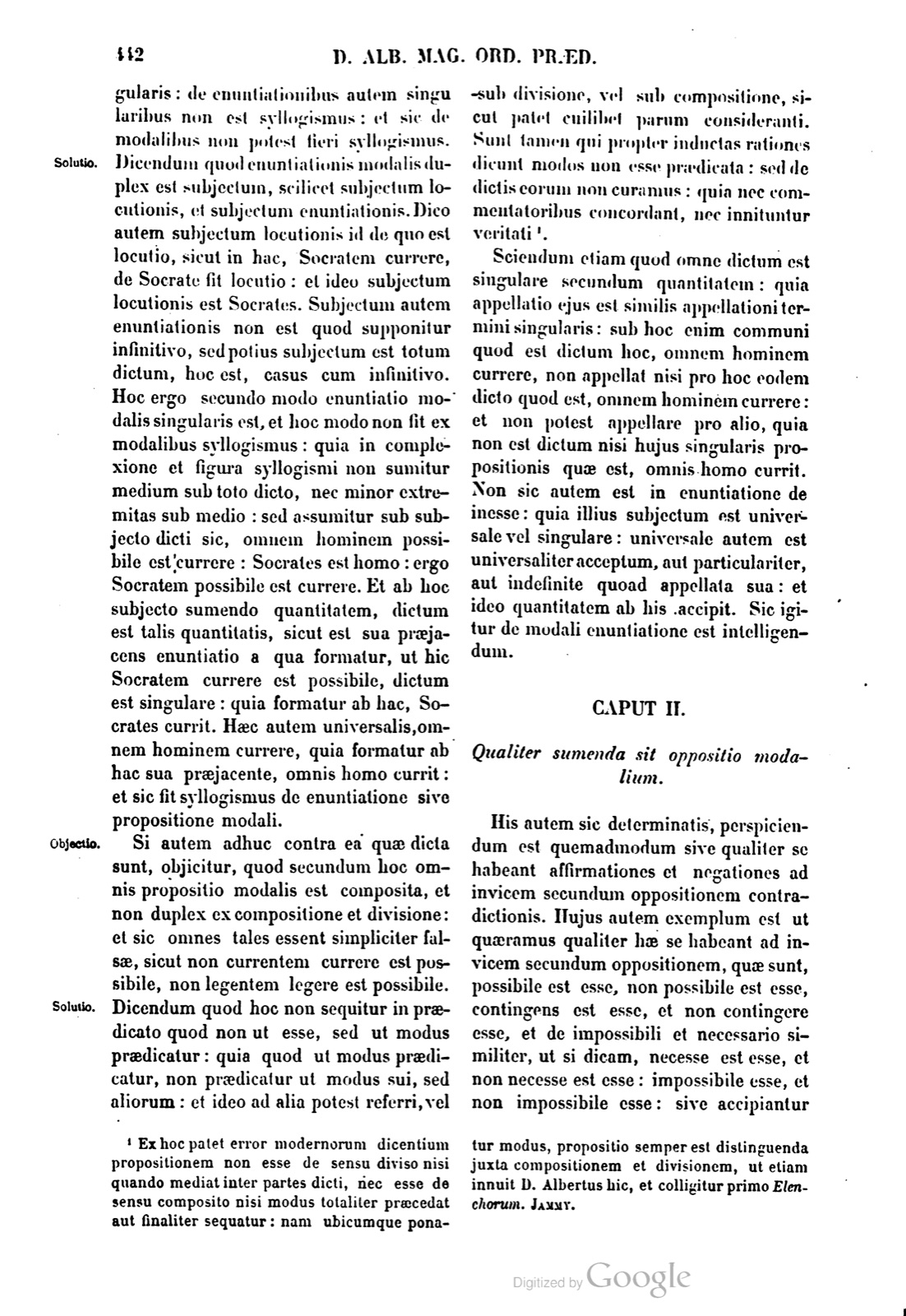
Si autem adhuc objicitur: quia secundum hoc omnis talis enuntiatio est singularis: de enuntiationibus autem singularibus non est syllogismus: et sic de modalibus non potest fieri syllogismus. Dicendum quod enuntiationis modalis duplex est subjectum, scilicet subjectum locutionis, et subjectum enuntiationis. Dico autem subjectum locutionis id de quo est locutio, sicut in hac, Socratem currere, de Socrate fit locutio: et ideo subjectum locutionis est Socrates. Subjectum autem enuntiationis non est quod supponitur infinitivo, sed potius subjectum est totum dictum, hoc est, casus cum infinitivo. Hoc ergo secundo modo enuntiatio modalis singularis est, et hoc modo non fit ex modalibus syllogismus: quia in complexione et figura syllogismi non sumitur medium sub toto dicto, nec minor extremitas sub medio: sed assumitur sub subjecto dicti sic, omnem hominem possibile est currere: Socrates est homo: ergo Socratem possibile est currere. Et ab hoc subjecto sumendo quantitatem, dictum est talis quantitatis, sicut est sua praejacens enuntiatio a qua formatur, ut hic Socratem currere est possibile, dictum est singulare: quia formatur ab hac, Socrates currit. Haec autem universalis, omnem hominem currere, quia formatur ab hac sua praejacente, omnis homo currit: et sic fit syllogismus de enuntiatione sive propositione modali.
### Marginal Labels - 442: Solutio. - 442: Objectio.
Si autem adhuc contra ea quae dicta sunt, objicitur, quod secundum hoc omnis propositio modalis est composita, et non duplex ex compositione et divisione: et sic omnes tales essent simpliciter falsae, sicut non currentem currere est possibile, non legentem legere est possibile. Dicendum quod hoc non sequitur in praedicato quod non ut esse, sed ut modus praedicatur: quia quod ut modus praedicatur, non praedicatur ut modus sui, sed aliorum: et ideo ad alia potest referri, vel sub divisione, vel sub compositione, sicut patet cuilibet parum consideranti. Sunt tamen qui propter inductas rationes dicunt modos non esse praedicata: sed de dictis eorum non curamus: quia nec commentatoribus concordant, nec innituntur veritati2.
### Marginal Labels - 442: Solutio.
Sciendum etiam quod omne dictum est singulare secundum quantitatem: quia appellatio ejus est similis appellationi termini singularis: sub hoc enim communi quod est dictum hoc, omnem hominem currere, non appellat nisi pro hoc eodem dicto quod est, omnem hominem currere: et non potest appellare pro alio, quia non est dictum nisi hujus singularis propositionis quae est, omnis homo currit. Non sic autem est in enuntiatione de inesse: quia illius subjectum est universale vel singulare: universale autem est universaliter acceptum, aut particulariter, aut indefinite quoad appellata sua: et ideo quantitatem ab his accipit. Sic igitur de modali enuntiatione est intelligendum.
### Marginal Labels - 441: Alexander's solution to be noted. - 441: Objection.
But if it is still objected that according to this every such enunciation is singular, while concerning singular enunciations there is no syllogism, and thus no syllogism can be made from modals: one must say that the subject of a modal enunciation is twofold, namely the subject of locution and the subject of enunciation. But I call the subject of locution that about which the locution is, as in this, "Socrates to run," the locution is made about Socrates; and therefore the subject of locution is Socrates. But the subject of enunciation is not what is supposed by the infinitive, but rather the subject is the whole dictum, that is, the case with the infinitive. Therefore in this second way a modal enunciation is singular, and in this way a syllogism is not made from modals, because in the complexion and figure of the syllogism the middle is not taken under the whole dictum, nor the minor extreme under the middle, but it is assumed under the subject of the dictum thus: "every man can run; Socrates is man; therefore Socrates can run." And by taking quantity from this subject, the dictum is of such quantity as its underlying enunciation from which it is formed, as here "that Socrates runs is possible," the dictum is singular, because it is formed from this, "Socrates runs." But this universal, "that every man runs," because it is formed from this its underlying proposition, "every man runs," and thus a syllogism is made about a modal enunciation or proposition.
### Marginal Labels - 442: Solution. - 442: Objection.
But if, still against those things which have been said, it is objected that according to this every modal proposition is composite and not twofold from composition and division, and thus all such would be false simply, as "that a non-running one runs is possible," "that a non-reading one reads is possible": one must say that this does not follow in a predicate which is predicated not as being but as a mode, because what is predicated as a mode is not predicated as a mode of itself, but of other things; and therefore it can be referred to other things, either under division or under composition, as is clear to anyone considering a little. Yet there are some who, on account of the reasons introduced, say that modes are not predicates; but we do not care about their sayings, because they neither agree with the commentators nor rest upon truth2.
### Marginal Labels - 442: Solution.
One must also know that every dictum is singular according to quantity, because its appellation is similar to the appellation of a singular term; for under this common thing which is this dictum, "that every man runs," it does not appell for anything except for this same dictum which is "that every man runs," and it cannot appell for another, because it is not the dictum except of this singular proposition which is "every man runs." But it is not so in an enunciation about being-in, because its subject is universal or singular; and the universal is taken universally, or particularly, or indefinitely with respect to its appellata, and therefore it receives quantity from these. Thus therefore one must understand concerning modal enunciation.
Notes
- The mode is the predicate in a modal enunciation; but on the contrary, if it were so, then it would not be a mode. This is clear, because the same thing cannot be the mode of an enunciation and an extreme of the same, since a mode is a determination, and an extreme is determinable. Solve from the sayings of D. Albert below in chapter 6. (Modus est praedicatum in enuntiatione modali: sed contra, si sic esset, tunc non esset modus. Patet, quia idem non potest esse modus enuntiationis et extremum ejusdem, cum modus sit determinatio, et extremum sit determinabile. Solve ex dictis D. Alberti, infra in cap. 6.) ↩
- From this is clear the error of the moderns who say that a proposition is not of the divided sense except when the mode stands between the parts of the dictum, nor of the composite sense unless the mode entirely precedes or finally follows; for wherever the mode is placed, the proposition must always be distinguished according to composition and division, as D. Albert also intimates here, and as is gathered from the first book of the Sophistical Refutations. Jammy. (Ex hoc patet error modernorum dicentium propositionem non esse de sensu diviso nisi quando mediat inter partes dicti, nec esse de sensu composito nisi modus totaliter praecedat aut finaliter sequatur: nam ubicumque ponatur modus, propositio semper est distinguenda juxta compositionem et divisionem, ut etiam innuit D. Albertus hic, et colligitur primo Elenchorum. JAMMY.) ↩
If a page does not appear, its photograph has not been uploaded yet.