Works › On Interpretation, Books I–II
Volume 1 · pp. 434–439
Chapter V. On The Consequence Of Enunciations In Which Many Things Are Said Of One Or One Thing Is Said Of Many.
A marker with ≈ is an approximate page boundary, placed by measure of the text; the page photographs remain the authority. In the paired views, clicking a page marker brings that page into view.
CAPUT V. De consequentia enuntiationum in quibus plura de uno vel unum de pluribus dicitur.
His autem habitis, determinandum est de enuntiationibus in quibus vel plura de uno subjecto praedicata dicuntur, vel de pluribus subjectis unum dicitur praedicatum. Cum enim quatuor sint secundum haec enuntiationum differentiae, scilicet quod unum de uno, vel plura de pluribus, vel plura de uno, vel unum de pluribus dicatur: jam satis dictum est de eis in quibus unum de uno dicitur. In quibus autem plura de pluribus dicuntur hic omittimus: quia non intendimus nisi de enuntiatione quae aliquo modo est una: illa vero in qua plura dicuntur de pluribus, nullo modo est una: ideo non est tractandum de ipsa. Cum ergo de his in quibus unum de uno dicitur jam tractatum sit, de his ergo in quibus de uno plura, vel unum de pluribus dicitur, nunc relinquitur esse dicendum.
Dicamus ergo si non est affirmare vel negare unum de pluribus, vel plura de uno, sed semper plura de pluribus affirmare vel negare: tunc talis affirmatio et negatio non est una aliquo modo: quia non est una ex parte subjecti, nec est una ex parte praedicati: et de tali enuntiatione hic non intendimus. In talibus autem dico unum non quod est unum voce tantum, sicut in aequivocis, sicut si unum nomen pluribus impositum sit, quod tamen actu plura et aeque principaliter significat, ex quibus pluribus non fit unum per essentiam vel per accidens, sicut si dicam interrupta pronuntiatione vel prolatione, animal et mansuetum et bipes: haec enim sic prolata unam enuntiationem non faciunt: quia unumquodque eorum significatur ut actus: actus autem ut actus nihil unum constituunt. Si autem pronuntientur continue ut actus et potentia, ut dicatur animal mansuetum bipes, ex his unum fit quod uno nomine dicitur, quod est homo, quod nomen non plura significat, sed unum: quia actus et potentia sunt unum. Et ideo dixi fortasse1: quia si hoc nomen, homo, esset animali et mansueto et bipedi impositum divisim ut actibus, non oporteret esse in significando unum, nec in supponendo, nec in praedicando. Quando autem imponitur his quae dicta sunt sicut potentiae et actui, tunc stat pro uno, sive sit subjectum, sive praedicatum. Ex albo et ambulante non fit unum subjectum: quia nec faciunt unum secundum substantiam vel essentiam, nec unum per accidens: quia quamvis homo et album et ambulans possint esse unum subjectum secundum substantiam quae substat utrique, tamen in enuntiatione veram rationem supponendi sive substandi verbo non habent homo albus, et homo ambulans: et ideo aliud subjectum est homo albus, et aliud homo ambulans, et aliud album ambulans.
Propter quod etiam si aliquis de tali subjecto quod est plura, affirmet aliquid verum praedicatum, non propter hoc erit affirmatio una. Similiter autem est si taliter, ut dictum est, plura praedicet de uno subjecto: plures enim est illa enuntiatio in qua unum de pluribus, vel in qua plura de uno, vel in qua plura de pluribus praedicantur, sicut in priori hujus scientiae libro determinatum est. In talibus ergo enuntiationibus quae non unae, sed plures sunt, vox quidem una est quando una et non interpolata fit pronuntiatio: sed tamen affirmationes vel negationes sunt multae. Quod autem plures sit hujusmodi enuntiatio ex hoc patet: quia si omnis dialectica interrogatio est responsionis petitio: et hoc modo petit opponens fieri sibi responsionem quo interrogat: petit enim a respondente propositionem affirmativam vel negativam quae est altera pars contradictionis2. Tunc si ita est, sicut dictum est, quod propositio affirmativa non est nisi unius contradictionis: quia una propositio non habet nisi unam contradictorie oppositam: tunc hujusmodi interrogationi quae plura significat, ut dictum est, non erit una dialectica responsio, sicut nec una fuit interrogatio. Quamvis forte in toto sive in pluribus illis quae supponuntur vel praedicantur sit una: quia a sophistis qui cavendi sunt, posset argui talis responsio. De his autem qualiter interrogandum et qualiter respondendum sit, in dialecticis Topicis dictum est. In Topicis autem elenchis (quia et sophistici et elenchi topica sunt quaedam) dictum est de interrogatione plures ut una.
CHAPTER V. On the consequence of enunciations in which many things are said of one, or one thing is said of many.
But with these things held, one must determine concerning enunciations in which either many predicates are said of one subject, or one predicate is said of many subjects. For since there are four differences of enunciations according to these things, namely that one thing is said of one, or many of many, or many of one, or one of many, enough has already been said about those in which one thing is said of one. But those in which many things are said of many we omit here, because we intend only an enunciation which in some way is one. But that in which many things are said of many is in no way one; therefore it must not be treated. Since therefore it has already been treated concerning those in which one thing is said of one, it remains now to speak concerning those in which many things are said of one, or one thing is said of many.
Therefore let us say: if it is not to affirm or deny one thing of many, or many things of one, but always to affirm or deny many things of many, then such affirmation and negation is not one in any way, because it is not one on the part of the subject, nor is it one on the part of the predicate; and we do not intend such an enunciation here. But in such cases I call one not what is one only in voice, as in equivocal terms, as if one name has been imposed on many things, which nevertheless actually signifies many things and equally principally, from which many things no one thing comes to be through essence or through accident; as if I were to say, with interrupted pronouncing or utterance, "animal and tame and two-footed." For these, uttered in this way, do not make one enunciation, because each of them is signified as an act, and acts as acts constitute no one thing. But if they are pronounced continuously as act and potency, so that "two-footed tame animal" is said, from these one thing comes to be which is said by one name, which is man; that name does not signify many things, but one, because act and potency are one. And therefore I said "perhaps"1, because if this name, "man," had been imposed separately on animal and tame and two-footed as on acts, it would not have to be one in signifying, nor in supposing, nor in predicating. But when it is imposed on those things which have been said as on potencies and act, then it stands for one, whether it is subject or predicate. From white and walking one subject does not come to be, because they do not make one thing according to substance or essence, nor one thing through accident; because although man and white and walking can be one subject according to the substance which underlies each, nevertheless in an enunciation "white man" and "walking man" do not have the true account of supposing or standing under the verb; and therefore white man is one subject, walking man another, and white walking thing another.
On account of this also, if someone affirms some true predicate of such a subject which is many, the affirmation will not on this account be one. But it is similar if, in the way stated, he predicates many things of one subject; for that enunciation is many in which one thing is predicated of many, or in which many things are predicated of one, or in which many things are predicated of many, as was determined in the prior book of this science. Therefore in such enunciations, which are not one but many, the voice indeed is one when the pronunciation is one and not interrupted; yet nevertheless the affirmations or negations are many. But that such an enunciation is many is clear from this: because if every dialectical interrogation is a request for a response, and in this way the opponent asks that a response be made to him by the way in which he interrogates, for he asks from the respondent an affirmative or negative proposition which is the other part of a contradiction2, then, if it is as has been said, that an affirmative proposition belongs only to one contradiction, because one proposition has only one contradictorily opposed proposition, there will not be one dialectical response to an interrogation of this sort which signifies many things, as was said, just as neither was there one interrogation. Although perhaps in the whole, or in those many things which are supposed or predicated, there may be one response, because such a response could be argued by sophists who must be guarded against. But in the dialectical Topics it has been said how one must interrogate and how one must respond about these things. But in the Topics on elenchi, because both sophistical arguments and elenchi are certain topical things, it has been said concerning an interrogation of many things as one.
Patet etiam similiter, quod propter hoc quod dialectica interrogatio petitio est responsionis per alteram partem contradictionis (quamcumque partem respondens elegerit) quod de quaestione quid est non est dialectica interrogatio, ut si quis interroget, quid est animal per diffinitionem et substantiam? In dialectica autem interrogatione oportet respondentem ex data quacumque dialectica interrogatione eligere utram velit partem contradictionis. In tali enim interrogatione oportet interrogationem determinare utrum homo sit animal de quo interrogat, vel non: hoc autem non licet in quaestione quid est, in qua est determinata responsio diffinitionis3.
Ex omnibus autem inductis constat quod plures enuntiatio de qua hic intendimus, est in qua vel plura de uno vel de pluribus unum enuntiatur. Istae enim enuntiationes aliquid de unitate habent: et ideo de his intendimus ad praesens. Quaeramus ergo de illis, utrum ea plura quae composita sive conjuncta praedicantur de aliquo uno subjecto, praedicentur divisa de eodem subjecto communi. Ad hoc autem determinandum accipiamus illud quod jam determinatum est, quod scilicet quaedam praedicantur composita de uno subjecto quae sic conjuncta sunt, ut omne sive totum praedicamentum sive totum praedicatum fiat ex omnibus illis vel substantialiter vel essentialiter, ita quod quodlibet suppositorum conjunctorum extra compositionem divisim acceptum per se inferat subjectum quando sumitur extra compositionem. Si enim quaeramus sic aut enuntiemus quod eorum quae conjuncta praedicantur plura de uno subjecto conjuncta sive composita, quaedam de toto composito praedicantur divisim, et quaedam conjunctim, convenientia non praedicantur de toto divisim, quae sic differentia sunt inter haec et illa, ut de homine verum est dicere quod est animal bipes: et iterum verum est dicere extra sive divisim, quod homo est animal, et quod homo est bipes. Et similiter de hoc toto conjuncto quod est animal bipes, verum est dicere, quod est animal: quia animal bipes est animal. Et iterum de hoc eodem verum est dicere, quod est bipes: quia animal bipes est bipes, divisim praedicatum: et de homine (quod implicite est animal bipes) verum est dicere, quod est animal divisim, et quod est bipes: haec enim conjunctim et sine interruptione prolata praedicatur, prout unum est ex ipsis, sive prout ipsa sunt unum. Similiter cum dicitur conjunctim homo albus, de hoc praedicatur divisim et albus et homo: quia homo albus est albus, et homo albus est homo. Et haec etiam praedicantur ut unum subjecto et unum per accidens: quia album non habet rationem supponendi vel substandi nisi per subjectum in quo est: et ideo hoc fuit subjecto unum sive substando: et non multiplicatur in eis ratio substandi cum non sint unum per substantiam et essentiam.
It is also similarly clear that, because dialectical interrogation is a request for a response through the other part of a contradiction, whichever part the respondent chooses, there is no dialectical interrogation about the question "what is it?" as if someone asks, "What is animal through definition and substance?" But in a dialectical interrogation the respondent must, from any given dialectical interrogation, choose whichever part of the contradiction he wishes. For in such an interrogation it is necessary that the interrogation determine whether man is the animal about which it asks, or not. But this is not permitted in the question "what is it?" in which the response of definition is determined3.
But from all the things introduced it is established that the many enunciation about which we intend here is that in which either many things are enunciated of one or one thing of many. For those enunciations have something of unity, and therefore we intend them for the present. Therefore let us ask about them whether the many things which are predicated compositely or conjointly of some one subject are predicated separately of the same common subject. But to determine this we should take what has already been determined, namely that certain things are predicated compositely of one subject which are so conjoined that the whole category or whole predicate comes to be from all those things either substantially or essentially, so that any of the things joined, taken separately outside the composition, of itself entails the subject when it is taken outside the composition. For if we ask in this way or enunciate that, of those things which are predicated conjointly, many of one subject, joined or composed, certain things are predicated separately of the whole composite, and certain things conjointly, things fitting together are not predicated separately of the whole, which are different in this way between these and those: as of man it is true to say that he is a two-footed animal; and again it is true to say outside the composition or separately that man is animal and that man is two-footed. And similarly of this whole conjoined thing which is two-footed animal, it is true to say that it is animal, because two-footed animal is animal. And again of this same thing it is true to say that it is two-footed, because two-footed animal is two-footed, with the predicate taken separately; and of man, who implicitly is two-footed animal, it is true to say separately that he is animal and that he is two-footed. For these are predicated conjointly and uttered without interruption insofar as one thing is from them, or insofar as they themselves are one. Likewise when "white man" is said conjointly, white and man are predicated separately of this, because white man is white and white man is man. And these are also predicated as one thing in subject and one thing through accident, because white does not have the account of supposing or standing under except through the subject in which it is; and therefore this was one with the subject or in standing under, and the account of standing under is not multiplied in them, since they are not one through substance and essence.
Hoc autem in omnibus non est similiter. Si enim dicam, iste est citharaedus bonus, haec quidem conjunctim praedicantur de isto homine: et tamen divisim non valet praedicatio. Si enim dicam, iste est citharaedus bonus, vera est praedicatio si sit ita in re sicut enuntiatur in praedicatione: tamen non sequitur, iste est citharaedus bonus: igitur iste est citharaedus, et iste est bonus: nec sequitur etiam, est citharaedus et est bonus, ergo est citharaedus bonus. Si enim concedatur, quod quotiescumque duorum vel plurium alterutrum conjunctim dicatur de aliquo, utrumque duorum vel utrumque trium quae conjuncta dicuntur, divisim de eodem praedicantur, multa sequuntur inconvenientia. Sequitur enim primo in talibus, quod nugatio in multis erit explicita: nam de homine conjunctim et divisim verum est dicere, et quod est homo, et quod est albus. Si ergo utrumque illorum divisim verum est dicere de toto conjuncto: tunc verum est dicere de homine albo, quod est homo, et quod est albus, et sic homo albus est homo: et hoc est iterum conjungere, ut dicatur, homo albus homo: et de hoc conjuncto verum est dicere iterum divisim, quod est homo: ergo homo homo albus, est homo: ergo est homo, homo homo albus. Et similiter est de eo quod est album: quia homo albus est album: et de hoc toto dicetur album: ergo homo albus albus est albus: et hoc procedit in infinitum. Et similiter si dicam, homo est musicus ambulans quae conjunctim conveniunt homini. Et si de toto conjuncto ea quae conjuncta sunt, praedicantur divisim, nugatio erit, et nugando procedetur in infinitum: haec enim et implicita sive conjunctim sunt convenientia subjecto: quia subjecto actu et intellectu et voce sunt conjuncta. Si iterum dicuntur de eo divisim, erit nugatio explicita et expressa.
Amplius autem in substantialibus ex quibus fit unum per substantiam, idem sequitur inconveniens, si de toto conjuncto divisim praedicentur, quae composita subjecto conveniunt. Si enim propter hoc quod Socrates divisim et homo est, et bipes, etiam homo bipes est homo et bipes: et sic homo bipes est homo: et de hoc conjuncto iterum praedicatur homo: et sic homo bipes est homo homo bipes: et eadem ratione erit homo bipes homo homo homo bipes: et sic procedur nugando in infinitum per hunc modum. Manifestum est ergo quod plura contingunt inconvenientia si quis ponat complexionem, hoc est, compositam praedicationem fieri de his quae divisim toti composito conveniunt, sicut jam in parte ostensum est.
Quod si de composito componentia divisim praedicantur tam in accidentibus praedicatis quam in substantialibus, amplius hoc etiam deducetur ad nugationem implicitam: si enim quaecumque praedicantur conjunctim, praedicantur etiam divisim: cum sciamus, quod Socrates est et homo divisim, et bipes divisim, secundum hoc Socrates erit homo bipes conjunctim: et de hoc toto conjuncto praedicatur et homo et bipes: ergo Socrates homo bipes erit homo et erit bipes: et iterum illa conjunctim dicentur de Socrate homine bipede: ergo Socrates erit homo homo bipes bipes: et hoc procedet in infinitum sicut prius. Adhuc in homine actu et intellectu est bipes: addere ergo non oportet: et si addatur, erit nugatio. Si enim sic dicatur: Socrates est homo, per hoc quod dico homo, ponitur et bipes: et bipes etiam additur: ergo Socrates est homo bipes bipes. Similiter statim nominato Socrate intelligitur homo: si enim dicam, Socrates homo, sequitur quod Socrates est homo homo: et sic in infinitum. Et scias quod hunc modum sic ponit Alfarabius, nec aliter exponi potest quod perspicue sit verum quod hic ponitur.
But this is not similar in all cases. For if I say, "this man is a good lyre-player," these indeed are predicated conjointly of this man; and nevertheless the predication is not valid separately. For if I say, "this man is a good lyre-player," the predication is true if it is so in reality as is enunciated in the predication; nevertheless it does not follow, "this man is a good lyre-player; therefore this man is a lyre-player and this man is good." Nor does it also follow, "he is a lyre-player and is good; therefore he is a good lyre-player." For if it were granted that whenever one of two or more things is said conjointly of something, each of the two or each of the three things which are said conjointly is predicated separately of the same thing, many inconveniences follow. For first in such cases it follows that in many things useless repetition will be explicit: for of man, conjointly and separately, it is true to say both that he is man and that he is white. Therefore if each of these is true to say separately of the whole conjoined thing, then it is true to say of white man that he is man and that he is white, and thus white man is man; and this is to conjoin again, so that "white man man" is said. And of this conjoined thing it is again true to say separately that it is man; therefore man-man-white is man; therefore he is man, man-man-white. And it is similar concerning that which is white, because white man is white; and white will be said of this whole; therefore white-man-white is white; and this proceeds to infinity. And similarly if I say, "man is musical walking," which conjointly belong to man. And if of the whole conjoined thing those things which are conjoined are predicated separately, there will be useless repetition, and by repeating uselessly one will proceed to infinity. For these are both implicit or conjointly fitting the subject, because they are conjoined to the subject in act and in understanding and in voice. If they are again said of it separately, there will be explicit and expressed useless repetition.
Moreover, in substantial things from which one thing comes to be through substance, the same inconvenience follows if, of the whole conjoined thing, those things which compositely belong to the subject are predicated separately. For if, because Socrates separately is both man and two-footed, two-footed man also is man and two-footed, then two-footed man is man; and of this conjoined thing man is again predicated; and thus two-footed man is two-footed man-man; and by the same reason there will be two-footed man man man man two-footed; and so by this manner one proceeds by useless repetition to infinity. Therefore it is manifest that many inconveniences happen if someone posits that a complex, that is, a composite predication, is made from those things which separately belong to the whole composite, as has already been shown in part.
But if the components are predicated separately of the composite, both in accidental predicates and in substantial predicates, this will further also be led back to implicit useless repetition. For if whatever things are predicated conjointly are also predicated separately, since we know that Socrates is both man separately and two-footed separately, according to this Socrates will be two-footed man conjointly; and of this whole conjoined thing both man and two-footed are predicated. Therefore Socrates the two-footed man will be man and will be two-footed; and again those will be said conjointly of Socrates the two-footed man. Therefore Socrates will be man-man two-footed-two-footed; and this will proceed to infinity as before. Moreover, in man, in act and in understanding, two-footed is present; therefore it is not necessary to add it, and if it is added, there will be useless repetition. For if it is said thus, "Socrates is man," through this which I say, "man," two-footed also is posited; and two-footed also is added. Therefore Socrates is two-footed two-footed man. Likewise, as soon as Socrates is named, man is understood. For if I say, "Socrates man," it follows that Socrates is man-man, and so on to infinity. And know that Alfarabius posits this manner so, and it cannot be expounded otherwise so that what is placed here may be clearly true.
### Marginal Labels - 437: Expositio Alfarabii.
Quaecumque ergo sunt de numero eorum quae praedicantur, vel quaecumque sunt etiam de numero subjectorum de quibus illa praedicantur, sunt talia quae secundum accidens praedicantur de aliquo: vel talia sunt, quod secundum accidens praedicatur unum eorum de reliquo, haec divisim convenientia non erunt unum conjunctim praedicatum: ut si dicam divisim, homo est albus, et homo est musicus, non erit idem compositum praedicatum musicus et albus: quia ista sunt accidentia eidem, et e converso: et unum eorum non est sicut potentia, et alterum ut actus: et ideo non faciunt unum conjunctum praedicatum: unde quamvis aliquando sit verum dicere album esse musicum, hoc est, quod aliquis albus est musicus, non tamen propter hoc erit unum conjunctum praedicatum ex his quae sunt album et musicum, sicut unum fit ex potentia et actu, ut si dicatur coloratum album: haec enim conjuncta sicut actus et potentia unum actum faciunt praedicatum.
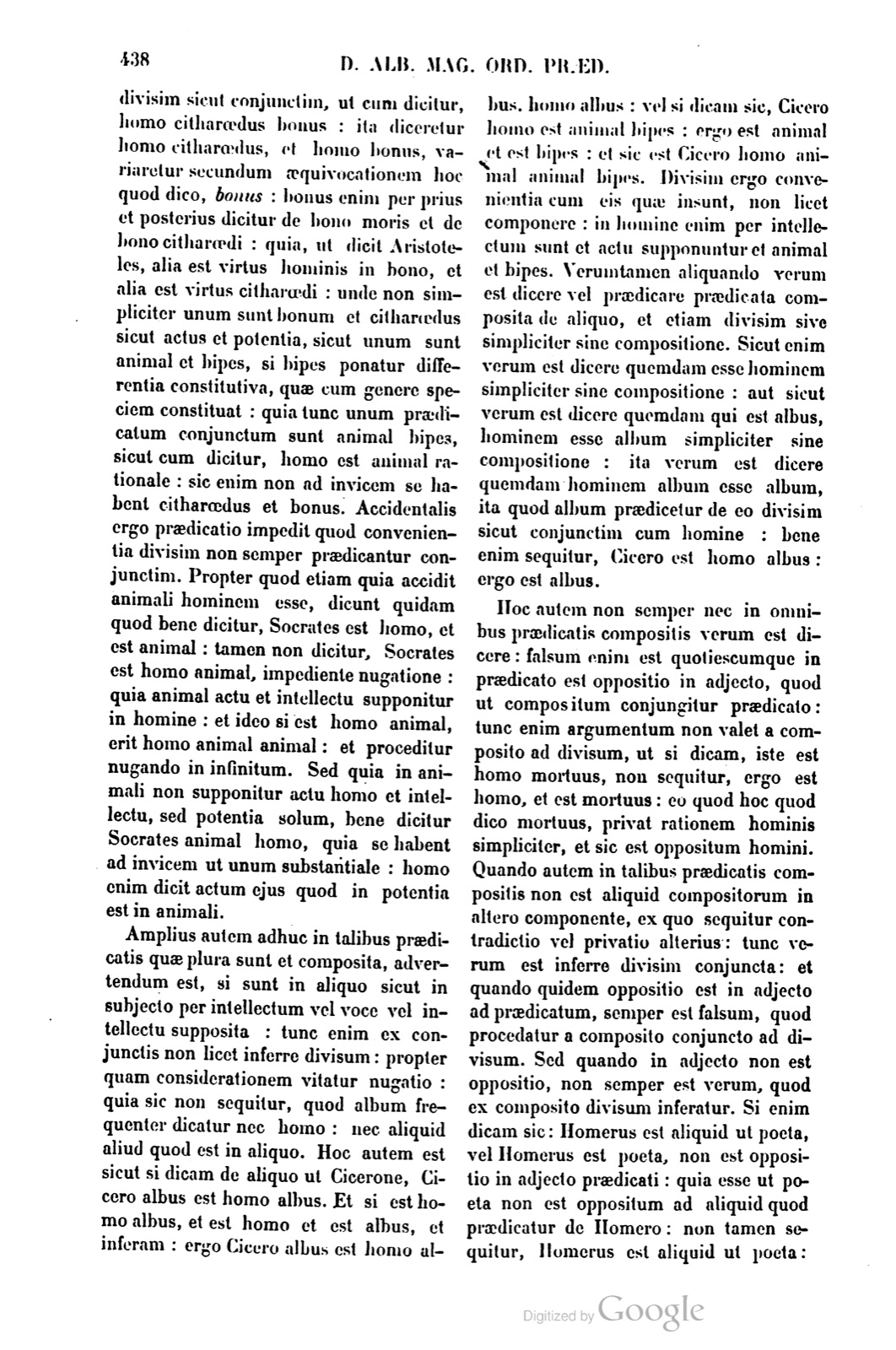
Ex quo sequitur quod nec illa quae superius inducta sunt, cum dicitur si citharaedus bonus sit, non fuit simpliciter unum, hoc est, universaliter unum praedicatum: quoniam hoc quod dico bonus, non semper dicit bonitatem citharaedi: sed quando simpliciter praedicatur sine eo cui adjungitur circa quod ponit formam suae bonitatis, dicit bonitatem ejus quo praedicatur, ut cum dicitur, homo est bonus, dicit hominis bonitatem et non citharaedi. Et ideo si illa praedicentur divisim sicut conjunctim, ut cum dicitur, homo citharaedus bonus: ita diceretur homo citharaedus, et homo bonus, variaretur secundum aequivocationem hoc quod dico, bonus: bonus enim per prius et posterius dicitur de bono moris et de bono citharaedi: quia, ut dicit Aristoteles, alia est virtus hominis in bono, et alia est virtus citharaedi: unde non simpliciter unum sunt bonum et citharaedus sicut actus et potentia, sicut unum sunt animal et bipes, si bipes ponatur differentia constitutiva, quae cum genere speciem constituat: quia tunc unum praedicatum conjunctum sunt animal bipes, sicut cum dicitur, homo est animal rationale: sic enim non ad invicem se habent citharaedus et bonus. Accidentalis ergo praedicatio impedit quod convenientia divisim non semper praedicantur conjunctim. Propter quod etiam quia accidit animali hominem esse, dicunt quidam quod bene dicitur, Socrates est homo, et est animal: tamen non dicitur, Socrates est homo animal, impediente nugatione: quia animal actu et intellectu supponitur in homine: et ideo si est homo animal, erit homo animal animal: et proceditur nugando in infinitum. Sed quia in animali non supponitur actu homo et intellectu, sed potentia solum, bene dicitur Socrates animal homo, quia se habent ad invicem ut unum substantiale: homo enim dicit actum ejus quod in potentia est in animali.
### Marginal Labels - 437: Exposition of Alfarabius.
Therefore whatever things are of the number of those which are predicated, or whatever things also are of the number of subjects of which those things are predicated, are such as are predicated of something according to accident; or they are such that one of them is predicated of the other according to accident. These, fitting separately, will not be one conjoined predicate: as if I say separately, "man is white" and "man is musical," there will not be the same composite predicate, musical and white, because those are accidents of the same thing, and conversely; and one of them is not as potency and the other as act, and therefore they do not make one conjoined predicate. Hence, although it is sometimes true to say that white is musical, that is, that some white thing is musical, nevertheless on account of this there will not be one conjoined predicate from these which are white and musical, as one thing comes to be from potency and act, as if "colored white" is said; for these, conjoined as act and potency, make one actual predicate.
From this it follows that neither were those things introduced above, when it is said "if he is a good lyre-player," simply one, that is, universally one predicate, since this which I say, "good," does not always state the goodness of the lyre-player; but when it is predicated simply without that to which it is joined and around which it posits the form of its goodness, it states the goodness of that of which it is predicated, as when it is said, "man is good," it states the goodness of man and not of the lyre-player. And therefore, if those things are predicated separately as conjointly, as when it is said, "good lyre-player man," so "lyre-player man" and "good man" would be said, then what I say, "good," would be varied according to equivocation. For good is said according to prior and posterior of moral good and of the good of a lyre-player, because, as Aristotle says, the virtue of a man in the good is one thing, and the virtue of a lyre-player another. Hence good and lyre-player are not one simply as act and potency, as animal and two-footed are one, if two-footed is posited as a constitutive difference which, with the genus, constitutes the species; because then two-footed animal is one conjoined predicate, as when it is said, "man is rational animal." For lyre-player and good are not related to one another in this way. Therefore accidental predication prevents things fitting separately from always being predicated conjointly. On account of this also, because to be man happens to animal, some say that it is well said, "Socrates is man and is animal"; nevertheless it is not said, "Socrates is man animal," useless repetition preventing it, because animal is supposed in man in act and in understanding; and therefore if he is man-animal, he will be man-animal-animal, and one proceeds by useless repetition to infinity. But because man is not supposed in animal in act and understanding, but only in potency, it is well said "Socrates is animal man," because they are related to each other as one substantial thing; for man states the act of that which is in potency in animal.
Amplius autem adhuc in talibus praedicatis quae plura sunt et composita, advertendum est, si sunt in aliquo sicut in subjecto per intellectum vel voce vel intellectu supposita: tunc enim ex conjunctis non licet inferre divisum: propter quam considerationem vitatur nugatio: quia sic non sequitur, quod album frequenter dicatur nec homo: nec aliquid aliud quod est in aliquo. Hoc autem est sicut si dicam de aliquo ut Cicerone, Cicero albus est homo albus. Et si est homo albus, et est homo et est albus, et inferam: ergo Cicero albus est homo albus, homo albus: vel si dicam sic, Cicero homo est animal bipes: ergo est animal et est bipes: et sic est Cicero homo animal animal bipes. Divisim ergo convenientia cum eis quae insunt, non licet componere: in homine enim per intellectum sunt et actu supponuntur et animal et bipes. Verumtamen aliquando verum est dicere vel praedicare praedicata composita de aliquo, et etiam divisim sive simpliciter sine compositione. Sicut enim verum est dicere quemdam esse hominem simpliciter sine compositione: aut sicut verum est dicere quemdam qui est albus, hominem esse album simpliciter sine compositione: ita verum est dicere quemdam hominem album esse album, ita quod album praedicetur de eo divisim sicut conjunctim cum homine: bene enim sequitur, Cicero est homo albus: ergo est albus.
Hoc autem non semper nec in omnibus praedicatis compositis verum est dicere: falsum enim est quotiescumque in praedicato est oppositio in adjecto, quod compositum conjungitur praedicato: tunc enim argumentum non valet a composito ad divisum, ut si dicam, iste est homo mortuus, non sequitur, ergo est homo, et est mortuus: eo quod hoc quod dico mortuus, privat rationem hominis simpliciter, et sic est oppositum homini. Quando autem in talibus praedicatis compositis non est aliquid compositorum in altero componente, ex quo sequitur contradictio vel privatio alterius: tunc verum est inferre divisim conjuncta: et quando quidem oppositio est in adjecto ad praedicatum, semper est falsum, quod procedatur a composito conjuncto ad divisum. Sed quando in adjecto non est oppositio, non semper est verum, quod ex composito divisum inferatur. Si enim dicam sic: Homerus est aliquid ut poeta, vel Homerus est poeta, non est oppositio in adjecto praedicati: quia esse ut poeta non est oppositum ad aliquid quod praedicatur de Homero: non tamen sequitur, Homerus est aliquid ut poeta: ergo est aliquid, et est poeta: quia esse ut poetam accidit Homero: et ideo ex tali accidente non infertur esse simpliciter: quia esse ut poetam Homero est esse secundum quid, et hoc non infert esse simpliciter. Adhuc autem ponitur expressius aliud exemplum quod est: Homerus vivit ut poeta, non sequitur, ergo vivit: vivere enim ut poeta est vivere in memoria poesis quam fecit.
Moreover, further in such predicates which are many and composite, one must observe whether they are in something as in a subject through understanding or in voice or supposed in understanding. For then from the conjoined things it is not permitted to infer the divided thing; by this consideration useless repetition is avoided, because thus it does not follow that white is said frequently, nor man, nor anything else which is in something. This is as if I say of someone, as of Cicero, "white Cicero is white man." And if he is white man, and is man and is white, and I infer, "therefore white Cicero is white man, white man"; or if I say thus, "Cicero man is two-footed animal; therefore he is animal and is two-footed," and thus Cicero man is animal-animal two-footed. Therefore things fitting separately, with those things which are present in them, must not be composed; for in man, through understanding, both animal and two-footed are present and are actually supposed. Nevertheless sometimes it is true to say or predicate composite predicates of something, and also separately or simply without composition. For just as it is true to say that someone is man simply without composition, or just as it is true to say that someone who is white is a white man simply without composition, so it is true to say that some white man is white, so that white is predicated of him separately as conjointly with man; for it follows well, "Cicero is a white man; therefore he is white."
But this is not always nor in all composite predicates true to say; for it is false whenever in the predicate there is opposition in the adjective, because the composite is joined to the predicate. For then the argument is not valid from the composite to the divided, as if I say, "this is a dead man," it does not follow, "therefore he is man and is dead," because this which I say, "dead," deprives the account of man simply, and thus is opposed to man. But when in such composite predicates there is not something of the things composed in the other component, from which contradiction or privation of the other follows, then it is true to infer separately the conjoined things. And indeed when the opposition is in the adjective with respect to the predicate, it is always false that one proceed from the conjoined composite to the divided. But when there is not opposition in the adjective, it is not always true that the divided is inferred from the composite. For if I say thus, "Homer is something as poet," or "Homer is poet," there is no opposition in the adjective of the predicate, because being as poet is not opposed to anything that is predicated of Homer. Nevertheless it does not follow, "Homer is something as poet; therefore he is something and is poet," because to be as poet happens to Homer; and therefore from such an accident being simply is not inferred, because to be as poet for Homer is to be in a qualified respect, and this does not infer being simply. Moreover, another more express example is posited, which is: "Homer lives as poet"; it does not follow, "therefore he lives," for to live as poet is to live in the memory of the poetry which he made.
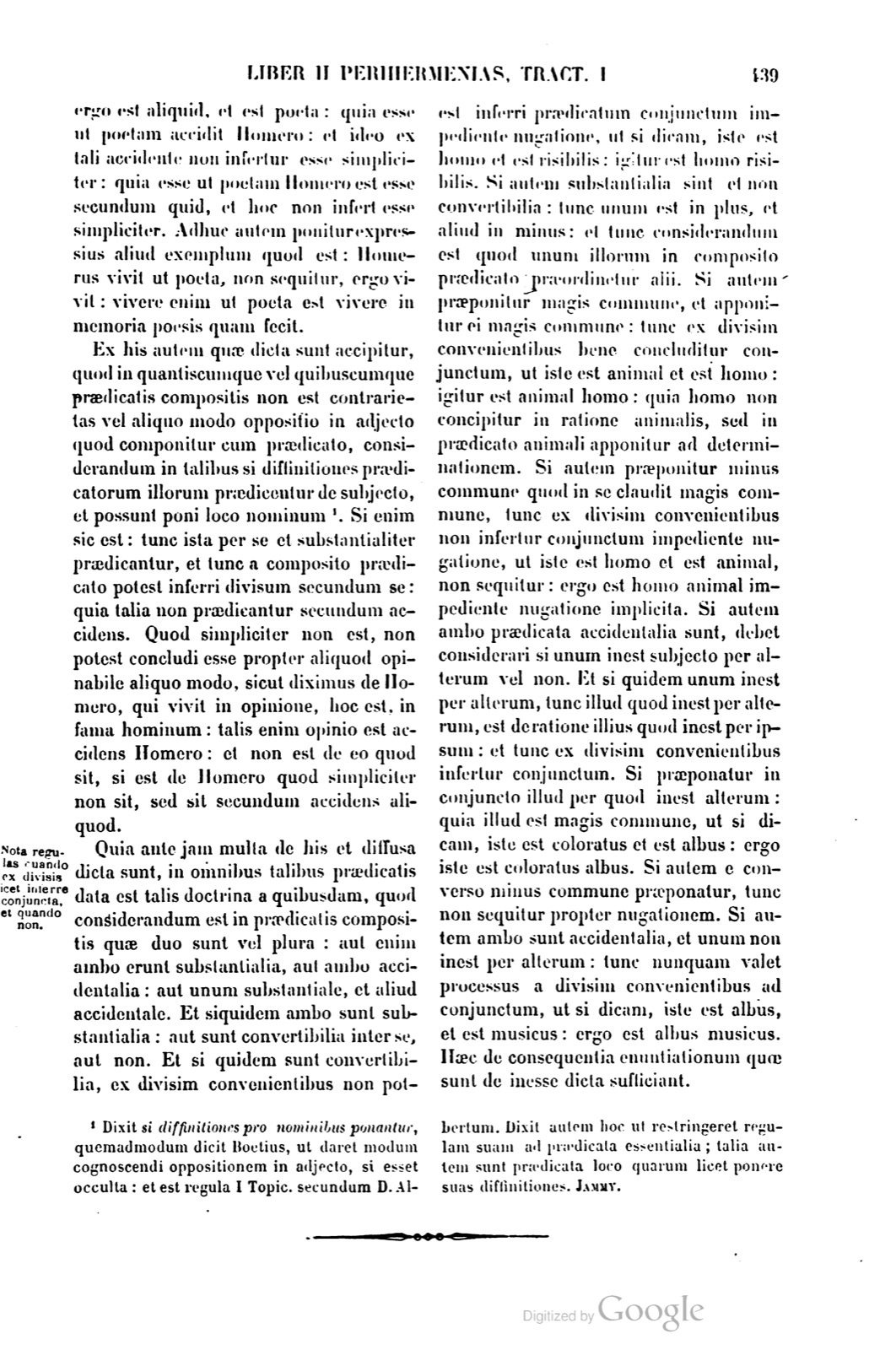
Ex his autem quae dicta sunt accipitur, quod in quantiscumque vel quibuscumque praedicatis compositis non est contrarietas vel aliquo modo oppositio in adjecto quod componitur cum praedicato, considerandum in talibus si diffinitiones praedicatorum illorum praedicentur de subjecto, et possunt poni loco nominum4. Si enim sic est: tunc ista per se et substantialiter praedicantur, et tunc a composito praedicato potest inferri divisum secundum se: quia talia non praedicantur secundum accidens. Quod simpliciter non est, non potest concludi esse propter aliquod opinabile aliquo modo, sicut diximus de Homero, qui vivit in opinione, hoc est, in fama hominum: talis enim opinio est accidens Homero: et non est de eo quod sit, si est de Homero quod simpliciter non sit, sed sit secundum accidens aliquid.
### Marginal Labels - 439: Nota regulas quando ex divisis licet inferre conjuncta, et quando non.
Quia ante jam multa de his et diffusa dicta sunt, in omnibus talibus praedicatis data est talis doctrina a quibusdam, quod considerandum est in praedicatis compositis quae duo sunt vel plura: aut enim ambo erunt substantialia, aut ambo accidentalia: aut unum substantiale, et aliud accidentale. Et si quidem ambo sunt substantialia: aut sunt convertibilia inter se, aut non. Et si quidem sunt convertibilia, ex divisim convenientibus non potest inferri praedicatum conjunctum impediente nugatione, ut si dicam, iste est homo et est risibilis: igitur est homo risibilis. Si autem substantialia sint et non convertibilia: tunc unum est in plus, et aliud in minus: et tunc considerandum est quod unum illorum in composito praedicato praeordinetur alii. Si autem praeponitur magis commune, et apponitur ei magis commune: tunc ex divisim convenientibus bene concluditur conjunctum, ut iste est animal et est homo: igitur est animal homo: quia homo non concipitur in ratione animalis, sed in praedicato animali apponitur ad determinationem. Si autem praeponitur minus commune quod in se claudit magis commune, tunc ex divisim convenientibus non infertur conjunctum impediente nugatione, ut iste est homo et est animal, non sequitur: ergo est homo animal impediente nugatione implicita. Si autem ambo praedicata accidentalia sunt, debet considerari si unum inest subjecto per alterum vel non. Et si quidem unum inest per alterum, tunc illud quod inest per alterum, est de ratione illius quod inest per ipsum: et tunc ex divisim convenientibus infertur conjunctum. Si praeponatur in conjuncto illud per quod inest alterum: quia illud est magis commune, ut si dicam, iste est coloratus et est albus: ergo iste est coloratus albus. Si autem e converso minus commune praeponatur, tunc non sequitur propter nugationem. Si autem ambo sunt accidentalia, et unum non inest per alterum: tunc nunquam valet processus a divisim convenientibus ad conjunctum, ut si dicam, iste est albus, et est musicus: ergo est albus musicus. Haec de consequentia enuntiationum quae sunt de inesse dicta sufficiant.
But from these things which have been said it is taken that, in however many or whatever composite predicates in which there is no contrariety or in any way opposition in the adjective which is composed with the predicate, one must consider in such cases whether the definitions of those predicates are predicated of the subject and can be put in place of the names4. For if it is so, then those are predicated per se and substantially, and then from the composite predicate the divided can be inferred according to itself, because such things are not predicated according to accident. What simply is not cannot be concluded to be because of something opinionable in some way, as we said about Homer, who lives in opinion, that is, in the fame of human beings; for such opinion is an accident to Homer, and it does not belong to him that he is, if it belongs to Homer that he simply is not, but that he is something according to accident.
### Marginal Labels - 439: Note the rules when from divided things it is permitted to infer conjoined things, and when not.
Because before now many and diffuse things have been said about these matters, in all such predicates this teaching has been given by some, that one must consider in composite predicates which are two or many: either both will be substantial, or both accidental, or one substantial and the other accidental. And if both are substantial, either they are convertible with each other, or not. And if indeed they are convertible, from things fitting separately a conjoined predicate cannot be inferred, useless repetition preventing it, as if I say, "this is man and is risible; therefore he is man-risible." But if they are substantial and not convertible, then one is in more and another in less; and then one must consider that one of them in the composite predicate is ordered before the other. But if the more common is put first, and the more common is appended to it, then from things fitting separately the conjoined thing is well concluded, as "this is animal and is man; therefore this is animal man," because man is not conceived in the account of animal, but is appended in the predicate animal for determination. But if the less common, which includes in itself the more common, is put first, then from things fitting separately the conjoined thing is not inferred, useless repetition preventing it, as "this is man and is animal"; it does not follow, "therefore this is man-animal," because implicit useless repetition prevents it. But if both predicates are accidental, one ought to consider whether one belongs to the subject through the other or not. And if indeed one belongs through the other, then that which belongs through the other is of the account of that through which it belongs, and then from things fitting separately the conjoined thing is inferred, if in the conjoined predicate that through which the other belongs is put first, because it is more common; as if I say, "this is colored and is white; therefore this is colored white." But if conversely the less common is put first, then it does not follow on account of useless repetition. But if both are accidental and one does not belong through the other, then the process from things fitting separately to the conjoined is never valid, as if I say, "this is white and is musical; therefore this is white musical." Let these things said about the consequence of enunciations which are about being-in suffice.
Notes
- Compare Boethius, because he expounded the word "perhaps" otherwise. (Cf. Boetium quia aliter exposuit ly fortasse.) ↩
- From this place it is gathered that the dialectician interrogates only one part of a contradiction. The contrary is found in Topics I, chapter 3, at the end. It is answered that if the dialectician interrogates by a dialectical proposition, then he interrogates only one thing explicitly; but if by a dialectical problem, then he interrogates many things explicitly. Jammy. (Ex hoc loco colligitur quod dialecticus non interrogat nisi unam partem contradictionis. Contrarium habetur I Topic. cap. 3. in fine. Respondetur quod si dialecticus interrogat per propositionem dialecticam, tunc tantum unum interrogat explicite; si autem per problema dialecticum, tunc plura interrogat explicite. JAMMY.) ↩
- On the contrary: definition is a dialectical predicate, as is clear in the first book of the Topics. Therefore the dialectician interrogates through "what it is." Compare John the Grammarian and Themistius, On the second book of the Posterior Analytics, around the beginning, for the solution of this. (Contra: Diffinitio est praedicatum dialecticum, ut patet primo Topic. Ergo dialecticus interrogat per quid est. Cf. Joannem Grammaticum et Themistium, 2 Posteriorum, circa principium pro solutione hujus.) ↩
- He said "if definitions are put in place of names," just as Boethius says, so that he might give a way of knowing opposition in the adjective, if it were hidden; and it is a rule of Topics I according to D. Albert. But he said this so that he might restrict his rule to essential predicates; but such are predicates in place of which it is permitted to put their definitions. Jammy. (Dixit si diffinitiones pro nominibus ponantur, quemadmodum dicit Boetius, ut daret modum cognoscendi oppositionem in adjecto, si esset occulta: et est regula I Topic. secundum D. Albertum. Dixit autem hoc ut restringeret regulam suam ad praedicata essentialia; talia autem sunt praedicata loco quarum licet ponere suas diffinitiones. JAMMY.) ↩
If a page does not appear, its photograph has not been uploaded yet.