Works › On Interpretation, Books I–II
Volume 1 · pp. 433–434
Chapter IV (conclusion). On The Removal Of Errors Which Can Occur Concerning The Things That Have Been Said.
A marker with ≈ is an approximate page boundary, placed by measure of the text; the page photographs remain the authority. In the paired views, clicking a page marker brings that page into view.
non sapiens est: et est idem si negatio praeponatur vel postponatur.
In universalibus vero illa quae similiter dicitur per positionem negationis non est vera, ut si dicam: Putasne omnis homo sapiens est? Si respondeas tunc, non: si tunc inferam et dicam: Ergo omnis homo non est sapiens, postponendo negationem post subjectum distributum, male infero: quia utraque falsa est, et illa quae dicit, omnis homo est sapiens, et illa quae dicit, omnis homo non est sapiens, quia aequivalet illi, nullus homo est sapiens: quae contrariae sunt et simul falsae: et ideo ipsa non fuit opposita contradictorie illi quam dicit respondens. Sed cum interrogatus an homo sapiens est? dicit non, inferre debuit, igitur non omnis homo sapiens est: haec enim est contradictorie opposita illi, omnis homo sapiens est. Et sic patet quoniam situs negationis in universalibus facit oppositionis et consequentiae diversitatem, et non in singularibus.
Est etiam error ex infinitatione negationis: quia posset aliquis credere, quod negationes infinitantes essent verae negationes, et propositiones de infinito subjecto vel praedicato essent verae negativae: et hoc non est verum. Illae enim dictiones finitae et infinitae quae sunt sibi contrajacentes secundum nomina infinita vel secundum verba infinita, ut in eo quod est non homo, vel non justum (quae sunt nomina infinita contrajacentia ad hoc homo et justum) videntur esse negationes quae sine nomine et verbo accipiuntur: et hoc inducit in errorem. Videntur enim similia negationibus, et tamen non sunt verae negationes simpliciter: necesse est enim semper negationem esse veram vel falsam in contradictione, et nunquam simul cum affirmatione est vera vel falsa. Qui vero dixerit, non homo, per terminum infinitum nihil dixit penitus per dictionem de homine: sed potius cum dicitur, homo, aliquid ponitur: et cum dicitur, non homo, quod dictum est tollitur, et nihil ponitur per dictionem: et ideo de homine nihil magis sed minus verum fuit, vel in toto de homine falsum, secundum quod verum convertitur cum ente, et falsum cum non ente, quando verum et falsum sunt in incomplexis: et ideo negatio non est in termino infinito nisi aliquid addatur: tunc enim potest fieri vera affirmatio vel vera negatio, ut cum dicitur, non homo currit.
Posset etiam esse error ex hoc quod dictum est, quod illa de praedicato infinito sequitur negativam de praedicato finito. Forte enim putaret aliquis, quod etiam de infinito subjecto affirmativa sequeretur negativam de subjecto finito, et non est ita. Haec enim qua dicitur, omnis non homo est justus, nulli illorum idem in consequendo vel in aequipollendo significat quae sunt de subjecto finito negative: et similiter nec negatio contradictorie opposita, quae est non omnis non homo est justus, alicui illarum quae sunt de subjecto finito idem in consequendo significant: et ideo non illa de subjecto finito idem in consequendo significat illi de subjecto finito. Et ideo non ita de finito et infinito subjecto accipitur consequentia inter affirmativam et negativam, sicut accipitur consequentia inter istas quae sunt de infinito praedicato et finito. Sed universalis affirmativa de utroque, subjecto scilicet et praedicato infinitis, significat idem quod universalis negativa de subjecto infinito et praedicato finito: et ideo se invicem consequuntur, omnis non justus est non homo, et nullus est justus non homo: et sic sunt ordinandae, omnis non homo est non justus, et nullus non homo est justus. Istae ergo duae idem in consequendo significant.
not wise: and it is the same whether the negation is put before or put after.
But in universals that which is similarly said by the position of the negation is not true; for example, if I say, "Do you think every man is wise?" If then you answer, "no," and if then I infer and say, "Therefore every man is not wise," putting the negation after the distributed subject, I infer badly, because each is false, both that which says, "every man is wise," and that which says, "every man is not wise," since it is equivalent to this, "no man is wise." These are contraries and false together; and therefore it was not contradictorily opposed to that which the respondent says. But when the one asked whether man is wise says "no," he ought to have inferred, "therefore not every man is wise"; for this is contradictorily opposed to that, "every man is wise." And thus it is clear that the position of the negation in universals makes a diversity of opposition and consequence, and not in singulars.
There is also an error from the infinitization of negation, because someone could believe that infinitizing negations are true negations, and that propositions about an infinite subject or predicate are true negatives; and this is not true. For those finite and infinite words which are set over against each other according to infinite nouns or according to infinite verbs, as in that which is "non-man" or "non-just" (which are infinite nouns set over against this "man" and "just"), seem to be negations which are taken without noun and verb; and this leads into error. For they seem similar to negations, and yet they are not true negations simply. For in a contradiction a negation must always be true or false, and it is never true or false together with the affirmation. But one who says "non-man," through an infinite term, has said absolutely nothing by the word about man; rather, when "man" is said, something is posited, and when "non-man" is said, what has been said is taken away, and nothing is posited by the word. Therefore concerning man there was nothing more but less true, or wholly false of man, insofar as true is convertible with being and false with non-being, when true and false are in incomposites. And therefore negation is not in an infinite term unless something is added; for then a true affirmation or a true negation can be made, as when it is said, "non-man runs."
There could also be an error from the fact that it has been said that the proposition about an infinite predicate follows the negative about a finite predicate. For perhaps someone would think that also, from an infinite subject, an affirmative would follow a negative about a finite subject; and it is not so. For this, by which it is said, "every non-man is just," signifies the same in following or in equivalence as none of those which are negative about a finite subject; and similarly neither does the contradictorily opposed negation, which is "not every non-man is just," signify the same in consequence as any of those which are about a finite subject. And therefore that proposition about a finite subject does not signify the same in consequence as that proposition about a finite subject. And therefore consequence between an affirmative and a negative is not taken in the same way concerning finite and infinite subject as consequence is taken between those which are about an infinite predicate and a finite predicate. But the universal affirmative about both, namely with subject and predicate infinite, signifies the same as the universal negative about an infinite subject and a finite predicate; and therefore they follow one another: "every non-just thing is non-man," and "nothing just is non-man"; and so they must be ordered: "every non-man is non-just," and "no non-man is just." Therefore these two signify the same in consequence.
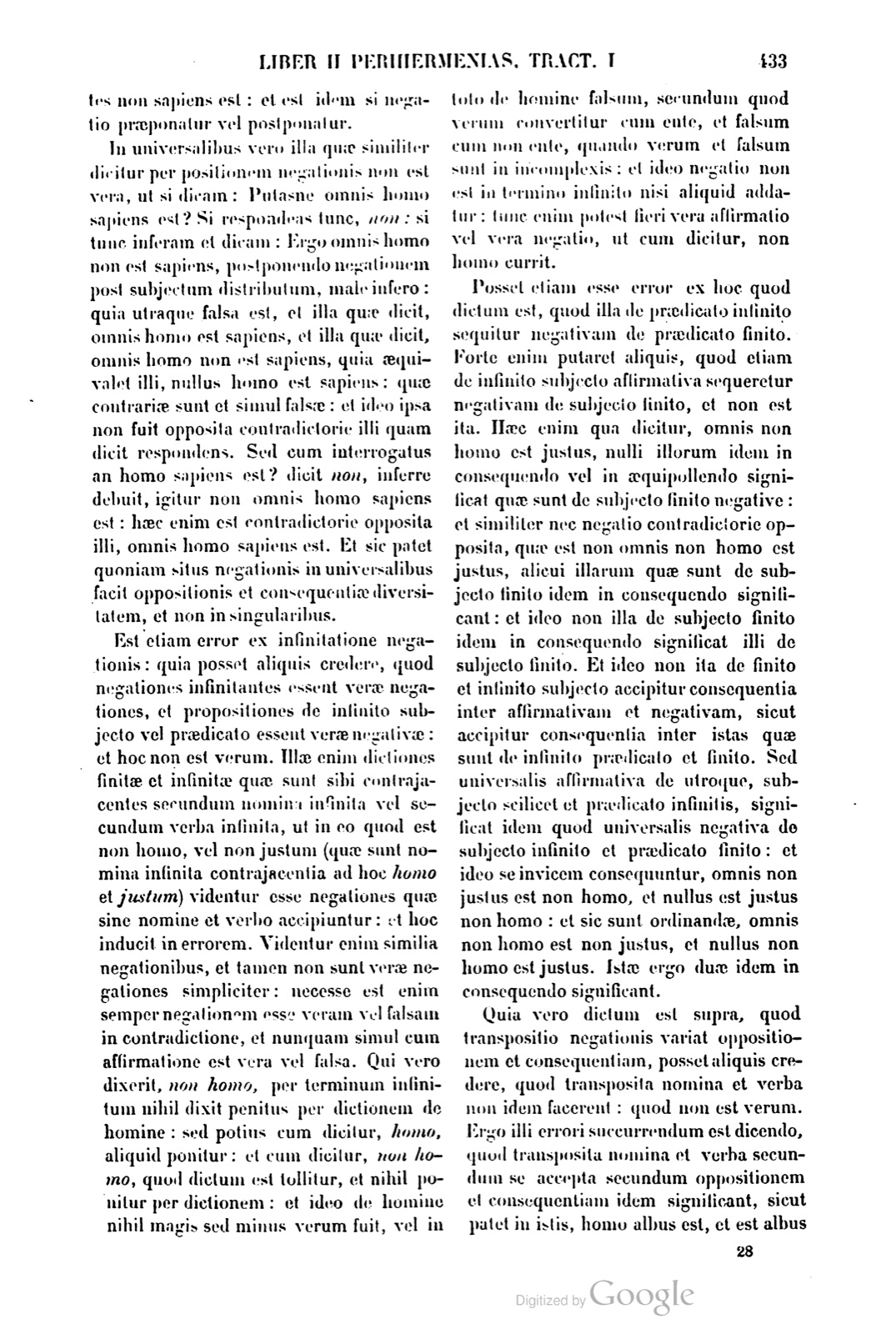
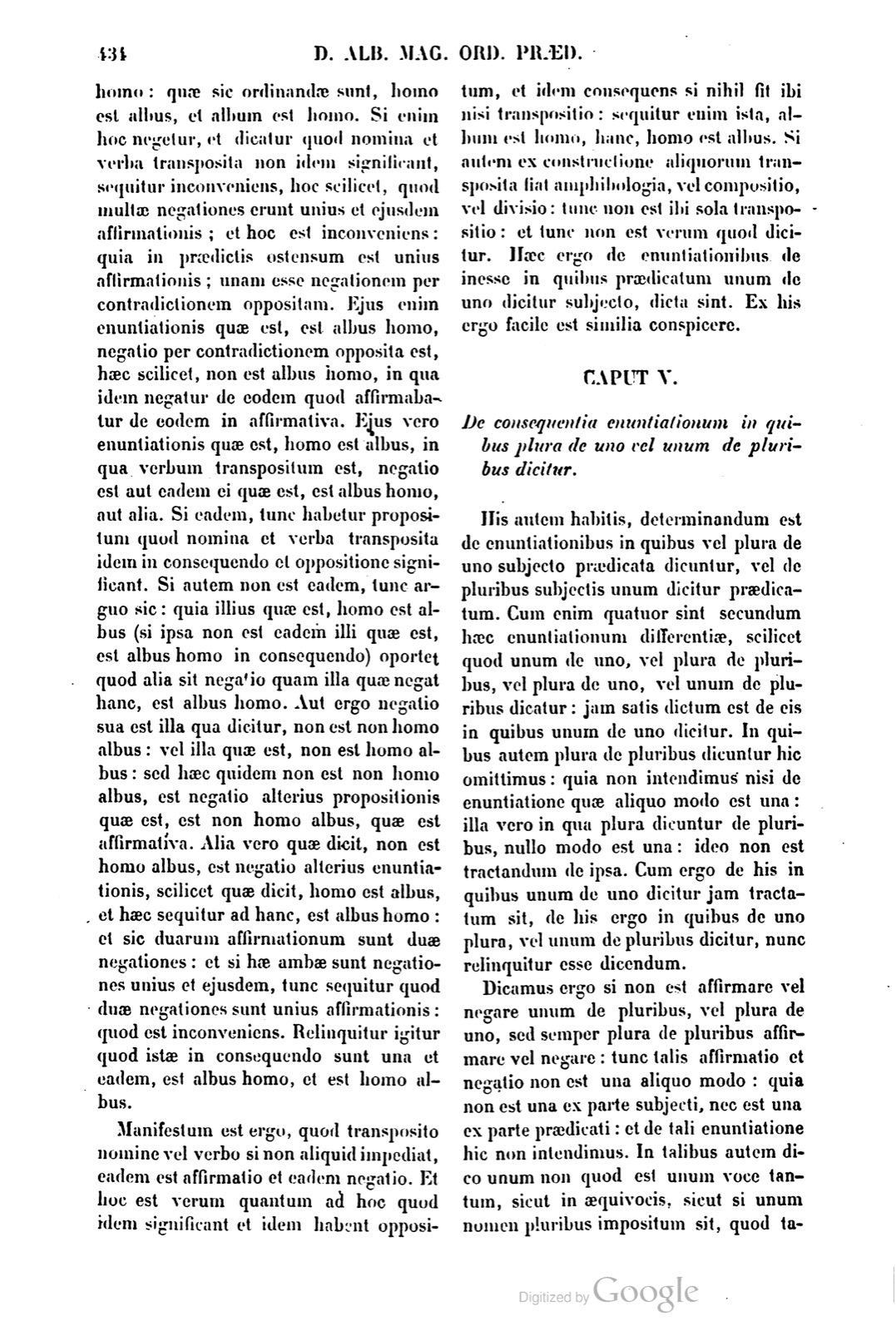
Quia vero dictum est supra, quod transpositio negationis variat oppositionem et consequentiam, posset aliquis credere, quod transposita nomina et verba non idem facerent: quod non est verum. Ergo illi errori succurrendum est dicendo, quod transposita nomina et verba secundum se accepta secundum oppositionem et consequentiam idem significant, sicut patet in istis, homo albus est, et est albus homo: quae sic ordinandae sunt, homo est albus, et album est homo. Si enim hoc negetur, et dicatur quod nomina et verba transposita non idem significant, sequitur inconveniens, hoc scilicet, quod multae negationes erunt unius et ejusdem affirmationis; et hoc est inconveniens: quia in praedictis ostensum est unius affirmationis, unam esse negationem per contradictionem oppositam. Ejus enim enuntiationis quae est, est albus homo, negatio per contradictionem opposita est, haec scilicet, non est albus homo, in qua idem negatur de eodem quod affirmabatur de eodem in affirmativa. Ejus vero enuntiationis quae est, homo est albus, in qua verbum transpositum est, negatio est aut eadem ei quae est, est albus homo, aut alia. Si eadem, tunc habetur propositum quod nomina et verba transposita idem in consequendo et oppositione significant. Si autem non est eadem, tunc arguo sic: quia illius quae est, homo est albus (si ipsa non est eadem illi quae est, est albus homo in consequendo) oportet quod alia sit negatio quam illa quae negat hanc, est albus homo. Aut ergo negatio sua est illa qua dicitur, non est non homo albus: vel illa quae est, non est homo albus: sed haec quidem non est non homo albus, est negatio alterius propositionis quae est, est non homo albus, quae est affirmativa. Alia vero quae dicit, non est homo albus, est negatio alterius enuntiationis, scilicet quae dicit, homo est albus, et haec sequitur ad hanc, est albus homo: et sic duarum affirmationum sunt duae negationes: et si hae ambae sunt negationes unius et ejusdem, tunc sequitur quod duae negationes sunt unius affirmationis: quod est inconveniens. Relinquitur igitur quod istae in consequendo sunt una et eadem, est albus homo, et est homo albus.
Manifestum est ergo, quod transposito nomine vel verbo si non aliquid impediat, eadem est affirmatio et eadem negatio. Et hoc est verum quantum ad hoc quod idem significant et idem habent oppositum, et idem consequens si nihil fit ibi nisi transpositio: sequitur enim ista, album est homo, hanc, homo est albus. Si autem ex constructione aliquorum transposita fiat amphibologia, vel compositio, vel divisio: tunc non est ibi sola transpositio: et tunc non est verum quod dicitur. Haec ergo de enuntiationibus, de inesse in quibus praedicatum unum de uno dicitur subjecto, dicta sint. Ex his ergo facile est similia conspicere.
But because it was said above that transposition of negation varies opposition and consequence, someone could believe that transposed nouns and verbs would not make the same thing; this is not true. Therefore that error must be helped by saying that transposed nouns and verbs, taken according to themselves, signify the same thing according to opposition and consequence, as is clear in these: "white man is" and "there is a white man," which must be ordered thus: "man is white" and "the white is man." For if this is denied, and it is said that transposed nouns and verbs do not signify the same thing, an inconvenience follows, namely this, that there will be many negations of one and the same affirmation; and this is inconvenient, because in the preceding things it has been shown that of one affirmation there is one negation opposed by contradiction. For of the enunciation which is "there is a white man," the negation opposed by contradiction is this, namely, "there is not a white man," in which the same thing is denied of the same thing which was affirmed of the same thing in the affirmative. But of the enunciation which is "man is white," in which the verb has been transposed, the negation is either the same as that which is "there is a white man," or another. If the same, then the proposed point is had, that transposed nouns and verbs signify the same thing in consequence and opposition. But if it is not the same, then I argue thus: because of that which is "man is white" (if it is not the same in consequence as that which is "there is a white man"), there must be another negation than that which negates this, "there is a white man." Therefore its negation is either that by which it is said, "there is not a non-man white," or that which is "man is not white." But this, "there is not a non-man white," is the negation of another proposition, which is "there is a non-man white," which is affirmative. But the other, which says "man is not white," is the negation of another enunciation, namely of that which says "man is white," and this follows upon this, "there is a white man." And thus of two affirmations there are two negations; and if these two are negations of one and the same, then it follows that two negations belong to one affirmation, which is inconvenient. Therefore it remains that these in consequence are one and the same, "there is a white man" and "man is white."
Therefore it is manifest that, when a noun or verb has been transposed, if nothing prevents it, there is the same affirmation and the same negation. And this is true as to the fact that they signify the same thing and have the same opposite and the same consequent, if nothing occurs there except transposition; for this, "the white is man," follows this, "man is white." But if from the construction of some words, when transposed, amphiboly, or composition, or division comes about, then there is not only transposition there; and then what is said is not true. Therefore let these things have been said about enunciations about being-in in which one predicate is said of one subject. From these, therefore, similar things are easily seen.
If a page does not appear, its photograph has not been uploaded yet.