Works › On Interpretation, Books I–II
Volume 1 · p. 432
Chapter IV. On The Removal Of Errors Which Can Be Around The Things That Have Been Said.
CAPUT IV. De remotione errorum qui possunt esse circa ea quae dicta sunt.
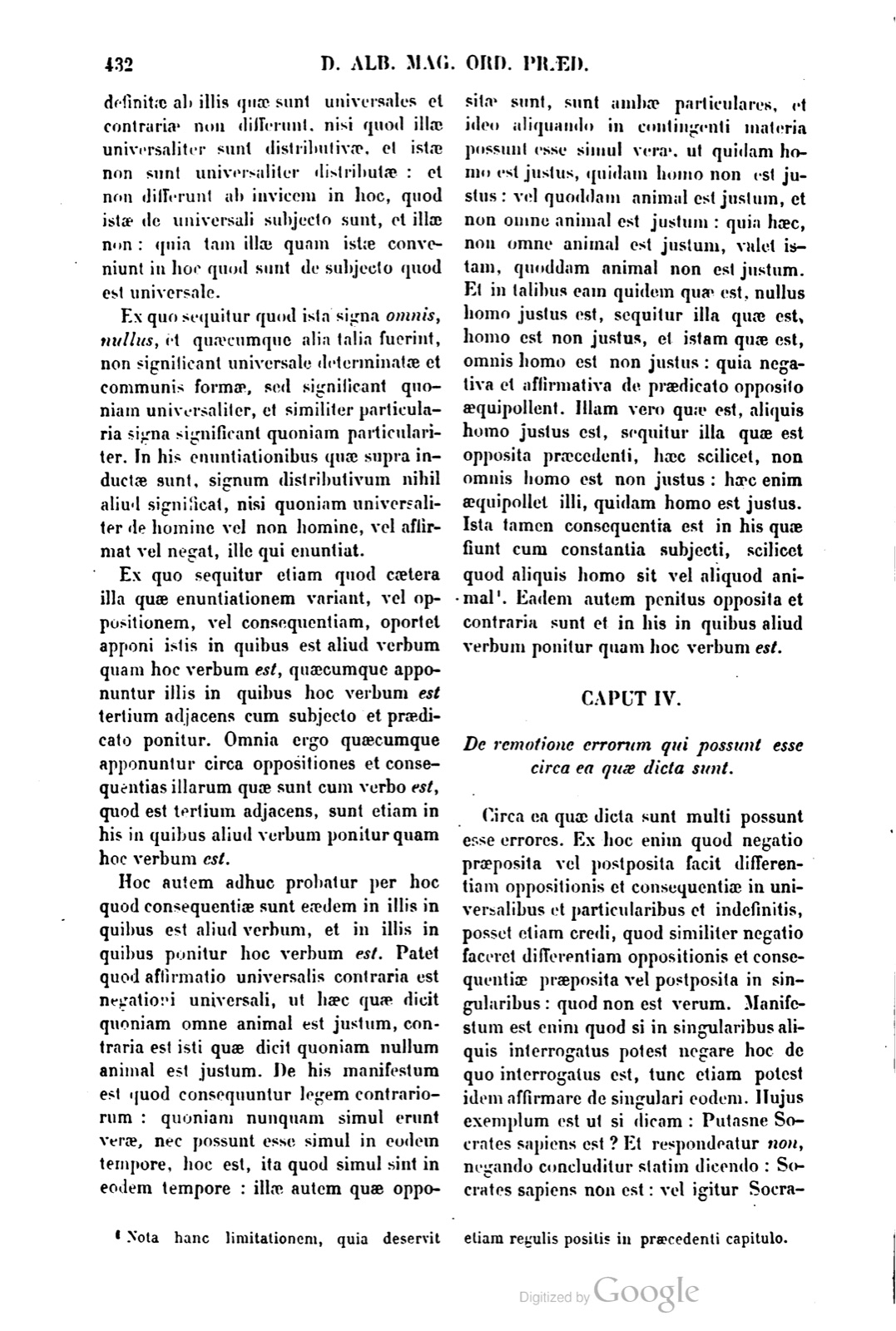
Circa ea quae dicta sunt multi possunt esse errores. Ex hoc enim quod negatio praeposita vel postposita facit differentiam oppositionis et consequentiae in universalibus et particularibus et indefinitis, posset etiam credi, quod similiter negatio faceret differentiam oppositionis et consequentiae praeposita vel postposita in singularibus: quod non est verum. Manifestum est enim quod si in singularibus aliquis interrogatus potest negare hoc de quo interrogatus est, tunc etiam potest idem affirmare de singulari eodem. Hujus exemplum est ut si dicam: Putasne Socrates sapiens est? Et respondeatur non, negando concluditur statim dicendo: Socrates sapiens non est: vel igitur Socrates
CHAPTER IV. On the removal of errors which can be around the things that have been said.
Around those things which have been said there can be many errors. For from the fact that negation placed before or after makes a difference of opposition and consequence in universals and particulars and indefinites, one might also believe that similarly negation placed before or after would make a difference of opposition and consequence in singulars; but this is not true. For it is manifest that if in singulars someone who has been questioned can deny this about which he has been questioned, then he can also affirm the same thing about the same singular. An example of this is as if I say: Do you think Socrates is wise? And let the answer be no; by denying, it is immediately concluded by saying: Socrates is not wise; or therefore Socrates
If a page does not appear, its photograph has not been uploaded yet.