Works › On Interpretation, Books I–II
Volume 1 · pp. 424–428
Book II Perihermenias. Treatise I. On The Consequences Of Enunciations About Being-In. Chapter I. In What Way Enunciations About Being-In Are To Be Taken, Among Which There Is Consequence, Which Are One, And In Which Is Is Adjacent As Second.
A marker with ≈ is an approximate page boundary, placed by measure of the text; the page photographs remain the authority. In the paired views, clicking a page marker brings that page into view.
LIBER II PERIHERMENIAS.
TRACTATUS I. DE CONSEQUENTIIS ENUNTIATIONUM DE INESSE.
CAPUT I. Qualiter sumendae sunt enuntiationes de inesse, inter quas est consequentia, quae sunt unae, et in quibus est secundum est adjacens.
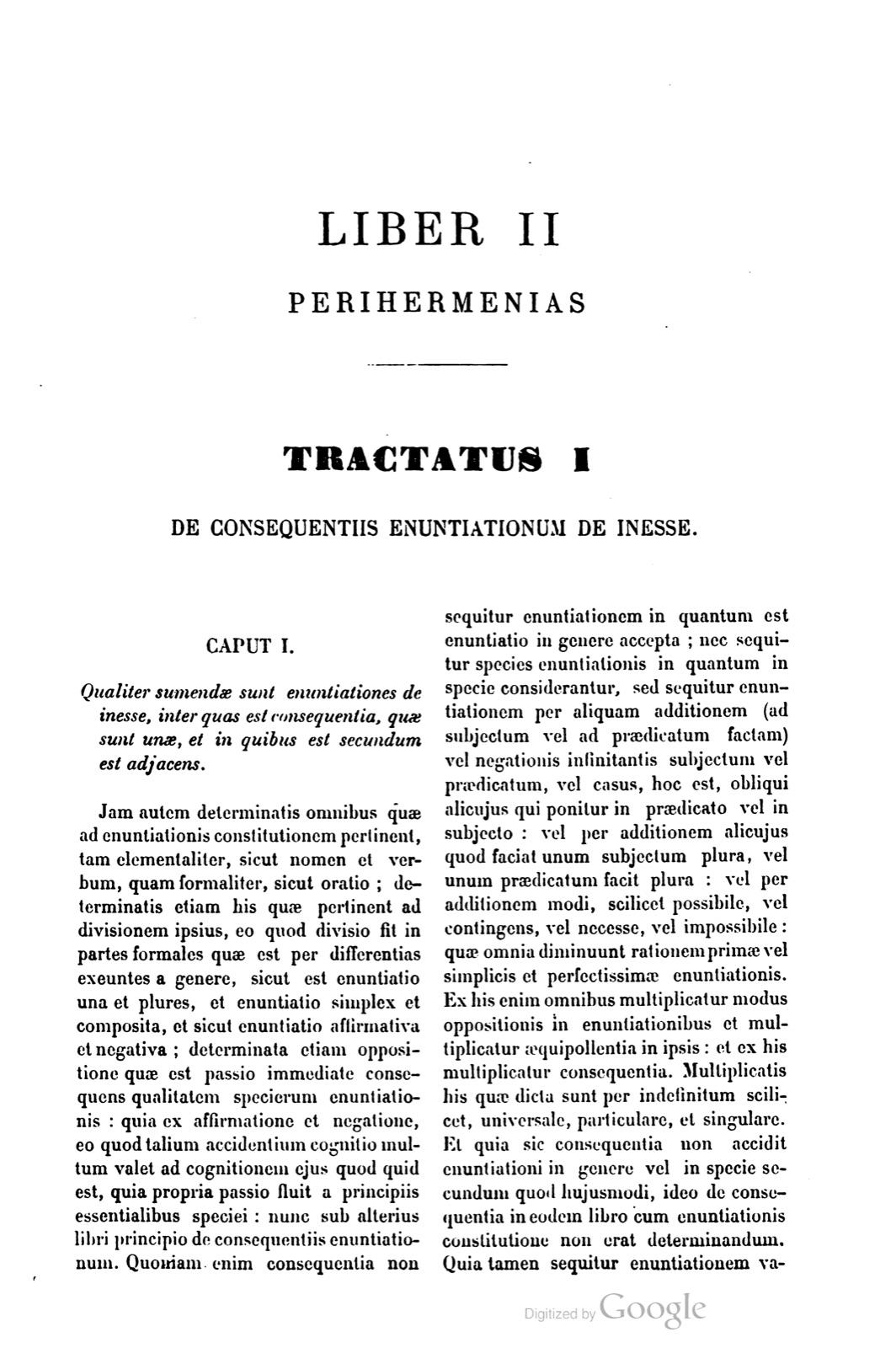
Jam autem determinatis omnibus quae ad enuntiationis constitutionem pertinent, tam elementaliter, sicut nomen et verbum, quam formaliter, sicut oratio; determinatis etiam his quae pertinent ad divisionem ipsius, eo quod divisio fit in partes formales quae est per differentias exeuntes a genere, sicut est enuntiatio una et plures, et enuntiatio simplex et composita, et sicut enuntiatio affirmativa et negativa; determinata etiam oppositione quae est passio immediate consequens qualitatem specierum enuntiationis: quia ex affirmatione et negatione, eo quod talium accidentium cognitio multum valet ad cognitionem ejus quod quid est, quia propria passio fluit a principiis essentialibus speciei: nunc sub alterius libri principio de consequentiis enuntiationum. Quoniam enim consequentia non sequitur enuntiationem in quantum est enuntiatio in genere accepta; nec sequitur species enuntiationis in quantum in specie considerantur, sed sequitur enuntiationem per aliquam additionem (ad subjectum vel ad praedicatum factam) vel negationis infinitantis subjectum vel praedicatum, vel casus, hoc est, obliqui alicujus qui ponitur in praedicato vel in subjecto: vel per additionem alicujus quod faciat unum subjectum plura, vel unum praedicatum facit plura: vel per additionem modi, scilicet possibile, vel contingens, vel necesse, vel impossibile: quae omnia diminuunt rationem primae vel simplicis et perfectissimae enuntiationis. Ex his enim omnibus multiplicatur modus oppositionis in enuntiationibus et multiplicatur aequipollentia in ipsis: et ex his multiplicatur consequentia. Multiplicatis his quae dicta sunt per indefinitum scilicet, universale, particulare, et singulare. Et quia sic consequentia non accidit enuntiationi in genere vel in specie secundum quod hujusmodi, ideo de consequentia in eodem libro cum enuntiationis constitutione non erat determinandum. Quia tamen sequitur enuntiationem variatam ex additione aliqua ad ea quae constituunt enuntiationem, ideo in eadem scientia tractandum est de consequentia in qua determinatur de enuntiatione sub alterius libri principio.
BOOK II PERIHERMENIAS.
TREATISE I. ON THE CONSEQUENCES OF ENUNCIATIONS ABOUT BEING-IN.
CHAPTER I. In what way enunciations about being-in are to be taken, among which there is consequence, which are one, and in which "is" is adjacent as second.
Now that all things have been determined which pertain to the constitution of enunciation, both elementally, as noun and verb, and formally, as speech; and also those things have been determined which pertain to its division, because division is made into formal parts, which is through differences coming forth from the genus, as one and many enunciation, and simple and composite enunciation, and affirmative and negative enunciation; and opposition has also been determined, which is the attribute immediately following the quality of the species of enunciation, because it comes from affirmation and negation, since knowledge of such accidents greatly helps toward knowledge of what a thing is, because the proper attribute flows from the essential principles of the species: now, under the beginning of the other book, concerning the consequences of enunciations. For since consequence does not follow enunciation insofar as it is enunciation taken in the genus, nor does it follow the species of enunciation insofar as they are considered in species, but follows enunciation through some addition made to the subject or to the predicate, either of a negation infinitizing the subject or predicate, or of a case, that is, of some oblique term which is placed in the predicate or in the subject; or through the addition of something which makes one subject many, or makes one predicate many; or through the addition of a mode, namely possible, or contingent, or necessary, or impossible; all these diminish the account of the first or simple and most perfect enunciation. For from all these the mode of opposition is multiplied in enunciations and equivalence is multiplied in them, and from these consequence is multiplied, when the things which have been said are multiplied by indefinite, universal, particular, and singular. And because consequence thus does not occur to enunciation in the genus or in the species as such, therefore consequence did not have to be determined in the same book with the constitution of enunciation. Yet because it follows enunciation varied by some addition to those things which constitute enunciation, therefore consequence must be treated in the same science in which enunciation is determined, under the beginning of the other book.

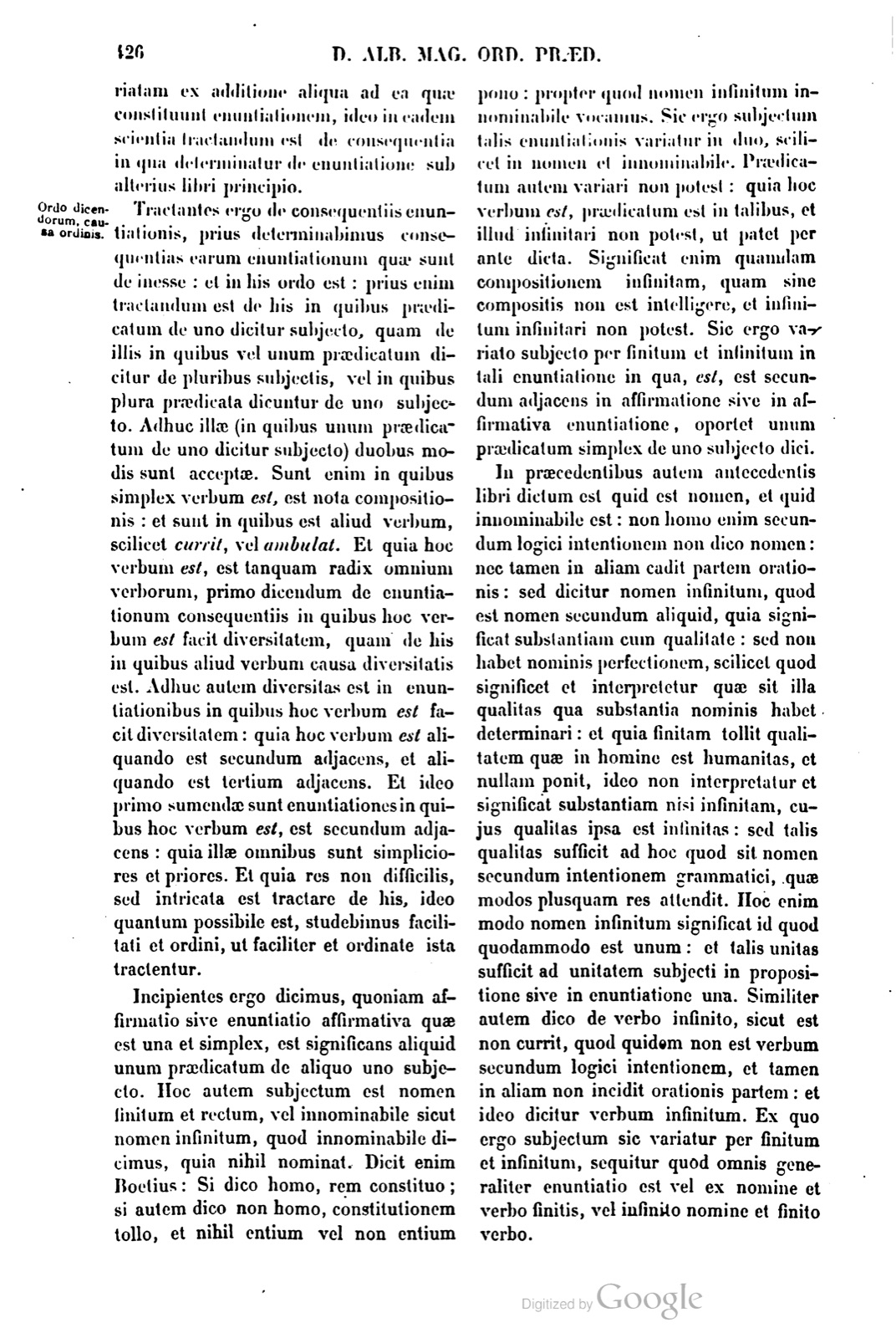
Tractantes ergo de consequentiis enuntiationis, prius determinabimus consequentias earum enuntiationum quae sunt de inesse: et in his ordo est: prius enim tractandum est de his in quibus praedicatum de uno dicitur subjecto, quam de illis in quibus vel unum praedicatum dicitur de pluribus subjectis, vel in quibus plura praedicata dicuntur de uno subjecto. Adhuc illae (in quibus unum praedicatum de uno dicitur subjecto) duobus modis sunt acceptae. Sunt enim in quibus simplex verbum est, est nota compositionis: et sunt in quibus est aliud verbum, scilicet currit, vel ambulat. Et quia hoc verbum est, est tanquam radix omnium verborum, primo dicendum de enuntiationum consequentiis in quibus hoc verbum est facit diversitatem, quam de his in quibus aliud verbum causa diversitatis est. Adhuc autem diversitas est in enuntiationibus in quibus hoc verbum est facit diversitatem: quia hoc verbum est aliquando est secundum adjacens, et aliquando est tertium adjacens. Et ideo primo sumendae sunt enuntiationes in quibus hoc verbum est, est secundum adjacens: quia illae omnibus sunt simpliciores et priores. Et quia res non difficilis, sed intricata est tractare de his, ideo quantum possibile est, studebimus facilitati et ordini, ut faciliter et ordinate ista tractentur.
Incipientes ergo dicimus, quoniam affirmatio sive enuntiatio affirmativa quae est una et simplex, est significans aliquid unum praedicatum de aliquo uno subjecto. Hoc autem subjectum est nomen finitum et rectum, vel innominabile sicut nomen infinitum, quod innominabile dicimus, quia nihil nominat. Dicit enim Boetius: Si dico homo, rem constituo; si autem dico non homo, constitutionem tollo, et nihil entium vel non entium pono: propter quod nomen infinitum innominabile vocamus. Sic ergo subjectum talis enuntiationis variatur in duo, scilicet in nomen et innominabile. Praedicatum autem variari non potest: quia hoc verbum est, praedicatum est in talibus, et illud infinitari non potest, ut patet per ante dicta. Significat enim quamdam compositionem infinitam, quam sine compositis non est intelligere, et infinitum infinitari non potest. Sic ergo variato subjecto per finitum et infinitum in tali enuntiatione in qua, est, est secundum adjacens in affirmatione sive in affirmativa enuntiatione, oportet unum praedicatum simplex de uno subjecto dici.
Therefore, treating of the consequences of enunciation, we will first determine the consequences of those enunciations which are about being-in. And in these this is the order: first one must treat those in which a predicate is said of one subject, before those in which either one predicate is said of several subjects, or in which several predicates are said of one subject. Moreover those in which one predicate is said of one subject are taken in two ways. For there are those in which the simple verb "is" is the mark of composition; and there are those in which there is another verb, namely "runs" or "walks." And because this verb "is" is as the root of all verbs, one must first speak about the consequences of enunciations in which this verb "is" makes diversity, before those in which another verb is the cause of diversity. Moreover there is diversity in enunciations in which this verb "is" makes diversity, because this verb "is" sometimes is adjacent as second and sometimes is adjacent as third. And therefore first the enunciations must be taken in which this verb "is" is adjacent as second, because those are simpler than all and prior. And because the matter is not difficult, but is intricate, to treat about these, therefore as far as possible we will aim at ease and order, so that those things may be treated easily and in order.
Therefore, beginning, we say that affirmation or affirmative enunciation which is one and simple is signifying some one predicate about some one subject. But this subject is a finite and direct noun, or an innominable as an infinite noun, which we call innominable because it names nothing. For Boethius says: if I say "man," I establish a thing; but if I say "non-man," I take away the establishment and posit nothing of beings or non-beings. On account of this we call an infinite noun innominable. Therefore the subject of such an enunciation is varied into two, namely into noun and innominable. But the predicate cannot be varied, because this verb "is" is the predicate in such cases, and it cannot be infinitized, as is clear through what was said before. For it signifies a certain infinite composition, which cannot be understood without things composed, and the infinite cannot be infinitized. Therefore, when the subject has been varied through finite and infinite in such an enunciation in which "is" is adjacent as second in affirmation or in affirmative enunciation, one simple predicate must be said of one subject.
In praecedentibus autem antecedentis libri dictum est quid est nomen, et quid innominabile est: non homo enim secundum logici intentionem non dico nomen: nec tamen in aliam cadit partem orationis: sed dicitur nomen infinitum, quod est nomen secundum aliquid, quia significat substantiam cum qualitate: sed non habet nominis perfectionem, scilicet quod significet et interpretetur quae sit illa qualitas qua substantia nominis habet determinari: et quia finitam tollit qualitatem quae in homine est humanitas, et nullam ponit, ideo non interpretatur et significat substantiam nisi infinitam, cujus qualitas ipsa est infinitas: sed talis qualitas sufficit ad hoc quod sit nomen secundum intentionem grammatici, quae modos plusquam res attendit. Hoc enim modo nomen infinitum significat id quod quodammodo est unum: et talis unitas sufficit ad unitatem subjecti in propositione sive in enuntiatione una. Similiter autem dico de verbo infinito, sicut est non currit, quod quidem non est verbum secundum logici intentionem, et tamen in aliam non incidit orationis partem: et ideo dicitur verbum infinitum. Ex quo ergo subjectum sic variatur per finitum et infinitum, sequitur quod omnis generaliter enuntiatio est vel ex nomine et verbo finitis, vel infinito nomine et finito verbo.
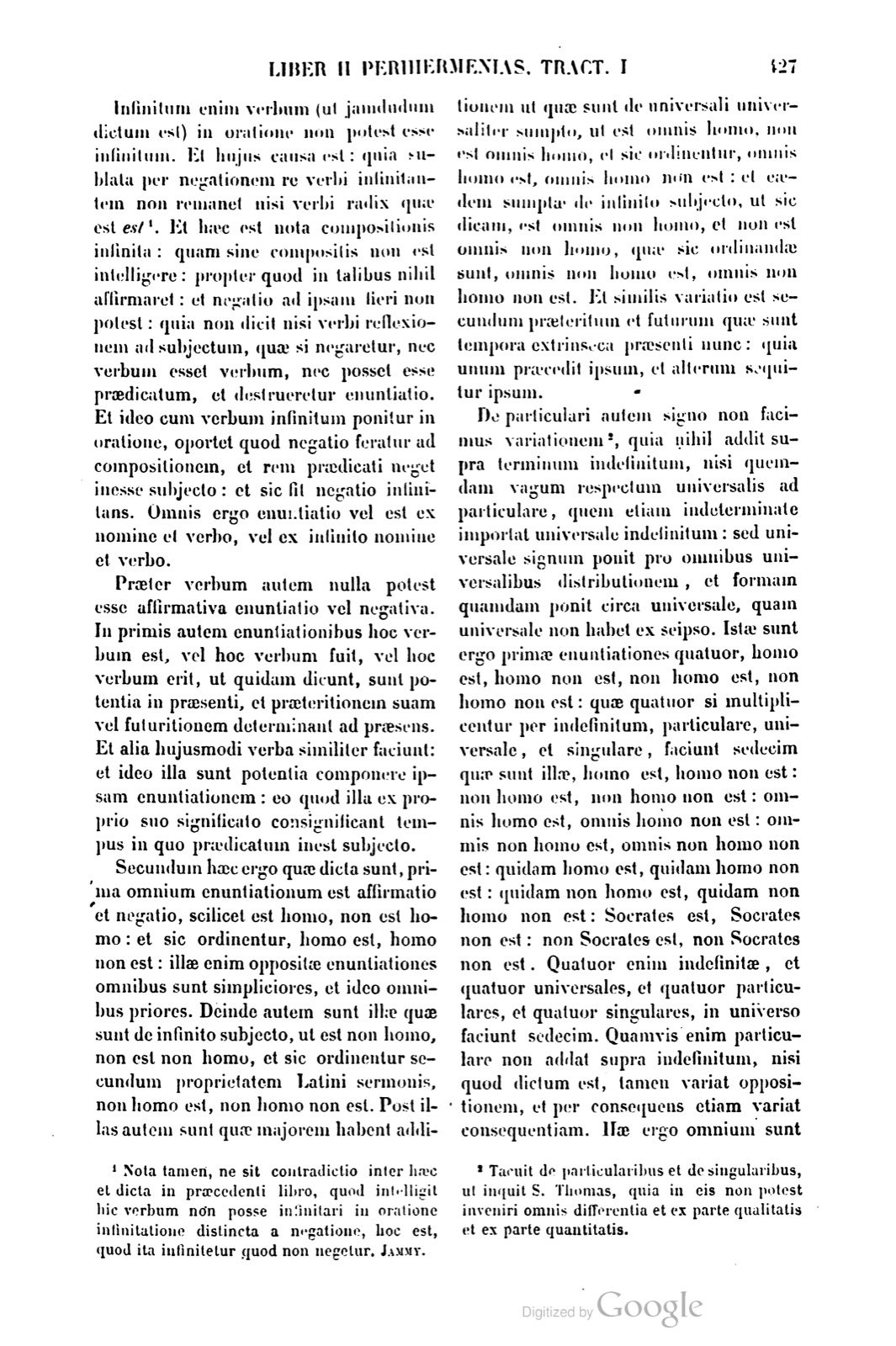
Infinitum enim verbum (ut jamdudum dictum est) in oratione non potest esse infinitum1. Et hujus causa est: quia sublata per negationem re verbi infinitantem non remanet nisi verbi radix quae est est2. Et haec est nota compositionis infinita: quam sine compositis non est intelligere: propter quod in talibus nihil affirmaret: et negatio ad ipsam fieri non potest: quia non dicit nisi verbi reflexionem ad subjectum, quae si negaretur, nec verbum esset verbum, nec posset esse praedicatum, et destrueretur enuntiatio. Et ideo cum verbum infinitum ponitur in oratione, oportet quod negatio feratur ad compositionem, et rem praedicati neget inesse subjecto: et sic fit negatio infinitans. Omnis ergo enuntiatio vel est ex nomine et verbo, vel ex infinito nomine et verbo.
But in the preceding parts of the preceding book it was said what a noun is and what an innominable is. For according to the intention of the logician I do not call "non-man" a noun; nor nevertheless does it fall into another part of speech, but it is called an infinite noun, which is a noun in a certain respect, because it signifies substance with quality; but it does not have the perfection of a noun, namely that it signify and interpret what that quality is by which the substance of the noun has to be determined. And because it takes away the finite quality which in man is humanity, and posits none, therefore it does not interpret and signify substance except as infinite, whose quality is infinity itself. But such a quality suffices for this, that it be a noun according to the intention of the grammarian, who considers modes more than things. For in this way an infinite noun signifies that which is in some way one; and such unity suffices for the unity of the subject in a proposition or in one enunciation. But I speak similarly about an infinite verb, such as "does not run," which indeed is not a verb according to the intention of the logician, and nevertheless does not fall into another part of speech; and therefore it is called an infinite verb. Therefore from the fact that the subject is thus varied through finite and infinite, it follows that every enunciation generally is either from finite noun and verb, or from infinite noun and finite verb.
For an infinite verb, as was said a while ago, cannot be infinite in speech1. And the cause of this is that, when the thing of the verb has been taken away by an infinitizing negation, nothing remains except the root of the verb, which is "is"2. And this is the mark of infinite composition, which cannot be understood without composed things; on account of this it would affirm nothing in such cases. And negation cannot be made to it, because it says nothing except the reflection of the verb to the subject; if this were denied, the verb would not be a verb, nor could it be a predicate, and enunciation would be destroyed. And therefore when an infinite verb is placed in speech, the negation must be referred to the composition and deny that the thing of the predicate belongs to the subject; and thus an infinitizing negation is made. Therefore every enunciation is either from a noun and a verb, or from an infinite noun and a verb.
Praeter verbum autem nulla potest esse affirmativa enuntiatio vel negativa. In primis autem enuntiationibus hoc verbum est, vel hoc verbum fuit, vel hoc verbum erit, ut quidam dicunt, sunt potentia in praesenti, et praeteritionem suam vel futuritionem determinant ad praesens. Et alia hujusmodi verba similiter faciunt: et ideo illa sunt potentia componere ipsam enuntiationem: eo quod illa ex proprio suo significato consignificant tempus in quo praedicatum inest subjecto.
Secundum haec ergo quae dicta sunt, prima omnium enuntiationum est affirmatio et negatio, scilicet est homo, non est homo: et sic ordinentur, homo est, homo non est: illae enim oppositae enuntiationes omnibus sunt simpliciores, et ideo omnibus priores. Deinde autem sunt illae quae sunt de infinito subjecto, ut est non homo, non est non homo, et sic ordinentur secundum proprietatem Latini sermonis, non homo est, non homo non est. Post illas autem sunt quae majorem habent additionem ut quae sunt de universali universaliter sumpto, ut est omnis homo, non est omnis homo, et sic ordinentur, omnis homo est, omnis homo non est: et eaedem sumptae de infinito subjecto, ut sic dicam, est omnis non homo, et non est omnis non homo, quae sic ordinandae sunt, omnis non homo est, omnis non homo non est. Et similis variatio est secundum praeteritum et futurum quae sunt tempora extrinseca praesenti nunc: quia unum praecedit ipsum, et alterum sequitur ipsum.
But apart from a verb there can be no affirmative or negative enunciation. But in the first enunciations this verb "is," or this verb "was," or this verb "will be," as some say, are in potency in the present, and determine their own pastness or futurity to the present. And other verbs of this sort do similarly; and therefore those are in potency to compose the enunciation itself, because from their own proper signification they consignify the time in which the predicate belongs to the subject.
Therefore, according to these things which have been said, the first of all enunciations is affirmation and negation, namely "man is," "man is not"; and so they should be ordered: "man is," "man is not." For those opposed enunciations are simpler than all, and therefore prior to all. Then there are those which are about an infinite subject, as "non-man is," "non-man is not," and so they should be ordered according to the propriety of Latin speech: "non-man is," "non-man is not." But after those are the ones which have a greater addition, as those which are about a universal universally taken, as "every man is," "not every man is," and so they should be ordered: "every man is," "every man is not"; and the same taken of an infinite subject, so that I may say, "every non-man is," and "not every non-man is," which should be ordered thus: "every non-man is," "every non-man is not." And there is a similar variation according to past and future, which are times extrinsic to the present now, because one precedes it and the other follows it.
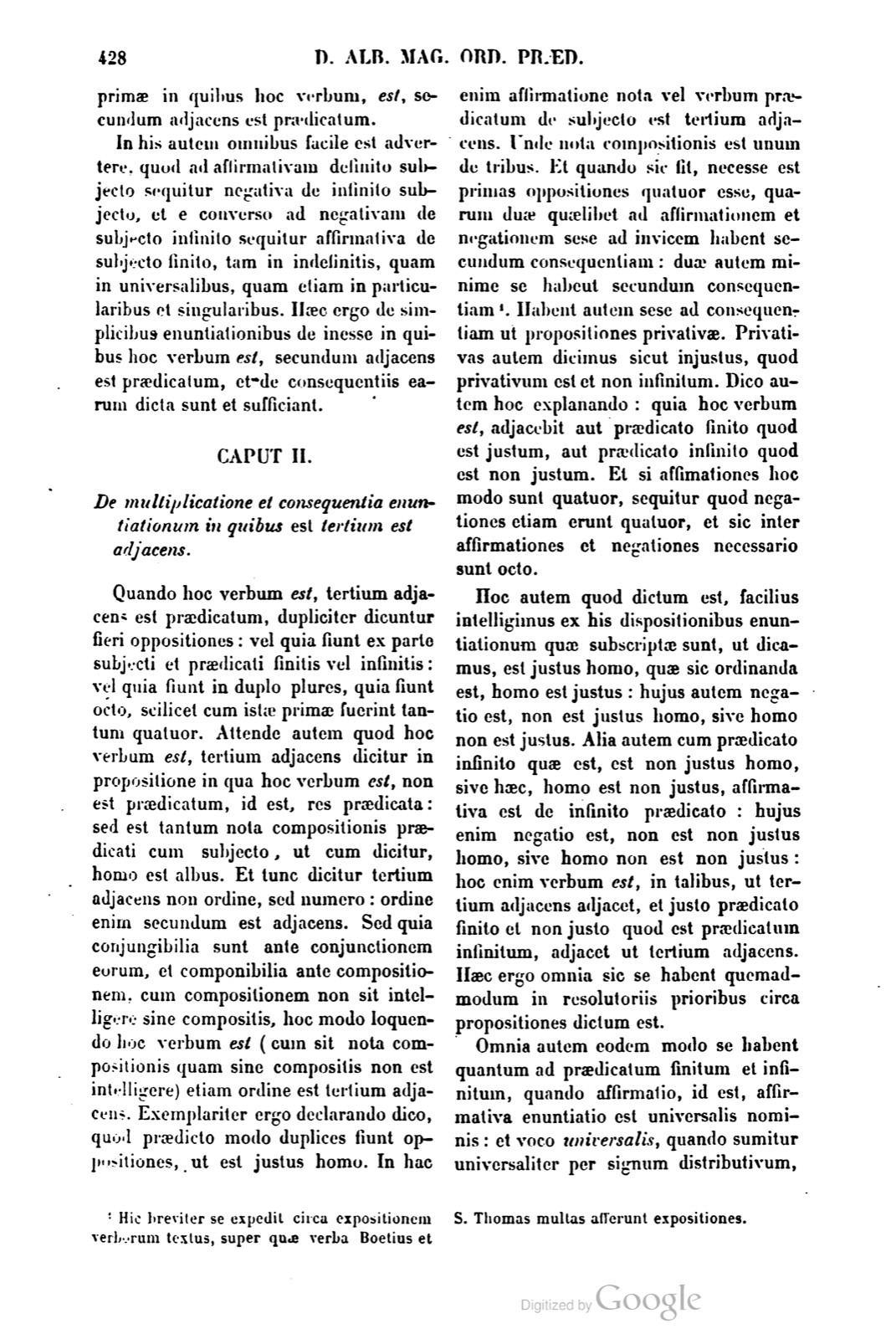
De particulari autem signo non facimus variationem2, quia nihil addit supra terminum indefinitum, nisi quemdam vagum respectum universalis ad particulare, quem etiam indeterminate importat universale indefinitum: sed universale signum ponit pro omnibus universalibus distributionem, et formam quamdam ponit circa universale, quam universale non habet ex seipso. Istae sunt ergo primae enuntiationes quatuor, homo est, homo non est, non homo est, non homo non est: quae quatuor si multiplicentur per indefinitum, particulare, universale, et singulare, faciunt sedecim quae sunt illae, homo est, homo non est: non homo est, non homo non est: omnis homo est, omnis homo non est: omnis non homo est, omnis non homo non est: quidam homo est, quidam homo non est: quidam non homo est, quidam non homo non est: Socrates est, Socrates non est: non Socrates est, non Socrates non est. Quatuor enim indefinitae, et quatuor universales, et quatuor particulares, et quatuor singulares, in universo faciunt sedecim. Quamvis enim particulare non addat supra indefinitum, nisi quod dictum est, tamen variat oppositionem, et per consequens etiam variat consequentiam. Hae ergo omnium sunt primae in quibus hoc verbum, est, secundum adjacens est praedicatum.
In his autem omnibus facile est advertere, quod ad affirmativam definito subjecto sequitur negativa de infinito subjecto, et e converso ad negativam de subjecto infinito sequitur affirmativa de subjecto finito, tam in indefinitis, quam in universalibus, quam etiam in particularibus et singularibus. Haec ergo de simplicibus enuntiationibus de inesse in quibus hoc verbum est, secundum adjacens est praedicatum, et de consequentiis earum dicta sunt et sufficiant.
### Marginal Labels - 426: Ordo dicendorum, causa ordinis.
But we do not make a variation from the particular sign2, because it adds nothing beyond the indefinite term except a certain vague relation of the universal to the particular, which the indefinite universal also brings in indeterminately. But the universal sign posits distribution for all universals and posits a certain form around the universal which the universal does not have from itself. Therefore these are the first four enunciations: "man is," "man is not," "non-man is," "non-man is not." If these four are multiplied by indefinite, particular, universal, and singular, they make sixteen, which are these: "man is," "man is not"; "non-man is," "non-man is not"; "every man is," "every man is not"; "every non-man is," "every non-man is not"; "some man is," "some man is not"; "some non-man is," "some non-man is not"; "Socrates is," "Socrates is not"; "non-Socrates is," "non-Socrates is not." For four indefinites, and four universals, and four particulars, and four singulars make sixteen in the whole. For although the particular adds nothing beyond the indefinite except what has been said, nevertheless it varies opposition, and consequently also varies consequence. Therefore these are first of all, in which this verb "is" is the predicate adjacent as second.
But in all these it is easy to notice that from an affirmative with a definite subject follows a negative with an infinite subject, and conversely from a negative with an infinite subject follows an affirmative with a finite subject, both in indefinites and in universals, and also in particulars and singulars. Therefore these things about simple enunciations about being-in, in which this verb "is" is the predicate adjacent as second, and about their consequences, have been said and let them suffice.
### Marginal Labels - 426: The order of things to be said, the cause of the order.
Notes
- Yet note, lest there be a contradiction between these things and what was said in the preceding book, that he understands here that a verb cannot be infinitized in speech with an infinitization distinct from negation, that is, so that it is infinitized in such a way that it is not denied. Jammy. (Nota tamen, ne sit contradictio inter haec et dicta in praecedenti libro, quod intelligit hic verbum non posse infinitari in oratione infinitatione distincta a negatione, hoc est, quod ita infinitetur quod non negetur. JAMMY.) ↩
- He was silent about particulars and singulars, as St. Thomas says, because in them every difference cannot be found both on the part of quality and on the part of quantity. (Tacuit de particularibus et de singularibus, ut inquit S. Thomas, quia in eis non potest inveniri omnis differentia et ex parte qualitatis et ex parte quantitatis.) ↩
If a page does not appear, its photograph has not been uploaded yet.