Works › On Interpretation, Books I–II
Volume 1 · pp. 428–431
Chapter II. On The Multiplication And Consequence Of Enunciations In Which Is Is Adjacent As Third.
A marker with ≈ is an approximate page boundary, placed by measure of the text; the page photographs remain the authority. In the paired views, clicking a page marker brings that page into view.
CAPUT II. De multiplicatione et consequentia enuntiationum in quibus est tertium est adjacens.
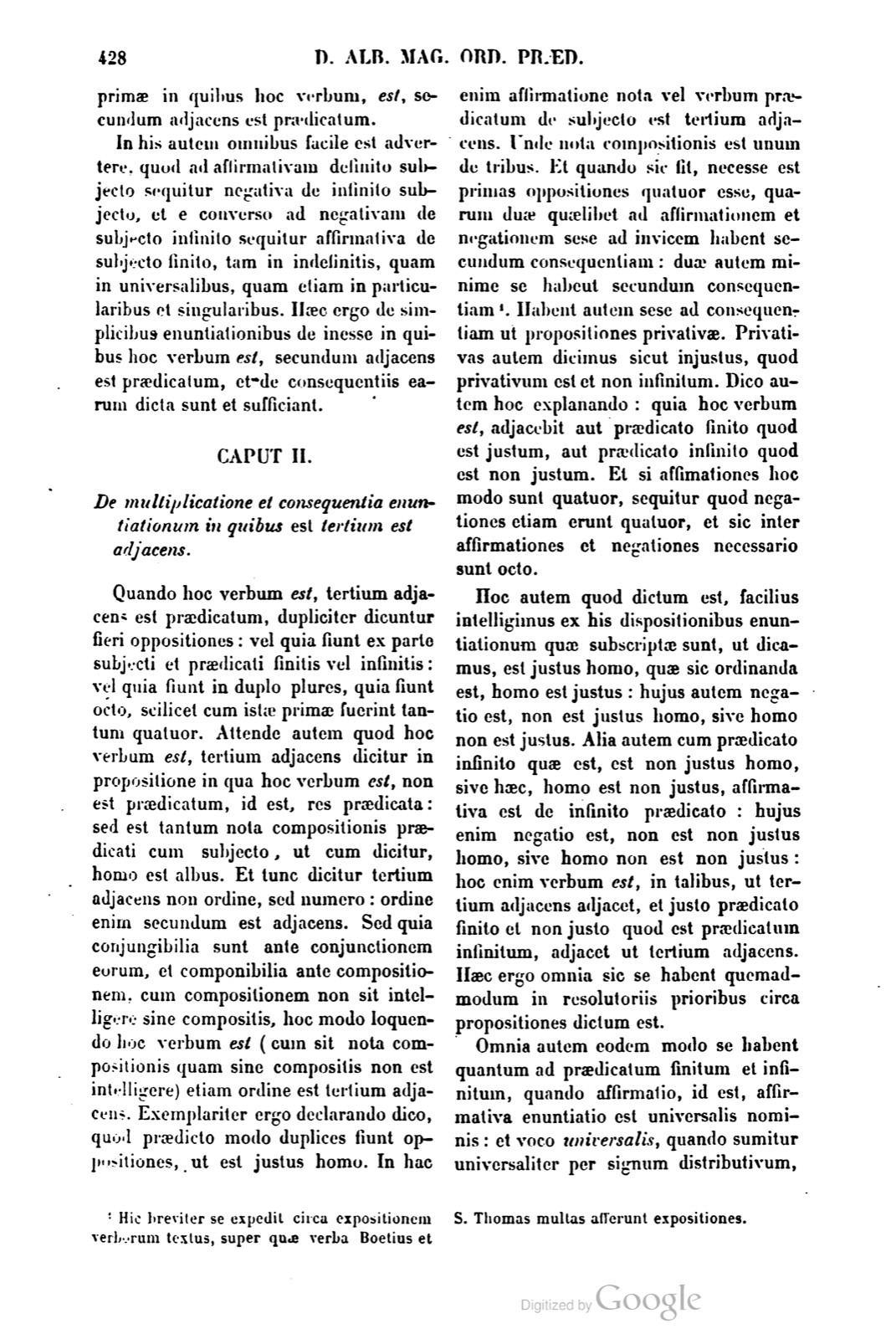
Quando hoc verbum est, tertium adjacens est praedicatum, dupliciter dicuntur fieri oppositiones: vel quia fiunt ex parte subjecti et praedicati finitis vel infinitis: vel quia fiunt in duplo plures, quia fiunt octo, scilicet cum istae primae fuerint tantum quatuor. Attende autem quod hoc verbum est, tertium adjacens dicitur in propositione in qua hoc verbum est, non est praedicatum, id est, res praedicata: sed est tantum nota compositionis praedicati cum subjecto, ut cum dicitur, homo est albus. Et tunc dicitur tertium adjacens non ordine, sed numero: ordine enim secundum est adjacens. Sed quia conjungibilia sunt ante conjunctionem eorum, et componibilia ante compositionem, cum compositionem non sit intelligere sine compositis, hoc modo loquendo hoc verbum est (cum sit nota compositionis quam sine compositis non est intelligere) etiam ordine est tertium adjacens. Exemplariter ergo declarando dico, quod praedicto modo duplices fiunt oppositiones, ut est justus homo. In hac enim affirmatione nota vel verbum praedicatum de subjecto est tertium adjacens. Unde nota compositionis est unum de tribus. Et quando sic fit, necesse est primas oppositiones quatuor esse, quarum duae quaelibet ad affirmationem et negationem sese ad invicem habent secundum consequentiam: duae autem minime se habent secundum consequentiam1. Habent autem sese ad consequentiam ut propositiones privativae. Privativas autem dicimus sicut injustus, quod privativum est et non infinitum. Dico autem hoc explanando: quia hoc verbum est, adjacebit aut praedicato finito quod est justum, aut praedicato infinito quod est non justum. Et si affirmationes hoc modo sunt quatuor, sequitur quod negationes etiam erunt quatuor, et sic inter affirmationes et negationes necessario sunt octo.
Hoc autem quod dictum est, facilius intelligimus ex his dispositionibus enuntiationum quae subscriptae sunt, ut dicamus, est justus homo, quae sic ordinanda est, homo est justus: hujus autem negatio est, non est justus homo, sive homo non est justus. Alia autem cum praedicato infinito quae est, est non justus homo, sive haec, homo est non justus, affirmativa est de infinito praedicato: hujus enim negatio est, non est non justus homo, sive homo non est non justus: hoc enim verbum est, in talibus, ut tertium adjacens adjacet, et justo praedicato finito et non justo quod est praedicatum infinitum, adjacet ut tertium adjacens. Haec ergo omnia sic se habent quemadmodum in resolutoriis prioribus circa propositiones dictum est.
CHAPTER II. On the multiplication and consequence of enunciations in which "is" is adjacent as third.
When this verb "is" is the predicate adjacent as third, oppositions are said to be made in two ways: either because they are made on the part of subject and predicate, finite or infinite; or because they are made twice as many, because eight are made, namely when those first ones were only four. But attend that this verb "is" is said to be adjacent as third in a proposition in which this verb "is" is not the predicate, that is, the thing predicated, but is only the mark of the composition of the predicate with the subject, as when it is said, "man is white." And then it is called adjacent as third not in order, but in number, for in order it is adjacent as second. But because things capable of conjunction are before their conjunction, and things capable of composition before composition, since composition cannot be understood without composed things, speaking in this way this verb "is," since it is the mark of composition which cannot be understood without composed things, is also adjacent as third in order. Therefore, declaring by example, I say that in the aforesaid way double oppositions are made, as "just man is." In this affirmation the mark or verb predicated of the subject is adjacent as third. Hence the mark of composition is one of three. And when it is made so, the first oppositions must be four, of which any two have themselves to each other according to consequence with respect to affirmation and negation, but two have themselves least of all according to consequence1. But they have themselves to consequence as privative propositions. Now we call privative propositions such as "unjust," which is privative and not infinite. But I say this by explaining: because this verb "is" will be adjacent either to the finite predicate which is "just," or to the infinite predicate which is "non-just." And if affirmations in this way are four, it follows that negations will also be four, and thus between affirmations and negations there are necessarily eight.
But what has been said we understand more easily from these arrangements of enunciations which are written below, so that we may say "is just man," which must be ordered thus: "man is just"; but the negation of this is "is not just man," or "man is not just." But another with an infinite predicate, which is "is non-just man," or this, "man is non-just," is an affirmative about an infinite predicate; for its negation is "is not non-just man," or "man is not non-just." For this verb "is," in such cases, is adjacent as third, and is adjacent as third to the finite predicate just and to non-just, which is an infinite predicate. Therefore all these have themselves as was said in the prior Analytics concerning propositions.
Omnia autem eodem modo se habent quantum ad praedicatum finitum et infinitum, quando affirmatio, id est, affirmativa enuntiatio est universalis nominis: et voco universalis, quando sumitur universaliter per signum distributivum, ut omnis homo justus est, non omnis homo justus est, quae sunt affirmatio et negatio oppositae de subjecto et praedicato finitis. Est omnis homo non justus, non est omnis homo non justus: quae sunt oppositae per affirmationem et negationem de praedicato infinito. Sed in talibus non contingit similiter sicut in prioribus angulares esse veras simul sicut contingit in prioribus. Contingit tamen angulares veras esse simul aliquando.
Istae ergo duae quae sunt, est justus, et est non justus, sunt oppositae et faciunt duas oppositiones et quatuor opposita.
Aliae autem duae oppositiones et quatuor opposita habent aliquid additum sive compositionem sive conjunctionem ad non homo, sicut ad subjectum infinitum. Dico autem aliquod additum: quia infinitum subjectum non proprie subjectum est, cum quo proprie aliquid componi possit: habet tamen praedicatum ad ipsum additum, ut compositum cum ipso faciat enuntiationis modum et non perfectam enuntiationem. Tales autem sunt, ut justus est non homo, sive non homo est justus: et negativa hujus, non est justus non homo, sive non homo non est justus. Similiter quando infinitum praedicatum dicitur vel non dicitur inesse subjecto infinito per affirmationem et negationem, ut sicut dicam, est non justus non homo, sive non homo est non justus, quae est affirmativa, et hujus negativa opposita est, non est non justus non homo, sive non homo non est non justus. Hae ergo octo sunt, scilicet, homo est justus, homo non est justus: homo est non justus, homo non est non justus: non homo est justus, non homo non est justus: non homo est non justus, non homo non est non justus.
Magis autem in his plures in quibus hoc verbum est, tertium est adjacens, non sunt oppositae sive per oppositionem affirmationis et negationis acceptae: quia plures esse non possunt. Hae ergo in quibus hoc verbum est, tertium est adjacens, sunt extra illas, hoc est, extra numerum illarum in quibus hoc verbum est, secundum est adjacens: et illae quae sunt de finito subjecto vel praedicato, sunt extra illas quae sunt de subjecto et praedicato infinitis, et alia habent opposita et alias consequentias: et sic sunt extra illas quae ipsae secundum se sunt enuntiationes perfectae, sicut illae quae sunt de finitis subjecto et praedicato. Sunt autem extra eas nomine infinito quod est in eis sicut est non homo. Cum termino enim infinito non fit enuntiatio quae secundum seipsam sit enuntiatio perfecta.
But all things have themselves in the same way as to finite and infinite predicate when the affirmation, that is, the affirmative enunciation, belongs to a universal noun; and I call it universal when it is taken universally through a distributive sign, as "every man is just," "not every man is just," which are opposed affirmation and negation about finite subject and predicate. "Every man is non-just," "not every man is non-just," are opposed through affirmation and negation about an infinite predicate. But in such cases it does not happen similarly as in the prior cases that angular propositions are true at the same time, as happens in the prior cases. Nevertheless it does sometimes happen that angulars are true at the same time.
Therefore those two which are "is just" and "is non-just" are opposed and make two oppositions and four opposites.
But the other two oppositions and four opposites have something added, or composition or conjunction, to "non-man," as to an infinite subject. But I say something added because an infinite subject is not properly a subject with which something can properly be composed; nevertheless it has a predicate added to it, so that what is composed with it makes the mode of enunciation and not a perfect enunciation. Such are, for example, "just is non-man," or "non-man is just"; and its negative, "just is not non-man," or "non-man is not just." Similarly, when an infinite predicate is said or not said to belong to an infinite subject through affirmation and negation, as when I say "non-just non-man is," or "non-man is non-just," which is affirmative, and its opposed negative is "non-just non-man is not," or "non-man is not non-just." Therefore these are eight, namely "man is just," "man is not just"; "man is non-just," "man is not non-just"; "non-man is just," "non-man is not just"; "non-man is non-just," "non-man is not non-just."
But more in number than these in which this verb "is" is adjacent as third are not opposed, or taken through the opposition of affirmation and negation, because there cannot be more. Therefore these in which this verb "is" is adjacent as third are outside those, that is, outside the number of those in which this verb "is" is adjacent as second; and those which are about finite subject or predicate are outside those which are about infinite subject and predicate, and they have other opposites and other consequences; and thus they are outside those which of themselves are perfect enunciations, as those which are about finite subject and predicate are. But they are outside them by the infinite noun which is in them, as "non-man" is. For with an infinite term an enunciation is not made which of itself is a perfect enunciation.
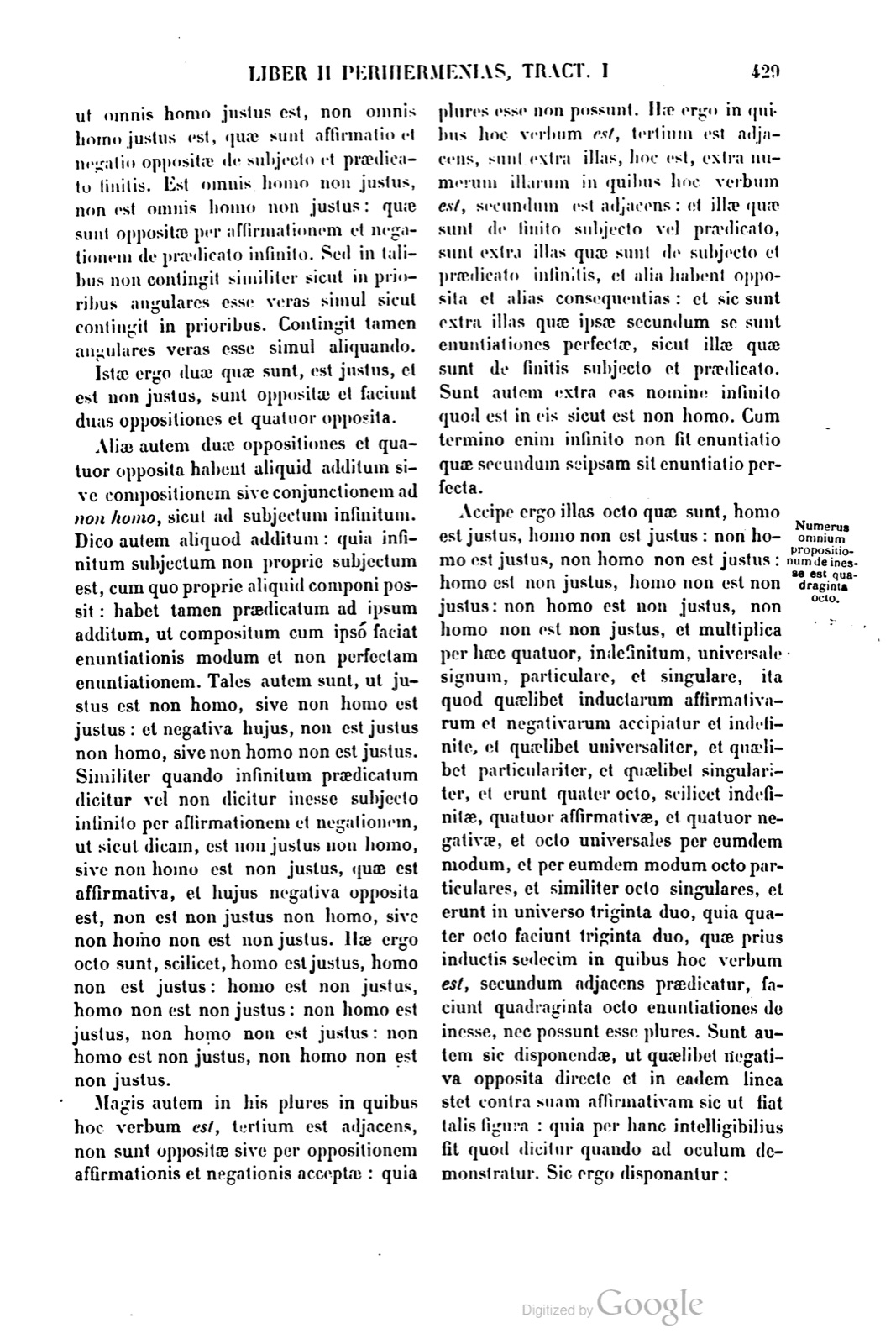
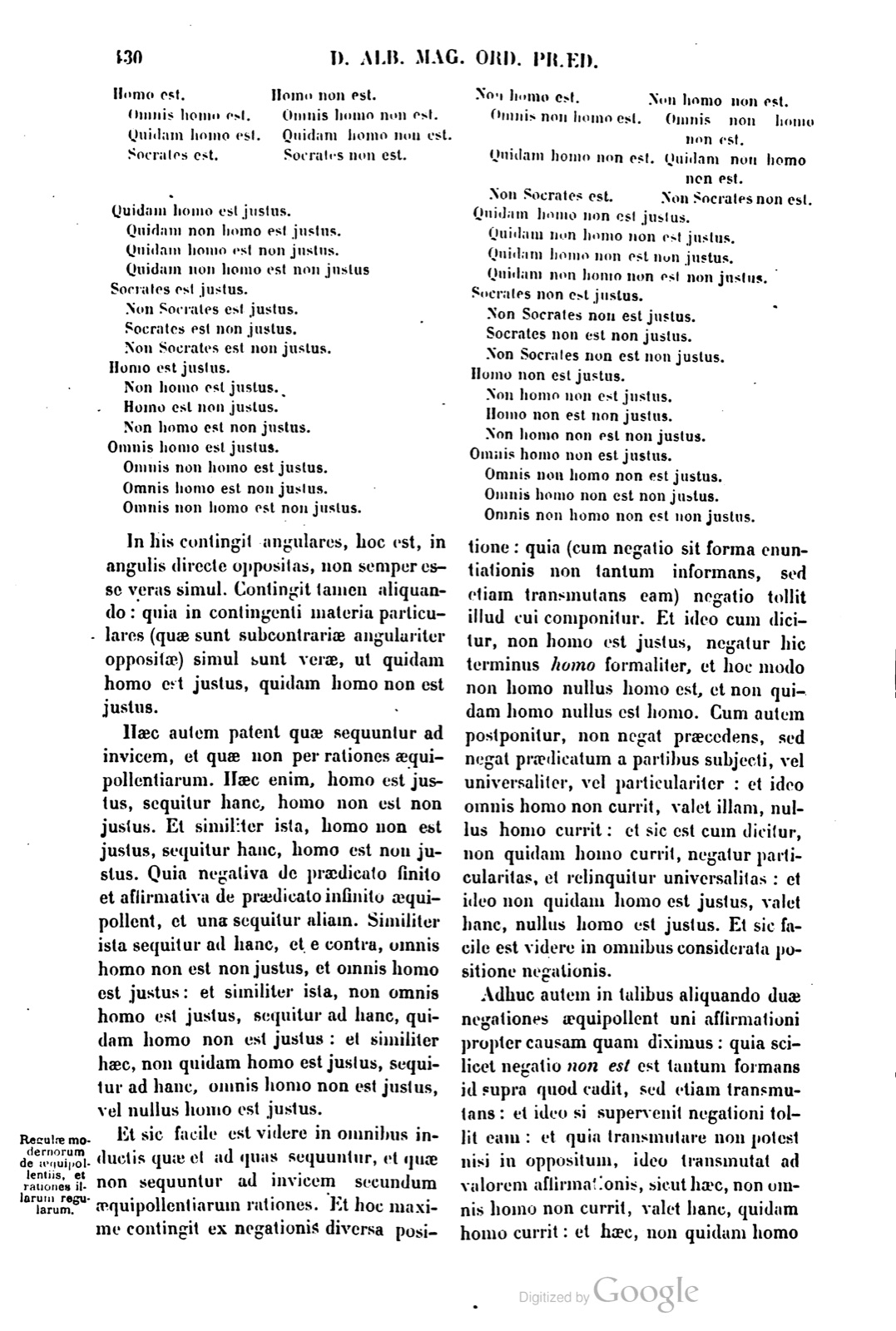
Accipe ergo illas octo quae sunt, homo est justus, homo non est justus: non homo est justus, non homo non est justus: homo est non justus, homo non est non justus: non homo est non justus, non homo non est non justus, et multiplica per haec quatuor, indefinitum, universale signum, particulare, et singulare, ita quod quaelibet inductarum affirmativarum et negativarum accipiatur et indefinite, et quaelibet universaliter, et quaelibet particulariter, et quaelibet singulariter, et erunt quater octo, scilicet indefinitae, quatuor affirmativae, et quatuor negativae, et octo universales per eumdem modum, et per eumdem modum octo particulares, et similiter octo singulares, et erunt in universo triginta duo, quia quater octo faciunt triginta duo, quae prius inductis sedecim in quibus hoc verbum est, secundum adjacens praedicatur, faciunt quadraginta octo enuntiationes de inesse, nec possunt esse plures. Sunt autem sic disponendae, ut quaelibet negativa opposita directe et in eadem linea stet contra suam affirmativam sic ut fiat talis figura: quia per hanc intelligibilius fit quod dicitur quando ad oculum demonstratur. Sic ergo disponantur:
Homo est. Homo non est. Non homo est. Non homo non est. Omnis homo est. Omnis homo non est. Omnis non homo est. Omnis non homo non est. Quidam homo est. Quidam homo non est. Quidam non homo est. Quidam non homo non est. Socrates est. Socrates non est. Non Socrates est. Non Socrates non est. Quidam homo est justus. Quidam homo non est justus. Quidam non homo est justus. Quidam non homo non est justus. Quidam homo est non justus. Quidam homo non est non justus. Quidam non homo est non justus. Quidam non homo non est non justus. Socrates est justus. Socrates non est justus. Non Socrates est justus. Non Socrates non est justus. Socrates est non justus. Socrates non est non justus. Non Socrates est non justus. Non Socrates non est non justus. Homo est justus. Homo non est justus. Non homo est justus. Non homo non est justus. Homo est non justus. Homo non est non justus. Non homo est non justus. Non homo non est non justus. Omnis homo est justus. Omnis homo non est justus. Omnis non homo est justus. Omnis non homo non est justus. Omnis homo est non justus. Omnis homo non est non justus. Omnis non homo est non justus. Omnis non homo non est non justus.
In his contingit angulares, hoc est, in angulis directe oppositas, non semper esse veras simul. Contingit tamen aliquando: quia in contingenti materia particulares (quae sunt subcontrariae angulariter oppositae) simul sunt verae, ut quidam homo est justus, quidam homo non est justus.
Take, therefore, those eight which are "man is just," "man is not just"; "non-man is just," "non-man is not just"; "man is non-just," "man is not non-just"; "non-man is non-just," "non-man is not non-just," and multiply by these four, indefinite, universal sign, particular, and singular, so that each of the introduced affirmatives and negatives is taken indefinitely, and each universally, and each particularly, and each singularly; and there will be four times eight, namely indefinite ones, four affirmative and four negative, and eight universals in the same way, and in the same way eight particulars, and likewise eight singulars; and there will be thirty-two in the whole, because four times eight make thirty-two, which with the sixteen introduced before in which this verb "is" is predicated as adjacent as second make forty-eight enunciations about being-in, and there cannot be more. But they must be arranged so that each opposed negative stands directly and in the same line against its own affirmative, so that such a figure is made, because through this what is said becomes more intelligible when it is demonstrated to the eye. Therefore let them be arranged thus:
Man is. Man is not. Non-man is. Non-man is not. Every man is. Every man is not. Every non-man is. Every non-man is not. Some man is. Some man is not. Some non-man is. Some non-man is not. Socrates is. Socrates is not. Non-Socrates is. Non-Socrates is not. Some man is just. Some man is not just. Some non-man is just. Some non-man is not just. Some man is non-just. Some man is not non-just. Some non-man is non-just. Some non-man is not non-just. Socrates is just. Socrates is not just. Non-Socrates is just. Non-Socrates is not just. Socrates is non-just. Socrates is not non-just. Non-Socrates is non-just. Non-Socrates is not non-just. Man is just. Man is not just. Non-man is just. Non-man is not just. Man is non-just. Man is not non-just. Non-man is non-just. Non-man is not non-just. Every man is just. Every man is not just. Every non-man is just. Every non-man is not just. Every man is non-just. Every man is not non-just. Every non-man is non-just. Every non-man is not non-just.
In these it happens that the angulars, that is, those directly opposed in the angles, are not always true at the same time. Nevertheless it sometimes happens; because in contingent matter particulars, which are subcontraries opposed angularly, are true at the same time, as "some man is just," "some man is not just."
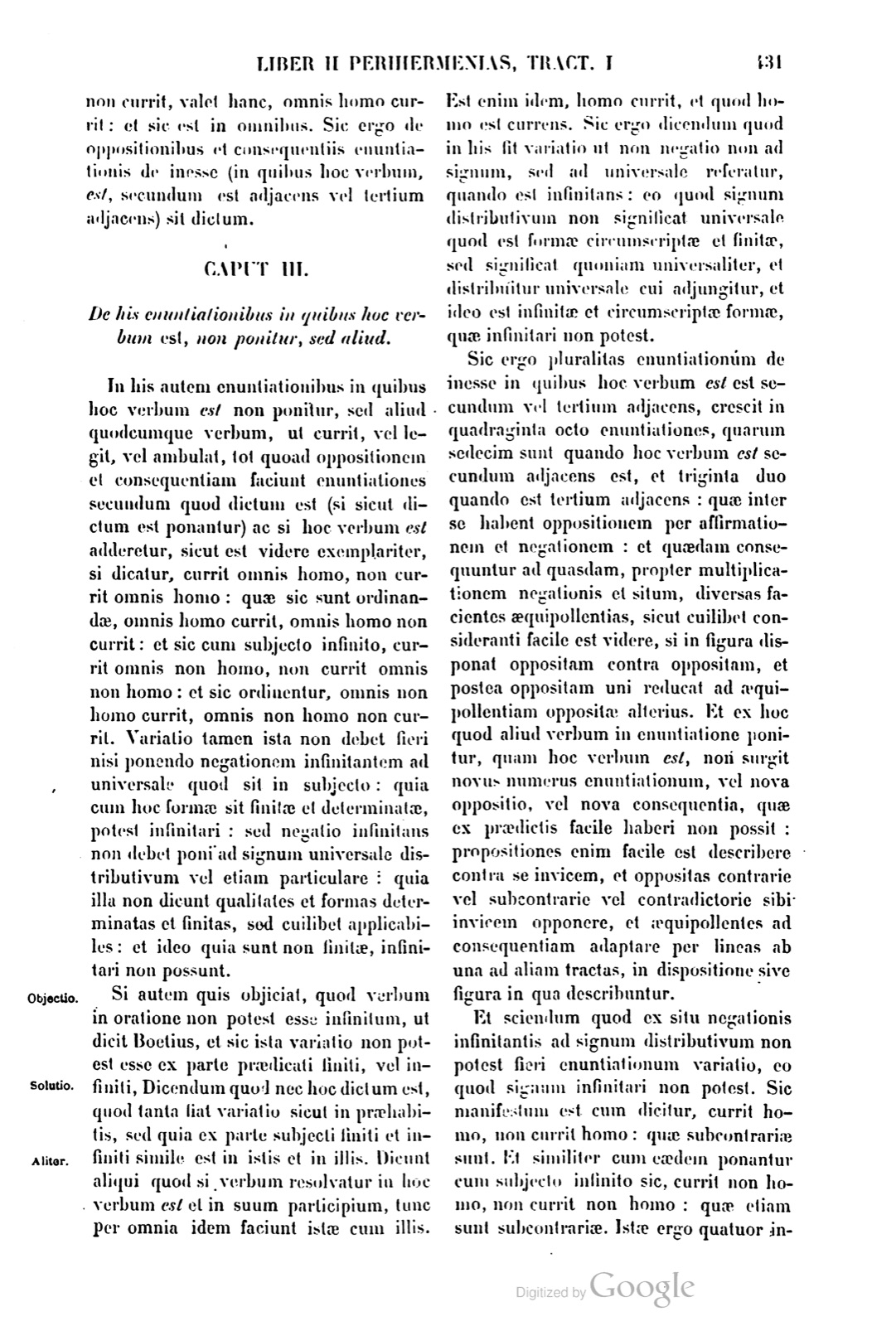
Haec autem patent quae sequuntur ad invicem, et quae non per rationes aequipollentiarum. Haec enim, homo est justus, sequitur hanc, homo non est non justus. Et similiter ista, homo non est justus, sequitur hanc, homo est non justus. Quia negativa de praedicato finito et affirmativa de praedicato infinito aequipollent, et una sequitur aliam. Similiter ista sequitur ad hanc, et e contra, omnis homo non est non justus, et omnis homo est justus: et similiter ista, non omnis homo est justus, sequitur ad hanc, quidam homo non est justus: et similiter haec, non quidam homo est justus, sequitur ad hanc, omnis homo non est justus, vel nullus homo est justus.
Et sic facile est videre in omnibus inductis quae et ad quas sequuntur, et quae non sequuntur ad invicem secundum aequipollentiarum rationes. Et hoc maxime contingit ex negationis diversa positione: quia (cum negatio sit forma enuntiationis non tantum informans, sed etiam transmutans eam) negatio tollit illud cui componitur. Et ideo cum dicitur, non homo est justus, negatur hic terminus homo formaliter, et hoc modo non homo nullus homo est, et non quidam homo nullus est homo. Cum autem postponitur, non negat praecedens, sed negat praedicatum a partibus subjecti, vel universaliter, vel particulariter: et ideo omnis homo non currit, valet illam, nullus homo currit: et sic est cum dicitur, non quidam homo currit, negatur particularitas, et relinquitur universalitas: et ideo non quidam homo est justus, valet hanc, nullus homo est justus. Et sic facile est videre in omnibus considerata positione negationis.
Adhuc autem in talibus aliquando duae negationes aequipollent uni affirmationi propter causam quam diximus: quia scilicet negatio non est est tantum formans id supra quod cadit, sed etiam transmutans: et ideo si supervenit negationi tollit eam: et quia transmutare non potest nisi in oppositum, ideo transmutat ad valorem affirmationis, sicut haec, non omnis homo non currit, valet hanc, quidam homo currit: et haec, non quidam homo non currit, valet hanc, omnis homo currit: et sic est in omnibus. Sic ergo de oppositionibus et consequentiis enuntiationis de inesse (in quibus hoc verbum, est, secundum est adjacens vel tertium adjacens) sit dictum.
### Marginal Labels - 429: Numerus omnium propositionum de inesse est quadraginta octo. - 430: Regulae modernorum de aequipollentiis, et rationes illarum regularum.
But these things are evident, which follow each other and which do not, through the accounts of equivalences. For this, "man is just," follows this, "man is not non-just." And similarly that, "man is not just," follows this, "man is non-just." Because the negative about a finite predicate and the affirmative about an infinite predicate are equivalent, and one follows the other. Similarly that follows this and conversely, "every man is not non-just" and "every man is just"; and similarly that, "not every man is just," follows this, "some man is not just"; and similarly this, "not some man is just," follows this, "every man is not just," or "no man is just."
And thus it is easy to see in all the things introduced which things follow and to which things they follow, and which do not follow each other according to the accounts of equivalences. And this happens especially from the diverse position of negation, because, since negation is the form of enunciation not only informing it but also transmuting it, negation takes away that to which it is composed. And therefore when it is said, "non-man is just," this term man is here formally denied, and in this way non-man is no man, and not some man is no man. But when it is placed after, it does not deny what precedes, but denies the predicate from the parts of the subject, either universally or particularly; and therefore "every man does not run" is equivalent to that, "no man runs"; and so it is when it is said, "not some man runs," particularity is denied and universality is left; and therefore "not some man is just" is equivalent to this, "no man is just." And thus it is easy to see in all cases, once the position of negation has been considered.
Moreover, in such cases sometimes two negations are equivalent to one affirmation on account of the cause which we have stated, namely because negation is not only forming that upon which it falls, but also transmuting it; and therefore if it supervenes upon negation it takes it away; and because it cannot transmute except into the opposite, therefore it transmutates to the value of an affirmation, as this, "not every man does not run," is equivalent to this, "some man runs"; and this, "not some man does not run," is equivalent to this, "every man runs"; and so it is in all cases. Therefore let this have been said about the oppositions and consequences of enunciation about being-in, in which this verb "is" is adjacent as second or as third.
### Marginal Labels - 429: The number of all propositions about being-in is forty-eight. - 430: Rules of the moderns concerning equivalences, and the reasons for those rules.
Notes
- Here he briefly extricates himself concerning the exposition of the words of the text, concerning which words Boethius and St. Thomas bring forward many expositions. (Hic breviter se expedit circa expositionem verborum textus, super quae verba Boetius et S. Thomas multas afferunt expositiones.) ↩
If a page does not appear, its photograph has not been uploaded yet.