Works › On Interpretation, Books I–II
Volume 1 · pp. 422–423
Chapter VII. On The Solution Of Doubtful Points Which Are Around The Foregoing.
A marker with ≈ is an approximate page boundary, placed by measure of the text; the page photographs remain the authority. In the paired views, clicking a page marker brings that page into view.
CAPUT VII. De solutione dubitabilium quae sunt circa praedicta.
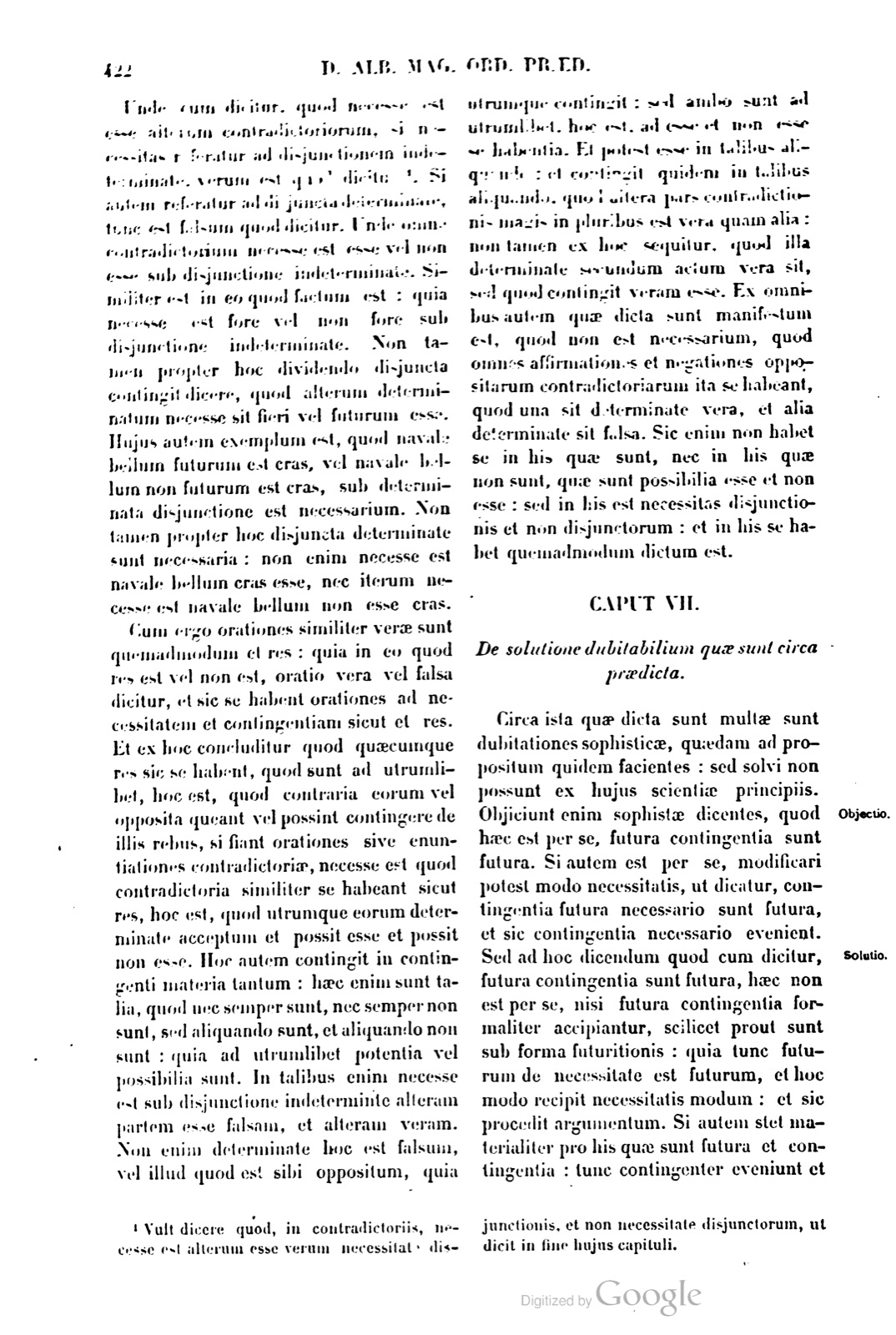
Circa ista quae dicta sunt multae sunt dubitationes sophisticae, quaedam ad propositum quidem facientes: sed solvi non possunt ex hujus scientiae principiis. Objiciunt enim sophistae dicentes, quod haec est per se, futura contingentia sunt futura. Si autem est per se, modificari potest modo necessitatis, ut dicatur, contingentia futura necessario sunt futura, et sic contingentia necessario evenient. Sed ad hoc dicendum quod cum dicitur, futura contingentia sunt futura, haec non est per se, nisi futura contingentia formaliter accipiantur, scilicet prout sunt sub forma futuritionis: quia tunc futurum de necessitate est futurum, et hoc modo recipit necessitatis modum: et sic procedit argumentum. Si autem stet materialiter pro his quae sunt futura et contingentia: tunc contingenter eveniunt et non recipiunt modum necessitatis. Dicunt tamen aliter quidam, quod futura contingentia de necessitate eveniunt hoc modo quo sunt futura, hoc est, contingenter: et sic necessarium est hoc vel illud evenire, sed non necessario alterum determinate, ut prius dictum est.
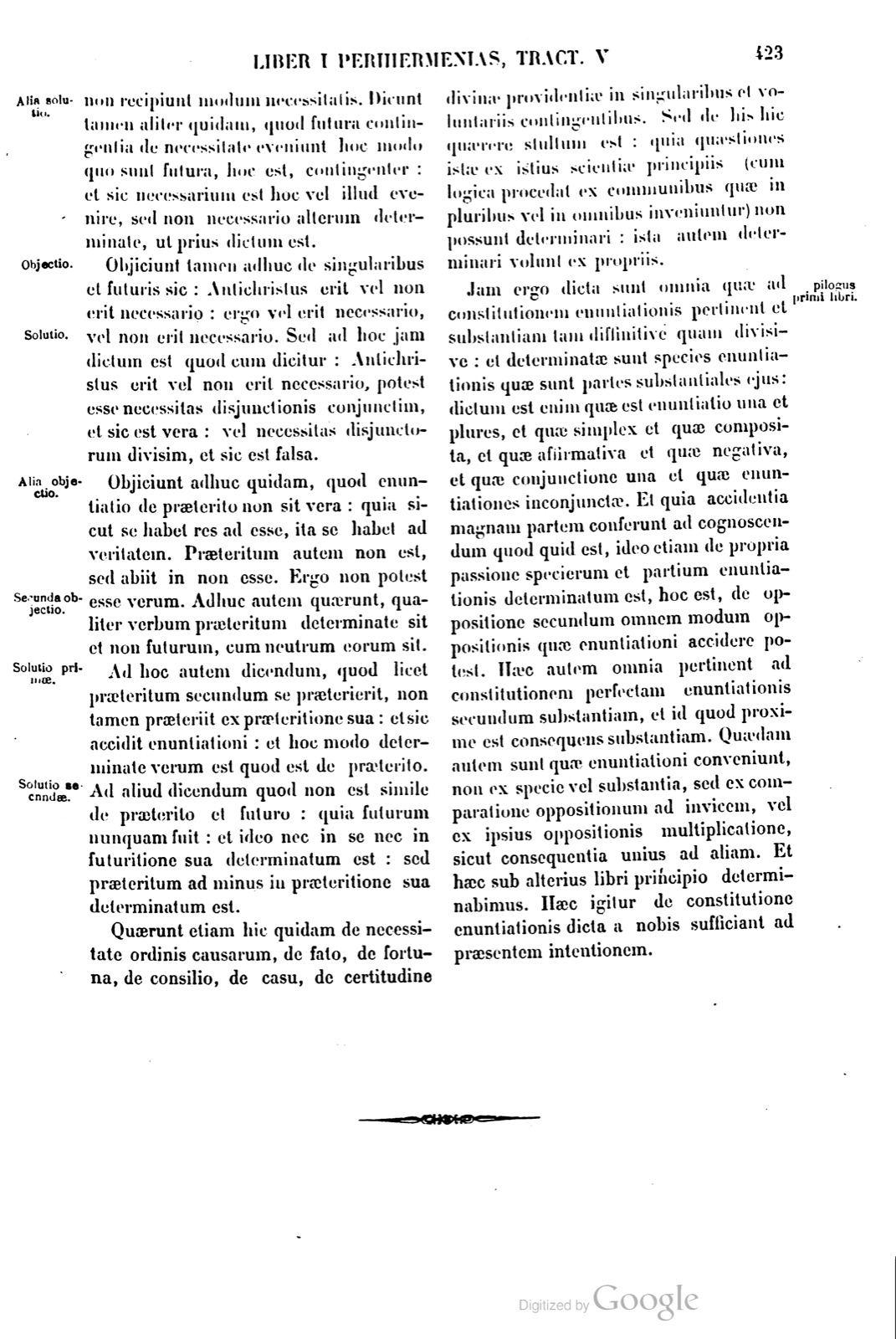
Objiciunt tamen adhuc de singularibus et futuris sic: Antichristus erit vel non erit necessario: ergo vel erit necessario, vel non erit necessario. Sed ad hoc jam dictum est quod cum dicitur: Antichristus erit vel non erit necessario, potest esse necessitas disjunctionis conjunctim, et sic est vera: vel necessitas disjunctorum divisim, et sic est falsa.
Objiciunt adhuc quidam, quod enuntiatio de praeterito non sit vera: quia sicut se habet res ad esse, ita se habet ad veritatem. Praeteritum autem non est, sed abiit in non esse. Ergo non potest esse verum. Adhuc autem quaerunt, qualiter verbum praeteritum determinate sit et non futurum, cum neutrum eorum sit. Ad hoc autem dicendum, quod licet praeteritum secundum se praeterierit, non tamen praeteriit ex praeteritione sua: et sic accidit enuntiationi: et hoc modo determinate verum est quod est de praeterito. Ad aliud dicendum quod non est simile de praeterito et futuro: quia futurum nunquam fuit: et ideo nec in se nec in futuritione sua determinatum est: sed praeteritum ad minus in praeteritione sua determinatum est.
CHAPTER VII. On the solution of doubtful points which are around the foregoing.
Around those things which have been said there are many sophistical doubts, some indeed making for the proposed point, but they cannot be solved from the principles of this science. For the sophists object, saying that this is per se: future contingents are future. But if it is per se, it can be modified by the mode of necessity, so that it is said: future contingents are necessarily future, and thus contingents will happen necessarily. But to this it must be said that when it is said, "future contingents are future," this is not per se unless future contingents are taken formally, namely insofar as they are under the form of futurity, because then the future is of necessity future, and in this way it receives the mode of necessity, and thus the argument proceeds. But if it stands materially for those things which are future and contingent, then they happen contingently and do not receive the mode of necessity. Yet some speak otherwise, that future contingents happen of necessity in the mode in which they are future, that is, contingently; and thus it is necessary that this or that happen, but not that one determinate thing happen necessarily, as was said before.
Nevertheless they still object concerning singular and future things in this way: Antichrist will be or will not be necessarily; therefore either he will be necessarily, or he will not be necessarily. But to this it has already been said that when it is said, "Antichrist will be or will not be necessarily," there can be necessity of the disjunction conjointly, and thus it is true; or necessity of the disjuncts separately, and thus it is false.
Some still object that an enunciation about the past is not true, because as the thing is related to being, so it is related to truth. But the past is not, but has gone away into non-being. Therefore it cannot be true. Moreover they ask how the past verb is determinate and not the future, since neither of them is. To this it must be said that although the past according to itself has passed away, nevertheless it has not passed away from its pastness; and thus it belongs to enunciation; and in this way what is about the past is determinately true. To the other it must be said that it is not similar concerning the past and the future, because the future never was; and therefore neither in itself nor in its futurity is it determinate. But the past at least in its pastness is determinate.
Quaerunt etiam hic quidam de necessitate ordinis causarum, de fato, de fortuna, de consilio, de casu, de certitudine divinae providentiae in singularibus et voluntariis contingentibus. Sed de his hic quaerere stultum est: quia quaestiones istae ex istius scientiae principiis (cum logica procedat ex communibus quae in pluribus vel in omnibus inveniuntur) non possunt determinari: ista autem determinari volunt ex propriis.
Jam ergo dicta sunt omnia quae ad primi libri constitutionem enuntiationis pertinent et substantiam tam diffinitive quam divisive: et determinatae sunt species enuntiationis quae sunt partes substantiales ejus: dictum est enim quae est enuntiatio una et plures, et quae simplex et quae composita, et quae affirmativa et quae negativa, et quae conjunctione una et quae enuntiationes inconjunctae. Et quia accidentia magnam partem conferunt ad cognoscendum quod quid est, ideo etiam de propria passione specierum et partium enuntiationis determinatum est, hoc est, de oppositione secundum omnem modum oppositionis quae enuntiationi accidere potest. Haec autem omnia pertinent ad constitutionem perfectam enuntiationis secundum substantiam, et id quod proxime est consequens substantiam. Quaedam autem sunt quae enuntiationi conveniunt, non ex specie vel substantia, sed ex comparatione oppositionum ad invicem, vel ex ipsius oppositionis multiplicatione, sicut consequentia unius ad aliam. Et haec sub alterius libri principio determinabimus. Haec igitur de constitutione enuntiationis dicta a nobis sufficiant ad praesentem intentionem.
### Marginal Labels - 422: Objectio. - 422: Solutio. - 423: Alia solutio. - 423: Objectio. - 423: Solutio. - 423: Alia objectio. - 423: Secunda objectio. - 423: Solutio primae. - 423: Solutio secundae. - 423: Epilogus primi libri.
Some also ask here about the necessity of the order of causes, about fate, about fortune, about counsel, about chance, about the certitude of divine providence in singular and voluntary contingents. But to ask about these here is foolish, because those questions cannot be determined from the principles of this science, since logic proceeds from common things which are found in many or in all; but they wish those things to be determined from proper principles.
Therefore now all the things have been said which pertain to the constitution and substance of enunciation in the first book, both definitively and divisively; and the species of enunciation which are its substantial parts have been determined. For it has been said what one and many enunciation are, and what simple and composite enunciation are, and what affirmative and negative enunciation are, and what is one by conjunction and what enunciations are unconjoined. And because accidents contribute a great part toward knowing what a thing is, therefore it has also been determined concerning the proper attribute of the species and parts of enunciation, that is, concerning opposition according to every mode of opposition which can occur to enunciation. But all these things pertain to the perfect constitution of enunciation according to substance and to that which most nearly follows substance. Yet there are certain things which belong to enunciation not from species or substance, but from the comparison of oppositions to each other, or from the multiplication of opposition itself, such as the consequence of one to another. And these we will determine under the beginning of the other book. Therefore let these things said by us about the constitution of enunciation suffice for the present intention.
### Marginal Labels - 422: Objection. - 422: Solution. - 423: Another solution. - 423: Objection. - 423: Solution. - 423: Another objection. - 423: Second objection. - 423: Solution of the first. - 423: Solution of the second. - 423: Epilogue of the first book.
If a page does not appear, its photograph has not been uploaded yet.