Works › On Interpretation, Books I–II
Volume 1 · pp. 421–422
Chapter VI. On The Determination Of The Doubt Introduced.
A marker with ≈ is an approximate page boundary, placed by measure of the text; the page photographs remain the authority. In the paired views, clicking a page marker brings that page into view.
CAPUT VI. De determinatione dubitationis inductae.
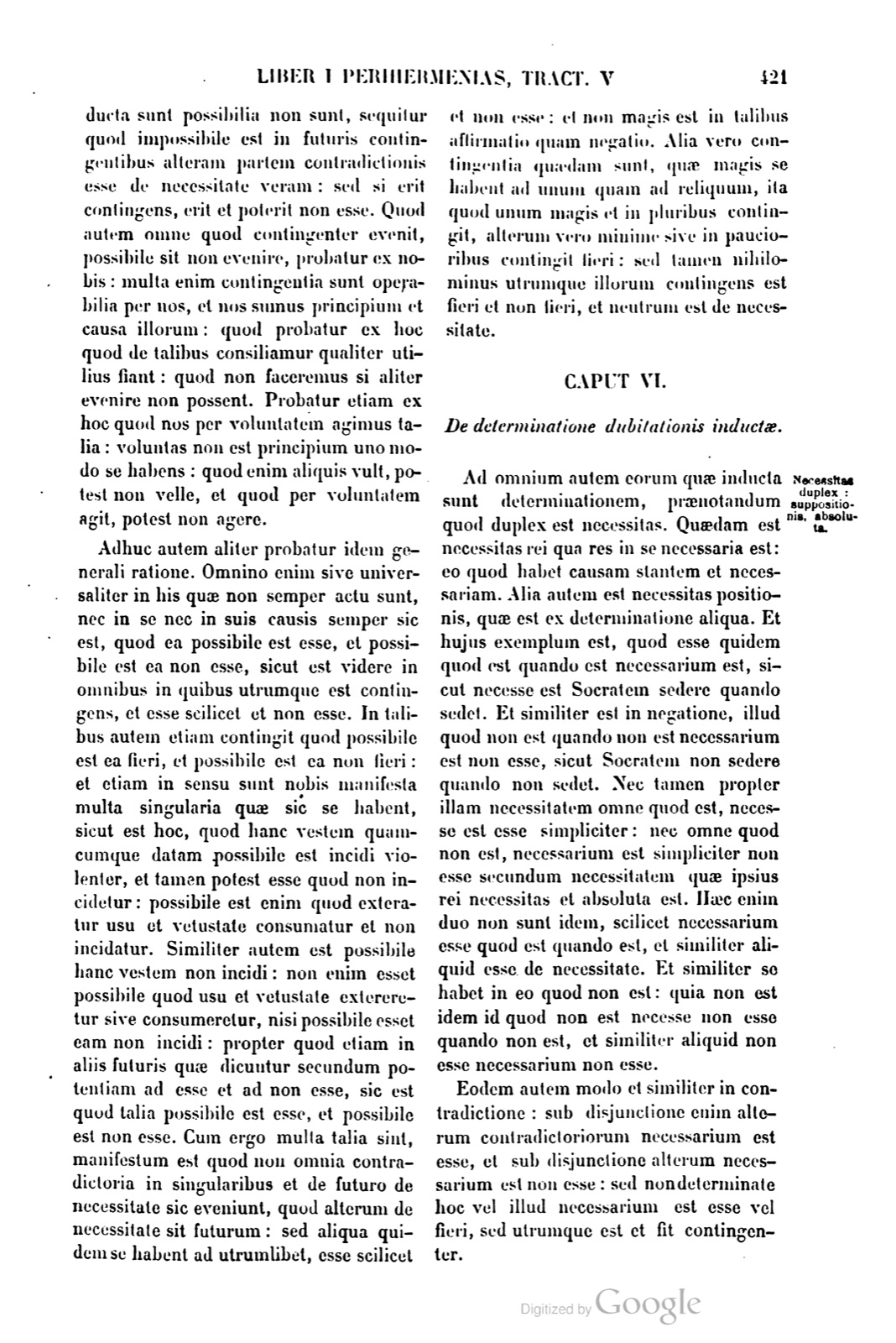
Ad omnium autem eorum quae inducta sunt determinationem, praenotandum quod duplex est necessitas. Quaedam est necessitas rei qua res in se necessaria est: eo quod habet causam stantem et necessariam. Alia autem est necessitas positionis, quae est ex determinatione aliqua. Et hujus exemplum est, quod esse quidem quod est quando est necessarium est, sicut necesse est Socratem sedere quando sedet. Et similiter est in negatione, illud quod non est quando non est necessarium est non esse, sicut Socratem non sedere quando non sedet. Nec tamen propter illam necessitatem omne quod est, necesse est esse simpliciter: nec omne quod non est, necessarium est simpliciter non esse secundum necessitatem quae ipsius rei necessitas et absoluta est. Haec enim duo non sunt idem, scilicet necessarium esse quod est quando est, et similiter aliquid esse de necessitate. Et similiter se habet in eo quod non est: quia non est idem id quod non est necesse non esse quando non est, et similiter aliquid non esse necessarium non esse.
Eodem autem modo et similiter in contradictione: sub disjunctione enim alterum contradictoriorum necessarium est esse, et sub disjunctione alterum necessarium est non esse: sed nondeterminate hoc vel illud necessarium est esse vel fieri, sed utrumque est et fit contingenter.
Unde cum dicitur, quod necesse est esse alterum contradictoriorum, si necessitas referatur ad disjunctionem indeterminate, verum est quod dicitur1. Si autem referatur ad disjuncta determinate, tunc est falsum quod dicitur. Unde omne contradictorium necesse est esse vel non esse sub disjunctione indeterminate. Similiter est in eo quod factum est: quia necesse est fore vel non fore sub disjunctione indeterminate. Non tamen propter hoc dividendo disjuncta contingit dicere, quod alterum determinatum necesse sit fieri vel futurum esse. Hujus autem exemplum est, quod navale bellum futurum est cras, vel navale bellum non futurum est cras, sub determinata disjunctione est necessarium. Non tamen propter hoc disjuncta determinate sunt necessaria: non enim necesse est navale bellum cras esse, nec iterum necesse est navale bellum non esse cras.
CHAPTER VI. On the determination of the doubt introduced.
For the determination of all the things which have been introduced, it must be noted beforehand that necessity is twofold. One is the necessity of the thing, by which the thing is necessary in itself, in that it has a standing and necessary cause. The other is the necessity of position, which is from some determination. And an example of this is that the being which is, when it is, is necessary, as it is necessary that Socrates sit when he sits. And similarly it is in negation: that which is not, when it is not, is necessary not to be, as Socrates not sitting when he does not sit. Yet not on account of that necessity is everything which is necessary to be simply; nor is everything which is not necessary simply not to be according to the necessity which is the necessity of the thing itself and absolute. For these two are not the same, namely that what is, when it is, is necessary, and similarly that something is of necessity. And similarly it has itself in what is not, because that which is not, when it is not, is necessarily not to be is not the same as that something not being is necessarily not to be.
In the same way and similarly in contradiction: for under disjunction one of the contradictories is necessary to be, and under disjunction one is necessary not to be; but it is not determinately necessary that this one or that one be or come to be, but each is and comes to be contingently.
Hence when it is said that it is necessary that one of the contradictories be, if the necessity is referred to the disjunction indeterminately, what is said is true1. But if it is referred to the disjuncts determinately, then what is said is false. Hence every contradictory must necessarily be or not be under an indeterminate disjunction. It is similar in what has been done, because it is necessary that it will be or will not be under an indeterminate disjunction. Yet on account of this, by dividing the disjuncts, it does not happen that one can say that one determinate thing must necessarily come to be or be future. An example of this is that "a naval battle will be tomorrow" or "a naval battle will not be tomorrow" is necessary under a determinate disjunction. Yet on account of this the disjuncts are not determinately necessary; for it is not necessary that a naval battle be tomorrow, nor again is it necessary that a naval battle not be tomorrow.
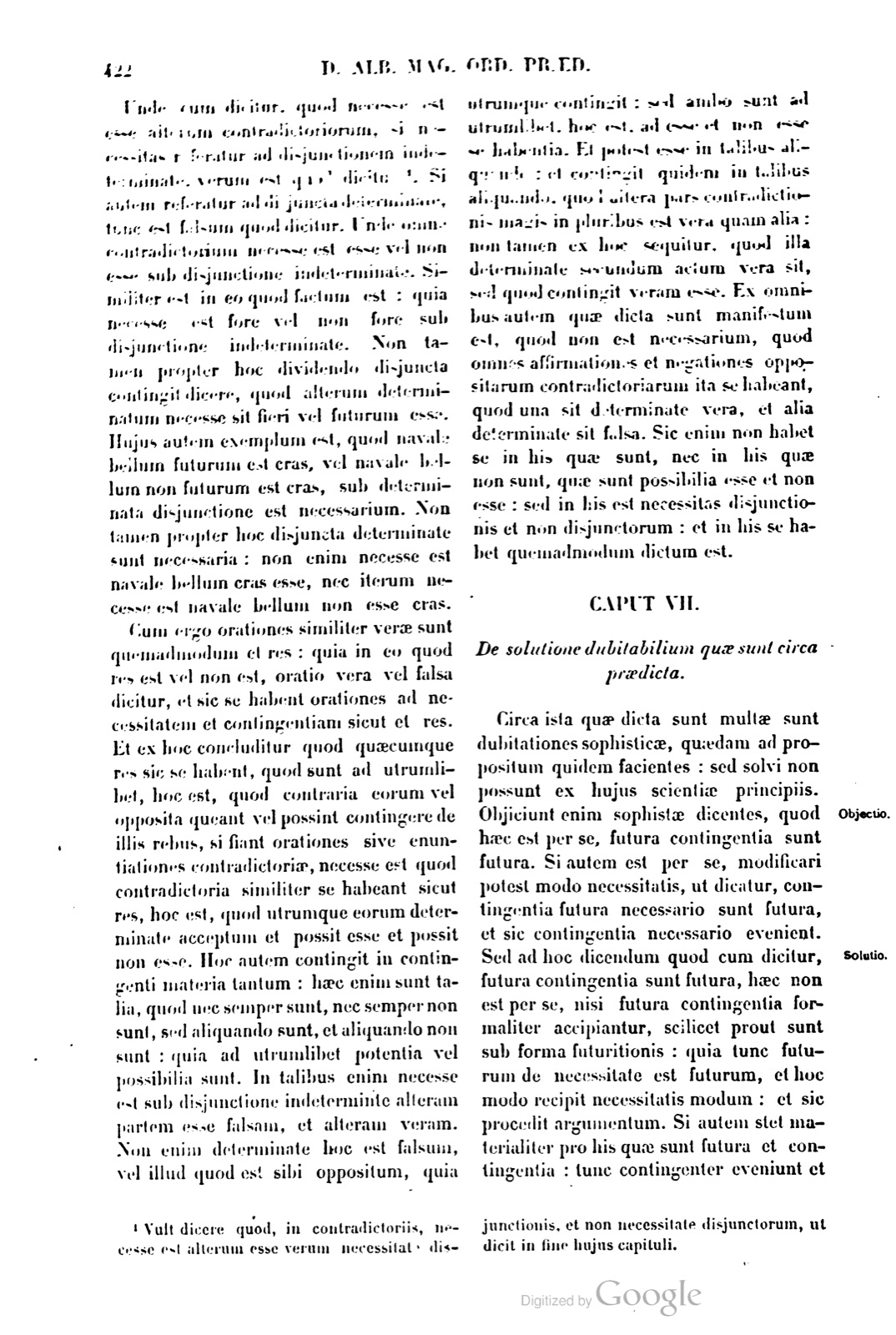
Cum ergo orationes similiter verae sunt quemadmodum et res: quia in eo quod res est vel non est, oratio vera vel falsa dicitur, et sic se habent orationes ad necessitatem et contingentiam sicut et res. Et ex hoc concluditur quod quaecumque res sic se habent, quod sunt ad utrumlibet, hoc est, quod contraria eorum vel opposita queant vel possint contingere de illis rebus, si fiant orationes sive enuntiationes contradictoriae, necesse est quod contradictoria similiter se habeant sicut res, hoc est, quod utrumque eorum determinate acceptum et possit esse et possit non esse. Hoc autem contingit in contingenti materia tantum: haec enim sunt talia, quod nec semper sunt, nec semper non sunt, sed aliquando sunt, et aliquando non sunt: quia ad utrumlibet potentia vel possibilia sunt. In talibus enim necesse est sub disjunctione indeterminate alteram partem esse falsam, et alteram veram. Non enim determinate hoc est falsum, vel illud quod est sibi oppositum, quia utrumque contingit: sed ambo sunt ad utrumlibet, hoc est, ad esse et non esse se habentia. Et potest esse in talibus aliquando, quod contingit quidem in talibus aliquando, quod altera pars contradictionis magis in pluribus est vera quam alia: non tamen ex hoc sequitur, quod illa determinate secundum actum vera sit, sed quod contingit veram esse. Ex omnibus autem quae dicta sunt manifestum est, quod non est necessarium, quod omnes affirmationes et negationes oppositarum contradictoriarum ita se habeant, quod una sit determinate vera, et alia determinate sit falsa. Sic enim non habet se in his quae sunt, nec in his quae non sunt, quae sunt possibilia esse et non esse: sed in his est necessitas disjunctionis et non disjunctorum: et in his se habet quemadmodum dictum est.
### Marginal Labels - 421: Necessitas duplex: suppositionis, absoluta.
Since therefore speeches are true in the same way as things are, because in that a thing is or is not, speech is said to be true or false, and thus speeches are related to necessity and contingency as things also are. And from this it is concluded that whatever things have themselves so that they are toward either alternative, that is, that their contraries or opposites can or are able to happen concerning those things, if contradictory speeches or enunciations are made, it is necessary that the contradictories have themselves similarly as the things, that is, that each of them, taken determinately, can be and can not be. But this happens in contingent matter only; for these are such that they neither always are nor always are not, but sometimes are and sometimes are not, because they are in potency or possible toward either alternative. For in such things it is necessary under an indeterminate disjunction that one part be false and the other true. For determinately this one is not false, nor that one which is opposed to it, because each can happen; but both are toward either alternative, that is, having themselves toward being and not being. And it can be in such things at some time, and indeed it happens in such things at some time, that one part of the contradiction is true in more cases than another; nevertheless from this it does not follow that it is determinately true according to act, but that it can be true. But from all the things which have been said it is manifest that it is not necessary that all affirmations and negations of opposed contradictories have themselves so that one is determinately true and the other determinately false. For it does not have itself so in those things which are, nor in those things which are not, which are possible to be and not to be; but in these there is necessity of the disjunction and not of the disjuncts, and in these it has itself as has been said.
### Marginal Labels - 421: Twofold necessity: of supposition, absolute.
Notes
- He wishes to say that, in contradictories, it is necessary that one be true by necessity of the disjunction, and not by necessity of the disjuncts, as he says at the end of this chapter. (Vult dicere quod, in contradictoriis, necesse est alterum esse verum necessitate disjunctionis, et non necessitate disjunctorum, ut dicit in fine hujus capituli.) ↩
If a page does not appear, its photograph has not been uploaded yet.