Works › On Interpretation, Books I–II
Volume 1 · pp. 420–421
Chapter V. On The Inconveniences Which Follow On The Part Of Those Things Of Which We Are The Cause.
CAPUT V. De inconvenientibus quae sequuntur ex parte eorum quorum nos causa sumus.
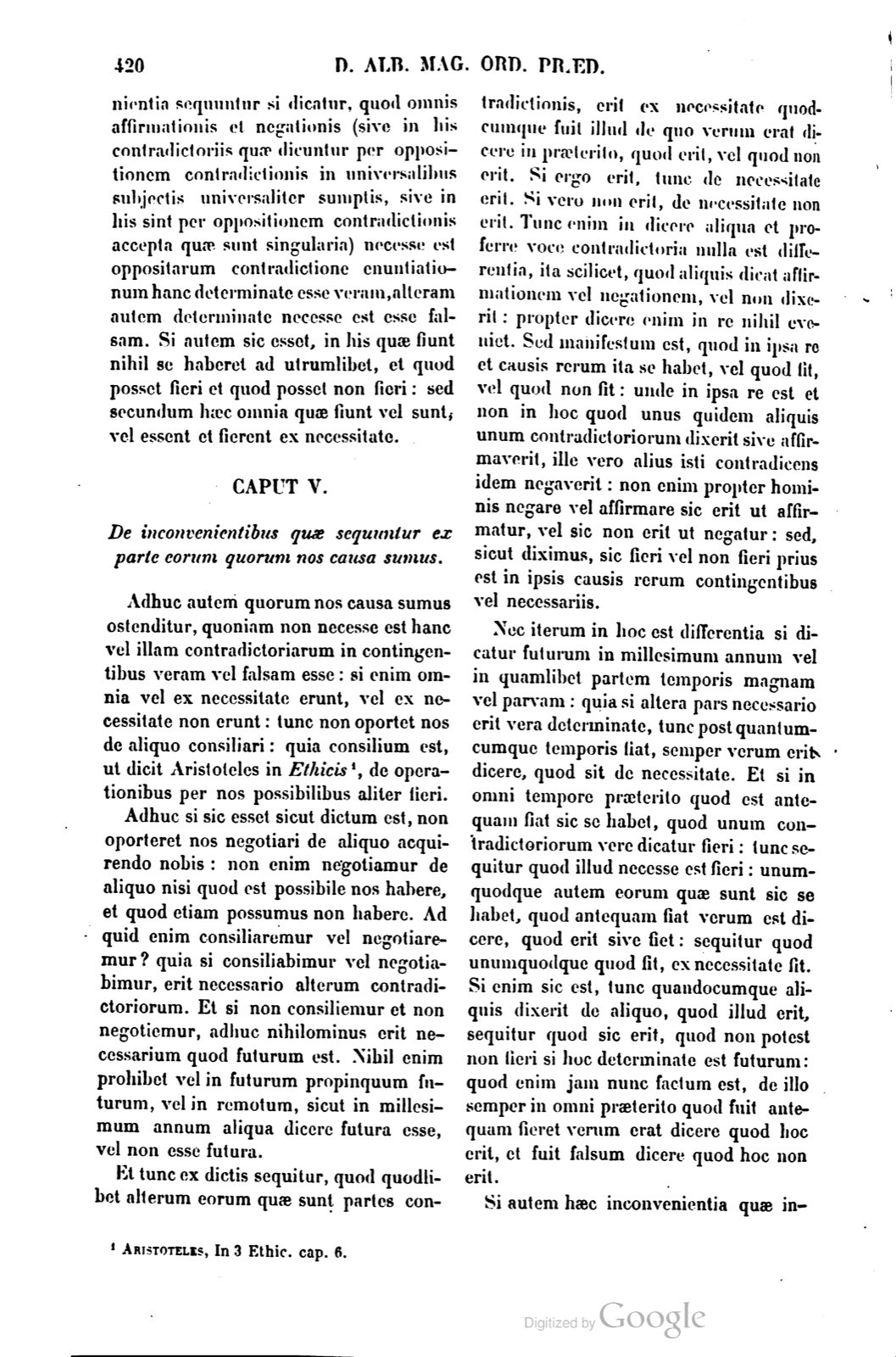
Adhuc autem quorum nos causa sumus ostenditur, quoniam non necesse est hanc vel illam contradictoriarum in contingentibus veram vel falsam esse: si enim omnia vel ex necessitate erunt, vel ex necessitate non erunt: tunc non oportet nos de aliquo consiliari: quia consilium est, ut dicit Aristoteles in Ethicis1, de operationibus per nos possibilibus aliter fieri.
Adhuc si sic esset sicut dictum est, non oporteret nos negotiari de aliquo acquirendo nobis: non enim negotiamur de aliquo nisi quod est possibile nos habere, et quod etiam possumus non habere. Ad quid enim consiliaremur vel negotiaremur? quia si consiliabimur vel negotiabimur, erit necessario alterum contradictoriorum. Et si non consiliemur et non negotiemur, adhuc nihilominus erit necessarium quod futurum est. Nihil enim prohibet vel in futurum propinquum futurum, vel in remotum, sicut in millesimum annum aliqua dicere futura esse, vel non esse futura.
Et tunc ex dictis sequitur, quod quodlibet alterum eorum quae sunt partes contradictionis, erit ex necessitate quodcumque fuit illud de quo verum erat dicere in praeterito, quod erit, vel quod non erit. Si ergo erit, tunc de necessitate erit. Si vero non erit, de necessitate non erit. Tunc enim in dicere aliqua et proferre voce contradictoria nulla est differentia, ita scilicet, quod aliquis dicat affirmationem vel negationem, vel non dixerit: propter dicere enim in re nihil eveniet. Sed manifestum est, quod in ipsa re et causis rerum ita se habet, vel quod fit, vel quod non fit: unde in ipsa re est et non in hoc quod unus quidem aliquis unum contradictoriorum dixerit sive affirmaverit, ille vero alius isti contradicens idem negaverit: non enim propter hominis negare vel affirmare sic erit ut affirmatur, vel sic non erit ut negatur: sed, sicut diximus, sic fieri vel non fieri prius est in ipsis causis rerum contingentibus vel necessariis.
Nec iterum in hoc est differentia si dicatur futurum in millesimum annum vel in quamlibet partem temporis magnam vel parvam: quia si altera pars necessario erit vera determinate, tunc post quantumcumque temporis fiat, semper verum erit dicere, quod sit de necessitate. Et si in omni tempore praeterito quod est antequam fiat sic se habet, quod unum contradictoriorum vere dicatur fieri: tunc sequitur quod illud necesse est fieri: unumquodque autem eorum quae sunt sic se habet, quod antequam fiat verum est dicere, quod erit sive fiet: sequitur quod unumquodque quod fit, ex necessitate fit. Si enim sic est, tunc quandocumque aliquis dixerit de aliquo, quod illud erit, sequitur quod sic erit, quod non potest non fieri si hoc determinate est futurum: quod enim jam nunc factum est, de illo semper in omni praeterito quod fuit antequam fieret verum erat dicere quod hoc erit, et fuit falsum dicere quod hoc non erit.
Si autem haec inconvenientia quae inducta
CHAPTER V. On the inconveniences which follow on the part of those things of which we are the cause.
Moreover, concerning those things of which we are the cause, it is shown that it is not necessary that this or that one of the contradictories in contingents be true or false: for if all things either will be from necessity or will not be from necessity, then it is not fitting for us to deliberate about anything, because counsel, as Aristotle says in the Ethics1, concerns operations possible through us to come to be otherwise.
Moreover, if it were so as has been said, it would not be fitting for us to be occupied in acquiring anything for ourselves; for we are not occupied about anything unless it is possible for us to have it, and unless we can also not have it. To what end, then, would we deliberate or be occupied? Because if we deliberate or are occupied, one of the contradictories will be necessary. And if we do not deliberate and are not occupied, nonetheless what is future will still be necessary. For nothing prevents saying that some things will be future, or will not be future, either in a future near future, or in a remote one, as in the thousandth year.
And then from the things said it follows that either one of those which are the parts of a contradiction will be from necessity, whatever that was about which it was true to say in the past that it will be or that it will not be. Therefore if it will be, then it will be of necessity. But if it will not be, it will not be of necessity. For then in saying things and putting forth contradictory things by voice there is no difference, namely whether someone says an affirmation or negation, or has not said it; for because of saying, nothing will happen in the thing. But it is manifest that in the thing itself and in the causes of things it is so, either that it comes to be or that it does not come to be; hence it is in the thing itself and not in this, that one particular person has said or affirmed one of the contradictories, while another, contradicting him, has denied the same thing. For it will not be so because of a man's denying or affirming, as it is affirmed, nor will it not be so as it is denied; but, as we have said, to come to be or not to come to be in this way is prior in the very causes of contingent or necessary things.
Nor again is there a difference in this if the future is said to be in the thousandth year or in any part of time, great or small; because if one part will necessarily be determinately true, then after however much time it comes to be, it will always be true to say that it is of necessity. And if in every past time which is before it comes to be it has itself so that one of the contradictories is truly said to come to be, then it follows that that necessarily comes to be. But each of those things which are has itself so, that before it comes to be it is true to say that it will be or will come to be; it follows that each thing which comes to be comes to be from necessity. For if it is so, then whenever someone says of something that it will be, it follows that it will be in such a way that it cannot fail to come to be, if this is determinately future; for concerning what has already now been made, in every past time which was before it came to be it was always true to say that this will be, and it was false to say that this will not be.
But if these inconveniences which have been introduced
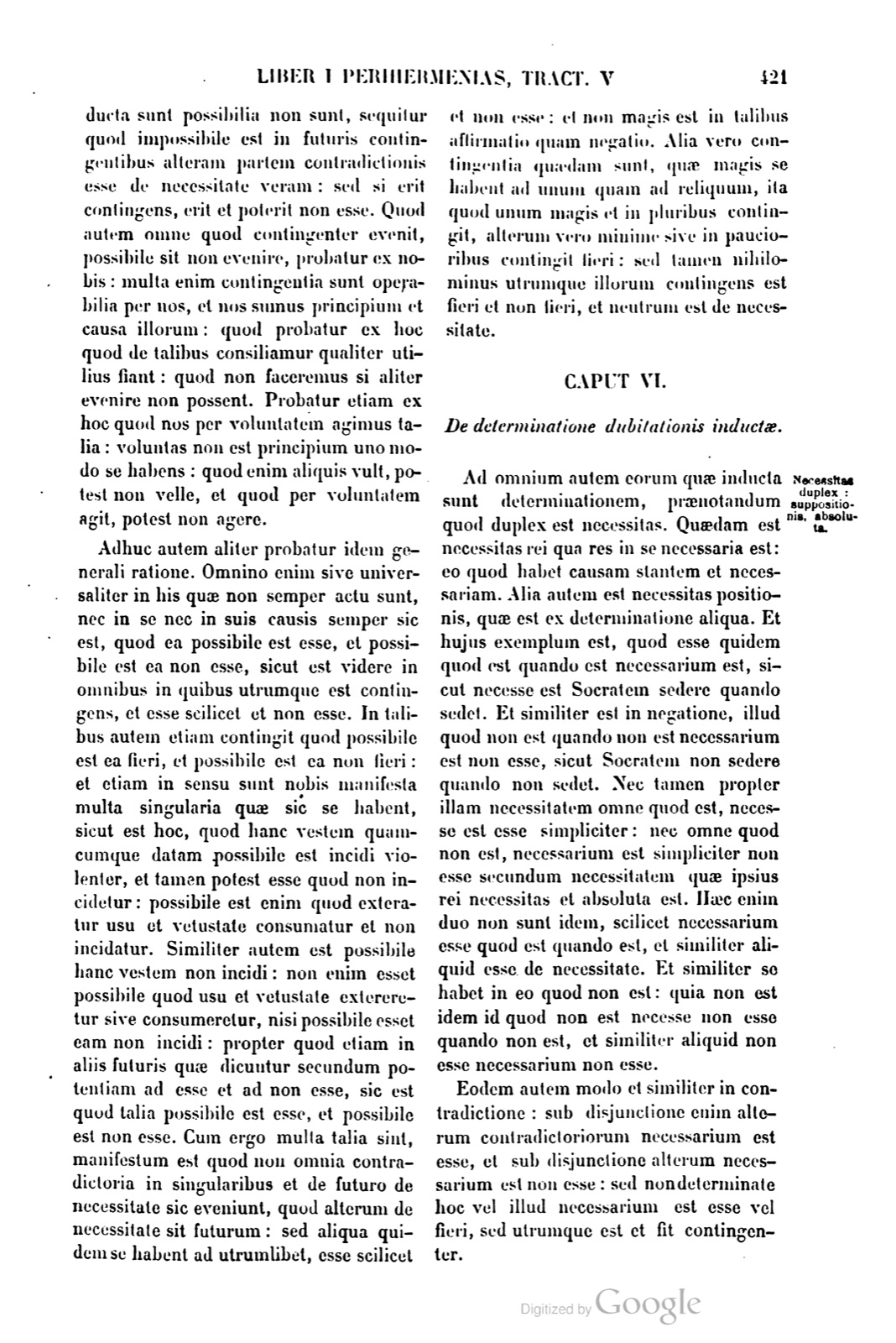
sunt possibilia non sunt, sequitur quod impossibile est in futuris contingentibus alteram partem contradictionis esse de necessitate veram: sed si erit contingens, erit et poterit non esse. Quod autem omne quod contingenter evenit, possibile sit non evenire, probatur ex nobis: multa enim contingentia sunt operabilia per nos, et nos sumus principium et causa illorum: quod probatur ex hoc quod de talibus consiliamur qualiter utilius fiant: quod non faceremus si aliter evenire non possent. Probatur etiam ex hoc quod nos per voluntatem agimus talia: voluntas non est principium uno modo se habens: quod enim aliquis vult, potest non velle, et quod per voluntatem agit, potest non agere.
Adhuc autem aliter probatur idem generali ratione. Omnino enim sive universaliter in his quae non semper actu sunt, nec in se nec in suis causis semper sic est, quod ea possibile est esse, et possibile est ea non esse, sicut est videre in omnibus in quibus utrumque est contingens, et esse scilicet et non esse. In talibus autem etiam contingit quod possibile est ea fieri, et possibile est ea non fieri: et etiam in sensu sunt nobis manifesta multa singularia quae sic se habent, sicut est hoc, quod hanc vestem quamcumque datam possibile est incidi violenter, et tamen potest esse quod non incidetur: possibile est enim quod exteratur usu et vetustate consumatur et non incidatur. Similiter autem est possibile hanc vestem non incidi: non enim esset possibile quod usu et vetustate extereretur sive consumeretur, nisi possibile esset eam non incidi: propter quod etiam in aliis futuris quae dicuntur secundum potentiam ad esse et ad non esse, sic est quod talia possibile est esse, et possibile est non esse. Cum ergo multa talia sint, manifestum est quod non omnia contradictoria in singularibus et de futuro de necessitate sic eveniunt, quod alterum de necessitate sit futurum: sed aliqua quidem se habent ad utrumlibet, esse scilicet et non esse: et non magis est in talibus affirmatio quam negatio. Alia vero contingentia quaedam sunt, quae magis se habent ad unum quam ad reliquum, ita quod unum magis et in pluribus contingit, alterum vero minime sive in paucioribus contingit fieri: sed tamen nihilominus utrumque illorum contingens est fieri et non fieri, et neutrum est de necessitate.
are not possible, it follows that it is impossible in future contingents for the one part of a contradiction to be true of necessity; but if it will be contingent, it will be and will be able not to be. But that everything which happens contingently is able not to happen is proved from us: for many contingent things are operable through us, and we are their principle and cause. This is proved from the fact that we deliberate about such things, in what way they may come about more usefully; we would not do this if they could not happen otherwise. It is also proved from the fact that we do such things through will; will is not a principle having itself in one way. For what someone wills, he can not will, and what he does through will, he can not do.
Moreover, the same thing is proved otherwise by a general argument. For altogether or universally, in those things which are not always actually, neither in themselves nor in their causes is it always so that it is possible for them to be and possible for them not to be, as one may see in all things in which each is contingent, namely being and not being. But in such things it also happens that it is possible for them to come to be and possible for them not to come to be; and also in sense there are manifest to us many singulars which have themselves thus, as this, that it is possible for this given garment to be cut violently, and nevertheless it can be that it will not be cut; for it is possible that it be worn away by use and consumed by age and not cut. Likewise it is possible that this garment not be cut; for it would not be possible that it be worn away or consumed by use and age unless it were possible that it not be cut. On account of this also in other futures which are said according to potency toward being and toward not being, it is so that such things are possible to be and possible not to be. Since therefore there are many such things, it is manifest that not all contradictories in singulars and about the future happen by necessity in such a way that one of them is future by necessity; but some indeed are related to either alternative, namely being and not being, and in such things the affirmation is not more than the negation. But other contingent things are certain things which are more related to one than to the remaining one, so that one happens more and in more cases, while the other happens least or in fewer cases; nevertheless each of those is contingent, to come to be and not to come to be, and neither is of necessity.
Notes
- Aristotle, in Book 3 of the Ethics, chapter 6. (ARISTOTELES, In 3 Ethic. cap. 6.) ↩
If a page does not appear, its photograph has not been uploaded yet.