Works › On Interpretation, Books I–II
Volume 1 · pp. 418–420
Chapter IV. Whether In Future Singular Contingents There Is Determinate Truth.
A marker with ≈ is an approximate page boundary, placed by measure of the text; the page photographs remain the authority. In the paired views, clicking a page marker brings that page into view.
CAPUT IV. Utrum in singularibus contingentibus de futuro sit determinata veritas.
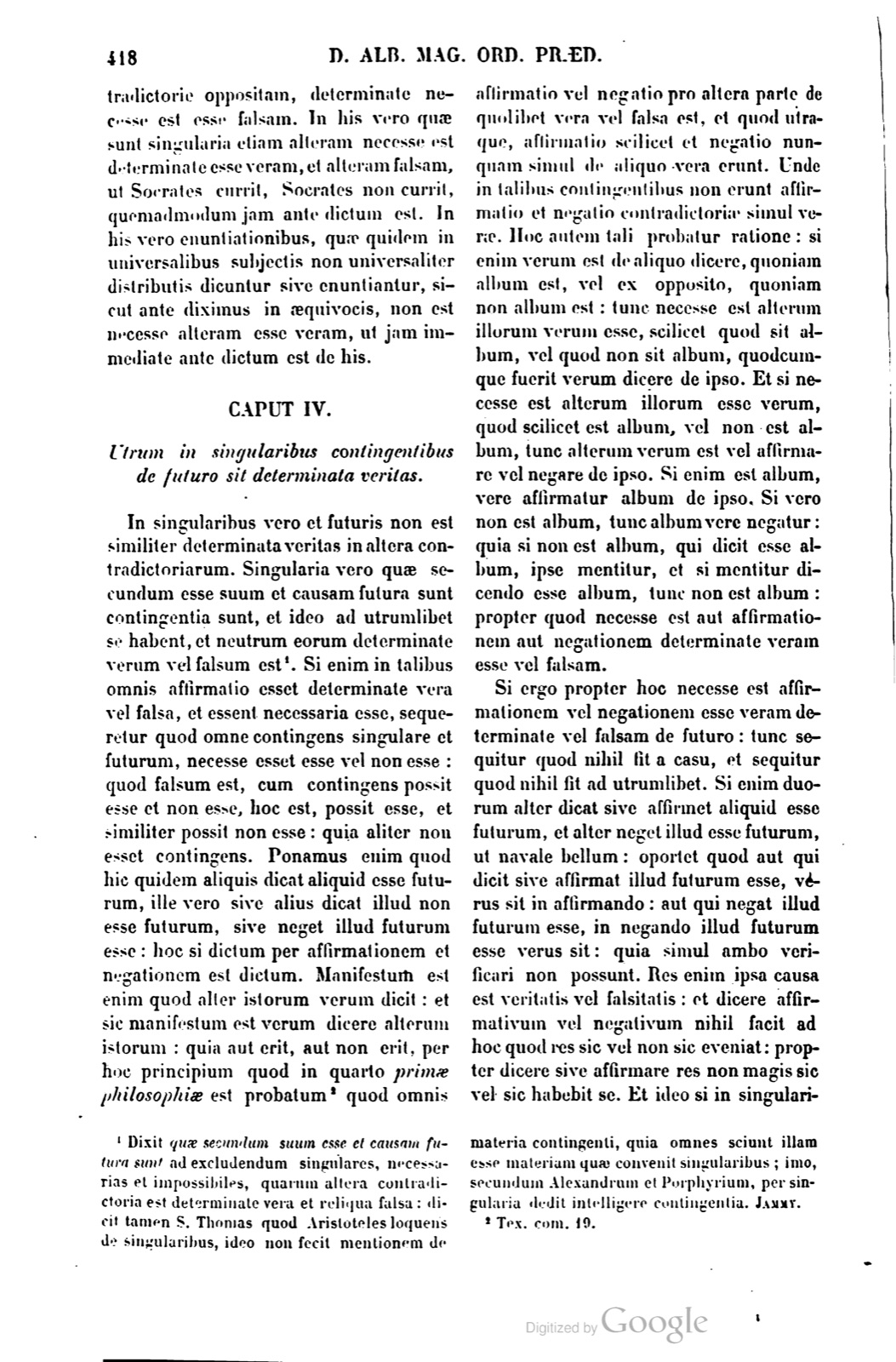
In singularibus vero et futuris non est similiter determinata veritas in altera contradictoriarum. Singularia vero quae secundum esse suum et causam futura sunt contingentia sunt, et ideo ad utrumlibet se habent, et neutrum eorum determinate verum vel falsum est1. Si enim in talibus omnis affirmatio esset determinate vera vel falsa, et essent necessaria esse, sequeretur quod omne contingens singulare et futurum, necesse esset esse vel non esse: quod falsum est, cum contingens possit esse et non esse, hoc est, possit esse, et similiter possit non esse: quia aliter non esset contingens. Ponamus enim quod hic quidem aliquis dicat aliquid esse futurum, ille vero sive alius dicat illud non esse futurum, sive neget illud futurum esse: hoc si dictum per affirmationem et negationem est dictum. Manifestum est enim quod alter istorum verum dicit: et sic manifestum est verum dicere alterum istorum: quia aut erit, aut non erit, per hoc principium quod in quarto primae philosophiae est probatum2 quod omnis affirmatio vel negatio pro altera parte de quolibet vera vel falsa est, et quod utraque, affirmatio scilicet et negatio nunquam simul de aliquo vera erunt. Unde in talibus contingentibus non erunt affirmatio et negatio contradictoriae simul verae. Hoc autem tali probatur ratione: si enim verum est de aliquo dicere, quoniam album est, vel ex opposito, quoniam non album est: tunc necesse est alterum illorum verum esse, scilicet quod sit album, vel quod non sit album, quodcumque fuerit verum dicere de ipso. Et si necesse est alterum illorum esse verum, quod scilicet est album, vel non est album, tunc alterum verum est vel affirmare vel negare de ipso. Si enim est album, vere affirmatur album de ipso. Si vero non est album, tunc album vere negatur: quia si non est album, qui dicit esse album, ipse mentitur, et si mentitur dicendo esse album, tunc non est album: propter quod necesse est aut affirmationem aut negationem determinate veram esse vel falsam.
Si ergo propter hoc necesse est affirmationem vel negationem esse veram determinate vel falsam de futuro: tunc sequitur quod nihil fit a casu, et sequitur quod nihil fit ad utrumlibet. Si enim duorum alter dicat sive affirmet aliquid esse futurum, et alter neget illud esse futurum, ut navale bellum: oportet quod aut qui dicit sive affirmat illud futurum esse, verus sit in affirmando: aut qui negat illud futurum esse, in negando illud futurum esse verus sit: quia simul ambo verificari non possunt. Res enim ipsa causa est veritatis vel falsitatis: et dicere affirmativum vel negativum nihil facit ad hoc quod res sic vel non sic eveniat: propter dicere sive affirmare res non magis sic vel sic habebit se. Et ideo si in singularibus et contingentibus de futuro altera pars contradictionis necessario et determinate sit vera, quodcumque eveniet, necesse est quod eveniat et non possit non evenire, et sic nihil erit a casu et nihil erit ad utrumlibet.
CHAPTER IV. Whether in future singular contingents there is determinate truth.
But in singular and future things there is not similarly determinate truth in one of the contradictories. For singulars which according to their own being and cause are future are contingent, and therefore they are related to either alternative, and neither of them is determinately true or false1. For if in such things every affirmation were determinately true or false, and they were necessary to be, it would follow that every singular and future contingent would have to be or not be; which is false, since a contingent can be and not be, that is, can be, and similarly can not be, because otherwise it would not be contingent. For let us posit that here someone says that something will be, while that man, or another, says that it will not be, or denies that it will be; this is said if it has been said through affirmation and negation. For it is manifest that one of these speaks truly; and thus it is manifest that one of these things is truly said, because either it will be or it will not be, through this principle which was proved in the fourth book of the First Philosophy2, that every affirmation or negation for the other part is true or false of anything, and that both, namely affirmation and negation, will never at the same time be true of anything. Hence in such contingent things affirmation and negation will not be contradictory and true at the same time. But this is proved by such an argument: for if it is true to say of something that it is white, or from the opposite, that it is not white, then it is necessary that one of those be true, namely that it is white or that it is not white, whichever it will have been true to say of it. And if it is necessary that one of those be true, namely that it is white or is not white, then one thing is true, either to affirm or to deny about it. For if it is white, white is truly affirmed of it. But if it is not white, then white is truly denied; because if it is not white, he who says that it is white lies, and if he lies by saying that it is white, then it is not white; on account of which it is necessary that either affirmation or negation be determinately true or false.
Therefore if on account of this it is necessary that affirmation or negation be determinately true or false about the future, then it follows that nothing comes to be by chance, and it follows that nothing comes to be as able to be either way. For if of two men one says or affirms that something will be, and the other denies that it will be, as a naval battle, it is necessary either that he who says or affirms that it will be is true in affirming, or that he who denies that it will be is true in denying that it will be, because both cannot be verified at the same time. For the thing itself is the cause of truth or falsity; and affirmative or negative saying does nothing toward this, that the thing happen thus or not thus. On account of saying or affirming, the thing will not have itself more thus or thus. And therefore, if in singulars and contingents concerning the future one part of the contradiction is necessarily and determinately true, whatever will happen, it is necessary that it happen and cannot not happen; and thus nothing will be by chance and nothing will be able to be either way.
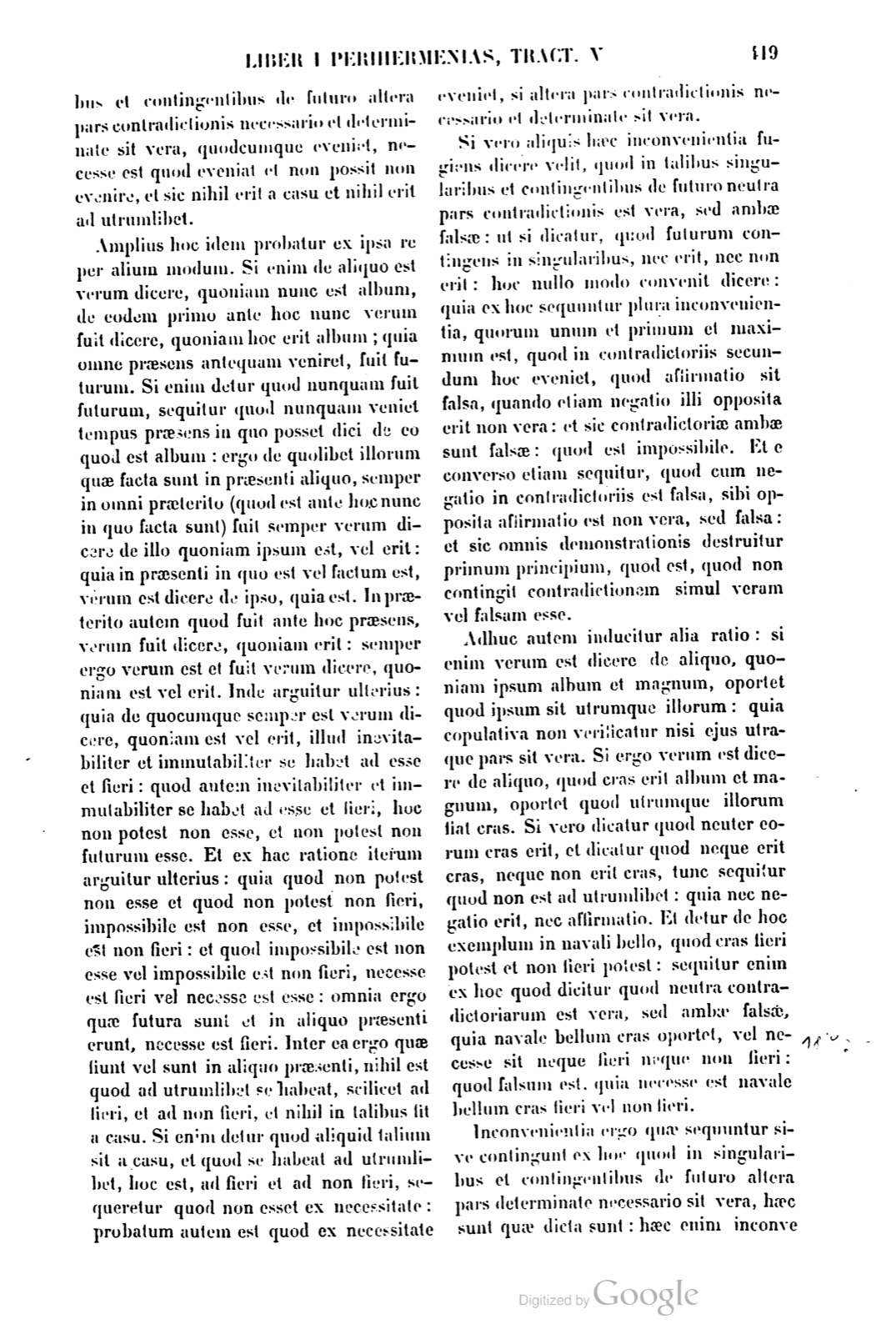
Amplius hoc idem probatur ex ipsa re per alium modum. Si enim de aliquo est verum dicere, quoniam nunc est album, de eodem primo ante hoc nunc verum fuit dicere, quoniam hoc erit album; quia omne praesens antequam veniret, fuit futurum. Si enim detur quod nunquam fuit futurum, sequitur quod nunquam veniet tempus praesens in quo posset dici de eo quod est album: ergo de quolibet illorum quae facta sunt in praesenti aliquo, semper in omni praeterito (quod est ante hoc nunc in quo facta sunt) fuit semper verum dicere de illo quoniam ipsum est, vel erit: quia in praesenti in quo est vel factum est, verum est dicere de ipso, quia est. In praeterito autem quod fuit ante hoc praesens, verum fuit dicere, quoniam erit: semper ergo verum est et fuit verum dicere, quoniam est vel erit. Inde arguitur ulterius: quia de quocumque semper est verum dicere, quoniam est vel erit, illud inevitabiliter et immutabiliter se habet ad esse et fieri: quod autem inevitabiliter et immutabiliter se habet ad esse et fieri, hoc non potest non esse, et non potest non futurum esse. Et ex hac ratione iterum arguitur ulterius: quia quod non potest non esse et quod non potest non fieri, impossibile est non esse, et impossibile est non fieri: et quod impossibile est non esse vel impossibile est non fieri, necesse est fieri vel necesse est esse: omnia ergo quae futura sunt et in aliquo praesenti erunt, necesse est fieri. Inter ea ergo quae fiunt vel sunt in aliquo praesenti, nihil est quod ad utrumlibet se habeat, scilicet ad fieri, et ad non fieri, et nihil in talibus fit a casu. Si enim detur quod aliquid talium sit a casu, et quod se habeat ad utrumlibet, hoc est, ad fieri et ad non fieri, sequeretur quod non esset ex necessitate: probatum autem est quod ex necessitate eveniet, si altera pars contradictionis necessario et determinate sit vera.
Si vero aliquis haec inconvenientia fugiens dicere velit, quod in talibus singularibus et contingentibus de futuro neutra pars contradictionis est vera, sed ambae falsae: ut si dicatur, quod futurum contingens in singularibus, nec erit, nec non erit: hoc nullo modo convenit dicere: quia ex hoc sequuntur plura inconvenientia, quorum unum et primum et maximum est, quod in contradictoriis secundum hoc eveniet, quod affirmatio sit falsa, quando etiam negatio illi opposita erit non vera: et sic contradictoriae ambae sunt falsae: quod est impossibile. Et e converso etiam sequitur, quod cum negatio in contradictoriis est falsa, sibi opposita affirmatio est non vera, sed falsa: et sic omnis demonstrationis destruitur primum principium, quod est, quod non contingit contradictionem simul veram vel falsam esse.
Further, this same thing is proved from the thing itself in another way. For if about something it is true to say that now it is white, about the same thing, first before this now, it was true to say that this will be white, because every present thing, before it came, was future. For if it is granted that it was never future, it follows that the present time will never come in which it could be said of it that it is white. Therefore of any of those things which have been made in some present, always in every past time, which is before this now in which they have been made, it was always true to say of that thing that it is, or will be; because in the present in which it is or has been made, it is true to say of it that it is. But in the past which was before this present, it was true to say that it will be; therefore it is always true and was true to say that it is or will be. Thence it is argued further: because about whatever it is always true to say that it is or will be, that is related inevitably and immutably to being and becoming; but what is related inevitably and immutably to being and becoming cannot not be, and cannot not be future. And from this argument it is again argued further: because what cannot not be and what cannot not come to be, it is impossible for it not to be, and impossible for it not to come to be; and what is impossible not to be or impossible not to come to be, necessarily comes to be or necessarily is. Therefore all things which are future and will be in some present necessarily come to be. Therefore among those things which come to be or are in some present, nothing is related to either alternative, namely to coming to be and not coming to be, and nothing in such things comes to be by chance. For if it is granted that something of such things is by chance, and that it is related to either alternative, that is, to coming to be and not coming to be, it would follow that it was not from necessity; but it has been proved that it happens from necessity, if the other part of the contradiction is necessarily and determinately true.
But if someone, fleeing these inconveniences, wished to say that in such singulars and contingents about the future neither part of the contradiction is true, but both are false, as if it were said that a future contingent in singulars neither will be nor will not be, this is not fitting to say in any way; because from this several inconveniences follow, of which one, and the first and greatest, is that in contradictories according to this it will happen that the affirmation is false when also the negation opposed to it will be not true; and thus contradictories are both false, which is impossible. And conversely it also follows that when the negation in contradictories is false, the affirmation opposed to it is not true, but false; and thus the first principle of every demonstration is destroyed, which is that it does not happen that a contradiction is true or false at the same time.
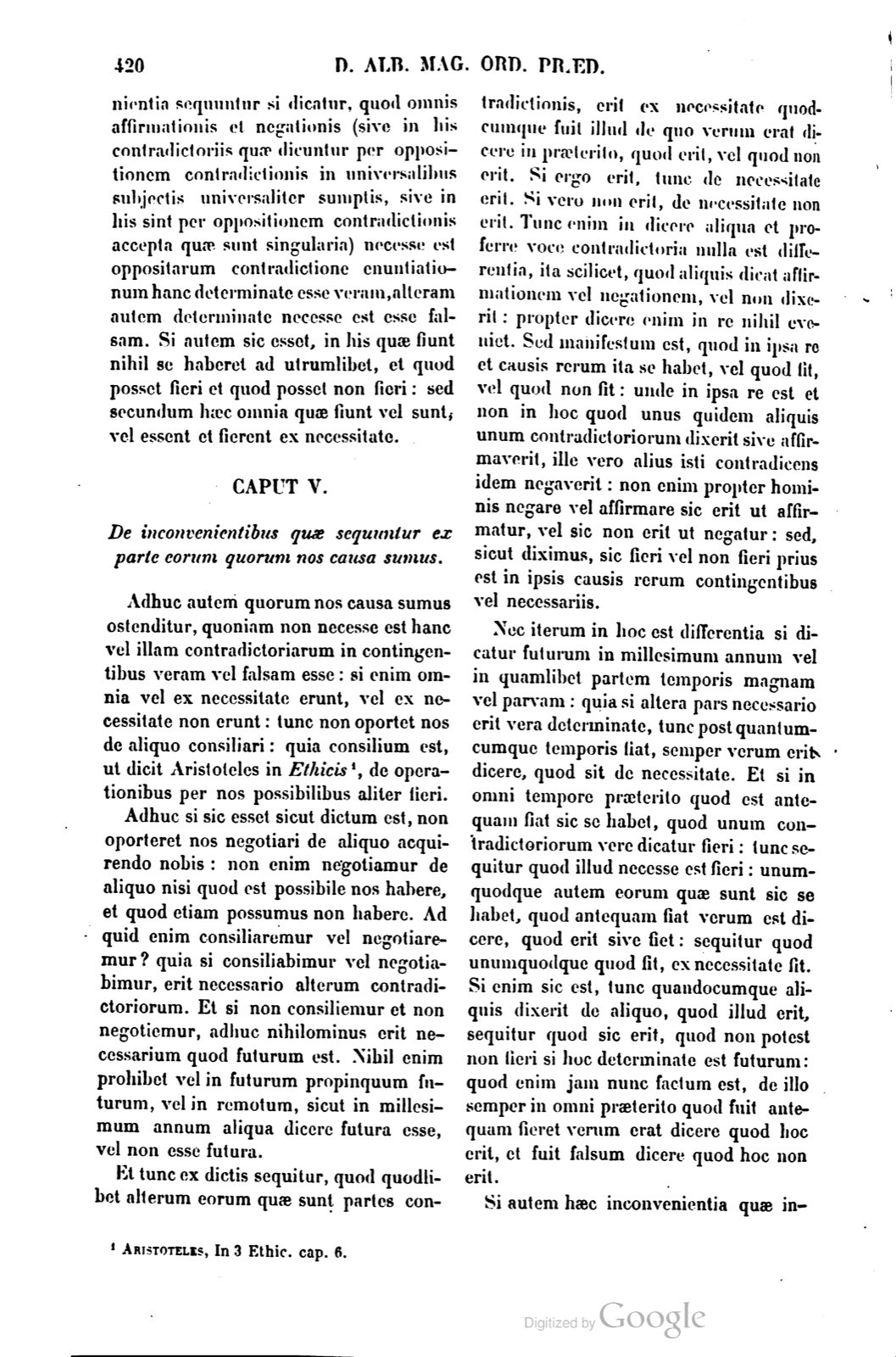
Adhuc autem inducitur alia ratio: si enim verum est dicere de aliquo, quoniam ipsum album et magnum, oportet quod ipsum sit utrumque illorum: quia copulativa non verificatur nisi ejus utraque pars sit vera. Si ergo verum est dicere de aliquo, quod cras erit album et magnum, oportet quod utrumque illorum fiat cras. Si vero dicatur quod neuter eorum cras erit, et dicatur quod neque erit cras, neque non erit cras, tunc sequitur quod non est ad utrumlibet: quia nec negatio erit, nec affirmatio. Et detur de hoc exemplum in navali bello, quod cras fieri potest et non fieri potest: sequitur enim ex hoc quod dicitur quod neutra contradictoriarum est vera, sed ambae falsae, quia navale bellum cras oportet, vel necesse sit neque fieri neque non fieri: quod falsum est, quia necesse est navale bellum cras fieri vel non fieri.
Inconvenientia ergo quae sequuntur sive contingunt ex hoc quod in singularibus et contingentibus de futuro altera pars determinate necessario sit vera, haec sunt quae dicta sunt: haec enim inconvenientia sequuntur si dicatur, quod omnis affirmationis et negationis (sive in his contradictoriis quae dicuntur per oppositionem contradictionis in universalibus subjectis universaliter sumptis, sive in his sint per oppositionem contradictionis accepta quae sunt singularia) necesse est oppositarum contradictione enuntiationum hanc determinate esse veram, alteram autem determinate necesse est esse falsam. Si autem sic esset, in his quae fiunt nihil se haberet ad utrumlibet, et quod posset fieri et quod posset non fieri: sed secundum haec omnia quae fiunt vel sunt, vel essent et fierent ex necessitate.
Moreover, another argument is brought in: for if it is true to say of something that it is white and great, it must be both of those, because a copulative is not verified unless each part of it is true. Therefore if it is true to say of something that tomorrow it will be white and great, each of those must come to be tomorrow. But if it is said that neither of them will be tomorrow, and it is said that it will neither be tomorrow nor not be tomorrow, then it follows that it is not related to either alternative, because there will be neither negation nor affirmation. And let an example of this be given in a naval battle, which can take place tomorrow and can fail to take place: for it follows from this, that it is said that neither contradictory is true, but both are false, because a naval battle tomorrow must, or must necessarily, neither take place nor not take place; which is false, because it is necessary that a naval battle tomorrow either take place or not take place.
Therefore the inconveniences which follow or occur from this, that in singulars and contingents about the future one part is determinately and necessarily true, are these which have been stated; for these inconveniences follow if it is said that, of every affirmation and negation, whether in these contradictories which are said by the opposition of contradiction in universal subjects taken universally, or in those singular things which are taken by the opposition of contradiction, it is necessary that of the opposed enunciations in contradiction this one be determinately true, while the other must necessarily be determinately false. But if it were so, in those things which come to be nothing would be related to either alternative, both what could come to be and what could not come to be; but according to these, all things which come to be or are either would be and would come to be from necessity.
Notes
- He said "which according to their own being and cause are future" in order to exclude singular necessary and impossible things, of which one contradictory is determinately true and the remaining one false; yet St. Thomas says that Aristotle, speaking of singulars, therefore did not make mention of contingent matter, because all know that it is the matter which belongs to singulars; indeed, according to Alexander and Porphyry, through singulars he gave contingents to be understood. Jammy. (Dixit quae secundum suum esse et causam futura sunt ad excludendum singulares, necessarias et impossibiles, quarum altera contradictoria est determinate vera et reliqua falsa: dicit tamen S. Thomas quod Aristoteles loquens de singularibus, ideo non fecit mentionem de materia contingenti, quia omnes sciunt illam esse materiam quae convenit singularibus; imo, secundum Alexandrum et Porphyrium, per singularia dedit intelligere contingentia. JAMMY.) ↩
- Text, commentary 19. (Tex. com. 19.) ↩
If a page does not appear, its photograph has not been uploaded yet.