Works › On Interpretation, Books I–II
Volume 1 · pp. 416–418
Chapter III. Whether Always One Of The Contradictories Is Determinately True.
A marker with ≈ is an approximate page boundary, placed by measure of the text; the page photographs remain the authority. In the paired views, clicking a page marker brings that page into view.
CAPUT III. Utrum semper altera contradictoriarum determinate est vera.
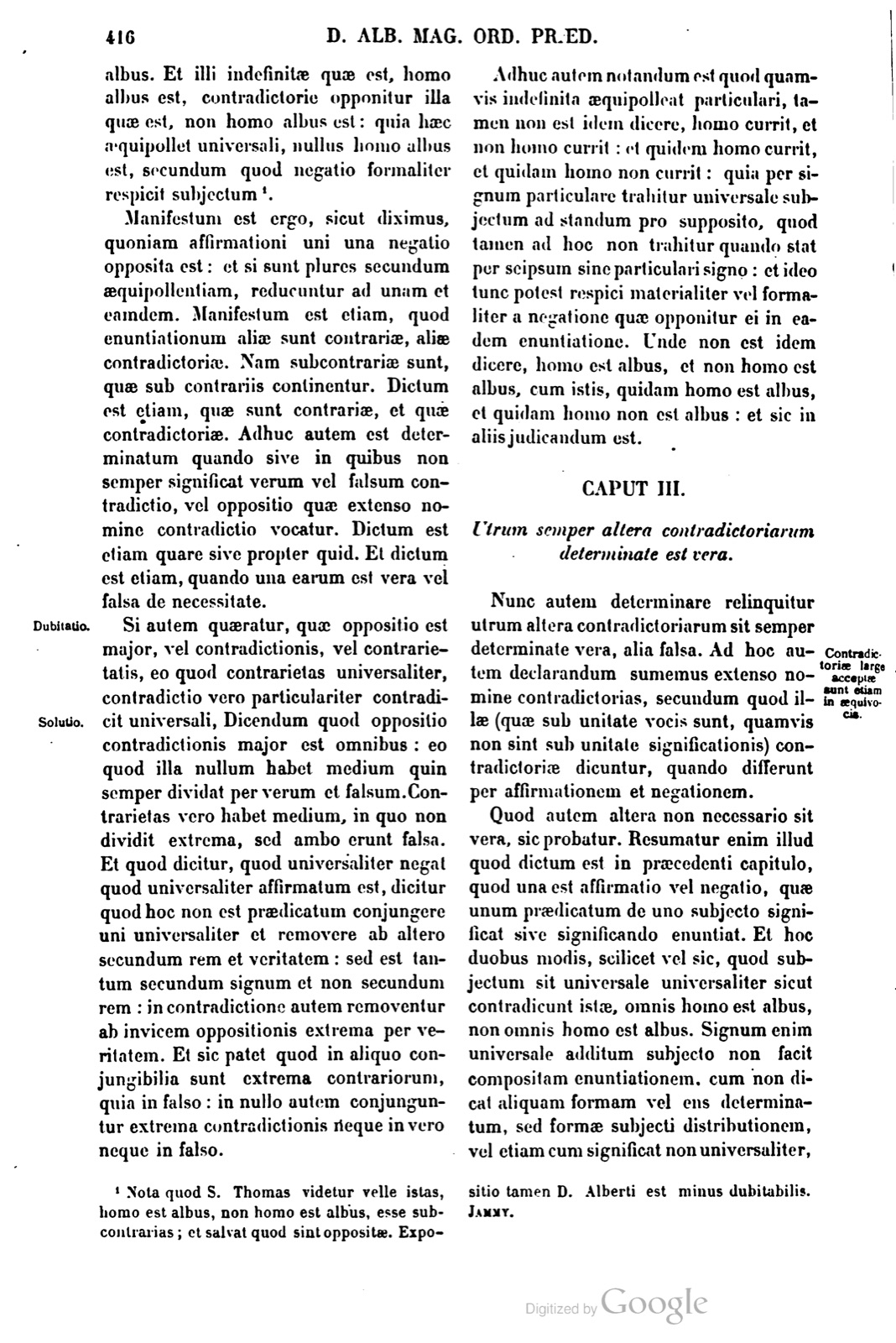
Nunc autem determinare relinquitur utrum altera contradictoriarum sit semper determinate vera, alia falsa. Ad hoc autem declarandum sumemus extenso nomine contradictorias, secundum quod illae (quae sub unitate vocis sunt, quamvis non sint sub unitate significationis) contradictoriae dicuntur, quando differunt per affirmationem et negationem.
Quod autem altera non necessario sit vera, sic probatur. Resumatur enim illud quod dictum est in praecedenti capitulo, quod una est affirmatio vel negatio, quae unum praedicatum de uno subjecto significat sive significando enuntiat. Et hoc duobus modis, scilicet vel sic, quod subjectum sit universale universaliter sicut contradicunt istae, omnis homo est albus, non omnis homo est albus. Signum enim universale additum subjecto non facit compositam enuntiationem, cum non dicat aliquam formam vel ens determinatum, sed formae subjecti distributionem, vel etiam cum significat non universaliter, ut quando particularis opponitur universali, ut quidam homo albus est, nullus homo albus est. Et quia etiam ista, non omnis homo albus est, aequipollet particulari: et haec, non nullus homo albus est, particulari aequipollet. In his enim albus quod est praedicatum, significat unum et idem de eodem subjecto quod est homo.
Si vero propositio significatione subjecti quidem plures sit: cum tamen voce et nomine subjecti sit una, ut si duobus unum nomen sit impositum, ex quibus duobus non fit unum, nec potest fieri unum sicut in diffinitione ex genere et differentia fit unum: tunc secundum significationem non est una affirmatio, in qua uni praedicato subjicitur tale subjectum: quia propter duas impositiones actu factas nomen illud utrumque illorum actu significat, et sic plura significat actu. Et hujus exemplum est, ut si quis imponat hoc nomen, tunica, homini et equo duabus actualibus impositionibus, et dicat, tunica est alba, vel tunica non est alba: non est simpliciter affirmatio vel negatio: quia significatione actuali non est una: quia quamvis dicat Boetius quod termino semel sumpto non contingit uti aequivoce, tamen nihil prohibet quin duo duabus acceptionibus termini possint uti aequivoce: et sic inter respondentem et opponentem possit accipi aequivoce: et sic non est inter eos contradictio: quia affirmationem et negationem non referunt ad idem: secundum hoc enim nihil refert dicere, tunica est alba, quam homo et equus est albus divisim, ut sit sensus, quod homo est albus et quod equus est albus. Sic ergo haec enuntiatio, homo et equus est albus, multa significet propter diversa et explicita subjecta plura. Manifestum est quoniam et prima multa significat propter multas unius nominis institutiones ad plura significanda. Institutio enim principalis est in significatione nominis, cum nomen sit vox significativa ad placitum, et non a natura. Aequali enim ratione qua significat unum, significat et reliquum. Unde vel utrumque significat, vel neutrum, vel significat id quod fit ex duobus: sed non significat neutrum, nec quod fit ex utraque, quia non fit unum aliquod ex duobus, homine scilicet et equo: ergo significat actu utrumque. Propter quod in his et in talibus aequivocis non necesse est hanc quidem propositionem contradictionis unam partem esse veram determinate, aliam vero falsam determinate: sed utraque dubia est. Et, sicut diximus, large hic accipimus contradictionem, prout contradictio in unitate vocis consistit, et non univocae significationis: et haec est quae videtur contradictoria, et non est.
CHAPTER III. Whether always one of the contradictories is determinately true.
Now it remains to determine whether one of the contradictories is always determinately true, and the other false. But for declaring this we will take contradictories under the extended name, according as those which are under unity of voice, although they are not under unity of signification, are called contradictories when they differ through affirmation and negation.
But that one is not necessarily true is proved in this way. Let that be resumed which was said in the preceding chapter, that an affirmation or negation is one which signifies, or by signifying enunciates, one predicate of one subject. And this in two ways, namely either so that the subject is universal universally, as these contradict, "every man is white," "not every man is white." For a universal sign added to the subject does not make a composite enunciation, since it does not say some form or determinate being, but the distribution of the subject's form; or also when it signifies not universally, as when a particular is opposed to a universal, as "some white man is," "no white man is." And because this also, "not every white man is," is equivalent to a particular, and this, "not no white man is," is equivalent to a particular. For in these, white, which is the predicate, signifies one and the same thing about the same subject, which is man.
But if a proposition by the signification of the subject is several, while nevertheless by the voice and name of the subject it is one, as if one name has been imposed on two things, from which two one thing does not come to be, nor can one thing come to be as in a definition one thing comes to be from genus and difference, then according to signification there is not one affirmation in which such a subject is subjected to one predicate, because on account of two impositions actually made that name actually signifies both of those, and thus it actually signifies several things. And an example of this is if someone imposes this name, "tunic," on man and horse by two actual impositions, and says, "the tunic is white," or "the tunic is not white"; it is not simply an affirmation or negation, because in actual signification it is not one. For although Boethius says that, once a term has been taken, one cannot use it equivocally, nevertheless nothing prevents two persons from being able to use it equivocally by two acceptions of the term; and thus between the respondent and the opponent it can be taken equivocally; and thus there is no contradiction between them, because they do not refer the affirmation and negation to the same thing. For according to this it makes no difference to say "the tunic is white" than "man and horse are white" dividedly, so that the sense is that man is white and that horse is white. Therefore in this way this enunciation, "man and horse are white," would signify many things on account of diverse and explicit plural subjects. It is manifest that the first also signifies many things on account of many institutions of one name for signifying many things. For institution is principal in the signification of a noun, since a noun is a significant utterance by convention and not by nature. For by equal reason by which it signifies one, it signifies also the remaining one. Hence either it signifies both, or neither, or it signifies that which comes to be from the two; but it does not signify neither, nor what comes to be from both, because not some one thing comes to be from the two, namely man and horse; therefore it actually signifies both. On account of this, in these and in such equivocal things it is not necessary that this proposition, one part of a contradiction, be determinately true, and the other determinately false; but each is doubtful. And, as we said, here we take contradiction broadly, insofar as contradiction consists in unity of voice and not of univocal signification; and this is what seems contradictory and is not.
In his autem non aequivocis quae vel sunt secundum praesens, vel facta sunt secundum praeteritum, eo quod illa nullam sui partem habent in potentia dependentem ad futurum, ut homo est, vel homo fuit, vel homo non est, vel homo non fuit, si affirmatio et negatio ad idem referantur, necesse est vel affirmationem vel negationem determinate veram vel falsam esse. Dicimus tamen praesentia vel facta, quae nullam, ut diximus, dependentiam habent ad futurum: quia si aliquam ad futurum habent dependentiam, non simpliciter sunt, vel facta sunt, sed sunt et facta sunt secundum quid. Simpliciter autem sunt in potentia, et dependent in futurum, sicut ea quae praesentia vel facta sunt in astrorum dispositione, quae adhuc secundum causas inferiores et secundum effectum dependent in futurum, et multis modis, ut dicit Ptolemaeus, possunt impediri. Idem est de his quae modo prophetico enuntiantur.
But in those non-equivocal things which either are according to the present, or have been made according to the past, because they have no part of themselves in potency dependent on the future, as "man is," or "man was," or "man is not," or "man was not," if affirmation and negation are referred to the same thing, it is necessary that either the affirmation or the negation be determinately true or false. Nevertheless we call present or past-made things those which have no dependence on the future, as we have said, because if they have some dependence on the future, they simply are not, or have not simply been made, but are and have been made in a certain respect. But simply they are in potency and depend on the future, as those things which are present or have been made in the disposition of the stars, which still according to inferior causes and according to effect depend on the future, and in many ways, as Ptolemy says, can be impeded. The same is true of those things which are enunciated in a prophetic mode.
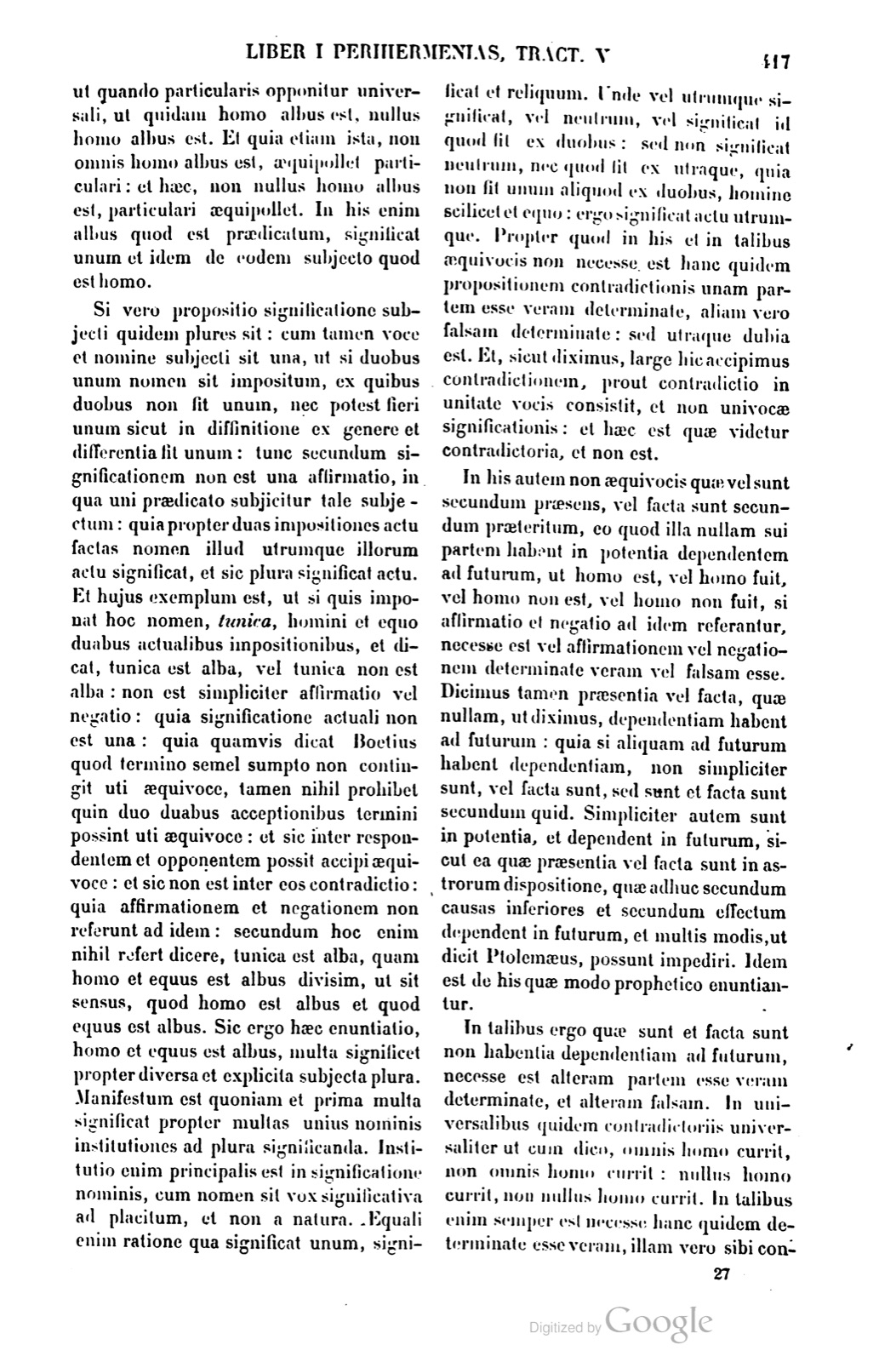
In talibus ergo quae sunt et facta sunt non habentia dependentiam ad futurum, necesse est alteram partem esse veram determinate, et alteram falsam. In universalibus quidem contradictoriis universaliter ut cum dico, omnis homo currit, non omnis homo currit: nullus homo currit, non nullus homo currit. In talibus enim semper est necesse hanc quidem determinate esse veram, illam vero sibi contradictorie oppositam, determinate necesse est esse falsam. In his vero quae sunt singularia etiam alteram necesse est determinate esse veram, et alteram falsam, ut Socrates currit, Socrates non currit, quemadmodum jam ante dictum est. In his vero enuntiationibus, quae quidem in universalibus subjectis non universaliter distributis dicuntur sive enuntiantur, sicut ante diximus in aequivocis, non est necesse alteram esse veram, ut jam immediate ante dictum est de his.
### Marginal Labels - 416: Contradictoriae large acceptae sunt etiam in aequivocis.
Therefore in such things which are and have been made, not having dependence on the future, it is necessary that one part be determinately true and the other false. In universal contradictories, indeed, universally, as when I say, "every man runs," "not every man runs"; "no man runs," "not no man runs." For in such things it is always necessary that this one be determinately true, and that one contradictorily opposed to it necessarily be determinately false. But in those things which are singular, it is also necessary that one be determinately true and the other false, as "Socrates runs," "Socrates does not run," as was already said before. But in these enunciations which are said or enunciated in universal subjects not universally distributed, as before we spoke in equivocals, it is not necessary that one be true, as was already immediately said about these.
### Marginal Labels - 416: Contradictories taken broadly are also in equivocal things.
If a page does not appear, its photograph has not been uploaded yet.