Works › On Interpretation, Books I–II
Volume 1 · pp. 413–416
Chapter II. On The Laws And Consequences Of The Said Oppositions.
A marker with ≈ is an approximate page boundary, placed by measure of the text; the page photographs remain the authority. In the paired views, clicking a page marker brings that page into view.
CAPUT II. De legibus et consequentiis dictarum oppositionum.
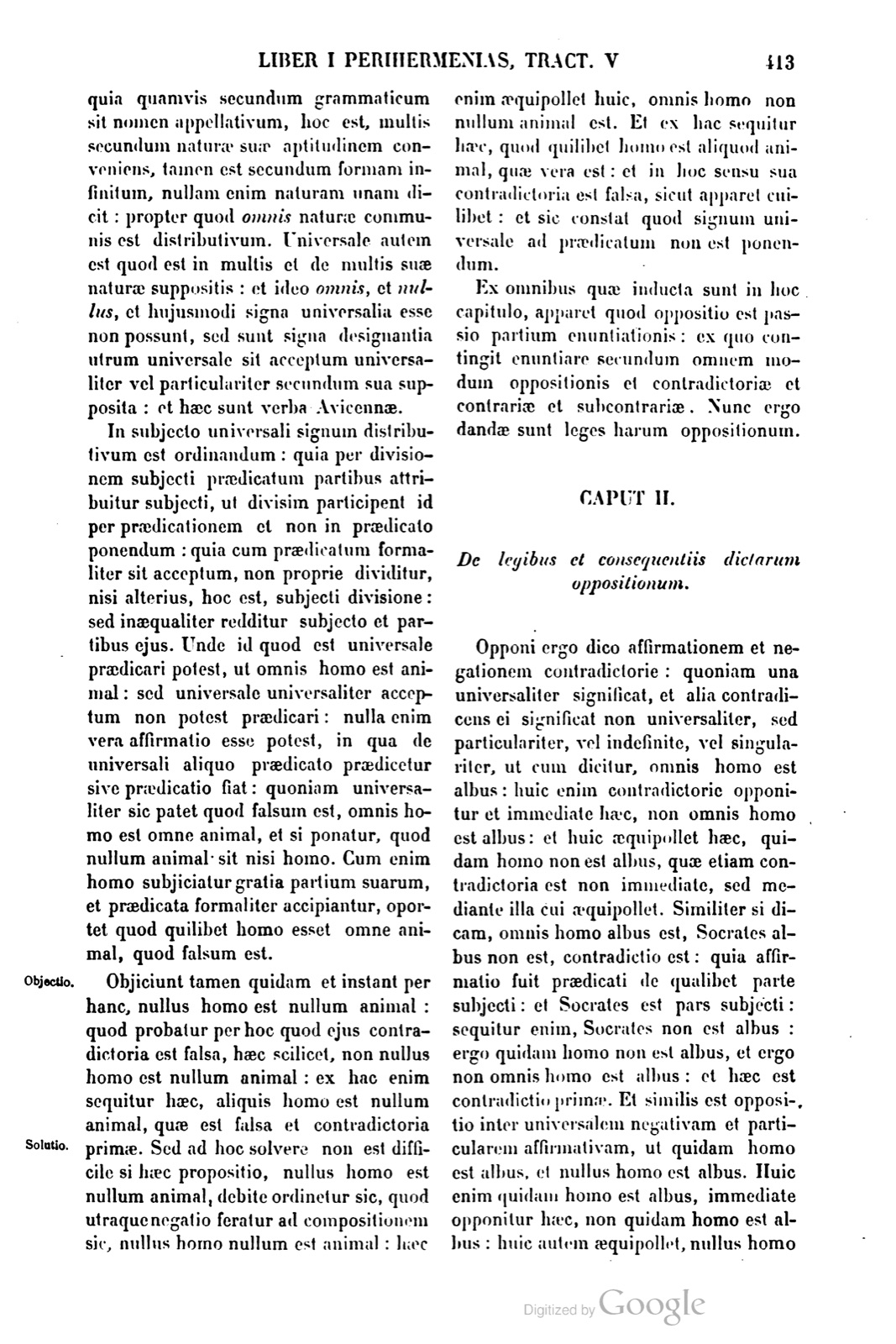
Opponi ergo dico affirmationem et negationem contradictorie: quoniam una universaliter significat, et alia contradicens ei significat non universaliter, sed particulariter, vel indefinite, vel singulariter, ut cum dicitur, omnis homo est albus: huic enim contradictorie opponitur et immediate haec, non omnis homo est albus: et huic aequipollet haec, quidam homo non est albus, quae etiam contradictoria est non immediate, sed mediante illa cui aequipollet. Similiter si dicam, omnis homo albus est, Socrates albus non est, contradictio est: quia affirmatio fuit praedicati de qualibet parte subjecti: et Socrates est pars subjecti: sequitur enim, Socrates non est albus: ergo quidam homo non est albus, et ergo non omnis homo est albus: et haec est contradictio primae. Et similis est oppositio inter universalem negativam et particularem affirmativam, ut quidam homo est albus, et nullus homo est albus. Huic enim quidam homo est albus, immediate opponitur haec, non quidam homo est albus: huic autem aequipollet, nullus homo est albus, quae est contradictoria per illam cui aequipollet: et sic est in aliis1.
Contrarie vero dico opponi in enuntiationibus universalem affirmativam et universalem negativam. Dico autem universalem quae designat quoniam universaliter, ut cum dicitur, omnis homo est justus; et cum dicitur, nullus homo justus est. Inter has enim contrarietatis est oppositio: propterea quod sunt ambae universales. Et non est possibile quod istae unquam sint simul verae in aliqua materia: quia si praedicatum est essentiale subjecto, tunc erit necessaria, et erit una vera, et altera falsa, ut cum dicitur, omnis homo est animal, nullus homo est animal. Si autem praedicatum repugnet subjecto, tunc est impossibilis materia, et erit negativa vera, et affirmativa falsa. Si autem praedicatum est accidentale subjecto: tunc enuntiatio erit in materia contingenti, et tunc erunt ambae simul falsae, si accipiatur accidens ad utrumlibet, videlicet cum dicitur, omnis homo est albus, nullus homo est albus. Hae enim sunt contrariae, et sunt ambae falsae.
Oppositae autem contrariis in modo signi universalis sunt subcontrariae: quia utraque illarum est particularis, cum utraque contrariarum sit universalis. Et illarum lex est, quod ambae possunt simul esse verae in materia contingenti: sunt enim simul verae istae, non omnis homo albus est, et quidam homo albus est. Haec enim non omnis homo albus est, aequivalet huic, quidam homo non est albus, quae est subcontraria istius, quidam homo est albus: et sunt ambae verae in materia contingenti ad utrumlibet.
Resumentes de contradictorie oppositis, dicimus quod quaecumque enuntiationis contradictiones sive contradictorie oppositae, et sunt universalium subjectorum et universaliter distributorum, in his necesse est semper unam enuntiationem esse veram et alteram falsam in omni materia: per illud principium quod dicitur: De quolibet affirmatio vel negatio est vera, et de nullo simul ambae, ut omnis homo justus est, et quidam homo justus non est: et omnis homo animal est, et quidam homo animal non est: nullus homo lapis est, et quidam homo lapis est.
CHAPTER II. On the laws and consequences of the said oppositions.
Therefore I say that affirmation and negation are opposed contradictorily because one signifies universally, and the other, contradicting it, signifies not universally, but particularly, or indefinitely, or singularly, as when it is said, "every man is white." For to this is opposed contradictorily and immediately this, "not every man is white"; and to this this is equivalent, "some man is not white," which is also contradictory, not immediately, but by means of that to which it is equivalent. Likewise if I say, "every white man is," "white Socrates is not," it is a contradiction, because there was affirmation of the predicate concerning any part of the subject; and Socrates is a part of the subject; for it follows, "Socrates is not white"; therefore some man is not white, and therefore not every man is white; and this is the contradiction of the first. And the opposition is similar between a universal negative and a particular affirmative, as "some man is white" and "no man is white." For to this, "some man is white," this is immediately opposed, "not some man is white"; but to this is equivalent, "no man is white," which is contradictory through that to which it is equivalent; and so it is in the others1.
But I say that in enunciations the universal affirmative and the universal negative are opposed contrarily. And I call universal that which designates universally, as when it is said, "every man is just," and when it is said, "no man is just." For between these there is an opposition of contrariety, because both are universal. And it is not possible that these ever be true at the same time in any matter; because if the predicate is essential to the subject, then it will be necessary, and one will be true and the other false, as when it is said, "every man is an animal," "no man is an animal." But if the predicate is repugnant to the subject, then the matter is impossible, and the negative will be true and the affirmative false. But if the predicate is accidental to the subject, then the enunciation will be in contingent matter, and then both will at once be false, if the accident is taken as able to be either way, namely when it is said, "every man is white," "no man is white." For these are contrary, and both are false.
But opposites to contraries in the mode of the universal sign are subcontraries, because each of them is particular, while each of the contraries is universal. And their law is that both can be true at the same time in contingent matter; for these are true at the same time, "not every white man is," and "some white man is." For this, "not every white man is," is equivalent to this, "some man is not white," which is subcontrary to this, "some man is white"; and both are true in contingent matter able to be either way.
Taking up again what concerns contradictorily opposed things, we say that whatever contradictions of enunciation, or things contradictorily opposed, are of universal subjects and universally distributed, in these it is always necessary that one enunciation be true and the other false in every matter, through that principle which is said: of anything affirmation or negation is true, and of nothing are both at once true, as "every man is just" and "some man is not just"; and "every man is an animal" and "some man is not an animal"; "no man is a stone" and "some man is a stone."
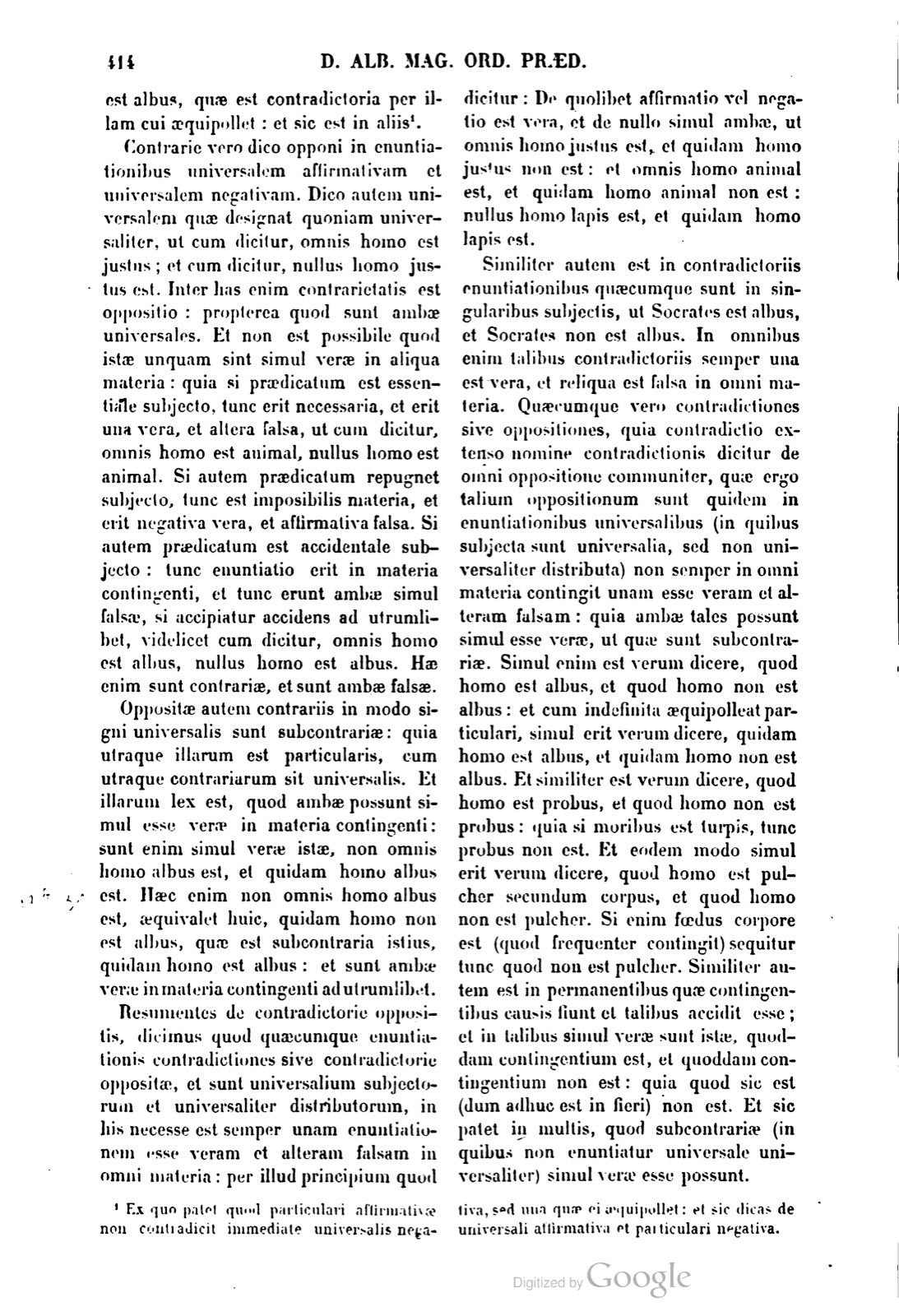
Similiter autem est in contradictoriis enuntiationibus quaecumque sunt in singularibus subjectis, ut Socrates est albus, et Socrates non est albus. In omnibus enim talibus contradictoriis semper una est vera, et reliqua est falsa in omni materia. Quaecumque vero contradictiones sive oppositiones, quia contradictio extenso nomine contradictionis dicitur de omni oppositione communiter, quae ergo talium oppositionum sunt quidem in enuntiationibus universalibus (in quibus subjecta sunt universalia, sed non universaliter distributa) non semper in omni materia contingit unam esse veram et alteram falsam: quia ambae tales possunt simul esse verae, ut quae sunt subcontrariae. Simul enim est verum dicere, quod homo est albus, et quod homo non est albus: et cum indefinita aequipolleat particulari, simul erit verum dicere, quidam homo est albus, et quidam homo non est albus. Et similiter est verum dicere, quod homo est probus, et quod homo non est probus: quia si moribus est turpis, tunc probus non est. Et eodem modo simul erit verum dicere, quod homo est pulcher secundum corpus, et quod homo non est pulcher. Si enim foedus corpore est (quod frequenter contingit) sequitur tunc quod non est pulcher. Similiter autem est in permanentibus quae contingentibus causis fiunt et talibus accidit esse; et in talibus simul verae sunt istae, quoddam contingentium est, et quoddam contingentium non est: quia quod sic est (dum adhuc est in fieri) non est. Et sic patet in multis, quod subcontrariae (in quibus non enuntiatur universale universaliter) simul verae esse possunt.
Hoc tamen si prima facie et non subtiliter inspiciatur, videbitur esse inconveniens. Et hoc idcirco est, quia haec enuntiatio, non est homo albus, videtur per aequipollentiam significare idem quod nemo est homo albus, sive quod nullus homo est albus: haec enim nemo est albus, neque idem est cum hac, non est homo albus, neque simul verificatur cum hac, est homo albus. Impossibile est enim has duas verificari simul, quia contradictoriae sunt. Hoc autem ideo contingit, quia cum dicitur, non est homo albus, negatio, quia praecedit subjectum, videtur formaliter respicere subjectum et negare: et sic idem est, non est homo albus, quod nemo est albus. Sed, sicut diximus, si termini enuntiationum istarum debite ordinentur, tunc hoc non contingit: ut si ista, non est homo albus, resolvatur in hanc, homo non est albus, et tunc non est eadem cum hac, nemo est albus: et verificatur simul cum sua subcontrarie opposita, homo est albus: quia tunc negatio non refertur ad formam subjecti, sed ad compositionem.
Similarly it is in contradictory enunciations, whatever are in singular subjects, as "Socrates is white" and "Socrates is not white." For in all such contradictories one is always true and the remaining one false in every matter. But whatever contradictions or oppositions, because contradiction by the extended name of contradiction is said commonly of every opposition, whatever oppositions of such things are indeed in universal enunciations, in which the subjects are universals but not universally distributed, in every matter it does not always happen that one is true and the other false, because both such can be true at the same time, as those which are subcontrary. For it is at once true to say that man is white and that man is not white; and since an indefinite is equivalent to a particular, it will at once be true to say, "some man is white," and "some man is not white." And similarly it is true to say that man is upright, and that man is not upright, because if he is shameful in morals, then he is not upright. And in the same way it will at once be true to say that man is beautiful according to the body, and that man is not beautiful. For if he is foul in body, which frequently happens, then it follows that he is not beautiful. Likewise it is in permanent things which come to be by contingent causes and to which it happens to be such; and in such things these are true at the same time, that some contingent thing is, and that some contingent thing is not, because what is such, while it is still in becoming, is not. And thus it is clear in many cases that subcontraries, in which the universal is not enunciated universally, can be true at the same time.
Yet this, if it is inspected at first glance and not subtly, will seem to be unfitting. And this is because this enunciation, "not is white man," seems by equivalence to signify the same as "no one is a white man," or that no man is white; for this, "no one is white," is neither the same with this, "not is white man," nor is it verified at the same time with this, "man is white." For it is impossible for these two to be verified at the same time, because they are contradictories. But this happens because, when it is said, "not is white man," the negation, because it precedes the subject, seems formally to look to the subject and deny; and thus "not is white man" is the same as "no one is white." But, as we have said, if the terms of these enunciations are duly ordered, then this does not happen; for if that, "not is white man," is resolved into this, "man is not white," then it is not the same with this, "no one is white," and it is verified at the same time with its subcontrarily opposed, "man is white," because then the negation is not referred to the form of the subject, but to the composition.
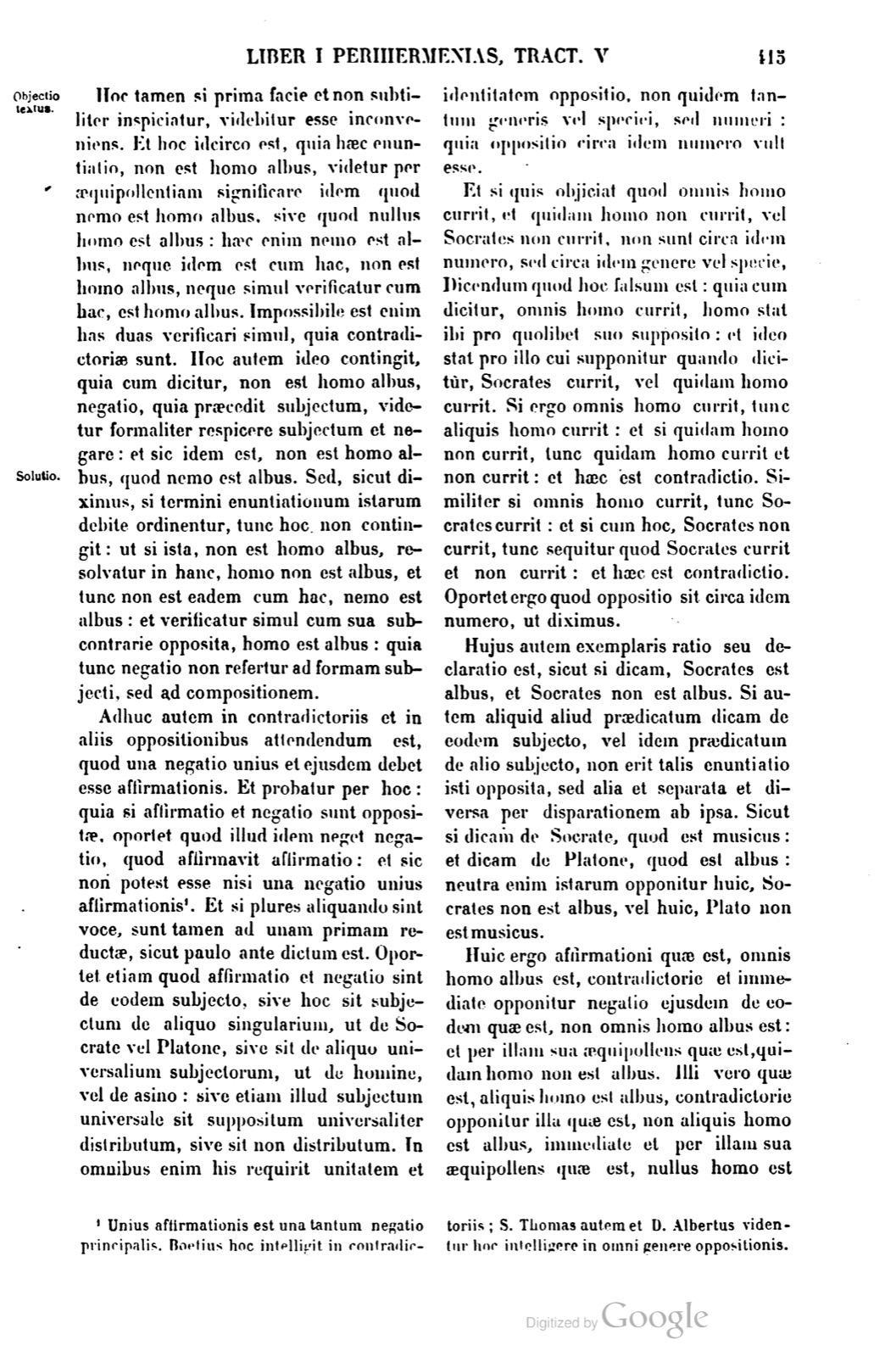
Adhuc autem in contradictoriis et in aliis oppositionibus attendendum est, quod una negatio unius et ejusdem debet esse affirmationis. Et probatur per hoc: quia si affirmatio et negatio sunt oppositae, oportet quod illud idem neget negatio, quod affirmavit affirmatio: et sic non potest esse nisi una negatio unius affirmationis2. Et si plures aliquando sint voce, sunt tamen ad unam primam reductae, sicut paulo ante dictum est. Oportet etiam quod affirmatio et negatio sint de eodem subjecto, sive hoc sit subjectum de aliquo singularium, ut de Socrate vel Platone, sive sit de aliquo universalium subjectorum, ut de homine, vel de asino: sive etiam illud subjectum universale sit suppositum universaliter distributum, sive sit non distributum. In omnibus enim his requirit unitatem et identitatem oppositio, non quidem tantum generis vel speciei, sed numeri: quia oppositio circa idem numero vult esse.
Et si quis objiciat quod omnis homo currit, et quidam homo non currit, vel Socrates non currit, non sunt circa idem numero, sed circa idem genere vel specie, Dicendum quod hoc falsum est: quia cum dicitur, omnis homo currit, homo stat ibi pro quolibet suo supposito: et ideo stat pro illo cui supponitur quando dicitur, Socrates currit, vel quidam homo currit. Si ergo omnis homo currit, tunc aliquis homo currit: et si quidam homo non currit, tunc quidam homo currit et non currit: et haec est contradictio. Similiter si omnis homo currit, tunc Socrates currit: et si cum hoc, Socrates non currit, tunc sequitur quod Socrates currit et non currit: et haec est contradictio. Oportet ergo quod oppositio sit circa idem numero, ut diximus.
Hujus autem exemplaris ratio seu declaratio est, sicut si dicam, Socrates est albus, et Socrates non est albus. Si autem aliquid aliud praedicatum dicam de eodem subjecto, vel idem praedicatum de alio subjecto, non erit talis enuntiatio isti opposita, sed alia et separata et diversa per disparationem ab ipsa. Sicut si dicam de Socrate, quod est musicus: et dicam de Platone, quod est albus: neutra enim istarum opponitur huic, Socrates non est albus, vel huic, Plato non est musicus.
Huic ergo affirmationi quae est, omnis homo albus est, contradictorie et immediate opponitur negatio ejusdem de eodem quae est, non omnis homo albus est: et per illam sua aequipollens quae est, quidam homo non est albus. Illi vero quae est, aliquis homo est albus, contradictorie opponitur illa quae est, non aliquis homo est albus, immediate et per illam sua aequipollens quae est, nullus homo est albus. Et illi indefinitae quae est, homo albus est, contradictorie opponitur illa quae est, non homo albus est: quia haec aequipollet universali, nullus homo albus est, secundum quod negatio formaliter respicit subjectum3.
Moreover, in contradictories and in other oppositions it must be considered that one negation ought to belong to one and the same affirmation. And this is proved by this: because if affirmation and negation are opposed, the negation must deny that same thing which the affirmation affirmed; and thus there cannot be except one negation of one affirmation2. And if sometimes there are several in voice, nevertheless they are reduced to one first one, as was said a little before. It must also be that affirmation and negation are about the same subject, whether this subject is about one of the singulars, as about Socrates or Plato, or about one of the universal subjects, as about man or ass; or even whether that universal subject is supposed as universally distributed or is not distributed. For in all these opposition requires unity and identity, not indeed only of genus or species, but of number, because opposition wishes to be around the same thing in number.
And if someone objects that "every man runs" and "some man does not run," or "Socrates does not run," are not around the same thing in number, but around the same thing in genus or species, it must be said that this is false, because when it is said, "every man runs," man there stands for any of its supposits; and therefore it stands for that for which it is supposed when it is said, "Socrates runs," or "some man runs." Therefore if every man runs, then some man runs; and if some man does not run, then some man runs and does not run, and this is a contradiction. Similarly, if every man runs, then Socrates runs; and if with this Socrates does not run, then it follows that Socrates runs and does not run, and this is a contradiction. Therefore opposition must be around the same thing in number, as we have said.
But the exemplary account or declaration of this is as if I say, "Socrates is white" and "Socrates is not white." But if I say some other predicate about the same subject, or the same predicate about another subject, such an enunciation will not be opposed to that one, but will be another and separate and diverse by disparity from it. As if I say of Socrates that he is musical, and I say of Plato that he is white; for neither of these is opposed to this, "Socrates is not white," or to this, "Plato is not musical."
Therefore to this affirmation, "every white man is," there is opposed contradictorily and immediately the negation of the same concerning the same, which is "not every white man is"; and through that, its equivalent, which is "some man is not white." But to that which is "some man is white," that which is "not some man is white" is opposed contradictorily and immediately, and through that its equivalent which is "no man is white." And to that indefinite which is "white man is," that which is "not white man is" is opposed contradictorily, because this is equivalent to the universal, "no white man is," insofar as negation formally looks to the subject3.
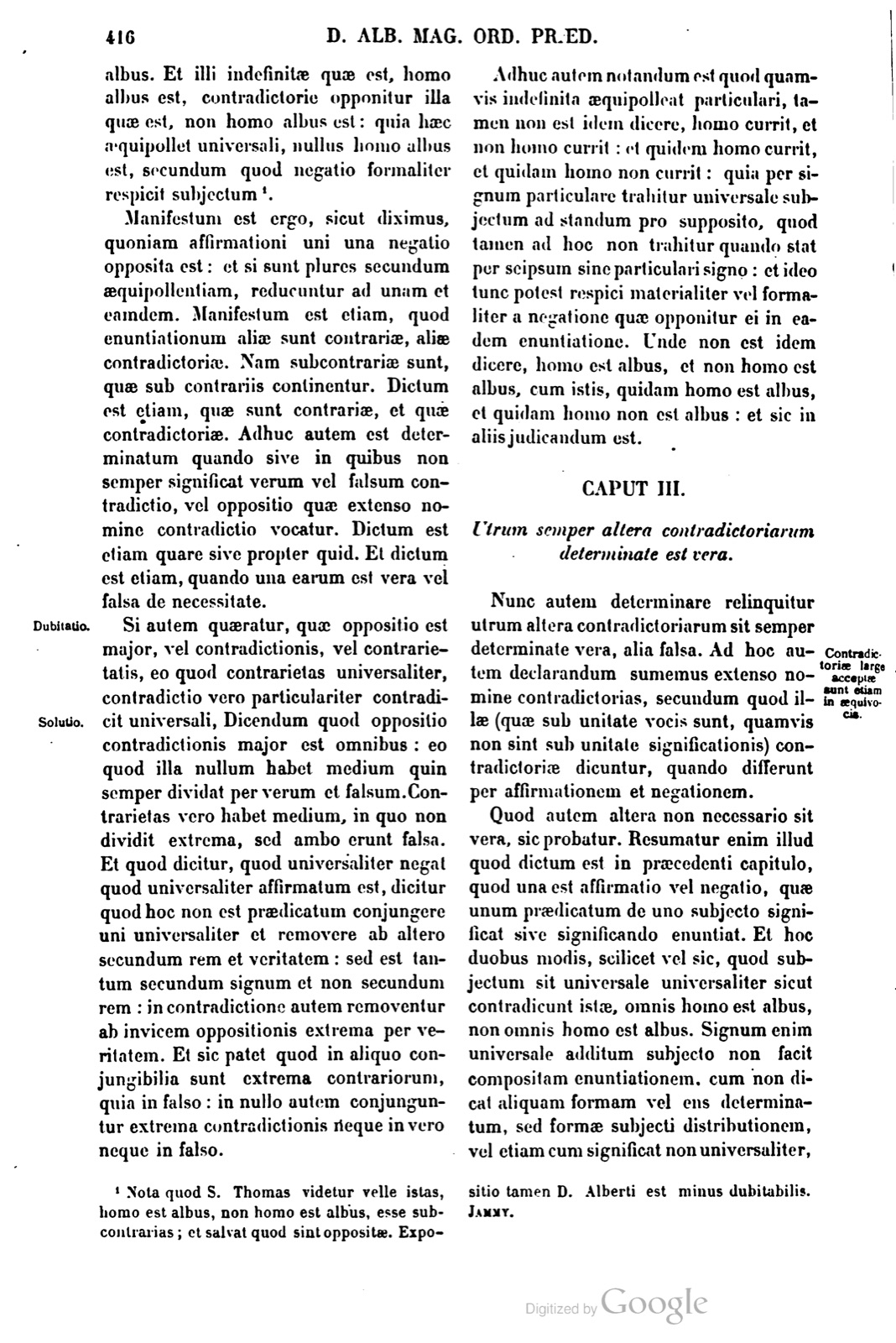
Manifestum est ergo, sicut diximus, quoniam affirmationi uni una negatio opposita est: et si sunt plures secundum aequipollentiam, reducuntur ad unam et eamdem. Manifestum est etiam, quod enuntiationum aliae sunt contrariae, aliae contradictoriae. Nam subcontrariae sunt, quae sub contrariis continentur. Dictum est etiam, quae sunt contrariae, et quae contradictoriae. Adhuc autem est determinatum quando sive in quibus non semper significat verum vel falsum contradictio, vel oppositio quae extenso nomine contradictio vocatur. Dictum est etiam quare sive propter quid. Et dictum est etiam, quando una earum est vera vel falsa de necessitate.
Si autem quaeratur, quae oppositio est major, vel contradictionis, vel contrarietatis, eo quod contrarietas universaliter, contradictio vero particulariter contradicit universali, Dicendum quod oppositio contradictionis major est omnibus: eo quod illa nullum habet medium quin semper dividat per verum et falsum. Contrarietas vero habet medium, in quo non dividit extrema, sed ambo erunt falsa. Et quod dicitur, quod universaliter negat quod universaliter affirmatum est, dicitur quod hoc non est praedicatum conjungere uni universaliter et removere ab altero secundum rem et veritatem: sed est tantum secundum signum et non secundum rem: in contradictione autem removentur ab invicem oppositionis extrema per veritatem. Et sic patet quod in aliquo conjungibilia sunt extrema contrariorum, quia in falso: in nullo autem conjunguntur extrema contradictionis neque in vero neque in falso.
Adhuc autem notandum est quod quamvis indefinita aequipolleat particulari, tamen non est idem dicere, homo currit, et non homo currit: et quidem homo currit, et quidam homo non currit: quia per signum particulare trahitur universale subjectum ad standum pro supposito, quod tamen ad hoc non trahitur quando stat per seipsum sine particulari signo: et ideo tunc potest respici materialiter vel formaliter a negatione quae opponitur ei in eadem enuntiatione. Unde non est idem dicere, homo est albus, et non homo est albus, cum istis, quidam homo est albus, et quidam homo non est albus: et sic in aliis judicandum est.
### Marginal Labels - 415: Objectio textus. - 415: Solutio. - 416: Dubitatio. - 416: Solutio.
Therefore it is manifest, as we have said, that to one affirmation one negation is opposed; and if there are several according to equivalence, they are reduced to one and the same. It is also manifest that of enunciations some are contrary, others contradictory. For subcontraries are those which are contained under contraries. It has also been said which are contraries and which are contradictories. Moreover, it has been determined when, or in which cases, contradiction, or opposition which by an extended name is called contradiction, does not always signify true or false. It has also been said why, or on account of what. And it has also been said when one of them is true or false of necessity.
But if it is asked which opposition is greater, that of contradiction or that of contrariety, because contrariety contradicts the universal universally, while contradiction contradicts the universal particularly, it must be said that the opposition of contradiction is greater than all, because it has no middle which prevents it from always dividing through true and false. But contrariety has a middle in which it does not divide the extremes, but both will be false. And as to what is said, that it universally denies what was universally affirmed, it is said that this is not to join a predicate to one universally and to remove it from another according to reality and truth, but it is only according to the sign and not according to reality; but in contradiction the extremes of the opposition are removed from each other through truth. And thus it is clear that in something the extremes of contraries are joinable, namely in the false; but in nothing are the extremes of contradiction joined, neither in the true nor in the false.
Moreover, it must be noted that although an indefinite is equivalent to a particular, nevertheless it is not the same to say "man runs" and "non-man runs," and indeed "man runs" and "some man does not run"; because through a particular sign the universal subject is drawn to standing for a supposit, yet it is not drawn to this when it stands by itself without a particular sign; and therefore then it can be looked to materially or formally by the negation which is opposed to it in the same enunciation. Hence it is not the same to say "man is white" and "non-man is white" as with these, "some man is white" and "some man is not white"; and thus judgment must be made in the others.
### Marginal Labels - 415: Objection of the text. - 415: Solution. - 416: Doubt. - 416: Solution.
Notes
- From this it is clear that the universal negative does not immediately contradict the particular affirmative, but one which is equivalent to it does; and so you should speak concerning the universal affirmative and particular negative. (Ex quo patet quod particulari affirmativae non contradicit immediate universalis negativa, sed una quae ei aequipollet: et sic dicas de universali affirmativa et particulari negativa.) ↩
- Of one affirmation there is only one principal negation. Boethius understands this in contradictories; but St. Thomas and D. Albert seem to understand this in every genus of opposition. (Unius affirmationis est una tantum negatio principalis. Boetius hoc intelligit in contradictoriis; S. Thomas autem et D. Albertus videntur hoc intelligere in omni genere oppositionis.) ↩
- Note that St. Thomas seems to wish these, "man is white," "non-man is white," to be subcontraries; and he preserves that they are opposites. Yet D. Albert's exposition is less doubtful. Jammy. (Nota quod S. Thomas videtur velle istas, homo est albus, non homo est albus, esse subcontrarias; et salvat quod sint oppositae. Expositio tamen D. Alberti est minus dubitabilis. JAMMY.) ↩
If a page does not appear, its photograph has not been uploaded yet.