Works › On Interpretation, Books I–II
Volume 1 · pp. 409–410
Treatise IV, Chapter II (continuation): On the division of enunciation according to one and many
A marker with ≈ is an approximate page boundary, placed by measure of the text; the page photographs remain the authority. In the paired views, clicking a page marker brings that page into view.
simpliciter unum praedicatur de uno quod non est aequivocum vel multiplex.
Sed secundum ea quae dicta sunt videtur quod haec non sit una: Socrates albus currit, quia Socrates et album non sunt simpliciter unum, sed aggregatum. Ad quod dicendum, quod non est unum primo, sed per accidens, sicut per accidens unum est unum. Si autem tunc objicitur, quod haec etiam est una, homo albus musicus currit, Dicendum quod non est verum: quia album et musicum propter hoc quod sunt duo accidentia ordinem essentialem non habentia ad se invicem, faciunt duo subjecta: et sic propositio non est una, sed plures. Sic autem non est hic, homo albus coloratus currit: et ideo illa est una unitate per accidens.
His itaque praenotatis, facile est invenire enuntiationis divisionem, et partes ejus dividentes. Dicimus enim quod illa quae una est et prima oratio enuntiativa, est affirmatio, et deinde negatio1: quia quamvis affirmatio et negatio sint species coaequaevae enuntiationis, et sic ex aequo se habent ad genus quod est enuntiatio: tamen si comparentur ad invicem, et per id quo sunt et ex quo sunt, affirmatio est ante negationem: quia sicut pars ejus et causa ipsius: et ideo prius est affirmatio, et deinde negatio. Aliae vero quae sunt unae enuntiationes, sunt conjunctione unae. Habetur ergo haec divisio enuntiationis: enuntiationum quaedam sunt simpliciter et primo unae, aliae sunt conjunctione potius unitae quam unae. Sed sive primo modo sit una, sive secundo modo, sive etiam non una.
Hic sciendum quod ex pluribus nominibus tantum, vel ex verbis pluribus tantum non potest esse oratio enuntiativa: sed necesse est orationem enuntiativam esse ex nomine et ex verbo, vel ex nomine et casu verbi. Et si aliquis objiciat quod oratio enuntiativa sit ex nomine infinito (quod non est nomen) et verbo: ut cum dico, non homo currit. Objectio non valet, quia non est enuntiatio de nomine infinito. Vel nomen infinitum quamvis non sit nomen ad interpretandum, tamen nomen est ad qualitercumque enuntiandum. Non omnem enim amittit virtutem nominis.
Quod autem sine verbo per sola nomina non fiat enuntiatio, probatur a majori. Si enim aliqua oratio sine verbo faceret enuntiationem, hoc magis faceret oratio diffinitiva: quia illa dicit esse. Oratio autem diffinitiva enuntiationem non facit. Ergo nec aliqua aliarum2. Cujus exemplum est: quia rationi hominis quae est animal gressibile bipes si non addatur est, vel fuit, vel aliquod verbum, nondum faciet enuntiationem: cum enim sic dicitur animal gressibile bipes, totum illud est unum quoddam et non multa: quia unitate ultimae differentiae totum unum est. Et quia sic unum est et non multa, ideo non potest dicere unum de uno: et hoc est de substantia enuntiationis, quod aliquid de alio dicatur. Et cum solum verbum nota sit dicendi unum de altero, non potest esse enuntiatio sine verbo vel casu verbi. Ratio enim diffinitiva non propter hoc unum est simpliciter, quia partes illius orationis quae sunt voces et nomina ea posita propinque, hoc est, sine distantia proferuntur vel sine conjunctione copulante: sed ideo, ut diximus, sunt unum, quia praecedentes et generales uniuntur et determinantur ultima differentia quae est unus simplex actus.
simply one thing is predicated of one thing which is not equivocal or multiple.
But according to the things that have been said it seems that this is not one: "white Socrates runs," because Socrates and white are not simply one, but an aggregate. To this it must be said that it is not one primarily, but accidentally, just as accidentally one thing is one. But if it is then objected that this also is one, "white musical man runs," it must be said that it is not true, because white and musical, because they are two accidents not having an essential order to one another, make two subjects; and thus the proposition is not one, but several. But it is not so here, "white colored man runs"; and therefore that is one by unity through accident.
Therefore, with these things noted beforehand, it is easy to find the division of enunciation, and its dividing parts. For we say that that which is one and the first enunciative speech is affirmation, and then negation1; because although affirmation and negation are coeval species of enunciation, and thus are related equally to the genus which is enunciation, nevertheless, if they are compared to each other, and through that by which they are and from which they are, affirmation is before negation, because it is as a part of it and its cause; and therefore affirmation is prior, and then negation. But the other enunciations which are one are one by conjunction. Therefore this division of enunciation is had: of enunciations, some are simply and primarily one, others are rather united by conjunction than one. But whether it is one in the first way, or in the second way, or even not one.
Here it must be known that from several nouns only, or from several verbs only, there cannot be an enunciative speech; but it is necessary that enunciative speech be from a noun and from a verb, or from a noun and a case of a verb. And if someone objects that enunciative speech is from an infinite noun, which is not a noun, and a verb, as when I say, "non-man runs," the objection is not valid, because it is not an enunciation concerning an infinite noun. Or, although an infinite noun is not a noun for interpreting, nevertheless it is a noun for enunciating in whatever way. For it does not lose every power of a noun.
But that without a verb, through nouns alone, enunciation does not come about is proved from the greater case. For if any speech without a verb made an enunciation, definitional speech would do this more, because it says being. But definitional speech does not make an enunciation. Therefore neither does any of the others2. An example of this is that if to the account of man which is "gressible two-footed animal" there is not added "is," or "was," or some verb, it will not yet make an enunciation; for when "gressible two-footed animal" is said in this way, that whole is a certain one thing and not many, because by the unity of the ultimate difference the whole is one. And because it is thus one and not many, therefore it cannot say one thing of one thing; and this belongs to the substance of enunciation, that something be said of another. And since only the verb is the mark of saying one thing of another, there cannot be an enunciation without a verb or a case of a verb. For a definitional account is not simply one because the parts of that speech, which are words and nouns, are uttered when they have been placed near, that is, without distance, or without a coupling conjunction; but, as we said, they are one because the preceding and general things are united and determined by the ultimate difference, which is one simple act.
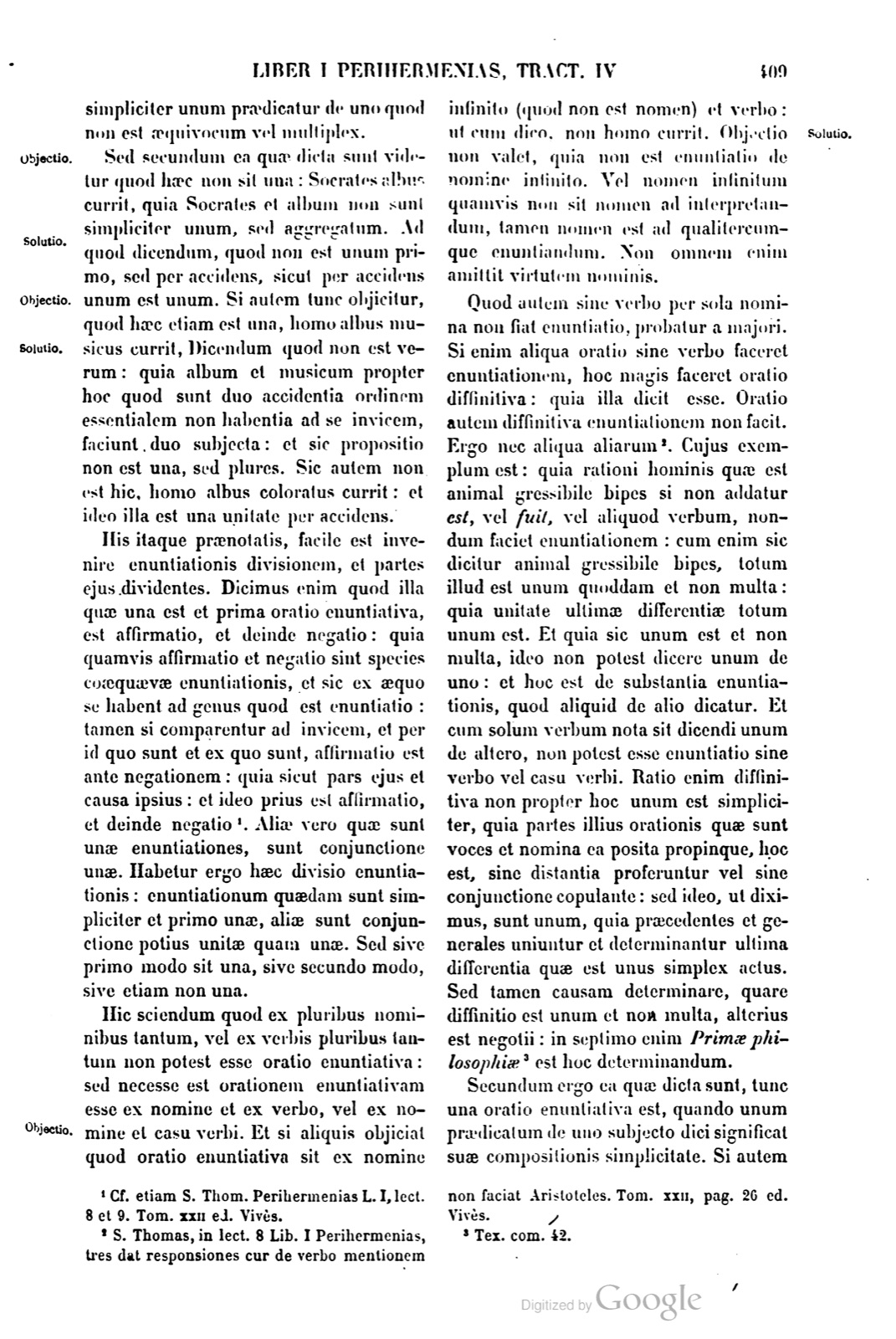
Sed tamen causam determinare, quare diffinitio est unum et non multa, alterius est negotii: in septimo enim Primae philosophiae3 est hoc determinandum.
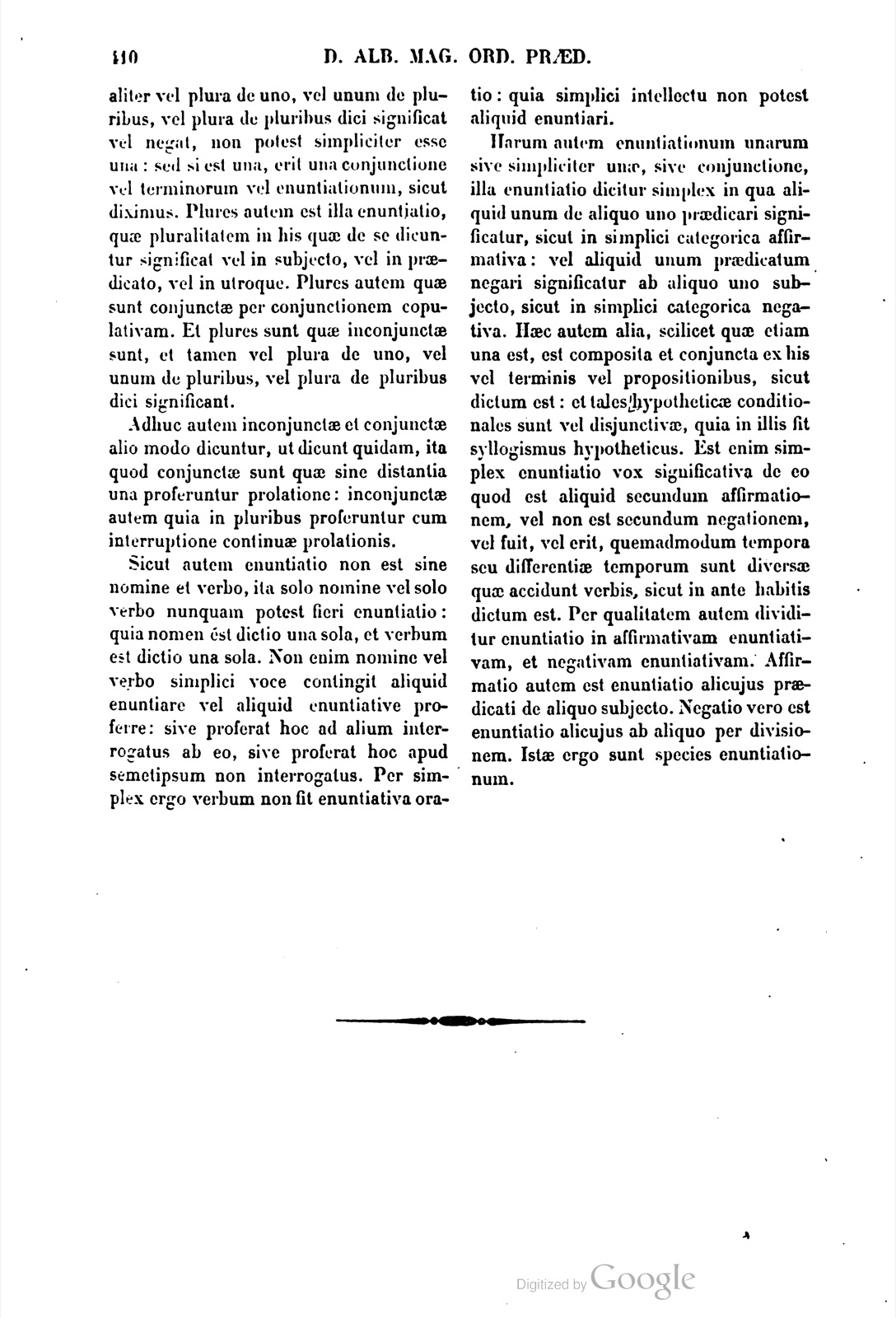
Secundum ergo ea quae dicta sunt, tunc una oratio enuntiativa est, quando unum praedicatum de uno subjecto dici significat suae compositionis simplicitate. Si autem aliter vel plura de uno, vel unum de pluribus, vel plura de pluribus dici significat vel negat, non potest simpliciter esse una: sed si est una, erit una conjunctione vel terminorum vel enuntiationum, sicut diximus. Plures autem est illa enuntiatio, quae pluralitatem in his quae de se dicuntur significat vel in subjecto, vel in praedicato, vel in utroque. Plures autem quae sunt conjunctae per conjunctionem copulativam. Et plures sunt quae inconjunctae sunt, et tamen vel plura de uno, vel unum de pluribus, vel plura de pluribus dici significant.
Adhuc autem inconjunctae et conjunctae alio modo dicuntur, ut dicunt quidam, ita quod conjunctae sunt quae sine distantia una proferuntur prolatione: inconjunctae autem quia in pluribus proferuntur cum interruptione continuae prolationis.
Sicut autem enuntiatio non est sine nomine et verbo, ita solo nomine vel solo verbo nunquam potest fieri enuntiatio: quia nomen est dictio una sola, et verbum est dictio una sola. Non enim nomine vel verbo simplici voce contingit aliquid enuntiare vel aliquid enuntiative proferre: sive proferat hoc ad alium interrogatus ab eo, sive proferat hoc apud semetipsum non interrogatus. Per simplex ergo verbum non fit enuntiativa oratio: quia simplici intellectu non potest aliquid enuntiari.
Harum autem enuntiationum unarum sive simpliciter unae, sive conjunctione, illa enuntiatio dicitur simplex in qua aliquid unum de aliquo uno praedicari significatur, sicut in simplici categorica affirmativa: vel aliquid unum praedicatum negari significatur ab aliquo uno subjecto, sicut in simplici categorica negativa. Haec autem alia, scilicet quae etiam una est, est composita et conjuncta ex his vel terminis vel propositionibus, sicut dictum est: et tales hypotheticae conditionales sunt vel disjunctivae, quia in illis fit syllogismus hypotheticus. Est enim simplex enuntiatio vox significativa de eo quod est aliquid secundum affirmationem, vel non est secundum negationem, vel fuit, vel erit, quemadmodum tempora seu differentiae temporum sunt diversae quae accidunt verbis, sicut in ante habitis dictum est. Per qualitatem autem dividitur enuntiatio in affirmativam enuntiativam, et negativam enuntiativam. Affirmatio autem est enuntiatio alicujus praedicati de aliquo subjecto. Negatio vero est enuntiatio alicujus ab aliquo per divisionem. Istae ergo sunt species enuntiationum.
### Marginal Labels - 409: Objectio. - 409: Solutio. - 409: Objectio. - 409: Solutio. - 409: Objectio. - 409: Solutio.
But to determine the cause why a definition is one and not many belongs to another business; for this must be determined in the seventh book of the First Philosophy3.
Therefore according to the things that have been said, then an enunciative speech is one when by the simplicity of its composition it signifies that one predicate is said of one subject. But if otherwise it signifies or denies that several are said of one, or one of several, or several of several, it cannot simply be one; but if it is one, it will be one by conjunction either of terms or of enunciations, as we have said. But that enunciation is several which signifies plurality in those things which are said of themselves, either in the subject, or in the predicate, or in both. And those are several which are conjoined through a copulative conjunction. And those are several which are unconjoined, and nevertheless signify that either several things are said of one, or one of several, or several of several.
Moreover, unconjoined and conjoined are said in another way, as some say, so that conjoined are those which are uttered without distance in one utterance, but unconjoined because they are uttered in several utterances with an interruption of continuous utterance.
But just as enunciation is not without noun and verb, so by a noun alone or a verb alone an enunciation can never be made; because a noun is one single diction, and a verb is one single diction. For by a noun or a verb in a simple utterance it does not happen that something is enunciated or that something is put forth enunciatively, whether one puts this forth to another after being questioned by him, or puts this forth within himself when not questioned. Therefore by a simple verb an enunciative speech is not made, because by a simple intellect something cannot be enunciated.
But of these one enunciations, whether simply one or one by conjunction, that enunciation is called simple in which it is signified that some one thing is predicated of some one thing, as in a simple affirmative categorical; or it is signified that some one predicate is denied of some one subject, as in a simple negative categorical. But this other, namely that which is also one, is composed and conjoined out of these, either terms or propositions, as has been said; and such are hypothetical conditionals or disjunctives, because in them a hypothetical syllogism is made. For a simple enunciation is a significant utterance concerning this, that something is according to affirmation, or is not according to negation, or was, or will be, just as times or differences of times which befall verbs are diverse, as was said in what preceded. But by quality enunciation is divided into affirmative enunciative speech and negative enunciative speech. Now affirmation is an enunciation of some predicate concerning some subject. But negation is an enunciation of something from something through division. Therefore these are the species of enunciations.
### Marginal Labels - 409: Objection. - 409: Solution. - 409: Objection. - 409: Solution. - 409: Objection. - 409: Solution.
Notes
- Compare also St. Thomas, Perihermenias, Book I, lectures 8 and 9, volume XXII of the Vives edition. (Cf. etiam S. Thom. Perihermenias L. I, lect. 8 et 9. Tom. XXII ed. Vives.) ↩
- St. Thomas, in lecture 8 of Book I of the Perihermenias, gives three answers why Aristotle does not make mention of the verb. Volume XXII, page 26 of the Vives edition. (S. Thomas, in lect. 8 Lib. I Perihermenias, tres dat responsiones cur de verbo mentionem non faciat Aristoteles. Tom. XXII, pag. 26 ed. Vives.) ↩
- Text, commentary 42. (Tex. com. 42.) ↩
If a page does not appear, its photograph has not been uploaded yet.