Works › On Interpretation, Books I–II
Volume 1 · p. 408
Chapter II. On the definition of enunciation in its species.
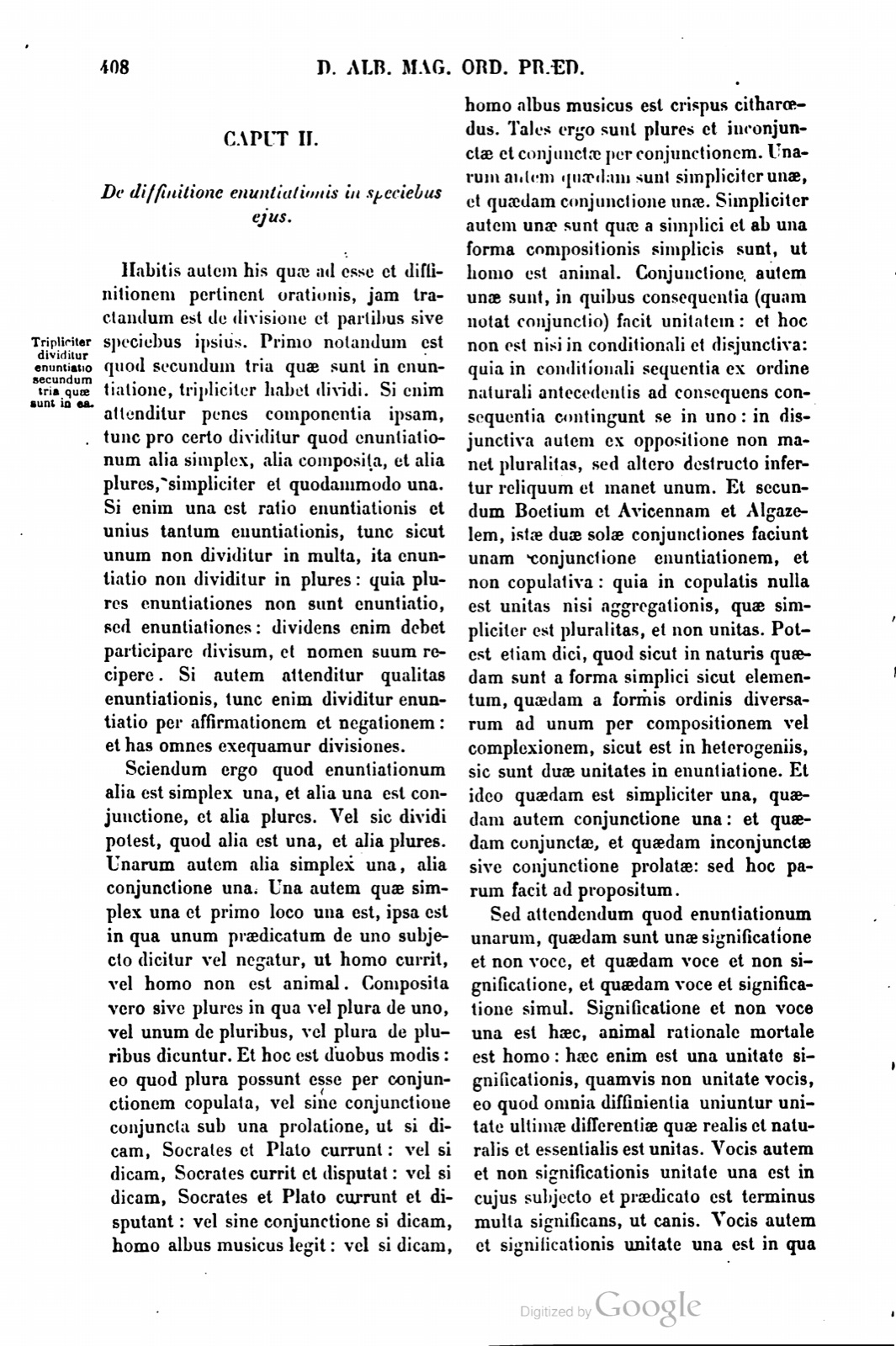
CAPUT II. De diffinitione enuntiationis in speciebus ejus.
Habitis autem his quae ad esse et diffinitionem pertinent orationis, jam tractandum est de divisione et partibus sive speciebus ipsius. Primo notandum est quod secundum tria quae sunt in enuntiatione, tripliciter habet dividi. Si enim attenditur penes componentia ipsam, tunc pro certo dividitur quod enuntiationum alia simplex, alia composita, et alia plures, simpliciter et quodammodo una. Si enim una est ratio enuntiationis et unius tantum enuntiationis, tunc sicut unum non dividitur in multa, ita enuntiatio non dividitur in plures: quia plures enuntiationes non sunt enuntiatio, sed enuntiationes: dividens enim debet participare divisum, et nomen suum recipere. Si autem attenditur qualitas enuntiationis, tunc enim dividitur enuntiatio per affirmationem et negationem: et has omnes exequamur divisiones.
Sciendum ergo quod enuntiationum alia est simplex una, et alia una est conjunctione, et alia plures. Vel sic dividi potest, quod alia est una, et alia plures. Unarum autem alia simplex una, alia conjunctione una. Una autem quae simplex una et primo loco una est, ipsa est in qua unum praedicatum de uno subjecto dicitur vel negatur, ut homo currit, vel homo non est animal. Composita vero sive plures in qua vel plura de uno, vel unum de pluribus, vel plura de pluribus dicuntur. Et hoc est duobus modis: eo quod plura possunt esse per conjunctionem copulata, vel sine conjunctione conjuncta sub una prolatione, ut si dicam, Socrates et Plato currunt: vel si dicam, Socrates currit et disputat: vel si dicam, Socrates et Plato currunt et disputant: vel sine conjunctione si dicam, homo albus musicus legit: vel si dicam, homo albus musicus est crispus citharedus. Tales ergo sunt plures et inconjunctae et conjunctae per conjunctionem. Unarum autem quaedam sunt simpliciter unae, et quaedam conjunctione unae. Simpliciter autem unae sunt quae a simplici et ab una forma compositionis simplicis sunt, ut homo est animal. Conjunctione autem unae sunt, in quibus consequentia (quam notat conjunctio) facit unitatem: et hoc non est nisi in conditionali et disjunctiva: quia in conditionali sequentia ex ordine naturali antecedentis ad consequens consequentia contingunt se in uno: in disjunctiva autem ex oppositione non manet pluralitas, sed altero destructo infertur reliquum et manet unum. Et secundum Boetium et Avicennam et Algazelem, istae duae solae conjunctiones faciunt unam conjunctione enuntiationem, et non copulativa: quia in copulatis nulla est unitas nisi aggregationis, quae simpliciter est pluralitas, et non unitas. Potest etiam dici, quod sicut in naturis quaedam sunt a forma simplici sicut elementum, quaedam a formis ordinis diversarum ad unum per compositionem vel complexionem, sicut est in heterogeniis, sic sunt duae unitates in enuntiatione. Et ideo quaedam est simpliciter una, quaedam autem conjunctione una: et quaedam conjunctae, et quaedam inconjunctae sive conjunctione prolatae: sed hoc parum facit ad propositum.
Sed attendendum quod enuntiationum unarum, quaedam sunt unae significatione et non voce, et quaedam voce et non significatione, et quaedam voce et significatione simul. Significatione et non voce una est haec, animal rationale mortale est homo: haec enim est una unitate significationis, quamvis non unitate vocis, eo quod omnia diffinientia uniuntur unitate ultimae differentiae quae realis et naturalis et essentialis est unitas. Vocis autem et non significationis unitate una est in cujus subjecto et praedicato est terminus multa significans, ut canis. Vocis autem et significationis unitate una est in qua
CHAPTER II. On the definition of enunciation in its species.
Now that those things which pertain to the being and definition of speech have been had, one must now treat its division and parts or species. First it must be noted that according to the three things which are in enunciation, it has to be divided in three ways. For if it is attended according to the things composing it, then it is divided for certain that among enunciations one is simple, another composite, and another plural, simply and in a certain way one. For if there is one account of enunciation and of only one enunciation, then just as one is not divided into many, so enunciation is not divided into many, because many enunciations are not enunciation but enunciations. For what divides ought to participate in the divided thing and receive its name. But if the quality of enunciation is attended, then enunciation is divided by affirmation and negation; and let us carry out all these divisions.
Therefore it must be known that among enunciations one is simple and one, another is one by conjunction, and another is many. Or it can be divided thus, that one is one and another many. But of the ones, one is simple and one, another one by conjunction. The one which is simple one and one in the first place is that in which one predicate is said or denied of one subject, as a human being runs, or a human being is not an animal. But the composite, or many, is that in which either many things are said of one, or one thing of many, or many things of many. And this is in two ways, because many things can be copulated through conjunction, or joined without conjunction under one utterance, as if I say, Socrates and Plato run; or if I say, Socrates runs and disputes; or if I say, Socrates and Plato run and dispute; or without conjunction if I say, the white musical human being reads; or if I say, the white musical human being is a curly-haired harp-player. Therefore such enunciations are many, both unjoined and joined through conjunction. But of the ones, some are simply one, and some are one by conjunction. Those are simply one which are from a simple and one form of simple composition, as a human being is an animal. But those are one by conjunction in which consequence, which the conjunction notes, makes unity; and this is only in the conditional and the disjunctive, because in the conditional the things following from the natural order of antecedent to consequent touch one another in one consequence; but in the disjunctive, from opposition plurality does not remain, but when one has been destroyed the remainder is inferred and one remains. And according to Boethius and Avicenna and Algazel, only those two conjunctions make an enunciation one by conjunction, and not the copulative conjunction, because in copulated things there is no unity except that of aggregation, which is simply plurality and not unity. It can also be said that just as in natures some things are from a simple form, as an element, and some from forms of diverse things ordered to one through composition or combination, as is the case in heterogeneous things, so there are two unities in enunciation. Therefore one is simply one, while another is one by conjunction; and some are joined, and some unjoined or uttered by conjunction. But this contributes little to the proposed matter.
But it must be attended that of one enunciations, some are one in signification and not in vocal sound, some in vocal sound and not in signification, and some in vocal sound and signification at once. One in signification and not in vocal sound is this: a rational mortal animal is a human being. For this is one by unity of signification, although not by unity of vocal sound, because all the defining things are united by the unity of the ultimate difference, which is a real, natural, and essential unity. But one by unity of vocal sound and not of signification is that in whose subject and predicate there is a term signifying many things, as dog. But one by unity of vocal sound and signification is that in which
If a page does not appear, its photograph has not been uploaded yet.