Works › On Interpretation, Books I–II
Volume 1 · pp. 406–407
Tractate IV. Chapter I. On the definition of speech which is the genus of enunciation.
A marker with ≈ is an approximate page boundary, placed by measure of the text; the page photographs remain the authority. In the paired views, clicking a page marker brings that page into view.
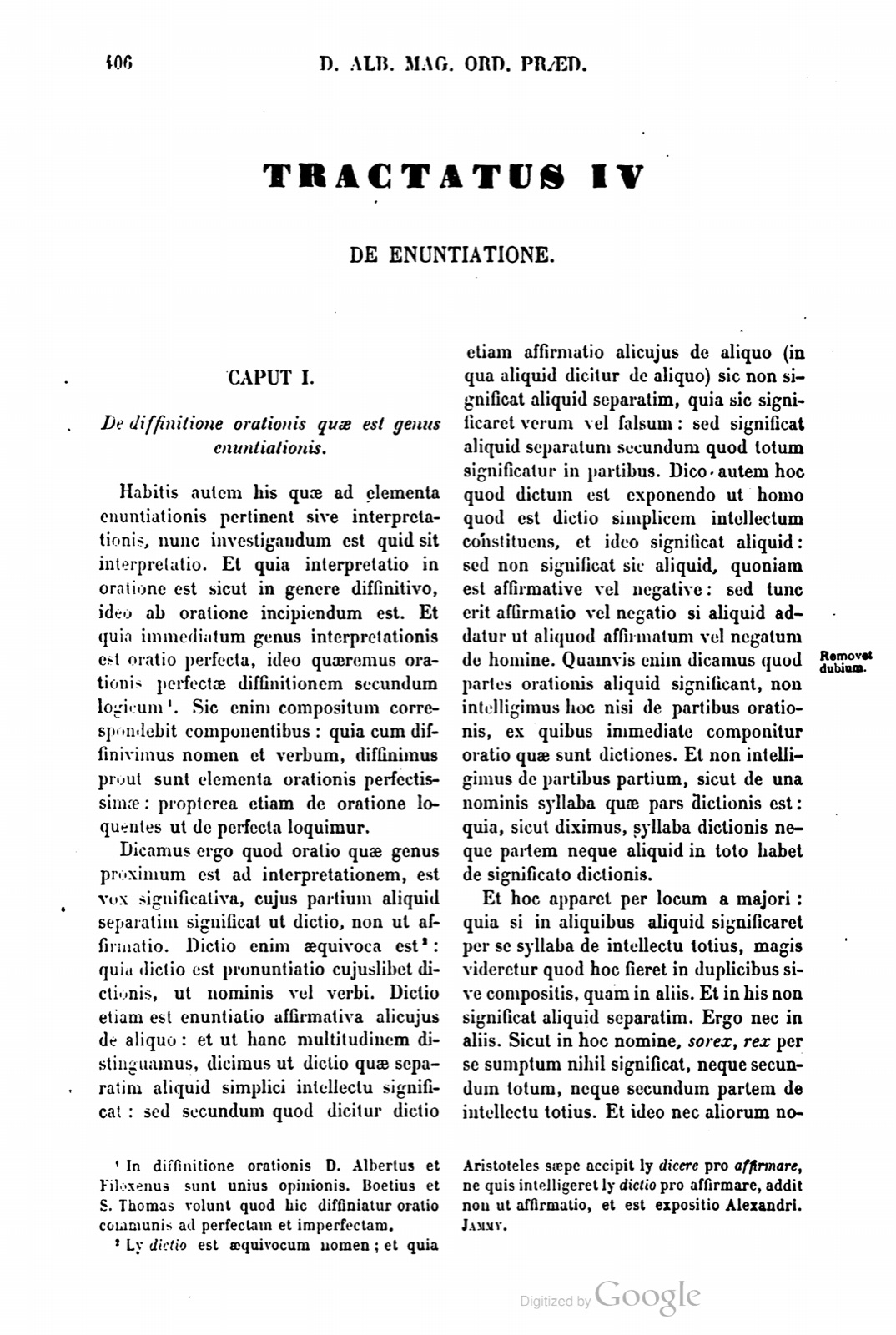
TRACTATUS IV. DE ENUNTIATIONE. CAPUT I. De diffinitione orationis quae est genus enuntiationis.
Habitis autem his quae ad elementa enuntiationis pertinent sive interpretationis, nunc investigandum est quid sit interpretatio. Et quia interpretatio in oratione est sicut in genere diffinitivo, ideo ab oratione incipiendum est. Et quia immediatum genus interpretationis est oratio perfecta, ideo quaeremus orationis perfectae diffinitionem secundum logicum 1. Sic enim compositum correspondebit componentibus: quia cum diffinivimus nomen et verbum, diffinimus prout sunt elementa orationis perfectissime: propterea etiam de oratione loquentes ut de perfecta loquimur.
Dicamus ergo quod oratio quae genus proximum est ad interpretationem, est vox significativa, cujus partium aliquid separatim significat ut dictio, non ut affirmatio. Dictio enim aequivoca est 2: quia dictio est pronuntiatio cujuslibet dictionis, ut nominis vel verbi. Dictio etiam est enuntiatio affirmativa alicujus de aliquo (in qua aliquid dicitur de aliquo) sic non significat aliquid separatim, quia sic significaret verum vel falsum: sed significat aliquid separatum secundum quod totum significatur in partibus. Dico autem hoc quod dictum est exponendo ut homo quod est dictio simplicem intellectum constituens, et ideo significat aliquid: sed non significat sic aliquid, quoniam est affirmative vel negative: sed tunc erit affirmatio vel negatio si aliquid addatur ut aliquod affirmatum vel negatum de homine. Quamvis enim dicamus quod partes orationis aliquid significant, non intelligimus hoc nisi de partibus orationis, ex quibus immediate componitur oratio quae sunt dictiones. Et non intelligimus de partibus partium, sicut de una nominis syllaba quae pars dictionis est: quia, sicut diximus, syllaba dictionis neque partem neque aliquid in toto habet de significato dictionis.
Et hoc apparet per locum a majori: quia si in aliquibus aliquid significaret per se syllaba de intellectu totius, magis videretur quod hoc fieret in duplicibus sive compositis, quam in aliis. Et in his non significat aliquid separatim. Ergo nec in aliis. Sicut in hoc nomine, sorex, rex per se sumptum nihil significat, neque secundum totum, neque secundum partem de intellectu totius. Et ideo nec aliorum nominum pars dictionis aliquid per se separatim significat: non significat quidem pars compositae dictionis aliquid separatim, hoc est dictu, id quod est pars secundum quod pars est nihil significat de intentione totius.
Cum autem dicimus orationem significativam, non dicimus eam significativam ut instrumentum, sed sicut dictum est, dicimus eam significativam esse ad placitum: omne enim instrumentum alicujus causae est instrumentum et naturaliter et accidentaliter est ordinatum ad unum et non ad aliud. Vox autem litterata et articulata, sive sit dictio sive oratio non est ad unum: quia quod in uno idiomate sonat unum, in alio sonat statim oppositum vel aliud: et ideo non est significativa ut instrumentum, sed ad placitum 3.
TRACTATE IV. ON ENUNCIATION. CHAPTER I. On the definition of speech which is the genus of enunciation.
Now that those things which pertain to the elements of enunciation or interpretation have been had, it must now be investigated what interpretation is. And because interpretation is in speech as in a definitive genus, one must begin from speech. And because the immediate genus of interpretation is perfect speech, therefore we shall seek the definition of perfect speech according to the logician 1. For thus the composite will correspond to the components, because when we defined noun and verb, we defined them insofar as they are most perfectly elements of speech. Therefore also, speaking about speech, we speak about it as perfect.
Therefore let us say that speech, which is the proximate genus for interpretation, is significative vocal sound, something of whose parts signifies separately as diction, not as affirmation. For diction is equivocal 2, because diction is the pronunciation of any diction, such as of noun or verb. Diction is also the affirmative enunciation of something about something, in which something is said of something; in that way it does not signify something separately, because in that way it would signify true or false. But it signifies something separated according as the whole is signified in the parts. I say this by expounding what has been said, as human, which is a diction constituting a simple understanding and therefore signifies something; but it does not signify something in such a way because it is affirmatively or negatively. Rather, then there will be affirmation or negation if something is added as something affirmed or denied of a human being. For although we say that the parts of speech signify something, we understand this only of the parts of speech from which speech is immediately composed, which are dictions. And we do not understand this of the parts of parts, as of one syllable of a noun which is a part of a diction, because, as we have said, the syllable of a diction has neither a part nor anything in the whole from the signified of the diction.
And this appears through an argument from the greater: because if in any cases a syllable by itself signified something of the understanding of the whole, it would seem more that this would happen in double or composite words than in others. And in these it does not signify anything separately. Therefore neither in others. As in this name, sorex, rex taken by itself signifies nothing, neither according to the whole nor according to a part of the understanding of the whole. And therefore neither does a part of the diction of other nouns signify anything separately by itself: indeed, the part of a composite diction does not signify anything separately; that is to say, what is a part, according as it is a part, signifies nothing of the intention of the whole.
But when we call speech significative, we do not say that it is significative as an instrument, but, as has been said, we say that it is significative by convention. For every instrument of some cause is an instrument and is naturally and accidentally ordered to one thing and not to another. But lettered and articulated vocal sound, whether it is diction or speech, is not ordered to one thing, because what sounds as one thing in one language immediately sounds as the opposite or another thing in another. Therefore it is not significative as an instrument, but by convention 3.
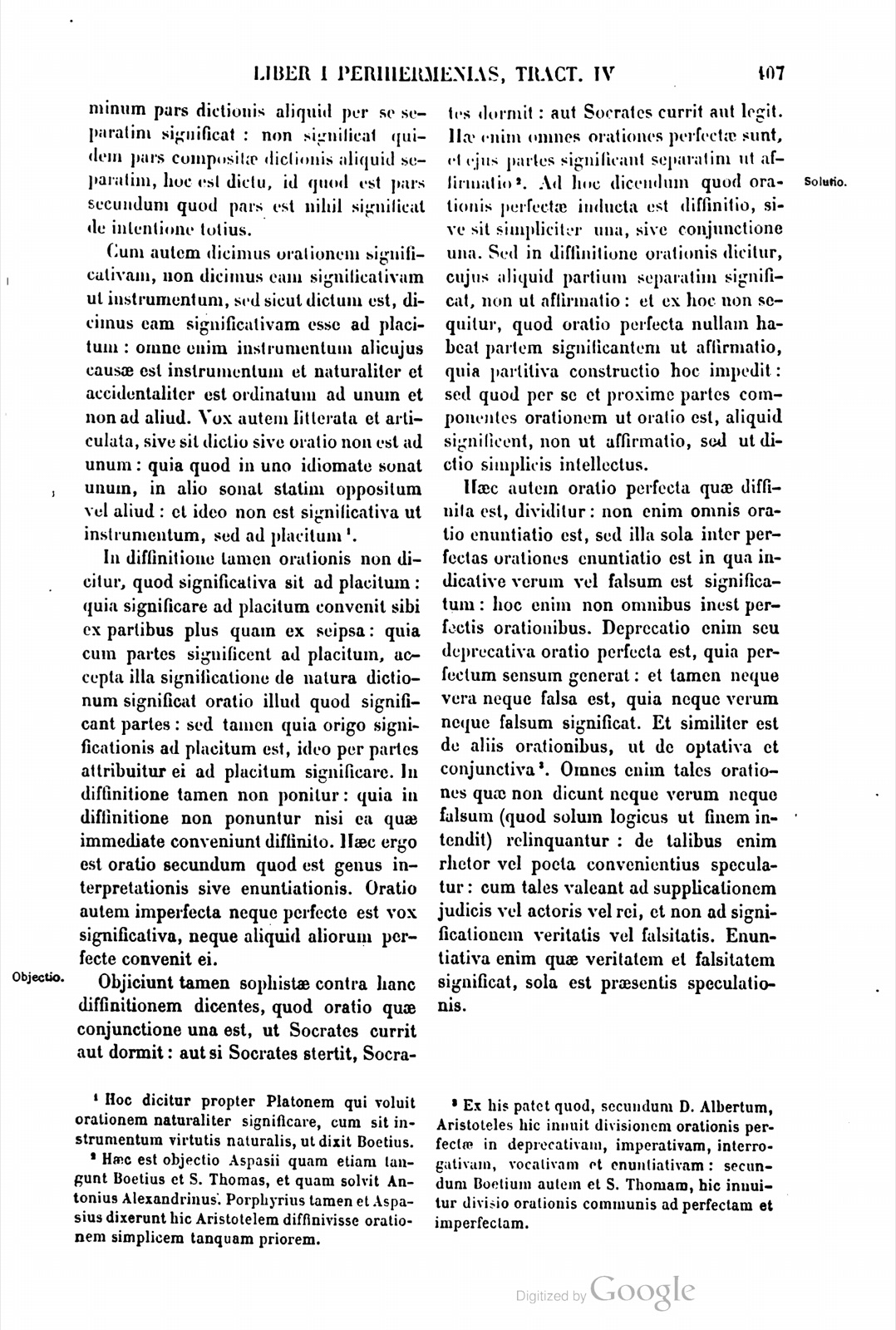
In diffinitione tamen orationis non dicitur, quod significativa sit ad placitum: quia significare ad placitum convenit sibi ex partibus plus quam ex seipsa: quia cum partes significent ad placitum, accepta illa significatione de natura dictionum significat oratio illud quod significant partes: sed tamen quia origo significationis ad placitum est, ideo per partes attribuitur ei ad placitum significare. In diffinitione tamen non ponitur: quia in diffinitione non ponuntur nisi ea quae immediate conveniunt diffinito. Haec ergo est oratio secundum quod est genus interpretationis sive enuntiationis. Oratio autem imperfecta neque perfecte est vox significativa, neque aliquid aliorum perfecte convenit ei.
Objiciunt tamen sophistae contra hanc diffinitionem dicentes, quod oratio quae conjunctione una est, ut Socrates currit aut dormit: aut si Socrates stertit, Socrates dormit: aut Socrates currit aut legit. Hae enim omnes orationes perfectae sunt, et ejus partes significant separatim ut affirmatio 4. Ad hoc dicendum quod orationis perfectae inducta est diffinitio, sive sit simpliciter una, sive conjunctione una. Sed in diffinitione orationis dicitur, cujus aliquid partium separatim significat, non ut affirmatio: et ex hoc non sequitur, quod oratio perfecta nullam habeat partem significantem ut affirmatio, quia partitiva constructio hoc impedit: sed quod per se et proxime partes componentes orationem ut oratio est, aliquid significant, non ut affirmatio, sed ut dictio simplicis intellectus.
Haec autem oratio perfecta quae diffinita est, dividitur: non enim omnis oratio enuntiatio est, sed illa sola inter perfectas orationes enuntiatio est in qua indicative verum vel falsum est significatum: hoc enim non omnibus inest perfectis orationibus. Deprecatio enim seu deprecativa oratio perfecta est, quia perfectum sensum generat: et tamen neque vera neque falsa est, quia neque verum neque falsum significat. Et similiter est de aliis orationibus, ut de optativa et conjunctiva 5. Omnes enim tales orationes quae non dicunt neque verum neque falsum (quod solum logicus ut finem intendit) relinquantur: de talibus enim rhetor vel poeta convenientius speculatur: cum tales valeant ad supplicationem judicis vel actoris vel rei, et non ad significationem veritatis vel falsitatis. Enuntiativa enim quae veritatem et falsitatem significat, sola est praesentis speculationis.
Nevertheless, in the definition of speech it is not said that it is significative by convention, because to signify by convention belongs to it from its parts more than from itself. For since the parts signify by convention, when that signification has been received from the nature of the dictions, speech signifies what the parts signify. Yet, because the origin of signification is by convention, to signify by convention is attributed to speech through its parts. Nevertheless it is not placed in the definition, because only those things which immediately belong to the defined thing are placed in a definition. Therefore this is speech according as it is the genus of interpretation or enunciation. But imperfect speech is neither perfectly significative vocal sound, nor does any of the other things belong to it perfectly.
Nevertheless the sophists object against this definition, saying that speech which is one by conjunction, as Socrates runs or sleeps, or if Socrates snores, Socrates sleeps, or Socrates runs or reads, is such that all these are perfect speeches, and their parts signify separately as affirmation 4. To this it must be said that the definition introduced is the definition of perfect speech, whether it is one simply or one by conjunction. But in the definition of speech it is said, something of whose parts signifies separately, not as affirmation. And from this it does not follow that perfect speech has no part signifying as affirmation, because the partitive construction prevents this; rather, it follows that the parts which of themselves and proximately compose speech as speech signify something, not as affirmation, but as diction of simple understanding.
But this perfect speech which has been defined is divided: for not every speech is enunciation, but among perfect speeches only that one is enunciation in which true or false is signified indicatively. For this does not belong to all perfect speeches. For deprecation, or deprecative speech, is perfect because it generates a perfect sense; and nevertheless it is neither true nor false, because it signifies neither true nor false. And it is similar with other speeches, as with optative and conjunctive speech 5. Therefore all such speeches which say neither true nor false, which alone the logician intends as the end, are to be left aside. For concerning such speeches the rhetorician or poet speculates more suitably, since such speeches are useful for the supplication of a judge, plaintiff, or defendant, and not for the signification of truth or falsity. For enunciative speech, which signifies truth and falsity, alone belongs to the present speculation.
Notes
- In the definition of speech, D. Albert and Philoxenus are of one opinion. Boethius and St. Thomas hold that common speech, common to perfect and imperfect speech, is defined here. (In diffinitione orationis D. Albertus et Filoxenus sunt unius opinionis. Boetius et S. Thomas volunt quod hic diffiniatur oratio communis ad perfectam et imperfectam.) ↩
- The expression diction is an equivocal name; and because Aristotle often takes the expression to say for to affirm, lest someone understand the expression diction as affirming, he adds not as affirmation, and this is the exposition of Alexander. Jammy. (Ly dictio est aequivocum nomen; et quia Aristoteles saepe accipit ly dicere pro affirmare, ne quis intelligeret ly dictio pro affirmare, addit non ut affirmatio, et est expositio Alexandri. JAMMY.) ↩
- This is said because of Plato, who held that speech signifies naturally, since it is an instrument of a natural power, as Boethius said. (Hoc dicitur propter Platonem qui voluit orationem naturaliter significare, cum sit instrumentum virtutis naturalis, ut dixit Boetius.) ↩
- This is the objection of Aspasius, which Boethius and St. Thomas also touch upon, and which Antonius Alexandrinus solves. Porphyry, however, and Aspasius said that Aristotle here defined simple speech as prior. (Haec est objectio Aspasii quam etiam tangunt Boetius et S. Thomas, et quam solvit Antonius Alexandrinus. Porphyrius tamen et Aspasius dixerunt hic Aristotelem diffinivisse orationem simplicem tanquam priorem.) ↩
- From these things it is clear that, according to D. Albert, Aristotle here suggests the division of perfect speech into deprecative, imperative, interrogative, vocative, and enunciative speech; but according to Boethius and St. Thomas, the division of speech common to perfect and imperfect speech is suggested here. (Ex his patet quod, secundum D. Albertum, Aristoteles hic innuit divisionem orationis perfectae in deprecativam, imperativam, interrogativam, vocativam et enuntiativam: secundum Boetium autem et S. Thomam, hic innuitur divisio orationis communis ad perfectam et imperfectam.) ↩
If a page does not appear, its photograph has not been uploaded yet.