Works › On Interpretation, Books I–II
Volume 1 · pp. 404–405
Chapter II. That verbs said according to themselves are nouns.
A marker with ≈ is an approximate page boundary, placed by measure of the text; the page photographs remain the authority. In the paired views, clicking a page marker brings that page into view.
CAPUT II. Quia verba secundum se dicta nomina sunt.
Ipsa verba secundum se dicta, hoc est, secundum se sola accepta (non in oratione ut partes orationis posita) nomina sunt. Cujus probatio: quia significant aliquod determinatum quod proprium est nominis, notam scilicet. Et si quaeratur, quid est nomen hujus verbi quod est amo: dicetur quod nomen ejus amor est: et dicimus, hoc verbum amo est activum verbum. Et talia sic dicta ostendunt quod verba secundum se accepta (et non ad subjecta per compositionem reflexa) sunt accepta ut nomina. Hujus probatio: quia qui primo verbo imposuit tale nomen, et similiter qui simplici dictione dicit vel nominat verbum, talem intendit constituere intellectum, ut scilicet nomine illo tale verbum significetur. Et qui audit sic dicentem et nominantem verbum, quiescit in tali intellectu simplici, et non quaerit amplius. Si enim dicam verbum, et quaeratur quod verbum, et dicatur quod amo vel lego, verbum audiens statim quiescit, non autem quiesceret nisi esset sciens, quod amo determinati et certi verbi nomen est; et ideo per intellectum simplicem quiescit in illo. Verbum autem per se sumptum nondum significat verum vel falsum: non enim significat de re si est, vel si non est per negationem.
Et hujus causa est, quia verbum per se sumptum, neque est signum esse rei, neque signum non esse; et esse quidem per affirmationem, non esse quidem per negationem. Ad hoc autem quod significetur ut esse, oportet quod actu componatur cum re cujus esse secundum aliquem actum vel passionem significat: et tunc proprie est verbum, quia tunc concepit compositionem determinatam ad id cujus est: unde secundum se sumptum nihil habet de verbi significatione. Hoc autem a majori probatur sic. Si enim aliquod verbum per se aliquid significet de intentione verbi, tunc maxime videtur, quod id verbum per se sumptum significet quod concipitur in omni verbo, et hoc est hoc verbum, est: sed si hoc verbum, est, purum et simplex dixeris, ipsum quidem nihil est et nihil finitum significat. Cum significet enim infinite quamdam compositionem, quam sine extremis non est intelligere, ut Avicenna dicit, si dicam, est, nihil penitus significat, nisi addatur quid est vel substantiali vel accidentali praedicato ut dicatur, est lapis, est album, vel est rationale, vel aliquid hujusmodi. Tamen hujus alia ratio est, quia compositio est medium conjungens composita: non conjungit autem nisi per rationem compositorum: et sic compositionis ratio sumitur a compositis: sic ergo verissime intelligitur illud quod dicitur de verbis secundum se dictis, quod nomina sunt.
CHAPTER II. That verbs said according to themselves are nouns.
Verbs themselves said according to themselves, that is, taken by themselves alone and not posited in speech as parts of speech, are nouns. The proof of this is that they signify something determinate, which is proper to a noun, namely a note. And if it is asked, what is the name of this verb which is amo, it will be said that its name is love; and we say, this verb amo is an active verb. And such things said in this way show that verbs taken according to themselves, and not bent back to subjects through composition, are accepted as nouns. The proof of this is that one who first imposed such a name on a verb, and similarly one who says or names a verb by a simple diction, intends to constitute such an understanding, namely that such a verb be signified by that name. And one who hears someone thus saying and naming a verb rests in such a simple understanding and does not seek further. For if I say verb, and it is asked which verb, and it is said amo or lego, the hearer of the verb immediately rests; but he would not rest unless he knew that amo is the name of a determinate and definite verb. And therefore he rests in it through a simple understanding. But a verb taken by itself does not yet signify true or false; for it does not signify concerning a thing whether it is, or whether it is not by negation.
And the cause of this is that a verb taken by itself is neither a sign of the being of a thing nor a sign of non-being: being, indeed, through affirmation, and non-being through negation. But in order for it to be signified as being, it must actually be composed with the thing whose being it signifies according to some act or passion; and then it is properly a verb, because then it has conceived determinate composition toward that of which it is. Whence, taken according to itself, it has nothing of the signification of verb. This is proved from the greater thus. For if some verb by itself signifies something of the intention of verb, then it especially seems that that verb taken by itself signifies what is conceived in every verb, and this is this verb is. But if you say this verb is pure and simple, it indeed is nothing and signifies nothing finite. For since it signifies infinitely a certain composition which cannot be understood without extremes, as Avicenna says, if I say is, it signifies utterly nothing unless what-is is added with either a substantial or accidental predicate, so that it is said, is a stone, is white, or is rational, or something of this sort. Yet there is another reason for this: because composition is the middle joining the things composed; but it does not join except through the account of the things composed. And thus the account of composition is taken from the things composed. Thus, therefore, what is said about verbs said according to themselves, that they are nouns, is understood most truly.
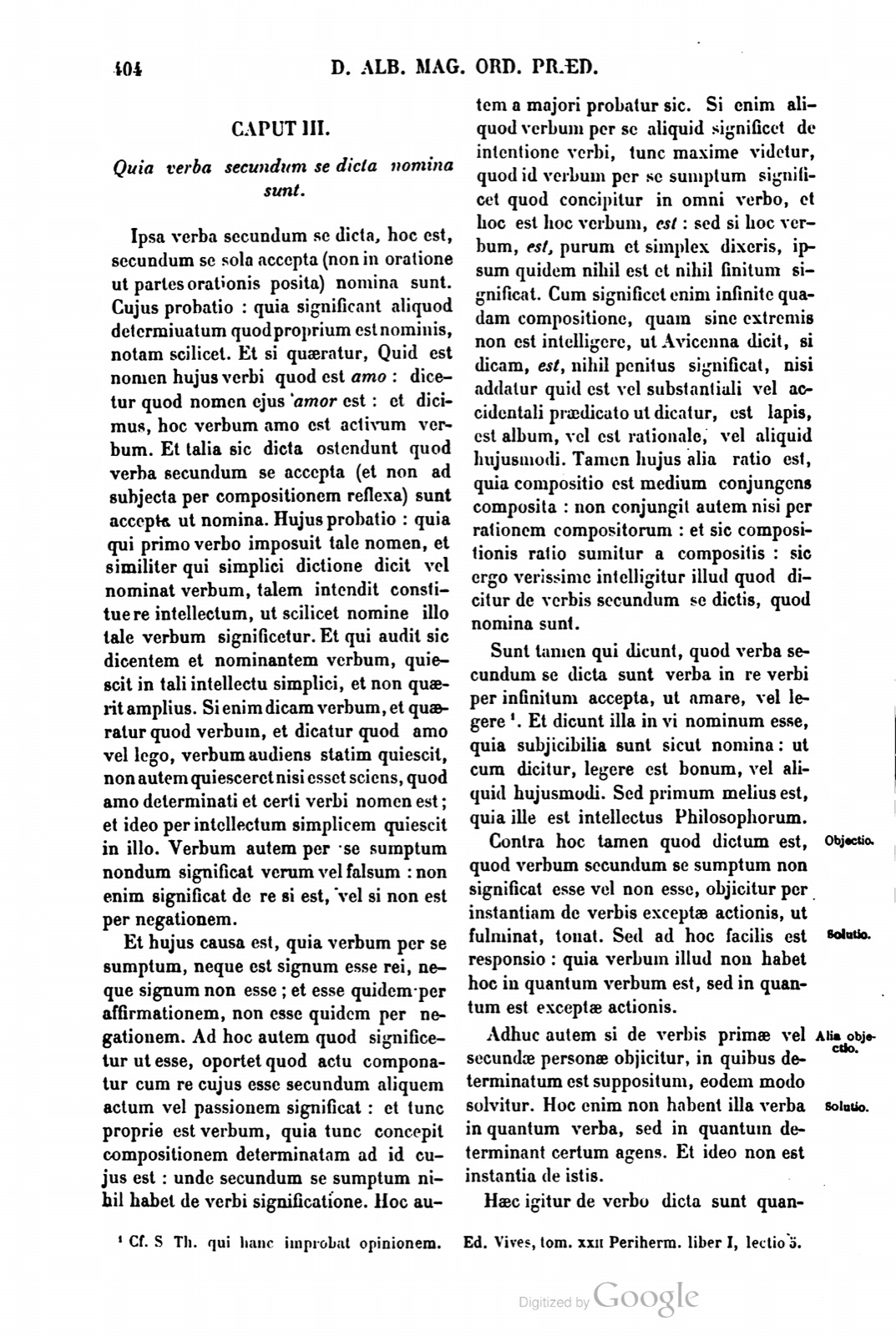
Sunt tamen qui dicunt, quod verba secundum se dicta sunt verba in re verbi per infinitum accepta, ut amare, vel legere 1. Et dicunt illa in vi nominum esse, quia subjicibilia sunt sicut nomina: ut cum dicitur, legere est bonum, vel aliquid hujusmodi. Sed primum melius est, quia ille est intellectus Philosophorum.
Contra hoc tamen quod dictum est, quod verbum secundum se sumptum non significat esse vel non esse, objicitur per instantiam de verbis exceptae actionis, ut fulminat, tonat. Sed ad hoc facilis est responsio: quia verbum illud non habet hoc in quantum verbum est, sed in quantum est exceptae actionis.
Adhuc autem si de verbis primae vel secundae personae objicitur, in quibus determinatum est suppositum, eodem modo solvitur. Hoc enim non habent illa verba in quantum verba, sed in quantum determinant certum agens. Et ideo non est instantia de istis.
Haec igitur de verbo dicta sunt quantum ad naturam interpretationis, de qua hic principaliter quaerimus: quia enim non interpretamur nisi aliquid quod est ut esse, de alio quod est ut ens, et nomen significat ut ens, verbum autem ut esse, ideo non oportet hujus plures partes interpretationis quaerere. Pronomen non significat ut ens finitum et perfectum. Participium autem non significat ut esse per comparationem ad id ad quod est reductum: et ideo non perfecta ratione sunt elementa interpretationis: propter quod de illis omittendum est. Habitis autem elementis interpretationis, nunc ea sunt quaerenda quae formalia sunt principia interpretationis.
Yet there are some who say that verbs said according to themselves are verbs in the thing of the verb received through the infinitive, as to love or to read 1. And they say that these are in the force of nouns, because they can be subjected like nouns, as when it is said, to read is good, or something of this sort. But the first is better, because that is the understanding of the Philosophers.
Nevertheless, against what has been said, that a verb taken according to itself does not signify being or non-being, objection is made by an instance concerning verbs of exceptional action, such as it lightnings, it thunders. But the response to this is easy, because that verb does not have this insofar as it is a verb, but insofar as it is of exceptional action.
Again, if objection is made concerning verbs of the first or second person, in which the supposit is determinate, it is solved in the same way. For those verbs do not have this insofar as they are verbs, but insofar as they determine a definite agent. Therefore there is no instance from these.
These things, then, have been said about the verb with respect to the nature of interpretation, about which we are chiefly asking here. For because we interpret only something which is as to-be, about another which is as being, and noun signifies as being while verb signifies as to-be, therefore it is not necessary to seek more parts of interpretation for this. A pronoun does not signify as finite and perfect being. A participle, however, does not signify as to-be by comparison to that to which it is reduced; and therefore by a perfect account they are not elements of interpretation. On account of this they must be omitted. But once the elements of interpretation have been had, now those things must be sought which are the formal principles of interpretation.
Notes
- Compare St. Thomas, who rejects this opinion. Vives edition, volume XXI, Perihermenias, book I, lecture 5. (Cf. S. Th. qui hanc improbat opinionem. Ed. Vives, tom. XXI Periherm. liber I, lectio 5.) ↩
If a page does not appear, its photograph has not been uploaded yet.