Works › On Interpretation, Books I–II
Volume 1 · pp. 401–403
Chapter II. What a verb is by logical definition.
A marker with ≈ is an approximate page boundary, placed by measure of the text; the page photographs remain the authority. In the paired views, clicking a page marker brings that page into view.
CAPUT II. Quid (per diffinitionem logicam) sit verbum.
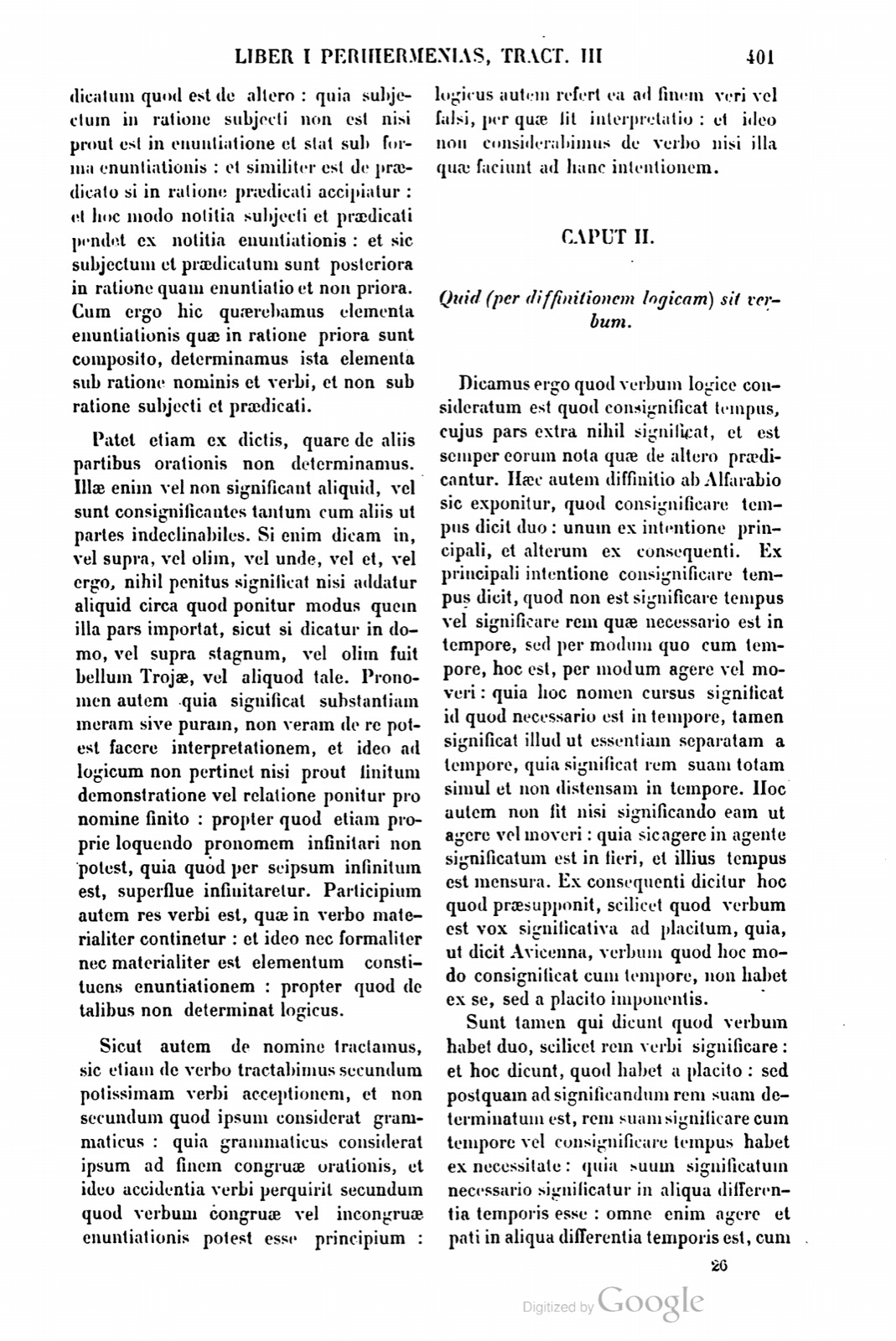
Dicamus ergo quod verbum logice consideratum est quod consignificat tempus, cujus pars extra nihil significat, et est semper eorum nota quae de altero praedicantur. Haec autem diffinitio ab Alfarabio sic exponitur, quod consignificare tempus dicit duo: unum ex intentione principali, et alterum ex consequenti. Ex principali intentione consignificare tempus dicit, quod non est significare tempus vel significare rem quae necessario est in tempore, sed per modum quo cum tempore, hoc est, per modum agere vel moveri: quia hoc nomen cursus significat id quod necessario est in tempore, tamen significat illud ut essentiam separatam a tempore, quia significat rem suam totam simul et non distensam in tempore. Hoc autem non fit nisi significando eam ut agere vel moveri: quia sic agere in agente significatum est in fieri, et illius tempus est mensura. Ex consequenti dicitur hoc quod praesupponit, scilicet quod verbum est vox significativa ad placitum, quia, ut dicit Avicenna, verbum quod hoc modo consignificat cum tempore, non habet ex se, sed a placito imponentis.
Sunt tamen qui dicunt quod verbum habet duo, scilicet rem verbi significare: et hoc dicunt, quod habet a placito: sed postquam ad significandum rem suam determinatum est, rem suam significare cum tempore vel consignificare tempus habet ex necessitate: quia suum significatum necessario significatur in aliqua differentia temporis esse: omne enim agere et pati in aliqua differentia temporis est, cum dicat Philosophus in quarto Physicorum quod idem est esse in tempore, et quadam parte temporis mensurari.
Quod autem dicitur quod est semper eorum quae de altero dicuntur nota, propter compositionem dictum est quae concipitur in verbo: per hanc enim rem suam retorquet ad subjectum cui inest. Inesse autem est causa praedicationis de altero; et ideo per rem suam et compositionem nota est eorum quae de subjecto praedicantur per hoc quod in subjecto sunt.
Sunt autem quae verba videntur, sed secundum potissimam verbi rationem verba non sunt: verbum enim secundum potissimam sui rationem est per quod aliquid interpretari potest de subjecto, et secundum hoc non currit, non laborat, verbum dici non potest. Et similiter caetera verba infinita. Sed tali parti orationis sive tali verbi differentiae nomen proprie non est impositum. In hoc enim cum verbo convenit, quod semper consignificat tempus, et in hoc quod semper est praedicatum de aliquo. Et ideo, si placet, dicatur verbum infinitum: quia nec ad esse nec ad non esse finitur. Et hoc est ideo quia similiter sive aequaliter est in quolibet et quod est et quod non est. Hujus autem causa est: quia sicut in nomine infinito privatur forma et remanet substantia infinita, quae nec ad ens, nec ad non ens finita est, quae designatur per hoc nomen ens, secundum quod communiter dicit id quod est sive in natura sive in ratione vel aestimatione sola, de qua cogitari vel sermo haberi potest: ita verbum infinitum privat rem verbi, et relinquit actum infinitum ordinatum ad substantiam infinitam, ratione cujus consignificat tempus et compositionem in se habet, per quam sic infinitum actum retorquet ad subjectum: et per hoc est nota eorum quae de subjecto dicuntur. Sed quia nullam rem verbi significat finitam, ideo per ipsum nihil est interpretabile de subjecto, et ideo non potest esse pars interpretationis.
CHAPTER II. What a verb is by logical definition.
Therefore let us say that a verb considered logically is that which co-signifies time, no part of which signifies anything outside, and is always a note of those things which are predicated of another. This definition is expounded by Alfarabi thus: to co-signify time says two things, one from principal intention and the other consequently. From principal intention, to co-signify time says that it is not to signify time or to signify a thing which is necessarily in time, but by the mode by which it is with time, that is, by the mode of acting or being moved. For this noun running signifies what is necessarily in time, yet it signifies it as an essence separated from time, because it signifies its thing wholly at once and not stretched out in time. But this is not done except by signifying it as acting or being moved, because thus acting signified in the agent is in becoming, and time is its measure. Consequently there is said what it presupposes, namely that a verb is vocal sound significative by convention, because, as Avicenna says, a verb which co-signifies with time in this way does not have this from itself, but from the convention of the one imposing.
Yet there are some who say that a verb has two things, namely to signify the thing of the verb; and they say that it has this from convention. But after it has been determined for signifying its thing, it has from necessity to signify its thing with time or to co-signify time, because its signified is necessarily signified as being in some difference of time. For all acting and undergoing is in some difference of time, since the Philosopher says in the fourth book of the Physics that to be in time and to be measured by some part of time are the same.
But what is said, that it is always a note of those things which are said of another, is said because of the composition which is conceived in the verb; for through this it turns its thing back to the subject in which it inheres. But inhering is the cause of predication about another; and therefore through its thing and composition it is a note of those things which are predicated of the subject through the fact that they are in the subject.
There are, however, things which seem to be verbs, but according to the most powerful account of verb are not verbs. For a verb, according to its most powerful account, is that through which something can be interpreted about a subject; and according to this does not run, does not labor cannot be called a verb. And likewise the other infinite verbs. But a name has not properly been imposed on such a part of speech or such a difference of verb. For in this it agrees with a verb, that it always co-signifies time, and in this, that it is always predicated of something. Therefore, if it pleases, let it be called an infinite verb, because it is bounded neither to being nor to non-being. And this is because similarly or equally there is in anything both what it is and what it is not. The cause of this is that, just as in an infinite noun the form is deprived and infinite substance remains, which is bounded neither to being nor to non-being and is designated through this noun being, according as it commonly says that which is either in nature or in reason or in estimation alone, about which thought or speech can be had, so the infinite verb deprives the thing of the verb and leaves an infinite act ordered to infinite substance. By reason of this it co-signifies time and has composition in itself, through which it thus turns the infinite act back to the subject; and through this it is a note of those things which are said of the subject. But because it signifies no finite thing of the verb, therefore nothing is interpretable of a subject through it, and therefore it cannot be a part of interpretation.
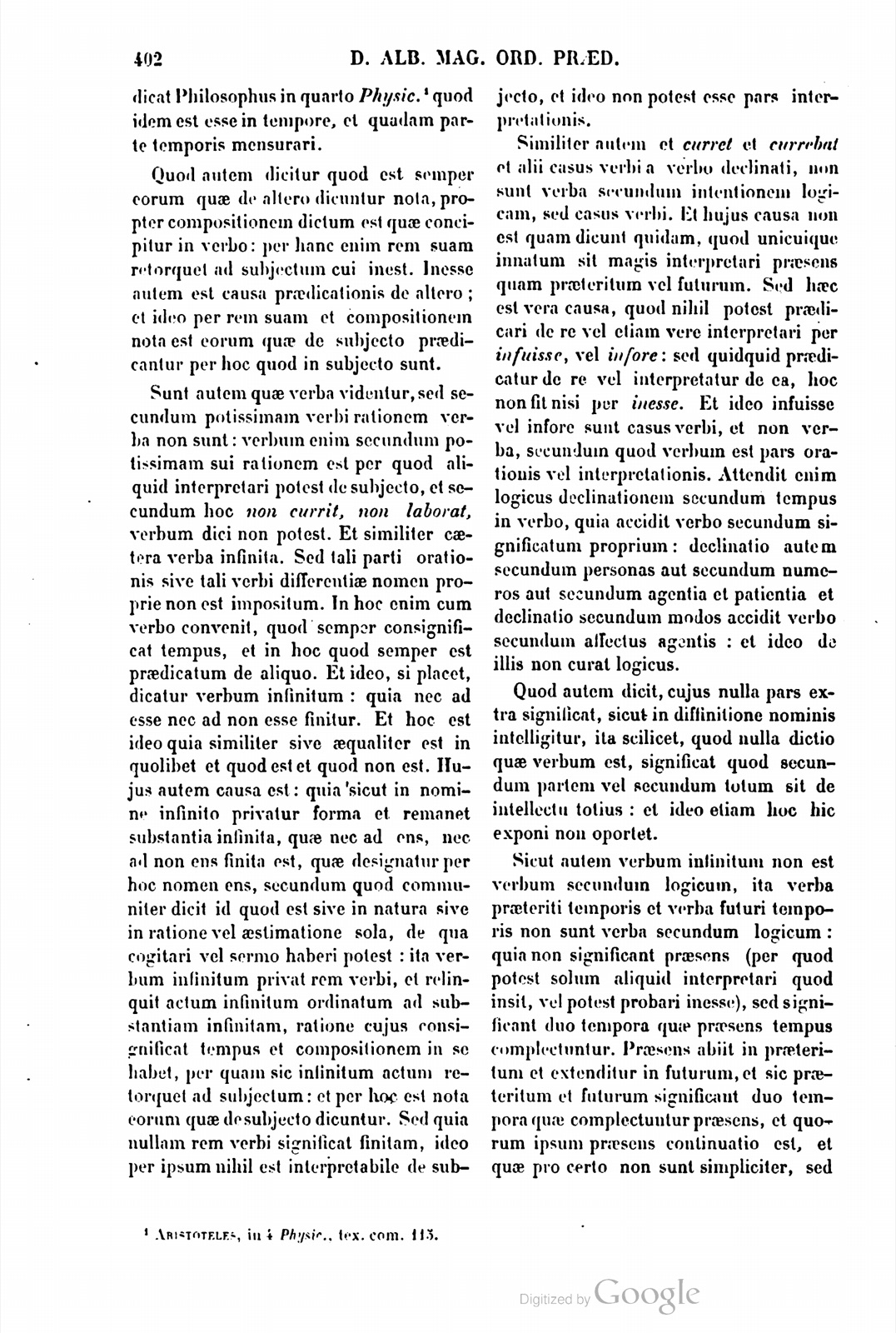
Similiter autem et curret et currebat et alii casus verbi a verbo declinati, non sunt verba secundum intentionem logicam, sed casus verbi. Et hujus causa non est quam dicunt quidam, quod unicuique innatum sit magis interpretari praesens quam praeteritum vel futurum. Sed haec est vera causa, quod nihil potest praedicari de re vel etiam vere interpretari per infuisse, vel infore: sed quidquid praedicatur de re vel interpretatur de ea, hoc non fit nisi per inesse. Et ideo infuisse vel infore sunt casus verbi, et non verba, secundum quod verbum est pars orationis vel interpretationis. Attendit enim logicus declinationem secundum tempus in verbo, quia accidit verbo secundum significatum proprium: declinatio autem secundum personas aut secundum numeros aut secundum agentia et patientia et declinatio secundum modos accidit verbo secundum affectus agentis: et ideo de illis non curat logicus.
Quod autem dicit, cujus nulla pars extra significat, sicut in diffinitione nominis intelligitur, ita scilicet, quod nulla dictio quae verbum est, significat quod secundum partem vel secundum totum sit de intellectu totius: et ideo etiam hoc hic exponi non oportet.
Sicut autem verbum infinitum non est verbum secundum logicum, ita verba praeteriti temporis et verba futuri temporis non sunt verba secundum logicum: quia non significant praesens (per quod potest solum aliquid interpretari quod insit, vel potest probari inesse), sed significant duo tempora quae praesens tempus complectuntur. Praesens abiit in praeteritum et extenditur in futurum, et sic praeteritum et futurum significant duo tempora quae complectuntur praesens, et quorum ipsum praesens continuatio est, et quae pro certo non sunt simpliciter, sed secundum quid sunt, secundum quod ad id quod est substantia temporis et complectentia ipsum reducuntur. Et siquidem secundum naturale esse temporis accipiantur, tunc primum est nunc praesens quod abiit secundum esse finis in praeteritum, et secundum esse principii extenditur in futurum. Si autem tempus accipiatur in temporali quod prius in potentia quam in actu fit, quoad hoc prius est futurum, et deinde praesens, ultimo praeteritum. Si autem tempus accipiatur ut spatium periodi generatorum, tunc prius est praeteritum, deinde praesens, et ultimo expectatur futurum.
Similarly, will run and was running and the other cases of a verb declined from a verb are not verbs according to logical intention, but cases of the verb. And the cause of this is not what some say, namely that it is more innate to each person to interpret the present than the past or future. But this is the true cause: that nothing can be predicated of a thing or even truly interpreted through having-been-in or going-to-be-in, but whatever is predicated of a thing or interpreted about it is done only through being-in. Therefore having-been-in or going-to-be-in are cases of the verb and not verbs, according as verb is part of speech or interpretation. For the logician attends to declension according to time in the verb, because it happens to the verb according to its proper signified; but declension according to persons, or according to numbers, or according to agents and patients, and declension according to modes, happens to the verb according to the affects of the agent. Therefore the logician is not concerned with those.
But what he says, no part of which signifies outside, is understood as in the definition of noun, namely in this way, that no diction which is a verb signifies what, according to part or according to whole, would belong to the understanding of the whole; and therefore this also need not be expounded here.
But just as an infinite verb is not a verb according to the logician, so verbs of past time and verbs of future time are not verbs according to the logician, because they do not signify the present, through which alone something that inheres can be interpreted, or can be proved to inhere, but they signify two times which embrace present time. The present has passed into the past and is extended into the future; and thus past and future signify two times which embrace the present, and of which the present itself is the continuation, and which certainly are not simply, but are in a qualified respect, according as they are reduced to that which is the substance of time and to the things embracing it. And if they are received according to the natural being of time, then first there is the present now, which has passed according to the being of an end into the past, and according to the being of a beginning is extended into the future. But if time is received in the temporal thing, which comes to be first in potency before act, in this respect the future is first, then the present, and last the past. But if time is received as the space of the period of generated things, then the past is first, then the present, and last the future is expected.
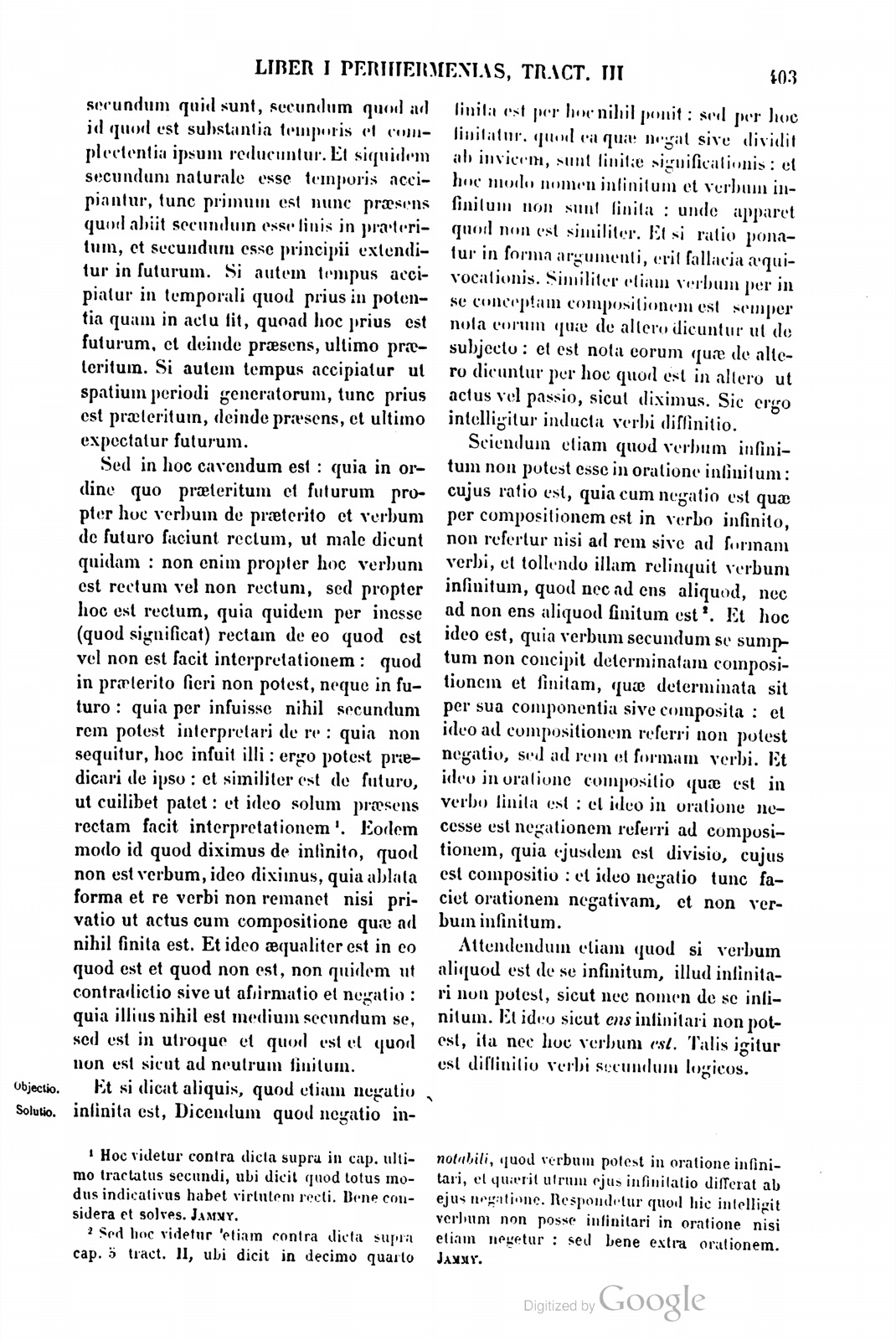
Sed in hoc cavendum est: quia in ordine quo praeteritum et futurum propter hoc verbum de praeterito et verbum de futuro faciunt rectum, ut male dicunt quidam: non enim propter hoc verbum est rectum vel non rectum, sed propter hoc est rectum, quia quidem per inesse (quod significat) rectam de eo quod est vel non est facit interpretationem: quod in praeterito fieri non potest, neque in futuro: quia per infuisse nihil secundum rem potest interpretari de re: quia non sequitur, hoc infuit illi: ergo potest praedicari de ipso: et similiter est de futuro, ut cuilibet patet: et ideo solum praesens rectam facit interpretationem 1. Eodem modo id quod diximus de infinito, quod non est verbum, ideo diximus, quia ablata forma et re verbi non remanet nisi privatio ut actus cum compositione quae ad nihil finita est. Et ideo aequaliter est in eo quod est et quod non est, non quidem ut contradictio sive ut affirmatio et negatio: quia illius nihil est medium secundum se, sed est in utroque et quod est et quod non est sicut ad neutrum finitum.
Et si dicat aliquis, quod etiam negatio infinita est, dicendum quod negatio infinita est per hoc nihil ponit: sed per hoc finitatur, quod ea quae negat sive dividit ab invicem, sunt finitae significationis: et hoc modo nomen infinitum et verbum infinitum non sunt finita: unde apparet quod non est similiter. Et si ratio ponatur in forma argumenti, erit fallacia aequivocationis. Similiter etiam verbum per in se conceptam compositionem est semper nota eorum quae de altero dicuntur ut de subjecto: et est nota eorum quae de altero dicuntur per hoc quod est in altero ut actus vel passio, sicut diximus. Sic ergo intelligitur inducta verbi diffinitio.
Sciendum etiam quod verbum infinitum non potest esse in oratione infinitum 2: cujus ratio est, quia cum negatio est quae per compositionem est in verbo infinito, non refertur nisi ad rem sive ad formam verbi, et tollendo illam relinquit verbum infinitum, quod nec ad ens aliquod, nec ad non ens aliquod finitum est. Et hoc ideo est, quia verbum secundum se sumptum non concipit determinatam compositionem et finitam, quae determinata sit per sua componentia sive composita: et ideo ad compositionem referri non potest negatio, sed ad rem et formam verbi. Et ideo in oratione compositio quae est in verbo finita est: et ideo in oratione necesse est negationem referri ad compositionem, quia ejusdem est divisio, cujus est compositio: et ideo negatio tunc faciet orationem negativam, et non verbum infinitum.
Attendendum etiam quod si verbum aliquod est de se infinitum, illud infinitari non potest, sicut nec nomen de se infinitum. Et ideo sicut ens infinitari non potest, ita nec hoc verbum est. Talis igitur est diffinitio verbi secundum logicos.
But caution is needed in this: because in the order by which past and future, on this account, make a verb about the past and a verb about the future right, as some badly say; for a verb is not right or not right on account of this, but is right on account of this, that through being-in, which it signifies, it makes a right interpretation concerning what is or is not. This cannot be done in the past nor in the future, because through having-been-in nothing can be interpreted about a thing according to reality, because it does not follow: this has been in that; therefore it can be predicated of it. And it is similar concerning the future, as is clear to anyone; and therefore only the present makes right interpretation 1. In the same way, what we said about the infinite, that it is not a verb, we said for this reason: because when the form and thing of the verb have been removed, nothing remains except privation as act with a composition which is bounded to nothing. Therefore it is equally in what is and what is not, not indeed as contradiction or as affirmation and negation, because of that there is no middle according to itself, but it is in both what is and what is not as bounded to neither.
And if someone says that negation also is infinite, it must be said that negation is infinite in that through this it posits nothing; but it is bounded through this, that the things which it denies or divides from one another are of finite signification. In this way an infinite noun and an infinite verb are not finite; whence it appears that it is not similar. And if the reason is posited in the form of an argument, it will be a fallacy of equivocation. Similarly also the verb, through composition conceived in itself, is always a note of those things which are said of another as of a subject; and it is a note of those things which are said of another through the fact that it is in another as act or passion, as we have said. Thus, therefore, the introduced definition of verb is understood.
It must also be known that an infinite verb cannot be infinite in speech 2. The reason for this is that, since negation is what is in an infinite verb through composition, it is referred only to the thing or form of the verb, and by taking that away it leaves an infinite verb, which is bounded neither to any being nor to any non-being. And this is because a verb taken according to itself does not conceive a determinate and finite composition which is determined through its components or things composed; and therefore negation cannot be referred to composition, but to the thing and form of the verb. And therefore in speech the composition which is in the verb is finite; and therefore in speech negation must be referred to composition, because division belongs to the same thing to which composition belongs. And therefore negation will then make negative speech and not an infinite verb.
It must also be attended that if some verb is infinite of itself, it cannot be made infinite, just as neither can a noun that is infinite of itself. Therefore, just as being cannot be made infinite, so neither can this verb is. Such, therefore, is the definition of verb according to the logicians.
Notes
- This seems contrary to the things said above in the last chapter of the second tractate, where he says that the whole indicative mode has the power of the nominative. Consider well and you will solve it. Jammy. (Hoc videtur contra dicta supra in cap. ultimo tractatus secundi, ubi dicit quod totus modus indicativus habet virtutem recti. Bene considera et solves. JAMMY.) ↩
- But this also seems contrary to the things said above, chapter 5, tractate II, where he says in the fourteenth notable point that a verb can be infinitated in speech, and asks whether its infinitation differs from its negation. The answer is that here he understands that a verb cannot be infinitated in speech unless it is also denied, but that it can well be infinitated outside speech. Jammy. (Sed hoc videtur etiam contra dicta supra cap. 5 tract. II, ubi dicit in decimo quarto notabili, quod verbum potest in oratione infinitari, et quaerit utrum ejus infinitatio differat ab ejus negatione. Respondetur quod hic intelligit verbum non posse infinitari in oratione nisi etiam negetur: sed bene extra orationem. JAMMY.) ↩
If a page does not appear, its photograph has not been uploaded yet.