Works › On Interpretation, Books I–II
Volume 1 · pp. 400–401
Tractate III. Chapter I. How the verb belongs to logical consideration.
A marker with ≈ is an approximate page boundary, placed by measure of the text; the page photographs remain the authority. In the paired views, clicking a page marker brings that page into view.
TRACTATUS III. DE VERBO. CAPUT I. Qualiter verbum est de consideratione logica.
Interpretatio (quae de re sicut est vel non est interpretatur) non potest fieri solo nomine, sed oportet quod verbum adjungatur: quia verbum per hoc quod significat agere vel pati (quod est substantiae nominis proprium) significat illud quod inest nomini. Inesse autem in eo quod inest, causa est praedicationis de altero, sicut in scientia Universalium dictum est: et ideo interpretatio de esse vel non esse rei non nisi per verbum fieri potest. Propter quod de verbo in scientia de interpretatione determinari conveniens est: quia est alterum interpretationis elementum.
Et si objiciatur quod verbum non semper est praedicatum quod de altero dicitur, sed ut frequenter praedicantur nomina, ut homo est animal, Socrates est homo, homo est rationale vel risibile vel album, et sic de aliis quae sub quinque universalibus et praedicatis continentur, facile est solvere: quia praedicatum est duplex, scilicet materiale, et formale. Formale quidem est, quod intra se concipit formam per quam retorquet ad alterum cui inest, et de quo est ut de subjecto: haec autem forma non est nisi compositio: et hanc formam verbum (per hoc quod alterius est) in se concipit. Et ideo solum verbum praedicatum formale est. Hoc autem probatur exemplo: quia cum dicitur, homo currit, sensus est, homo est currens, ut participium sit res verbi praedicata materialiter: ipsum autem quod dico est quod est nota compositionis, formam dicit qua res verbi refertur ad subjectum sicut inhaerens sibi vel aliquid ejus, et ut aliquid quod de ipso sit: talis autem forma non est concepta in significato nominis.
Si autem quaeritur ratio, quare compositio magis concipitur in verbo quam in nomine, praecipue cum compositio media sit inter composita, et aequaliter videatur utrumque extremorum respicere? Dicendum cum Dionysio, quod nulla compositio est a primo, sed omnis compositio incipit et principiatur a secundo. Primum enim ut primum nulli inest, sed secundum potest inesse. Adhuc quia per verbum significatur id quod inest, ideo in secundo concipitur compositio et non in primo.
Si ergo aliquis dicat quod vere quinque sunt praedicata quae sunt vere universalia, et sic non solum verbum est praedicatum, patet responsio: quia omnia illa materialiter sunt praedicata, solum autem verbum est praedicatum formaliter propter jam inductam rationem. Unde etiam nec pronomen nec participium formaliter est praedicatum, propter quod de istis in logicis ut de partibus interpretationis non determinatur.
TRACTATE III. ON THE VERB. CHAPTER I. How the verb belongs to logical consideration.
Interpretation, which interprets concerning a thing as it is or is not, cannot be made by noun alone, but it is necessary that a verb be joined to it, because the verb, through the fact that it signifies acting or undergoing, which is proper to the substance of a noun, signifies that which inheres in the noun. But in-being in that in which it inheres is the cause of predication about another, as was said in the science of Universals; and therefore interpretation concerning the being or non-being of a thing can be made only through a verb. For this reason it is fitting that determination be made about the verb in the science of interpretation, because it is the other element of interpretation.
And if it is objected that the verb is not always the predicate which is said of another, but that nouns are predicated more often, as a human being is an animal, Socrates is a human being, a human being is rational or risible or white, and so concerning the others which are contained under the five universals and predicates, it is easy to solve this: because predicate is twofold, namely material and formal. The formal predicate is what conceives within itself the form through which it turns back to another in which it inheres and about which it is as about a subject. But this form is nothing except composition; and the verb, through the fact that it belongs to another, conceives this form in itself. Therefore only the verb is the formal predicate. This is proved by an example: because when it is said, a human being runs, the sense is, a human being is running, so that the participle is the thing of the verb predicated materially; but the very thing that I say, is, which is the note of composition, says the form by which the thing of the verb is referred to the subject as inhering in it or as something of it, and as something which belongs to it. But such a form is not conceived in the signified of a noun.
But if the reason is asked why composition is conceived more in the verb than in the noun, especially since composition is a middle between the things composed and seems equally to regard both extremes, it must be said with Dionysius that no composition is from the first, but every composition begins and is principled from the second. For the first, as first, inheres in nothing, but the second can inhere. Again, because what inheres is signified through the verb, therefore composition is conceived in the second and not in the first.
Therefore if someone says that truly there are five predicates which are truly universal, and thus the verb alone is not a predicate, the response is clear: because all those are predicates materially, but only the verb is predicate formally because of the reason already introduced. Whence neither pronoun nor participle is formally a predicate; on account of this, determination is not made about these in logic as about parts of interpretation.
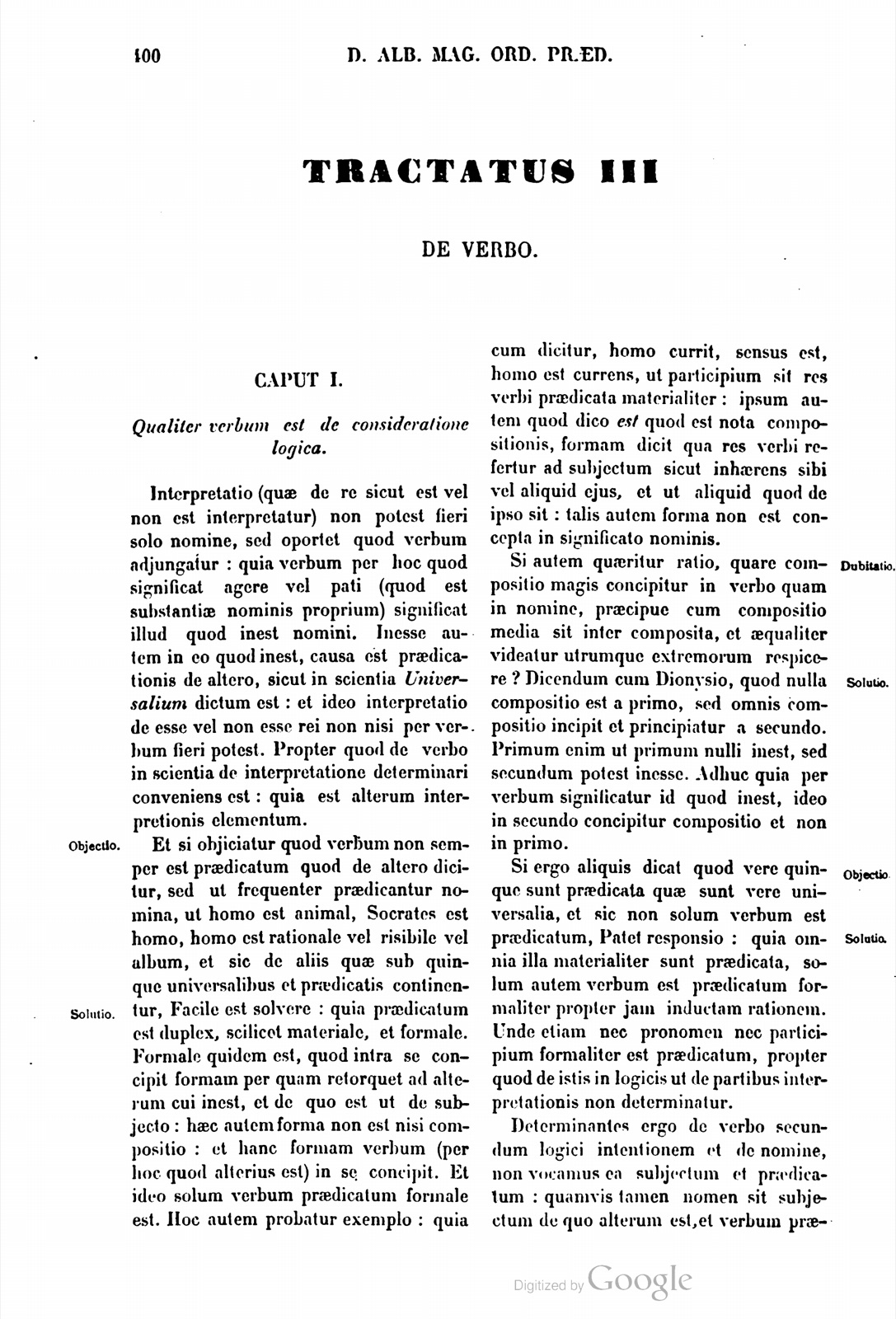
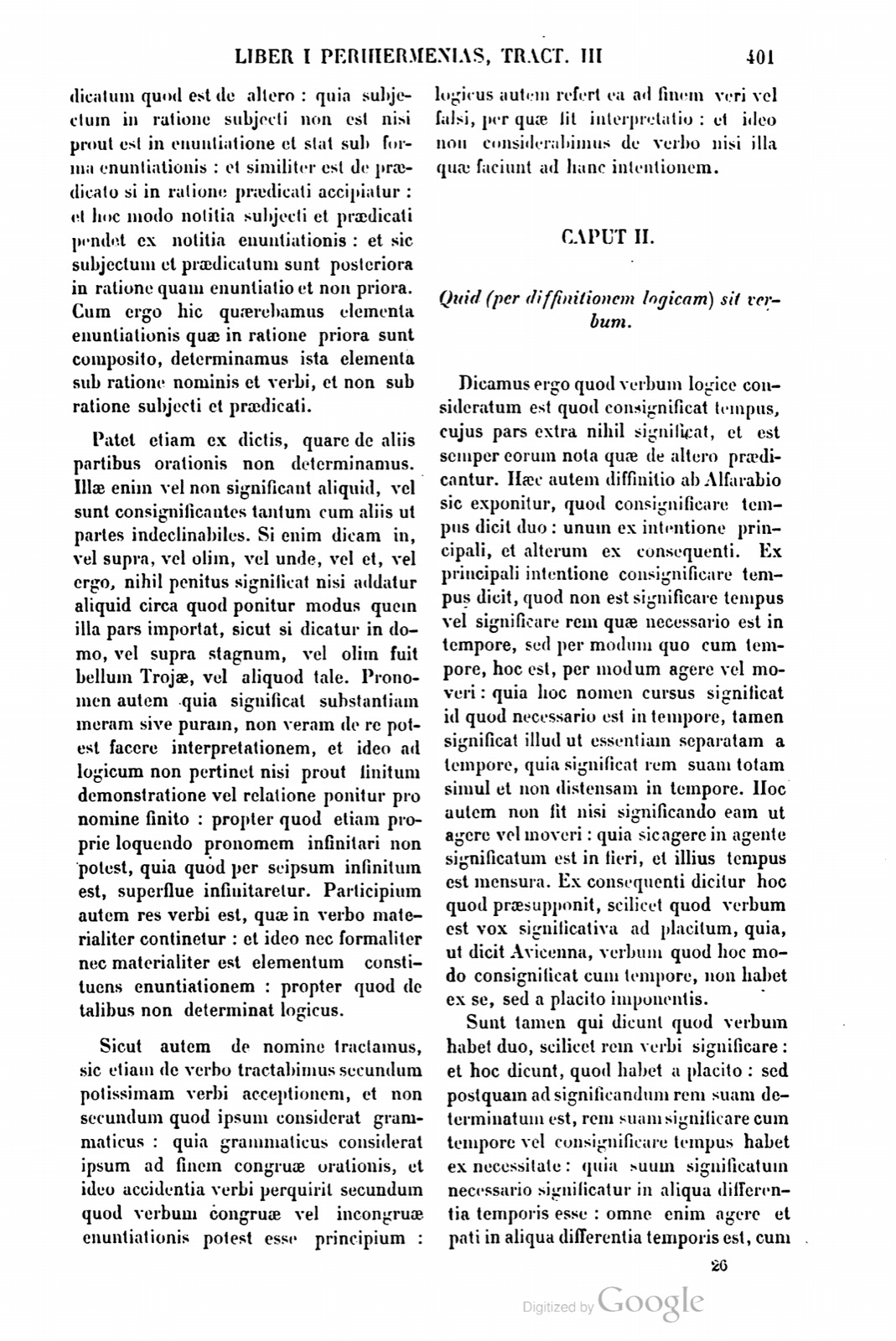
Determinantes ergo de verbo secundum logici intentionem et de nomine, non vocamus ea subjectum et praedicatum: quamvis tamen nomen sit subjectum de quo alterum est, et verbum praedicatum quod est de altero: quia subjectum in ratione subjecti non est nisi prout est in enuntiatione et stat sub forma enuntiationis: et similiter est de praedicato si in ratione praedicati accipiatur: et hoc modo notitia subjecti et praedicati pendet ex notitia enuntiationis: et sic subjectum et praedicatum sunt posteriora in ratione quam enuntiatio et non priora. Cum ergo hic quaerebamus elementa enuntiationis quae in ratione priora sunt composito, determinamus ista elementa sub ratione nominis et verbi, et non sub ratione subjecti et praedicati.
Patet etiam ex dictis, quare de aliis partibus orationis non determinamus. Illae enim vel non significant aliquid, vel sunt consignificantes tantum cum aliis ut partes indeclinabiles. Si enim dicam in, vel supra, vel olim, vel unde, vel et, vel ergo, nihil penitus significat nisi addatur aliquid circa quod ponitur modus quem illa pars importat, sicut si dicatur in domo, vel supra stagnum, vel olim fuit bellum Trojae, vel aliquod tale. Pronomen autem quia significat substantiam meram sive puram, non veram de re potest facere interpretationem, et ideo ad logicum non pertinet nisi prout finitum demonstratione vel relatione ponitur pro nomine finito: propter quod etiam proprie loquendo pronomen infinitari non potest, quia quod per seipsum infinitum est, superflue infinitaretur. Participium autem res verbi est, quae in verbo materialiter continetur: et ideo nec formaliter nec materialiter est elementum constituens enuntiationem: propter quod de talibus non determinat logicus.
Sicut autem de nomine tractamus, sic etiam de verbo tractabimus secundum potissimam verbi acceptionem, et non secundum quod ipsum considerat grammaticus: quia grammaticus considerat ipsum ad finem congruae orationis, et ideo accidentia verbi perquirit secundum quod verbum congruae vel incongruae enuntiationis potest esse principium: logicus autem refert ea ad finem veri vel falsi, per quae fit interpretatio: et ideo non considerabimus de verbo nisi illa quae faciunt ad hanc intentionem.
Therefore, when determining about verb according to the intention of the logician and about noun, we do not call them subject and predicate, although nevertheless noun is the subject about which the other is, and verb is the predicate which is about another. For subject in the account of subject exists only insofar as it is in enunciation and stands under the form of enunciation; and it is similar concerning predicate if it is taken in the account of predicate. In this way knowledge of subject and predicate depends on knowledge of enunciation; and thus subject and predicate are posterior in account to enunciation and not prior. Therefore, since here we were seeking the elements of enunciation which are prior in account to the composite, we determine these elements under the account of noun and verb, and not under the account of subject and predicate.
It is also clear from what has been said why we do not determine about the other parts of speech. For they either do not signify anything, or they only co-signify with others, as indeclinable parts do. For if I say in, or above, or formerly, or whence, or and, or therefore, it signifies utterly nothing unless something is added concerning which the mode which that part conveys is posited, as if it were said in the house, or above the pond, or formerly there was the Trojan war, or something of this sort. But because a pronoun signifies mere or pure substance, it cannot make a true interpretation concerning the thing, and therefore it does not pertain to the logician except insofar as, made finite by demonstration or relation, it is posited for a finite noun. On account of this, properly speaking, a pronoun also cannot be made infinite, because what is infinite through itself would be made infinite superfluously. But a participle is the thing of the verb, which is contained materially in the verb; and therefore it is neither formally nor materially an element constituting enunciation. On account of this the logician does not determine about such things.
But just as we treat noun, so also we shall treat verb according to the most powerful acceptance of verb, and not according as the grammarian considers it, because the grammarian considers it for the end of congruous speech, and therefore seeks out the accidents of the verb according as the verb can be a principle of congruous or incongruous enunciation. But the logician refers them to the end of the true or false, through which interpretation is made; and therefore we shall consider about the verb only those things which make for this intention.
If a page does not appear, its photograph has not been uploaded yet.