Works › On Interpretation, Books I–II
Volume 1 · pp. 398–399
Chapter VI. On the case of a noun.
A marker with ≈ is an approximate page boundary, placed by measure of the text; the page photographs remain the authority. In the paired views, clicking a page marker brings that page into view.
CAPUT VI. De casu nominis.
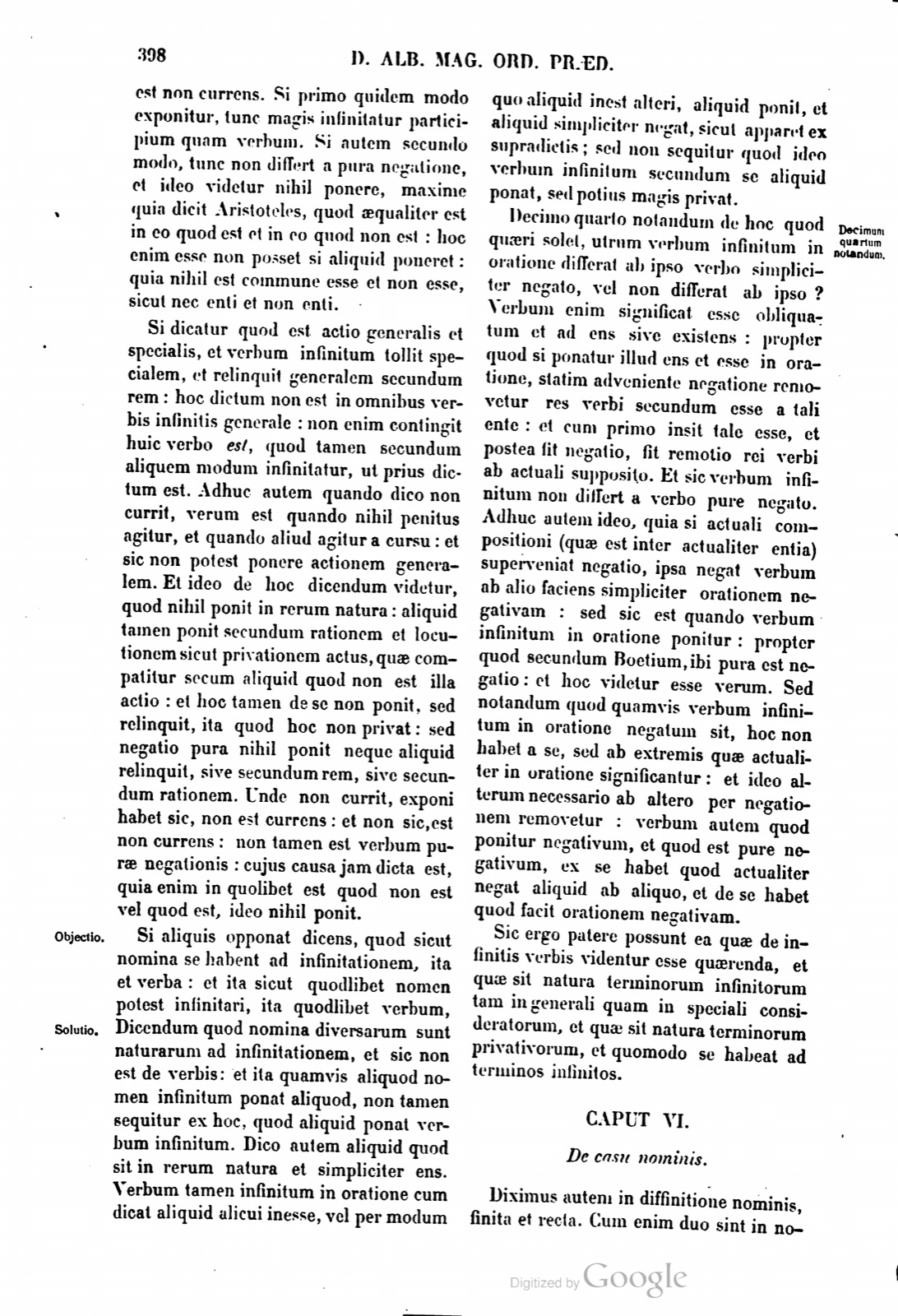
Diximus autem in diffinitione nominis, finita et recta. Cum enim duo sint in nomine secundum perfectam nominis rationem, substantia scilicet et qualitas, infinitum nomen esse non potest, de quo aliquid enuntietur propter defectum qualitatis. Similiter casus nominis sive nomen obliquum, nomen hic esse non potest: quia deficit in significatione substantiae, quam ita designari oportet, ut de ea aliquid enuntiabile sit: quod non potest fieri nisi in recto: genitivus enim non significat substantiam, sed aliquid esse ipsius. Similiter dativus non significat substantiam, sed significat aliquid esse illi. Et eodem modo accusativus non significat substantiam, sed aliquid ad ipsam. Et ideo nullus casus directe significat substantiam nisi rectus, qui significat eam prout aliquid est enuntiabile de ea.
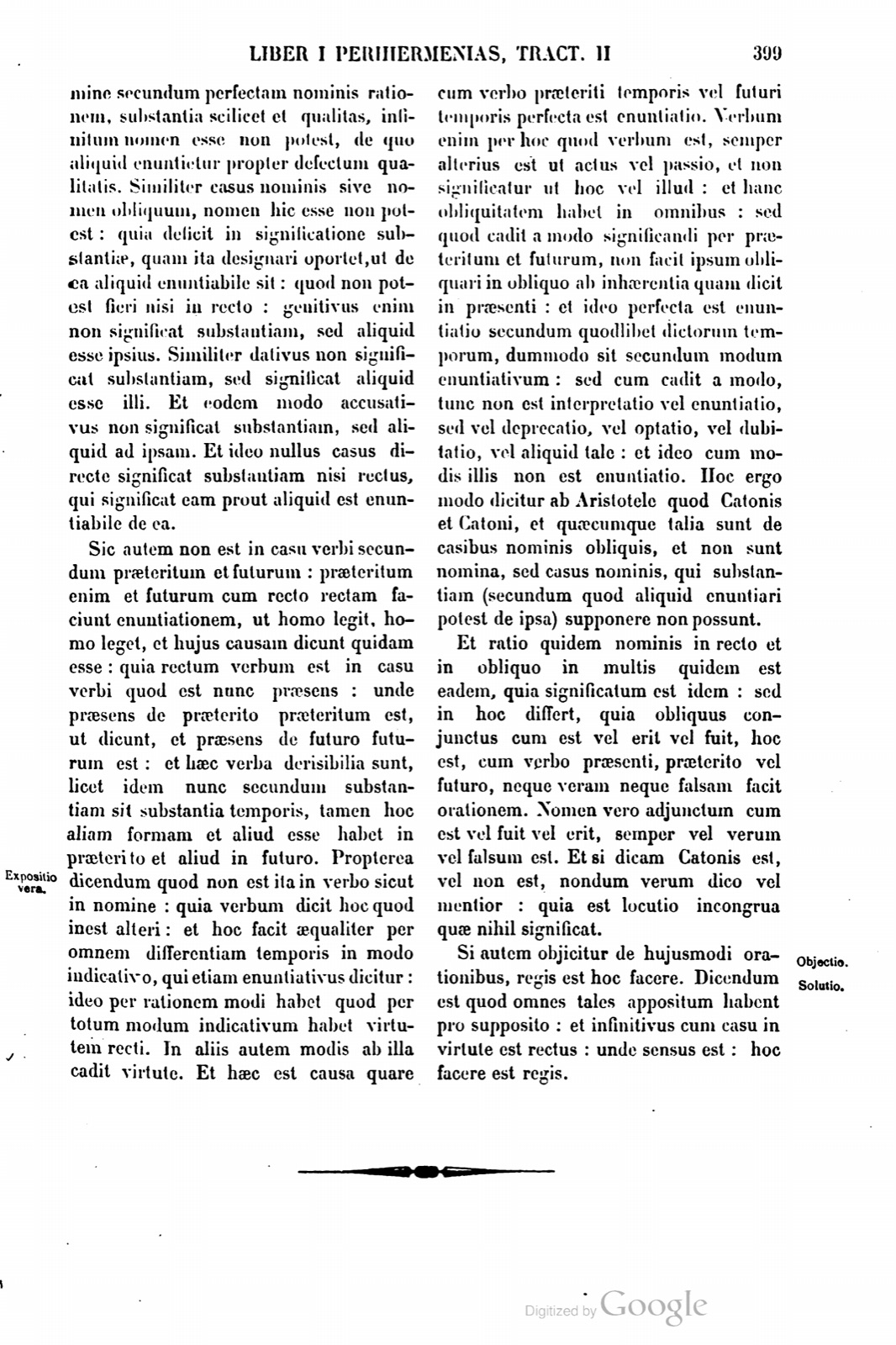
Sic autem non est in casu verbi secundum praeteritum et futurum: praeteritum enim et futurum cum recto rectam faciunt enuntiationem, ut homo legit, homo leget, et hujus causam dicunt quidam esse: quia rectum verbum est in casu verbi quod est nunc praesens: unde praesens de praeterito praeteritum est, ut dicunt, et praesens de futuro futurum est: et haec verba derisibilia sunt, licet idem nunc secundum substantiam sit substantia temporis, tamen hoc aliam formam et aliud esse habet in praeterito et aliud in futuro. Propterea dicendum quod non est ita in verbo sicut in nomine: quia verbum dicit hoc quod inest alteri: et hoc facit aequaliter per omnem differentiam temporis in modo indicativo, qui etiam enuntiativus dicitur: ideo per rationem modi habet quod per totum modum indicativum habet virtutem recti. In aliis autem modis ab illa cadit virtute. Et haec est causa quare cum verbo praeteriti temporis vel futuri temporis perfecta est enuntiatio. Verbum enim per hoc quod verbum est, semper alterius est ut actus vel passio, et non significatur ut hoc vel illud: et hanc obliquitatem habet in omnibus: sed quod cadit a modo significandi per praeteritum et futurum, non facit ipsum obliquari in obliquo ab inhaerentia quam dicit in praesenti: et ideo perfecta est enuntiatio secundum quodlibet dictorum temporum, dummodo sit secundum modum enuntiativum: sed cum cadit a modo, tunc non est interpretatio vel enuntiatio, sed vel deprecatio, vel optatio, vel dubitatio, vel aliquid tale: et ideo cum modis illis non est enuntiatio. Hoc ergo modo dicitur ab Aristotele quod Catonis et Catoni, et quaecumque talia sunt de casibus nominis obliquis, et non sunt nomina, sed casus nominis, qui substantiam (secundum quod aliquid enuntiari potest de ipsa) supponere non possunt.
CHAPTER VI. On the case of a noun.
Now we have said in the definition of noun: finite and right. For since there are two things in a noun according to the perfect account of noun, namely substance and quality, an infinite noun cannot be that about which something is enunciated because of the defect of quality. Similarly, a case of a noun, or an oblique noun, cannot be a noun here, because it is deficient in the signification of substance, which must be designated in such a way that something can be enunciated about it; this cannot be done except in the right case. For the genitive does not signify substance, but that something belongs to it. Similarly, the dative does not signify substance, but signifies that something is for it. And in the same way the accusative does not signify substance, but something toward it. Therefore no case directly signifies substance except the nominative, which signifies it according as something is enunciable about it.
But it is not so in the case of a verb according to past and future. For past and future, with a nominative, make a right enunciation, as a human being read, a human being will read. And some say that the cause of this is that a right verb is in the case of the verb which is the present now; whence, as they say, the present from the past is past, and the present from the future is future. And these words are laughable, for although the same now according to substance is the substance of time, nevertheless this has one form and one being in the past and another in the future. Therefore it must be said that it is not so in the verb as in the noun, because the verb says what inheres in another; and it does this equally through every difference of time in the indicative mode, which is also called enunciative. Therefore through the account of mode it has that throughout the whole indicative mode it has the power of the nominative. But in other modes it falls away from that power. And this is the cause why, with a verb of past time or future time, there is a perfect enunciation. For the verb, by the fact that it is a verb, always belongs to another as act or passion, and is not signified as this or that; and it has this obliquity in all cases. But the fact that it falls away from the mode of signifying through past and future does not make it be made oblique in an oblique case away from the inherence which it says in the present. Therefore there is a perfect enunciation according to any of the stated times, provided that it is according to the enunciative mode. But when it falls away from the mode, then it is not interpretation or enunciation, but either deprecation, optation, doubt, or something of this sort; and therefore with those modes there is no enunciation. In this way, therefore, Aristotle says that Cato's and to Cato, and whatever such things are from the oblique cases of a noun, are not nouns, but cases of a noun, which cannot suppose substance according as something can be enunciated about it.
Et ratio quidem nominis in recto et in obliquo in multis quidem est eadem, quia significatum est idem: sed in hoc differt, quia obliquus conjunctus cum est vel erit vel fuit, hoc est, cum verbo praesenti, praeterito vel futuro, neque veram neque falsam facit orationem. Nomen vero adjunctum cum est vel fuit vel erit, semper vel verum vel falsum est. Et si dicam Catonis est, vel non est, nondum verum dico vel mentior: quia est locutio incongrua quae nihil significat.
Si autem objicitur de hujusmodi orationibus, regis est hoc facere. Dicendum est quod omnes tales appositum habent pro supposito: et infinitivus cum casu in virtute est rectus: unde sensus est: hoc facere est regis.
And indeed the account of noun in the nominative and in the oblique is the same in many things, because the signified is the same; but it differs in this, that an oblique joined with is, will be, or was, that is, with a present, past, or future verb, makes neither true nor false speech. But a noun joined with is, was, or will be is always either true or false. And if I say Cato's is, or is not, I do not yet speak truth or lie, because it is incongruous speech which signifies nothing.
But if objection is made concerning speeches of this sort, it belongs to the king to do this, it must be said that all such speeches have what is apposited as supposit; and the infinitive with the case is virtually nominative. Whence the sense is: to do this belongs to the king.
If a page does not appear, its photograph has not been uploaded yet.