Works › On Interpretation, Books I–II
Volume 1 · pp. 397–398
Continuation of Chapter V. What an infinite noun is, and why it is not a noun for the logician.
A marker with ≈ is an approximate page boundary, placed by measure of the text; the page photographs remain the authority. In the paired views, clicking a page marker brings that page into view.
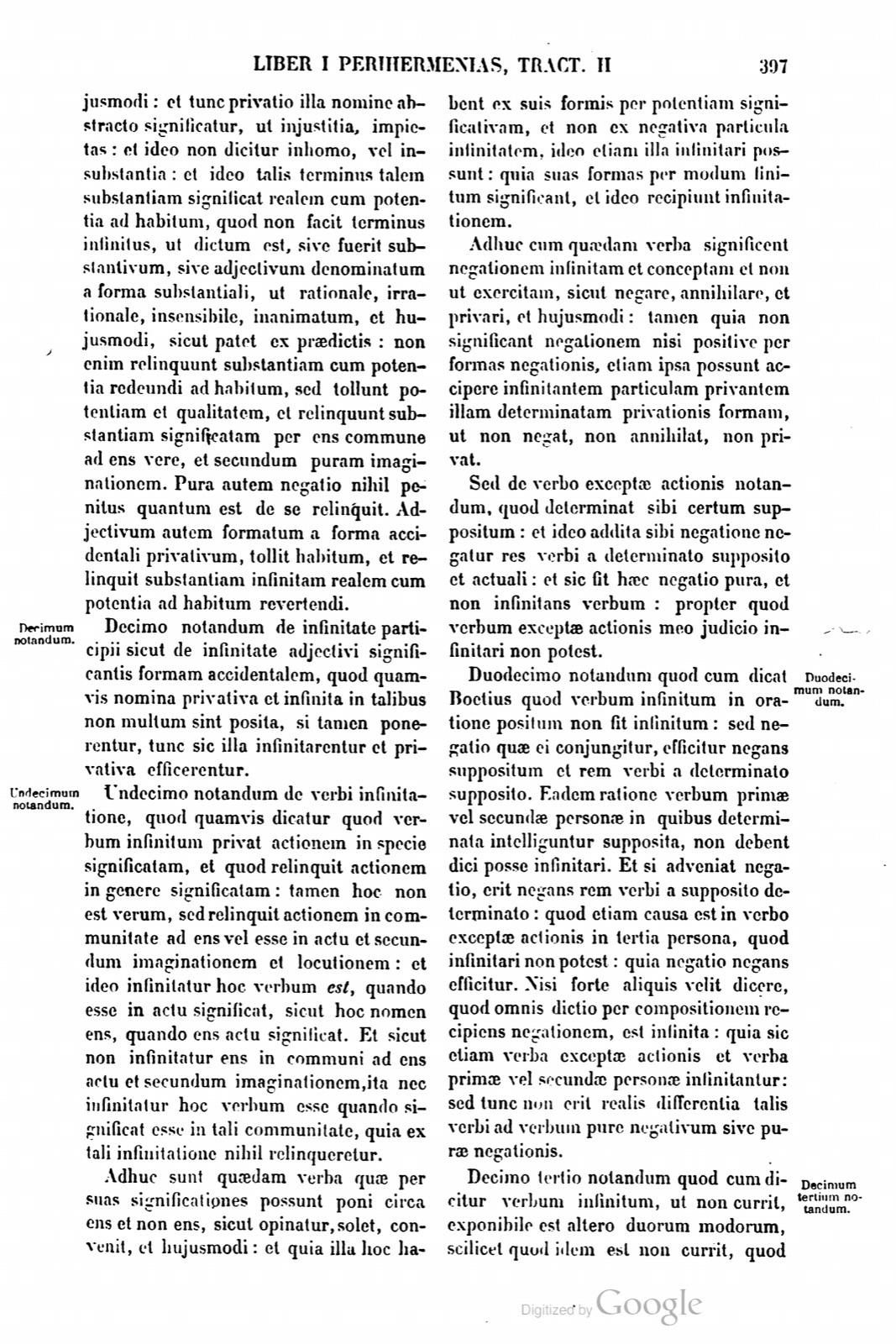
et tunc privatio illa nomine abstracto significatur, ut injustitia, impietas: et ideo non dicitur inhomo, vel insubstantia: et ideo talis terminus talem substantiam significat realem cum potentia ad habitum, quod non facit terminus infinitus, ut dictum est, sive fuerit substantivum, sive adjectivum denominatum a forma substantiali, ut rationale, irrationale, insensibile, inanimatum, et hujusmodi, sicut patet ex praedictis: non enim relinquunt substantiam cum potentia redeundi ad habitum, sed tollunt potentiam et qualitatem, et relinquunt substantiam significatam per ens commune ad ens vere, et secundum puram imaginationem. Pura autem negatio nihil penitus quantum est de se relinquit. Adjectivum autem formatum a forma accidentali privativum, tollit habitum, et relinquit substantiam infinitam realem cum potentia ad habitum revertendi.
Decimo notandum de infinitate participii sicut de infinitate adjectivi significantis formam accidentalem, quod quamvis nomina privativa et infinita in talibus non multum sint posita, si tamen ponerentur, tunc sic illa infinitarentur et privativa efficerentur.
Undecimo notandum de verbi infinitatione, quod quamvis dicatur quod verbum infinitum privat actionem in specie significatam, et quod relinquit actionem in genere significatam: tamen hoc non est verum, sed relinquit actionem in communitate ad ens vel esse in actu et secundum imaginationem et locutionem: et ideo infinitatur hoc verbum est, quando esse in actu significat, sicut hoc nomen ens, quando ens actu significat. Et sicut non infinitatur ens in communi ad ens actu et secundum imaginationem, ita nec infinitatur hoc verbum esse quando significat esse in tali communitate, quia ex tali infinitatione nihil relinqueretur.
Adhuc sunt quaedam verba quae per suas significationes possunt poni circa ens et non ens, sicut opinatur, solet, convenit, et hujusmodi: et quia illa hoc habent ex suis formis per potentiam significativam, et non ex negativa particula infinitatem, ideo etiam illa infinitari possunt: quia suas formas per modum finitum significant, et ideo recipiunt infinitationem.
Adhuc cum quaedam verba significent negationem infinitam et conceptam et non ut exercitam, sicut negare, annihilare, et privari, et hujusmodi: tamen quia non significant negationem nisi positive per formas negationis, etiam ipsa possunt accipere infinitantem particulam privantem illam determinatam privationis formam, ut non negat, non annihilat, non privat.
Sed de verbo exceptae actionis notandum, quod determinat sibi certum suppositum: et ideo addita sibi negatione negatur res verbi a determinato supposito et actuali: et sic fit haec negatio pura, et non infinitans verbum: propter quod verbum exceptae actionis meo judicio infinitari non potest.
Duodecimo notandum quod cum dicat Boetius quod verbum infinitum in oratione positum non fit infinitum: sed negatio quae ei conjungitur, efficitur negans suppositum et rem verbi a determinato supposito. Eadem ratione verbum primae vel secundae personae in quibus determinata intelliguntur supposita, non debent dici posse infinitari. Et si adveniat negatio, erit negans rem verbi a supposito determinato: quod etiam causa est in verbo exceptae actionis in tertia persona, quod infinitari non potest: quia negatio negans efficitur. Nisi forte aliquis velit dicere, quod omnis dictio per compositionem recipiens negationem, est infinita: quia sic etiam verba exceptae actionis et verba primae vel secundae personae infinitantur: sed tunc non erit realis differentia talis verbi ad verbum pure negativum sive purae negationis.
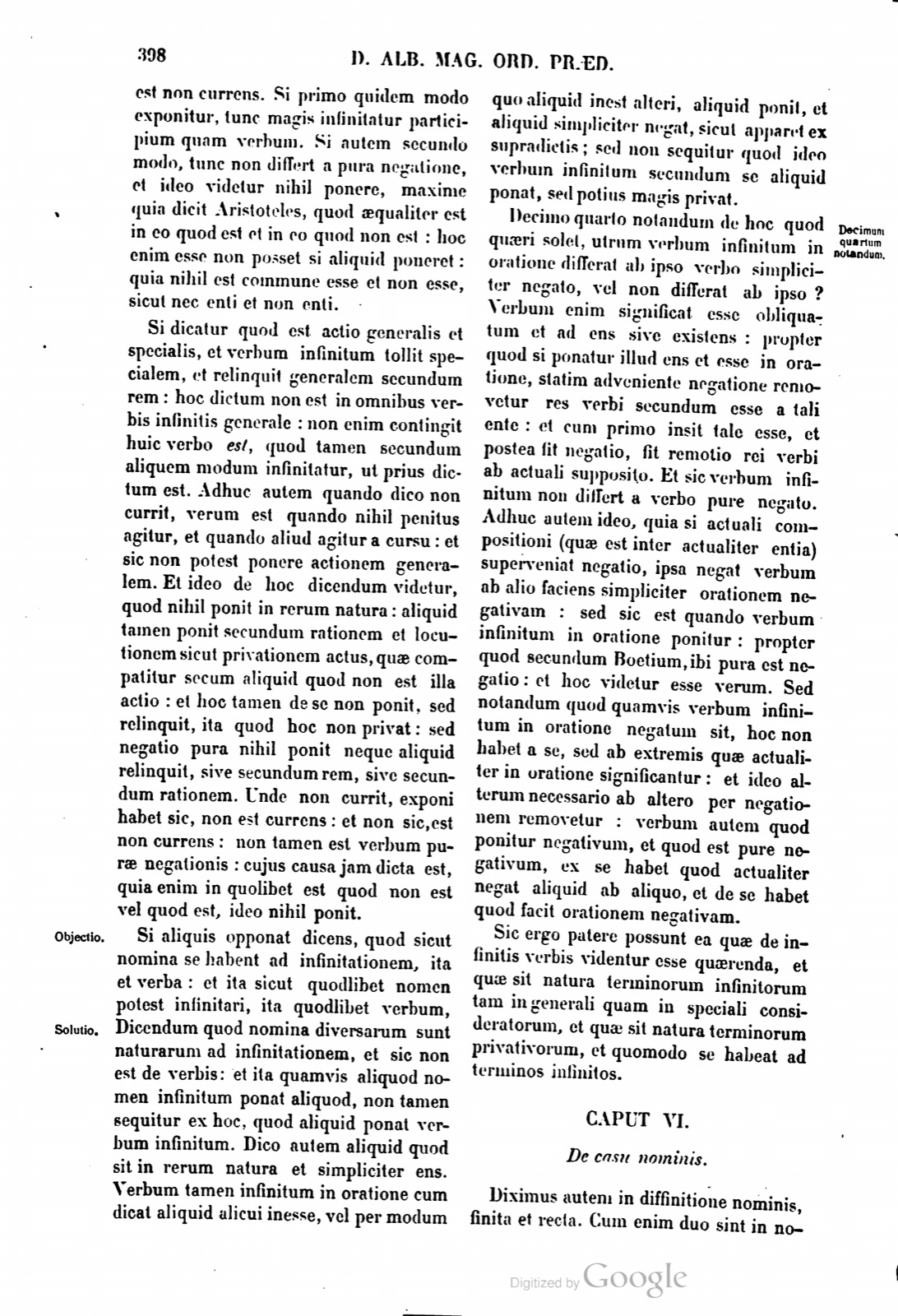
Decimo tertio notandum quod cum dicitur verbum infinitum, ut non currit, exponibile est altero duorum modorum, scilicet quod idem est non currit, quod est non currens. Si primo quidem modo exponitur, tunc magis infinitatur participium quam verbum. Si autem secundo modo, tunc non differt a pura negatione, et ideo videtur nihil ponere, maxime quia dicit Aristoteles, quod aequaliter est in eo quod est et in eo quod non est: hoc enim esse non posset si aliquid poneret: quia nihil est commune esse et non esse, sicut nec enti et non enti.
and then that privation is signified by an abstract name, as injustice, impiety; and therefore inhomo or insubstantia is not said. And therefore such a term signifies such a real substance with a potency toward habit, which an infinite term does not do, as has been said, whether it is substantive or an adjective denominated from a substantial form, such as rational, irrational, insensible, inanimate, and things of this sort, as is clear from the foregoing. For they do not leave substance with a potency of returning to habit, but take away potency and quality, and leave substance signified through being common to true being and according to pure imagination. But pure negation leaves utterly nothing as far as it itself is concerned. But a privative adjective formed from an accidental form takes away the habit and leaves real infinite substance with potency for returning to the habit.
Tenthly it must be noted concerning the infinity of the participle, as concerning the infinity of an adjective signifying an accidental form, that although privative and infinite names in such cases are not much posited, nevertheless, if they were posited, then in this way they would be made infinite and would be made privative.
Eleventhly it must be noted concerning the infinitation of the verb that, although it is said that an infinite verb deprives the action signified in species and leaves the action signified in genus, nevertheless this is not true. Rather, it leaves action in commonality to being or to-be in act and according to imagination and speech. Therefore this verb is is made infinite when it signifies to-be in act, just as this noun being is made infinite when it signifies being in act. And just as being is not made infinite as common to being in act and according to imagination, so neither is this verb to be made infinite when it signifies to-be in such commonality, because from such infinitation nothing would be left.
Again, there are certain verbs which through their significations can be posited around being and non-being, such as it is opined, it is accustomed, it is fitting, and things of this sort; and because those have this infinity from their forms through significative power, and not from the negative particle, therefore those too can be made infinite, because they signify their forms in a finite mode and therefore receive infinitation.
Again, although certain verbs signify infinite and conceived negation, and not negation as exercised, such as to deny, to annihilate, to be deprived, and things of this sort, nevertheless because they do not signify negation except positively through forms of negation, they too can receive an infinitating particle depriving that determinate form of privation, as does not deny, does not annihilate, does not deprive.
But concerning a verb of exceptional action it must be noted that it determines for itself a definite supposit; and therefore when negation is added to it, the thing of the verb is denied of a determinate and actual supposit; and thus this negation becomes pure and does not infinitate the verb. For this reason, in my judgment, a verb of exceptional action cannot be made infinite.
Twelfthly it must be noted that when Boethius says that an infinite verb posited in speech does not become infinite, but the negation which is joined to it becomes a negation denying the supposit and the thing of the verb from a determinate supposit, by the same reason verbs of the first or second person, in which determinate supposits are understood, ought not to be said to be able to be made infinite. And if negation comes upon them, it will be negating the thing of the verb from a determinate supposit. This also is the cause in a verb of exceptional action in the third person, that it cannot be made infinite, because the negation becomes a denying negation. Unless perhaps someone should wish to say that every diction receiving negation through composition is infinite; because in this way even verbs of exceptional action and verbs of the first or second person are made infinite. But then there will be no real difference of such a verb from a purely negative verb or a verb of pure negation.
Thirteenthly it must be noted that when an infinite verb is said, such as does not run, it can be expounded in one of two ways, namely that does not run is the same as not-running. If it is expounded in the first way, then the participle is made infinite more than the verb. But if in the second way, then it does not differ from pure negation, and therefore it seems to posit nothing, especially because Aristotle says that it is equally in what is and in what is not; for this could not be if it posited something, because nothing is common to to-be and not-to-be, just as nothing is common to being and non-being.
Si dicatur quod est actio generalis et specialis, et verbum infinitum tollit specialem, et relinquit generalem secundum rem: hoc dictum non est in omnibus verbis infinitis generale: non enim contingit huic verbo est, quod tamen secundum aliquem modum infinitatur, ut prius dictum est. Adhuc autem quando dico non currit, verum est quando nihil penitus agitur, et quando aliud agitur a cursu: et sic non potest ponere actionem generalem. Et ideo de hoc dicendum videtur, quod nihil ponit in rerum natura: aliquid tamen ponit secundum rationem et locutionem sicut privationem actus, quae compatitur secum aliquid quod non est illa actio: et hoc tamen de se non ponit, sed relinquit, ita quod hoc non privat: sed negatio pura nihil ponit neque aliquid relinquit, sive secundum rem, sive secundum rationem. Unde non currit, exponi habet sic, non est currens: et non sic, est non currens: non tamen est verbum purae negationis: cujus causa jam dicta est, quia enim in quolibet est quod non est vel quod est, ideo nihil ponit.
Si aliquis opponat dicens, quod sicut nomina se habent ad infinitationem, ita et verba: et ita sicut quodlibet nomen potest infinitari, ita quodlibet verbum. Dicendum quod nomina diversarum sunt naturarum ad infinitationem, et sic non est de verbis: et ita quamvis aliquod nomen infinitum ponat aliquid, non tamen sequitur ex hoc, quod aliquid ponat verbum infinitum. Dico autem aliquid quod sit in rerum natura et simpliciter ens. Verbum tamen infinitum in oratione cum dicat aliquid alicui inesse, vel per modum quo aliquid inest alteri, aliquid ponit, et aliquid simpliciter negat, sicut apparet ex supradictis; sed non sequitur quod ideo verbum infinitum secundum se aliquid ponat, sed potius magis privat.
Decimo quarto notandum de hoc quod quaeri solet, utrum verbum infinitum in oratione differat ab ipso verbo simpliciter negato, vel non differat ab ipso? Verbum enim significat esse obliquatum et ad ens sive existens: propter quod si ponatur illud ens et esse in oratione, statim adveniente negatione removetur res verbi secundum esse a tali ente: et cum primo insit tale esse, et postea fit negatio, fit remotio rei verbi ab actuali supposito. Et sic verbum infinitum non differt a verbo pure negato. Adhuc autem ideo, quia si actuali compositioni (quae est inter actualiter entia) superveniat negatio, ipsa negat verbum ab alio faciens simpliciter orationem negativam: sed sic est quando verbum infinitum in oratione ponitur: propter quod secundum Boetium, ibi pura est negatio: et hoc videtur esse verum. Sed notandum quod quamvis verbum infinitum in oratione negatum sit, hoc non habet a se, sed ab extremis quae actualiter in oratione significantur: et ideo alterum necessario ab altero per negationem removetur: verbum autem quod ponitur negativum, et quod est pure negativum, ex se habet quod actualiter negat aliquid ab aliquo, et de se habet quod facit orationem negativam.
Sic ergo patere possunt ea quae de infinitis verbis videntur esse quaerenda, et quae sit natura terminorum infinitorum tam in generali quam in speciali consideratorum, et quae sit natura terminorum privativorum, et quomodo se habeat ad terminos infinitos.
If it is said that there is general and special action, and that the infinite verb takes away the special and leaves the general according to reality, this saying is not general in all infinite verbs. For it does not apply to this verb is, which nevertheless is made infinite according to some mode, as was said before. Again, when I say does not run, it is true when absolutely nothing is being done and when something other than running is being done; and thus it cannot posit general action. Therefore about this it seems that one must say that it posits nothing in the nature of things. Yet it posits something according to reason and speech, as a privation of act, which is compatible with something that is not that action; and yet this of itself does not posit that thing, but leaves it, in such a way that this does not deprive it. But pure negation posits nothing and leaves nothing, whether according to reality or according to reason. Whence does not run must be expounded thus, is not running, and not thus, is not-running. Yet it is not a verb of pure negation; the cause of this has already been stated, for because in anything there is what it is not or what it is, therefore it posits nothing.
If someone opposes this, saying that as nouns are related to infinitation, so too are verbs, and thus, just as any noun can be made infinite, so any verb can be made infinite, it must be said that nouns are of diverse natures with respect to infinitation, and it is not so with verbs. Thus, although some infinite noun posits something, nevertheless it does not follow from this that an infinite verb posits something. By something I mean something which is in the nature of things and is being simply. Yet an infinite verb in speech, since it says that something inheres in something, or through the mode by which something inheres in another, posits something and simply denies something, as is clear from what has been said above. But it does not follow that for this reason an infinite verb according to itself posits something; rather, it more deprives.
Fourteenthly it must be noted concerning what is customarily asked, whether an infinite verb in speech differs from that same verb simply denied, or does not differ from it. For a verb signifies to-be obliquely and toward being or an existing thing. On account of this, if that being and to-be are posited in speech, as soon as negation comes upon it, the thing of the verb according to being is removed from such a being. And since first such being inheres, and afterward negation occurs, a removal of the thing of the verb from an actual supposit is made. And thus the infinite verb does not differ from the purely denied verb. Again, this is also because if negation comes upon an actual composition, which is between things actually being, it denies the verb from another, simply making negative speech; but this is the case when an infinite verb is posited in speech. For this reason, according to Boethius, there is pure negation there; and this seems to be true. But it must be noted that, although the infinite verb in speech has been denied, it does not have this from itself, but from the extremes which are actually signified in speech; and therefore one is necessarily removed from the other through negation. But the verb which is posited as negative and is purely negative has from itself that it actually denies something of something, and from itself has that it makes negative speech.
Thus, therefore, those things which seem to have to be asked concerning infinite verbs can be clear, and what the nature of infinite terms is, considered both generally and specially, and what the nature of privative terms is, and how it is related to infinite terms.
If a page does not appear, its photograph has not been uploaded yet.