Works › On Interpretation, Books I–II
Volume 1 · pp. 391–396
Chapter V. What an infinite noun is, and why it is not a noun for the logician.
A marker with ≈ is an approximate page boundary, placed by measure of the text; the page photographs remain the authority. In the paired views, clicking a page marker brings that page into view.
CAPUT V. Quid sit nomen infinitum, et quare non est nomen apud logicum.
Visa autem sic diffinitione nominis posita et exposita, patet quod secundum hanc diffinitionem nomen infinitum non est nomen. Quia nomen significat substantiam cum qualitate, et nisi hoc modo significet, de ipso nihil certum posset enuntiari: propter quod quia nomen infinitum deficit in hoc quod non est finitae qualitatis, et de quo aliquid enuntiari potest, patet quod nomen infinitum non perfectam habet nominis rationem, quia non est finitae qualitatis: ideo dicimus quod non homo, quod est nomen infinitum, non est nomen secundum perfectam rationem nominis. Sed tamen quamvis nomen non est etiam alia pars orationis: et ideo nomen infinitum cadit a perfecta ratione nominis, et non est alia pars orationis, et non est ei nomen impositum, quo illud appellari oporteat in partibus orationis. Ideo, si placet, vocetur nomen infinitum, ut et habeat rationem nominis quoad modum grammaticae, et quoad dialecticum extra perfectam rationem nominis extrahatur. Hoc ergo modo dicitur nomen non simpliciter, sed nomen infinitum. Non enim simpliciter negatio est, quia negatio nihil relinquit: nec etiam oratio, quia negatio cum dicitur non homo, per compositionem adjungitur ei quod est homo, et una dictio est non homo, et non oratio: et ideo cum perfectam rationem nominis non habeat, fit secundum nostram institutionem nomen infinitum.
De hoc autem nomine infinito multae sunt dubitationes. Et inter eas prima est, per quid negatio nomini per compositionem possit adjungi? Sed ad hoc statim prompta est responsio: quia sicut in verbo quolibet praedicato intelligitur nota compositionis, quae est est, sicut cum dico, homo currit, sensus est, homo est currens: ita in nomine quod subjicitur, intelligitur ens, sicut cum dico, homo currit, sensus est, homo ens vel existens currit, et ratione hujus potest ei addi negatio quae facit nomen infinitum.
Si autem quaeratur per quid differt nomen infinitum in logicis, a nomine infinito quod vocatur infinitum in grammaticis? Dicendum quod in grammaticis nomen est infinitum, ut quis, et qualis, quod ab omni determinato numero finitum est, ut quis vel qualis duorum vel trium vel quatuor, et sic de quolibet alio. Nomen autem infinitum in logicis est illud, cujus privata est determinata qualitas, et relicta substantia infinita, quae substantia infinita supponitur per hoc quod dico ens: unde non homo est ens non habens formam humanitatis.
Et ideo quaeritur cum non homo sit nomen, nomen autem infinitum ad aliam partem orationis reduci non potest nisi ad nomen, quid habeat pro substantia, et quid habeat pro qualitate? Dicendum quod substantiam habet indeterminatam et infinitam, et privationem qualitatis habet pro qualitate: et hoc sufficit apud grammaticum, ad hoc quod aliquid sit nomen, quamvis apud logicum non sufficiat ad perfectam nominis rationem. Et cum dicitur, quod nomen infinitum significat substantiam infinitam, non oportet quod illa substantia sit aliquid in rerum natura, sed sufficit quod sit aliquid in apprehensione vel dictione, secundum quod dicimus, quod chimaera est aliquid, et privationes et negationes sunt aliquid, per hoc quod aliquid habent in apprehensione: hoc enim modo substantia dicitur infinita, quia ad nullam formam entis finita est.
Propter quod quaeritur utrum nomen infinitum aliquid ponat, aut non? Et dicunt quidam, quod ponit aliquid, ad hoc adducentes rationes: quia Aristoteles dicit in fine Priorum, quod differt dicere, est non aequale, et non est aequale: quia negatio non est aequale, nihil ponit: terminus autem infinitus non aequale, ponit aliquid.
Secundo dicunt et inducunt hoc quod communiter dicitur et verum est, quod differt negatio ab infinitivo et privativo: negatio enim cum sit extra genus, nihil ponit. Infinitum autem cum sit negatio in genere et communitate entis, aliquid ponit, scilicet ens infinitum. Privatio etiam in genere est, et ponit subjectum cum aptitudine et dispositione ad habitum, ut caecum. Ex quo accipitur quod infinitum aliquid ponit.
CHAPTER V. What an infinite noun is, and why it is not a noun for the logician.
Once the definition of noun, thus posited and expounded, has been seen, it is clear that according to this definition an infinite noun is not a noun. Because a noun signifies substance with quality, and unless it signifies in this way, nothing certain could be enunciated about it. Therefore, because an infinite noun is deficient in this, that it is not of finite quality and something cannot be enunciated about it, it is clear that an infinite noun does not have the perfect account of noun, because it is not of finite quality. Therefore we say that non-human, which is an infinite noun, is not a noun according to the perfect account of noun. Yet nevertheless, although it is not a noun, it is also not another part of speech; and therefore the infinite noun falls away from the perfect account of noun, and is not another part of speech, and no name has been imposed on it by which it ought to be called among the parts of speech. Therefore, if it pleases, let it be called an infinite noun, so that it may both have the account of noun with respect to the mode of grammar, and with respect to dialectic may be drawn outside the perfect account of noun. In this way, then, it is called not a noun simply, but an infinite noun. For it is not simply a negation, because negation leaves nothing; nor is it speech, because when non-human is said, the negation is joined by composition to what is human, and non-human is one diction and not speech. Therefore, since it does not have the perfect account of noun, according to our institution it becomes an infinite noun.
But there are many doubts about this infinite noun. And among them the first is: by what can negation be joined to a noun through composition? But to this the response is immediately ready: because just as in any predicated verb there is understood the note of composition, which is “is,” as when I say “a human being runs,” the sense is “a human being is running,” so in the noun which is subjected there is understood being, as when I say “a human being runs,” the sense is “a human being, being or existing, runs”; and by reason of this, negation can be added to it which makes an infinite noun.
But if it is asked by what the infinite noun in logic differs from the infinite noun which is called infinite in grammar, it must be said that in grammar a noun is infinite, such as “who” and “of what quality,” because it is bounded away from every determinate number, as who or what sort of two, three, four, and so concerning any other. But the infinite noun in logic is that whose determinate quality has been deprived, with infinite substance left, which infinite substance is supposed through this which I say, being; whence non-human is a being not having the form of humanity.
And therefore, since non-human is a noun, while an infinite noun cannot be reduced to any other part of speech except to noun, one asks what it has for substance and what it has for quality. It must be said that it has indeterminate and infinite substance, and it has privation of quality for quality. This suffices for the grammarian, in order that something be a noun, although for the logician it does not suffice for the perfect account of noun. And when it is said that the infinite noun signifies infinite substance, it is not necessary that that substance be something in the nature of things, but it suffices that it be something in apprehension or diction, according as we say that a chimera is something, and privations and negations are something, through the fact that they have something in apprehension. For in this way substance is called infinite, because it is not bounded to any form of being.
On this account it is asked whether an infinite noun posits something or not. And some say that it posits something, bringing forward reasons for this: because Aristotle says at the end of the Prior Analytics that it differs to say “is not equal” and “is not equal” with the negation outside; because the negation “is not equal” posits nothing, but the infinite term “not-equal” posits something.
Secondly, they say and introduce what is commonly said and is true, namely that negation differs from the infinitive and privative: for negation, since it is outside the genus, posits nothing. But the infinite, since it is negation in the genus and community of being, posits something, namely infinite being. Privation also is in a genus, and posits a subject with aptitude and disposition toward habit, as “blind.” From this it is received that the infinite posits something.
Si autem hoc concedatur, videbitur contrarium per hoc quod omnis nominis impositio est a forma, sicut hoc nomen homo, a forma impositum est. Ab eadem forma imponitur et nomen habitus, et nomen privationis habitus ejusdem: cum ergo dicitur non homo, illud nomen etiam imponitur ab hominis forma. Sed differentia est in hoc, quod unum imponitur ab ipsa forma secundum se: alterum a privatione formae ejusdem. Si autem hoc nomen homo, a forma secundum se imponatur, ubicumque invenitur haec forma homo, illud est homo, et de illo enuntiatur quod homo est. Et ab opposito ubicumque invenitur privatio non homo, de illo enuntiatur quod est non homo. Non homo enim invenitur et in ente et in non ente aequaliter: non ens est non homo, et ens diversum ab homine, est non homo: ergo non homo aequaliter dicitur de ente et de non ente: ergo neutrum determinat. Et si non determinat nec ens, nec non ens, nihil ponit: ergo non homo nihil ponit.
Adhuc autem si unum nomen potest esse infinitum, quod aliquid ponat: tunc omne nomen potest esse infinitum, ita quod aliquid ponat: quia una, et eadem ratio est de uno et de omni nomine: sed ens est nomen: si ergo infinitetur ut dicatur non ens, aliquid ponet non ens secundum quod est nomen infinitum: ponet ergo aliquid quod est non entis: ergo est aliquid commune enti et non enti: nihil autem est commune enti et non enti: ergo nihil ponit penitus: vel relinquitur, quod sit non ens in rerum natura.
Adhuc autem cum dico, homo, dico formam: et cum dico hic homo, dico formam in hac materia: et in talibus idem est esse hominis et hujus hominis, sicut est idem esse universalis et particularis in quo est universale: sed universale in quo est, et particulare est id quod est: sublato ergo universali quod est in particulari, necesse est quod particulare secundum id quod est ab universali auferatur. Cum autem dicitur non homo, aufertur homo quo hic homo est hic homo: ergo et aufertur hic homo, et sic non remanente homine non remanet hic homo: ergo cum dico non homo nec ponitur universale nec particulare: et omne quod est aut est universale aut particulare alicujus naturae: videtur ergo quod non homo nihil ponat quod alicujus naturae sit.
Adhuc autem logice objicitur, quod si non homo aliquid ponat, cum haec propositio sit vera, omnis homo est animal, erit haec vera per conversionem per contrapositionem factam, omne non animal est non homo: et lapis est non animal: ergo lapis est non homo: ergo a primo si omnis homo est animal, lapis est non homo, et est aliquid quod non sequitur: et ideo cum consequentia ista sequitur, si non homo aliquid ponat: ergo videtur, quod non homo nihil ponit.
Ad haec autem et consimilia dici consuevit communiter et bene satis convenienter, quod est differentia in nominibus infinitis. Aut enim sunt substantiva, aut adjectiva. In substantivis quidem nomen nihil ponit quod est infinitum, propter hoc quod qualitas illius nominis quando privatur, privatur et ipsum quod est determinatum qualitate illa: et sic ablata qualitate qua est, privatur et ipsa substantia secundum id quod est. Et quia nomen infinitum privat qualitatem, privat etiam substantiam secundum id quod est, et sic nihil ponit quod in rerum natura sit. Et si dicitur quod relinquit substantiam infinitam, dicendum quod illam non relinquit nisi sub apprehensione, secundum quod supponitur per hoc nomen ens infinitum, et secundum hoc non est in rerum natura. In adjectivis autem quae qualitatem habent finitam, et substantiam habent infinitam, negata qualitate non necessario negatur substantia secundum id quod est, et ideo in talibus aliquid ponit. Unde cum dicitur non aequale, vel non simile, sensus est, ens quod non est aequale, et ens quod non est simile. Et de talibus infinitis loquitur Aristoteles in fine Priorum, sed non de substantivis infinitis. Sic ergo aliquando aliquid ponit, sicut in adjectivis, et aliquando nihil ponit, sicut in substantivis: et sic videtur infinitum nomen commune esse enti et non enti, quod non est inconveniens hoc modo quo infinitum est commune enti et non enti: quia licet aliquando relinquat ens, non tamen relinquit ens quod sit aliquid in rerum natura. Ex hoc patet qualiter facit negationem in genere entis et cujusmodi entis.
But if this is granted, the contrary will seem to follow from this, that every imposition of a noun is from form, as this noun human is imposed from a form. From the same form both the name of a habit and the name of the privation of that same habit are imposed; therefore, when non-human is said, that name is also imposed from the form of human being. But the difference is in this: one is imposed from the form itself according to itself; the other from the privation of that same form. But if this noun human is imposed from the form according to itself, wherever this form human is found, that thing is human, and it is enunciated of it that it is human. And oppositely, wherever the privation non-human is found, it is enunciated of that that it is non-human. For non-human is found equally in being and in non-being: non-being is non-human, and being diverse from human being is non-human; therefore non-human is said equally of being and non-being; therefore it determines neither. And if it determines neither being nor non-being, it posits nothing; therefore non-human posits nothing.
Again, if one noun can be infinite in such a way that it posits something, then every noun can be infinite in such a way that it posits something, because there is one and the same account of one noun and of every noun. But being is a noun; therefore if it is made infinite so that non-being is said, non-being will posit something according as it is an infinite noun; therefore it will posit something which belongs to non-being; therefore there is something common to being and non-being. But nothing is common to being and non-being; therefore it posits utterly nothing, or it remains that there is non-being in the nature of things.
Again, when I say human, I say a form; and when I say this human, I say a form in this matter. And in such things the being of human and of this human is the same, just as the being of the universal and of the particular in which the universal is is the same. But the universal in which it is, and the particular, is what it is; therefore, when the universal which is in the particular has been removed, it is necessary that the particular according to what it is be taken away from the universal. But when non-human is said, human is taken away, by which this human is this human; therefore this human is also taken away, and thus, when human does not remain, this human does not remain. Therefore when I say non-human, neither universal nor particular is posited; and everything that is is either universal or particular of some nature. Therefore it seems that non-human posits nothing which is of any nature.
Again it is objected logically that, if non-human posits something, since this proposition is true, “every human being is an animal,” this will be true by conversion made through contraposition, “every non-animal is non-human”; and a stone is a non-animal; therefore a stone is non-human; therefore from the first, if every human being is an animal, a stone is non-human, and it is something which does not follow. And therefore, since that consequence follows if non-human posits something, it seems that non-human posits nothing.
To these and similar points it is commonly and quite suitably customary to say that there is a difference among infinite nouns. For they are either substantives or adjectives. In substantives, indeed, the noun which is infinite posits nothing, because when the quality of that noun is deprived, the very thing which is determined by that quality is also deprived; and thus, when the quality by which it is has been removed, the substance itself according to what it is is deprived. And because the infinite noun deprives quality, it also deprives substance according to what it is, and thus posits nothing which is in the nature of things. And if it is said that it leaves infinite substance, it must be said that it leaves that only under apprehension, according as it is supposed through this name infinite being, and according to this it is not in the nature of things. But in adjectives, which have finite quality and infinite substance, when quality has been denied, substance according to what it is is not necessarily denied, and therefore in such cases it posits something. Whence when non-equal or non-similar is said, the sense is a being which is not equal, and a being which is not similar. Aristotle speaks about such infinites at the end of the Prior Analytics, but not about substantive infinites. Thus, therefore, sometimes it posits something, as in adjectives, and sometimes it posits nothing, as in substantives; and thus the infinite noun seems to be common to being and non-being, which is not unfitting in that mode in which the infinite is common to being and non-being, because although it sometimes leaves being, nevertheless it does not leave being which is something in the nature of things. From this it is clear how it makes negation in the genus of being and what sort of being.
Sed tunc quaeritur, cum (quando dicitur nullus et neuter) negatio veniat in nominis compositionem, sicut quando dicitur non homo, qualiter in uno facit terminum infinitum, et non in alio? Hoc autem solvere non est difficile: quia cum dicitur nullus, neuter, distributio quae importatur per signum distributivum, dividit supposita subjecti in comparationem ad praedicatum: et ideo negat praedicatum a partibus subjecti, et non negat qualitatem subjecti: et ideo non facit nomen infinitum. Cum autem dicitur non homo, negatur qualitas nominis in seipso. Propterea nomen infinitum est non homo. Sic ergo patet quod nomen infinitum privat qualitatem, et relinquit substantiam infinitam, quae supponitur per hoc nomen ens infinitum: secundum quod cadit sub apprehensione et locutione quod non est ens in natura: sicut dicimus quod idem est ens aliquo modo circa quod est intellectus, et de quo est locutio: et sic aliquando affirmatio entis negationi similis est, sicut cum dico, videns tenebras: videtur enim ibi esse affirmatio visionis. Cum autem consideratur quod tenebrae nihil sunt, scitur quod videns tenebras nihil videt: et nihil videns non videt: et sic videns tenebras, non videt: ideo cum dicitur non homo, intelligendo non hominem (cum non homo nihil ponat), nihil intelligit.
Sed attende quod licet nomen infinitum nihil ponat et nihil significet, non tamen est vox non significativa, ut bu ba baf: quia vox non significativa, non excitat intellectum ad aliquid de aliquo intelligendum, sed non homo excitat ad intelligendum de hoc quod est privatae qualitatis, quod tamen in rerum natura nihil est, quamvis sit in apprehensione: et hoc modo opinio est circa id quod est in apprehensione tantum. Et est simile sicut quando dicimus innominabile, hoc nihil est, et tamen prout cadit in apprehensione per suum oppositum quod est nominabile, ad aliquid excitat intellectum. Hoc modo apparet qualiter aliquid ponit, et qualiter nihil ponit nomen infinitum.
Attendendum tamen est quod nomina transcendentia infinitari non possunt, sicut res, ens, et aliquid: quia ablata qualitate istorum nominum cum infinita sint, non potest relinqui etiam secundum apprehensionem substantia infinita: propterea infinitari non possunt. Ad hoc enim quod aliquod nomen infinitetur, oportet quod habeat qualitatem determinatam quam non habent res ens et aliquid. Oportet etiam quod habeant ordinatam qualitatem ad substantiam finiendam et determinandam: et ideo omnis et quilibet et nullus et nemo infinitari non possunt, quia hujusmodi qualitatem non habent. Oportet etiam quod non fuerit ante infinitum: et ideo partes indeclinabiles, ut conjunctio, praepositio, et hujusmodi, infinitari non possunt, quia casu infinitarentur: quia ex seipsis infinita sunt. Et ideo etiam adjectivum quoad substantiam quam habet infinitam, non infinitatur per ablationem qualitatis, sed remanet substantia infinita, de qua tollitur qualitas: propter quod infinitatio talis aequipollet negationi.
But then it is asked, since, when nullus and neuter are said, negation comes into the composition of a noun, just as when non-human is said, how does it make an infinite term in one case and not in the other? This is not difficult to solve: because when nullus or neuter is said, the distribution which is implied by the distributive sign divides the supposits of the subject in comparison to the predicate; and therefore it denies the predicate from the parts of the subject, and does not deny the quality of the subject; and therefore it does not make an infinite noun. But when non-human is said, the quality of the noun in itself is denied. For this reason non-human is an infinite noun. Thus it is clear that the infinite noun deprives quality and leaves infinite substance, which is supposed through this name infinite being, according as it falls under apprehension and speech, because it is not being in nature; as we say that somehow the same thing is being around which there is understanding and about which there is speech. And thus sometimes an affirmation of being is similar to a negation, as when I say “seeing darknesses,” for there seems there to be an affirmation of vision. But when it is considered that darknesses are nothing, it is known that one seeing darknesses sees nothing; and one seeing nothing does not see; and thus one seeing darknesses does not see. Therefore, when non-human is said, by understanding non-human, since non-human posits nothing, one understands nothing.
But attend that although an infinite noun posits nothing and signifies nothing, nevertheless it is not a non-significative vocal sound, like bu ba baf, because a non-significative vocal sound does not stir the intellect to understand something about something; but non-human stirs it to understand concerning that which has deprived quality, which nevertheless is nothing in the nature of things, although it is in apprehension. And in this way opinion concerns that which is only in apprehension. And it is similar to when we say “unnameable”: this is nothing, and yet, insofar as it falls into apprehension through its opposite, which is nameable, it stirs the intellect toward something. In this way it appears how an infinite noun posits something and how it posits nothing.
Nevertheless it must be attended that transcendent names cannot be made infinite, such as thing, being, and something, because when the quality of those names is removed, since they are infinite, no infinite substance can be left even according to apprehension; for this reason they cannot be made infinite. For in order that some name be made infinite, it must have a determinate quality, which thing, being, and something do not have. It must also have a quality ordered to bounding and determining substance; and therefore every, any, no, and no one cannot be made infinite, because they do not have a quality of this sort. It must also not have been infinite beforehand; and therefore indeclinable parts, such as conjunction, preposition, and things of this sort, cannot be made infinite, because they would be made infinite only by case, since of themselves they are infinite. Therefore also an adjective, with respect to the substance which it has as infinite, is not made infinite by the removal of quality, but infinite substance remains, from which quality is taken away; on account of this such infinitation is equivalent to negation.
Attendendum etiam quod nomen finitum determinatae et circumscriptae est significationis: et per hoc quod infinitatur, efficitur incircumscriptae significationis, quae nec ad ens, nec ad non ens finiri potest: et haec est praecipue causa, quod nihil ponit nomen infinitum.
Et adhuc notandum est quod cum dicitur quod nomen significat substantiam cum qualitate, substantia nominis est id quod est et quod supponitur in nomine: qualitas autem est id quo est id quod est: quae in pluribus non sunt accipienda in abstracto, sed in concreto, sicut si dicamus, quod homo est quo id quod est homo, est homo: et sic apparet quod ablata qualitate ista quae dicitur per hoc nomen homo, non remanet homo id quod est homo, et per consequens nihil relinquitur positum de homine: quia quidquid ponitur per finitum, cum dicitur homo, tollitur per infinitum cum dicitur non homo. Et cum dicitur quod non homo est ens non homo, sicut ante diximus, illud ens non est rei vel naturae, sed ens in apprehensione animae: et hoc non est aliquid vel ens simpliciter, sed est ens in opinione, de quo ratiocinari et loqui possumus, sicut in ante habitis dictum est.
Ad habendum perfectam notitiam partium infinitarum, sciendum primo de infinitatione terminorum, et praecipue nominis et verbi, quod negatio est tollens verbi vel nominis formam, et relinquens substantiam quae est in hoc communi quod est ens, secundum quod ipsum est commune ad ens secundum naturam, et ens rationis vel in ratione vel in dictione significativa quocumque modo: hoc enim ens est infinitum, hoc est, ad nullam certam formam determinatum, quamvis per negationem tollatur significatio, et per consequens finitas quae primo fuit: tamen per appositionem negationis quae pro forma additur supra substantiam infinitam, generatur alia dictio quae est nomen vel verbum infinitum, et hoc pro forma vel qualitate habet ipsam privationem, et sic significat substantiam cum qualitate. Et similiter verbum quod significat esse et agere, privationem in agere significatam pro esse habet et agere, et dicitur nomen infinitum et verbum infinitum.
Secundo notandum quod quamvis una negatio possit negare duas compositiones, ut cum dicitur, non qui currit movetur: hoc tamen non facit negatio nisi sit libera non cadens in compositionem alicujus partis in illa oratione positae, et nisi secunda compositio sit determinatio alicujus partis primae compositionis: negatio autem infinitans cadit in compositionem termini infiniti, et ideo extra illum nihil negat: et ideo negatio illa simul duas dictiones infinitare non potest, ut cum dicitur, non homo albus, vel non lignum album: quamvis enim neget duas compositiones praedicati ad subjectum, istae compositiones dicunt esse et non entis compositionem. Entis enim compositio duplex est. Una quidem ex substantialibus forma et materia: alia ex accidente et substantia, quae est adjectivi cum subjecto, et illam tollit infinitans negatio: et ideo conjuncta cum termino accidentalis compositionis, nihil extra illam respicere potest: sed libera existens negatio ad utramque partem compositionis esse, quae est ex praedicato et subjecto, et determinatione partis illius compositionis simul, ita quod unam per alteram negare potest.
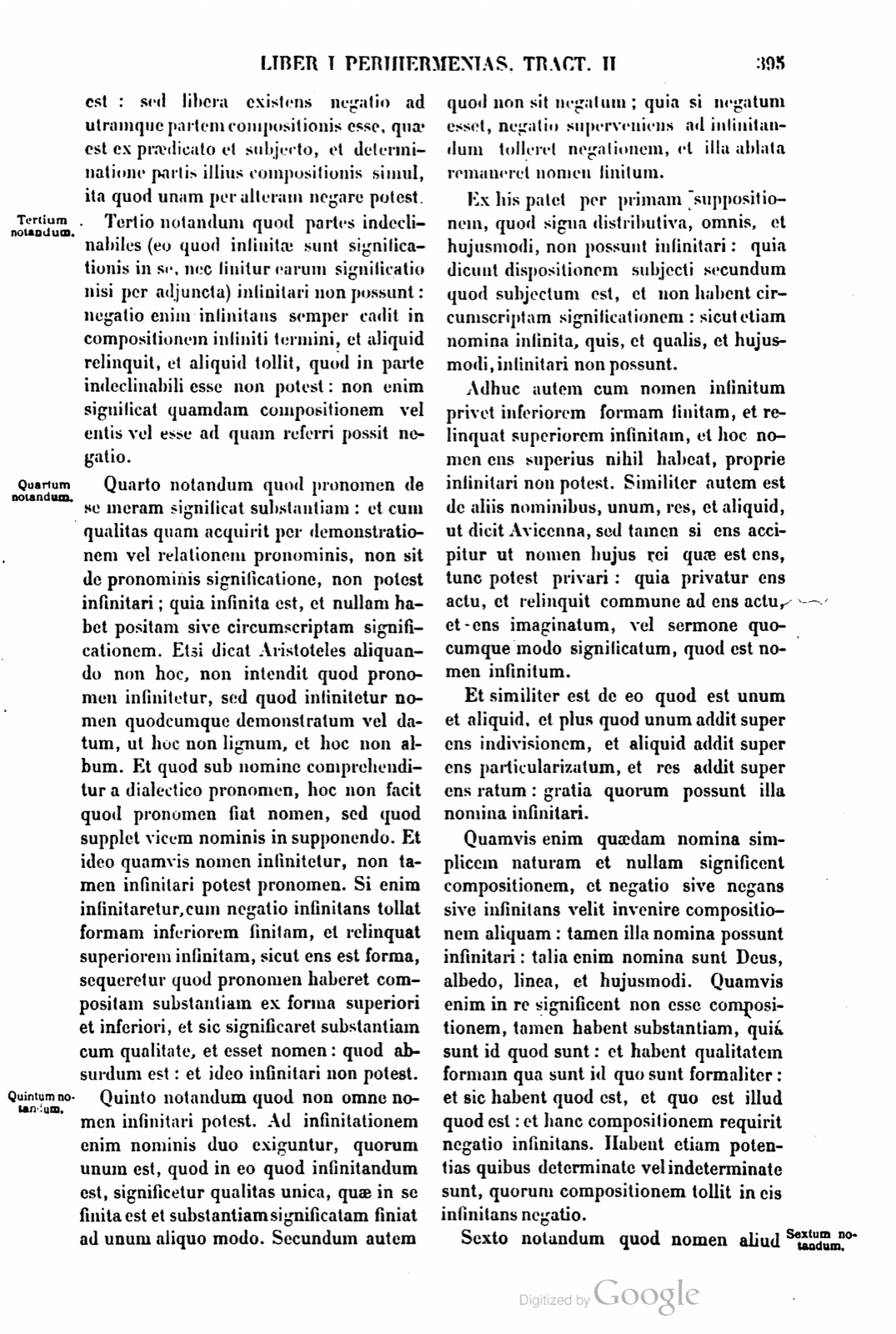
Tertio notandum quod partes indeclinabiles (eo quod infinitae sunt significationis in se, nec finitur earum significatio nisi per adjuncta) infinitari non possunt: negatio enim infinitans semper cadit in compositionem infiniti termini, et aliquid relinquit, et aliquid tollit, quod in parte indeclinabili esse non potest: non enim significat quamdam compositionem vel entis vel esse ad quam referri possit negatio.
It must also be attended that a finite noun is of determinate and circumscribed signification; and through the fact that it is made infinite, it becomes of uncircumscribed signification, which cannot be bounded either to being or to non-being. And this is especially the cause why an infinite noun posits nothing.
And further it must be noted that when it is said that a noun signifies substance with quality, the substance of the noun is what it is and what is supposed in the noun; but quality is that by which what it is is what it is. These, in most cases, must not be received in the abstract but in the concrete, as if we say that human is that by which what is human is human. And thus it appears that, when that quality which is said through this noun human is removed, there does not remain human as that which is human; and consequently nothing posited about human is left, because whatever is posited through the finite when human is said is taken away through the infinite when non-human is said. And when it is said that non-human is non-human being, as we said before, that being is not a being of the thing or of nature, but a being in the apprehension of the soul; and this is not something or being simply, but is being in opinion, about which we can reason and speak, as was said in the preceding matters.
For having perfect knowledge of infinite parts, one must know first, concerning the infinitation of terms, and especially of noun and verb, that negation takes away the form of the verb or noun and leaves the substance which is in this common thing, being, according as it is common to being according to nature and to being of reason, either in reason or in significative diction in whatever way. For this being is infinite, that is, determined to no definite form, although through negation signification is taken away, and consequently the finiteness which first existed; nevertheless, through the addition of negation, which is added as form above infinite substance, another diction is generated, which is an infinite noun or verb; and it has that very privation for form or quality, and thus signifies substance with quality. And similarly the verb which signifies being and acting has the privation signified in acting for being and acting, and is called an infinite noun and an infinite verb.
Secondly it must be noted that although one negation can deny two compositions, as when it is said, “not the one who runs is moved,” nevertheless negation does this only if it is free, not falling into the composition of some part posited in that speech, and only if the second composition is the determination of some part of the first composition. But infinitating negation falls into the composition of the infinite term, and therefore denies nothing outside it; and therefore that negation cannot make two dictions infinite at the same time, as when it is said, non-white human being or non-white wood. For although it denies two compositions of predicate to subject, those compositions express being and the composition of non-being. For the composition of being is twofold. One is from substantial form and matter; the other is from accident and substance, which is that of adjective with subject, and infinitating negation takes away that one. Therefore, joined with a term of accidental composition, it can regard nothing outside it; but when negation exists free, it can regard both parts of the composition of being, which is from predicate and subject, and at the same time the determination of the part of that composition, so that it can deny one through the other.
Thirdly it must be noted that indeclinable parts, because they are of infinite signification in themselves and their signification is not bounded except through things joined to them, cannot be made infinite. For infinitating negation always falls into the composition of an infinite term, and leaves something and takes something away; and this cannot be in an indeclinable part, for it does not signify a certain composition of being or to-be to which negation can be referred.
Quarto notandum quod pronomen de se meram significat substantiam: et cum qualitas quam acquirit per demonstrationem vel relationem pronominis, non sit de pronominis significatione, non potest infinitari; quia infinita est, et nullam habet positam sive circumscriptam significationem. Et si dicat Aristoteles aliquando non hoc, non intendit quod pronomen infinitetur, sed quod infinitetur nomen quodcumque demonstratum vel datum, ut hoc non lignum, et hoc non album. Et quod sub nomine comprehenditur a dialectico pronomen, hoc non facit quod pronomen fiat nomen, sed quod supplet vicem nominis in supponendo. Et ideo quamvis nomen infinitetur, non tamen infinitari potest pronomen. Si enim infinitaretur, cum negatio infinitans tollat formam inferiorem finitam, et relinquat superiorem infinitam, sicut ens est forma, sequeretur quod pronomen haberet compositam substantiam ex forma superiori et inferiori, et sic significaret substantiam cum qualitate, et esset nomen: quod absurdum est: et ideo infinitari non potest.
Quinto notandum quod non omne nomen infinitari potest. Ad infinitationem enim nominis duo exiguntur, quorum unum est, quod in eo quod infinitandum est, significetur qualitas unica, quae in se finita est et substantiam significatam finiat ad unum aliquo modo. Secundum autem quod non sit negatum; quia si negatum esset, negatio superveniens ad infinitandum tolleret negationem, et illa ablata remaneret nomen finitum.
Ex his patet per primam suppositionem, quod signa distributiva, omnis, et hujusmodi, non possunt infinitari: quia dicunt dispositionem subjecti secundum quod subjectum est, et non habent circumscriptam significationem: sicut etiam nomina infinita, quis, et qualis, et hujusmodi, infinitari non possunt.
Adhuc autem cum nomen infinitum privet inferiorem formam finitam, et relinquat superiorem infinitam, et hoc nomen ens superius nihil habeat, proprie infinitari non potest. Similiter autem est de aliis nominibus, unum, res, et aliquid, ut dicit Avicenna, sed tamen si ens accipitur ut nomen hujus rei quae est ens, tunc potest privari: quia privatur ens actu, et relinquit commune ad ens actu, et ens imaginatum, vel sermone quocumque modo significatum, quod est nomen infinitum.
Et similiter est de eo quod est unum et aliquid, et plus quod unum addit super ens indivisionem, et aliquid addit super ens particularizatum, et res addit super ens ratum: gratia quorum possunt illa nomina infinitari.
Quamvis enim quaedam nomina simplicem naturam et nullam significent compositionem, et negatio sive negans sive infinitans velit invenire compositionem aliquam: tamen illa nomina possunt infinitari: talia enim nomina sunt Deus, albedo, linea, et hujusmodi. Quamvis enim in re significent non esse compositionem, tamen habent substantiam, quia sunt id quod sunt: et habent qualitatem formam qua sunt id quo sunt formaliter: et sic habent quod est, et quo est illud quod est: et hanc compositionem requirit negatio infinitans. Habent etiam potentias quibus determinate vel indeterminate sunt, quorum compositionem tollit in eis infinitans negatio.
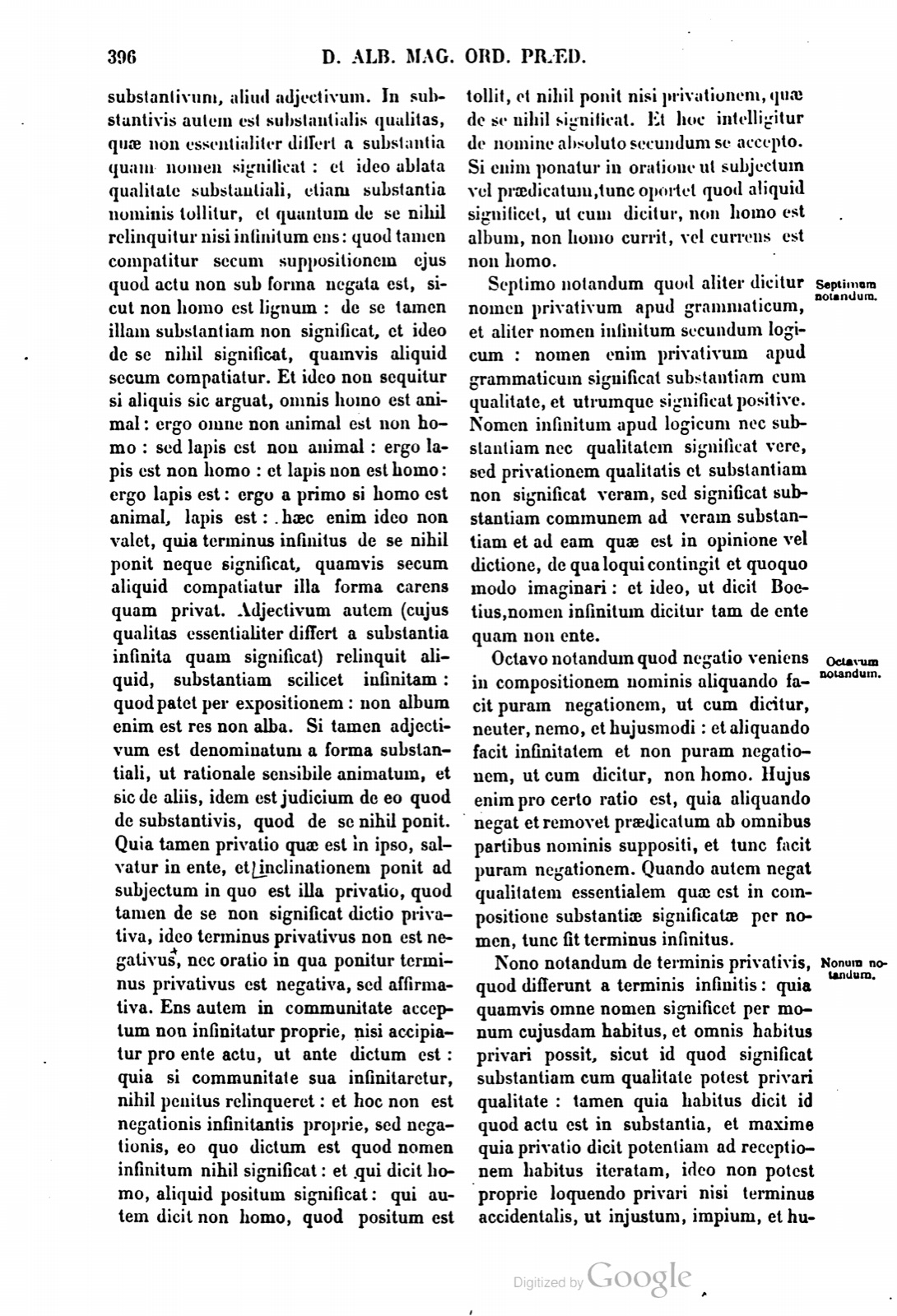
Sexto notandum quod nomen aliud substantivum, aliud adjectivum. In substantivis autem est substantialis qualitas, quae non essentialiter differt a substantia quam nomen significat: et ideo ablata qualitate substantiali, etiam substantia nominis tollitur, et quantum de se nihil relinquitur nisi infinitum ens: quod tamen compatitur secum suppositionem ejus quod actu non sub forma negata est, sicut non homo est lignum: de se tamen illam substantiam non significat, et ideo de se nihil significat, quamvis aliquid secum compatiatur. Et ideo non sequitur si aliquis sic arguat, omnis homo est animal: ergo omne non animal est non homo: sed lapis est non animal: ergo lapis est non homo: et lapis non est homo: ergo lapis est: ergo a primo si homo est animal, lapis est: haec enim ideo non valet, quia terminus infinitus de se nihil ponit neque significat, quamvis secum aliquid compatiatur illa forma carens quam privat. Adjectivum autem (cujus qualitas essentialiter differt a substantia infinita quam significat) relinquit aliquid, substantiam scilicet infinitam: quod patet per expositionem: non album enim est res non alba. Si tamen adjectivum est denominatum a forma substantiali, ut rationale sensibile animatum, et sic de aliis, idem est judicium de eo quod de substantivis, quod de se nihil ponit. Quia tamen privatio quae est in ipso, salvatur in ente, et inclinationem ponit ad subjectum in quo est illa privatio, quod tamen de se non significat dictio privativa, ideo terminus privativus non est negativus, nec oratio in qua ponitur terminus privativus est negativa, sed affirmativa. Ens autem in communitate acceptum non infinitatur proprie, nisi accipiatur pro ente actu, ut ante dictum est: quia si communitate sua infinitaretur, nihil penitus relinqueret: et hoc non est negationis infinitantis proprie, sed negationis, eo quo dictum est quod nomen infinitum nihil significat: et qui dicit homo, aliquid positum significat: qui autem dicit non homo, quod positum est tollit, et nihil ponit nisi privationem, quae de se nihil significat. Et hoc intelligitur de nomine absoluto secundum se accepto. Si enim ponatur in oratione ut subjectum vel praedicatum, tunc oportet quod aliquid significet, ut cum dicitur, non homo est album, non homo currit, vel currens est non homo.
Fourthly it must be noted that a pronoun of itself signifies mere substance; and since the quality which it acquires through demonstration or the relation of the pronoun is not of the signification of the pronoun, it cannot be made infinite, because it is infinite and has no posited or circumscribed signification. And if Aristotle sometimes says “not this,” he does not intend that the pronoun be made infinite, but that whatever name has been demonstrated or given be made infinite, as this non-wood and this non-white. And the fact that a pronoun is comprehended under noun by the dialectician does not make the pronoun become a noun, but makes it supply the place of a noun in supposing. Therefore, although a noun is made infinite, a pronoun cannot be made infinite. For if it were made infinite, since infinitating negation takes away the lower finite form and leaves the higher infinite one, as being is form, it would follow that a pronoun would have a substance composed from a higher and a lower form, and thus would signify substance with quality and would be a noun; which is absurd. Therefore it cannot be made infinite.
Fifthly it must be noted that not every noun can be made infinite. For two things are required for the infinitation of a noun. One is that in what is to be made infinite, a single quality be signified, which is finite in itself and somehow bounds the signified substance to one. The second is that it not be negated, because if it were negated, the negation coming upon it for infinitating would remove the negation, and, once that was removed, a finite noun would remain.
From these things it is clear through the first supposition that distributive signs, every and things of this sort, cannot be made infinite, because they express the disposition of the subject according as it is subject and do not have a circumscribed signification; just as also infinite names, who and of-what-quality and things of this sort, cannot be made infinite.
Again, since an infinite noun deprives the lower finite form and leaves the higher infinite one, and this name being has nothing higher, it cannot properly be made infinite. It is similar with other names, one, thing, and something, as Avicenna says. Nevertheless, if being is taken as the name of this thing which is being, then it can be deprived, because being in act is deprived and what is common to being in act and imagined being, or being signified by speech in whatever way, is left; and this is an infinite noun.
And it is similar concerning that which is one and something, and further because one adds indivision over being, something adds particularized being over being, and thing adds fixedness over being; by reason of these additions those names can be made infinite.
For although certain nouns signify a simple nature and no composition, and negation, whether denying or infinitating, wants to find some composition, nevertheless those nouns can be made infinite; such nouns are God, whiteness, line, and things of this sort. For although in reality they signify that there is no composition, nevertheless they have substance, because they are what they are; and they have as quality the form by which they are that by which they are formally; and thus they have what-is and that-by-which that which is is; and infinitating negation requires this composition. They also have powers by which they are determinately or indeterminately, and infinitating negation takes away the composition of these in them.
Sixthly it must be noted that one noun is substantive and another adjective. But in substantives there is a substantial quality which does not differ essentially from the substance which the noun signifies; and therefore, when the substantial quality is removed, the substance of the noun is also taken away, and, as far as it is concerned, nothing is left except infinite being. Yet this is compatible with the supposition of what is not actually under the negated form, as non-human is wood; nevertheless of itself it does not signify that substance, and therefore of itself signifies nothing, although it is compatible with something along with itself. And therefore it does not follow if someone argues thus: every human being is an animal; therefore every non-animal is non-human; but a stone is a non-animal; therefore a stone is non-human; and a stone is not human; therefore a stone is; therefore from the first, if a human being is an animal, a stone is. For this does not hold because an infinite term of itself posits or signifies nothing, although along with itself it is compatible with something lacking that form which it deprives. But the adjective, whose quality differs essentially from the infinite substance which it signifies, leaves something, namely infinite substance; this is clear through exposition, for non-white is a non-white thing. Yet if an adjective is denominated from a substantial form, as rational, sensible, animate, and so with the others, the same judgment applies to it as to substantives, because of itself it posits nothing. Yet because the privation which is in it is preserved in being, and posits an inclination to the subject in which that privation is, which nevertheless the privative diction of itself does not signify, therefore a privative term is not negative, nor is speech in which a privative term is posited negative, but affirmative. But being, taken in commonality, is not properly made infinite unless it is taken for being in act, as was said before; because if it were made infinite in its commonality, it would leave utterly nothing. And this does not belong properly to infinitating negation, but to negation, according to which it was said that an infinite noun signifies nothing. And one who says human signifies something posited; but one who says non-human takes away what is posited and posits nothing except privation, which of itself signifies nothing. And this is understood of an absolute noun taken according to itself. For if it is posited in speech as subject or predicate, then it must signify something, as when it is said, non-human is white, non-human runs, or one running is non-human.
Septimo notandum quod aliter dicitur nomen privativum apud grammaticum, et aliter nomen infinitum secundum logicum: nomen enim privativum apud grammaticum significat substantiam cum qualitate, et utrumque significat positive. Nomen infinitum apud logicum nec substantiam nec qualitatem significat vere, sed privationem qualitatis et substantiam non significat veram, sed significat substantiam communem ad veram substantiam et ad eam quae est in opinione vel dictione, de qua loqui contingit et quoquo modo imaginari: et ideo, ut dicit Boetius, nomen infinitum dicitur tam de ente quam non ente.
Octavo notandum quod negatio veniens in compositionem nominis aliquando facit puram negationem, ut cum dicitur, neuter, nemo, et hujusmodi: et aliquando facit infinitatem et non puram negationem, ut cum dicitur, non homo. Hujus enim pro certo ratio est, quia aliquando negat et removet praedicatum ab omnibus partibus nominis suppositi, et tunc facit puram negationem. Quando autem negat qualitatem essentialem quae est in compositione substantiae significatae per nomen, tunc fit terminus infinitus.
Nono notandum de terminis privativis, quod differunt a terminis infinitis: quia quamvis omne nomen significet per modum cujusdam habitus, et omnis habitus privari possit, sicut id quod significat substantiam cum qualitate potest privari qualitate: tamen quia habitus dicit id quod actu est in substantia, et maxime quia privatio dicit potentiam ad receptionem habitus iteratam, ideo non potest proprie loquendo privari nisi terminus accidentalis, ut injustum, impium, et hujusmodi
Seventhly it must be noted that a privative noun is said in one way for the grammarian and an infinite noun in another way according to the logician. For a privative noun for the grammarian signifies substance with quality, and signifies both positively. An infinite noun for the logician signifies truly neither substance nor quality, but the privation of quality; and it does not signify true substance, but signifies substance common to true substance and to that which is in opinion or diction, about which it happens to speak and to imagine in whatever way. Therefore, as Boethius says, an infinite noun is said both of being and of non-being.
Eighthly it must be noted that negation coming into the composition of a noun sometimes makes pure negation, as when neuter, nemo, and things of this sort are said; and sometimes it makes infinity and not pure negation, as when non-human is said. The reason for this as certain is that sometimes it denies and removes the predicate from all parts of the supposed noun, and then it makes pure negation. But when it denies the essential quality which is in the composition of the substance signified by the noun, then an infinite term is made.
Ninthly it must be noted concerning privative terms that they differ from infinite terms. Although every noun signifies in the mode of a certain habit, and every habit can be deprived, just as that which signifies substance with quality can be deprived of quality, nevertheless, because habit says what is actually in substance, and especially because privation says a power toward repeated reception of the habit, therefore properly speaking only an accidental term can be deprived, such as unjust, impious, and things of this sort
If a page does not appear, its photograph has not been uploaded yet.