Works › On Interpretation, Books I–II
Volume 1 · pp. 388–391
Chapter IV. On the definition of noun and its declaration.
A marker with ≈ is an approximate page boundary, placed by measure of the text; the page photographs remain the authority. In the paired views, clicking a page marker brings that page into view.
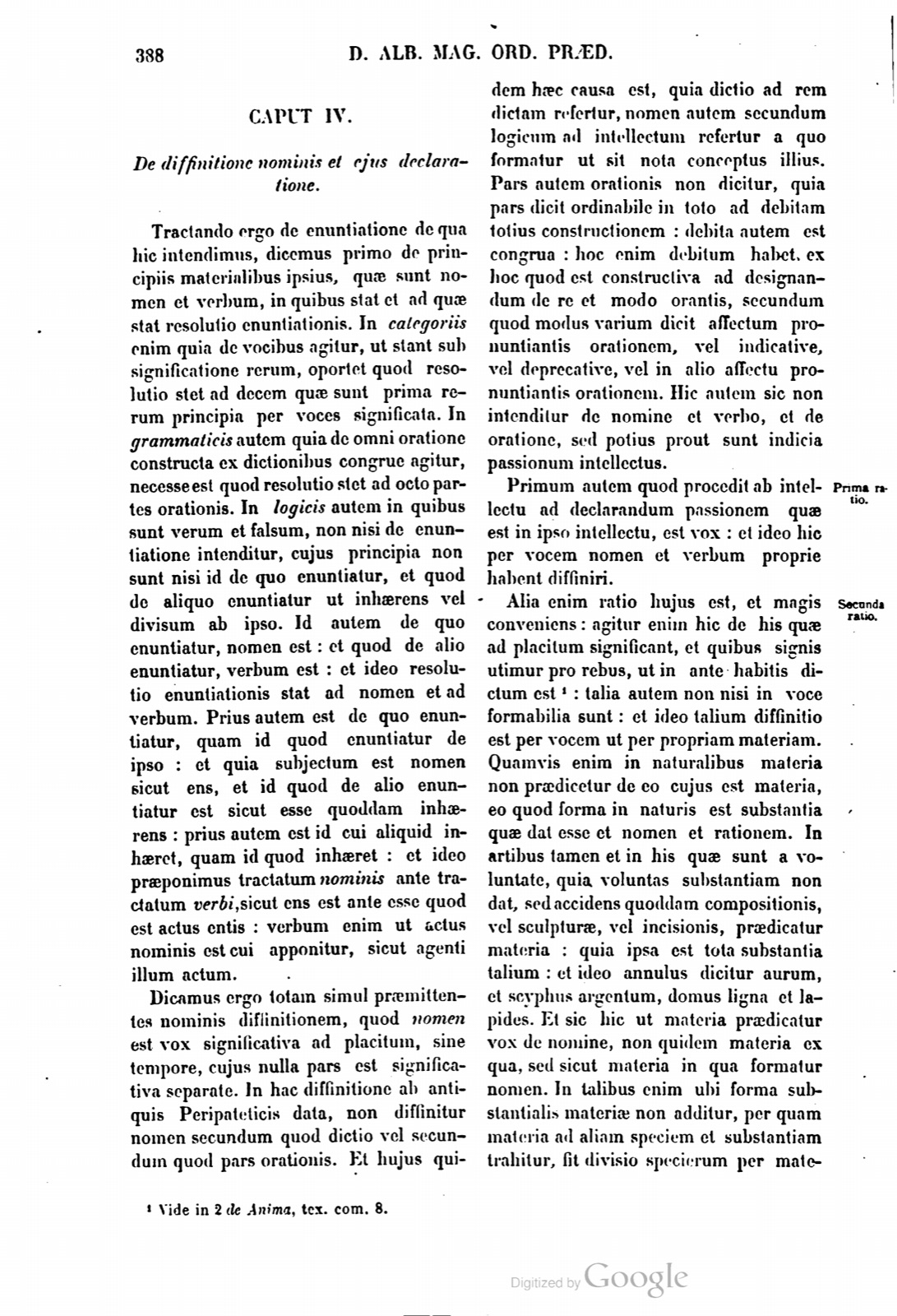
CAPUT IV. De diffinitione nominis et ejus declaratione.
Tractando ergo de enuntiatione de qua hic intendimus, dicemus primo de principiis materialibus ipsius, quae sunt nomen et verbum, in quibus stat et ad quae stat resolutio enuntiationis. In categoriis enim quia de vocibus agitur, ut stant sub significatione rerum, oportet quod resolutio stet ad decem quae sunt prima rerum principia per voces significata. In grammaticis autem quia de omni oratione constructa ex dictionibus congrue agitur, necesse est quod resolutio stet ad octo partes orationis. In logicis autem in quibus sunt verum et falsum, non nisi de enuntiatione intenditur, cujus principia non sunt nisi id de quo enuntiatur, et quod de aliquo enuntiatur ut inhaerens vel divisum ab ipso. Id autem de quo enuntiatur, nomen est: et quod de alio enuntiatur, verbum est: et ideo resolutio enuntiationis stat ad nomen et ad verbum. Prius autem est de quo enuntiatur, quam id quod enuntiatur de ipso: et quia subjectum est nomen sicut ens, et id quod de alio enuntiatur est sicut esse quoddam inhaerens: prius autem est id cui aliquid inhaeret, quam id quod inhaeret: et ideo praeponimus tractatum nominis ante tractatum verbi, sicut ens est ante esse quod est actus entis: verbum enim ut actus nominis est cui apponitur, sicut agenti illum actum.
Dicamus ergo totam simul praemittentes nominis diffinitionem, quod nomen est vox significativa ad placitum, sine tempore, cujus nulla pars est significativa separate. In hac diffinitione ab antiquis Peripateticis data, non diffinitur nomen secundum quod dictio vel secundum quod pars orationis. Et hujus quidem haec causa est, quia dictio ad rem dictam refertur, nomen autem secundum logicum ad intellectum refertur a quo formatur ut sit nota conceptus illius. Pars autem orationis non dicitur, quia pars dicit ordinabile in toto ad debitam totius constructionem: debita autem est congrua: hoc enim debitum habet, ex hoc quod est constructiva ad designandum de re et modo orantis, secundum quod modus varium dicit affectum pronuntiantis orationem, vel indicative, vel deprecative, vel in alio affectu pronuntiantis orationem. Hic autem sic non intenditur de nomine et verbo, et de oratione, sed potius prout sunt indicia passionum intellectus.
Primum autem quod procedit ab intellectu ad declarandum passionem quae est in ipso intellectu, est vox: et ideo hic per vocem nomen et verbum proprie habent diffiniri.
Alia enim ratio hujus est, et magis conveniens: agitur enim hic de his quae ad placitum significant, et quibus signis utimur pro rebus, ut in ante habitis dictum est: talia autem non nisi in voce formabilia sunt: et ideo talium diffinitio est per vocem ut per propriam materiam. Quamvis enim in naturalibus materia non praedicetur de eo cujus est materia, eo quod forma in naturis est substantia quae dat esse et nomen et rationem. In artibus tamen et in his quae sunt a voluntate, quia voluntas substantiam non dat, sed accidens quoddam compositionis, vel sculpturae, vel incisionis, praedicatur materia: quia ipsa est tota substantia talium: et ideo annulus dicitur aurum, et scyphus argentum, domus ligna et lapides. Et sic hic ut materia praedicatur vox de nomine, non quidem materia ex qua, sed sicut materia in qua formatur nomen. In talibus enim ubi forma substantialis materiae non additur, per quam materia ad aliam speciem et substantiam trahitur, fit divisio specierum per materiam, sicut domorum alia lignea, alia lapidea, et sic de aliis similibus.
CHAPTER IV. On the definition of noun and its declaration.
Therefore, in treating enunciation, about which we intend here, we shall speak first about its material principles, which are noun and verb, in which and at which the resolution of enunciation stands. For in the Categories, because vocal sounds are treated as they stand under the signification of things, the resolution must stand at the ten things which are the first principles of things signified through vocal sounds. But in grammar, because every speech constructed congruously from dictions is treated, the resolution must stand at the eight parts of speech. But in logic, in which there are true and false, nothing is intended except enunciation, whose principles are only that about which something is enunciated and that which is enunciated of something as inhering in it or divided from it. That about which something is enunciated is the noun; and that which is enunciated of another is the verb. Therefore the resolution of enunciation stands at noun and verb. But that about which something is enunciated is prior to that which is enunciated of it; and because the subject is a noun as being is, and what is enunciated of another is like a certain inhering being, while that in which something inheres is prior to what inheres, therefore we set the treatment of noun before the treatment of verb, as being is before to-be, which is the act of being. For the verb is as the act of the noun to which it is joined, as to the agent of that act.
Therefore let us speak by first setting down the whole definition of noun at once: a noun is vocal sound significative by convention, without time, no part of which is significative separately. In this definition given by the ancient Peripatetics, noun is not defined according as it is diction or according as it is part of speech. And this indeed is the cause of this: diction is referred to the thing said, but noun according to the logician is referred to the intellect by which it is formed so that it may be a note of that concept. It is not called part of speech, because part says what is orderable in a whole toward the due construction of the whole; and what is due is congruous. For it has this due character from the fact that it is constructive for designating concerning the thing and the mode of the one speaking, according as the mode says the varied affect of one pronouncing speech, either indicatively, deprecatively, or in another affect of one pronouncing speech. But here noun, verb, and speech are not intended in this way, but rather insofar as they are indications of the passions of the intellect.
But the first thing which proceeds from the intellect for declaring the passion which is in that intellect is vocal sound; and therefore here noun and verb properly have to be defined through vocal sound.
For there is another reason for this, and a more fitting one: here those things are treated which signify by convention and which signs we use for things, as was said in the preceding matters. But such things are formable only in vocal sound; and therefore the definition of such things is through vocal sound as through proper matter. For although in natural things matter is not predicated of that of which it is the matter, because in natures form is the substance which gives being and name and account, nevertheless in arts and in those things which are from will, because will does not give substance but a certain accident of composition, sculpture, or incision, matter is predicated, because it is the whole substance of such things. Therefore a ring is called gold, a cup silver, a house wood and stones. And thus here vocal sound is predicated of noun as matter, not indeed as matter from which, but as matter in which the noun is formed. For in such things, where the substantial form of the matter is not added, by which the matter is drawn to another species and substance, the division of species is made through matter, as among houses one is wooden and another stone, and so with other similar things.
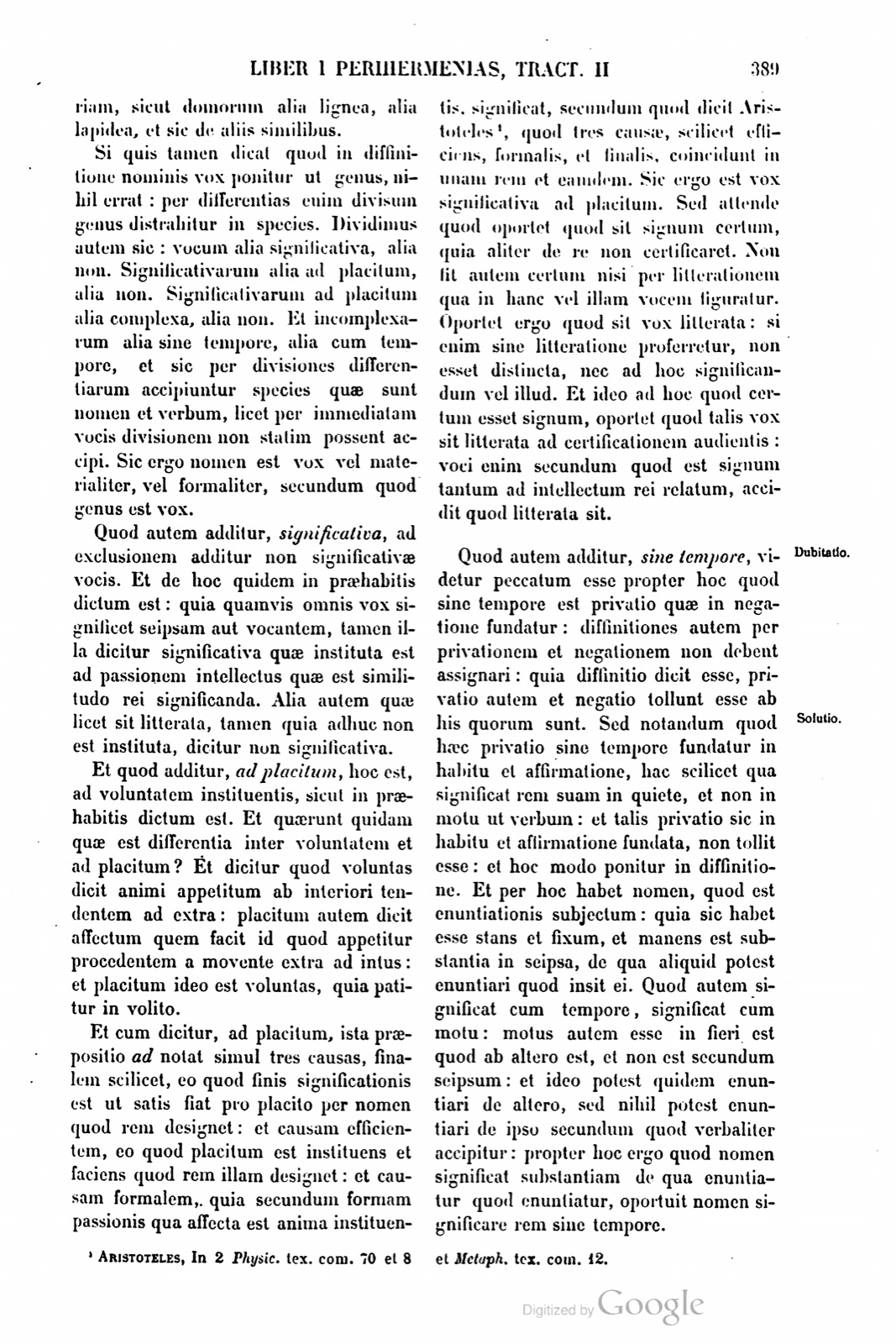
Si quis tamen dicat quod in diffinitione nominis vox ponitur ut genus, nihil errat: per differentias enim divisum genus distrahitur in species. Dividimus autem sic: vocum alia significativa, alia non. Significativarum alia ad placitum, alia non. Significativarum ad placitum alia complexa, alia non. Et incomplexarum alia sine tempore, alia cum tempore, et sic per divisiones differentiarum accipiuntur species quae sunt nomen et verbum, licet per immediatam vocis divisionem non statim possent accipi. Sic ergo nomen est vox vel materialiter, vel formaliter, secundum quod genus est vox.
Quod autem additur, significativa, ad exclusionem additur non significativae vocis. Et de hoc quidem in praehabitis dictum est: quia quamvis omnis vox significet seipsam aut vocantem, tamen illa dicitur significativa quae instituta est ad passionem intellectus quae est similitudo rei significanda. Alia autem quae licet sit litterata, tamen quia adhuc non est instituta, dicitur non significativa.
Et quod additur, ad placitum, hoc est, ad voluntatem instituentis, sicut in praehabitis dictum est. Et quaerunt quidam quae est differentia inter voluntatem et ad placitum? Et dicitur quod voluntas dicit animi appetitum ab interiori tendentem ad extra: placitum autem dicit affectum quem facit id quod appetitur procedentem a movente extra ad intus: et placitum ideo est voluntas, quia patitur in volito.
Et cum dicitur, ad placitum, ista praepositio ad notat simul tres causas, finalem scilicet, eo quod finis significationis est ut satis fiat pro placito per nomen quod rem designet: et causam efficientem, eo quod placitum est instituens et faciens quod rem illam designet: et causam formalem, quia secundum formam passionis qua affecta est anima instituentis, significat, secundum quod dicit Aristoteles 1, quod tres causae, scilicet efficiens, formalis, et finalis, coincidunt in unam rem et eamdem. Sic ergo est vox significativa ad placitum. Sed attende quod oportet quod sit signum certum, quia aliter de re non certificaret. Non fit autem certum nisi per litterationem qua in hanc vel illam vocem figuratur. Oportet ergo quod sit vox litterata: si enim sine litteratione proferretur, non esset distincta, nec ad hoc significandum vel illud. Et ideo ad hoc quod certum esset signum, oportet quod talis vox sit litterata ad certificationem audientis: voci enim secundum quod est signum tantum ad intellectum rei relatum, accidit quod litterata sit.
Yet if someone says that in the definition of noun vocal sound is posited as genus, he does not err; for a genus divided through differences is distributed into species. We divide thus: of vocal sounds, some are significative and some not. Of significative vocal sounds, some are by convention and some not. Of significative vocal sounds by convention, some are complex and some not. And of incomplex ones, some are without time and some with time; and thus through divisions of differences the species which are noun and verb are received, although through an immediate division of vocal sound they could not immediately be received. Thus noun is vocal sound either materially or formally, according as vocal sound is the genus.
But the addition “significative” is added for the exclusion of non-significative vocal sound. And about this, indeed, it was said in the preceding matters: because although every vocal sound signifies itself or the one calling, nevertheless that is called significative which has been instituted to signify a passion of the intellect which is a likeness of a thing. But another vocal sound, although it may be lettered, is called non-significative because it has not yet been instituted.
And the addition “by convention” means according to the will of the one instituting, as was said in the preceding matters. And some ask what the difference is between will and convention. It is said that will says an appetite of the soul tending from the interior to the exterior; but convention says the affect made by what is desired, proceeding from the mover outside to the interior. And therefore convention is will, because it is affected in the thing willed.
And when “by convention” is said, this preposition “by” notes at once three causes: namely the final cause, because the end of signification is that satisfaction be made for the convention through the noun which designates the thing; the efficient cause, because convention is what institutes and causes it to designate that thing; and the formal cause, because it signifies according to the form of the passion by which the soul of the one instituting is affected, according as Aristotle says 1 that the three causes, namely efficient, formal, and final, coincide in one and the same thing. Thus, then, it is vocal sound significative by convention. But attend that it must be a certain sign, because otherwise it would not certify about the thing. It is not made certain except through lettering, by which it is figured into this or that vocal sound. Therefore it must be a lettered vocal sound; for if it were uttered without lettering, it would not be distinct, nor determined to signifying this or that. And therefore, in order that it be a certain sign, such vocal sound must be lettered for the certification of the hearer; for it happens to vocal sound, according as it is only a sign referred to the understanding of the thing, that it be lettered.
Quod autem additur, sine tempore, videtur peccatum esse propter hoc quod sine tempore est privatio quae in negatione fundatur: diffinitiones autem per privationem et negationem non debent assignari: quia diffinitio dicit esse, privatio autem et negatio tollunt esse ab his quorum sunt. Sed notandum quod haec privatio sine tempore fundatur in habitu et affirmatione, hac scilicet qua significat rem suam in quiete, et non in motu ut verbum: et talis privatio sic in habitu et affirmatione fundata, non tollit esse: et hoc modo ponitur in diffinitione. Et per hoc habet nomen, quod est enuntiationis subjectum: quia sic habet esse stans et fixum, et manens est substantia in seipsa, de qua aliquid potest enuntiari quod insit ei. Quod autem significat cum tempore, significat cum motu: motus autem esse in fieri est quod ab altero est, et non est secundum seipsum: et ideo potest quidem enuntiari de altero, sed nihil potest enuntiari de ipso secundum quod verbaliter accipitur: propter hoc ergo quod nomen significat substantiam de qua enuntiatur quod enuntiatur, oportuit nomen significare rem sine tempore.
Quod autem dicitur, cujus nulla pars est significativa separata, ideo dicitur, quia significatio nominis sic refertur ad totum nomen, ita quod non ad partes: pars enim prima sive syllaba sive littera non habet primam partem significati, et secunda pars secundum, et sic deinceps: sicut cum dico, dominus, hoc ipsum do, quod prima syllaba est, non habet primam tertiam significationis, et mi quod est secunda syllaba secundam, et nus, quod est tertia syllaba, non habet ultimam tertiam, et sic nomen totum dicit et habet totam significationem: quia nulla pars separata habet aliquid significationis, neque secundum totum, neque secundum partem: et ideo nihil penitus retinet de significatione totius.
Haec autem causa est, ut dicit Avicenna, quia institutio est causa significationis in nomine: non est autem institutum ut pars aliquid significet separata, sed ut totum significet totum: et ideo pars nihil significat. Et quia ars imitatur naturam, in natura invenitur similiter, sicut in motibus animalium, ut in volatu, qui non fit ab una parte divisim secundum unam partem, et ab altera parte altera pars, sed ab utraque ala mota simul. Mixtum etiam non fit ab aliquo tantum miscibili, nec ab uno secundum unam partem mixtionis et ab altero secundum aliam partem: sed cum quodlibet est, cum quolibet perficitur mixtio. Non ergo significatio infusa est nomini sic, quod sit conveniens partibus, sicut est in homogeniis, in quibus quaelibet pars habet nomen et rationem totius, ut ignis, vel aer: quaelibet enim pars ignis est ignis, et quaelibet pars aeris est aer. Nec iterum est infusa significatio ut in heterogeniis, in quibus pars una habet partem unam totius, et alteram altera, sicut caput et pes et cor in corpore hominis, sed sic est totius, quod nullius partis est, nec secundum totam significationem, nec secundum partem.
But the addition “without time” seems to be a fault, because “without time” is a privation founded in negation; but definitions ought not to be assigned through privation and negation, because definition says being, while privation and negation take away being from those things of which they are. But it must be noted that this privation “without time” is founded in a habit and affirmation, namely in this, that it signifies its thing in rest and not in motion as a verb does. And such a privation, thus founded in habit and affirmation, does not take away being; and in this way it is placed in the definition. And through this a noun has the fact that it is the subject of enunciation, because thus it has standing and fixed being, and substance remaining in itself, about which something can be enunciated as being in it. But what signifies with time signifies with motion; and motion is being in becoming, which is from another and is not according to itself. Therefore it can indeed be enunciated of another, but nothing can be enunciated of it according as it is taken verbally. Therefore, because noun signifies the substance about which what is enunciated is enunciated, noun had to signify the thing without time.
But what is said, “no part of which is significative separately,” is said because the signification of the noun is so referred to the whole noun that it is not referred to the parts. For the first part, whether syllable or letter, does not have the first part of the signified, and the second part the second, and so thereafter. As when I say dominus, this very do, which is the first syllable, does not have the first third of the signification, and mi, which is the second syllable, does not have the second, and nus, which is the third syllable, does not have the last third. Thus the whole noun says and has the whole signification, because no separated part has anything of the signification, either according to the whole or according to a part; and therefore it retains utterly nothing of the signification of the whole.
But the cause of this, as Avicenna says, is that institution is the cause of signification in a noun. It has not been instituted so that a part would signify something separately, but so that the whole would signify the whole; and therefore a part signifies nothing. And because art imitates nature, something similar is found in nature, as in the movements of animals, for example in flight, which is not made by one part separately according to one part and by another part according to another part, but by both wings moved at once. A mixture also is not made by one mixable thing alone, nor by one according to one part of the mixture and by another according to another part; but when each thing exists with each thing, the mixture is perfected. Therefore signification is not infused into a noun in such a way that it is suitable to the parts, as it is in homogeneous things, in which any part has the name and account of the whole, as fire or air; for any part of fire is fire, and any part of air is air. Nor again is signification infused as in heterogeneous things, in which one part has one part of the whole and another has another, as head and foot and heart in the body of a human being; rather, it belongs to the whole in such a way that it belongs to no part, neither according to the whole signification nor according to a part.
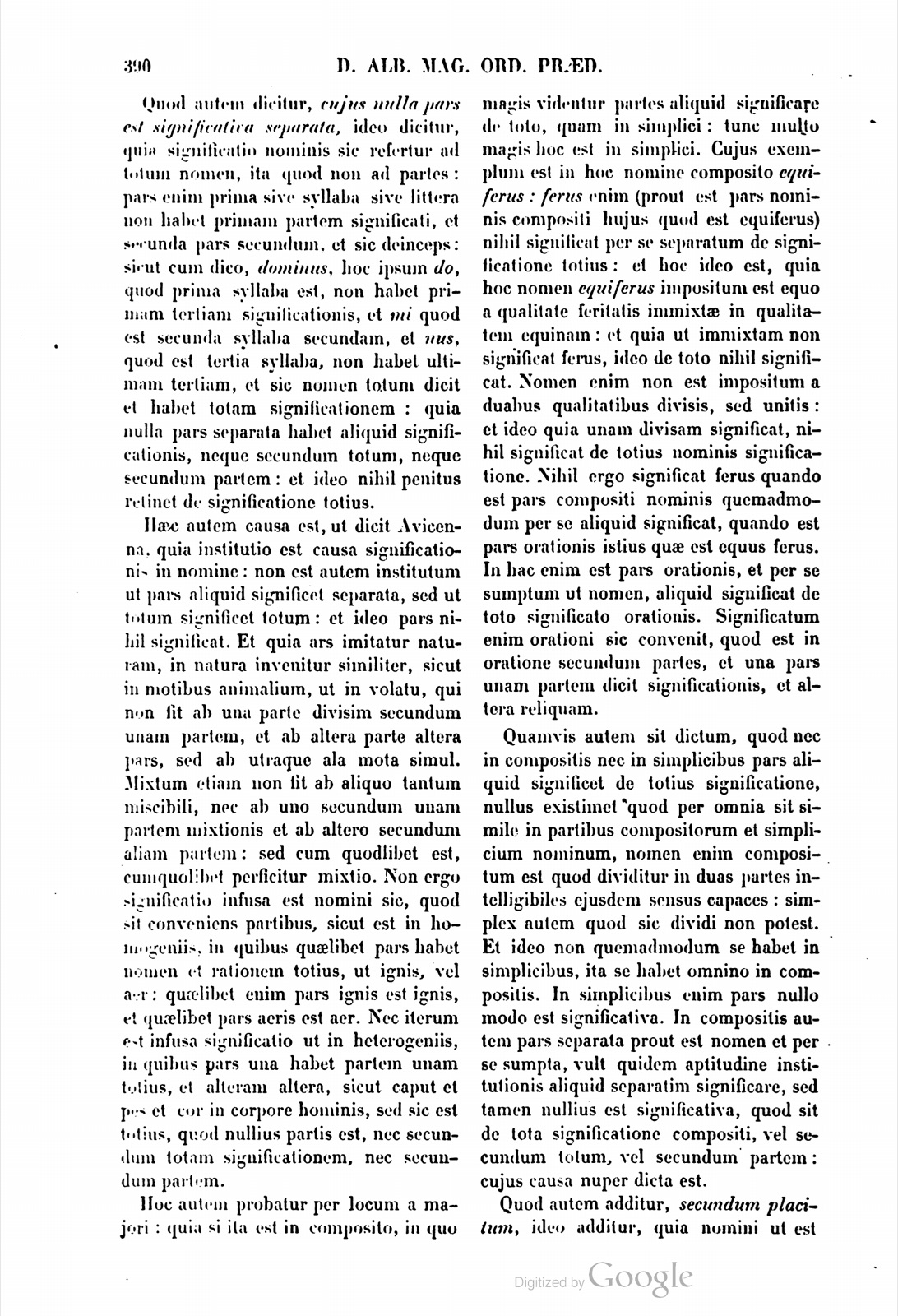
Hoc autem probatur per locum a majori: quia si ita est in composito, in quo magis videntur partes aliquid significare de toto, quam in simplici: tunc multo magis hoc est in simplici. Cujus exemplum est in hoc nomine composito equiferus: ferus enim (prout est pars nominis compositi hujus quod est equiferus) nihil significat per se separatum de significatione totius: et hoc ideo est, quia hoc nomen equiferus impositum est equo a qualitate feritatis immixtae in qualitatem equinam: et quia ut immixtam non significat ferus, ideo de toto nihil significat. Nomen enim non est impositum a duabus qualitatibus divisis, sed unitis: et ideo quia unam divisam significat, nihil significat de totius nominis significatione. Nihil ergo significat ferus quando est pars compositi nominis quemadmodum per se aliquid significat, quando est pars orationis istius quae est equus ferus. In hac enim est pars orationis, et per se sumptum ut nomen, aliquid significat de toto significato orationis. Significatum enim orationi sic convenit, quod est in oratione secundum partes, et una pars unam partem dicit significationis, et altera reliquam.
Quamvis autem sit dictum, quod nec in compositis nec in simplicibus pars aliquid significet de totius significatione, nullus existimet quod per omnia sit simile in partibus compositorum et simplicium nominum, nomen enim compositum est quod dividitur in duas partes intelligibiles ejusdem sensus capaces: simplex autem quod sic dividi non potest. Et ideo non quemadmodum se habet in simplicibus, ita se habet omnino in compositis. In simplicibus enim pars nullo modo est significativa. In compositis autem pars separata prout est nomen et per se sumpta, vult quidem aptitudine institutionis aliquid separatim significare, sed tamen nullius est significativa, quod sit de tota significatione compositi, vel secundum totum, vel secundum partem: cujus causa nuper dicta est.
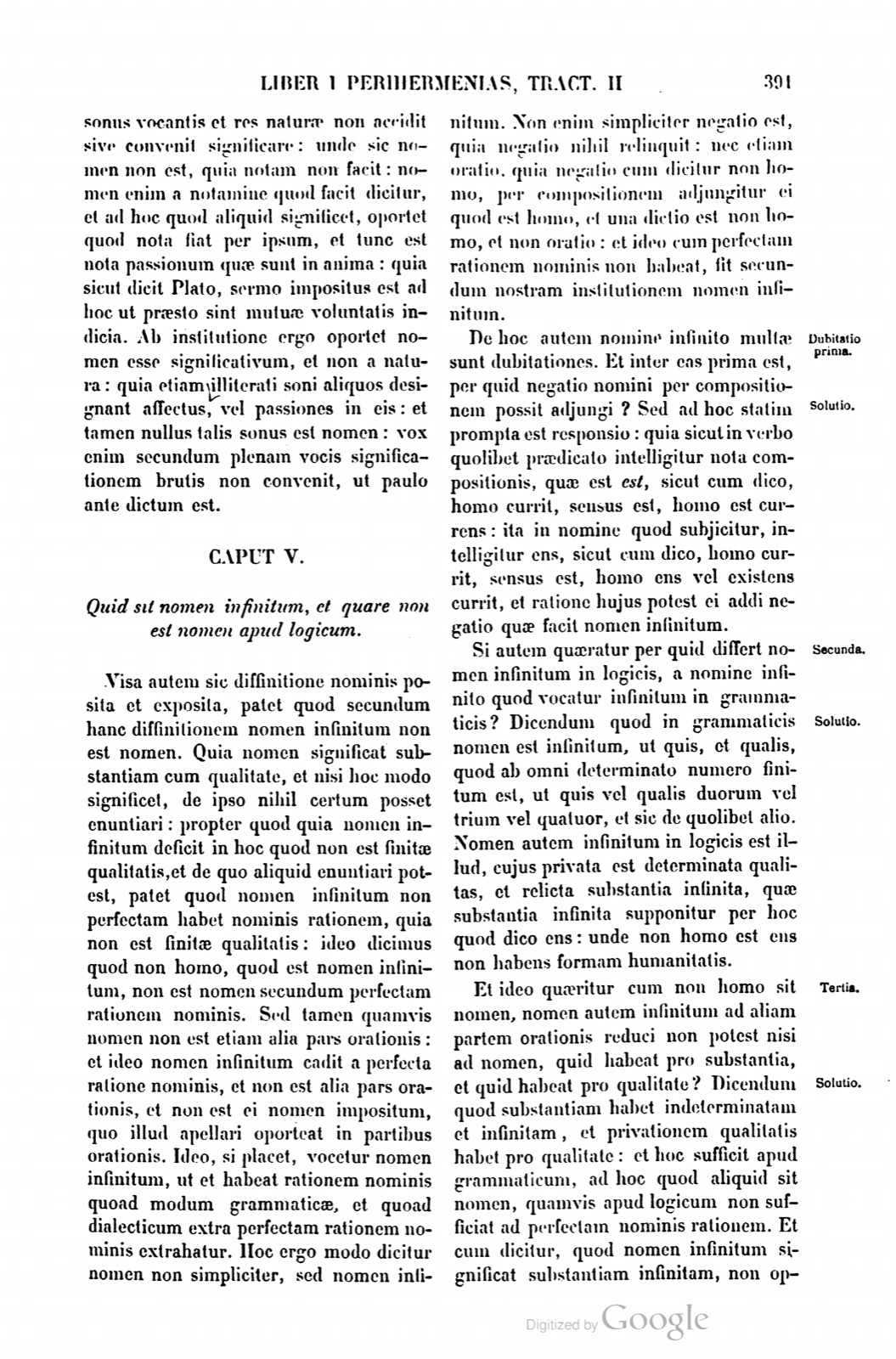
Quod autem additur, secundum placitum, ideo additur, quia nomini ut est sonus vocantis et res naturae non accidit sive convenit significare: unde sic nomen non est, quia notam non facit: nomen enim a notamine quod facit dicitur, et ad hoc quod aliquid significet, oportet quod nota fiat per ipsum, et tunc est nota passionum quae sunt in anima: quia sicut dicit Plato, sermo impositus est ad hoc ut praesto sint mutuae voluntatis indicia. Ab institutione ergo oportet nomen esse significativum, et non a natura: quia etiam illiterati soni aliquos designant affectus, vel passiones in eis: et tamen nullus talis sonus est nomen: vox enim secundum plenam vocis significationem brutis non convenit, ut paulo ante dictum est.
This is proved by an argument from the greater: because if it is so in the composite, in which parts seem more to signify something of the whole than in the simple, then much more is this so in the simple. An example of this is in the composite name equiferus. For ferus, insofar as it is part of this composite name equiferus, signifies nothing by itself, separated from the signification of the whole. And this is because this name equiferus is imposed on a horse from the quality of wildness mixed into the equine quality; and because ferus does not signify wildness as mixed, therefore it signifies nothing of the whole. For the name is not imposed from two divided qualities, but from united qualities; and therefore, because it signifies one as divided, it signifies nothing of the signification of the whole name. Therefore ferus signifies nothing when it is part of the composite name in the way in which it signifies something by itself when it is part of this speech which is equus ferus, “a wild horse.” For in this it is a part of speech, and taken by itself as a noun, it signifies something of the whole signified of the speech. For the signified belongs to speech in such a way that it is in the speech according to parts, and one part says one part of the signification, and the other the remaining part.
Although it has been said that neither in composites nor in simples does a part signify anything of the signification of the whole, no one should suppose that it is similar in every respect in the parts of composite and simple nouns. For a composite noun is one that is divided into two intelligible parts capable of the same sense; but a simple one cannot be divided in this way. Therefore it is not altogether with composites as it is with simples. For in simples a part is in no way significative. But in composites, a separated part, insofar as it is a noun and taken by itself, does indeed by aptitude of institution wish to signify something separately; nevertheless it is significative of nothing which belongs to the whole signification of the composite, either according to the whole or according to a part. The cause of this was said just now.
But “according to convention” is added because signifying does not happen or belong to a noun as it is the sound of one calling and a thing of nature; whence in this way it is not a noun, because it does not make a note. For noun is said from the noting that it makes, and in order that something signify, a note must be made through it, and then it is a note of the passions which are in the soul. For as Plato says, imposed speech exists so that indications of mutual will may be at hand. Therefore a noun must be significative from institution, and not from nature, because even unlettered sounds designate certain affects or passions in those who utter them; and yet no such sound is a noun. For vocal sound according to the full signification of vocal sound does not belong to brutes, as was said a little before.
Notes
- Aristotle, Physics, book 2, text commentaries 70 and 8, and Metaphysics, text commentary 12. (ARISTOTELES, In 2 Physic. tex. com. 70 et 8 et Metaph. tex. com. 12.) ↩
If a page does not appear, its photograph has not been uploaded yet.