Works › On Interpretation, Books I–II
Volume 1 · pp. 385–387
Continuation of Chapter II and Chapter III. On doubtful matters concerning the things that have been said.
A marker with ≈ is an approximate page boundary, placed by measure of the text; the page photographs remain the authority. In the paired views, clicking a page marker brings that page into view.
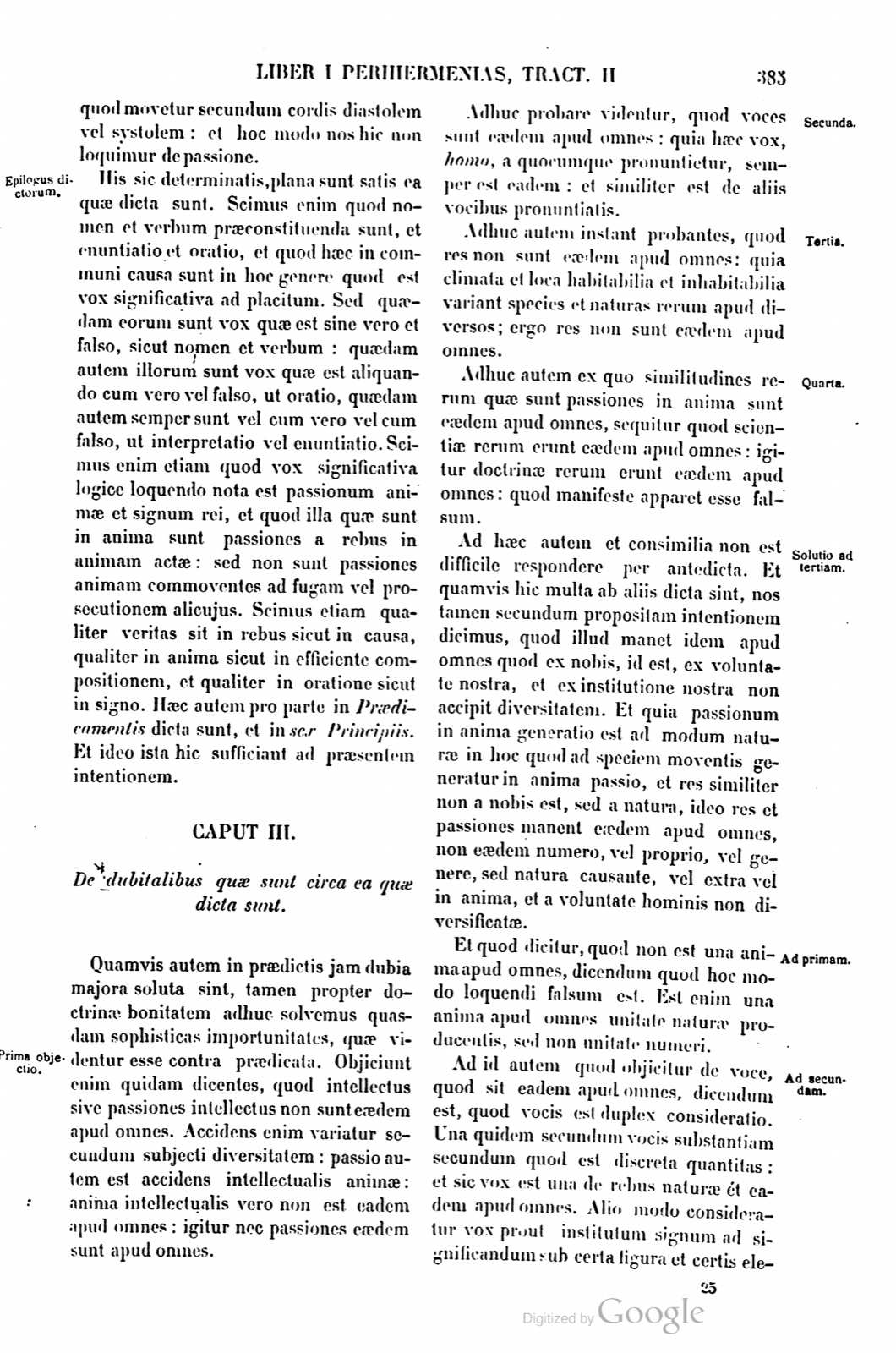
quod movetur secundum cordis diastolem vel systolem: et hoc modo nos hic non loquimur de passione.
His sic determinatis, plana sunt satis ea quae dicta sunt. Scimus enim quod nomen et verbum praeconstituenda sunt, et enuntiatio et oratio, et quod haec in communi causa sunt in hoc genere quod est vox significativa ad placitum. Sed quaedam eorum sunt vox quae est sine vero et falso, sicut nomen et verbum: quaedam autem illorum sunt vox quae est aliquando cum vero vel falso, ut oratio, quaedam autem semper sunt vel cum vero vel cum falso, ut interpretatio vel enuntiatio. Scimus enim etiam quod vox significativa logice loquendo nota est passionum animae et signum rei, et quod illa quae sunt in anima sunt passiones a rebus in animam actae: sed non sunt passiones animam commoventes ad fugam vel prosecutionem alicujus. Scimus etiam qualiter veritas sit in rebus sicut in causa, qualiter in anima sicut in efficiente compositionem, et qualiter in oratione sicut in signo. Haec autem pro parte in Praedicamentis dicta sunt, et in sex Principiis. Et ideo ista hic sufficiant ad praesentem intentionem.
CAPUT III. De dubitabilibus quae sunt circa ea quae dicta sunt.
Quamvis autem in praedictis jam dubia majora soluta sint, tamen propter doctrinae bonitatem adhuc solvemus quasdam sophisticas importunitates, quae videntur esse contra praedicata. Objiciunt enim quidam dicentes, quod intellectus sive passiones intellectus non sunt eaedem apud omnes. Accidens enim variatur secundum subjecti diversitatem: passio autem est accidens intellectualis animae: anima intellectualis vero non est eadem apud omnes: igitur nec passiones eaedem sunt apud omnes.
Adhuc probare videntur, quod voces sunt eaedem apud omnes: quia haec vox, homo, a quocumque pronuntietur, semper est eadem: et similiter est de aliis vocibus pronuntiatis.
Adhuc autem instant probantes, quod res non sunt eaedem apud omnes: quia climata et loca habitabilia et inhabitabilia variant species et naturas rerum apud diversos; ergo res non sunt eaedem apud omnes.
Adhuc autem ex quo similitudines rerum quae sunt passiones in anima sunt eaedem apud omnes, sequitur quod scientiae rerum erunt eaedem apud omnes: igitur doctrinae rerum erunt eaedem apud omnes: quod manifeste apparet esse falsum.
Ad haec autem et consimilia non est difficile respondere per antedicta. Et quamvis hic multa ab aliis dicta sint, nos tamen secundum propositam intentionem dicimus, quod illud manet idem apud omnes quod ex nobis, id est, ex voluntate nostra, et ex institutione nostra non accipit diversitatem. Et quia passionum in anima generatio est ad modum naturae in hoc quod ad speciem moventis generatur in anima passio, et res similiter non a nobis est, sed a natura, ideo res et passiones manent eaedem apud omnes, non eaedem numero, vel proprio, vel genere, sed natura causante, vel extra vel in anima, et a voluntate hominis non diversificatae.
Et quod dicitur, quod non est una anima apud omnes, dicendum quod hoc modo loquendi falsum est. Est enim una anima apud omnes unitate naturae producentis, sed non unitate numeri.
Ad id autem quod objicitur de voce, quod sit eadem apud omnes, dicendum est, quod vocis est duplex consideratio. Una quidem secundum vocis substantiam secundum quod est discreta quantitas: et sic vox est una de rebus naturae et eadem apud omnes. Alio modo consideratur vox prout institutum signum ad significandum sub certa figura et certis elementis, et sic est ad placitum, et non eadem apud omnes. Quamvis enim tympanum auris pulset in quantum est res naturae et secundum quod est acuta vel gravis, quod accidit ei in quantum est res naturae: tamen non ordinatur ad designandam animae et intellectus passionem, nisi in quantum est figurata et certis elementis determinata, et sic significativa. Et est solius hominis sic vocare: propter quod animalium brutorum imperfecta ratione voces sunt: quia sunt inarticulatae, et nullius ad extra designativae, sed in vocante significant affectum. Secundum hoc ergo quod voces a nobis sunt, sic diversae sunt secundum institutionem diversorum.
which is moved according to the diastole or systole of the heart; and in this way we do not speak here about passion.
When these things have thus been determined, the things that have been said are sufficiently plain. For we know that noun and verb must be preconstituted, and enunciation and speech also, and that these are in one common cause in this genus which is vocal sound significative by convention. But some of them are vocal sound which is without true and false, as noun and verb; while some of them are vocal sound which is sometimes with true or false, as speech; and some are always either with true or with false, as interpretation or enunciation. We also know that significative vocal sound, speaking logically, is a note of the passions of the soul and a sign of the thing, and that those things which are in the soul are passions acted into the soul by things; but they are not passions moving the soul to flight or pursuit of something. We also know how truth is in things as in a cause, how it is in the soul as in the efficient cause of composition, and how it is in speech as in a sign. These things have been said in part in the Categories and in the Six Principles. Therefore let these things suffice here for the present intention.
CHAPTER III. On doubtful matters concerning the things that have been said.
Although the greater doubts have already been solved in the foregoing, nevertheless, for the goodness of teaching, we shall still solve certain sophistical importunities which seem to be against the predicated things. For some object, saying that the intellect, or the passions of the intellect, are not the same among all. For an accident is varied according to the diversity of its subject; but a passion is an accident of the intellectual soul; and the intellectual soul is not the same among all; therefore the passions also are not the same among all.
Again, they seem to prove that vocal sounds are the same among all, because this vocal sound, “human being,” by whomever it is pronounced, is always the same; and it is similar with other pronounced vocal sounds.
Again, they press on, proving that things are not the same among all, because climates and habitable and inhabitable places vary the species and natures of things among diverse people; therefore things are not the same among all.
Again, from the fact that likenesses of things, which are passions in the soul, are the same among all, it follows that sciences of things will be the same among all; therefore teachings of things will be the same among all; and this manifestly appears to be false.
To these and similar points it is not difficult to respond through the things said before. And although many things have been said here by others, nevertheless according to the proposed intention we say that what remains the same among all is that which does not receive diversity from us, that is, from our will and from our institution. And because the generation of passions in the soul is according to the mode of nature in this, that a passion is generated in the soul according to the species of the mover, and similarly the thing is not from us but from nature, therefore things and passions remain the same among all, not the same in number, or in proper being, or in genus, but as caused by nature, either outside or in the soul, and not diversified by the will of man.
And as to what is said, that there is not one soul among all, it must be said that this mode of speaking is false. For there is one soul among all by the unity of the producing nature, but not by unity of number.
To that which is objected about vocal sound, that it is the same among all, it must be said that there is a twofold consideration of vocal sound. One is according to the substance of vocal sound, according as it is a discrete quantity; and thus vocal sound is one of the things of nature and the same among all. In another way vocal sound is considered insofar as it is an instituted sign for signifying under a definite figure and definite elements; and thus it is by convention, and not the same among all. For although it strikes the drum of the ear insofar as it is a thing of nature and according as it is acute or grave, which happens to it insofar as it is a thing of nature, nevertheless it is not ordered to designating the passion of the soul and intellect except insofar as it is figured and determined by definite elements, and thus significative. And to vocalize in this way belongs to man alone; on account of this the vocal sounds of brute animals are vocal sounds by an imperfect account, because they are inarticulate and designate nothing externally, but signify an affect in the one calling. Therefore according to this, that vocal sounds are from us, they are diverse according to the institution of diverse people.
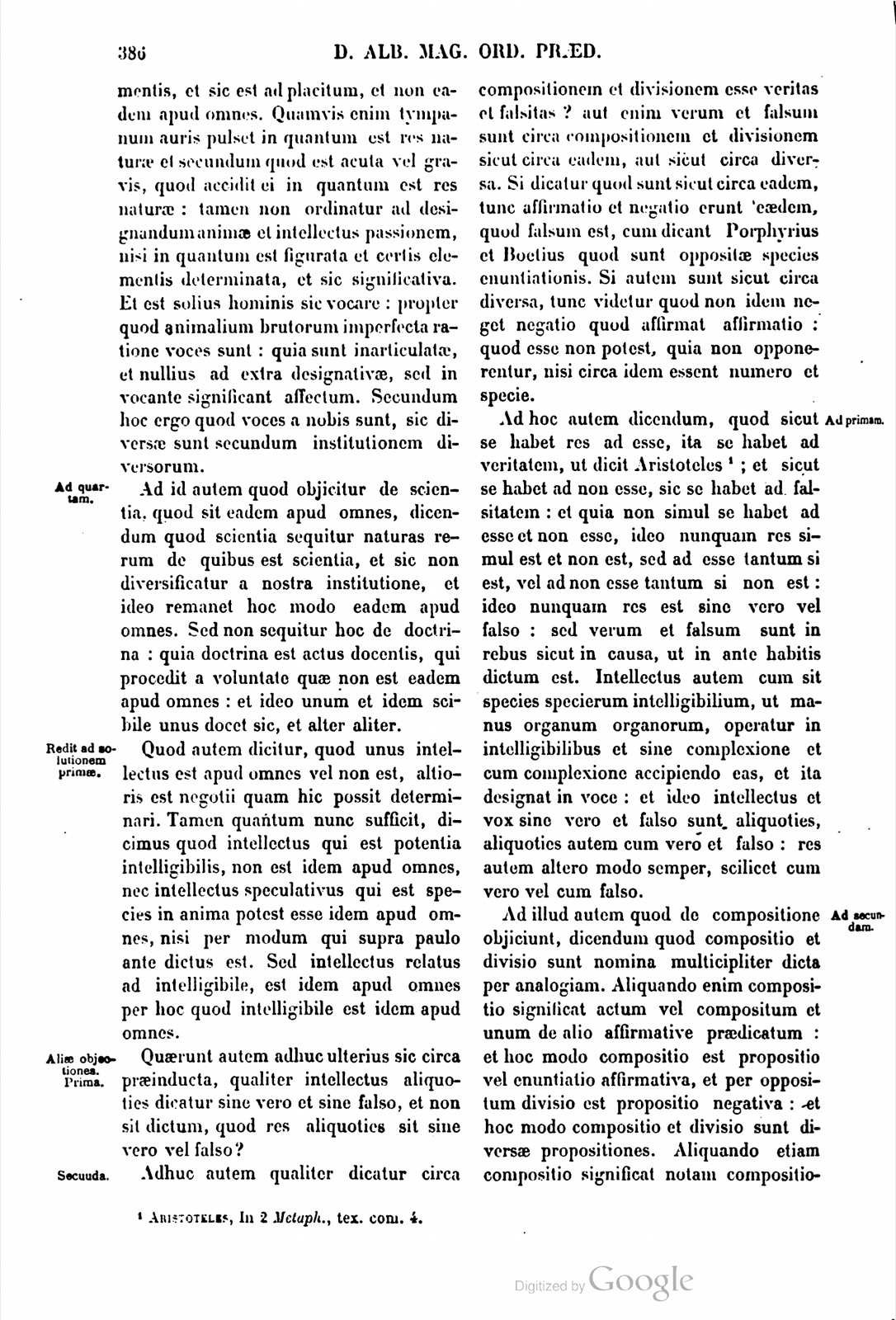
Ad id autem quod objicitur de scientia, quod sit eadem apud omnes, dicendum quod scientia sequitur naturas rerum de quibus est scientia, et sic non diversificatur a nostra institutione, et ideo remanet hoc modo eadem apud omnes. Sed non sequitur hoc de doctrina: quia doctrina est actus docentis, qui procedit a voluntate quae non est eadem apud omnes: et ideo unum et idem scibile unus docet sic, et alter aliter.
Quod autem dicitur, quod unus intellectus est apud omnes vel non est, altioris est negotii quam hic possit determinari. Tamen quantum nunc sufficit, dicimus quod intellectus qui est potentia intelligibilis, non est idem apud omnes, nec intellectus speculativus qui est species in anima potest esse idem apud omnes, nisi per modum qui supra paulo ante dictus est. Sed intellectus relatus ad intelligibile, est idem apud omnes per hoc quod intelligibile est idem apud omnes.
Quaerunt autem adhuc ulterius sic circa praeinducta, qualiter intellectus aliquoties dicatur sine vero et sine falso, et non sit dictum, quod res aliquoties sit sine vero vel falso?
Adhuc autem qualiter dicatur circa compositionem et divisionem esse veritas et falsitas? aut enim verum et falsum sunt circa compositionem et divisionem sicut circa eadem, aut sicut circa diversa. Si dicatur quod sunt sicut circa eadem, tunc affirmatio et negatio erunt eaedem, quod falsum est, cum dicant Porphyrius et Boetius quod sunt oppositae species enuntiationis. Si autem sunt sicut circa diversa, tunc videtur quod non idem neget negatio quod affirmat affirmatio: quod esse non potest, quia non opponerentur, nisi circa idem essent numero et specie.
Ad hoc autem dicendum, quod sicut se habet res ad esse, ita se habet ad veritatem, ut dicit Aristoteles 1; et sicut se habet ad non esse, sic se habet ad falsitatem: et quia non simul se habet ad esse et non esse, ideo nunquam res simul est et non est, sed ad esse tantum si est, vel ad non esse tantum si non est: ideo nunquam res est sine vero vel falso: sed verum et falsum sunt in rebus sicut in causa, ut in ante habitis dictum est. Intellectus autem cum sit species specierum intelligibilium, ut manus organum organorum, operatur in intelligibilibus et sine complexione et cum complexione accipiendo eas, et ita designat in voce: et ideo intellectus et vox sine vero et falso sunt aliquoties, aliquoties autem cum vero et falso: res autem altero modo semper, scilicet cum vero vel cum falso.
Ad illud autem quod de compositione objiciunt, dicendum quod compositio et divisio sunt nomina multipliciter dicta per analogiam. Aliquando enim compositio significat actum vel compositum et unum de alio affirmative praedicatum: et hoc modo compositio est propositio vel enuntiatio affirmativa, et per oppositum divisio est propositio negativa: et hoc modo compositio et divisio sunt diversae propositiones. Aliquando etiam compositio significat notam compositionis in propositione, et sic quidem substantialiter compositio est in divisione, ut probat objectio: et ideo dicit Aristoteles quod omnino est in negatione divisio. Et quamvis substantialiter est idem, tamen virtute et actu sunt opposita, propter oppositas qualitates affirmationis et negationis. Cum ergo dicitur quod verum et falsum sunt circa compositionem et divisionem, debet circa exponi per in, quae est praepositio notans continentiam: quia sunt in compositione et divisione, et non in eo quod simplex et incomplexum est. Sunt autem in eo sicut in relativo relatio est, sicut diximus in Praedicamentis: et ideo eo quod res est vel non est, oratio vera vel falsa est. Ad hoc autem intelligendum oportet scire, quod compositio non est causa veritatis in propositione vera, nec etiam divisio, sed potius adaequatio compositionis cum intellectu componente, et cum re extra, et non adaequatio est causa falsitatis. Et quia talis relatio est causa veritatis et falsitatis, et relationes sunt assistentes extrinsecus, ideo forte dicitur quod verum et falsum sunt circa compositionem et divisionem.
To that which is objected about science, that it is the same among all, it must be said that science follows the natures of the things about which the science is; and thus it is not diversified by our institution, and therefore in this way it remains the same among all. But this does not follow about teaching, because teaching is the act of one teaching, which proceeds from a will that is not the same among all; and therefore one person teaches one and the same knowable thing in this way, and another in another way.
But what is said, whether one intellect is among all or is not, belongs to a higher business than can be determined here. Nevertheless, so far as now suffices, we say that the intellect which is an intelligible power is not the same among all, nor can the speculative intellect which is a species in the soul be the same among all except in the mode which was said a little above. But the intellect related to the intelligible is the same among all through the fact that the intelligible is the same among all.
They also ask further in this way concerning the things already introduced: how the intellect is sometimes said to be without true and without false, and it is not said that the thing is sometimes without true or false.
Again, how is truth and falsity said to be around composition and division? For true and false are either around composition and division as around the same things, or as around diverse things. If it is said that they are as around the same things, then affirmation and negation will be the same, which is false, since Porphyry and Boethius say that they are opposite species of enunciation. But if they are as around diverse things, then it seems that negation does not deny the same thing which affirmation affirms; and this cannot be, because they would not be opposed unless they concerned the same thing in number and species.
To this it must be said that, as a thing is related to being, so it is related to truth, as Aristotle says 1; and as it is related to non-being, so it is related to falsity. And because it is not simultaneously related to being and non-being, therefore a thing never simultaneously is and is not, but is related only to being if it is, or only to non-being if it is not. Therefore a thing is never without true or false; but true and false are in things as in a cause, as was said in the preceding books. But the intellect, since it is the species of intelligible species, as the hand is the instrument of instruments, operates among intelligible things both without combination and with combination by receiving them, and thus designates in vocal sound. Therefore intellect and vocal sound are sometimes without true and false, and sometimes with true and false; but the thing is always in the other mode, namely with true or with false.
To what they object about composition, it must be said that composition and division are names said in many ways by analogy. Sometimes composition signifies the act, or the composite and one thing affirmatively predicated of another; and in this way composition is an affirmative proposition or enunciation, and oppositely division is a negative proposition; and in this way composition and division are diverse propositions. Sometimes also composition signifies the note of composition in a proposition, and thus substantially composition is in division, as the objection proves; and therefore Aristotle says that division is altogether in negation. And although it is substantially the same, nevertheless in power and act they are opposed because of the opposite qualities of affirmation and negation. Therefore when it is said that true and false are around composition and division, around must be explained by in, which is a preposition noting containment, because they are in composition and division, and not in what is simple and incomplex. But they are in it as relation is in the relative, as we said in the Categories; and therefore because the thing is or is not, speech is true or false. For understanding this, however, one must know that composition is not the cause of truth in a true proposition, nor is division, but rather the adequation of composition with the composing intellect and with the external thing; and non-adequation is the cause of falsity. And because such relation is the cause of truth and falsity, and relations are things assisting extrinsically, perhaps for this reason true and false are said to be around composition and division.
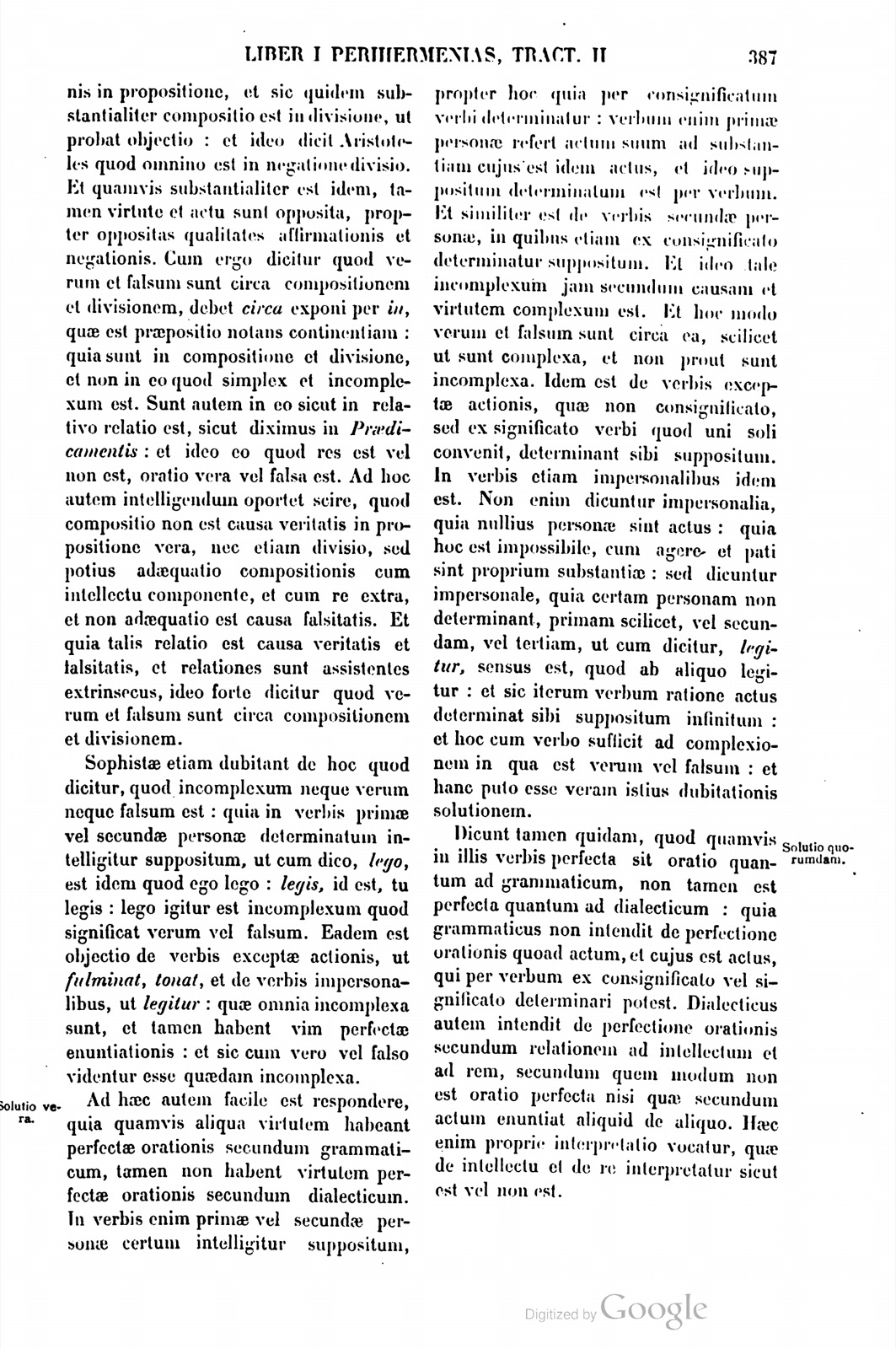
Sophistae etiam dubitant de hoc quod dicitur, quod incomplexum neque verum neque falsum est: quia in verbis primae vel secundae personae determinatum intelligitur suppositum, ut cum dico, lego, est idem quod ego lego: legis, id est, tu legis: lego igitur est incomplexum quod significat verum vel falsum. Eadem est objectio de verbis exceptae actionis, ut fulminat, tonat, et de verbis impersonalibus, ut legitur: quae omnia incomplexa sunt, et tamen habent vim perfectae enuntiationis: et sic cum vero vel falso videntur esse quaedam incomplexa.
Ad haec autem facile est respondere, quia quamvis aliqua virtutem habeant perfectae orationis secundum grammaticum, tamen non habent virtutem perfectae orationis secundum dialecticum. In verbis enim primae vel secundae personae certum intelligitur suppositum, propter hoc quia per consignificatum verbi determinatur: verbum enim primae personae refert actum suum ad substantiam cujus est idem actus, et ideo suppositum determinatum est per verbum. Et similiter est de verbis secundae personae, in quibus etiam ex consignificato determinatur suppositum. Et ideo tale incomplexum jam secundum causam et virtutem complexum est. Et hoc modo verum et falsum sunt circa ea, scilicet ut sunt complexa, et non prout sunt incomplexa. Idem est de verbis exceptae actionis, quae non consignificato, sed ex significato verbi quod uni soli convenit, determinant sibi suppositum. In verbis etiam impersonalibus idem est. Non enim dicuntur impersonalia, quia nullius personae sint actus: quia hoc est impossibile, cum agere et pati sint proprium substantiae: sed dicuntur impersonalia, quia certam personam non determinant, primam scilicet, vel secundam, vel tertiam, ut cum dicitur, legitur, sensus est, quod ab aliquo legitur: et sic iterum verbum ratione actus determinat sibi suppositum infinitum: et hoc cum verbo sufficit ad complexionem in qua est verum vel falsum: et hanc puto esse veram istius dubitationis solutionem.
Dicunt tamen quidam, quod quamvis in illis verbis perfecta sit oratio quantum ad grammaticum, non tamen est perfecta quantum ad dialecticum: quia grammaticus non intendit de perfectione orationis quoad actum, et cujus est actus, qui per verbum ex consignificato vel significato determinari potest. Dialecticus autem intendit de perfectione orationis secundum relationem ad intellectum et ad rem, secundum quem modum non est oratio perfecta nisi quae secundum actum enuntiat aliquid de aliquo. Haec enim proprie interpretatio vocatur, quae de intellectu et de re interpretatur sicut est vel non est.
The sophists also doubt about this which is said, that the incomplex is neither true nor false, because in verbs of the first or second person a determinate supposit is understood, as when I say, “I read,” it is the same as “I read”; “you read,” that is, “you read”; therefore “I read” is an incomplex thing which signifies true or false. The same objection concerns verbs of exceptional action, such as “it lightnings,” “it thunders,” and impersonal verbs, such as “it is read”; all these are incomplex, and yet have the force of a perfect enunciation; and thus certain incomplex things seem to be with true or false.
To these things it is easy to respond, because although some have the power of perfect speech according to the grammarian, nevertheless they do not have the power of perfect speech according to the dialectician. For in verbs of the first or second person a definite supposit is understood, because it is determined through what is co-signified by the verb. For a verb of the first person refers its act to the substance whose same act it is, and therefore the supposit is determined by the verb. And it is similar with verbs of the second person, in which the supposit is also determined from what is co-signified. Therefore such an incomplex thing is now complex according to cause and power. And in this way true and false are around them, namely as they are complex, and not insofar as they are incomplex. The same is true of verbs of exceptional action, which determine for themselves a supposit not from what is co-signified, but from the signified of the verb, which belongs to one thing alone. In impersonal verbs it is also the same. For they are not called impersonal because they are acts of no person, since this is impossible, as acting and undergoing are proper to substance; but they are called impersonal because they do not determine a definite person, namely first, second, or third, as when it is said, “it is read,” the sense is that it is read by someone. And thus again the verb, by reason of the act, determines for itself an indefinite supposit; and this, with the verb, suffices for the combination in which there is true or false. And I think this is the true solution of that doubt.
Yet some say that, although in those verbs speech is perfect as to the grammarian, nevertheless it is not perfect as to the dialectician, because the grammarian does not intend the perfection of speech with respect to act and whose act it is, which can be determined through the verb from what is co-signified or signified. But the dialectician intends the perfection of speech according to relation to the intellect and to the thing; according to this mode speech is not perfect unless it enunciates something of something according to act. For this is properly called interpretation, which interprets concerning intellect and concerning the thing as it is or is not.
Notes
- Aristotle, Metaphysics, book 2, text commentary 4. (ARISTOTELES, In 2 Metaph., tex. com. 4.) ↩
If a page does not appear, its photograph has not been uploaded yet.