Works › On Interpretation, Books I–II
Volume 1 · pp. 382–384
Chapter II. On the incomplex vocal sound which signifies neither true nor false.
A marker with ≈ is an approximate page boundary, placed by measure of the text; the page photographs remain the authority. In the paired views, clicking a page marker brings that page into view.
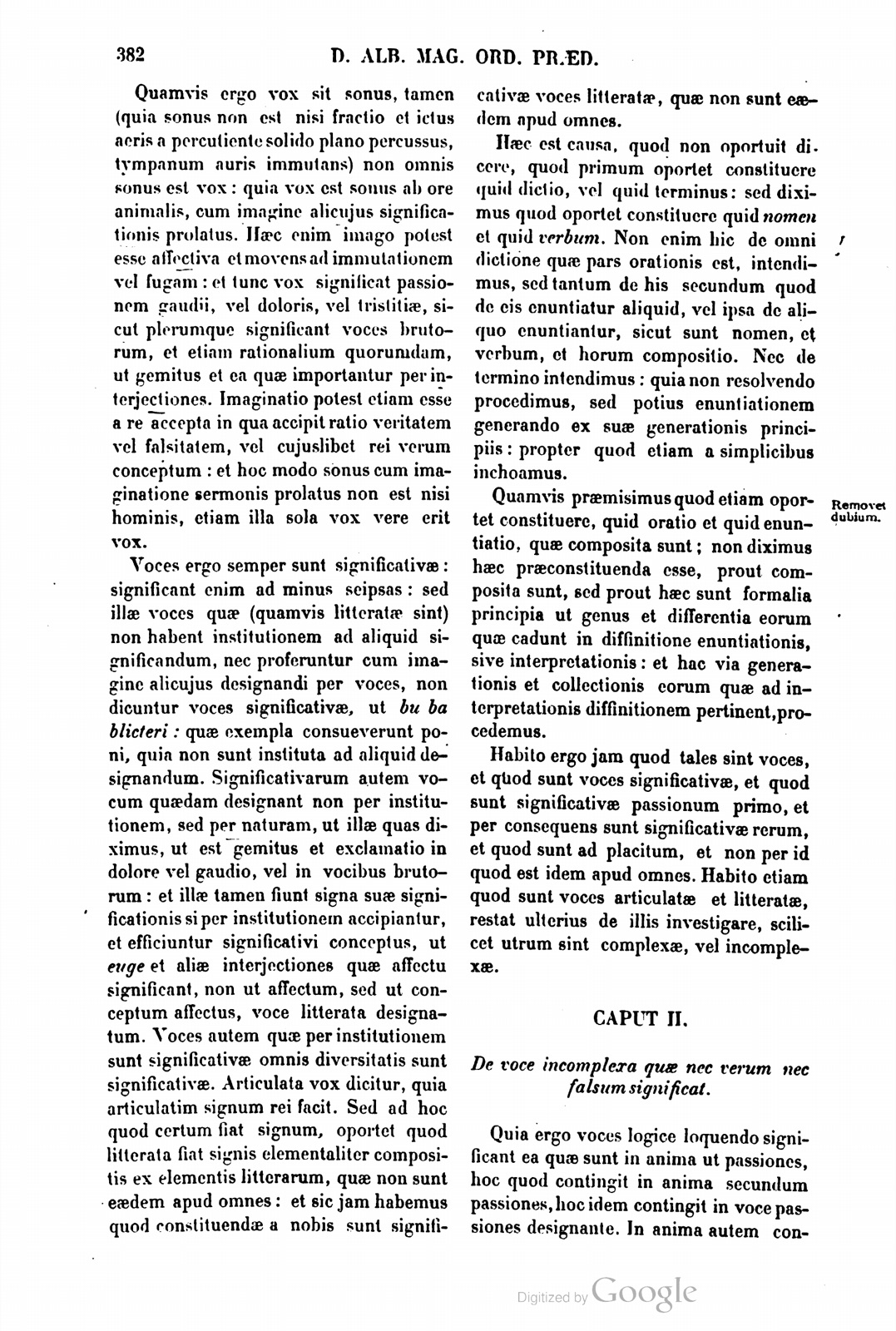
CAPUT II. De voce incomplexa quae nec verum nec falsum significat.
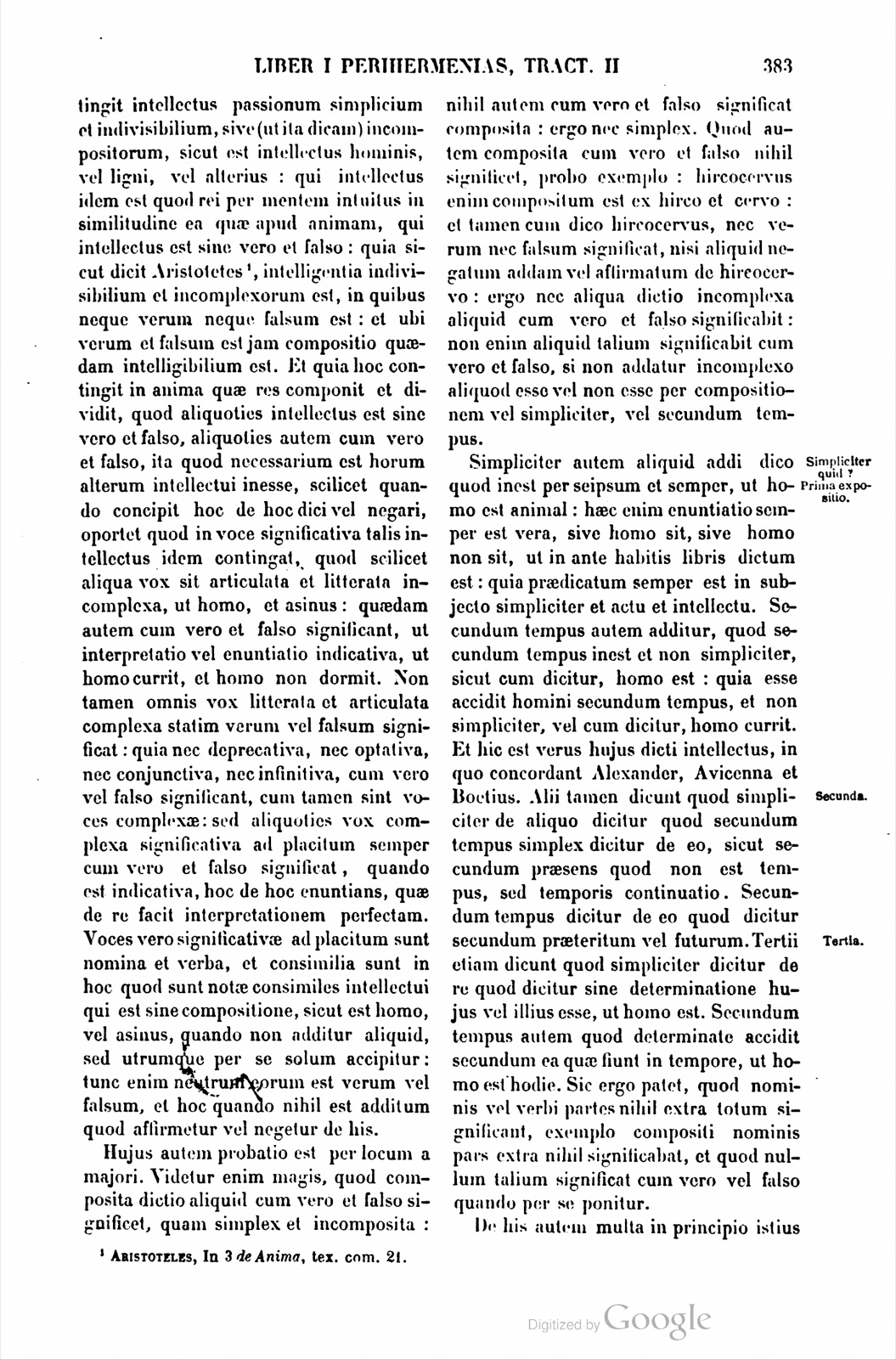
Quia ergo voces logice loquendo significant ea quae sunt in anima ut passiones, hoc quod contingit in anima secundum passiones, hoc idem contingit in voce passiones designante. In anima autem contingit intellectus passionum simplicium et indivisibilium, sive (ut ita dicam) incompositorum, sicut est intellectus hominis, vel ligni, vel alterius: qui intellectus idem est quod rei per mentem intuitus in similitudine ea quae apud animam, qui intellectus est sine vero et falso: quia sicut dicit Aristoteles 1, intelligentia indivisibilium et incomplexorum est, in quibus neque verum neque falsum est: et ubi verum et falsum est jam compositio quaedam intelligibilium est. Et quia hoc contingit in anima quae res componit et dividit, quod aliquoties intellectus est sine vero et falso, aliquoties autem cum vero et falso, ita quod necessarium est horum alterum intellectui inesse, scilicet quando concipit hoc de hoc dici vel negari, oportet quod in voce significativa talis intellectus idem contingat, quod scilicet aliqua vox sit articulata et litterata incomplexa, ut homo, et asinus: quaedam autem cum vero et falso significant, ut interpretatio vel enuntiatio indicativa, ut homo currit, et homo non dormit. Non tamen omnis vox litterata et articulata complexa statim verum vel falsum significat: quia nec deprecativa, nec optativa, nec conjunctiva, nec infinitiva, cum vero vel falso significant, cum tamen sint voces complexae: sed aliquoties vox complexa significativa ad placitum semper cum vero et falso significat, quando est indicativa, hoc de hoc enuntians, quae de re facit interpretationem perfectam.
Voces vero significativae ad placitum sunt nomina et verba, et consimilia sunt in hoc quod sunt notae consimiles intellectui qui est sine compositione, sicut est homo, vel asinus, quando non additur aliquid, sed utrumque per se solum accipitur: tunc enim neutrum eorum est verum vel falsum, et hoc quando nihil est additum quod affirmetur vel negetur de his.
Hujus autem probatio est per locum a majori. Videtur enim magis, quod composita dictio aliquid cum vero et falso significet, quam simplex et incomposita: nihil autem cum vero et falso significat composita: ergo nec simplex. Quod autem composita cum vero et falso nihil significet, probo exemplo: hircocervus enim compositum est ex hirco et cervo: et tamen cum dico hircocervus, nec verum nec falsum significat, nisi aliquid negatum addam vel affirmatum de hircocervo: ergo nec aliqua dictio incomplexa aliquid cum vero et falso significabit: non enim aliquid talium significabit cum vero et falso, si non addatur incomplexo aliquod esse vel non esse per compositionem vel simpliciter, vel secundum tempus.
CHAPTER II. On the incomplex vocal sound which signifies neither true nor false.
Therefore, because vocal sounds, speaking logically, signify those things which are in the soul as passions, the same thing which happens in the soul according to passions happens in the vocal sound designating the passions. But in the soul there occurs the understanding of simple and indivisible passions, or, so to speak, of incomposite ones, such as the understanding of human being, or wood, or another thing. This understanding is the same as the intuition of the thing through the mind in the likeness which is with the soul; and this understanding is without true and false, because, as Aristotle says 1, the understanding of indivisible and incomplex things is in those things in which there is neither true nor false; and where there is true and false, there is already a certain composition of intelligible things. And because this happens in the soul, which composes and divides things, namely that sometimes understanding is without true and false, but sometimes with true and false, so that one or the other of these must be in the understanding, namely when it conceives this to be said or denied of this, it is necessary that the same thing happen in significative vocal sound for such an understanding: namely, that some vocal sound be articulated and lettered and incomplex, as “human being” and “ass”; while certain vocal sounds signify with true and false, as interpretation or indicative enunciation, as “a human being runs” and “a human being does not sleep.” Yet not every complex lettered and articulated vocal sound immediately signifies true or false, because neither deprecative, nor optative, nor conjunctive, nor infinitive speech signifies with true or false, although they are complex vocal sounds. But sometimes a complex vocal sound significative by convention always signifies with true and false, when it is indicative, enunciating this of this, and so makes a perfect interpretation concerning the thing.
But vocal sounds significative by convention are nouns and verbs, and they are alike in this, that they are notes similar to the understanding which is without composition, as “human being” or “ass” is, when nothing is added but each is taken by itself alone. For then neither of them is true or false, and this is when nothing is added which is affirmed or denied of them.
The proof of this is through an argument from the greater. For it seems more likely that a composite diction signifies something with true and false than that a simple and incomposite one does; but a composite one signifies nothing with true and false; therefore neither does a simple one. That a composite signifies nothing with true and false I prove by an example: for hircocervus is composed from goat and stag, and yet when I say hircocervus, it signifies neither true nor false, unless I add something denied or affirmed of the hircocervus. Therefore no incomplex diction will signify anything with true and false. For none of such things will signify with true and false unless some being or non-being is added to the incomplex thing through composition, either simply or according to time.
Simpliciter autem aliquid addi dico quod inest per seipsum et semper, ut homo est animal: haec enim enuntiatio semper est vera, sive homo sit, sive homo non sit, ut in ante habitis libris dictum est: quia praedicatum semper est in subjecto simpliciter et actu et intellectu. Secundum tempus autem additur, quod secundum tempus inest et non simpliciter, sicut cum dicitur, homo est: quia esse accidit homini secundum tempus, et non simpliciter, vel cum dicitur, homo currit. Et hic est verus hujus dicti intellectus, in quo concordant Alexander, Avicenna et Boetius. Alii tamen dicunt quod simpliciter de aliquo dicitur quod secundum tempus simplex dicitur de eo, sicut secundum praesens quod non est tempus, sed temporis continuatio. Secundum tempus dicitur de eo quod dicitur secundum praeteritum vel futurum. Tertii etiam dicunt quod simpliciter dicitur de re quod dicitur sine determinatione hujus vel illius esse, ut homo est. Secundum tempus autem quod determinate accidit secundum ea quae fiunt in tempore, ut homo est hodie. Sic ergo patet, quod nominis vel verbi partes nihil extra totum significant, exemplo compositi nominis pars extra nihil significabat, et quod nullum talium significat cum vero vel falso quando per se ponitur.
De his autem multa in principio istius nostrae logicae dicta sunt: nihil enim dicitur significare quod de intellectu sui totius nihil significat, sicut cum dicitur dominus, neque do syllaba, neque mi, neque nus, aliquid significant de intellectu totius, vel secundum partem vel secundum totum. Sic etiam cum dicitur hircocervus, nec hircus nec cervus aliquid significant de intellectu totius: hircus enim non significat partem quae est hircus, et cervus aliam partem, sed utrumque per se nihil de toto significat, sed ambo conjuncta significant indivisibilem intellectum hircocervi totius.
Adhuc autem ut omnia ista facilius intelligantur, revocandum est ad memoriam quod in scientia Universalium dictum est: ibi enim dictum est quod compositionis in voce causa est inhaerentia, qua unum secundum rem inest alii. Et quamvis in re unum secundum rem inest alii sine aliqua media compositione, tamen intellectus nec sibi nec alii significare potest hoc sermone interiori apud se, nec voce exteriori apud alium, nisi ponat unum dici de alio mediante compositione, quam compositionem primo facit intellectus componens, et sicut facit eam apud se, ita designat eam per sermonem extrinsecum apud alium. Et quia hoc quod est apud intellectum sermo nuntiat per signum, ideo sermo exterior apud Graecos angelus intelligentiae vocatur. Et quia compositio primo est in anima, ideo dicit Aristoteles quod ubi verum et falsum est, jam compositio quaedam intellectuum est. Et in sexto philosophiae primae 2 dicit quod verum et falsum sunt in anima: sicut enim in agente compositio est in anima: sicut in signo autem est in voce enuntiativa; sicut autem in causa est in rebus extra: quia hoc quod unum est in alio in rebus extra, hoc est causa compositionis.
But I say that something is added simply when it belongs through itself and always, as “a human being is an animal”; for this enunciation is always true, whether a human being exists or does not exist, as was said in the books had before, because the predicate is always in the subject simply and in act and in understanding. But something is added according to time when it belongs according to time and not simply, as when it is said, “a human being is,” because being happens to a human being according to time and not simply, or when it is said, “a human being runs.” And this is the true understanding of this saying, in which Alexander, Avicenna, and Boethius agree. Yet others say that something is said simply of something when what is simple according to time is said of it, as according to the present, which is not time but the continuation of time. Something is said according to time of what is said according to past or future. A third group also says that something is said simply of a thing when it is said without determination of this or that being, as “a human being is.” But according to time is that which happens determinately according to those things which come to be in time, as “a human being is today.” Thus, therefore, it is clear that the parts of noun or verb signify nothing outside the whole, since by the example of a composite name a part outside signified nothing, and that none of such things signifies with true or false when it is posited by itself.
But many things about these matters have been said at the beginning of this logic of ours: for nothing is said to signify if it signifies nothing of the understanding of its whole, as when dominus is said, neither the syllable do, nor mi, nor nus signifies anything of the understanding of the whole, either according to part or according to whole. Thus also when hircocervus is said, neither hircus nor cervus signifies anything of the understanding of the whole: for hircus does not signify the part which is goat and cervus another part; rather each by itself signifies nothing of the whole, but both joined together signify the indivisible understanding of the whole hircocervus.
Further, so that all these things may be understood more easily, one must recall to memory what was said in the science of the Universals. For there it was said that the cause of composition in vocal sound is inherence, by which one thing according to reality is in another. And although in the thing one thing according to reality is in another without any intermediate composition, nevertheless the intellect can signify this neither to itself nor to another, neither by interior speech with itself nor by exterior vocal sound with another, unless it posits one thing to be said of another by means of composition. This composition the composing intellect first makes; and just as it makes it with itself, so it designates it through extrinsic speech with another. And because speech announces by a sign what is with the intellect, therefore exterior speech among the Greeks is called the angel of intelligence. And because composition is first in the soul, therefore Aristotle says that where true and false are, there is already a certain composition of understandings. And in the sixth book of First Philosophy 2 he says that true and false are in the soul: for as in an agent composition is in the soul, so as in a sign it is in enunciative vocal sound; but as in a cause it is in external things, because the fact that one thing is in another in external things is the cause of composition.
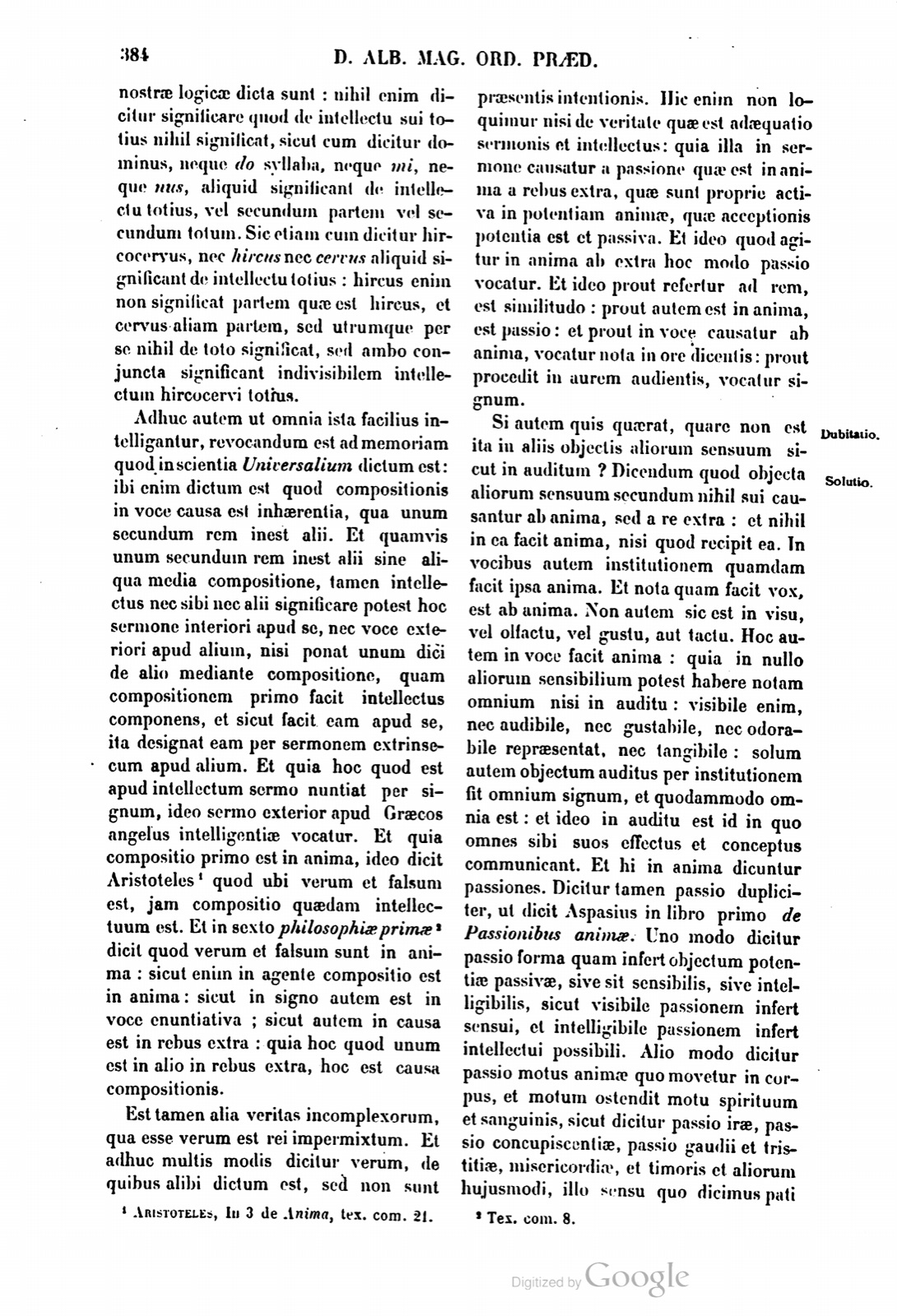
Est tamen alia veritas incomplexorum, qua esse verum est rei impermixtum. Et adhuc multis modis dicitur verum, de quibus alibi dictum est, sed non sunt praesentis intentionis. Hic enim non loquimur nisi de veritate quae est adaequatio sermonis et intellectus: quia illa in sermone causatur a passione quae est in anima a rebus extra, quae sunt proprie activa in potentiam animae, quae acceptionis potentia est et passiva. Et ideo quod agitur in anima ab extra hoc modo passio vocatur. Et ideo prout refertur ad rem, est similitudo: prout autem est in anima, est passio: et prout in voce causatur ab anima, vocatur nota in ore dicentis: prout procedit in aurem audientis, vocatur signum.
Si autem quis quaerat, quare non est ita in aliis objectis aliorum sensuum sicut in auditum? Dicendum quod objecta aliorum sensuum secundum nihil sui causantur ab anima, sed a re extra: et nihil in ea facit anima, nisi quod recipit ea. In vocibus autem institutionem quamdam facit ipsa anima. Et nota quam facit vox, est ab anima. Non autem sic est in visu, vel olfactu, vel gustu, aut tactu. Hoc autem in voce facit anima: quia in nullo aliorum sensibilium potest habere notam omnium nisi in auditu: visibile enim, nec audibile, nec gustabile, nec odorabile repraesentat, nec tangibile: solum autem objectum auditus per institutionem fit omnium signum, et quodammodo omnia est: et ideo in auditu est id in quo omnes sibi suos effectus et conceptus communicant. Et hi in anima dicuntur passiones. Dicitur tamen passio dupliciter, ut dicit Aspasius in libro primo de Passionibus animae. Uno modo dicitur passio forma quam infert objectum potentiae passivae, sive sit sensibilis, sive intelligibilis, sicut visibile passionem infert sensui, et intelligibile passionem infert intellectui possibili. Alio modo dicitur passio motus animae quo movetur in corpus, et motum ostendit motu spirituum et sanguinis, sicut dicitur passio irae, passio concupiscentiae, passio gaudii et tristitiae, misericordiae, et timoris et aliorum hujusmodi, illo sensu quo dicimus pati
There is nevertheless another truth of incomplex things, by which true being is the unmingled being of the thing. And true is said in many further ways, about which it has been said elsewhere, but they do not belong to the present intention. For here we speak only about truth which is the adequation of speech and understanding, because that truth in speech is caused by a passion which is in the soul from external things, which are properly active upon the power of the soul, which is a power of receiving and is passive. And therefore what is acted in the soul from without in this way is called a passion. And therefore, insofar as it is referred to the thing, it is a likeness; but insofar as it is in the soul, it is a passion; and insofar as it is caused in vocal sound by the soul, it is called a note in the mouth of the speaker; insofar as it proceeds into the ear of the hearer, it is called a sign.
But if someone asks why it is not so in the other objects of the other senses as in hearing, it must be said that the objects of the other senses are caused according to nothing of themselves by the soul, but by the external thing; and the soul does nothing in them except receive them. But in vocal sounds the soul itself makes a certain institution. And the note which vocal sound makes is from the soul. But it is not so in sight, smell, taste, or touch. The soul does this in vocal sound because in none of the other sensible things can it have the note of all things except in hearing. For the visible represents neither the audible, nor the tasteable, nor the smellable, nor the tangible; but only the object of hearing, through institution, becomes the sign of all things, and in some way is all things. And therefore in hearing there is that in which all communicate to themselves their effects and concepts. And these in the soul are called passions. Yet passion is said in two ways, as Aspasius says in the first book On the Passions of the Soul. In one way, passion is called the form which an object introduces into a passive power, whether it is sensible or intelligible, as the visible introduces a passion into sense, and the intelligible introduces a passion into the possible intellect. In another way, passion is called a motion of the soul by which it is moved into the body, and it shows the motion by the motion of spirits and blood, as the passion of anger, the passion of desire, the passion of joy and sadness, of mercy, of fear, and of other things of this sort are spoken of, in that sense in which we say to suffer
If a page does not appear, its photograph has not been uploaded yet.