Works › On Interpretation, Books I–II
Volume 1 · pp. 380–382
Tractate II. Chapter I. On the defining things that are the principle of enunciation.
A marker with ≈ is an approximate page boundary, placed by measure of the text; the page photographs remain the authority. In the paired views, clicking a page marker brings that page into view.
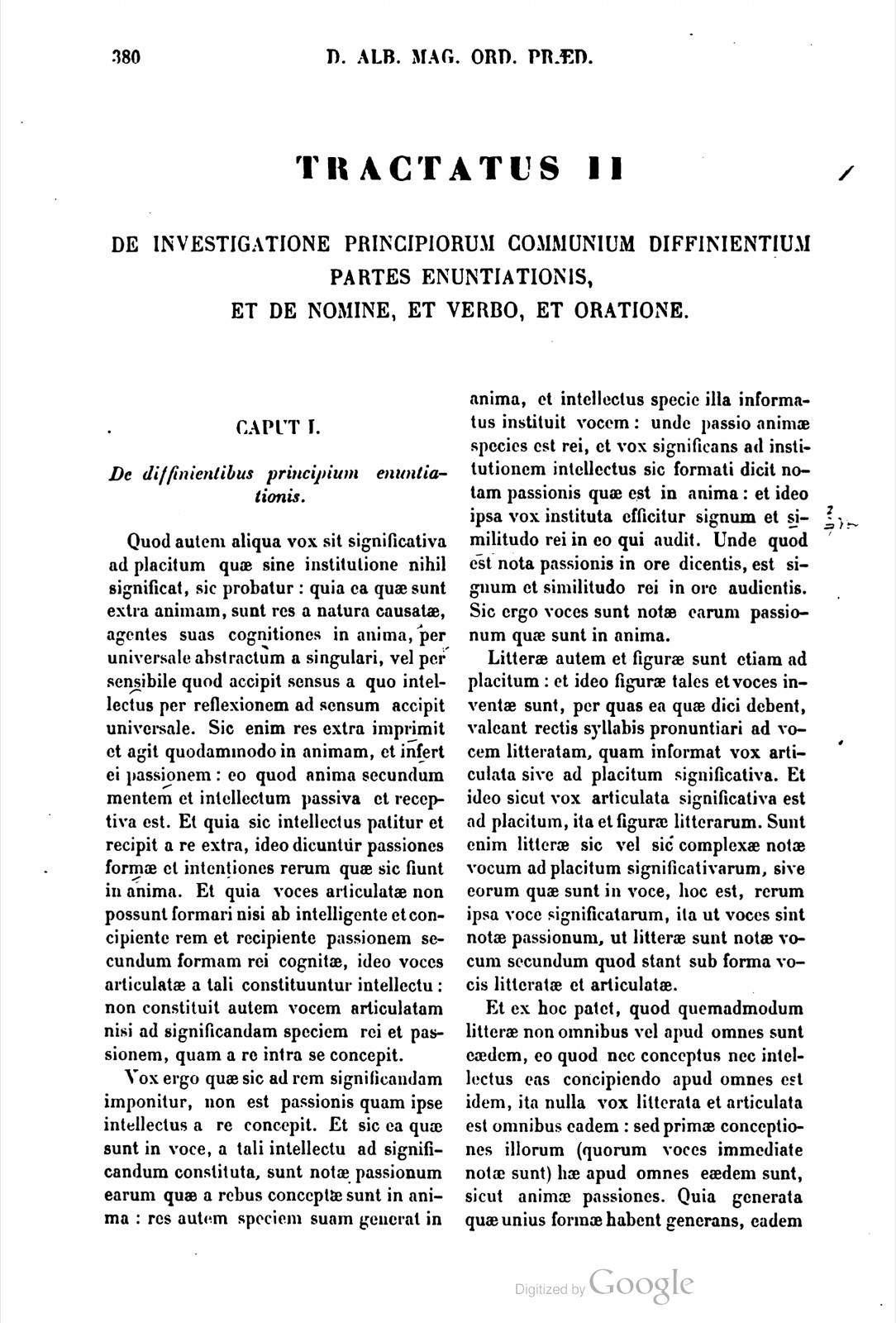
TRACTATUS II. DE INVESTIGATIONE PRINCIPIORUM COMMUNIUM DIFFINIENTIUM PARTES ENUNTIATIONIS, ET DE NOMINE, ET VERBO, ET ORATIONE. CAPUT I. De diffinientibus principium enuntiationis.
Quod autem aliqua vox sit significativa ad placitum quae sine institutione nihil significat, sic probatur: quia ea quae sunt extra animam, sunt res a natura causatae, agentes suas cognitiones in anima, per universale abstractum a singulari, vel per sensibile quod accipit sensus a quo intellectus per reflexionem ad sensum accipit universale. Sic enim res extra imprimit et agit quodammodo in animam, et infert ei passionem: eo quod anima secundum mentem et intellectum passiva et receptiva est. Et quia sic intellectus patitur et recipit a re extra, ideo dicuntur passiones formae et intentiones rerum quae sic fiunt in anima. Et quia voces articulatae non possunt formari nisi ab intelligente et concipiente rem et recipiente passionem secundum formam rei cognitae, ideo voces articulatae a tali constituuntur intellectu: non constituit autem vocem articulatam nisi ad significandam speciem rei et passionem, quam a re intra se concepit.
Vox ergo quae sic ad rem significandam imponitur, nota est passionis quam ipse intellectus a re concepit. Et sic ea quae sunt in voce, a tali intellectu ad significandum constituta, sunt notae passionum earum quae a rebus conceptae sunt in anima: res autem speciem suam generat in anima, et intellectus specie illa informatus instituit vocem: unde passio animae species est rei, et vox significans ad institutionem intellectus sic formati dicit notam passionis quae est in anima: et ideo ipsa vox instituta efficitur signum et similitudo rei in eo qui audit. Unde quod est nota passionis in ore dicentis, est signum et similitudo rei in ore audientis. Sic ergo voces sunt notae earum passionum quae sunt in anima.
Litterae autem et figurae sunt etiam ad placitum: et ideo figurae tales et voces inventae sunt, per quas ea quae dici debent, valeant rectis syllabis pronuntiari ad vocem litteratam, quam informat vox articulata sive ad placitum significativa. Et ideo sicut vox articulata significativa est ad placitum, ita et figurae litterarum. Sunt enim litterae sic vel sic complexae notae vocum ad placitum significativarum, sive eorum quae sunt in voce, hoc est, rerum ipsa voce significatarum, ita ut voces sint notae passionum, ut litterae sunt notae vocum secundum quod stant sub forma vocis litteratae et articulatae.
Et ex hoc patet, quod quemadmodum litterae non omnibus vel apud omnes sunt eaedem, eo quod nec conceptus nec intellectus eas concipiendo apud omnes est idem, ita nulla vox litterata et articulata est omnibus eadem: sed primae conceptiones illorum (quorum voces immediate notae sunt) hae apud omnes eaedem sunt, sicut animae passiones. Quia generata quae unius formae habent generans, eadem sunt in forma et specie, passiones sunt similitudines rerum in anima. Res vero se habent in anima per similitudinem generantis. Cum ergo res ubique et apud omnes sunt eaedem, easdem in specie generabunt passiones, et ideo conceptiones ad omnes res recte concipiendas eaedem sunt in specie. Et similiter etiam res apud omnes et ubique sunt in specie, quarum passiones animae sunt notae: quia rerum sunt similitudines in animalibus a rebus generatae. Institutio autem nostra nihil variat in rebus naturae. De talibus autem qualiter a rebus rerum similitudines generantur in anima, tertio libro de Anima 1 satis dictum est, ubi determinatum est quod res non sunt in anima, sed similitudines rerum. Alterius enim negotii sunt illa, et ad physicum pertinent.
TRACTATE II. ON THE INVESTIGATION OF THE COMMON PRINCIPLES DEFINING THE PARTS OF ENUNCIATION, AND ON NOUN, VERB, AND SPEECH. CHAPTER I. On the defining things that are the principle of enunciation.
That some vocal sound is significative by convention, and without institution signifies nothing, is proved thus: because those things which are outside the soul are things caused by nature, causing their cognitions in the soul through the universal abstracted from the singular, or through the sensible which sense receives, from which the intellect, by reflection upon sense, receives the universal. For in this way the external thing impresses and in some way acts upon the soul, and introduces a passion into it, because the soul according to mind and intellect is passive and receptive. And because the intellect is thus affected and receives from the external thing, therefore the forms and intentions of things which are thus made in the soul are called passions. And because articulated vocal sounds cannot be formed except by one understanding and conceiving a thing and receiving a passion according to the form of the known thing, therefore articulated vocal sounds are constituted by such an intellect. But it does not constitute an articulated vocal sound except for signifying the species of the thing and the passion which it has conceived within itself from the thing.
Therefore a vocal sound which is thus imposed for signifying a thing is a note of the passion which the intellect itself has conceived from the thing. And thus those things which are in vocal sound, constituted for signifying by such an intellect, are notes of those passions which have been conceived from things in the soul. But the thing generates its species in the soul, and the intellect, informed by that species, institutes the vocal sound. Whence the passion of the soul is the species of the thing, and the vocal sound signifying according to the institution of the intellect so formed expresses a note of the passion which is in the soul. And therefore the instituted vocal sound itself becomes a sign and likeness of the thing in the one who hears. Whence what is a note of the passion in the mouth of the speaker is a sign and likeness of the thing in the ear of the hearer. Thus, therefore, vocal sounds are notes of those passions which are in the soul.
Letters, however, and figures are also by convention; and therefore such figures and vocal sounds were invented through which those things which must be said may be pronounced in right syllables according to a lettered vocal sound, which the articulated vocal sound, or the vocal sound significative by convention, informs. And therefore, just as an articulated significative vocal sound is by convention, so also are the figures of letters. For letters, complexed in this or that way, are notes of vocal sounds significative by convention, or of those things which are in vocal sound, that is, of things signified by the vocal sound itself, so that vocal sounds are notes of passions, as letters are notes of vocal sounds according as they stand under the form of lettered and articulated vocal sound.
And from this it is clear that, just as letters are not the same for all or among all, because neither the conception nor the intellect in conceiving them is the same among all, so no lettered and articulated vocal sound is the same for all; but the first conceptions of those things of which vocal sounds are immediate notes are the same among all, just as the passions of the soul are. Because things generated which have one generator of one form are the same in form and species, passions are likenesses of things in the soul. But things are in the soul through the likeness of the generator. Therefore, since things everywhere and among all are the same, they will generate the same passions in species; and therefore the conceptions for rightly conceiving all things are the same in species. And similarly also things, of which the passions of the soul are notes, are in species among all and everywhere, because they are likenesses of things in animals, generated by things. But our institution changes nothing in the things of nature. Concerning such matters, how likenesses of things are generated from things in the soul, enough has been said in the third book On the Soul 1, where it was determined that things are not in the soul, but likenesses of things. For those matters belong to another business and pertain to the natural philosopher.
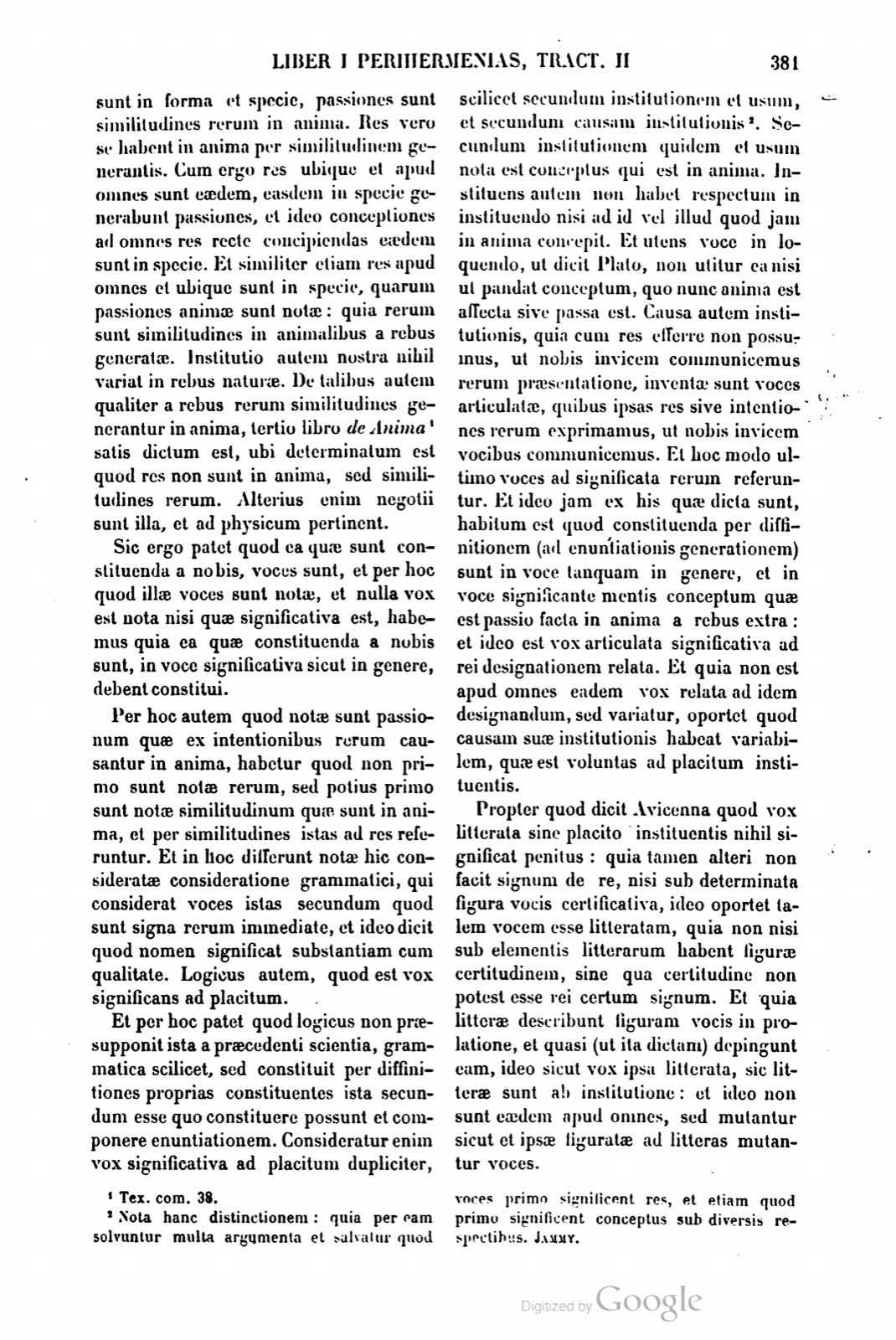
Sic ergo patet quod ea quae sunt constituenda a nobis, voces sunt, et per hoc quod illae voces sunt notae, et nulla vox est nota nisi quae significativa est, habemus quia ea quae constituenda a nobis sunt, in voce significativa sicut in genere, debent constitui.
Per hoc autem quod notae sunt passionum quae ex intentionibus rerum causantur in anima, habetur quod non primo sunt notae rerum, sed potius primo sunt notae similitudinum quae sunt in anima, et per similitudines istas ad res referuntur. Et in hoc differunt notae hic consideratae consideratione grammatici, qui considerat voces istas secundum quod sunt signa rerum immediate, et ideo dicit quod nomen significat substantiam cum qualitate. Logicus autem, quod est vox significans ad placitum.
Et per hoc patet quod logicus non praesupponit ista a praecedenti scientia, grammatica scilicet, sed constituit per diffinitiones proprias constituentes ista secundum esse quo constituere possunt et componere enuntiationem. Consideratur enim vox significativa ad placitum dupliciter, scilicet secundum institutionem et usum, et secundum causam institutionis 2. Secundum institutionem quidem et usum nota est conceptus qui est in anima. Instituens autem non habet respectum in instituendo nisi ad id vel illud quod jam in anima concepit. Et utens voce in loquendo, ut dicit Plato, non utitur ea nisi ut pandat conceptum, quo nunc anima est affecta sive passa est. Causa autem institutionis, quia cum res efferre non possumus, ut nobis invicem communicemus rerum praesentatione, inventae sunt voces articulatae, quibus ipsas res sive intentiones rerum exprimamus, ut nobis invicem vocibus communicemus. Et hoc modo ultimo voces ad significata rerum referuntur. Et ideo jam ex his quae dicta sunt, habitum est quod constituenda per diffinitionem (ad enuntiationis generationem) sunt in voce tanquam in genere, et in voce significante mentis conceptum quae est passio facta in anima a rebus extra: et ideo est vox articulata significativa ad rei designationem relata. Et quia non est apud omnes eadem vox relata ad idem designandum, sed variatur, oportet quod causam suae institutionis habeat variabilem, quae est voluntas ad placitum instituentis.
Propter quod dicit Avicenna quod vox litterata sine placito instituentis nihil significat penitus: quia tamen alteri non facit signum de re, nisi sub determinata figura vocis certificativa, ideo oportet talem vocem esse litteratam, quia non nisi sub elementis litterarum habent figurae certitudinem, sine qua certitudine non potest esse rei certum signum. Et quia litterae describunt figuram vocis in prolatione, et quasi (ut ita dictam) depingunt eam, ideo sicut vox ipsa litterata, sic litterae sunt ab institutione: et ideo non sunt eaedem apud omnes, sed mutantur sicut et ipsae figuratae ad litteras mutantur voces.
Quamvis ergo vox sit sonus, tamen (quia sonus non est nisi fractio et ictus aeris a percutiente solido plano percussus, tympanum auris immutans) non omnis sonus est vox: quia vox est sonus ab ore animalis, cum imagine alicujus significationis prolatus. Haec enim imago potest esse affectiva et movens ad immutationem vel fugam: et tunc vox significat passionem gaudii, vel doloris, vel tristitiae, sicut plerumque significant voces brutorum, et etiam rationalium quorumdam, ut gemitus et ea quae importantur per interjectiones. Imaginatio potest etiam esse a re accepta in qua accipit ratio veritatem vel falsitatem, vel cujuslibet rei verum conceptum: et hoc modo sonus cum imaginatione sermonis prolatus non est nisi hominis, etiam illa sola vox vere erit vox.
Thus, therefore, it is clear that the things to be constituted by us are vocal sounds; and through the fact that those vocal sounds are notes, and no vocal sound is a note except one that is significative, we have that the things to be constituted by us must be constituted in significative vocal sound as in a genus.
But through the fact that they are notes of passions which are caused in the soul from the intentions of things, it is held that they are not first notes of things, but rather first notes of the likenesses which are in the soul, and through those likenesses they are referred to things. And in this the notes considered here differ from the consideration of the grammarian, who considers those vocal sounds according as they are signs of things immediately, and therefore says that a noun signifies substance with quality. But the logician says that it is a vocal sound signifying by convention.
And through this it is clear that the logician does not presuppose these things from a preceding science, namely grammar, but constitutes them through proper definitions constituting these things according to the being by which they can constitute and compose enunciation. For vocal sound significative by convention is considered in two ways: namely according to institution and use, and according to the cause of institution 2. According to institution and use, it is a note of the concept which is in the soul. But the one instituting has no regard in instituting except to this or that which he has already conceived in the soul. And the one using vocal sound in speaking, as Plato says, uses it only to disclose the concept by which the soul is now affected or has been acted upon. But the cause of institution is that, since we cannot carry out things themselves so that we may communicate with one another by the presentation of things, articulated vocal sounds were invented by which we may express the things themselves or the intentions of things, so that we may communicate with one another by vocal sounds. And in this final way vocal sounds are referred to the significates of things. Therefore now from the things which have been said it has been held that the things to be constituted through definition, for the generation of enunciation, are in vocal sound as in a genus, and in vocal sound signifying the concept of the mind, which is a passion made in the soul by external things. And therefore it is articulated vocal sound significative and referred to the designation of a thing. And because the same vocal sound referred to designating the same thing is not the same among all, but is varied, it must have a variable cause of its institution, which is the will of the one instituting by convention.
On this account Avicenna says that lettered vocal sound without the convention of the one instituting signifies utterly nothing. Yet because it does not make a sign of a thing to another except under a determinate certificative figure of vocal sound, such a vocal sound must be lettered, because figures have certainty only under the elements of letters; without that certainty there cannot be a certain sign of the thing. And because letters describe the figure of the vocal sound in utterance, and, as it were, paint it, so to speak, therefore, just as the lettered vocal sound itself is from institution, so also letters are from institution; and therefore they are not the same among all, but are changed just as the vocal sounds themselves figured according to letters are changed.
Therefore, although vocal sound is sound, nevertheless, because sound is nothing but a breaking and blow of air struck by a solid, flat striker, changing the drum of the ear, not every sound is vocal sound; because vocal sound is sound uttered from the mouth of an animal, with the image of some signification. For this image can be affective and moving toward alteration or flight; and then vocal sound signifies the passion of joy, pain, or sadness, as the vocal sounds of brute animals mostly signify, and also of certain rational beings, as groaning and those things which are conveyed through interjections. The imagination can also be received from a thing, in which reason receives truth or falsity, or the true concept of any thing; and in this way sound uttered with the imagination of speech belongs only to a human being, and that vocal sound alone will truly be vocal sound.
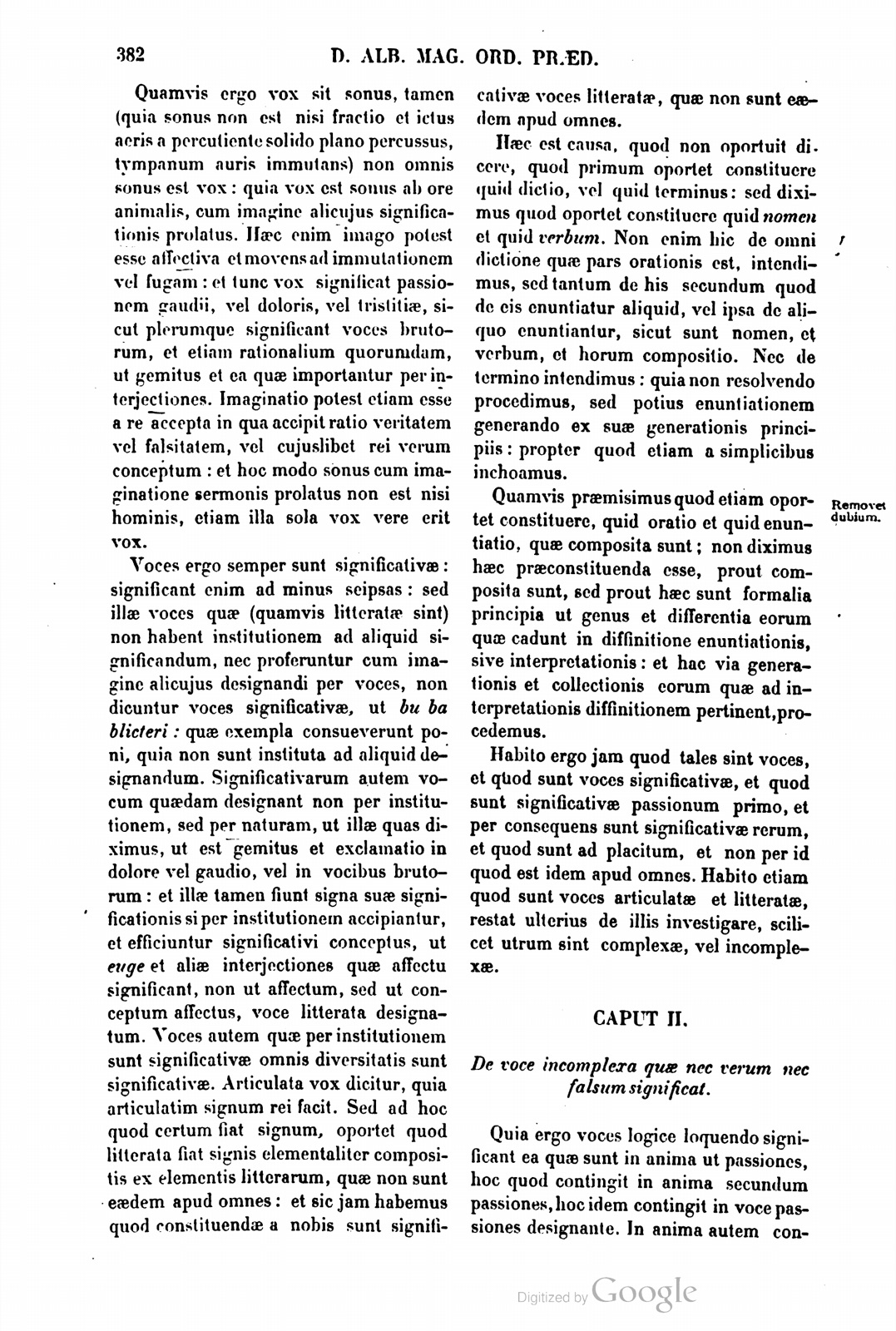
Voces ergo semper sunt significativae: significant enim ad minus seipsas: sed illae voces quae (quamvis litteratae sint) non habent institutionem ad aliquid significandum, nec proferuntur cum imagine alicujus designandi per voces, non dicuntur voces significativae, ut bu ba blicteri: quae exempla consueverunt poni, quia non sunt instituta ad aliquid designandum. Significativarum autem vocum quaedam designant non per institutionem, sed per naturam, ut illae quas diximus, ut est gemitus et exclamatio in dolore vel gaudio, vel in vocibus brutorum: et illae tamen fiunt signa suae significationis si per institutionem accipiantur, et efficiuntur significativi conceptus, ut euge et aliae interjectiones quae affectu significant, non ut affectum, sed ut conceptum affectus, voce litterata designatum. Voces autem quae per institutionem sunt significativae omnis diversitatis sunt significativae. Articulata vox dicitur, quia articulatim signum rei facit. Sed ad hoc quod certum fiat signum, oportet quod litterata fiat signis elementaliter compositis ex elementis litterarum, quae non sunt eaedem apud omnes: et sic jam habemus quod constituendae a nobis sunt significativae voces litteratae, quae non sunt eaedem apud omnes.
Haec est causa, quod non oportuit dicere, quod primum oportet constituere quid dictio, vel quid terminus: sed diximus quod oportet constituere quid nomen et quid verbum. Non enim hic de omni dictione quae pars orationis est, intendimus, sed tantum de his secundum quod de eis enuntiatur aliquid, vel ipsa de aliquo enuntiantur, sicut sunt nomen, et verbum, et horum compositio. Nec de termino intendimus: quia non resolvendo procedimus, sed potius enuntiationem generando ex suae generationis principiis: propter quod etiam a simplicibus inchoamus.
Quamvis praemisumus quod etiam oportet constituere, quid oratio et quid enuntiatio, quae composita sunt; non diximus haec praeconstituenda esse, prout composita sunt, sed prout haec sunt formalia principia ut genus et differentia eorum quae cadunt in diffinitione enuntiationis, sive interpretationis: et hac via generationis et collectionis eorum quae ad interpretationis diffinitionem pertinent, procedemus.
Habito ergo jam quod tales sint voces, et quod sunt voces significativae, et quod sunt significativae passionum primo, et per consequens sunt significativae rerum, et quod sunt ad placitum, et non per id quod est idem apud omnes. Habito etiam quod sunt voces articulatae et litteratae, restat ulterius de illis investigare, scilicet utrum sint complexae, vel incomplexae.
Therefore vocal sounds are always significative, for they signify at least themselves. But those vocal sounds which, although they are lettered, do not have institution for signifying something, nor are uttered with the image of something to be designated by vocal sounds, are not called significative vocal sounds, as bu ba blicteri; these examples have customarily been posited because they are not instituted for designating anything. But among significative vocal sounds some designate not by institution but by nature, as those which we have mentioned, such as groaning and exclamation in pain or joy, or in the vocal sounds of brute animals. And nevertheless these become signs of their signification if they are received through institution, and become significative concepts, as euge and other interjections which signify by affect, not as affect, but as a concept of affect designated by a lettered vocal sound. But vocal sounds which are significative through institution are significative of every diversity. Articulated vocal sound is so called because it makes a sign of a thing articulately. But in order that it become a certain sign, it must become lettered by signs elementally composed from the elements of letters, which are not the same among all; and so now we have that what must be constituted by us are significative lettered vocal sounds, which are not the same among all.
This is the reason why it was not necessary to say that first one must constitute what diction is, or what term is; instead we said that one must constitute what noun is and what verb is. For here we do not intend every diction which is a part of speech, but only these according as something is enunciated about them, or they themselves are enunciated about something, as are noun and verb and the composition of these. Nor do we intend term, because we proceed not by resolving but rather by generating enunciation from the principles of its generation; on account of this we also begin from simple things.
Although we have set beforehand that one must also constitute what speech is and what enunciation is, which are composite things, we did not say that these must be preconstituted insofar as they are composite, but insofar as they are formal principles as genus and difference of those things which fall into the definition of enunciation or interpretation. And by this way of generation and collection of the things which pertain to the definition of interpretation, we shall proceed.
Therefore, now that it has been held that vocal sounds are such, that they are significative vocal sounds, that they are first significative of passions and consequently significative of things, and that they are by convention and not through what is the same among all, and now that it has also been held that they are articulated and lettered vocal sounds, it remains to investigate further about them, namely whether they are complex or incomplex.
Notes
- Text commentary 38. (Tex. com. 38.) ↩
- Note this distinction, because through it many arguments are solved and it is preserved both that vocal sounds first signify things and also that they first signify concepts under diverse respects. Jammy. (Nota hanc distinctionem: quia per eam solvuntur multa argumenta et salvatur quod voces primo significant res, et etiam quod primo significant conceptus sub diversis respectibus. JAMMY.) ↩
If a page does not appear, its photograph has not been uploaded yet.