Works › On Interpretation, Books I–II
Volume 1 · pp. 378–379
Chapter III. On the proemial part.
A marker with ≈ is an approximate page boundary, placed by measure of the text; the page photographs remain the authority. In the paired views, clicking a page marker brings that page into view.
CAPUT III. De parte proaemiali.
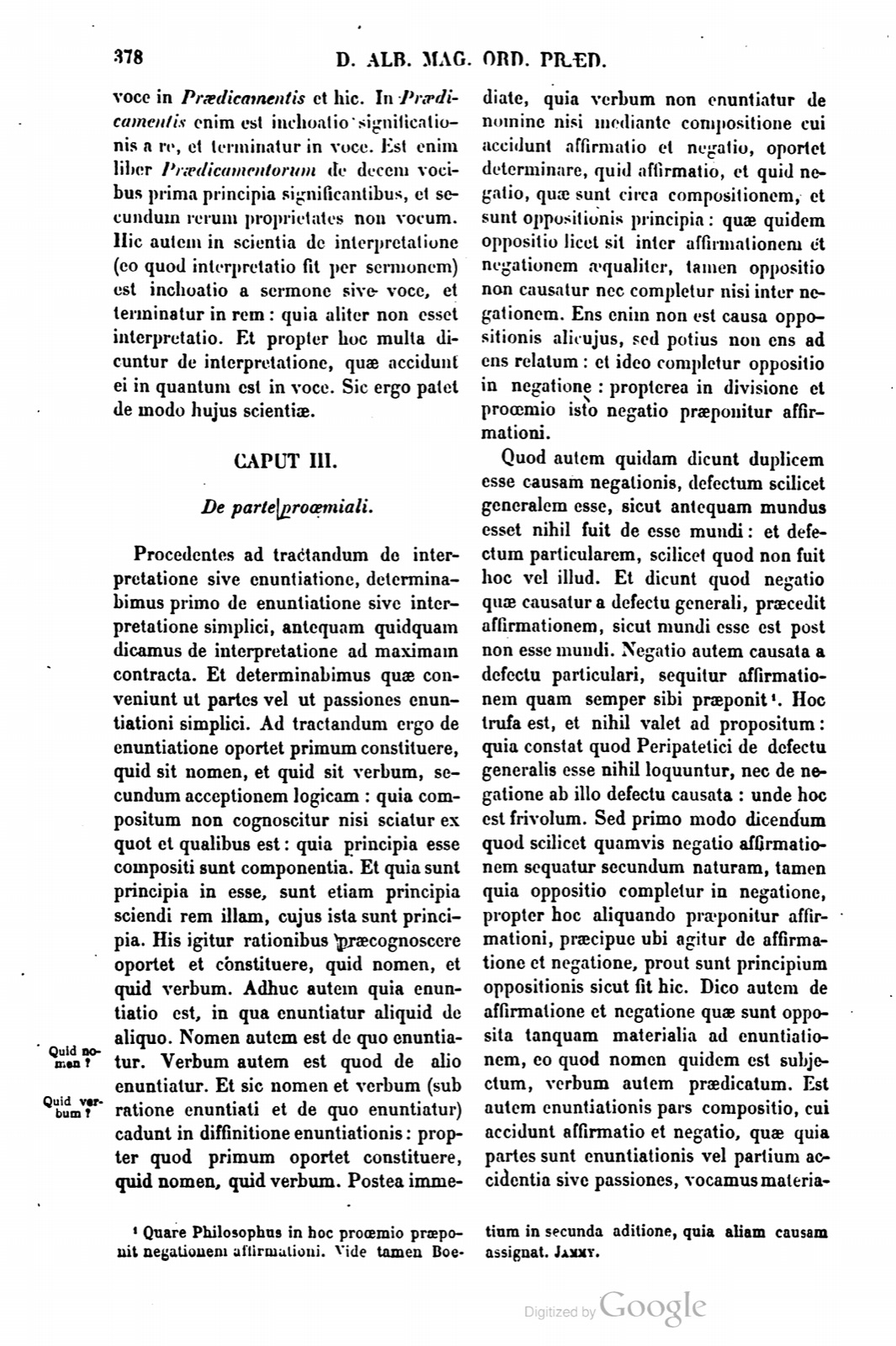
Procedentes ad tractandum de interpretatione sive enuntiatione, determinabimus primo de enuntiatione sive interpretatione simplici, antequam quidquam dicamus de interpretatione ad maximam contracta. Et determinabimus quae conveniunt ut partes vel ut passiones enuntiationi simplici. Ad tractandum ergo de enuntiatione oportet primum constituere, quid sit nomen, et quid sit verbum, secundum acceptionem logicam: quia compositum non cognoscitur nisi sciatur ex quot et qualibus est: quia principia esse compositi sunt componentia. Et quia sunt principia in esse, sunt etiam principia sciendi rem illam, cujus ista sunt principia. His igitur rationibus praecognoscere oportet et constituere, quid nomen, et quid verbum. Adhuc autem quia enuntiatio est, in qua enuntiatur aliquid de aliquo. Nomen autem est de quo enuntiatur. Verbum autem est quod de alio enuntiatur. Et sic nomen et verbum (sub ratione enuntiati et de quo enuntiatur) cadunt in diffinitione enuntiationis: propter quod primum oportet constituere, quid nomen, quid verbum. Postea immediate, quia verbum non enuntiatur de nomine nisi mediante compositione cui accidunt affirmatio et negatio, oportet determinare, quid affirmatio, et quid negatio, quae sunt circa compositionem, et sunt oppositionis principia: quae quidem oppositio licet sit inter affirmationem et negationem aequaliter, tamen oppositio non causatur nec completur nisi inter negationem. Ens enim non est causa oppositionis alicujus, sed potius non ens ad ens relatum: et ideo completur oppositio in negatione: propterea in divisione et prooemio isto negatio praeponitur affirmationi.
Quod autem quidam dicunt duplicem esse causam negationis, defectum scilicet generalem esse, sicut antequam mundus esset nihil fuit de esse mundi: et defectum particularem, scilicet quod non fuit hoc vel illud. Et dicunt quod negatio quae causatur a defectu generali, praecedit affirmationem, sicut mundi esse est post non esse mundi. Negatio autem causata a defectu particulari, sequitur affirmationem quam semper sibi praeponit 1. Hoc trufa est, et nihil valet ad propositum: quia constat quod Peripatetici de defectu generalis esse nihil loquuntur, nec de negatione ab illo defectu causata: unde hoc est frivolum. Sed primo modo dicendum quod scilicet quamvis negatio affirmationem sequatur secundum naturam, tamen quia oppositio completur in negatione, propter hoc aliquando praeponitur affirmationi, praecipue ubi agitur de affirmatione et negatione, prout sunt principium oppositionis sicut fit hic. Dico autem de affirmatione et negatione quae sunt opposita tanquam materialia ad enuntiationem, eo quod nomen quidem est subjectum, verbum autem praedicatum. Est autem enuntiationis pars compositio, cui accidunt affirmatio et negatio, quae quia partes sunt enuntiationis vel partium accidentia sive passiones, vocamus materialia enuntiationis principia et ideo de illis praemitti oportet et constituere, et postea de formalibus consequenter tractare secundum differentiam et speciem diffiniendam (quae est enuntiatio) et secundum genus proprium quod est oratio.
CHAPTER III. On the proemial part.
Proceeding to treat interpretation or enunciation, we shall determine first concerning simple enunciation or interpretation, before we say anything about interpretation contracted to the greatest degree. And we shall determine those things which belong as parts or as properties to simple enunciation. Therefore, in order to treat enunciation, it is necessary first to constitute what a noun is and what a verb is, according to logical acceptance, because the composite is not known unless it is known from how many and what sort of things it is, since the principles of the being of the composite are the components. And because they are principles in being, they are also principles of knowing that thing of which they are the principles. Therefore for these reasons one must foreknow and constitute what a noun is and what a verb is. Moreover, enunciation is that in which something is enunciated of something. A noun is that about which something is enunciated. A verb is what is enunciated of another. And so noun and verb, under the account of what is enunciated and that about which it is enunciated, fall into the definition of enunciation. On account of this it is necessary first to constitute what noun is and what verb is. Afterward immediately, because a verb is not enunciated of a noun except by means of composition, to which affirmation and negation happen, it is necessary to determine what affirmation is and what negation is, which are about composition and are principles of opposition. Although this opposition is equally between affirmation and negation, nevertheless opposition is not caused or completed except in negation. For being is not the cause of any opposition, but rather non-being referred to being; and therefore opposition is completed in negation. On this account, in this division and proem, negation is set before affirmation.
But some say that there is a twofold cause of negation, namely a general defect of being, as before the world existed there was nothing of the being of the world, and a particular defect, namely that this or that did not exist. And they say that the negation which is caused by a general defect precedes affirmation, as the being of the world is after the non-being of the world. But negation caused by a particular defect follows affirmation, which it always sets before itself 1. This is trifling, and it avails nothing for the proposed matter, because it is evident that the Peripatetics say nothing about the defect of general being, nor about negation caused by that defect; whence this is frivolous. But in the first way it must be said that, although negation follows affirmation according to nature, nevertheless because opposition is completed in negation, for this reason it is sometimes set before affirmation, especially where affirmation and negation are being treated insofar as they are the principle of opposition, as happens here. But I speak of affirmation and negation which are opposed as material things with respect to enunciation, since the noun is the subject and the verb is the predicate. Now composition is a part of enunciation, to which affirmation and negation happen; and because these are parts of enunciation, or accidents or properties of the parts, we call them the material principles of enunciation, and therefore they must be set beforehand and constituted. Afterward one must treat consequently the formal principles, according to the difference and the species to be defined, which is enunciation, and according to the proper genus, which is speech.
Unde cum dicimus, quod primum oportet constituere, intelligimus primum in ratione principii constituentis. Et cum dicimus “oportet”, intelligimus quod hoc habet necessitatem suppositionis sive finis. Si enim debeat cognosci interpretatio, tunc oportet sic fieri: non tamen hoc est necessarium simpliciter, secundum quod necessarium est quod non potest non esse. Propter hoc autem, quod dicimus “constituere”, intelligitur quod haec constituuntur, quae ipsa contestatione sunt haec quae sunt. “Nomen” autem a grammatici contestatione non sufficit ad hoc quod pars enuntiationis sit constitutiva, si significat substantiam cum qualitate, substantiam ejus cui imponitur, et qualitatem a qua imponitur: et sic non facit nisi notitiam de re cujus est nomen: nec hoc modo aliquid enuntiatur de ipso. Nomen autem prout hic statuitur, statuitur secundum formam qua de ipso aliquid potest enuntiari, et ideo constitutione dialectica talem accipit formam “nomen et verbum”.
Constitutis autem his postea consequenter intendendum quid sit “affirmatio et negatio”. Haec enim (cum qualitates sint) non primo constituunt enuntiationem, sed consequenter: quia accidunt compositioni enuntiationis. Et hujusmodi principiis sic habitis enuntiationis materialibus, circa quae ponitur forma enuntiationis, intendendum est de formalibus principiis, quid scilicet enuntiatio secundum differentias constitutivas quae in nomine speciei importantur, et quid oratio quae est genus enuntiationis contrahendum per differentias ad enuntiationis constitutionem.
Therefore, when we say that one must constitute first, we understand first in the account of the constituting principle. And when we say “one must,” we understand that this has necessity of supposition or of end. For if interpretation is to be known, then it must be done thus; nevertheless this is not necessary simply, according as the necessary is what cannot not be. But because we say “constitute,” it is understood that these things are constituted which by that very attestation are the things they are. But “noun” from the grammarian's attestation is not sufficient for it to be a constitutive part of enunciation, if it signifies substance with quality, the substance of that to which it is imposed and the quality from which it is imposed; and thus it makes only knowledge about the thing of which it is the name, and in this way nothing is enunciated about it. But the noun, as it is established here, is established according to the form by which something can be enunciated about it, and therefore by dialectical constitution it receives such a form, “noun and verb.”
When these have been constituted, one must afterward consequently attend to what “affirmation and negation” are. For these, since they are qualities, do not first constitute enunciation, but consequently, because they happen to the composition of enunciation. And when the material principles of enunciation of this sort have thus been had, around which the form of enunciation is posited, one must attend to the formal principles: namely, what enunciation is according to the constitutive differences which are implied in the name of the species, and what speech is, which is the genus of enunciation to be contracted by differences to the constitution of enunciation.
Notes
- Why the Philosopher in this proem sets negation before affirmation. See, however, Boethius in the second edition, because he assigns another cause. Jammy. (Quare Philosophus in hoc prooemio praeponit negationem affirmationi. Vide tamen Boetium in secunda editione, quia aliam causam assignat. JAMMY.) ↩
If a page does not appear, its photograph has not been uploaded yet.