Works › On Interpretation, Books I–II
Volume 1 · pp. 376–378
Chapter II. On the mode of the science and its end.
A marker with ≈ is an approximate page boundary, placed by measure of the text; the page photographs remain the authority. In the paired views, clicking a page marker brings that page into view.
CAPUT II. De modo scientiae et fine.
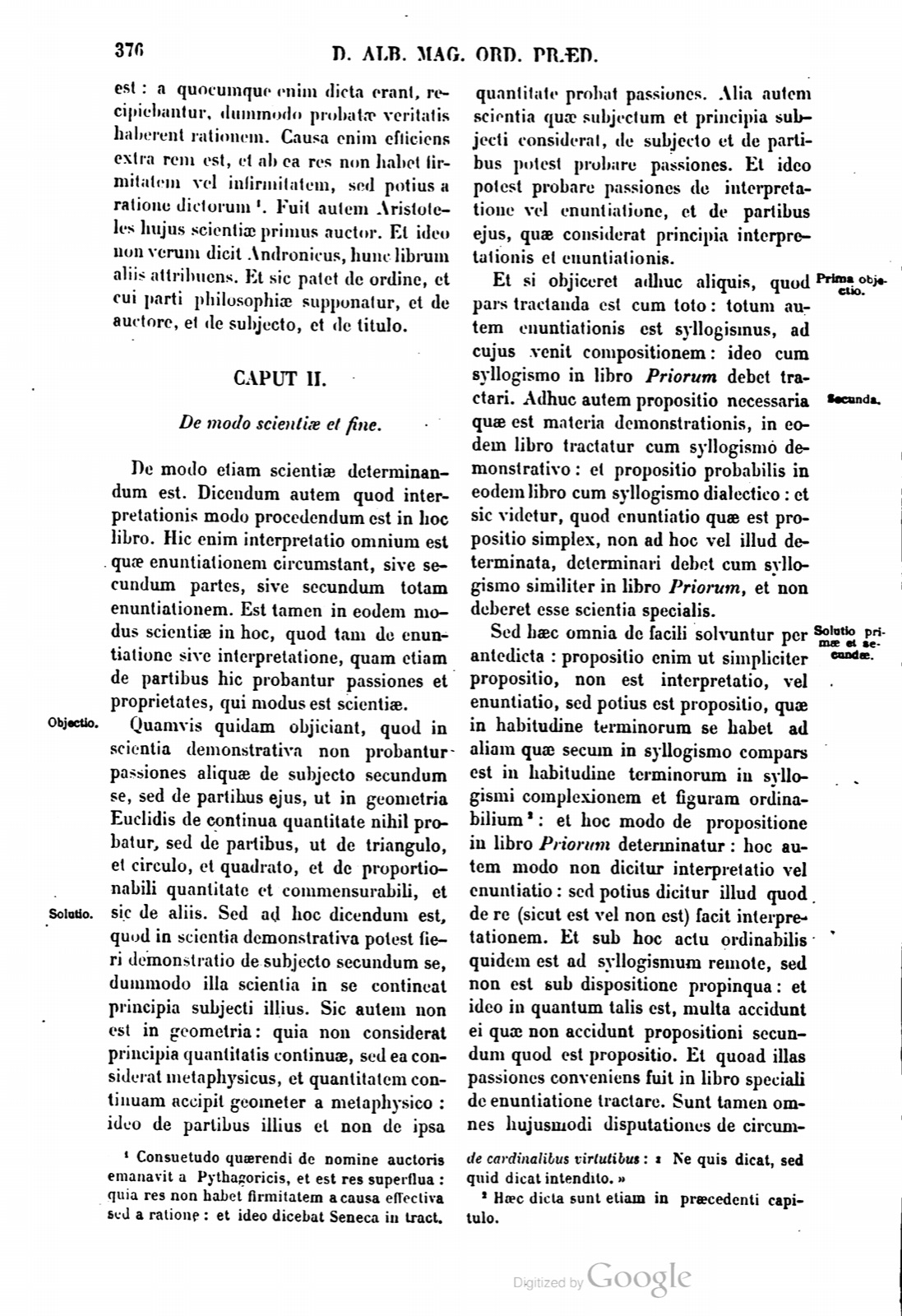
De modo etiam scientiae determinandum est. Dicendum autem quod interpretationis modo procedendum est in hoc libro. Hic enim interpretatio omnium est quae enuntiationem circumstant, sive secundum partes, sive secundum totam enuntiationem. Est tamen in eodem modus scientiae in hoc, quod tam de enuntiatione sive interpretatione, quam etiam de partibus hic probantur passiones et proprietates, qui modus est scientiae.
Quamvis quidam objiciant, quod in scientia demonstrativa non probantur passiones aliquae de subjecto secundum se, sed de partibus ejus, ut in geometria Euclidis de continua quantitate nihil probatur, sed de partibus, ut de triangulo, et circulo, et quadrato, et de proportionabili quantitate et commensurabili, et sic de aliis. Sed ad hoc dicendum est, quod in scientia demonstrativa potest fieri demonstratio de subjecto secundum se, dummodo illa scientia in se contineat principia subjecti illius. Sic autem non est in geometria: quia non considerat principia quantitatis continuae, sed ea considerat metaphysicus, et quantitatem continuam accipit geometer a metaphysico: ideo de partibus illius et non de ipsa quantitate probat passiones. Alia autem scientia quae subjectum et principia subjecti considerat, de subjecto et de partibus potest probare passiones. Et ideo potest probare passiones de interpretatione vel enuntiatione, et de partibus ejus, quae considerat principia interpretationis et enuntiationis.
Et si objiceret adhuc aliquis, quod pars tractanda est cum toto: totum autem enuntiationis est syllogismus, ad cujus venit compositionem: ideo cum syllogismo in libro Priorum debet tractari. Adhuc autem propositio necessaria quae est materia demonstrationis, in eodem libro tractatur cum syllogismo demonstrativo: et propositio probabilis in eodem libro cum syllogismo dialectico: et sic videtur, quod enuntiatio quae est propositio simplex, non ad hoc vel illud determinata, determinari debet cum syllogismo similiter in libro Priorum, et non deberet esse scientia specialis.
Sed haec omnia de facili solvuntur per antedicta: propositio enim ut simpliciter propositio, non est interpretatio, vel enuntiatio, sed potius est propositio, quae in habitudine terminorum se habet ad aliam quae secum in syllogismo compars est in habitudine terminorum in syllogismi complexionem et figuram ordinabilium 1: et hoc modo de propositione in libro Priorum determinatur: hoc autem modo non dicitur interpretatio vel enuntiatio: sed potius dicitur illud quod de re (sicut est vel non est) facit interpretationem. Et sub hoc actu ordinabilis quidem est ad syllogismum remote, sed non est sub dispositione propinqua: et ideo in quantum talis est, multa accidunt ei quae non accidunt propositioni secundum quod est propositio. Et quoad illas passiones conveniens fuit in libro speciali de enuntiatione tractare. Sunt tamen omnes hujusmodi disputationes de circumstantiis scientiae, et non de ipsa materia de qua tractatur. Et ideo parum faciunt ad veram scientiam de hoc quod quaeritur. Nec etiam Antiqui inveniuntur de talibus inquisivisse.
CHAPTER II. On the mode of the science and its end.
The mode of the science must also be determined. It must be said that one must proceed in this book in the mode of interpretation. For here there is interpretation of all the things which surround enunciation, whether according to the parts or according to the whole enunciation. Yet in the same book there is the mode of science in this, that here properties and proper attributes are proved both about enunciation or interpretation and also about its parts; and this is the mode of science.
Although some object that in demonstrative science no properties are proved of the subject according to itself, but of its parts, as in Euclid's geometry nothing is proved of continuous quantity, but rather of its parts, as of triangle, circle, square, proportionable quantity, commensurable quantity, and so with the others. But to this it must be said that in demonstrative science demonstration can be made about the subject according to itself, provided that that science contains in itself the principles of that subject. But this is not so in geometry, because it does not consider the principles of continuous quantity; rather the metaphysician considers them, and the geometer receives continuous quantity from the metaphysician. Therefore he proves properties about its parts and not about the quantity itself. But another science, which considers the subject and the principles of the subject, can prove properties about the subject and about its parts. Therefore it can prove properties about interpretation or enunciation and about its parts, since it considers the principles of interpretation and enunciation.
And if someone should still object that a part must be treated with the whole, while the whole of enunciation is the syllogism, to whose composition it comes, therefore it ought to be treated with syllogism in the book of the Prior Analytics. Again, the necessary proposition, which is the matter of demonstration, is treated in the same book with demonstrative syllogism, and the probable proposition in the same book with dialectical syllogism; and thus it seems that enunciation, which is a simple proposition, not determined to this or that, ought likewise to be determined with syllogism in the book of the Prior Analytics, and ought not to be a special science.
But all these things are easily solved through the things said before: for proposition, as simply proposition, is not interpretation or enunciation, but rather is proposition, which in the disposition of terms is related to another proposition which is a fellow-part with it in the syllogism, in the disposition of terms orderable into the combining and figure of syllogism 1. And in this way proposition is determined in the book of the Prior Analytics. But in this way it is not called interpretation or enunciation; rather it is called that which makes interpretation about a thing, as it is or is not. And under this act it is indeed remotely orderable to syllogism, but it is not under a proximate disposition. Therefore, insofar as it is such, many things happen to it which do not happen to proposition according as it is proposition. And with respect to those properties it was fitting to treat enunciation in a special book. Nevertheless all disputations of this sort concern the circumstances of the science, and not the matter itself about which it treats. Therefore they contribute little to the true science concerning what is asked. Nor are the Ancients found to have inquired into such matters.
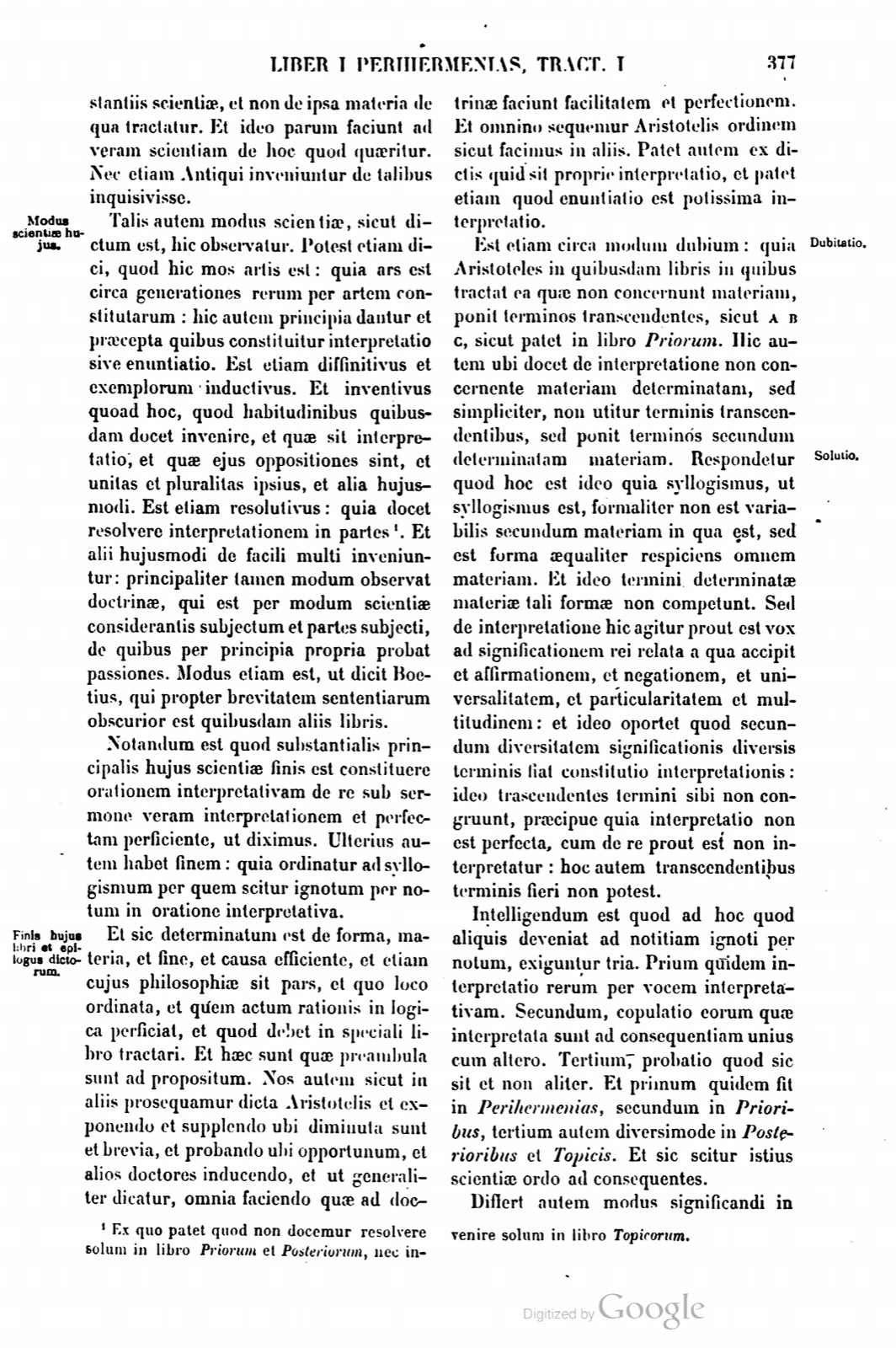
Talis autem modus scientiae, sicut dictum est, hic observatur. Potest etiam dici, quod hic mos artis est: quia ars est circa generationes rerum per artem constitutarum: hic autem principia dantur et praecepta quibus constituitur interpretatio sive enuntiatio. Est etiam diffinitivus et exemplorum inductivus. Et inventivus quoad hoc, quod habitudinibus quibusdam docet invenire, et quae sit interpretatio, et quae ejus oppositiones sint, et unitas et pluralitas ipsius, et alia hujusmodi. Est etiam resolutivus: quia docet resolvere interpretationem in partes 2. Et alii hujusmodi de facili multi inveniuntur: principaliter tamen modum observat doctrinae, qui est per modum scientiae considerantis subjectum et partes subjecti, de quibus per principia propria probat passiones. Modus etiam est, ut dicit Boetius, qui propter brevitatem sententiarum obscurior est quibusdam aliis libris.
Notandum est quod substantialis principalis hujus scientiae finis est constituere orationem interpretativam de re sub sermone veram interpretationem et perfectam perficiente, ut diximus. Ulterius autem habet finem: quia ordinatur ad syllogismum per quem scitur ignotum per notum in oratione interpretativa.
Et sic determinatum est de forma, materia, et fine, et causa efficiente, et etiam cujus philosophiae sit pars, et quo loco ordinata, et quem actum rationis in logica perficiat, et quod debet in speciali libro tractari. Et haec sunt quae praeambula sunt ad propositum. Nos autem sicut in aliis prosequamur dicta Aristotelis et exponendo et supplendo ubi diminuta sunt et brevia, et probando ubi opportunum, et alios doctores inducendo, et ut generaliter dicatur, omnia faciendo quae ad doctrinae faciunt facilitatem et perfectionem. Et omnino sequemur Aristotelis ordinem sicut facimus in aliis. Patet autem ex dictis quid sit proprie interpretatio, et patet etiam quod enuntiatio est potissima interpretatio.
Such a mode of science, however, as has been said, is observed here. It can also be said that here there is the custom of an art, because an art concerns the generations of things constituted through art. But here principles and precepts are given by which interpretation or enunciation is constituted. It is also definitive and inductive of examples. And it is inventive in this respect, that by certain dispositions it teaches one to discover what interpretation is, what its oppositions are, its unity and plurality, and other things of this sort. It is also resolutive, because it teaches one to resolve interpretation into parts 2. And many other modes of this sort are easily found; nevertheless it principally observes the mode of doctrine, which is through the mode of a science considering the subject and the parts of the subject, about which it proves properties through proper principles. The mode also is, as Boethius says, one which, because of the brevity of the sentences, is more obscure than certain other books.
It should be noted that the substantial principal end of this science is to constitute interpretative speech about a thing under discourse, perfecting a true and perfect interpretation, as we have said. But it has a further end, because it is ordered to syllogism through which the unknown is known through the known in interpretative speech.
And thus determination has been made about form, matter, end, and efficient cause, and also of what philosophy it is a part, in what place it is ordered, what act of reason it perfects in logic, and that it must be treated in a special book. These are the preambles to the proposed matter. But we, as in other works, shall pursue Aristotle's sayings by expounding and by supplying where they are diminished and brief, by proving where it is opportune, by bringing in other doctors, and, to speak generally, by doing all things which make for the ease and perfection of teaching. And in every way we shall follow Aristotle's order as we do in other matters. From what has been said it is clear what interpretation properly is, and it is also clear that enunciation is the most powerful interpretation.
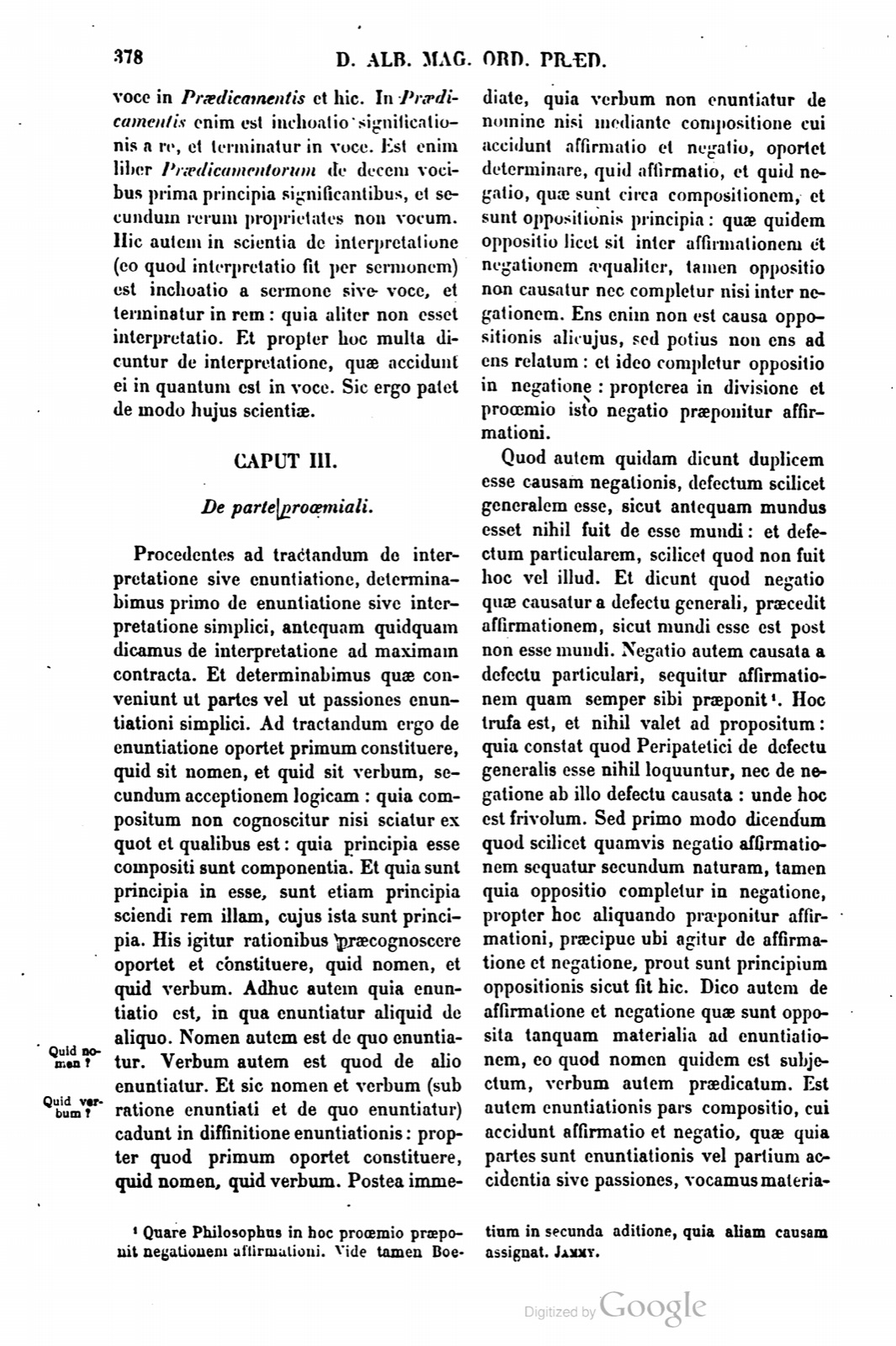
Est etiam circa modum dubium: quia Aristoteles in quibusdam libris in quibus tractat ea quae non concernunt materiam, ponit terminos transcendentes, sicut A B C, sicut patet in libro Priorum. Hic autem ubi docet de interpretatione non concernente materiam determinatam, sed simpliciter, non utitur terminis transcendentibus, sed ponit terminos secundum determinatam materiam. Respondetur quod hoc est ideo quia syllogismus, ut syllogismus est, formaliter non est variabilis secundum materiam in qua est, sed est forma aequaliter respiciens omnem materiam. Et ideo termini determinatae materiae tali formae non competunt. Sed de interpretatione hic agitur prout est vox ad significationem rei relata a qua accipit et affirmationem, et negationem, et universalitatem, et particularitatem et multitudinem: et ideo oportet quod secundum diversitatem significationis diversis terminis fiat constitutio interpretationis: ideo transcendentes termini sibi non congruunt, praecipue quia interpretatio non est perfecta, cum de re prout est non interpretatur: hoc autem transcendentibus terminis fieri non potest.
Intelligendum est quod ad hoc quod aliquis deveniat ad notitiam ignoti per notum, exiguntur tria. Primum quidem interpretatio rerum per vocem interpretativam. Secundum, copulatio eorum quae interpretata sunt ad consequentiam unius cum altero. Tertium, probatio quod sic sit et non aliter. Et primum quidem fit in Perihermenias, secundum in Prioribus, tertium autem diversimode in Posterioribus et Topicis. Et sic scitur istius scientiae ordo ad consequentes.
Differt autem modus significandi in voce in Praedicamentis et hic. In Praedicamentis enim est inchoatio significationis a re, et terminatur in voce. Est enim liber Praedicamentorum de decem vocibus prima principia significantibus, et secundum rerum proprietates non vocum. Hic autem in scientia de interpretatione (eo quod interpretatio fit per sermonem) est inchoatio a sermone sive voce, et terminatur in rem: quia aliter non esset interpretatio. Et propter hoc multa dicuntur de interpretatione, quae accidunt ei in quantum est in voce. Sic ergo patet de modo hujus scientiae.
There is also a doubt about the mode: because Aristotle, in certain books in which he treats those things which do not concern matter, posits transcendent terms, such as A, B, C, as is clear in the book of the Prior Analytics. But here, where he teaches about interpretation not as concerning determinate matter but simply, he does not use transcendent terms, but posits terms according to determinate matter. The response is that this is because syllogism, as it is syllogism, is not formally variable according to the matter in which it is, but is a form equally regarding every matter. Therefore terms of determinate matter do not belong to such a form. But here interpretation is treated according as it is a vocal sound referred to the signification of a thing, from which it receives affirmation, negation, universality, particularity, and multitude. Therefore it is necessary that, according to the diversity of signification, the constitution of interpretation be made by diverse terms; therefore transcendent terms do not fit it, especially because interpretation is not perfect when a thing is not interpreted as it is. But this cannot be done by transcendent terms.
It must be understood that, in order for someone to arrive at knowledge of the unknown through the known, three things are required. The first is interpretation of things through interpretative vocal sound. The second is a coupling of the things which have been interpreted toward the consequence of one with the other. The third is proof that it is thus and not otherwise. The first is done in the Perihermenias, the second in the Prior Analytics, and the third in diverse ways in the Posterior Analytics and Topics. And thus the order of this science toward the following sciences is known.
The mode of signifying in vocal sound differs in the Categories and here. For in the Categories the beginning of signification is from the thing and terminates in vocal sound. For the book of the Categories is about the ten vocal sounds signifying first principles, and according to the properties of things, not of vocal sounds. But here, in the science of interpretation, since interpretation is made through speech, the beginning is from speech or vocal sound and terminates in the thing, because otherwise there would not be interpretation. And on this account many things are said about interpretation which happen to it insofar as it is in vocal sound. Thus therefore the mode of this science is clear.
Notes
- These things were also said in the preceding chapter. (Haec dicta sunt etiam in praecedenti capitulo.) ↩
- From this it is clear that we are not taught to resolve only in the book of the Prior Analytics and Posterior Analytics, nor to discover only in the book of the Topics. (Ex quo patet quod non docemur resolvere solum in libro Priorum et Posteriorum, nec invenire solum in libro Topicorum.) ↩
If a page does not appear, its photograph has not been uploaded yet.