Works › On Interpretation, Books I–II
Volume 1 · pp. 373–376
Book I Perihermenias. Tractate I. Chapter I. In what order it stands among the logical books.
A marker with ≈ is an approximate page boundary, placed by measure of the text; the page photographs remain the authority. In the paired views, clicking a page marker brings that page into view.
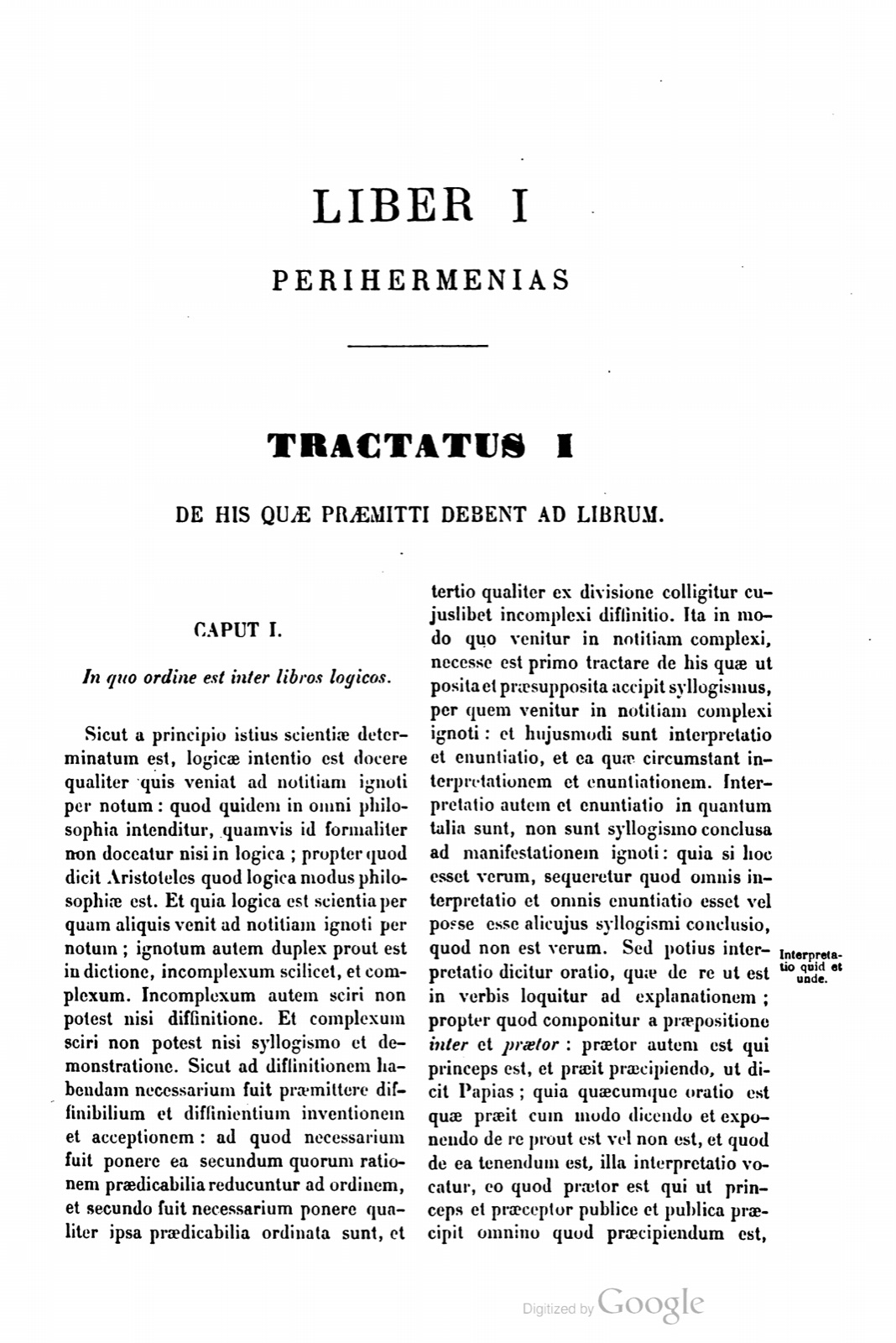
LIBER I PERIHERMENIAS. TRACTATUS I. DE HIS QUAE PRAEMITTI DEBENT AD LIBRUM. CAPUT I. In quo ordine est inter libros logicos.
Sicut a principio istius scientiae determinatum est, logicae intentio est docere qualiter quis veniat ad notitiam ignoti per notum: quod quidem in omni philosophia intenditur, quamvis id formaliter non doceatur nisi in logica; propter quod dicit Aristoteles quod logica modus philosophiae est. Et quia logica est scientia per quam aliquis venit ad notitiam ignoti per notum; ignotum autem duplex prout est in dictione, incomplexum scilicet, et complexum. Incomplexum autem sciri non potest nisi diffinitione. Et complexum sciri non potest nisi syllogismo et demonstratione. Sicut ad diffinitionem habendam necessarium fuit praemittere diffinibilium et diffinientium inventionem et acceptionem: ad quod necessarium fuit ponere ea secundum quorum rationem praedicabilia reducuntur ad ordinem, et secundo fuit necessarium ponere qualiter ipsa praedicabilia ordinata sunt, et tertio qualiter ex divisione colligitur cujuslibet incomplexi diffinitio. Ita in modo quo venitur in notitiam complexi, necesse est primo tractare de his quae ut posita et praesupposita accipit syllogismus, per quem venitur in notitiam complexi ignoti: et hujusmodi sunt interpretatio et enuntiatio, et ea quae circumstant interpretationem et enuntiationem.
Interpretatio autem et enuntiatio in quantum talia sunt, non sunt syllogismo conclusa ad manifestationem ignoti: quia si hoc esset verum, sequeretur quod omnis interpretatio et omnis enuntiatio esset vel posse esse alicujus syllogismi conclusio, quod non est verum. Sed potius interpretatio dicitur oratio, quae de re ut est in verbis loquitur ad explanationem; propter quod componitur a praepositione inter et praetor: praetor autem est qui princeps est, et praeit praecipiendo, ut dicit Papias; quia quaecumque oratio est quae praeit cum modo dicendo et exponendo de re prout est vel non est, et quod de ea tenendum est, illa interpretatio vocatur, eo quod praetor est qui ut princeps et praeceptor publice et publica praecipit omnino quod praecipiendum est, hoc est, universaliter, particulariter, et secundum affirmationem et negationem.
Propter hoc secundum aliquid differt ab enuntiatione. Interpretatio enim fit multis modis, ut dictum est. Enuntiatio autem non dicit nisi aliquid de aliquo dici vel praedicari. Et quamvis enuntiatio sit potissima interpretatio, non tamen convertitur cum interpretatione quae dicit expositionem rei per omnem modum, sive in parte, sicut in nomine vel in verbo, sive in toto, sicut in qualitate affirmationis vel negationis: sive in quantitate, sicut inesse universaliter particulariter, sive finite, sive infinite, sive una oratione, sive non una: quorum nihil nomine suo dicit enuntiatio. Interpretatio autem secundum optimum suum posse non fit, nisi fiat omnibus modis qui dicti sunt.
BOOK I PERIHERMENIAS. TRACTATE I. ON THOSE THINGS WHICH MUST BE SET BEFORE THE BOOK. CHAPTER I. In what order it stands among the logical books.
As was determined from the beginning of this science, the intention of logic is to teach how someone may come to knowledge of the unknown through what is known; and this indeed is intended in every philosophy, although it is not taught formally except in logic. On this account Aristotle says that logic is the mode of philosophy. And because logic is the science through which someone comes to knowledge of the unknown through what is known, while the unknown, as it is in diction, is twofold, namely incomplex and complex, the incomplex cannot be known except by definition. And the complex cannot be known except by syllogism and demonstration. Just as, in order to have definition, it was necessary to set beforehand the discovery and acceptance of things definable and defining, and for this it was necessary to posit those things according to whose account predicables are reduced to order, and secondly it was necessary to posit how the predicables themselves are ordered, and thirdly how from division the definition of any incomplex thing is gathered, so, in the mode by which one comes to knowledge of the complex, it is necessary first to treat those things which the syllogism, through which one comes to knowledge of the complex unknown, accepts as posited and presupposed. Such things are interpretation and enunciation, and those things which surround interpretation and enunciation.
But interpretation and enunciation, insofar as they are such, are not things concluded by a syllogism for the manifestation of the unknown; because, if this were true, it would follow that every interpretation and every enunciation would be, or could be, the conclusion of some syllogism, which is not true. Rather, interpretation is called speech which speaks in words about a thing as it is, for explanation. On this account it is composed from the preposition inter and praetor. Now a praetor is one who is a prince, and goes before by commanding, as Papias says; because whatever speech goes before with a mode of saying and explaining about a thing according as it is or is not, and what must be held about it, is called interpretation, since a praetor is one who, as prince and preceptor, commands publicly and public matters, altogether what must be commanded, that is, universally, particularly, and according to affirmation and negation.
On this account in some respect it differs from enunciation. For interpretation occurs in many ways, as has been said. But enunciation says only that something is said or predicated of something. And although enunciation is the most powerful interpretation, nevertheless it is not convertible with interpretation, which says the exposition of a thing according to every mode, whether in part, as in noun or in verb, or in the whole, as in the quality of affirmation or negation; or in quantity, as in being-in universally and particularly, whether finitely or infinitely, whether by one speech or not by one; none of these does enunciation say by its own name. But interpretation is not made according to its best power unless it is made in all the modes which have been said.
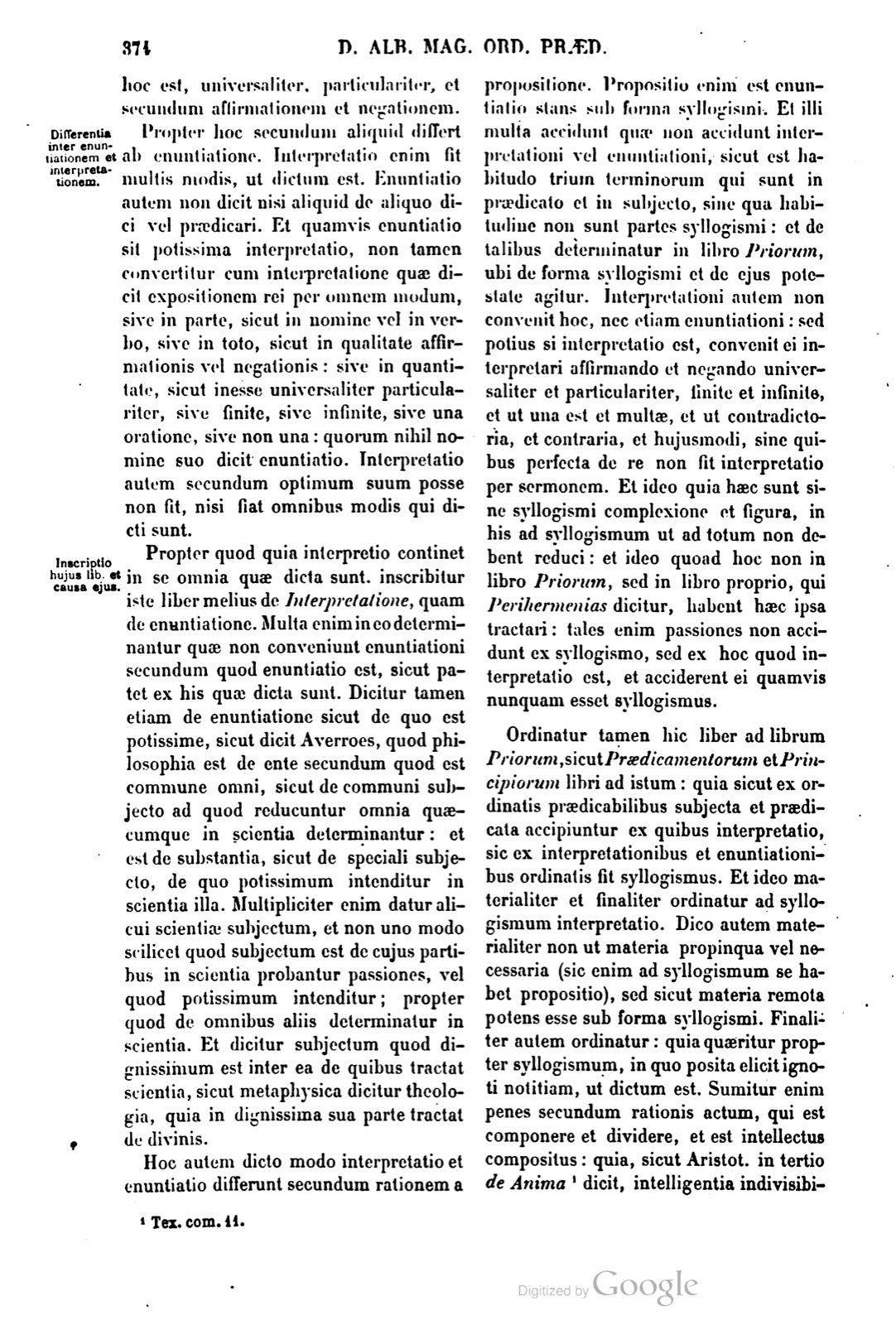
Propter quod quia interpretatio continet in se omnia quae dicta sunt, inscribitur iste liber melius de Interpretatione, quam de enuntiatione. Multa enim in eo determinantur quae non conveniunt enuntiationi secundum quod enuntiatio est, sicut patet ex his quae dicta sunt. Dicitur tamen etiam de enuntiatione sicut de quo est potissime, sicut dicit Averroes, quod philosophia est de ente secundum quod est commune omni, sicut de communi subjecto ad quod reducuntur omnia quaecumque in scientia determinantur: et est de substantia, sicut de speciali subjecto, de quo potissimum intenditur in scientia illa. Multipliciter enim datur alicui scientiae subjectum, et non uno modo scilicet quod subjectum est de cujus partibus in scientia probantur passiones, vel quod potissimum intenditur; propter quod de omnibus aliis determinatur in scientia. Et dicitur subjectum quod dignissimum est inter ea de quibus tractat scientia, sicut metaphysica dicitur theologia, quia in dignissima sua parte tractat de divinis.
Hoc autem dicto modo interpretatio et enuntiatio differunt secundum rationem a propositione. Propositio enim est enuntiatio stans sub forma syllogismi. Et illi multa accidunt quae non accidunt interpretationi vel enuntiationi, sicut est habitudo trium terminorum qui sunt in praedicato et in subjecto, sine qua habitudine non sunt partes syllogismi: et de talibus determinatur in libro Priorum, ubi de forma syllogismi et de ejus potestate agitur. Interpretationi autem non convenit hoc, nec etiam enuntiationi: sed potius si interpretatio est, convenit ei interpretari affirmando et negando universaliter et particulariter, finite et infinite, et ut una est et multae, et ut contradictoria, et contraria, et hujusmodi, sine quibus perfecta de re non fit interpretatio per sermonem. Et ideo quia haec sunt sine syllogismi complexione et figura, in his ad syllogismum ut ad totum non debent reduci: et ideo quoad hoc non in libro Priorum, sed in libro proprio, qui Perihermenias dicitur, habent haec ipsa tractari: tales enim passiones non accidunt ex syllogismo, sed ex hoc quod interpretatio est, et acciderent ei quamvis nunquam esset syllogismus.
Therefore, because interpretation contains in itself all the things which have been said, this book is better inscribed On Interpretation than On Enunciation. For many things are determined in it which do not belong to enunciation according as it is enunciation, as is clear from the things which have been said. Nevertheless it is also called On Enunciation as concerning that about which it chiefly is, just as Averroes says that philosophy is about being according as it is common to everything, as about a common subject to which all things whatsoever determined in the science are reduced, and that it is about substance as about the special subject about which that science chiefly intends. For a subject is given to a science in many ways, and not in one way: namely, that the subject is that of whose parts the properties are proved in the science, or that it is what is chiefly intended, on account of which all other things are determined in the science. And that is called the subject which is most worthy among the things about which the science treats, as metaphysics is called theology because in its most worthy part it treats divine things.
In this way just mentioned, interpretation and enunciation differ in account from proposition. For proposition is an enunciation standing under the form of syllogism. And many things happen to it which do not happen to interpretation or enunciation, such as the disposition of three terms which are in predicate and in subject, without which disposition they are not parts of a syllogism; and about such things determination is made in the book of the Prior Analytics, where the form of syllogism and its power are treated. But this does not belong to interpretation, nor even to enunciation. Rather, if there is interpretation, it belongs to it to interpret by affirming and denying universally and particularly, finitely and infinitely, both as it is one and many, and as contradictory, contrary, and of this sort; without these a perfect interpretation concerning a thing is not made through speech. And therefore, because these things are without the combining and figure of syllogism, in these respects they ought not to be reduced to syllogism as to a whole; and therefore, as to this, they have to be treated not in the book of the Prior Analytics but in their proper book, which is called Perihermenias. For such properties do not happen from syllogism, but from the fact that there is interpretation, and they would happen to it even if there never were a syllogism.
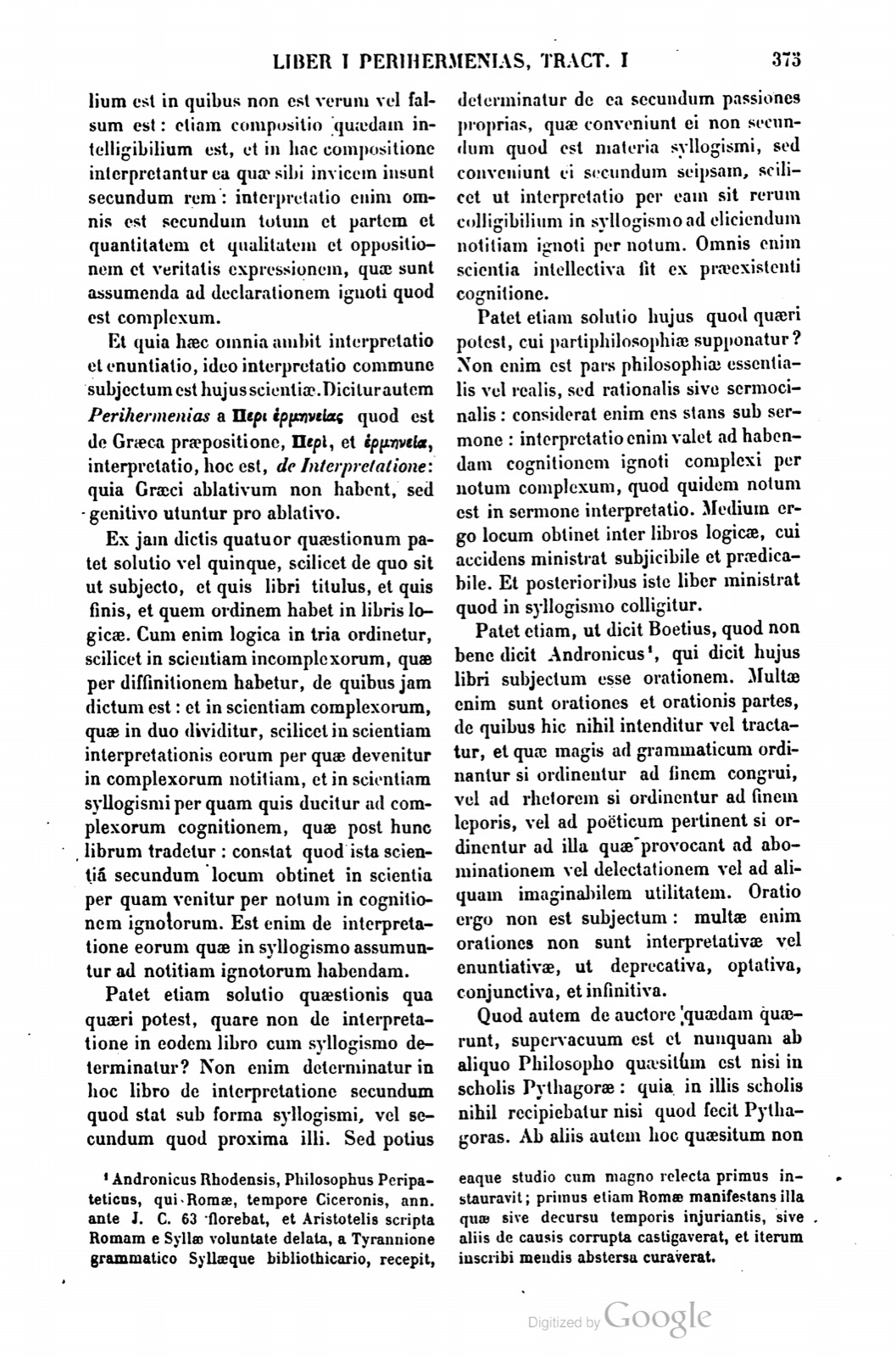
Ordinatur tamen hic liber ad librum Priorum, sicut Praedicamentorum et Principiorum libri ad istum: quia sicut ex ordinatis praedicabilibus subjecta et praedicata accipiuntur ex quibus interpretatio, sic ex interpretationibus et enuntiationibus ordinatis fit syllogismus. Et ideo materialiter et finaliter ordinatur ad syllogismum interpretatio. Dico autem materialiter non ut materia propinqua vel necessaria (sic enim ad syllogismum se habet propositio), sed sicut materia remota potens esse sub forma syllogismi. Finaliter autem ordinatur: quia quaeritur propter syllogismum, in quo posita elicit ignoti notitiam, ut dictum est. Sumitur enim penes secundum rationis actum, qui est componere et dividere, et est intellectus compositus: quia, sicut Aristoteles in tertio de Anima 1 dicit, intelligentia indivisibilium est in quibus non est verum vel falsum est: etiam compositio quaedam intelligibilium est, et in hac compositione interpretantur ea quae sibi invicem insunt secundum rem: interpretatio enim omnis est secundum totum et partem et quantitatem et qualitatem et oppositionem et veritatis expressionem, quae sunt assumenda ad declarationem ignoti quod est complexum.
Et quia haec omnia ambit interpretatio et enuntiatio, ideo interpretatio commune subjectum est hujus scientiae. Dicitur autem Perihermenias a περὶ ἑρμηνείας quod est de Graeca praepositione, περὶ, et ἑρμηνεία, interpretatio, hoc est, de Interpretatione: quia Graeci ablativum non habent, sed genitivo utuntur pro ablativo.
Ex jam dictis quatuor quaestionum patet solutio vel quinque, scilicet de quo sit ut subjecto, et quis libri titulus, et quis finis, et quem ordinem habet in libris logicae. Cum enim logica in tria ordinetur, scilicet in scientiam incomplexorum, quae per diffinitionem habetur, de quibus jam dictum est: et in scientiam complexorum, quae in duo dividitur, scilicet in scientiam interpretationis eorum per quae devenitur in complexorum notitiam, et in scientiam syllogismi per quam quis ducitur ad complexorum cognitionem, quae post hunc librum tradetur: constat quod ista scientia secundum locum obtinet in scientia per quam venitur per notum in cognitionem ignotorum. Est enim de interpretatione eorum quae in syllogismo assumuntur ad notitiam ignotorum habendam.
Nevertheless this book is ordered to the book of the Prior Analytics, as the books of the Categories and of the Principles are ordered to this one, because, just as from ordered predicables subjects and predicates are received from which interpretation is made, so from ordered interpretations and enunciations a syllogism is made. And therefore interpretation is ordered to syllogism materially and finally. I say materially, not as proximate or necessary matter, for in this way proposition is related to syllogism, but as remote matter capable of being under the form of syllogism. It is ordered finally because it is sought for the sake of syllogism, in which, once posited, it elicits knowledge of the unknown, as has been said. For it is taken according to the second act of reason, which is to compose and divide, and it is composite understanding; because, as Aristotle says in the third book On the Soul 1, the understanding of indivisible things is in those things in which there is no true or false; there is also a certain composition of intelligible things, and in this composition those things which belong to one another according to reality are interpreted. For every interpretation is according to whole and part, quantity and quality, opposition and expression of truth, which must be taken up for the declaration of the unknown which is complex.
And because interpretation and enunciation encompass all these things, interpretation is the common subject of this science. Perihermenias is said from περὶ ἑρμηνείας, which is from the Greek preposition περὶ and ἑρμηνεία, interpretation, that is, On Interpretation, because the Greeks do not have the ablative, but use the genitive for the ablative.
From the things already said the solution of four questions, or five, is clear: namely, about what it is as subject, what the title of the book is, what its end is, and what order it has among the books of logic. For since logic is ordered into three things, namely into the science of incomplex things, which is had through definition, about which it has already been said, and into the science of complex things, which is divided into two, namely into the science of the interpretation of those things through which one arrives at knowledge of complexes, and into the science of syllogism through which someone is led to cognition of complexes, which will be handed down after this book, it is evident that this science obtains the second place in the science through which one comes through the known into cognition of unknown things. For it concerns the interpretation of those things which are taken up in a syllogism for having knowledge of unknown things.
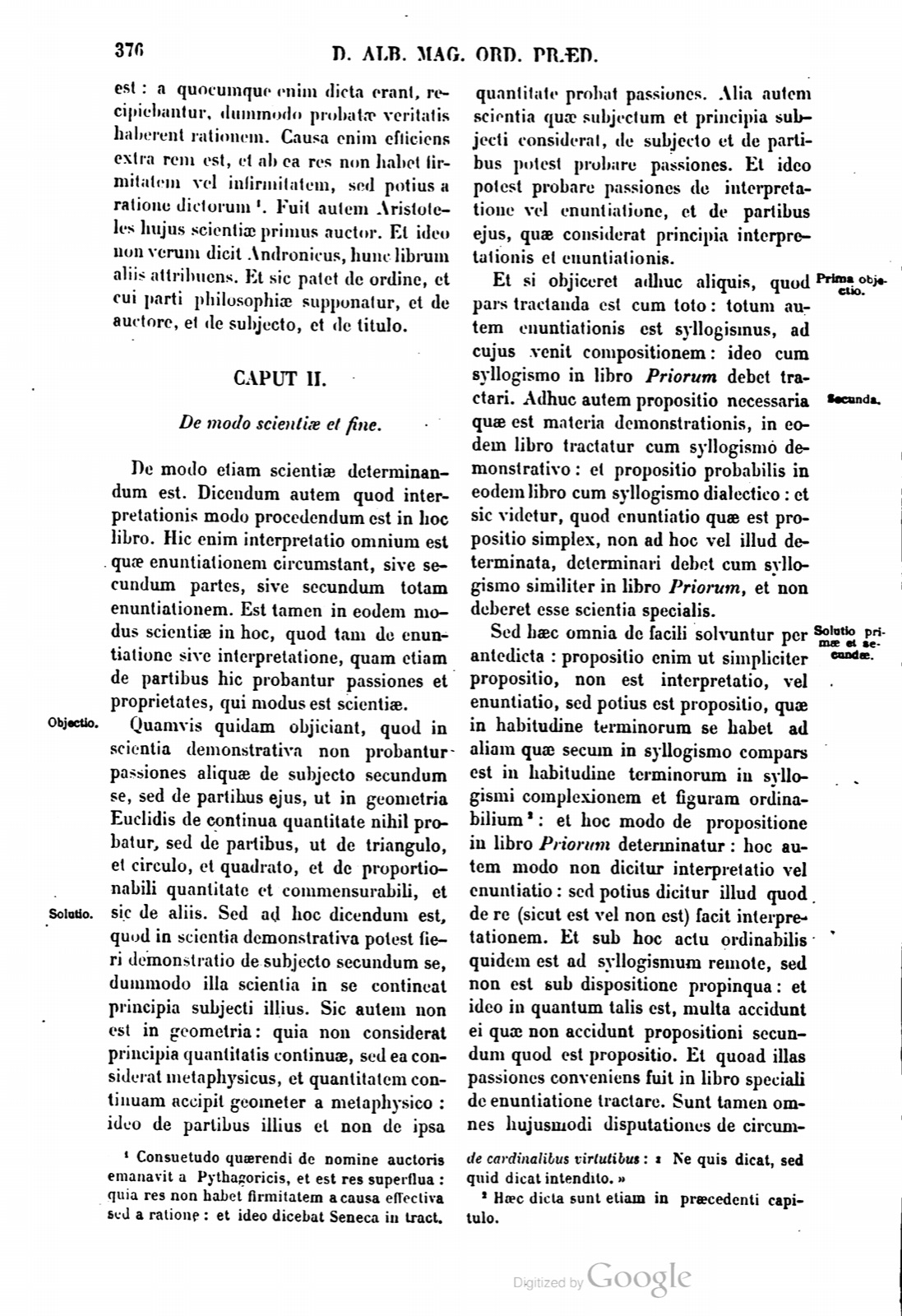
Patet etiam solutio quaestionis qua quaeri potest, quare non de interpretatione in eodem libro cum syllogismo determinatur? Non enim determinatur in hoc libro de interpretatione secundum quod stat sub forma syllogismi, vel secundum quod proxima illi. Sed potius determinatur de ea secundum passiones proprias, quae conveniunt ei non secundum quod est materia syllogismi, sed conveniunt ei secundum seipsam, scilicet ut interpretatio per eam sit rerum colligibilium in syllogismo ad eliciendum notitiam ignoti per notum. Omnis enim scientia intellectiva fit ex praeexistenti cognitione.
Patet etiam solutio hujus quod quaeri potest, cui parti philosophiae supponatur? Non enim est pars philosophiae essentialis vel realis, sed rationalis sive sermocinalis: considerat enim ens stans sub sermone: interpretatio enim valet ad habendam cognitionem ignoti complexi per notum complexum, quod quidem notum est in sermone interpretatio. Medium ergo locum obtinet inter libros logicae, cui accidens ministrat subjicibile et praedicabile. Et posterioribus iste liber ministrat quod in syllogismo colligitur.
Patet etiam, ut dicit Boetius, quod non bene dicit Andronicus 2, qui dicit hujus libri subjectum esse orationem. Multae enim sunt orationes et orationis partes, de quibus hic nihil intenditur vel tractatur, et quae magis ad grammaticum ordinantur si ordinentur ad finem congrui, vel ad rhetorem si ordinentur ad finem leporis, vel ad poeticum pertinent si ordinentur ad illa quae provocant ad abominationem vel delectationem vel ad aliquam imaginabilem utilitatem. Oratio ergo non est subjectum: multae enim orationes non sunt interpretativae vel enuntiativae, ut deprecativa, optativa, conjunctiva, et infinitiva.
Quod autem de auctore quaedam quaerunt, supervacuum est et nunquam ab aliquo Philosopho quaesitum est nisi in scholis Pythagorae: quia in illis scholis nihil recipiebatur nisi quod fecit Pythagoras. Ab aliis autem hoc quaesitum non est: a quocumque enim dicta erant, recipiebantur, dummodo probatae veritatis haberent rationem. Causa enim efficiens extra rem est, et ab ea res non habet firmitatem vel infirmitatem, sed potius a ratione dictorum 3. Fuit autem Aristoteles hujus scientiae primus auctor. Et ideo non verum dicit Andronicus, hunc librum aliis attribuens. Et sic patet de ordine, et cui parti philosophiae supponatur, et de auctore, et de subjecto, et de titulo.
The solution is also clear to the question by which one can ask why interpretation is not determined in the same book with syllogism. For in this book interpretation is not determined according as it stands under the form of syllogism, or according as it is proximate to it. Rather, it is determined according to the proper properties which belong to it, not according as it is matter of syllogism, but according as they belong to it according to itself, namely so that through it there may be an interpretation of the things gatherable in syllogism for eliciting knowledge of the unknown through the known. For every intellective science comes from pre-existing cognition.
The solution is also clear to that which can be asked, under what part of philosophy it is placed. For it is not an essential or real part of philosophy, but a rational or sermocinal part: for it considers being standing under speech. Interpretation is useful for having cognition of the complex unknown through a complex known thing, and that known thing is interpretation in speech. Therefore it obtains a middle place among the books of logic; an accident supplies to it the subjectable and the predicable. And this book supplies to the later books what is gathered in a syllogism.
It is also clear, as Boethius says, that Andronicus 2 does not speak well when he says that the subject of this book is speech. For there are many speeches and parts of speech about which nothing is here intended or treated, and which are ordered rather to the grammarian if they are ordered to the end of congruity, or to the rhetorician if they are ordered to the end of charm, or pertain to the poetic art if they are ordered to those things which provoke to abhorrence or delight or to some imaginable utility. Therefore speech is not the subject, for many speeches are not interpretative or enunciative, such as deprecative, optative, conjunctive, and infinitive speech.
But what some ask about the author is superfluous, and was never asked by any Philosopher except in the schools of Pythagoras, because in those schools nothing was received except what Pythagoras made. But by others this was not asked: for by whomever the things were said, they were received, provided that they had the account of proved truth. For the efficient cause is outside the thing, and from it the thing does not have firmness or infirmity, but rather from the account of the things said 3. But Aristotle was the first author of this science. Therefore Andronicus does not speak truly when he attributes this book to others. And thus the order is clear, and under what part of philosophy it is placed, and concerning the author, subject, and title.
Notes
- Text commentary 11. (Tex. com. 11.) ↩
- Andronicus of Rhodes, a Peripatetic philosopher, who flourished at Rome in the time of Cicero, in the year 63 before Jesus Christ, received the writings of Aristotle brought to Rome by the will of Sulla from Tyrannion the grammarian and Sulla's librarian, and, after rereading them with great zeal, was the first to restore them; he was also the first at Rome to make public those things which he had corrected, whether they had been corrupted by the passage of injurious time or by other causes, and he took care that they be written again cleansed from faults. (Andronicus Rhodensis, Philosophus Peripateticus, qui Romae, tempore Ciceronis, ann. ante J. C. 63 florebat, et Aristotelis scripta Romam e Syllae voluntate delata, a Tyrannione grammatico Syllaeque bibliothicario, recepit, eaque studio cum magno relecta primus instauravit; primus etiam Romae manifestans illa quae sive decursu temporis injuriantis, sive aliis de causis corrupta castigaverat, et iterum inscribi mendis abstersa curaverat.) ↩
- The custom of asking about the name of the author flowed from the Pythagoreans, and it is a superfluous matter, because a thing does not have firmness from the effective cause but from the account; and therefore Seneca said in the treatise On the Cardinal Virtues: “Do not attend to who says it, but to what he says.” (Consuetudo quaerendi de nomine auctoris emanavit a Pythagoricis, et est res superflua: quia res non habet firmitatem a causa effectiva sed a ratione: et ideo dicebat Seneca in tract. de cardinalibus virtutibus: “Ne quis dicat, sed quid dicat intendito.”) ↩
If a page does not appear, its photograph has not been uploaded yet.