Volume 1
Critical Bibliography, Volumes XIV-XX Opening
A marker with ≈ is an approximate page boundary, placed by measure of the text; the page photographs remain the authority. In the paired views, clicking a page marker brings that page into view.
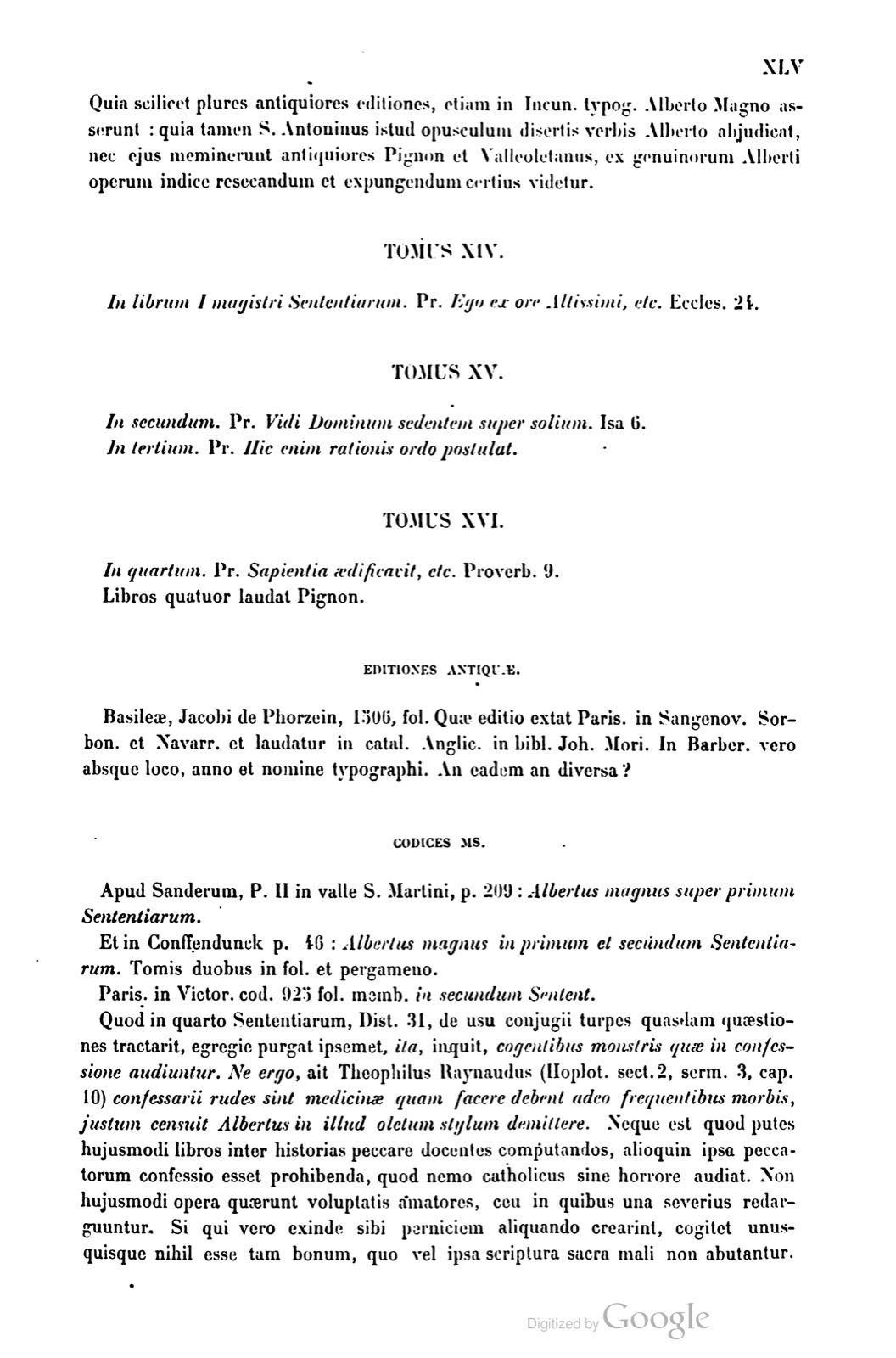
TOMUS XIV.
In librum I magistri Sententiarum. Pr. Ego ex ore Altissimi, etc. Eccles. 24.
TOMUS XV.
In secundum. Pr. Vidi Dominum sedentem super solium. Isa. 6. In tertium. Pr. Hic enim rationis ordo postulat.
TOMUS XVI.
In quartum. Pr. Sapientia aedificavit, etc. Proverb. 9. Libros quatuor laudat Pignon.
EDITIONES ANTIQUAE.
Basileae, Jacobi de Phorzein, 1506, fol. Quae editio extat Paris. in Sangenov. Sorbon. et Navarr. et laudatur in catal. Anglic. in bibl. Joh. Mori. In Barber. vero absque loco, anno et nomine typographi. An eadem an diversa?
CODICES MS.
Apud Sanderum, P. II in valle S. Martini, p. 209: Albertus magnus super primum Sententiarum. Et in Conffendunck p. 46: Albertus magnus in primum et secundum Sententiarum. Tomis duobus in fol. et pergameno. Paris. in Victor. cod. 925 fol. memb. in secundum Sentent. Quod in quarto Sententiarum, Dist. 31, de usu conjugii turpes quasdam quaestiones tractarit, egregie purgat ipsemet, ita, inquit, cogentibus monstris quae in confessione audiuntur. Ne ergo, ait Theophilus Raynaudus (Hoplot. sect. 2, serm. 3, cap. 10) confessarii rudes sint medicinae quam facere debent adeo frequentibus morbis, justum censuit Albertus in illud oletum stylum demittere. Neque est quod putes hujusmodi libros inter historias peccare docentes computandos, alioquin ipsa peccatorum confessio esset prohibenda, quod nemo catholicus sine horrore audiat. Non hujusmodi opera quaerunt voluptatis amatores, ceu in quibus una severius redarguuntur. Si qui vero exinde sibi perniciem aliquando crearint, cogitet unusquisque nihil esse tam bonum, quo vel ipsa scriptura sacra mali non abutantur.
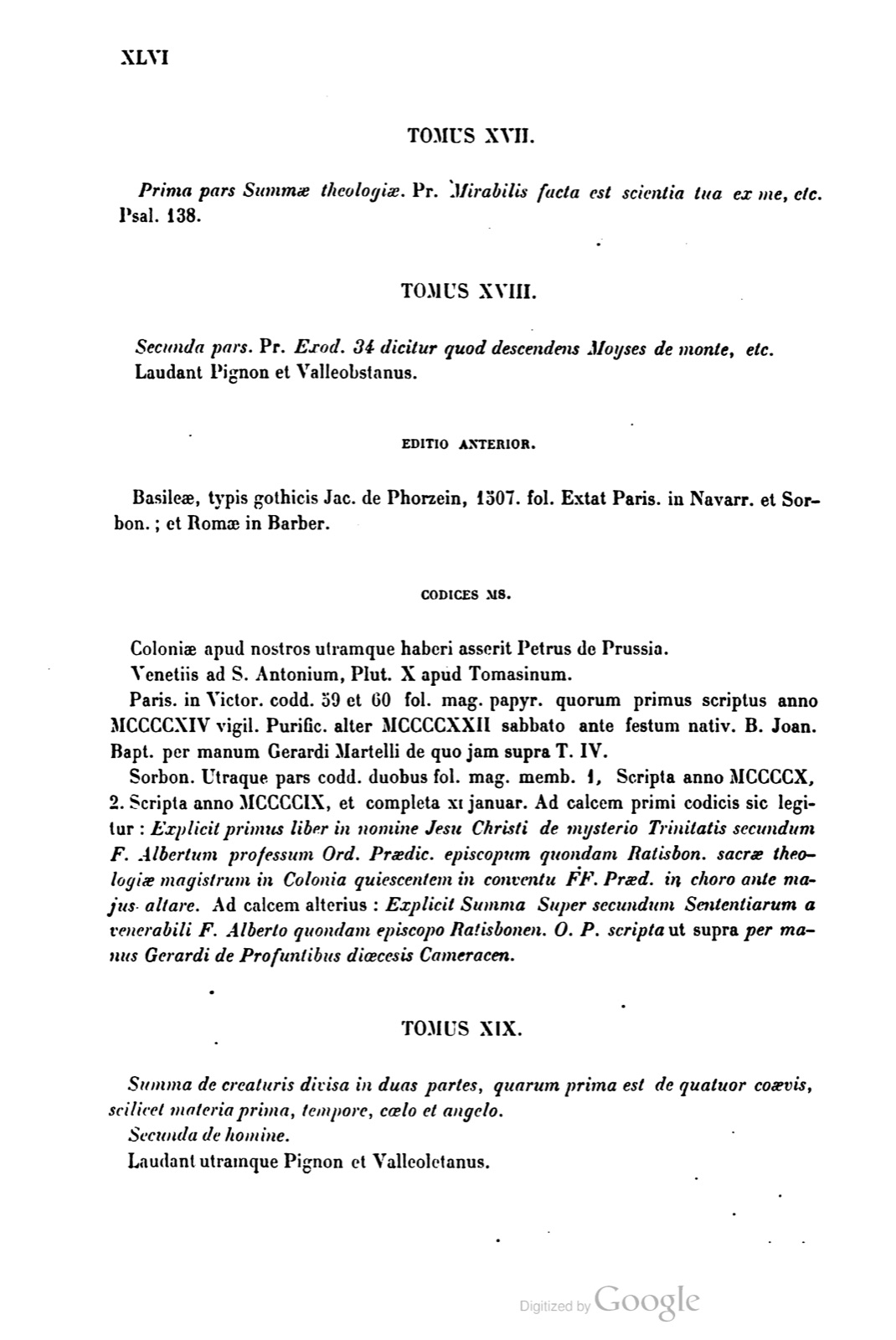
TOMUS XVII.
Prima pars Summae theologiae. Pr. Mirabilis facta est scientia tua ex me, etc. Psal. 138.
TOMUS XVIII.
Secunda pars. Pr. Exod. 34 dicitur quod descendens Moyses de monte, etc. Laudant Pignon et Valleoletanus.
VOLUME XIV.
On book I of the Master of the Sentences. Beginning: I from the mouth of the Most High, etc. Ecclesiasticus 24.
VOLUME XV.
On the second. Beginning: I saw the Lord sitting upon a throne. Isaiah 6. On the third. Beginning: For this the order of reason demands.
VOLUME XVI.
On the fourth. Beginning: Wisdom built, etc. Proverbs 9. Pignon praises the four books.
ANCIENT EDITIONS.
Basel, Jacob of Pforzheim, 1506, folio. This edition exists at Paris in Saint-Genevieve, the Sorbonne, and Navarre, and is praised in the English catalogue in the library of John More. In the Barberini, however, it is without place, year, and name of printer. Is it the same or a different one?
MANUSCRIPT CODICES.
In Sanderus, part II in the valley of St. Martin, page 209: Albert the Great on the first book of the Sentences. And in Conffendunck, page 46: Albert the Great on the first and second books of the Sentences. In two volumes in folio and parchment. Paris, in Victor, codex 925, folio parchment, on the second book of the Sentences. As to the fact that in the fourth book of the Sentences, distinction 31, on the use of marriage, he treated certain foul questions, he himself excellently clears it, thus, he says, because of the monsters that are heard in confession compelling him. Therefore, says Theophilus Raynaud (Hoplotheca, section 2, sermon 3, chapter 10), lest confessors be unskilled in the medicine which they ought to make for diseases so frequent, Albert judged it just to lower his style into that foul matter. Nor is there reason for you to think that books of this sort are to be counted among histories teaching how to sin; otherwise the very confession of sins would have to be prohibited, which no Catholic could hear without horror. Lovers of pleasure do not seek works of this sort, since in them they are more severely rebuked. But if any from this should at some time create destruction for themselves, let each one consider that there is nothing so good that evil men do not abuse even sacred Scripture itself.
VOLUME XVII.
The first part of the Summa of Theology. Beginning: Your knowledge has been made wonderful from me, etc. Psalm 138.
VOLUME XVIII.
The second part. Beginning: Exodus 34 says that Moses, descending from the mountain, etc. Pignon and Valladolid praise it.
EDITIO ANTERIOR.
Basileae, typis gothicis Jac. de Phorzein, 1507. fol. Extat Paris. in Navarr. et Sorbon.; et Romae in Barber.
CODICES MS.
Coloniae apud nostros utramque haberi asserit Petrus de Prussia. Venetiis ad S. Antonium, Plut. X apud Tomasinum. Paris. in Victor. codd. 59 et 60 fol. mag. papyr. quorum primus scriptus anno MCCCCXIV vigil. Purific. alter MCCCCXXII sabbato ante festum nativ. B. Joan. Bapt. per manum Gerardi Martelli de quo jam supra T. IV. Sorbon. Utraque pars codd. duobus fol. mag. memb. 1, Scripta anno MCCCCX, 2. Scripta anno MCCCCIX, et completa XI januar. Ad calcem primi codicis sic legitur: Explicit primus liber in nomine Jesu Christi de mysterio Trinitatis secundum F. Albertum professum Ord. Praedic. episcopum quondam Ratisbon. sacrae theologiae magistrum in Colonia quiescentem in conventu FF. Praed. in choro ante majus altare. Ad calcem alterius: Explicit Summa Super secundum Sententiarum a venerabili F. Alberto quondam episcopo Ratisbonen. O. P. scripta ut supra per manus Gerardi de Profuntibus dioecesis Cameracen.
TOMUS XIX.
Summa de creaturis divisa in duas partes, quarum prima est de quatuor coaevis, scilicet materia prima, tempore, caelo et angelo. Secunda de homine. Laudant utramque Pignon et Valleoletanus.
TOMUS XX.
1. Super Evangelium Missus est quaestiones CCXXX. Pr. Clara est, et quae nunquam marcescit sapientia. Sap. 6. 2. De laudibus B. Virginis libri duodecim. Pr. Universis Christi fidelibus, etc. 3. Biblia Mariana. Pr. In principio creavit Deus caelum et terram. Primum opus laudant Pignon et Valleoletanus sub titulo. De laudibus B. Virginis, cum hoc princ. Nunquam marcescit, etc.
EARLIER EDITION.
Basel, in Gothic type, Jacob of Pforzheim, 1507, folio. It exists at Paris in Navarre and the Sorbonne, and at Rome in the Barberini.
MANUSCRIPT CODICES.
Peter of Prussia asserts that each part is held at Cologne among our men. Venice at St. Anthony, Pluteus X, according to Tomasini. Paris, in Victor, codices 59 and 60, large folio paper, of which the first was written in the year 1414 on the vigil of the Purification, the other in 1422 on the Saturday before the feast of the Nativity of Blessed John the Baptist, by the hand of Gerard Martelli, about whom above in volume IV. Sorbonne. Each part in two large folio parchment codices: 1. Written in the year 1410. 2. Written in the year 1409 and completed on 11 January. At the end of the first codex it is read thus: Here ends the first book in the name of Jesus Christ, on the mystery of the Trinity, according to Brother Albert, professed of the Order of Preachers, formerly bishop of Ratisbon, master of sacred theology, resting at Cologne in the convent of the Friars Preachers in the choir before the high altar. At the end of the other: Here ends the Summa on the second book of the Sentences, written by the venerable Brother Albert, formerly bishop of Ratisbon, O.P., as above, by the hands of Gerard of Profuntibus of the diocese of Cambrai.
VOLUME XIX.
Summa on Creatures, divided into two parts, of which the first is on the four coeval things, namely first matter, time, heaven, and angel. The second is on man. Pignon and Valladolid praise both.
VOLUME XX.
1. On the Gospel Missus est, 230 questions. Beginning: Wisdom is clear and never withers. Wisdom 6. 2. On the praises of the Blessed Virgin, twelve books. Beginning: To all the faithful of Christ, etc. 3. The Marian Bible. Beginning: In the beginning God created heaven and earth. Pignon and Valladolid praise the first work under the title On the Praises of the Blessed Virgin, with this beginning: Never withers, etc.
If a page does not appear, its photograph has not been uploaded yet.