Volume 1
Critical Bibliography, Volumes XIX-XX
A marker with ≈ is an approximate page boundary, placed by measure of the text; the page photographs remain the authority. In the paired views, clicking a page marker brings that page into view.
EDITIONES ANTIQUAE.
Prodiit utraque pars typis Gothicis. Venetiis. Octav. Scoti, 1498, fol. Quae editio extat Paris. in Sangenov. Rursus ibidem 1519 fol. Romae in Barber.
CODICES MS.
Coloniae apud nostros haberi utramque docet Petrus de Prussia. Florentiae in S. Marci Arm. IV cod. 10 fol. mag. papyr. Clarissimi philosophi Alberti magni commentatoris Latini sacri Ord. Praedic. De homine. Dordrecht, anno D. MCCCCXLV. Nomen notarii. Sic tantum secunda pars. Venetiis, Bessarion, utraque codd. duobus in fol. memb. Ibidem ad S. Antonium secunda pars de homine. Catal. Anglic. T. I, P. II, cod. 750 utraque et plura alia ejusdem. Apud Sanderum, P. II p. 138 in Viridi valle: Albertus magnus de quatuor coaevis. At p. 209 in valle S. Martini utraque. Paris. in Navarr. Secunda pars cod. fol. med. papyr sed mutila. Augustin. ad Pontem novum eadem secunda de homine integra cod. 132 fol. med. membr. videtur ante MCCC scriptus. Regia eadem secunda integra cod. 4842 fol. mag. chart. Tholomaeus de Lucca aequalis (Hist. Eccl. Nov. lib. XXI, c. 18) sic habet de supracitatis theologicis operibus: Hic theologiam declaravit. Fecit enim scriptum super quatuor libros Sententiarum. Hic Summam theologiae inchoavit sed non complevit, fecit tamen duo volumina quae ad divinam naturam pertinent et emanationes creaturarum. Hic fecit librum de coaequaevis, ubi disputantur materiae naturales, et ponuntur sub quaestionibus philosophicis quantum dici potest in philosophiae terminis et etiam ipsam ad theologiam adaptando: ubi sub titulo de coaequaevis utramque partem complectitur.
TOMUS XX.
1. Super Evangelium Missus est quaestiones CCXXX. Pr. Clara est, et quae nunquam marcescit sapientia. Sap. 6. 2. De laudibus B. Virginis libri duodecim. Pr. Universis Christi fidelibus, etc. 3. Biblia Mariana. Pr. In principio creavit Deus caelum et terram. Primum opus laudant Pignon et Valleoletanus sub titulo. De laudibus B. Virginis, cum hoc princ. Nunquam marcescit, etc.
EDITIONES VETERES.
1. Mediolani, 1489 ex fide Beughemii. 2. Hoc titulo: Summula de laudibus Christiferae virginis magistri Alberti. Coloniae. Henrici Quentell. 1502, VI Kal. Sept. in 4 chart. Gothic. Quae editio Paris. in Navarr. Romae vero in Barber. Extat alia Venetiis. 1504, in-8.
CODICES MS.
Catal. Anglic. T. I, P. I, cod. 1288. Albertus Magnus de laudibus B. V. Apud Sanderum, P. II, Amstelodami, p. 71. Albertus de laudibus B. M. Pr. Nunquam marcescit. Traject. ad Rhenum, p. 1: De Mariae Virginis laudibus Albertus magnus, in fol. Idem codex est p. 83 recensitus. Et in Tongren. p. 188. Albertus magnus super missus est. Et in valle S. Martini, p. 209. De laude B. M. V. Claravall. Super missus est. Lipsien. S. Pauli apud Fellerum, p. 97, idem et p. 140. Alberti magni tractatus tripartitus super missus est. Parisiis in Victor. cod. 573 fol. mag. memb. saec. ut videtur XIV hoc principio: Nunquam marcescit sapientia. Ad finem sic legitur: Explicit liber de Laude B. Virginis Alberti magni. Alterum opus libris duodecim constans certo non est Alberti magni, neque inter ejus opera ullus veterum meminit nec Pignon nec Valleoletanus: ex catalogo itaque operum Alberti expungendum. Methodum tamen nostram in recensendis editionibus et codd. MS sequemur, et quid de vero auctore sentiant quidam addemus, ille enim ex industria nomen suum celavit, ne ut habet in fine secundi prologi cognito tractatore tractatus forte vilesceret.
ANCIENT EDITIONS.
Each part came forth in Gothic type. Venice, Octavianus Scotus, 1498, folio. This edition exists at Paris in Saint-Genevieve. Again in the same place, 1519, folio. At Rome in the Barberini.
MANUSCRIPT CODICES.
Peter of Prussia teaches that each part is held at Cologne among our men. Florence in St. Mark's, Armarium IV, codex 10, large folio paper: Of the very illustrious philosopher Albert the Great, Latin commentator of the sacred Order of Preachers, On Man. Dordrecht, in the year of the Lord 1445. Name of the notary. Thus only the second part. Venice, Bessarion, each in two folio parchment codices. In the same place at St. Anthony, the second part On Man. English catalogue, volume I, part II, codex 750, each and several other things of the same man. In Sanderus, part II, page 138, in Groenendael: Albert the Great on the four coeval things. But page 209, in the valley of St. Martin, each. Paris, in Navarre: the second part, medium folio paper codex, but mutilated. Augustinian library at the Pont Neuf: the same second part On Man complete, codex 132, medium folio parchment, seems written before 1300. Royal Library: the same second part complete, codex 4842, large folio paper. Ptolemy of Lucca, a contemporary (New Ecclesiastical History, book 21, chapter 18), has thus concerning the above-cited theological works: This man made theology clear. For he made a writing on the four books of the Sentences. This man began a Summa of Theology but did not complete it; nevertheless he made two volumes which pertain to the divine nature and the emanations of creatures. This man made a book On the Coeval Things, where natural matters are disputed and placed under philosophical questions as far as can be said in the terms of philosophy, and also by adapting it to theology. There, under the title On the Coeval Things, he includes both parts.
VOLUME XX.
1. On the Gospel Missus est, 230 questions. Beginning: Wisdom is clear and never withers. Wisdom 6. 2. On the praises of the Blessed Virgin, twelve books. Beginning: To all the faithful of Christ, etc. 3. The Marian Bible. Beginning: In the beginning God created heaven and earth. Pignon and Valladolid praise the first work under the title On the Praises of the Blessed Virgin, with this beginning: Never withers, etc.
OLD EDITIONS.
1. Milan, 1489, on the authority of Beughem. 2. Under this title: Little Summa on the praises of the Christ-bearing Virgin by master Albert. Cologne, Henry Quentell, 1502, on the sixth day before the Kalends of September, in quarto Gothic paper. This edition is at Paris in Navarre, and at Rome in the Barberini. Another exists at Venice, 1504, octavo.
MANUSCRIPT CODICES.
English catalogue, volume I, part I, codex 1288: Albert the Great on the praises of the Blessed Virgin. In Sanderus, part II, Amsterdam, page 71: Albert on the praises of the Blessed Mother. Beginning: Never withers. Utrecht on the Rhine, page 1: On the praises of the Virgin Mary, Albert the Great, in folio. The same codex is reviewed on page 83. And in Tongeren, page 188: Albert the Great on Missus est. And in the valley of St. Martin, page 209: On the praise of the Blessed Mary Virgin. Clairvaux: On Missus est. Leipzig, St. Paul, in Feller, page 97, likewise page 140: Albert the Great's tripartite treatise on Missus est. At Paris in Victor, codex 573, large folio parchment, of the fourteenth century as it seems, with this beginning: Wisdom never withers. At the end it is read thus: Here ends the book On the Praise of the Blessed Virgin by Albert the Great. The other work, consisting of twelve books, is certainly not Albert the Great's, and none of the ancients mentions it among his works, neither Pignon nor Valladolid; therefore it must be expunged from the catalogue of Albert's works. Nevertheless we shall follow our method in reviewing editions and manuscript codices, and we shall add what certain men think concerning the true author; for he deliberately concealed his name, lest, as he has at the end of the second prologue, once the writer was known the treatise might perhaps grow cheap.
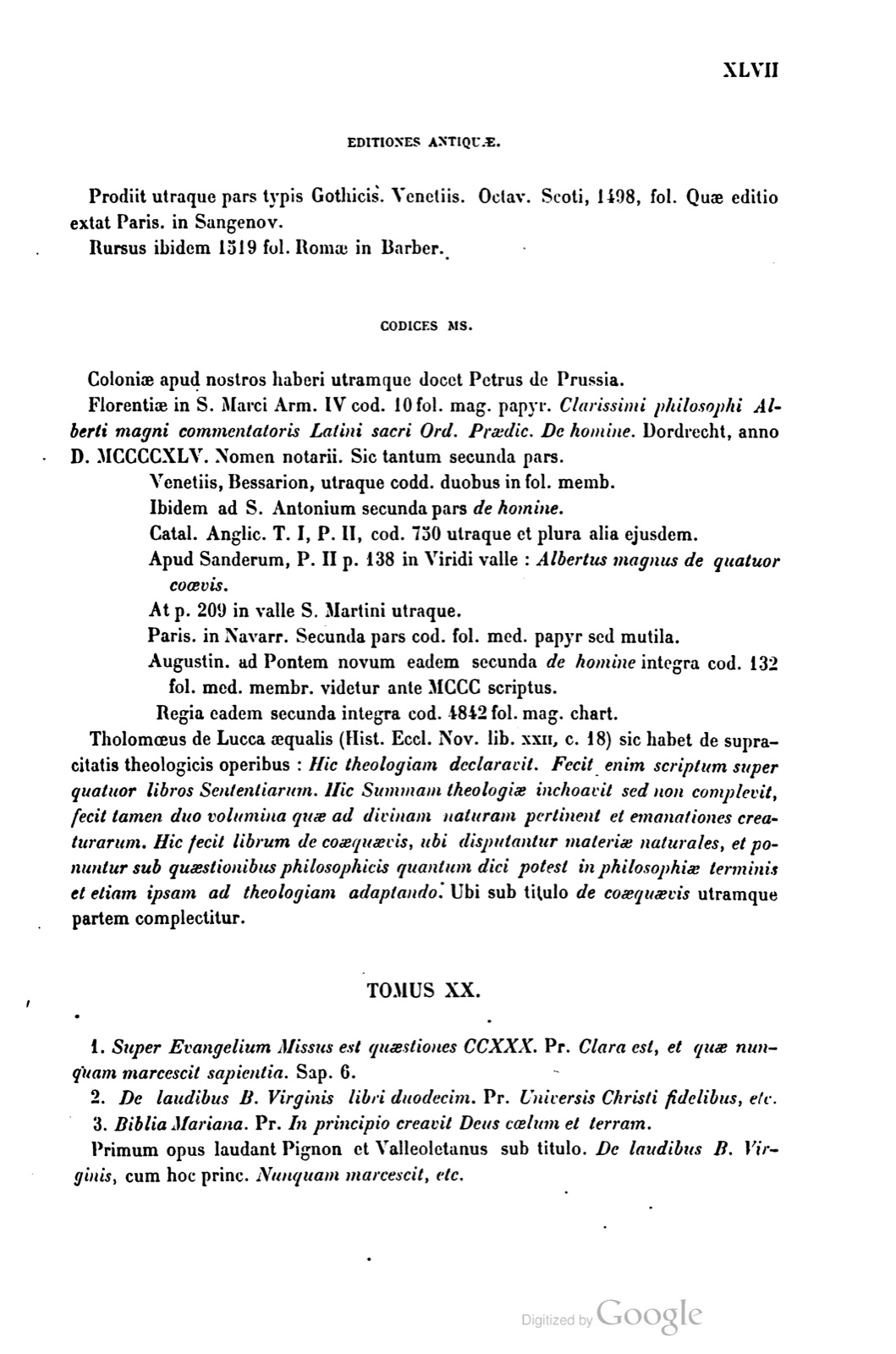
EDITIONES ANTIQUAE.
1. Sub hoc titulo. Opus insigne de laudibus B. Mariae virginis, alias mariale appellatum: Argentinae, Martini Simi, 1493 fol. Quae editio extat in Bibl. Caesar. Vindob. teste Lambecio, lib. 2, p. 777. Altera Coloniae absque anno fol. mag. laudatur ab Alva (Sol. Ver. Rad. 131) penes quem fides. Alia item Coloniae, 1509 fol. refertur a Lipenio, Bibl. Theol. P. II, p. 237, b. Tandem saeculo ultimum elapso idem opus typis prodiit hoc titulo: Richardi a Sancto Laurentio qui ante CCCC annos floruit de laudibus B. Mariae Virginis libri XII. Duaci, Joan. Bogardi, 1625-4 mag. Lipenius loco mox citato laudat editionem ejusdem anni Antverpiae, sed forte eadem est, quae ut solemne in his duabus civitatibus prostabat. Editor ut Richardo de S. Laurentio assereret, hoc momento persuasus est: quod auctor quibusdam locis remittat ad alios tractatus a se antea editos. Sic (lib. II, col. 152) citat tractatum suum de confessione et fructu ejus: (lib. IV, col. 233) citat tractatum de munditia cordis: (lib. VII, col. 442) tractatum suum de contritione, tit. de exprobratione peccati: (lib. X, col. 632) tractatum de scala Jacob seu de scala religionis, quos quatuor et plures alios ad numerum XXI dicti Richardi nomine insignitos ejusdem rationis ac styli editor prae manibus se habere affirmabat, et in fronte codicis sui MS quo continentur, titulum illum paenitentiarii Rotomagensis Ecclesiae insigniri. Revera D. Franciscus de la Pommeraye asceta Sammaureus (Histoire de la cathédrale de Rouen, Rotomagi, 1686 in-4 edita) ubi de visitatione ab Odone Clément archiepiscopo facta pro reformatione capituli Andeliacensis anno MCCXLV, in actis refert dici praesentes plures canonicos Ecclesiae Rotomagensis, et in his Richardum a S. Laurentio, qui forte sic dictus fuerit ab originis suae loco castro nempe ejusdem dioecesis in Caletibus, vel etiam ab ejusdem castri dominorum familia etiamnum illustri, vulgo de Saint Laurens. Ut ut sit ex fide Editoris Richardum a S. Laurentio operis hujus auctorem ultro annuunt Theophilus Raynaudus (Dypt. mar.) et Philippus Labbeus (Dissert. de script. Eccl. T. I, p. 31). Emendandus autem hic venit Casimirus Oudin in suo Supplem. de script. Eccl. p. 506, ubi dubitans de fide Labbei citantis editionem Duacensem anni 1625, opinatur legendum esse 1525 et ejus esse antiquitatis, quae, inquit, inventa fuit in coenobio Franciscanorum de Bernaio in Normania: in quo insigniter allucinatur, cum titulus exempli Bernaiani sit idem editionis Duacenae 1625 a Labbeo laudatae, quaeque non apud Bernaianos quaerenda fuit, ceu quae ubique prostat, et cujus etiam exemplum apud nostros Parisienses ad S. Honorati habetur. Imo secum ipso pugnat, nam cum asserat in titulo exempli Bernaiani auctorem dici ante 400 annos floruisse, si editio esset anni 1525, Richardum remitteret ad saeculum XII, et ad annum circiter 1125, quem tamen ipse collocat ad annum circiter 1230 vel 1245, quo revera auctorem circiter floruisse constabit ex sequentibus.
ANCIENT EDITIONS.
1. Under this title: Notable work on the praises of the Blessed Virgin Mary, otherwise called Mariale. Strasbourg, Martin Simus, 1493, folio. This edition exists in the Imperial Library at Vienna, according to Lambecius, book 2, page 777. Another at Cologne without year, large folio, is praised by Alva (Sun of Truth, ray 131), in whose hands the trust lies. Another likewise at Cologne, 1509, folio, is reported by Lipenius, Theological Library, part II, page 237b. Finally, in the last elapsed century, the same work came forth in print under this title: Twelve books On the Praises of the Blessed Virgin Mary by Richard of St. Laurent, who flourished four hundred years ago. Douai, John Bogard, 1625, large quarto. Lipenius in the place just cited praises an edition of the same year at Antwerp, but perhaps it is the same one, which as usual was offered for sale in these two cities. The editor, in order to assert it for Richard of St. Laurent, was persuaded by this point: that the author in certain places refers to other treatises previously published by him. Thus in book II, column 152, he cites his treatise On Confession and its Fruit; in book IV, column 233, he cites a treatise On Cleanness of Heart; in book VII, column 442, his treatise On Contrition, title On the Reproach of Sin; in book X, column 632, the treatise On the Ladder of Jacob or On the Ladder of Religion. The editor affirmed that he had before his hands these four and several others, to the number of twenty-one, marked with the name of the said Richard and of the same character and style, and that on the front of his manuscript codex in which they are contained that title of penitentiary of the Church of Rouen was inscribed. In truth, Dom François de la Pommeraye, a Maurist ascetic (History of the Cathedral of Rouen, published at Rouen, 1686, quarto), where he treats of the visitation made by Archbishop Odo Clément for the reform of the chapter of Andely in the year 1245, reports that in the acts several canons of the Church of Rouen are said to be present, and among these Richard of St. Laurent, who perhaps was so called from the place of his origin, namely a castle of the same diocese in the Pays de Caux, or also from the still illustrious family of the lords of the same castle, commonly de Saint Laurens. However the matter stands, on the authority of the editor Theophile Raynaud (Marian Diptych) and Philip Labbe (Dissertation on Ecclesiastical Writers, volume I, page 31) freely agree that Richard of St. Laurent was the author of this work. But Casimir Oudin here comes to be corrected in his Supplement on Ecclesiastical Writers, page 506, where, doubting the trustworthiness of Labbe who cites the Douai edition of 1625, he thinks that 1525 should be read and that it is of that antiquity which, he says, was found in the Franciscan monastery of Bernay in Normandy. In this he splendidly hallucinates, since the title of the Bernay copy is the same as that of the Douai edition of 1625 praised by Labbe, and it did not have to be sought among the Bernay men, since it is everywhere for sale and a copy of it is also held among our Parisian men at St. Honoratus. Indeed he fights with himself, for when he asserts that in the title of the Bernay copy the author is said to have flourished four hundred years earlier, if the edition were of the year 1525, it would send Richard back to the twelfth century and to about the year 1125; yet he himself places him about the year 1230 or 1245, at which time it will be clear from the following that the author in fact flourished.
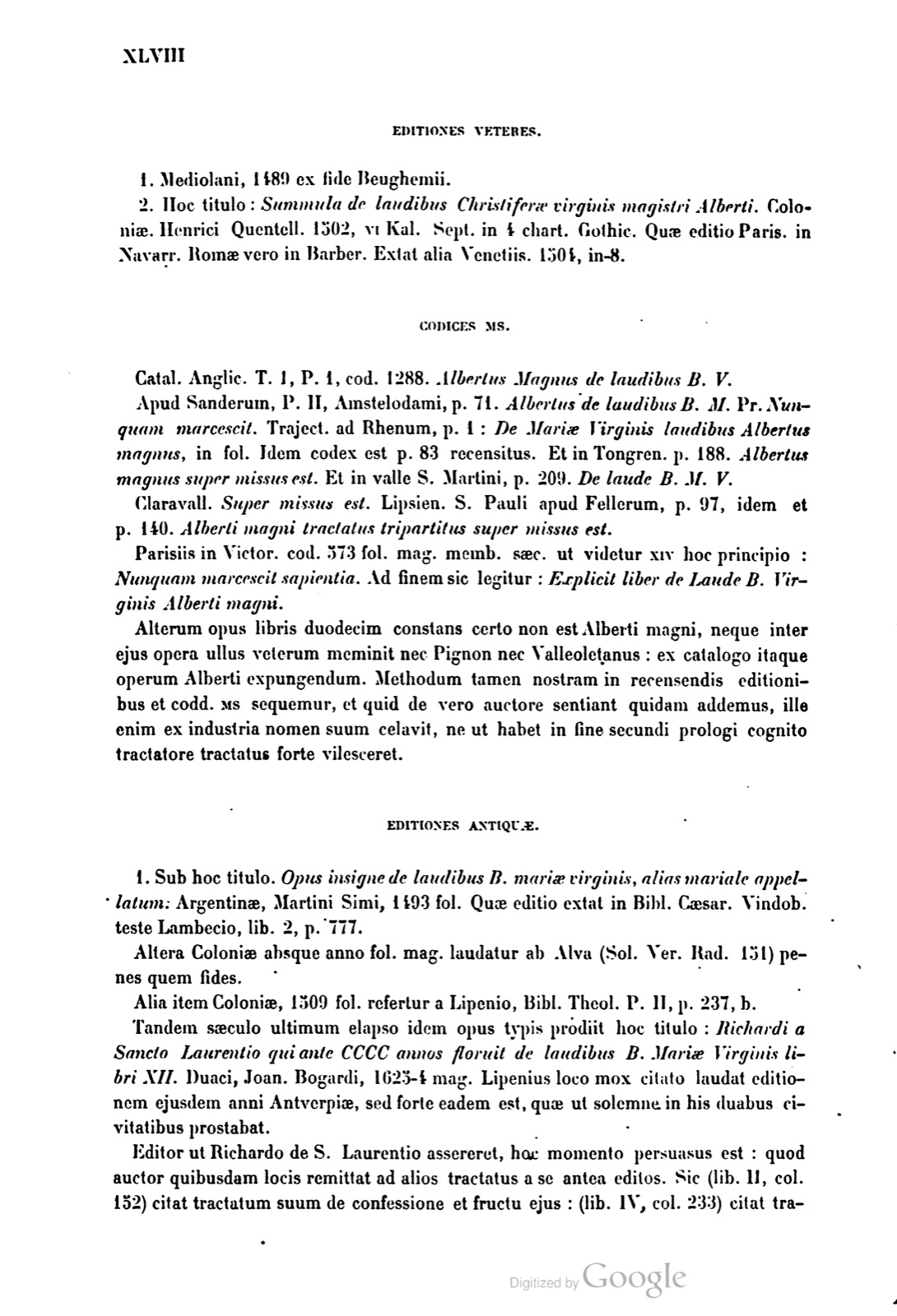
CODICES MS.
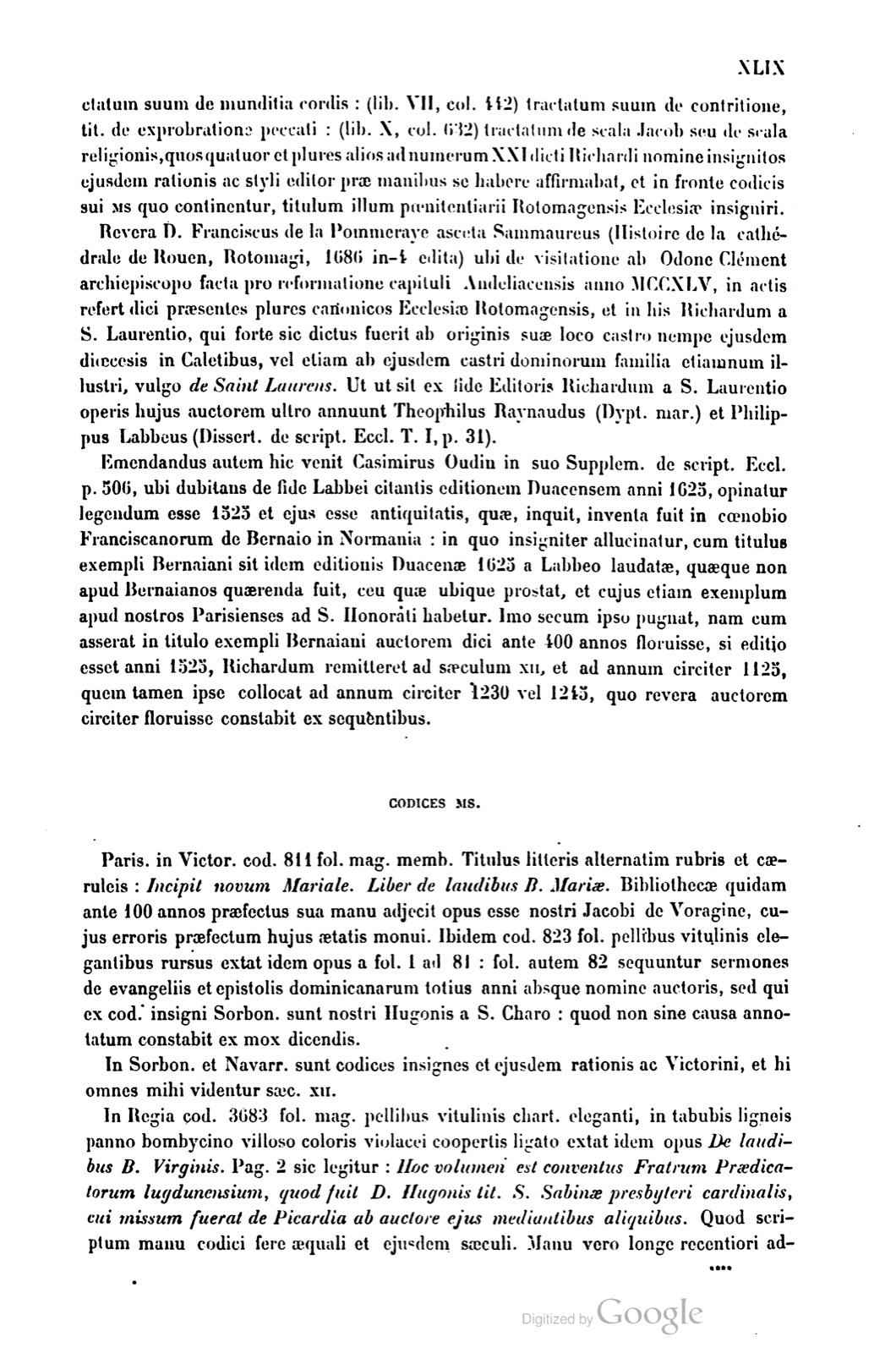
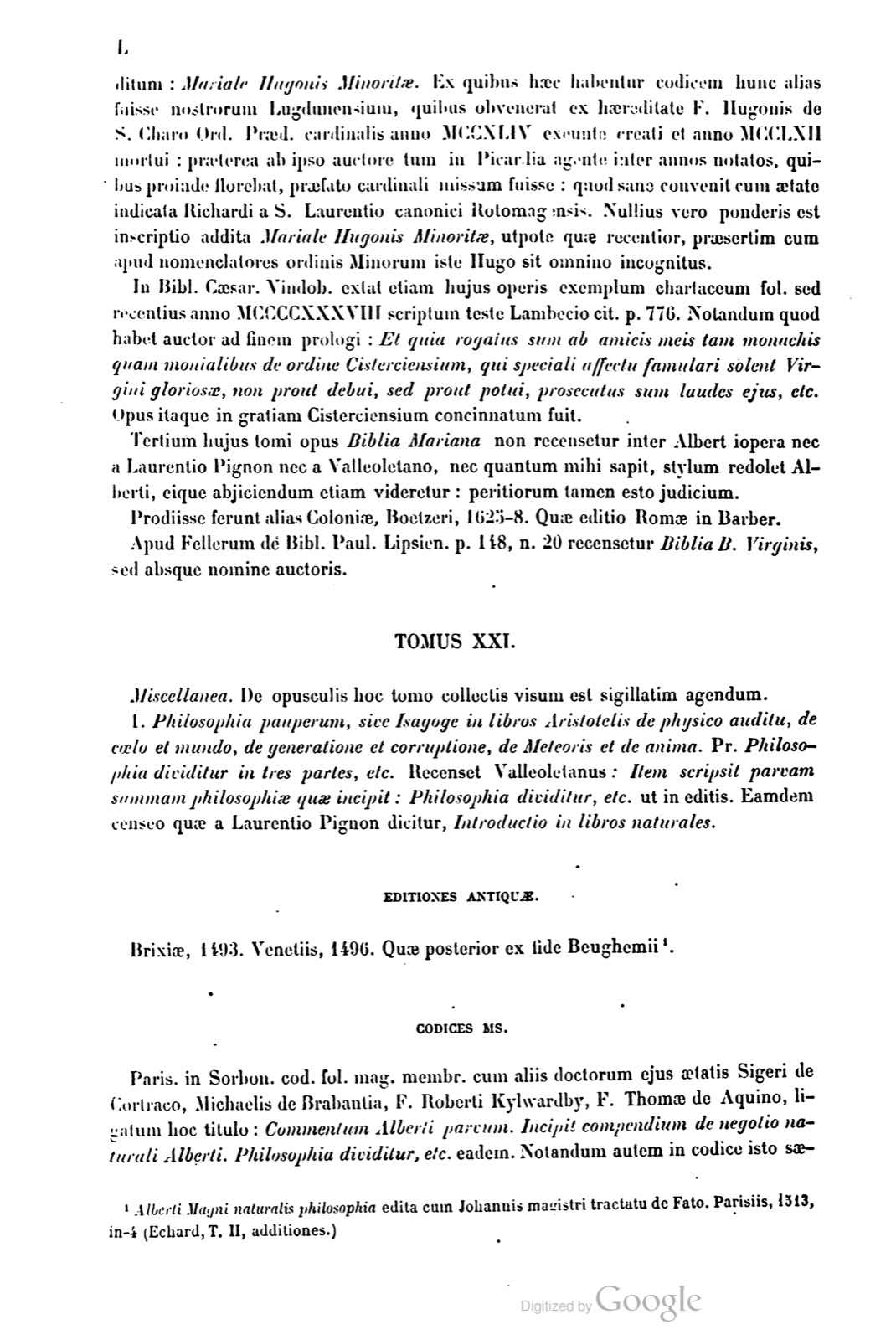
Paris. in Victor. cod. 811 fol. mag. memb. Titulus litteris alternatim rubris et caeruleis: Incipit novum Mariale. Liber de laudibus B. Mariae. Bibliothecae quidam ante 100 annos praefectus sua manu adjecit opus esse nostri Jacobi de Voragine, cujus erroris praefectum hujus aetatis monui. Ibidem cod. 823 fol. pellibus vitulinis elegantibus rursus extat idem opus a fol. 1 ad 81: fol. autem 82 sequuntur sermones de evangeliis et epistolis dominicarum totius anni absque nomine auctoris, sed qui ex cod. insigni Sorbon. sunt nostri Hugonis a S. Charo: quod non sine causa annotatum constabit ex mox dicendis. In Sorbon. et Navarr. sunt codices insignes et ejusdem rationis ac Victorini, et hi omnes mihi videntur saec. XII. In Regia cod. 3683 fol. mag. pellibus vitulinis chart. eleganti, in tabulis ligneis panno bombycino villoso coloris violacei coopertis ligato extat idem opus De laudibus B. Virginis. Pag. 2 sic legitur: Hoc volumen est conventus Fratrum Praedicatorum lugdunensium, quod fuit D. Hugonis tit. S. Sabinae presbyteri cardinalis, cui missum fuerat de Picardia ab auctore ejus mediantibus aliquibus. Quod scriptum manu codici fere aequali et ejusdem saeculi. Manu vero longe recentiori additum: Mariale Hugonis Minoritae. Ex quibus haec habentur codicem hunc alias fuisse nostrorum Lugdunensium, quibus obvenerat ex haereditate F. Hugonis de S. Charo Ord. Praed. cardinalis anno MCCXLIV exeunte creati et anno MCCLXII mortui: praeterea ab ipso auctore tum in Picardia agente inter annos notatos, quibus proinde florebat, praefato cardinali missum fuisse: quod sane convenit cum aetate indicata Richardi a S. Laurentio canonici Rotomagensis. Nullius vero ponderis est inscriptio addita Mariale Hugonis Minoritae, utpote quae recentior, praesertim cum apud nomenclatores ordinis Minorum iste Hugo sit omnino incognitus. In Bibl. Caesar. Vindob. extat etiam hujus operis exemplum chartaceum fol. sed recentius anno MCCCCXXXVIII scriptum teste Lambecio cit. p. 776. Notandum quod habet auctor ad finem prologi: Et quia rogatus sum ab amicis meis tam monachis quam monialibus de ordine Cisterciensium, qui speciali affectu famulari solent Virgini gloriosae, non prout debui, sed prout potui, prosecutus sum laudes ejus, etc. Opus itaque in gratiam Cisterciensium concinnatum fuit. Tertium hujus tomi opus Biblia Mariana non recensetur inter Alberti opera nec a Laurentio Pignon nec a Valleoletano, nec quantum mihi sapit, stylum redolet Alberti, eique abjiciendum etiam videretur: peritiorum tamen esto judicium. Prodiisse ferunt alias Coloniae, Boetzeri, 1625-8. Quae editio Romae in Barber. Apud Fellerum de Bibl. Paul. Lipsien. p. 148, n. 20 recensetur Biblia B. Virginis, sed absque nomine auctoris.
MANUSCRIPT CODICES.
Paris, in Victor, codex 811, large folio parchment. The title in alternately red and blue letters: Here begins the new Mariale. Book on the praises of the Blessed Mary. A certain prefect of the library, one hundred years ago, added by his own hand that the work was by our Jacobus de Voragine; I warned the prefect of this age of his error. In the same place, codex 823, folio on elegant calfskins, the same work again exists from folio 1 to 81; but on folio 82 there follow sermons on the Gospels and Epistles of the Sundays of the whole year without name of author, but which from the notable codex of the Sorbonne are by our Hugh of St. Cher; that this has not been noted without cause will be clear from what is soon to be said. In the Sorbonne and Navarre there are notable codices of the same character as the Victor codex, and all these seem to me to be of the twelfth century. In the Royal Library, codex 3683, large folio on calfskin, elegant paper, bound in wooden boards covered with shaggy silk cloth of violet color, the same work On the Praises of the Blessed Virgin exists. On page 2 it is read thus: This volume belongs to the convent of the Friars Preachers of Lyons; it belonged to Lord Hugh, priest cardinal of the title of St. Sabina, to whom it had been sent from Picardy by its author through certain intermediaries. This was written by a hand almost equal to the codex and of the same century. But by a far more recent hand was added: Mariale of Hugh the Minorite. From these things it is held that this codex once belonged to our Lyons brethren, to whom it had come from the inheritance of Brother Hugh of St. Cher, of the Order of Preachers, cardinal, created at the end of the year 1244 and dead in the year 1262; moreover, that it had been sent to the aforesaid cardinal by the author himself, then active in Picardy between the noted years, in which therefore he flourished. This indeed agrees with the indicated age of Richard of St. Laurent, canon of Rouen. But the added inscription Mariale of Hugh the Minorite is of no weight, since it is more recent, especially since among the cataloguers of the Order of Minors this Hugh is wholly unknown. In the Imperial Library at Vienna there also exists a paper folio copy of this work, but more recent, written in the year 1438, according to the cited Lambecius, page 776. It is to be noted what the author has at the end of the prologue: And because I was asked by my friends, both monks and nuns of the Cistercian order, who are accustomed to serve the glorious Virgin with special affection, I have pursued her praises, not as I ought, but as I could, etc. Therefore the work was put together for the sake of the Cistercians. The third work of this volume, the Marian Bible, is not reviewed among Albert's works either by Laurence Pignon or by Valladolid, nor, as far as it tastes to me, does it breathe Albert's style, and it would seem also to have to be cast away from him; nevertheless let the judgment belong to the more skilled. They report that it came forth elsewhere at Cologne, Boetzer, 1625 octavo. This edition is at Rome in the Barberini. In Feller on the Leipzig St. Paul Library, page 148, number 20, the Bible of the Blessed Virgin is reviewed, but without the name of the author.
If a page does not appear, its photograph has not been uploaded yet.