Volume 1 · pp. 359–364
TRACTATE VII. ON HABIT.
A marker with ≈ is an approximate page boundary, placed by measure of the text; the page photographs remain the authority. In the paired views, clicking a page marker brings that page into view.
TRACTATUS VII
DE HABITU.
CAPUT I.
Quid sit habitus secundum quod est praedicamentum.
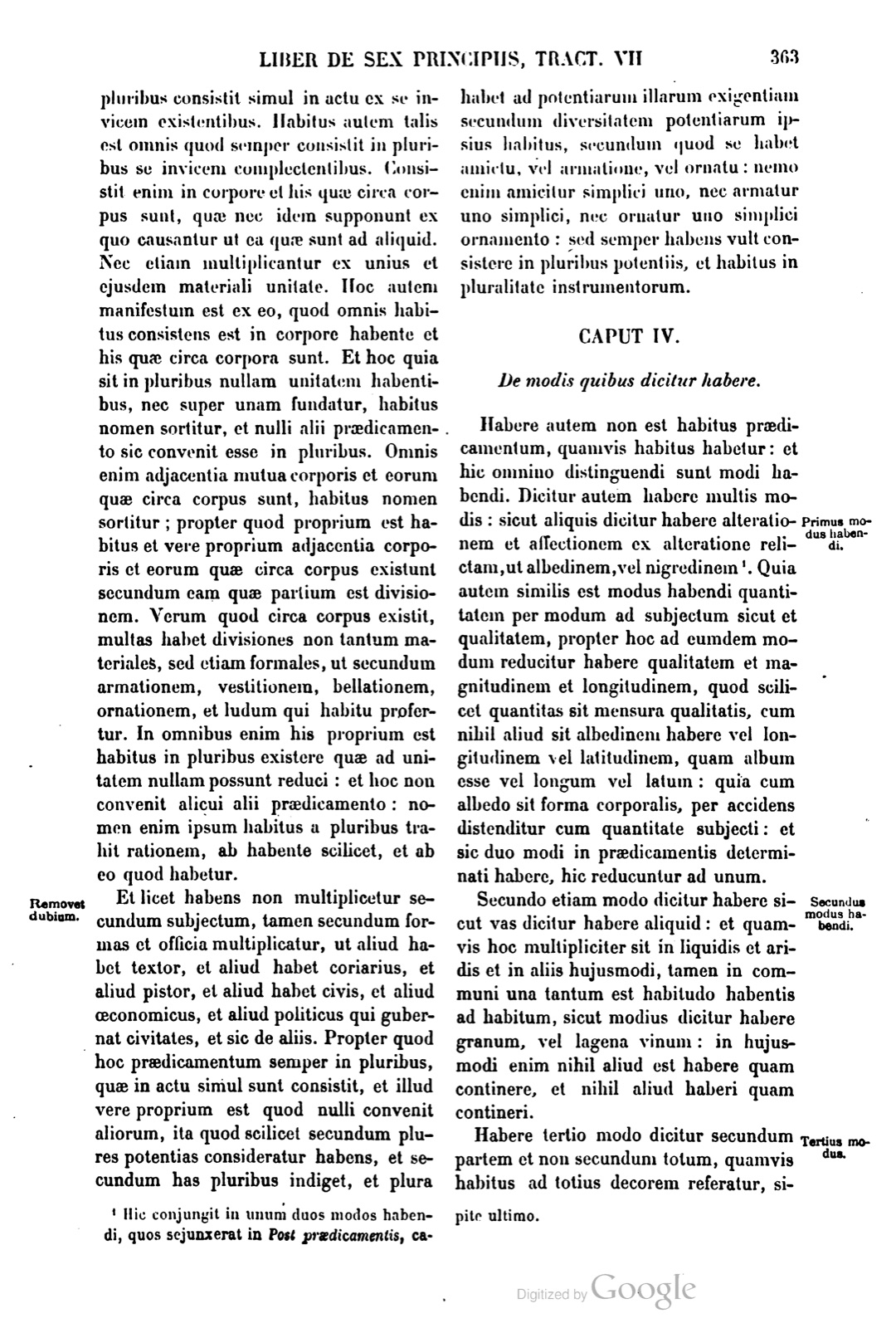
Habitus autem est corporum et eorum quae circa corpus sunt adjacentia, secundum quam haec habere, illa vero haberi dicuntur: habitus enim est habentis, et in habente est habitus, et de illo praedicatur per denominationem. Unde secundum quod est accidentis, sic est in habente ut accidens in subjecto. Cum autem dicitur, quod habitus est corporum, hoc ipsum quod dico corporum, est in habitudine causae finalis: quia propter corpus quaeritur habitus. Cum autem dicitur, et eorum quae circa corpus sunt, tangitur causa materialis, scilicet ex qua sumitur habitus. Et cum dicitur adjacentia, tangitur modus accidentis illius quod est habitus. Adjacentia enim habitus ad corpus dicit naturam illius accidentis: hoc enim adjacens est ut camisia, et ab hac dicitur camisiatus: et aliquid adjacet ut tunica, et ab hoc dicitur tunicatus, et similiter armatus, calceatus, et alia hujusmodi. Habitus igitur secundum quod est praedicamentum, est habitudo corporis ad circumstans, quod figuram corporis talem vel talem accipit: quia ab hac vel ab ista figura dicitur capatus, vel tunicatus, vel calceatus, vel aliter secundum habitum vestitus. Forma igitur quae est in corpore vestito, secundum quam ad circumstans extra comparatur et denominatur, est res hujus praedicamenti, et nomen significans illud hujus praedicamenti nomen existit. Hoc igitur praedicamenti nomen est significatum: et patet quod talis forma in nullo aliorum importatur praedicamentorum: et propter hoc specialiter exigit praedicamentum, quod est unum de generalissimis, cujus subalterna sunt vestitum esse, et armatum esse. Specialissima sunt autem esse tunicatum, capatum, loricatum. Individua autem loricatum esse Socratem, vel Platonem esse tunicatum, et hujusmodi. Quod autem additur, secundum quam haec dicuntur habere, hoc autem haberi, specificatio est habitudinis inter habens et habitum: in hoc enim quod est figuram dans et ut causa finalis dicitur habens: hoc autem quod figuram est accipiens alterius propter alterum assumptum, dicitur habitum.
Hoc autem speciale est in hoc praedicamento sive principio, quia hoc simpliciter inesse dicitur, sive sit secundum totum, sive sit secundum particularem divisionem: in aliis autem quod secundum totum inest, simpliciter dicitur inesse: quod autem secundum partem inest, non simpliciter, sed secundum quid dicitur inesse, ut Aethiops albus est secundum quid et non simpliciter albus: hic autem quod secundum partem inest, simpliciter dicitur inesse, ut calceatus secundum pedem, simpliciter dicitur calceatus, et annulatus secundum digitum, simpliciter annulatus dicitur esse. Est igitur habitus simpliciter, sive sit secundum totum, sive sit secundum partem dictum, ut annulatum quidem esse secundum digitum, et calceatum esse quod inest secundum partem, cum tamen utrumque dicatur simpliciter.
His autem neque rebus quae habitus sunt et formis quae habitum praedicant, simplicia quidem nomina imposita sunt, quibus ea quae habitus vere sunt appellentur. Simplicia autem dico nomina, quae vere primitiva sunt, et unum tantum significantia absolute, non in comparatione ad alia. Talia enim nomina non habent genera et species habitus, sed dicuntur habitus nomina, ut armatio, et calceatio, quorum primum ab armis derivatur, et habitudinem significat: quia corpus armis proportionatur et comparatur. Secundum autem derivatur a calceo et habitudinem notat, qua pars corporis calceo comparatur. Secundum autem derivatur a calceo et habitudinem notat, qua pars corporis calceo comparatur et proportionatur. Et similiter autem est in reliquis omnibus, quae generum vel specierum habitus nomina esse dicuntur, ut vestitio, capatio, tunicatio, et hujusmodi. Propter hoc enim quod ex duobus causatur, et uni debetur ut habenti, reliquo autem ut habito, ideo ab uno simplici nomen imponi non potuit, sed oportuit quod ab aliis derivaretur. Quia vero habentis est habitus et non habiti, ideo oportuit quod denominative nominaretur ut capatus, calceatus, et hujusmodi.
TRACTATE VII
ON HABIT.
CHAPTER I.
What habit is insofar as it is a category.
Habit is the adjacency of bodies and of those things which are around the body, according to which these things are said to have, but those things to be had. For habit belongs to the one having, and habit is in the one having, and it is predicated of that one through denomination. Hence, insofar as it is an accident, it is in the one having as an accident in a subject. But when it is said that habit is of bodies, this very thing that I say, of bodies, is in the relation of a final cause, because habit is sought on account of the body. But when it is said, and of those things which are around the body, the material cause is touched upon, namely that from which habit is taken. And when adjacency is said, the mode of that accident which is habit is touched upon. For the adjacency of habit to body says the nature of that accident: for this adjacent thing is as a shirt, and from this someone is called shirted; and something is adjacent as a tunic, and from this someone is called tunicked, and likewise armed, shod, and other things of this sort. Therefore habit, insofar as it is a category, is the relation of a body to something surrounding it, which receives such or such a figure of the body, because from this or that figure someone is called cloaked, or tunicked, or shod, or otherwise clothed according to habit. Therefore the form which is in the clothed body, according to which it is compared and denominated to the surrounding thing outside, is the thing of this category, and the name signifying that exists as the name of this category. Therefore this name of the category is what is signified, and it is clear that such a form is not imported in any of the other categories. And for this reason it specially requires a category, which is one of the most general things, whose subalterns are to be clothed and to be armed. But the most special species are to be tunicked, cloaked, armored. But individuals are for Socrates to be armored, or for Plato to be tunicked, and things of this sort. But what is added, according to which these things are said to have and those things to be had, is a specification of the relation between the one having and the thing had. For in this, that it gives figure and is as a final cause, it is called the one having; but this, that receives the figure of another, assumed on account of the other, is called the thing had.
But this is special in this category or principle, because this is said simply to inhere, whether it is according to the whole or according to a particular division. But in other things, what inheres according to the whole is simply said to inhere; what inheres according to a part is not said simply to inhere, but in a qualified respect, as an Ethiopian is white in a qualified respect and is not simply white. But here what inheres according to a part is simply said to inhere, as one shod according to the foot is simply said to be shod, and one ringed according to the finger is simply said to be ringed. Therefore it is habit simply, whether it is said according to the whole or according to a part, as to be ringed indeed according to the finger and to be shod, which inheres according to a part, although nevertheless both are said simply.
But on these things, neither on the things which are habits nor on the forms which predicate habit, have simple names been imposed, by which those things which are truly habits may be called. But I call those names simple which are truly primitive and signify only one thing absolutely, not in comparison to other things. For such names do not have genera and species of habit, but are called names of habit, as arming and shoeing; the first of these is derived from arms and signifies a relation, because the body is proportioned and compared to arms. The second, however, is derived from a shoe and marks the relation by which a part of the body is compared to a shoe. The second, however, is derived from a shoe and marks the relation by which a part of the body is compared and proportioned to a shoe. And likewise it is in all the remaining things which are said to be names of the genera or species of habit, as clothing, cloaking, tunicking, and things of this sort. For because habit is caused from two things and is owed to one as to the one having, but to the other as to the thing had, therefore a name could not be imposed from one simple thing, but it had to be derived from other things. But because habit belongs to the one having and not to the thing had, therefore it had to be named denominatively, as cloaked, shod, and things of this sort.
Quia vero in exterioribus est habitus, non interioribus, ideo id quod est secundum partem in quibusdam refertur ad totum: quia qui secundum pedem calceatus est, simpliciter dicitur calceatus esse: et galeatus simpliciter dicitur, qui secundum caput galeatus est. Hoc autem est in his in quibus habitus partis est pro toto. Calceatus enim secundum pedes, pro toto est calceatus, quia pedes totum protegunt, et annulatus secundum digitum, simpliciter est annulatus, quia annulus digiti est ornamentum totius. In quibus autem id quod est partis, ad totum referri non potest, non ita: protectus enim secundum lumbos, non simpliciter est protectus, ut velum capitis habens, est simpliciter velatus: et similiter est in aliis.
In naturalibus autem quamvis intrinseca et extrinseca circumdantur, tamen est habitus secundum modum, et non secundum veritatem, ut carnatus, et incarnatus, et inossatus, et medullatus: haec enim non vere sunt habitus, sed partes corporis secundum substantiam constitutam, quamvis ad modum habitus sint dicta ista. Et ideo ista non dicuntur habitus, sed partes substantiae dicuntur ad modum habitus, ut dictum est.
CAPUT II.
De propriis communibus habitus, quae sunt suscipere magis et minus, et non habere contrarium.
Suscipit autem habitus magis et minus secundum aliquem modum, sed est proprium quod non convenit soli, nec semper: dicitur enim eques pedite armatior, eo quod magis paratus est ad defendendum et ad impugnandum: quia instrumento bellico quod est equus paratus est, et equo utitur ut habitu armorum magis quam utatur eo ut vehiculo: et hoc modo equus ut instrumentum bellicum est in genere habitus, sicut et gladius cum dicitur aliquis gladiatus, vel lanceatus, vel aliquo alio instrumento bellico denominatus: et hoc modo secundum aliam speciem habitus calceatior est, qui caligis et calceamentis utitur, quam qui solis utitur caligis. Hoc autem convenit habitui secundum aliquas species ipsius: in quibusdam enim habitibus non est verum: quia cum magis et minus praedicentur, sicut vestitum esse, vel tunicatum esse, et similia. Unus enim alio vestitior non est qui pluribus utitur vestibus, quam qui paucioribus; vel qui melioribus, quam qui pauperioribus utitur indumentis. In habitu enim quaedam in specie comparantur secundum magis et minus: vestitum enim esse genus est ad tunicatum, et togatum, et pelliceatum: sicut armatum genus est ad loricatum, vel gladiatum, et lanceatum, vel in equestri bello esse, ut ita dicam, dexternatum vel equitatum. Sed in genere armorum recipit magis et minus secundum genus et speciem. Sed in genere vestimenti in neutro suscipit magis et minus. In genere autem calceamentorum suscipit magis et minus.
Marginalia Prima objectio.
Videtur tamen etiam quod in genere vestimentorum suscipit magis et minus: dicitur enim unum magis vestitum esse quam aliud, et alterum minus vestitum, sicut dicimus unum magis calceatum quam aliud.
But because habit is in exterior things, not interior things, therefore that which belongs according to a part is referred to the whole in some cases, because someone who is shod according to the foot is simply said to be shod; and someone helmeted is simply said to be helmeted, who is helmeted according to the head. But this is in those things in which the habit of a part is for the whole. For one shod according to the feet is shod for the whole, because the feet protect the whole; and someone ringed according to the finger is simply ringed, because the ring of the finger is an ornament of the whole. But in those things in which that which belongs to a part cannot be referred to the whole, it is not so. For one protected according to the loins is not simply protected; as one having a veil of the head is simply veiled; and likewise it is in the others.
But in natural things, although intrinsic and extrinsic things are surrounded, nevertheless there is habit according to a mode and not according to truth, as fleshed, incarnate, bony, and marrowed. For these things are not truly habits, but parts of the body according to constituted substance, although these things are said according to the mode of habit. And therefore these are not called habits, but are called parts of substance according to the mode of habit, as has been said.
CHAPTER II.
On the common properties of habit, which are to receive more and less and not to have a contrary.
But habit receives more and less according to some mode, but it is a property which does not belong to it alone, nor always. For a horseman is called more armed than a foot soldier, because he is more prepared for defending and for attacking, because he is prepared with the warlike instrument which is a horse, and he uses the horse as a habit of arms more than he uses it as a vehicle. And in this way a horse as a warlike instrument is in the genus of habit, just as also a sword is when someone is called sworded, or lanced, or denominated from some other warlike instrument. And in this way, according to another species of habit, one is more shod who uses boots and shoes than one who uses only boots. But this belongs to habit according to some of its species; in some habits it is not true, because when more and less are predicated, as to be clothed, or to be tunicked, and similar things. For one is not more clothed than another who uses more garments than one who uses fewer, or who uses better garments than one who uses poorer coverings. For in habit, some things in a species are compared according to more and less: for to be clothed is a genus to being tunicked, to being toga-clad, and to being fur-clad, just as armed is a genus to armored, sworded, lanced, or to being in equestrian war, so to speak, right-sided or mounted. But in the genus of arms it receives more and less according to genus and species. But in the genus of clothing it receives more and less in neither. But in the genus of shoes it receives more and less.
Marginalia First objection.
Yet it also seems that in the genus of clothing it receives more and less, for one is said to be more clothed than another, and another less clothed, just as we say that one is more shod than another.
Marginalia Secunda.
Adhuc autem quaeratur causa, cum unus sit armatior quam alius, et unus calceatior quam alius, quare unus vestitior quam alius non est?
Marginalia Ad primam et secundam.
Ad hoc autem dicendum quod vestimentum refertur in uno usu tantum, qui est calorem fovendo tegere: tegitur autem corpus simpliciter et totum uno quocumque vestimento, et non tegitur plus pluribus quam uno: et ideo quoad hunc actum habitus cum magis et minus non praedicatur. In calceis autem et armis non sic est. Arma enim non ad unum sunt belli actum, sed quaedam sunt impugnationis, quaedam defensionis, quaedam talis vel talis invasionis. Et haec omnia respiciunt bellum et belli proprios actus in defensione et in impugnatione: et ideo armatior est, qui ad plura quae belli sunt paratior est. Similiter est de calceamentis quae non quaeruntur ad tegimen pedis tantum, sed etiam ad viae expeditionem, ut pes melius et a nocumentis defendatur et facilius moveatur et in praesenti motu minus arceatur: et hoc modo calceatior est, qui ad plura talia ex calceis et caligis paratior est. Similiter etiam in ornatu, quod ornatior est, qui ad plures decores ornatior et paratior. Sed in vestitu ut vestitus est, non est nisi usus unus qui est tegenda conservare, et ita corpus tegitur uno sicut pluribus, et ita uno sicut multis: nec minus tectus est qui uno regit, dummodo uno totus et per totum tegatur, quam qui multis tegitur: et vestitum esse non est cum magis et minus. Hoc igitur proprium est quod nec convenit omni, nec soli, nec semper.
Habitui autem nihil est contrarium: et hoc est proprium quod convenit omni et semper, sed non soli. Hoc autem probatur inducendo et exemplorum positione. Armatio enim non est contraria vestitioni vel calceationi: quia si esset contraria, non posset simul esse in eodem. Idem autem simul et semel est armatus, calceatus, et vestitus. Quod autem aliis nihil est contrarium habitibus, palam est. Simile est in aliis sicut in istis, sicut facile est videre inducenti species et genera habitus. Et quia non suscipit contrarium, ideo etiam non simpliciter suscipit magis et minus. Magis enim et minus sunt secundum unam et eamdem formam separatam a contrario magis et minus. Quando autem dicimus aliquem esse magis armatum, vel calceatum, vel ornatum, non dicimus secundum unam aliquam eamdem formam, quae insit habenti habitum: sed hoc referendo ad actum quo proficit armatio vel calceatio vel ornatio: et hoc non est intensio vel remissio proprie: quamvis enim praeparatio sit una ad actum hunc vel illum, cum praeparantia non sint unum nisi in quantum sunt armantia vel calceantia vel ornantia, tamen quia haec non armant vel calceant vel ornant secundum unam et eamdem potentiam praeliandi vel eundi vel ornandi, ideo non relinquunt formam unam nisi in comparatione ad actum unum communem, ut diximus. Et ideo etiam non proprie habitus suscipit magis et minus, sed per comparationem ad actus perfectionem, ut dictum est.
Hoc autem ex hoc plane videri potest, quia non habet simpliciter contrarium, nisi genus quod est qualitas: ideo etiam nihil simpliciter suscipit magis et minus nisi qualitas: habitus ergo non suscipit magis et minus, nisi in comparatione ad actum alicujus in comparatione ad quem habitus est perfectior. Quod etiam actio et passio suscipiunt magis et minus, ideo oportet quia actio et passio causantur ab activis et passivis qualitatibus 1.
CAPUT III.
De proprie proprio habitus quod est semper in pluribus esse.
Marginalia Second.
Further, let the cause be asked: since one is more armed than another, and one is more shod than another, why is one not more clothed than another?
Marginalia To the first and second.
To this one must say that clothing is referred to one use only, which is to cover by fostering warmth. But the body is covered simply and wholly by any one garment, and it is not covered more by several than by one; and therefore with respect to this act habit is not predicated with more and less. But it is not so in shoes and arms. For arms are not for one act of war, but certain ones are for attack, certain ones for defense, certain ones for this or that invasion. And all these look to war and the proper acts of war in defense and in attack; and therefore he is more armed who is more prepared for several things which belong to war. It is likewise concerning shoes, which are not sought for the covering of the foot only, but also for the speeding of the way, so that the foot may be better defended from harms and moved more easily and in the present motion be less confined. And in this way he is more shod who is more prepared for several such things from shoes and boots. Likewise also in ornament, he is more adorned who is more adorned and prepared for more beauties. But in clothing insofar as it is clothing, there is only one use, which is to preserve the things to be covered, and thus the body is covered by one as by several, and by one as by many. Nor is he less covered who rules with one, provided that he is covered wholly and throughout by one, than he who is covered by many; and to be clothed is not with more and less. This, therefore, is a property which neither belongs to every one, nor to it alone, nor always.
But nothing is contrary to habit, and this is a property which belongs to every habit and always, but not to it alone. This is proved by induction and by the positing of examples. For arming is not contrary to clothing or shoeing, because if it were contrary, it could not be at once in the same thing. But the same thing is at once and together armed, shod, and clothed. That nothing is contrary to other habits is evident. It is similar in others as in these, as it is easy to see for one inducing species and genera of habit. And because it does not receive a contrary, therefore also it does not simply receive more and less. For more and less are according to one and the same form more and less separated from a contrary. But when we say that someone is more armed, or shod, or adorned, we do not say this according to some one same form which inheres in the one having the habit, but by referring this to the act for which arming or shoeing or adorning is useful. And this is not intension or remission properly. For although preparation is one toward this or that act, since the things preparing are not one except insofar as they are arming or shoeing or adorning, nevertheless, because these do not arm or shoe or adorn according to one and the same power of fighting or going or adorning, therefore they do not leave one form except in comparison to one common act, as we said. And therefore habit also does not properly receive more and less, but does so through comparison to the perfection of an act, as has been said.
But this can be plainly seen from this, that it does not have a contrary simply, except the genus which is quality. Therefore also nothing simply receives more and less except quality. Habit, therefore, does not receive more and less except in comparison to the act of something in comparison to which the habit is more perfect. But that action and passion also receive more and less must be because action and passion are caused by active and passive qualities 1.
CHAPTER III.
On the properly proper property of habit, which is always to be in several things.
Proprium autem habitus est quod convenit omni soli et semper, quod in pluribus sit quod non in uno, scilicet in corpore sicut habente, et in his quae circa corpus sunt habita, sicut in vestitu, et armis, et ornatu: nec unquam potest esse in uno nisi cum alio: habitus enim est forma quae non inest habenti, nisi sit cum eo quod actu habetur ut circumdans corpus: et hoc non est in aliquo coordinationis praedicamento, sicut facile patet in omnibus, ut in ubi et quando. Sed in ubi quidem, ubi est in eo quod est in loco 2, et nullo modo est in loco: cujus ratio, quia locus non est ubi vel alicubi, quia aliter iretur in infinitum. Similiter quando est in tempore sicut in causa, sed tamen non necessario est cum tempore: quando enim ex praeterito non necesse est esse cum praeterito, quia id praeteriit. Sed in habitu nunquam vere inest habitus habenti, nisi quando habitus circumdat habentem.
Soli igitur habitui convenit hoc non in uno, sed in pluribus semper existere: habitus enim est adjacentia corporis, et est eorum quae sunt circa corpus. Adjacet autem corpus habitui ut causans figuram totius vel figuram membri quod induitur vel armatur vel ornatur: habitus autem adjacet corpori ut circumdans ipsum, et sic utrumque diverso modo adjacet alteri. Et haec adjacentia duplex causa est adjacentiae quae est habitus: unde corpus adjacet habitui, et habitus corpori. Et hae duae adjacentiae causant adjacentiam, quae importatur per nomina specierum et generum habitus, ut loricatus, annulatus, tunicatus, et generaliter armatus, vestitus, vel ornatus. Quod autem habitus in pluribus semper sit secundum eamdem divisionem quae est in partibus, non quidem in partibus habentibus positionem, ut quidam male dicunt: sed ideo fit quia divisio est in his partibus in quibus ut partitis et divisis est habitus: et haec sunt habens quidem in parte una, et habitus in parte alia, quae substantialiter divisa sunt et nullo modo unita. Quod autem genus vel principium sic sit in pluribus, in paucis invenies. Non enim invenies rem alicujus principii vel praedicamenti sic esse in pluribus, nisi in quadam quantitate, et in quibusdam quae sunt ad aliquid. In ad aliquid quidem ut figuraliter dicatur secundum quod apparet in primo aspectu, ut similitudo, et dissimilitudo, aequalitas, inaequalitas, differentia, convenientia: haec omnia in pluribus sunt similibus et dissimilibus, aequalibus et inaequalibus, vel aliter ad invicem se habentibus: quae tamen omnia uniuntur in uno quod est qualitas eadem vel diversa quae est causa omnium illorum. Quantitas autem quae in pluribus actu est, ut numerus qui est in numeralibus, ut in his quae in actu plura sunt et numerantur, quae quidem in pluralitate aguntur secundum discretionem unitatum earum dum multifariam secundum assumptionem. Discretio enim unitatis facit numerum.
Et taliter non est in habitu. Ibi enim actu plura sunt, quae non multiplicantur secundum unam unitatis assumptionem. Unde quamvis simpliciter nihil invenias quod tot distribui possit partibus ut numerum, eo quod in infinitum excrescit unitatum appositione. Et quamvis etiam concederemus quod quantitas quaedam et relatio in pluribus consistit, non tamen omnis quantitas et relatio talis est, quod semper sit in pluribus. Continua enim quantitas non est in pluribus, nec omnis relatio. Idem enim refertur ad id quod est idem, et pater ad filium, et non in pluribus consistit simul in actu ex se invicem existentibus. Habitus autem talis est omnis quod semper consistit in pluribus se invicem complectentibus. Consistit enim in corpore et his quae circa corpus sunt, quae nec idem supponunt ex quo causantur ut ea quae sunt ad aliquid. Nec etiam multiplicantur ex unius et ejusdem materiali unitate. Hoc autem manifestum est ex eo, quod omnis habitus consistens est in corpore habente et his quae circa corpora sunt. Et hoc quia sit in pluribus nullam unitatem habentibus, nec super unam fundatur, habitus nomen sortitur, et nulli alii praedicamento sic convenit esse in pluribus. Omnis enim adjacentia mutua corporis et eorum quae circa corpus sunt, habitus nomen sortitur; propter quod proprium est habitus et vere proprium adjacentia corporis et eorum quae circa corpus existunt secundum eam quae partium est divisionem. Verum quod circa corpus existit, multas habet divisiones non tantum materiales, sed etiam formales, ut secundum armationem, vestitionem, bellationem, ornationem, et ludum qui habitu profertur. In omnibus enim his proprium est habitus in pluribus existere quae ad unitatem nullam possunt reduci: et hoc non convenit alicui alii praedicamento: nomen enim ipsum habitus a pluribus trahit rationem, ab habente scilicet, et ab eo quod habetur.
But the property of habit, which belongs to every habit, to it alone, and always, is that it is in several things and not in one, namely in the body as having, and in those things which are around the body as had, as in clothing, arms, and ornament. Nor can it ever be in one thing except with another. For habit is a form which does not inhere in the one having unless it is with that which is actually had as surrounding the body; and this is not in any category of coordination, as is easily clear in all, as in where and when. But in where, indeed, where is in that which is in place 2, and in no way is it in place; the reason for this is that place is not where or somewhere, because otherwise one would go to infinity. Likewise when is in time as in a cause, but nevertheless it is not necessarily with time; for when from the past does not necessarily exist with the past, because that has passed. But in habit, habit never truly inheres in the one having except when the habit surrounds the one having.
Therefore this belongs to habit alone, always to exist not in one thing but in several. For habit is the adjacency of a body and is of those things which are around the body. But body is adjacent to habit as causing the figure of the whole or the figure of the member which is clothed or armed or adorned; habit, however, is adjacent to the body as surrounding it, and thus each is adjacent to the other in a diverse way. And this double adjacency is the cause of the adjacency which is habit. Hence body is adjacent to habit, and habit to body. And these two adjacencies cause the adjacency which is imported through the names of the species and genera of habit, as armored, ringed, tunicked, and generally armed, clothed, or adorned. But the fact that habit is always in several things according to the same division which is in parts is not indeed in parts having position, as certain people badly say; but it comes about because the division is in those parts in which habit exists as in things parted and divided. And these are the one having in one part and the habit in another part, which are substantially divided and in no way united. But that a genus or principle is in several things in this way, you will find in few cases. For you will not find the thing of any principle or category to be in several things in this way, except in a certain quantity and in certain things which are relative. In relatives, indeed, to speak figuratively according to what appears at first sight, as likeness and unlikeness, equality, inequality, difference, agreement: all these are in several similar and dissimilar, equal and unequal things, or in things related otherwise to one another, all of which nevertheless are united in one thing, which is the same or diverse quality that is the cause of all those things. But quantity which is in several things in act, as number which is in countable things, as in those things which are several in act and are numbered, which indeed are carried on in plurality according to the discretion of their units while in many ways according to assumption. For the discretion of unity makes number.
And it is not so in habit. For there several things are in act, which are not multiplied according to one assumption of unity. Hence although you find absolutely nothing that can be distributed to so many parts as number, because it increases to infinity by the addition of units, and although we might even grant that a certain quantity and relation consists in several things, nevertheless not every quantity and relation is such that it is always in several things. For continuous quantity is not in several things, nor is every relation. For the same is referred to that which is the same, and father to son, and it does not consist in several things at once in act, existing mutually from themselves. But every habit is such that it always consists in several things embracing one another. For it consists in a body and those things which are around the body, which do not suppose the same thing from which they are caused, as relatives do. Nor are they multiplied from the material unity of one and the same thing. But this is manifest from this, that every habit is consisting in the body having and in those things which are around bodies. And because it is in several things having no unity, nor is it founded upon one, it obtains the name habit, and being in several things in this way belongs to no other category. For every mutual adjacency of a body and of those things which are around the body obtains the name habit; for this reason the property of habit, and its true property, is the adjacency of a body and of those things which exist around the body according to that division which belongs to parts. But that which exists around the body has many divisions, not only material but also formal, as according to arming, clothing, warring, adorning, and play which is brought forth by habit. For in all these it is proper to habit to exist in several things which cannot be reduced to any unity, and this belongs to no other category. For the name habit itself draws its account from several things, namely from the one having and from that which is had.
Marginalia Removet dubium.
Et licet habens non multiplicetur secundum subjectum, tamen secundum formas et officia multiplicatur, ut aliud habet textor, et aliud habet coriarius, et aliud pistor, et aliud habet civis, et aliud economicus, et aliud politicus qui gubernat civitates, et sic de aliis. Propter quod hoc praedicamentum semper in pluribus, quae in actu simul sunt consistit, et illud vere proprium est quod nulli convenit aliorum, ita quod scilicet secundum plures potentias consideratur habens, et secundum has pluribus indiget, et plura habet ad potentiarum illarum exigentiam secundum diversitatem potentiarum ipsius habitus, secundum quod se habet amictu, vel armatione, vel ornatu: nemo enim amicitur simplici uno, nec armatur uno simplici, nec ornatur uno simplici ornamento: sed semper habens vult consistere in pluribus potentiis, et habitus in pluralitate instrumentorum.
CAPUT IV.
De modis quibus dicitur habere.
Habere autem non est habitus praedicamentum, quamvis habitus habetur: et hic omnino distinguendi sunt modi habendi. Dicitur autem habere multis modis: sicut aliquis dicitur habere alterationem et affectionem ex alteratione relictam, ut albedinem, vel nigredinem 3.
Marginalia Primus modus habendi.
Quia autem similis est modus habendi quantitatem per modum ad subjectum sicut et qualitatem, propter hoc ad eumdem modum reducitur habere qualitatem et magnitudinem et longitudinem, quod scilicet quantitas sit mensura qualitatis, cum nihil aliud sit albedinem habere vel longitudinem vel latitudinem, quam album esse vel longum vel latum: quia cum albedo sit forma corporalis, per accidens distenditur cum quantitate subjecti: et sic duo modi in praedicamentis determinati habere, hic reducuntur ad unum.
Marginalia Secundus modus habendi.
Secundo etiam modo dicitur habere sicut vas dicitur habere aliquid: et quamvis hoc multipliciter sit in liquidis et aridis et in aliis hujusmodi, tamen in communi una tantum est habitudo habentis ad habitum, sicut modius dicitur habere granum, vel lagena vinum: in hujusmodi enim nihil aliud est habere quam continere, et nihil aliud haberi quam contineri.
Marginalia Tertius modus.
Habere tertio modo dicitur secundum partem et non secundum totum, quamvis habitus ad totius decorem referatur, sicut in membro. Verbi gratia in digito annulum habere dicimur, vel in fronte vel in pede ornatum vel in aure: haec enim omnia reducuntur ad unum communem modum. Cum enim dicimur in digito habere annulum, tantumdem valet ac si digitus in annulo sit et habeatur: et quia etiam membrum organicum ad usum totius habetur, ad eumdem modum reducitur habere membrum.
Marginalia He removes a doubt.
And although the one having is not multiplied according to subject, nevertheless it is multiplied according to forms and offices, as the weaver has one thing, and the leatherworker has another, and the baker another, and the citizen has another, and the householder another, and the statesman who governs cities another, and so with the rest. For this reason this category always consists in several things which are at once in act, and that is the true property which belongs to none of the others: namely that the one having is considered according to several powers, and according to these it needs several things, and it has several things for the requirement of those powers according to the diversity of the powers of the habit itself, according as it is disposed in clothing, or arming, or ornament. For no one is clothed with one simple thing, nor armed with one simple thing, nor adorned with one simple ornament, but the one having always wills to consist in several powers, and habit in the plurality of instruments.
CHAPTER IV.
On the modes in which to have is said.
But to have is not the category habit, although habit is had; and here the modes of having must be altogether distinguished. To have is said in many modes, as someone is said to have an alteration and an affection left from alteration, as whiteness or blackness 3.
Marginalia First mode of having.
But because the mode of having quantity by the mode toward a subject is similar to that of having quality, for this reason having quality and magnitude and length are reduced to the same mode, namely that quantity is the measure of quality, since to have whiteness or length or breadth is nothing other than to be white or long or broad; because, since whiteness is a bodily form, it is accidentally extended with the quantity of the subject, and thus the two modes of having determined in the Categories are here reduced to one.
Marginalia Second mode of having.
In a second mode also, to have is said as a vessel is said to have something; and although this is in many ways in liquid and dry things and in other things of this sort, nevertheless in common there is only one relation of the one having to the thing had, as a bushel is said to have grain, or a flask wine. For in things of this sort to have is nothing other than to contain, and to be had is nothing other than to be contained.
Marginalia Third mode.
To have is said in a third mode according to a part and not according to the whole, although the habit is referred to the beauty of the whole, as in a member. For example, we are said to have a ring on a finger, or an ornament on the forehead or on the foot or on the ear; for all these are reduced to one common mode. For when we are said to have a ring on a finger, it has as much force as if the finger is in the ring and is had; and because even an organic member is had for the use of the whole, to have a member is reduced to the same mode.
Marginalia Quartus modus.
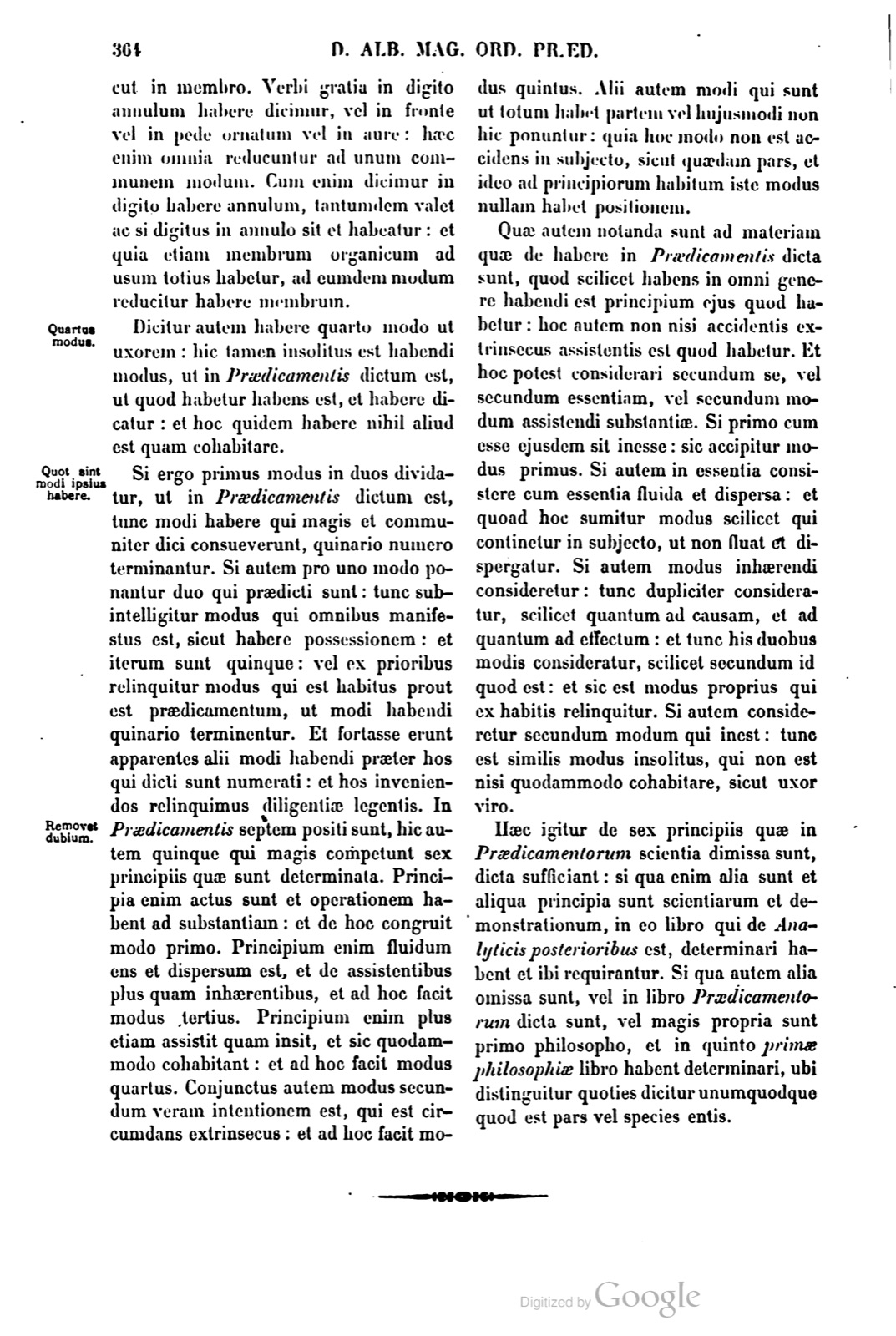
Dicitur autem habere quarto modo ut uxorem: hic tamen insolitus est habendi modus, ut in Praedicamentis dictum est, ut quod habetur habens est, et habere dicatur: et hoc quidem habere nihil aliud est quam cohabitare.
Marginalia Quot sint modi ipsius habere.
Si ergo primus modus in duos dividatur, ut in Praedicamentis dictum est, tunc modi habere qui magis et communiter dici consueverunt, quinario numero terminantur. Si autem pro uno modo ponantur duo qui praedicti sunt: tunc subintelligitur modus qui omnibus manifestus est, sicut habere possessionem: et iterum sunt quinque: vel ex prioribus relinquitur modus qui est habitus prout est praedicamentum, ut modi habendi quinario terminentur. Et fortasse erunt apparentes alii modi habendi praeter hos qui dicti sunt numerati: et hos inveniendos relinquimus diligentiae legentis. In Praedicamentis septem positi sunt, hic autem quinque qui magis competunt sex principiis quae sunt determinata. Principia enim actus sunt et operationem habent ad substantiam: et de hoc congruit modo primo. Principium enim fluidum ens et dispersum est, et de assistentibus plus quam inhaerentibus, et ad hoc facit modus tertius. Principium enim plus etiam assistit quam insit, et sic quodammodo cohabitant: et ad hoc facit modus quartus. Conjunctus autem modus secundum veram intentionem est, qui est circumdans extrinsecus: et ad hoc facit modus quintus. Alii autem modi qui sunt ut totum habet partem vel hujusmodi non hic ponuntur: quia hoc modo non est accidens in subjecto, sicut quaedam pars, et ideo ad principiorum habitum iste modus nullam habet positionem.
Quae autem notanda sunt ad materiam quae de habere in Praedicamentis dicta sunt, quod scilicet habens in omni genere habendi est principium ejus quod habetur: hoc autem non nisi accidentis extrinsecus assistentis est quod habetur. Et hoc potest considerari secundum se, vel secundum essentiam, vel secundum modum assistendi substantiae. Si primo cum esse ejusdem sit inesse: sic accipitur modus primus. Si autem in essentia consistere cum essentia fluida et dispersa: et quoad hoc sumitur modus scilicet qui continetur in subjecto, ut non fluat et dispergatur. Si autem modus inhaerendi consideretur: tunc dupliciter consideratur, scilicet quantum ad causam, et ad quantum ad effectum: et tunc his duobus modis consideratur, scilicet secundum id quod est: et sic est modus proprius qui ex habitis relinquitur. Si autem consideretur secundum modum qui inest: tunc est similis modus insolitus, qui non est nisi quodammodo cohabitare, sicut uxor viro.
Haec igitur de sex principiis quae in Praedicamentorum scientia dimissa sunt, dicta sufficiant: si qua enim alia sunt et aliqua principia sunt scientiarum et demonstrationum, in eo libro qui de Analyticis posterioribus est, determinari habent et ibi requirantur. Si qua autem alia omissa sunt, vel in libro Praedicamentorum dicta sunt, vel magis propria sunt primo philosopho, et in quinto primae philosophiae libro habent determinari, ubi distinguitur quoties dicitur unumquodque quod est pars vel species entis.
Marginalia Fourth mode.
To have is said in a fourth mode as having a wife. Yet this is an unusual mode of having, as was said in the Categories, so that what is had is the one having, and it is said to have; and this having is nothing other than to cohabit.
Marginalia How Many Are the Modes of Having Itself.
Therefore if the first mode is divided into two, as was said in the Categories, then the modes of having which have customarily been said more and commonly are terminated in the number five. But if the two which have been mentioned are posited as one mode, then the mode which is manifest to all is understood beneath it, as to have possession, and again there are five; or from the prior modes there is left the mode which is habit insofar as it is a category, so that the modes of having are terminated in five. And perhaps other apparent modes of having will exist besides those which have been numbered as said, and we leave these to be found by the diligence of the reader. In the Categories seven are posited, but here five, which are more suitable to the six principles which have been determined. For principles are of act and have operation toward substance, and the first mode fits this. For a principle is a flowing and dispersed being, and is of assisting things more than of inhering things, and the third mode makes for this. For a principle also assists more than it inheres, and thus in a certain way they cohabit, and the fourth mode makes for this. But the conjoined mode according to the true intention is the one which surrounds extrinsically, and the fifth mode makes for this. But other modes, which are as when the whole has a part or something of this sort, are not put down here, because in this mode there is not an accident in a subject, as a certain part is; and therefore this mode has no position for the habit of principles.
But the things to be noted with respect to the matter which was said about having in the Categories are these: namely that the one having in every genus of having is the principle of that which is had; but it belongs only to an accident assisting from outside to be what is had. And this can be considered according to itself, or according to essence, or according to the mode of assisting substance. If in the first way, since the being of the same thing is to inhere, the first mode is received in this way. But if it is to consist in essence with a flowing and dispersed essence, then with respect to this the mode is taken, namely that which is contained in a subject, so that it does not flow and become dispersed. But if the mode of inhering is considered, then it is considered in two ways, namely with respect to cause, and to with respect to effect; and then it is considered in these two modes, namely according to that which it is, and in this way there is the proper mode which is left from things had. But if it is considered according to the mode which inheres, then there is a similar unusual mode, which is nothing except in a certain way to cohabit, as a wife with a husband.
Therefore let these things that have been said about the six principles, which were omitted in the science of the Categories, suffice. For if there are any other things, and if any principles belong to sciences and demonstrations, they have to be determined in that book which is On the Posterior Analytics, and let them be sought there. But if any other things have been omitted, either they have been stated in the book of the Categories, or they are more proper to the first philosopher and have to be determined in the fifth book of First Philosophy, where it is distinguished in how many ways each thing is said which is a part or species of being.
Notes
- Concerning this, see above in the tractate On Quality, chapter 11. (De hoc vide supra in tract. de Qualitate, cap. 11.) ↩
- Namely in the located thing. (Scilicet in locato.) ↩
- Here he joins into one two modes of having, which he had separated in the Postpredicaments, in the last chapter. (Hic conjungit in unum duos modos habendi, quos sejunxerat in Post praedicamentis, capite ultimo.) ↩
If a page does not appear, its photograph has not been uploaded yet.