Volume 1 · pp. 365–372
TRACTATE VIII. ON MORE AND LESS.
A marker with ≈ is an approximate page boundary, placed by measure of the text; the page photographs remain the authority. In the paired views, clicking a page marker brings that page into view.
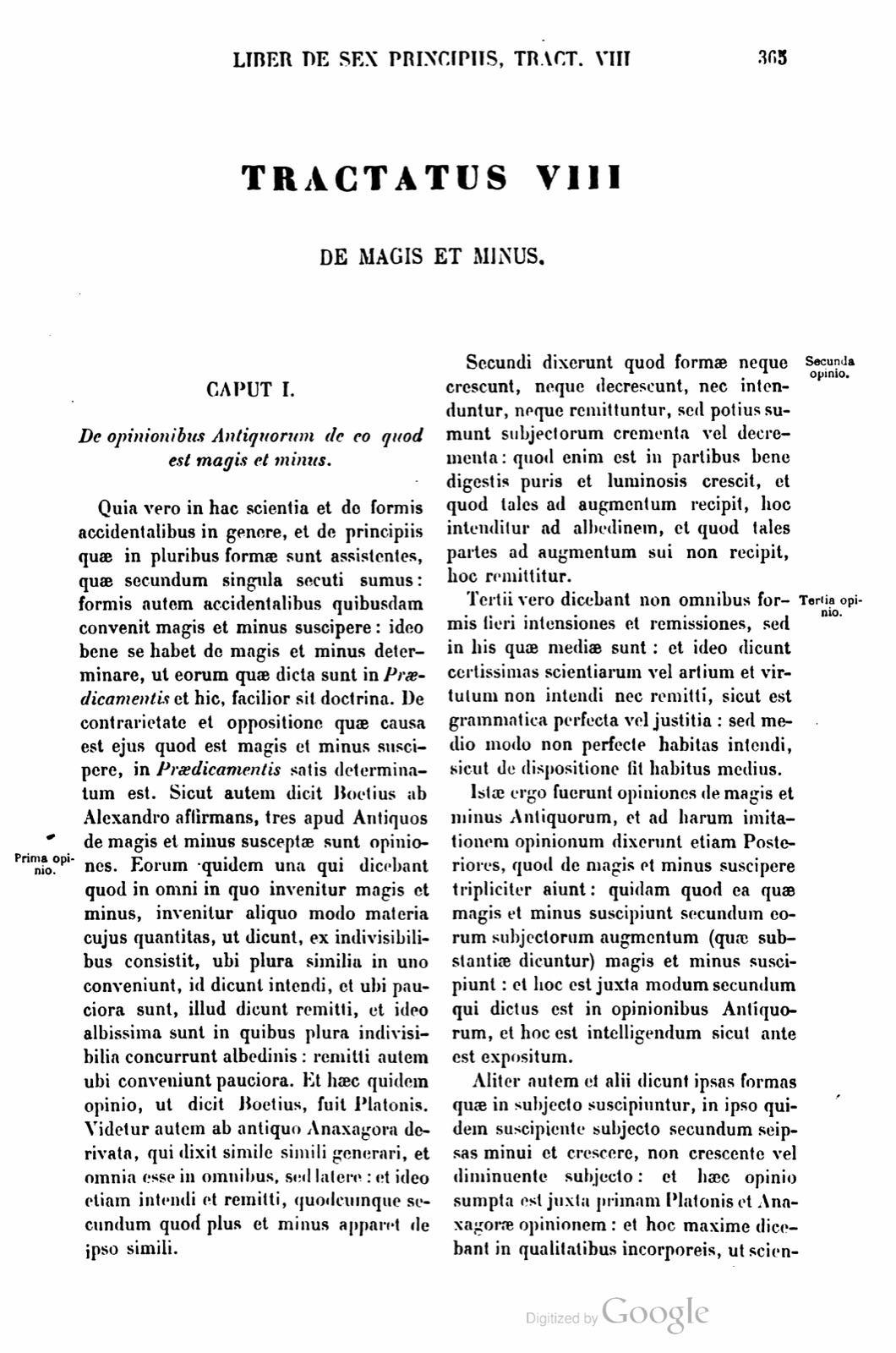
TRACTATUS VIII
DE MAGIS ET MINUS.
CAPUT I.
De opinionibus Antiquorum de eo quod est magis et minus.
Quia vero in hac scientia et de formis accidentalibus in genere, et de principiis quae in pluribus formae sunt assistentes, quae secundum singula secuti sumus: formis autem accidentalibus quibusdam convenit magis et minus suscipere: ideo bene se habet de magis et minus determinare, ut eorum quae dicta sunt in Praedicamentis et hic, facilior sit doctrina. De contrarietate et oppositione quae causa est ejus quod est magis et minus suscipere, in Praedicamentis satis determinatum est. Sicut autem dicit Boetius ab Alexandro affirmans, tres apud Antiquos de magis et minus susceptae sunt opiniones.
Marginalia Prima opinio.
Eorum quidem una qui dicebant quod in omni in quo invenitur magis et minus, invenitur aliquo modo materia cujus quantitas, ut dicunt, ex indivisibilibus consistit, ubi plura similia in uno conveniunt, id dicunt intendi, et ubi pauciora sunt, illud dicunt remitti, et ideo albissima sunt in quibus plura indivisibilia concurrunt albedinis: remitti autem ubi conveniunt pauciora. Et haec quidem opinio, ut dicit Boetius, fuit Platonis. Videtur autem ab antiquo Anaxagora derivata, qui dixit simile simili generari, et omnia esse in omnibus, sed latere: et ideo etiam intendi et remitti, quodcumque secundum quod plus et minus apparet de ipso simili.
Marginalia Secunda opinio.
Secundi dixerunt quod formae neque crescunt, neque decrescunt, nec intenduntur, neque remittuntur, sed potius sumunt subjectorum crementa vel decrementa: quod enim est in partibus bene digestis puris et luminosis crescit, et quod tales ad augmentum recipit, hoc intenditur ad albedinem, et quod tales partes ad augmentum sui non recipit, hoc remittitur.
Marginalia Tertia opinio.
Tertii vero dicebant non omnibus formis fieri intensiones et remissiones, sed in his quae mediae sunt: et ideo dicunt certissimas scientiarum vel artium et virtutum non intendi nec remitti, sicut est grammatica perfecta vel justitia: sed medio modo non perfecte habitas intendi, sicut de dispositione fit habitus medius.
Istae ergo fuerunt opiniones de magis et minus Antiquorum, et ad harum imitationem opinionum dixerunt etiam Posteriores, quod de magis et minus suscipere tripliciter aiunt: quidam quod ea quae magis et minus suscipiunt secundum eorum subjectorum augmentum (quae substantiae dicuntur) magis et minus suscipiunt: et hoc est juxta modum secundum qui dictus est in opinionibus Antiquorum, et hoc est intelligendum sicut ante est expositum.
Aliter autem et alii dicunt ipsas formas quae in subjecto suscipiuntur, in ipso quidem suscipiente subjecto secundum seipsas minui et crescere, non crescente vel diminuente subjecto: et haec opinio sumpta est juxta primam Platonis et Anaxagorae opinionem: et hoc maxime dicebant in qualitatibus incorporeis, ut scientia, et virtute, quae dona deorum esse dicebant: et in his primo data per secundo addita auget, et hanc esse intensionem et remissionem.
Alii autem videntes intendi multas qualitates ex causis mutantibus subjectum, dicebant intensionem et remissionem, et magis et minus fieri secundum utrumque istorum, ut quidam asserunt secundum subjecti incrementum et decrementum: et illam superius inductam opinionem conantur imitari, quia motus aliquis et subjecti est et formae quae in subjecto: subjecti quidem ut ejus quod movetur, formae autem ut ejus quod accipitur in motu.
TRACTATE VIII
ON MORE AND LESS.
CHAPTER I.
On the opinions of the ancients concerning that which is more and less.
But because in this science we have followed, one by one, both accidental forms in general and the principles which in several things are assisting forms, and because it belongs to certain accidental forms to receive more and less, therefore it is fitting to determine concerning more and less, so that the teaching of those things which have been said in the Categories and here may be easier. Concerning contrariety and opposition, which is the cause of receiving more and less, it has been sufficiently determined in the Categories. But as Boethius says, affirming it from Alexander, three opinions concerning more and less were received among the ancients.
Marginalia First opinion.
One of these was the opinion of those who said that in everything in which more and less is found, there is found in some way matter whose quantity, as they say, consists of indivisibles; where more similar things come together in one thing, they say that that thing is intensified, and where fewer are present, they say that that thing is remitted. And therefore the whitest things are those in which more indivisibles of whiteness concur; but remission occurs where fewer come together. And this opinion, as Boethius says, was Plato's. But it seems to have been derived from the ancient Anaxagoras, who said that like is generated by like, and that all things are in all things, but lie hidden; and therefore also anything is intensified and remitted according as more and less appears of the like itself.
Marginalia Second opinion.
The second group said that forms neither grow nor decrease, nor are intensified nor remitted, but rather take on the increases or decreases of subjects: for what is in well-digested, pure, and luminous parts grows, and what receives such parts for increase, this is intensified toward whiteness; and what does not receive such parts for its own increase, this is remitted.
Marginalia Third opinion.
But the third group said that intensifications and remissions do not happen to all forms, but in those which are intermediate; and therefore they say that the most certain of sciences or arts and virtues are not intensified or remitted, as perfect grammar or justice is, but things possessed in an intermediate mode, not perfectly, are intensified, as from disposition there comes to be an intermediate habit.
Therefore these were the opinions of the ancients concerning more and less; and in imitation of these opinions later thinkers also said that they assert in three ways concerning receiving more and less: certain people said that those things which receive more and less receive more and less according to the increase of their subjects, which are called substances; and this is according to the second mode which was stated among the opinions of the ancients, and this must be understood as it was explained before.
But in another way others say that the forms themselves which are received in a subject are diminished and grow according to themselves in the subject itself receiving them, while the subject does not grow or diminish; and this opinion has been taken according to the first opinion of Plato and Anaxagoras; and they said this especially in incorporeal qualities, as knowledge and virtue, which they said were gifts of the gods; and in these a thing first given grows by a second thing added, and they said that this is intension and remission.
But others, seeing that many qualities are intensified from causes changing the subject, said that intension and remission, and more and less, come to be according to both of these, as certain people assert, according to increase and decrease of the subject; and they try to imitate that opinion introduced above, because some motion is both of the subject and of the form which is in the subject: of the subject, indeed, as of that which is moved; but of the form as of that which is received in motion.
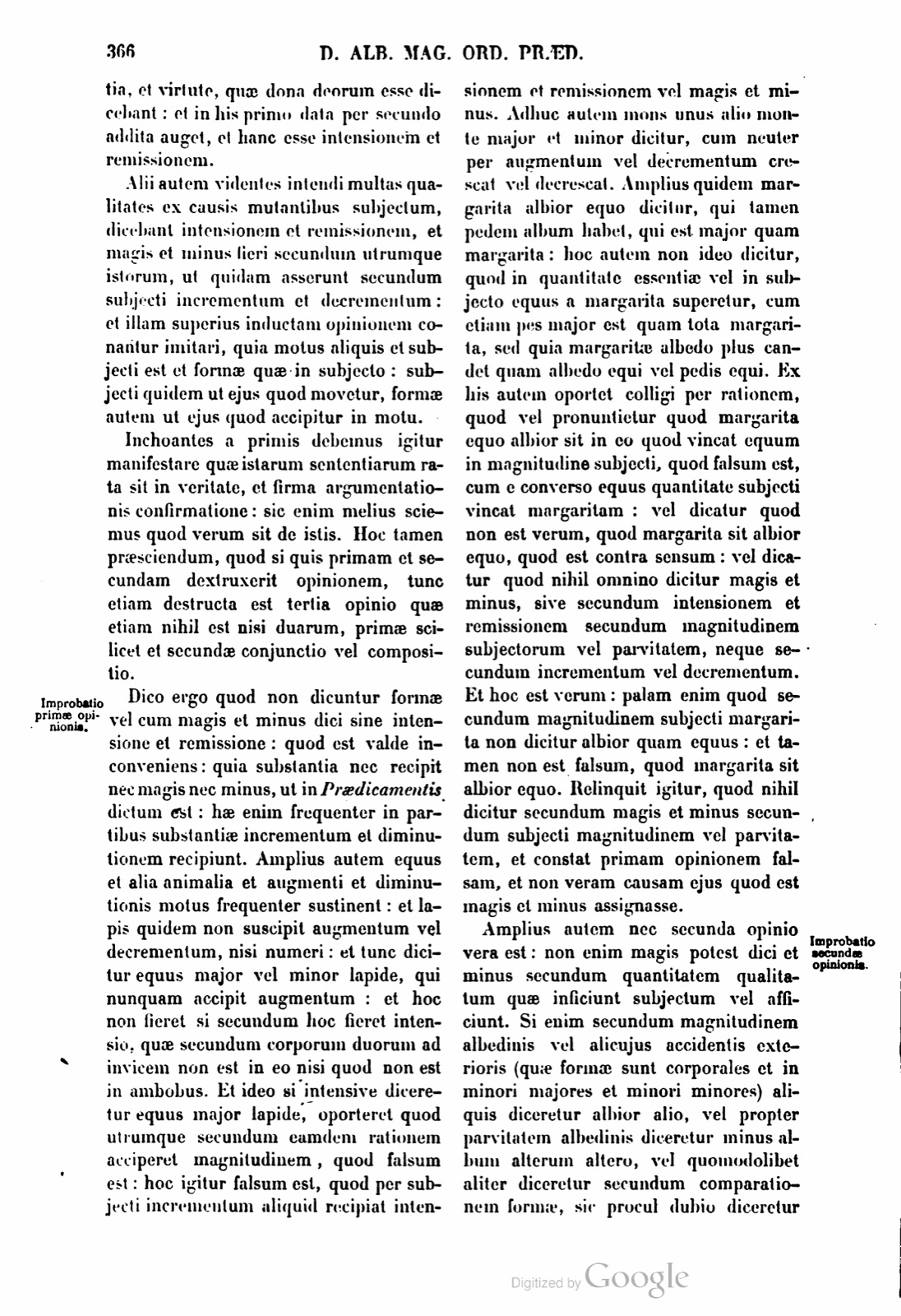
Inchoantes a primis debemus igitur manifestare quae istarum sententiarum rata sit in veritate, et firma argumentationis confirmatione: sic enim melius sciemus quod verum sit de istis. Hoc tamen praesciendum, quod si quis primam et secundam destruxerit opinionem, tunc etiam destructa est tertia opinio quae etiam nihil est nisi duarum, primae scilicet et secundae conjunctio vel compositio.
Marginalia Improbatio primae opinionis.
Dico ergo quod non dicuntur formae vel cum magis et minus dici sine intensione et remissione: quod est valde inconveniens: quia substantia nec recipit nec magis nec minus, ut in Praedicamentis dictum est: hae enim frequenter in partibus substantiae incrementum et diminutionem recipiunt. Amplius autem equus et alia animalia et augmenti et diminutionis motus frequenter sustinent: et lapis quidem non suscipit augmentum vel decrementum, nisi numeri: et tunc dicitur equus major vel minor lapide, qui nunquam accipit augmentum: et hoc non fieret si secundum hoc fieret intensio, quae secundum corporum duorum ad invicem non est in eo nisi quod non est in ambobus. Et ideo si intensive diceretur equus major lapide, oporteret quod utrumque secundum eamdem rationem acciperet magnitudinem, quod falsum est: hoc igitur falsum est, quod per subjecti incrementum aliquid recipiat intensionem et remissionem vel magis et minus. Adhuc autem mons unus alio monte major et minor dicitur, cum neuter per augmentum vel decrementum crescat vel decrescat. Amplius quidem margarita albior equo dicitur, qui tamen pedem album habet, qui est major quam margarita: hoc autem non ideo dicitur, quod in quantitate essentiae vel in subjecto equus a margarita superetur, cum etiam pes major est quam tota margarita, sed quia margaritae albedo plus candet quam albedo equi vel pedis equi. Ex his autem oportet colligi per rationem, quod vel pronuntietur quod margarita equo albior sit in eo quod vincat equum in magnitudine subjecti, quod falsum est, cum e converso equus quantitate subjecti vincat margaritam: vel dicatur quod non est verum, quod margarita sit albior equo, quod est contra sensum: vel dicatur quod nihil omnino dicitur magis et minus, sive secundum intensionem et remissionem secundum magnitudinem subjectorum vel parvitatem, neque secundum incrementum vel decrementum. Et hoc est verum: palam enim quod secundum magnitudinem subjecti margarita non dicitur albior quam equus: et tamen non est falsum, quod margarita sit albior equo. Relinquitur igitur, quod nihil dicitur secundum magis et minus secundum subjecti magnitudinem vel parvitatem, et constat primam opinionem falsam, et non veram causam ejus quod est magis et minus assignasse.
Marginalia Improbatio secundae opinionis.
Amplius autem nec secunda opinio vera est: non enim magis potest dici et minus secundum quantitatem qualitatum quae inficiunt subjectum vel afficiunt. Si enim secundum magnitudinem albedinis vel alicujus accidentis exterioris (quae formae sunt corporales et in minori majores et minori minores) aliquis diceretur albior alio, vel propter parvitatem albedinis diceretur minus album alterum altero, vel quomodolibet aliter diceretur secundum comparationem formae, sic procul dubio diceretur homo vel equus vel aliquid aliud album magnum magis album vel albius quam margarita: accidit enim major quantitas albedinis equo quam margaritae. Amplius magis et minus dicitur alterum altero non secundum subjecti vel secundum accidentis decrementum, vel quod majus et parvius dicitur in formis secundum intensionem et remissionem. Quia enim non secundum subjecti crementum vel decrementum vel magnitudinem vel parvitatem aliquid alio magis vel minus dicatur, manifestum est in his quae dicta sunt. Potest etiam patere ex dictis, quod unum non magis et minus dicitur ad aliud propter ampliorem accidentis quantitatem quam forma corporalis habet in subjecto: quantitas enim formae corporalis ultra subjectum protendi non potest: quia tunc accidens non esset in subjecto, quod est impossibile: quod patet in quantitate, quae tamen videtur esse per se magis quam aliquod aliorum accidentium: et illa non potest: ergo nulla alia forma accidentalis. Quod autem quantitas sine subjecto non sit, hoc patet ex hoc, quia terminus quantitatis est corpus cui inest quantitas, ita quod de quantitate nihil invenitur extra corpus quantum: quod patet ex hoc quod omne quantum magnum vel parvum est: parvitas autem quantitatis tota supponitur in parvo corpore, et ultra subjectum parvum nihil dictae parvitatis porrigitur: quanto igitur subjectum quod est substantia quanta, parvius efficitur, tanto etiam parvitas quantitatis (quae in subjecto est) minoratur. Patet itaque quod nihil cum magis et minus praedicatur, neque secundum subjecti vel accidentis solum augmentum vel diminutionem.
Beginning from the first things, therefore, we must manifest which of these opinions is ratified in truth and by firm confirmation of argumentation; for in this way we shall know better what is true about these matters. Yet this must be known beforehand, that if someone destroys the first and second opinion, then the third opinion also has been destroyed, since it too is nothing except the conjunction or composition of two opinions, namely the first and the second.
Marginalia Disproof of the first opinion.
I say, therefore, that forms are not said, or said with more and less, without intension and remission; and that is very unfitting, because substance receives neither more nor less, as was said in the Categories. For these things frequently receive increase and diminution in the parts of substance. Further, a horse and other animals frequently undergo motions both of increase and of diminution; but a stone does not receive increase or decrease except of number, and then a horse is called greater or lesser than a stone, which never receives increase. And this would not happen if intension came to be according to this, which, with respect to two bodies in relation to one another, is not in that except what is not in both. And therefore, if a horse were called greater than a stone intensively, each would have to receive magnitude according to the same account, which is false. Therefore this is false, that through the increase of a subject something receives intension and remission, or more and less. Further, one mountain is called greater and lesser than another mountain, although neither grows or decreases by increase or decrease. Moreover, indeed, a pearl is called whiter than a horse, although the horse has a white foot which is greater than the pearl. But this is not said because the horse is surpassed by the pearl in quantity of essence or in subject, since even the foot is greater than the whole pearl, but because the whiteness of the pearl shines more than the whiteness of the horse or of the horse's foot. From these things, however, one must gather by reason that either it is pronounced that the pearl is whiter than the horse in this, that it surpasses the horse in magnitude of subject, which is false, since conversely the horse surpasses the pearl by quantity of subject; or it is said that it is not true that the pearl is whiter than the horse, which is contrary to sense; or it is said that nothing at all is called more and less, or according to intension and remission, according to the magnitude or smallness of subjects, nor according to increase or decrease. And this is true: for it is evident that according to magnitude of subject the pearl is not called whiter than the horse, and nevertheless it is not false that the pearl is whiter than the horse. Therefore it remains that nothing is said according to more and less according to magnitude or smallness of subject, and it is established that the first opinion is false and did not assign the true cause of that which is more and less.
Marginalia Disproof of the second opinion.
Moreover, neither is the second opinion true. For more and less cannot be said according to the quantity of the qualities which stain the subject or affect it. For if according to the magnitude of whiteness or of some exterior accident, which forms are corporeal and in a smaller thing are greater and in a smaller thing smaller, someone were called whiter than another, or on account of the smallness of whiteness one thing were called less white than another, or in any other way it were said according to comparison of form, in this way without doubt a human being or a horse or some other great white thing would be called more white or whiter than a pearl; for a greater quantity of whiteness happens to a horse than to a pearl. Further, more and less is said, one thing than another, not according to decrease of subject or according to decrease of accident, or because greater and smaller is said in forms according to intension and remission. For that something is not called more or less than another according to increase or decrease, magnitude or smallness of subject, is manifest in the things that have been said. It can also be clear from what has been said that one thing is not called more and less in relation to another on account of a fuller quantity of accident which a corporeal form has in the subject. For the quantity of a corporeal form cannot be extended beyond the subject, because then an accident would not be in a subject, which is impossible. This is clear in quantity, which nevertheless seems to be more through itself than any of the other accidents; and that cannot do so; therefore no other accidental form can. But that quantity does not exist without a subject is clear from this, that the term of quantity is the body to which quantity belongs, so that nothing of quantity is found outside the quantified body. This is clear from this, that every quantified thing is great or small; but the smallness of quantity is wholly supposed in a small body, and beyond a small subject nothing of the said smallness is extended. Therefore, the smaller the subject which is quantified substance becomes, so much also is the smallness of quantity, which is in the subject, lessened. And so it is clear that nothing is predicated with more and less according only to increase or diminution of subject or accident.
Marginalia Improbatio tertiae opinionis.
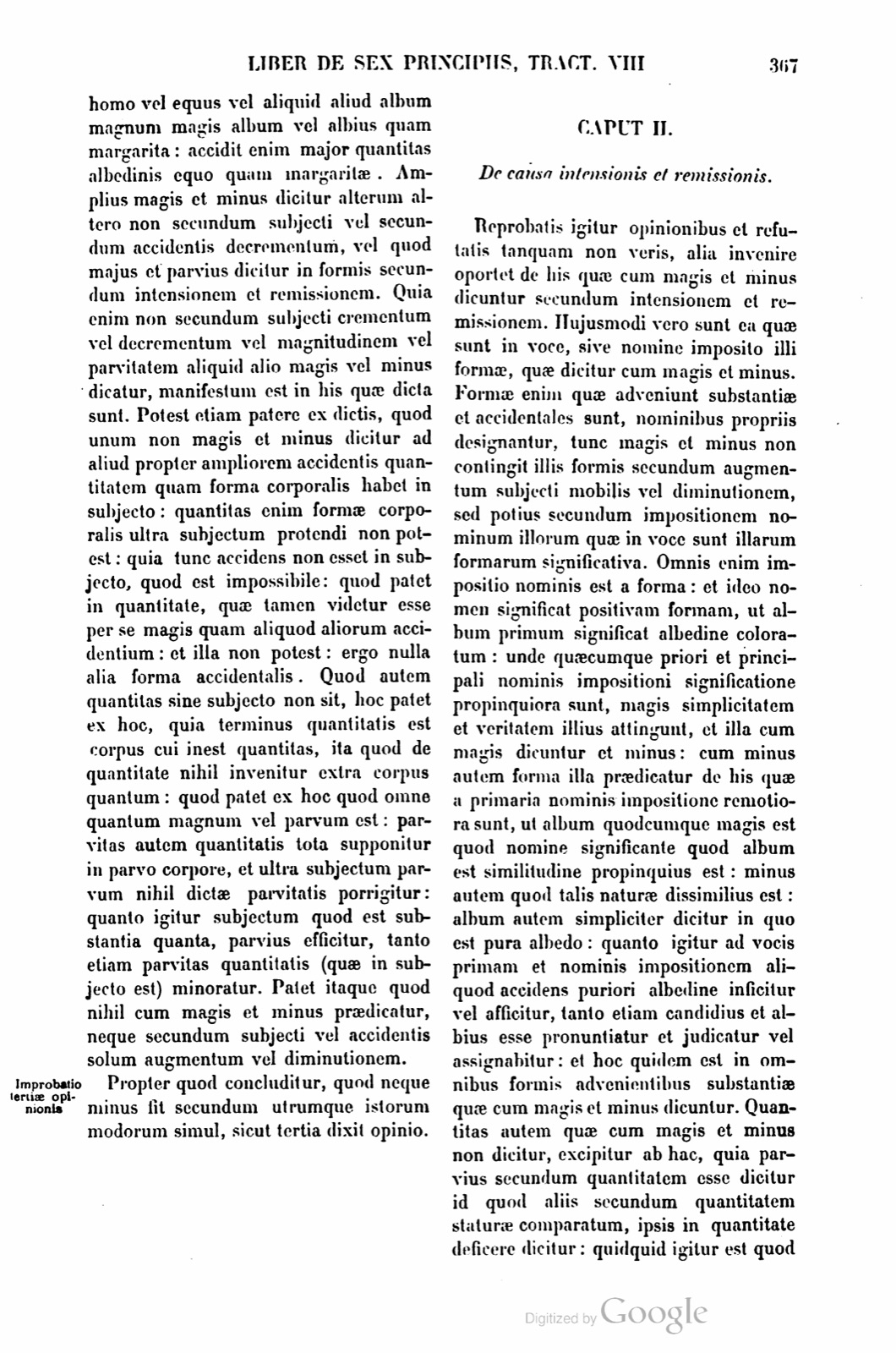
Propter quod concluditur, quod neque minus fit secundum utrumque istorum modorum simul, sicut tertia dixit opinio.
CAPUT II.
De causa intensionis et remissionis.
Reprobatis igitur opinionibus et refutatis tanquam non veris, alia invenire oportet de his quae cum magis et minus dicuntur secundum intensionem et remissionem. Hujusmodi vero sunt ea quae sunt in voce, sive nomine imposito illi formae, quae dicitur cum magis et minus. Formae enim quae adveniunt substantiae et accidentales sunt, nominibus propriis designantur, tunc magis et minus non contingit illis formis secundum augmentum subjecti mobilis vel diminutionem, sed potius secundum impositionem nominum illorum quae in voce sunt illarum formarum significativa. Omnis enim impositio nominis est a forma: et ideo nomen significat positivam formam, ut album primum significat albedine coloratum: unde quaecumque priori et principali nominis impositioni significatione propinquiora sunt, magis simplicitatem et veritatem illius attingunt, et illa cum magis dicuntur et minus: cum minus autem forma illa praedicatur de his quae a primaria nominis impositione remotiora sunt, ut album quodcumque magis est quod nomine significante quod album est similitudine propinquius est: minus autem quod talis naturae dissimilius est: album autem simpliciter dicitur in quo est pura albedo: quanto igitur ad vocis primam et nominis impositionem aliquid accidens puriori albedine inficitur vel afficitur, tanto etiam candidius et albius esse pronuntiatur et judicatur vel assignabitur: et hoc quidem est in omnibus formis advenientibus substantiae quae cum magis et minus dicuntur. Quantitas autem quae cum magis et minus non dicitur, excipitur ab hac, quia parvius secundum quantitatem esse dicitur id quod aliis secundum quantitatem staturae comparatum, ipsis in quantitate deficere dicitur: quidquid igitur est quod quantitatis mensura superatur, id continuo parvius pronuntiatur secundum quantitatis in corpore et quantitate decrementum. Et similiter est in aliis secundum quantitatem comparatis sive secundum longitudinem, sive secundum latitudinem, sive secundum profunditatem. In omnibus autem aliis quae intensionem et remissionem habent, est intensio et remissio secundum accessum vel recessum ad veram nominis impositionem, ut paulo ante dictum est.
Marginalia Disproof of the third opinion.
For this reason it is concluded that neither does less come to be according to both these modes at once, as the third opinion said.
CHAPTER II.
On the cause of intension and remission.
Therefore, when the opinions have been disproved and refuted as not true, it is necessary to find other things concerning those things which are said with more and less according to intension and remission. But things of this sort are those which are in speech, or in the name imposed on that form which is said with more and less. For forms which come to substance and are accidental are designated by proper names; then more and less does not befall those forms according to the increase or diminution of a movable subject, but rather according to the imposition of those names which are in speech and signify those forms. For every imposition of a name is from a form; and therefore a name signifies a positive form, as white first signifies what is colored by whiteness. Hence whatever things are nearer in signification to the prior and principal imposition of the name more attain the simplicity and truth of that name, and those things are said with more and less; but that form is predicated with less concerning those things which are more remote from the primary imposition of the name. Thus whatever white thing is more like what is white by the name signifying it is nearer; but what is more unlike such a nature is less. But white is said simply in that in which there is pure whiteness. Therefore, the more some accident is stained or affected by purer whiteness according to the first imposition of the word and of the name, so much also will it be pronounced, judged, or assigned to be brighter and whiter. And this indeed is in all forms coming to substance which are said with more and less. But quantity, which is not said with more and less, is excepted from this, because that is said to be smaller according to quantity which, compared to other things according to quantity of stature, is said to fall short of them in quantity. Therefore whatever is surpassed by the measure of quantity is immediately pronounced smaller according to decrease of quantity in body and in quantity. And it is similarly in other things compared according to quantity, whether according to length, breadth, or depth. But in all other things which have intension and remission, intension and remission are according to approach to or departure from the true imposition of the name, as was said a little before.
Marginalia Quot modis fit intensio, et remissio.
Sciendum autem multos esse modos intensionis et remissionis. Et ideo notandum quod quaecumque ad invicem comparantur secundum magis et minus, comparantur secundum quod sunt unum aliquo modo, aut genere, aut specie, aut analogia sive proportione: unum quidem specie, ut album quidem in quo unum albius est quam reliquum: unum autem analogia ad unum, sicut intellectuale, unum enim intellectualius est alio, sicut intelligentia per essentiam est intelligentior quam intelligentia per adeptionem intellectus: intellectualius et rationalius est id quod per essentiam est rationale, quam id quod participando dicitur rationale, ut dicit Aristoteles in tertio Ethicorum. Sic igitur oportet unum semper esse unitate secundum analogiam, quae comparantur ad invicem secundum magis et minus. Sed ea quae sunt unum genere vel specie, comparantur secundum unam formam quae est in illis: quae autem sunt unum secundum analogiam, non habent quidem unam formam, sed per formam dictam secundum prius et posterius comparantur secundum magis et minus ad unum actum, qui est intelligere in intellectualibus, vel ratiocinari in rationalibus. Comparatio enim fit etiam secundum duo non in genere dicta, scilicet secundum purius et minus purum: participare formam simpliciter, vel participare formam secundum comparationem ad actum. Et primo quidem modo est intensio secundum accessum ad veram nominis impositionem. Et hoc idem est quod secundum recessum contrarii permixtione, sicut cum dicitur album albius. Aut fit ad actus expeditionem: et hoc modo intensio fit secundum quod subjectum magis fit dispositum ad actum, et secundum hoc solum secundum subjecti dispositionem fit intensio vel remissio.
His igitur modis cum fiat intensio (secundum omnem modum simul dicendo) fit intensio vel remissio secundum hoc quod res in qua est intensio fit vel in effectu vel in forma accedente ad veram nominis impositionem: quia impositio nominis nominat formam quae sine impedimento expedita est ad agendum illius formae proprium actum et effectum. Fit autem comparatio ad veram nominis impositionem duobus modis, scilicet secundum recessum quidem a contrario in his quae non habent ad quod accedant, vel secundum accessum, vel secundum utrumque istorum simul. Secundum accessum quidem in eo quod non habet contrarium, sicut bonum melius: non enim bonum vere habet contrarium, sed privative oppositum. Si enim haberet contrarium, tunc esset illud in aliquo termino in quo esset status. Sed nihil summum est malum aut in quo sit status mali. Secundum recessum autem a contrario fit status mali, nam secundum recessum a contrario comparatur secundum magis et minus, scilicet malus, pejor, pessimus. Non enim aliquid est in mali termino ad quod ista comparentur, sed secundum recessum ab optimo talem accipiunt comparationem.
Marginalia In how many modes intension and remission come to be.
But one must know that there are many modes of intension and remission. And therefore it must be noted that whatever things are compared to one another according to more and less are compared according as they are one in some way, either in genus, or in species, or in analogy or proportion: one in species, indeed, as white, in which one thing is whiter than the other; but one by analogy to one thing, as intellectual, for one thing is more intellectual than another, as intelligence through essence is more intelligent than intelligence through attainment of intellect. That which is rational through essence is more intellectual and more rational than that which is called rational by participating, as Aristotle says in the third book of the Ethics. Thus, therefore, the things which are compared to one another according to more and less must always be one by a unity according to analogy. But those things which are one in genus or species are compared according to one form which is in them. Those things, however, which are one according to analogy do not indeed have one form, but through a form said according to prior and posterior they are compared according to more and less to one act, which is to understand in intellectual things, or to reason in rational things. For comparison also happens according to two things not said in a genus, namely according to purer and less pure: to participate in a form simply, or to participate in a form according to comparison to act. And in the first mode, indeed, intension is according to approach to the true imposition of the name. And this is the same as according to departure from the admixture of a contrary, as when white is called whiter. Or it happens for readiness of act; and in this way intension happens according as the subject becomes more disposed to act, and according to this alone intension or remission happens according to the disposition of the subject.
Therefore, since intension happens in these modes, speaking according to every mode at once, intension or remission happens according to this, that the thing in which there is intension comes to be either in effect or in form approaching the true imposition of the name, because the imposition of the name names the form which, without impediment, is ready for doing the proper act and effect of that form. But comparison to the true imposition of the name happens in two ways: namely according to departure from a contrary in those things which do not have something to which they may approach, or according to approach, or according to both of these at once. According to approach, indeed, it happens in that which does not have a contrary, as good is better; for good does not truly have a contrary, but a privatively opposed thing. For if it had a contrary, then that contrary would be in some term in which there would be a standing-point. But nothing is the highest evil, nor is there anything in which there is a standing-point of evil. But according to departure from a contrary there comes to be a standing-point of evil; for according to departure from the contrary it is compared according to more and less, namely bad, worse, worst. For there is not something in the term of evil to which these may be compared, but they receive such comparison according to departure from the best.
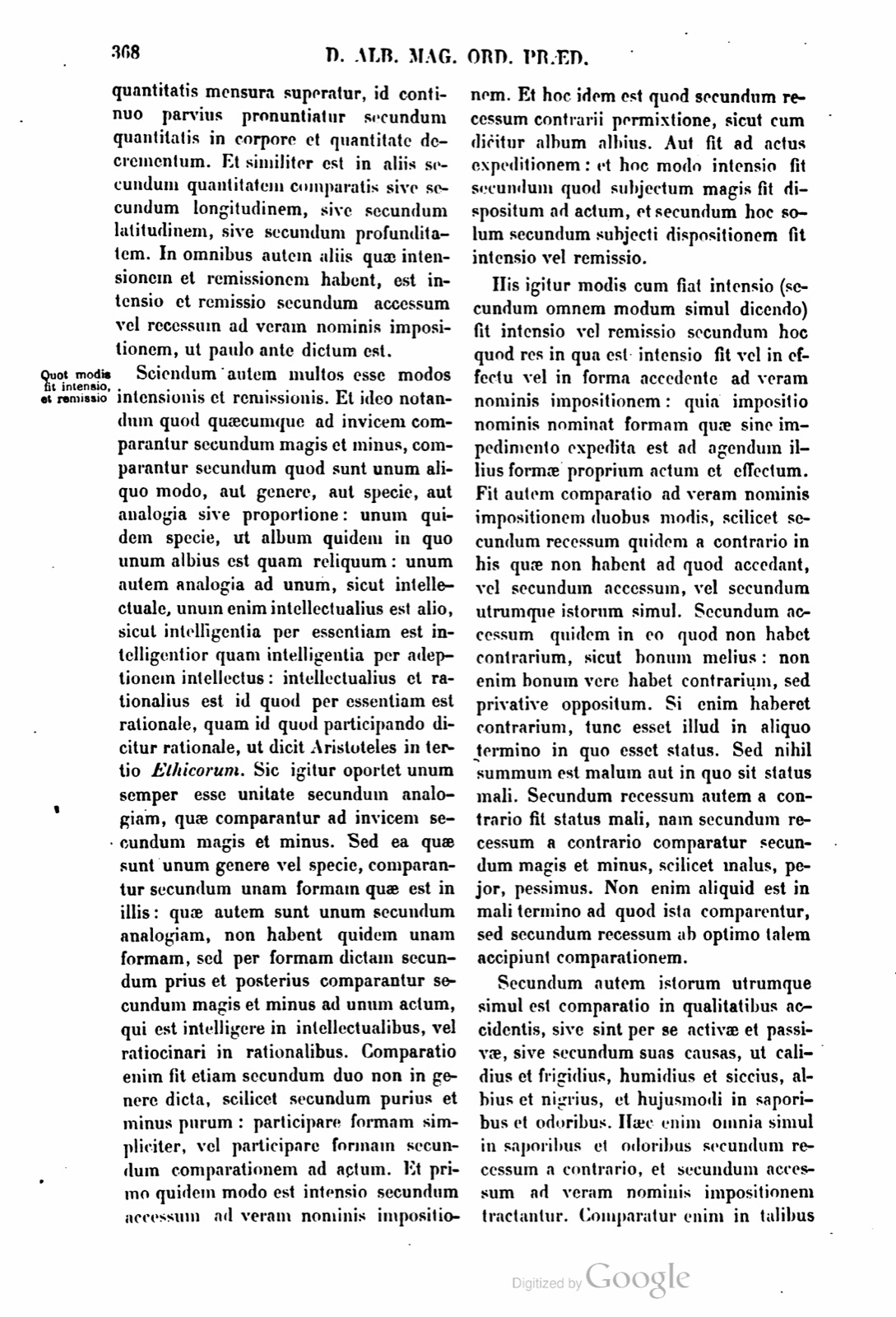
Secundum autem istorum utrumque simul est comparatio in qualitatibus accidentis, sive sint per se activae et passivae, sive secundum suas causas, ut calidius et frigidius, humidius et siccius, albius et nigrius, et hujusmodi in saporibus et odoribus. Haec enim omnia simul in saporibus et odoribus secundum recessum a contrario, et secundum accessum ad veram nominis impositionem tractantur. Comparatur enim in talibus omnibus recessus a contrario secundum eumdem modum, sicut accessus ad veram nominis impositionem.
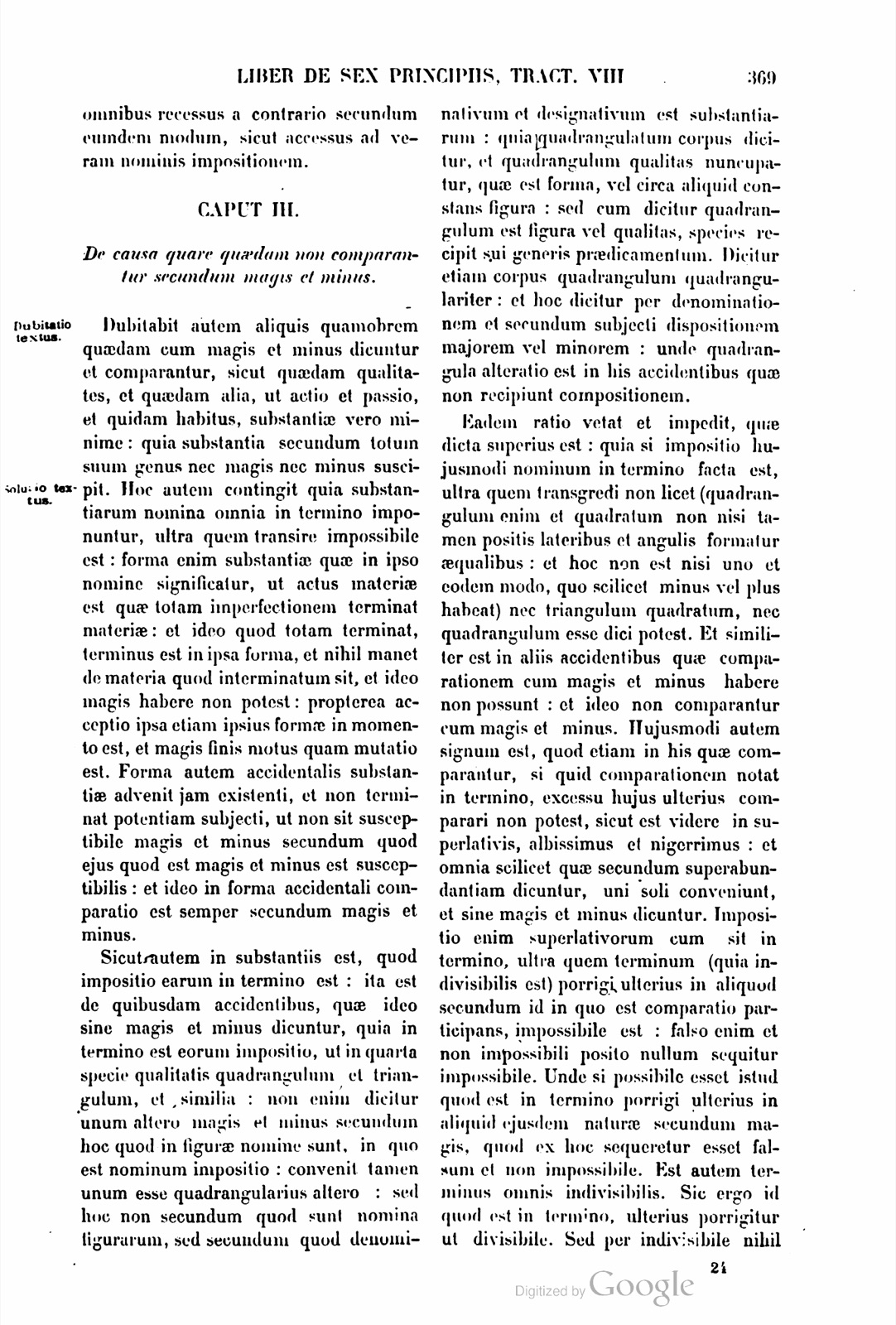
CAPUT III.
De causa quare quaedam non comparantur secundum magis et minus.
Marginalia Dubitatio textus.
Dubitabit autem aliquis quamobrem quaedam cum magis et minus dicuntur et comparantur, sicut quaedam qualitates, et quaedam alia, ut actio et passio, et quidam habitus, substantiae vero minime: quia substantia secundum totum suum genus nec magis nec minus suscipit.
Marginalia Solutio textus.
Hoc autem contingit quia substantiarum nomina omnia in termino imponuntur, ultra quem transire impossibile est: forma enim substantiae quae in ipso nomine significatur, ut actus materiae est quae totam imperfectionem terminat materiae: et ideo quod totam terminat, terminus est in ipsa forma, et nihil manet de materia quod interminatum sit, et ideo magis habere non potest: propterea acceptio ipsa etiam ipsius formae in momento est, et magis finis motus quam mutatio est. Forma autem accidentalis substantiae advenit jam existenti, et non terminat potentiam subjecti, ut non sit susceptibile magis et minus secundum quod ejus quod est magis et minus est susceptibilis: et ideo in forma accidentali comparatio est semper secundum magis et minus.
Sicut autem in substantiis est, quod impositio earum in termino est: ita est de quibusdam accidentibus, quae ideo sine magis et minus dicuntur, quia in termino est eorum impositio, ut in quarta specie qualitatis quadrangulum et triangulum, et similia: non enim dicitur unum altero magis et minus secundum hoc quod in figurae nomine sunt, in quo est nominum impositio: convenit tamen unum esse quadrangularius altero: sed hoc non secundum quod sunt nomina figurarum, sed secundum quod denominativum et designativum est substantiarum: quia quadrangulatum corpus dicitur, et quadrangulum qualitas nuncupatur, quae est forma, vel circa aliquid constans figura: sed cum dicitur quadrangulum est figura vel qualitas, species recipit sui generis praedicamentum. Dicitur etiam corpus quadrangulum quadrangulariter: et hoc dicitur per denominationem et secundum subjecti dispositionem majorem vel minorem: unde quadrangula alteratio est in his accidentibus quae non recipiunt compositionem.
Eadem ratio vetat et impedit, quae dicta superius est: quia si impositio hujusmodi nominum in termino facta est, ultra quem transgredi non licet (quadrangulum enim et quadratum non nisi tamen positis lateribus et angulis formatur aequalibus: et hoc non est nisi uno et eodem modo, quo scilicet minus vel plus habeat) nec triangulum quadratum, nec quadrangulum esse dici potest. Et similiter est in aliis accidentibus quae comparationem cum magis et minus habere non possunt: et ideo non comparantur cum magis et minus. Hujusmodi autem signum est, quod etiam in his quae comparantur, si quid comparationem notat in termino, excessu hujus ulterius comparari non potest, sicut est videre in superlativis, albissimus et nigerrimus: et omnia scilicet quae secundum superabundantiam dicuntur, uni soli conveniunt, et sine magis et minus dicuntur. Impositio enim superlativorum cum sit in termino, ultra quem terminum (quia indivisibilis est) porrigi ulterius in aliquod secundum id in quo est comparatio participans, impossibile est: falso enim et non impossibili posito nullum sequitur impossibile. Unde si possibile esset istud quod est in termino porrigi ulterius in aliquid ejusdem naturae secundum magis, quod ex hoc sequeretur esset falsum et non impossibile. Est autem terminus omnis indivisibilis. Sic ergo id quod est in termino, ulterius porrigitur ut divisibile. Sed per indivisibile nihil additur et nihil intenditur secundum magis et minus: quia si omnia puncta componantur, nullam magnitudinem faciunt: eo quod punctum puncto compositum, nihil auget: et punctum a puncto demptum, nihil diminuit. Et similiter cum terminus alicujus ulterius dicitur porrigi, nil auget de forma vel minuit: quia terminus est indivisibilis, cui nec addi, nec diminui potest. Et haec igitur causa est intensionis et remissionis.
But according to both of these at once there is comparison in qualities of accident, whether they are active and passive through themselves, or according to their causes, as hotter and colder, wetter and drier, whiter and blacker, and things of this sort in flavors and odors. For all these things together, in flavors and odors, are treated according to departure from a contrary and according to approach to the true imposition of the name. For in all such things departure from a contrary is compared according to the same mode as approach to the true imposition of the name.
CHAPTER III.
On the cause why certain things are not compared according to more and less.
Marginalia Difficulty of the text.
But someone will wonder why certain things are said and compared with more and less, such as certain qualities and certain other things, as action and passion and certain habits, but substance least of all, because substance according to its whole genus receives neither more nor less.
Marginalia Solution of the text.
This happens because all names of substances are imposed in a term beyond which it is impossible to pass. For the form of substance which is signified in the name itself is as the act of matter which terminates the whole imperfection of matter; and therefore what terminates the whole is a term in the form itself, and nothing remains of matter which is unterminated, and therefore it cannot have more. For this reason the very reception of that form itself is also in a moment, and is more the end of motion than a change. But accidental form comes to substance already existing, and does not terminate the potency of the subject so that it would not be susceptible of more and less according as it is susceptible of that which is more and less; and therefore in accidental form comparison is always according to more and less.
But just as in substances the imposition of their names is in a term, so also it is concerning certain accidents, which are therefore said without more and less because their imposition is in a term, as in the fourth species of quality quadrangular and triangular and similar things. For one thing is not called more and less than another according to this, that they are in the name of figure, in which the imposition of names exists. Nevertheless, one thing can be more quadrangular than another; but this is not according as they are names of figures, but according as it is denominative and designative of substances, because a quadrangled body is said, and quadrangle is named a quality, which is a form or a figure standing around something. But when it is said, a quadrangle is a figure or quality, the species receives the category of its genus. A quadrangular body is also called quadrangularly; and this is said through denomination and according to a greater or lesser disposition of the subject. Hence quadrangular alteration is in these accidents which do not receive composition.
The same account, which was stated above, forbids and impedes this, because if the imposition of names of this sort has been made in a term beyond which it is not permitted to go beyond, for a quadrangle and a square are formed only when sides and angles have been posited equal, and this is only in one and the same mode, in which namely it would have less or more, then neither can a triangle be called square, nor can it be called a quadrangle. And similarly it is in other accidents which cannot have comparison with more and less; and therefore they are not compared with more and less. A sign of this sort, however, is that even in those things which are compared, if something marks comparison in a term, by an excess beyond this it cannot be compared further, as is seen in superlatives, whitest and blackest; and all things, namely, which are said according to superabundance belong to one alone and are said without more and less. For since the imposition of superlatives is in a term beyond which term, because it is indivisible, it is impossible to extend further into something participating according to that in which there is comparison; for when a false but not impossible thing is posited, no impossibility follows. Hence if it were possible for that which is in a term to be extended further into something of the same nature according to more, what would follow from this would be false and not impossible. But every term is indivisible. Thus, therefore, that which is in a term is extended further as divisible. But through an indivisible nothing is added and nothing is intensified according to more and less, because if all points are composed, they make no magnitude, since a point composed with a point increases nothing, and a point taken away from a point diminishes nothing. And similarly, when the term of something is said to be extended further, it increases or lessens nothing of the form, because a term is indivisible, to which nothing can be added, nor can anything be diminished. And this, therefore, is the cause of intension and remission.
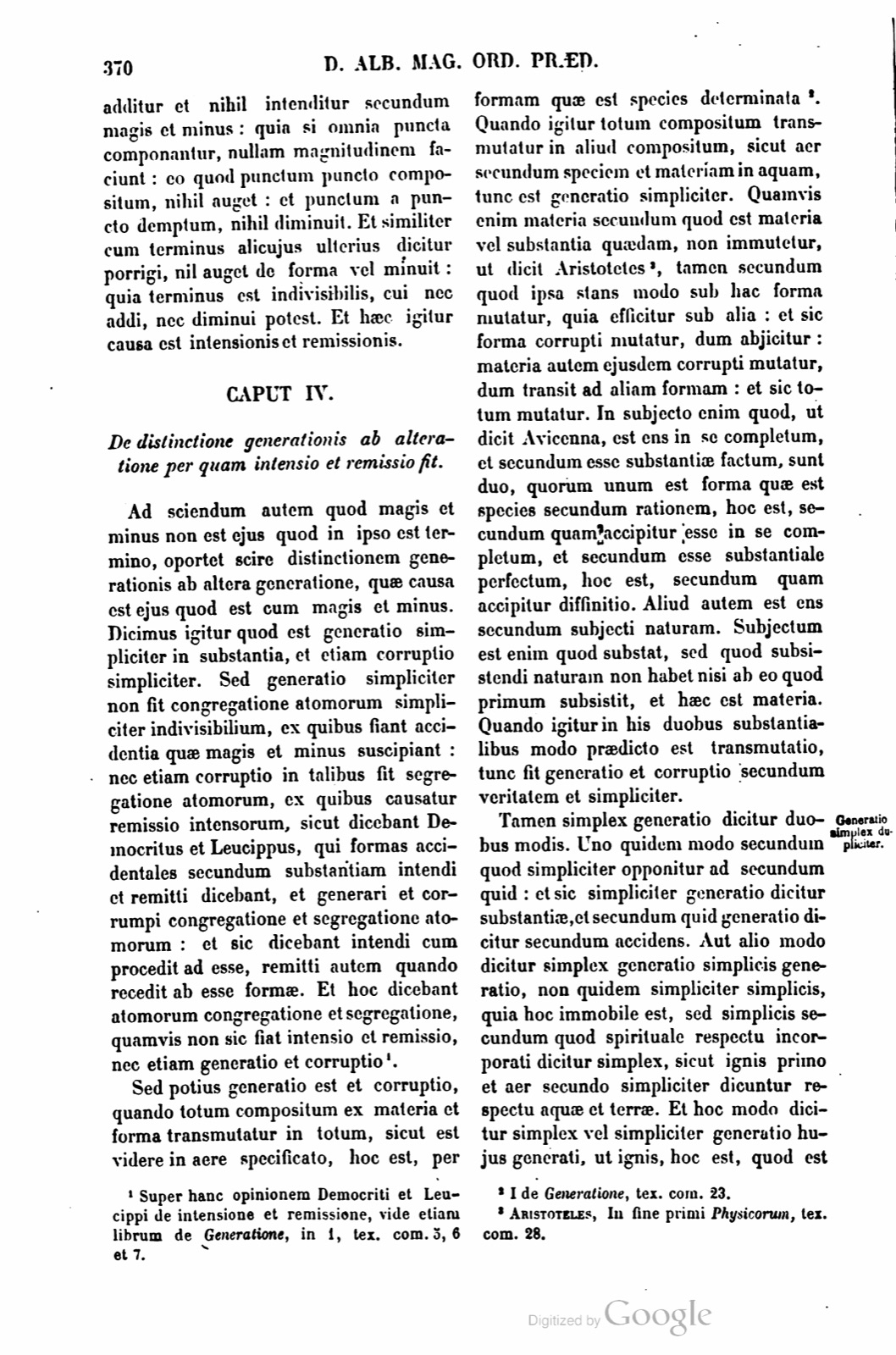
CAPUT IV.
De distinctione generationis ab alteratione per quam intensio et remissio fit.
Ad sciendum autem quod magis et minus non est ejus quod in ipso est termino, oportet scire distinctionem generationis ab altera generatione, quae causa est ejus quod est cum magis et minus. Dicimus igitur quod est generatio simpliciter in substantia, et etiam corruptio simpliciter. Sed generatio simpliciter non fit congregatione atomorum simpliciter indivisibilium, ex quibus fiant accidentia quae magis et minus suscipiant: nec etiam corruptio in talibus fit segregatione atomorum, ex quibus causatur remissio intensorum, sicut dicebant Democritus et Leucippus, qui formas accidentales secundum substantiam intendi et remitti dicebant, et generari et corrumpi congregatione et segregatione atomorum: et sic dicebant intendi cum procedit ad esse, remitti autem quando recedit ab esse formae. Et hoc dicebant atomorum congregatione et segregatione, quamvis non sic fiat intensio et remissio, nec etiam generatio et corruptio 1.
Sed potius generatio est et corruptio, quando totum compositum ex materia et forma transmutatur in totum, sicut est videre in aere specificato, hoc est, per formam quae est species determinata 2. Quando igitur totum compositum transmutatur in aliud compositum, sicut aer secundum speciem et materiam in aquam, tunc est generatio simpliciter. Quamvis enim materia secundum quod est materia vel substantia quaedam, non immutetur, ut dicit Aristoteles 3, tamen secundum quod ipsa stans modo sub hac forma mutatur, quia efficitur sub alia: et sic forma corrupti mutatur, dum abjicitur: materia autem ejusdem corrupti mutatur, dum transit ad aliam formam: et sic totum mutatur. In subjecto enim quod, ut dicit Avicenna, est ens in se completum, et secundum esse substantiae factum, sunt duo, quorum unum est forma quae est species secundum rationem, hoc est, secundum quam accipitur esse in se completum, et secundum esse substantiale perfectum, hoc est, secundum quam accipitur diffinitio. Aliud autem est ens secundum subjecti naturam. Subjectum est enim quod substat, sed quod subsistendi naturam non habet nisi ab eo quod primum subsistit, et haec est materia. Quando igitur in his duobus substantialibus modo praedicto est transmutatio, tunc fit generatio et corruptio secundum veritatem et simpliciter.
CHAPTER IV.
On the distinction of generation from alteration, through which intension and remission comes to be.
But for knowing that more and less does not belong to that which is in the term itself, one must know the distinction of generation from another generation, which is the cause of that which is with more and less. Therefore we say that there is generation simply in substance, and also corruption simply. But generation simply does not happen by the gathering-together of simply indivisible atoms, from which accidents would be made which receive more and less; nor also does corruption in such things happen by the separation of atoms, from which the remission of intensified things is caused, as Democritus and Leucippus said, who said that accidental forms are intensified and remitted according to substance, and generated and corrupted by the gathering-together and separation of atoms; and thus they said that a thing is intensified when it proceeds to the being of form, but remitted when it recedes from the being of form. And they said that this happens by the gathering-together and separation of atoms, although intension and remission do not happen in this way, nor also generation and corruption 1.
Rather, generation and corruption happen when the whole composite from matter and form is transmuted into a whole, as is to be seen in specified air, that is, through the form which is a determinate species 2. Therefore when the whole composite is transmuted into another composite, as air according to species and matter into water, then there is generation simply. For although matter, according as it is matter or a certain substance, is not changed, as Aristotle says 3, nevertheless according as it itself, standing now under this form, is changed, because it is brought about under another, and thus the form of the corrupted thing is changed while it is cast away; but the matter of that same corrupted thing is changed while it passes to another form, and thus the whole is changed. For in the subject which, as Avicenna says, is a being completed in itself and made according to the being of substance, there are two things, one of which is form, which is species according to reason, that is, that according to which being completed in itself is received, and according to perfect substantial being, that is, that according to which the definition is received. But the other is being according to the nature of the subject. For the subject is that which stands under; but what stands under does not have the nature of subsisting except from that which first subsists, and this is matter. Therefore when there is transmutation in these two substantial things in the aforesaid mode, then generation and corruption happen according to truth and simply.
Marginalia Generatio duplex simpliciter.
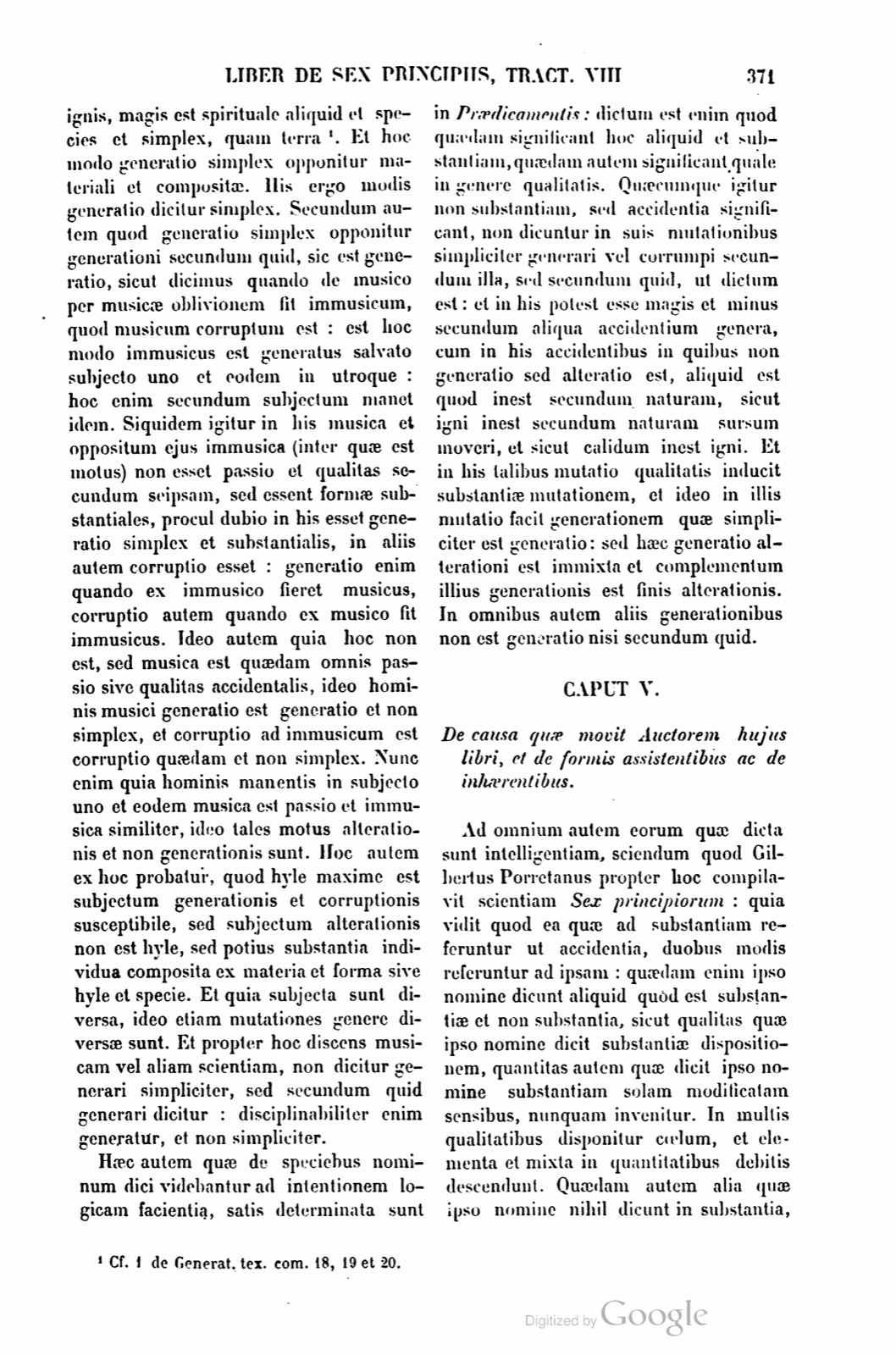
Tamen simplex generatio dicitur duobus modis. Uno quidem modo secundum quod simpliciter opponitur ad secundum quid: et sic simpliciter generatio dicitur substantiae, et secundum quid generatio dicitur secundum accidens. Aut alio modo dicitur simplex generatio simplicis generatio, non quidem simpliciter simplicis, quia hoc immobile est, sed simplicis secundum quod spirituale respectu incorporati dicitur simplex, sicut ignis primo et aer secundo simpliciter dicuntur respectu aquae et terrae. Et hoc modo dicitur simplex vel simpliciter generatio hujus generati, ut ignis, hoc est, quod est ignis, magis est spirituale aliquid et species et simplex, quam terra 4. Et hoc modo generatio simplex opponitur materiali et compositae. His ergo modis generatio dicitur simplex.
Secundum autem quod generatio simplex opponitur generationi secundum quid, sic est generatio, sicut dicimus quando de musico per musicae oblivionem fit immusicum, quod musicum corruptum est: et hoc modo immusicus est generatus salvato subjecto uno et eodem in utroque: hoc enim secundum subjectum manet idem. Siquidem igitur in his musica et oppositum ejus immusica (inter quae est motus) non esset passio et qualitas secundum seipsam, sed essent formae substantiales, procul dubio in his esset generatio simplex et substantialis, in aliis autem corruptio esset: generatio enim quando ex immusico fieret musicus, corruptio autem quando ex musico fit immusicus. Ideo autem quia hoc non est, sed musica est quaedam omnis passio sive qualitas accidentalis, ideo hominis musici generatio est generatio et non simplex, et corruptio ad immusicum est corruptio quaedam et non simplex. Nunc enim quia hominis manentis in subjecto uno et eodem musica est passio et immusica similiter, ideo tales motus alterationis et non generationis sunt. Hoc autem ex hoc probatur, quod hyle maxime est subjectum generationis et corruptionis susceptibile, sed subjectum alterationis non est hyle, sed potius substantia individua composita ex materia et forma sive hyle et specie. Et quia subjecta sunt diversa, ideo etiam mutationes genere diversae sunt. Et propter hoc discens musicam vel aliam scientiam, non dicitur generari simpliciter, sed secundum quid generari dicitur: disciplinabiliter enim generatur, et non simpliciter.
Haec autem quae de speciebus nominum dici videbantur ad intentionem logicam facientia, satis determinata sunt in Praedicamentis: dictum est enim quod quaedam significant hoc aliquid et substantiam, quaedam autem significant quale in genere qualitatis. Quaecumque igitur non substantiam, sed accidentia significant, non dicuntur in suis mutationibus simpliciter generari vel corrumpi secundum illa, sed secundum quid, ut dictum est: et in his potest esse magis et minus secundum aliqua accidentium genera, cum in his accidentibus in quibus non generatio sed alteratio est, aliquid est quod inest secundum naturam, sicut igni inest secundum naturam sursum moveri, et sicut calidum inest igni. Et in his talibus mutatio qualitatis inducit substantiae mutationem, et ideo in illis mutatio facit generationem quae simpliciter est generatio: sed haec generatio alterationi est immixta et complementum illius generationis est finis alterationis. In omnibus autem aliis generationibus non est generatio nisi secundum quid.
Marginalia Generation simply in a double way.
Nevertheless simple generation is said in two ways. In one way, indeed, according as simply is opposed to according to something; and in this way generation simply is called generation of substance, and generation according to something is called generation according to accident. Or in another way simple generation is called generation of the simple, not indeed of what is simple simply, because this is immobile, but of the simple according as what is spiritual in relation to the incorporated is called simple, as fire first and air second are called simple in relation to water and earth. And in this way the simple, or simply generation, of this generated thing is spoken of, as fire, that is, that it is fire, is something more spiritual and is species and simple more than earth 4. And in this way simple generation is opposed to material and composite generation. Therefore generation is called simple in these modes.
But according as simple generation is opposed to generation according to something, it is generation in the way we speak when, from a musical man, through forgetfulness of music, an unmusical man comes to be, that the musical man has been corrupted; and in this mode an unmusical man has been generated while one and the same subject has been preserved in each case. For this remains the same according to subject. Therefore, if in these things music and its opposite, unmusic, between which there is motion, were not passion and quality according to themselves but were substantial forms, without doubt in these there would be simple and substantial generation, and in the others there would be corruption: generation, indeed, when the musical man came to be from the unmusical, but corruption when the unmusical comes to be from the musical. But because this is not so, and music is a certain passion or accidental quality in every case, therefore the generation of a musical man is generation and not simple generation, and corruption to an unmusical man is a certain corruption and not simple corruption. For now, because music is a passion of the human being remaining in one and the same subject, and unmusic likewise, such motions are of alteration and not of generation. But this is proved from this, that hyle is especially the subject susceptible of generation and corruption, but the subject of alteration is not hyle, but rather the individual substance composed from matter and form, or from hyle and species. And because the subjects are diverse, therefore the changes also are diverse in genus. And for this reason one learning music or another science is not said to be generated simply, but is said to be generated according to something; for he is generated in a teachable way, and not simply.
But these things which seemed to be said about the species of names as making for logical intention have been sufficiently determined in the Categories. For it has been said that certain things signify this something and substance, but certain things signify the qualified in the genus of quality. Therefore whatever things signify not substance but accidents are not said, in their changes, to be generated or corrupted simply according to those things, but according to something, as has been said; and in these there can be more and less according to some genera of accidents, since in these accidents in which there is not generation but alteration, there is something that belongs according to nature, as to fire it belongs according to nature to be moved upward, and as hot belongs to fire. And in such things the change of quality induces the change of substance, and therefore in those things change makes generation which is simply generation; but this generation is mixed with alteration, and the completion of that generation is the end of alteration. But in all other generations there is no generation except according to something.
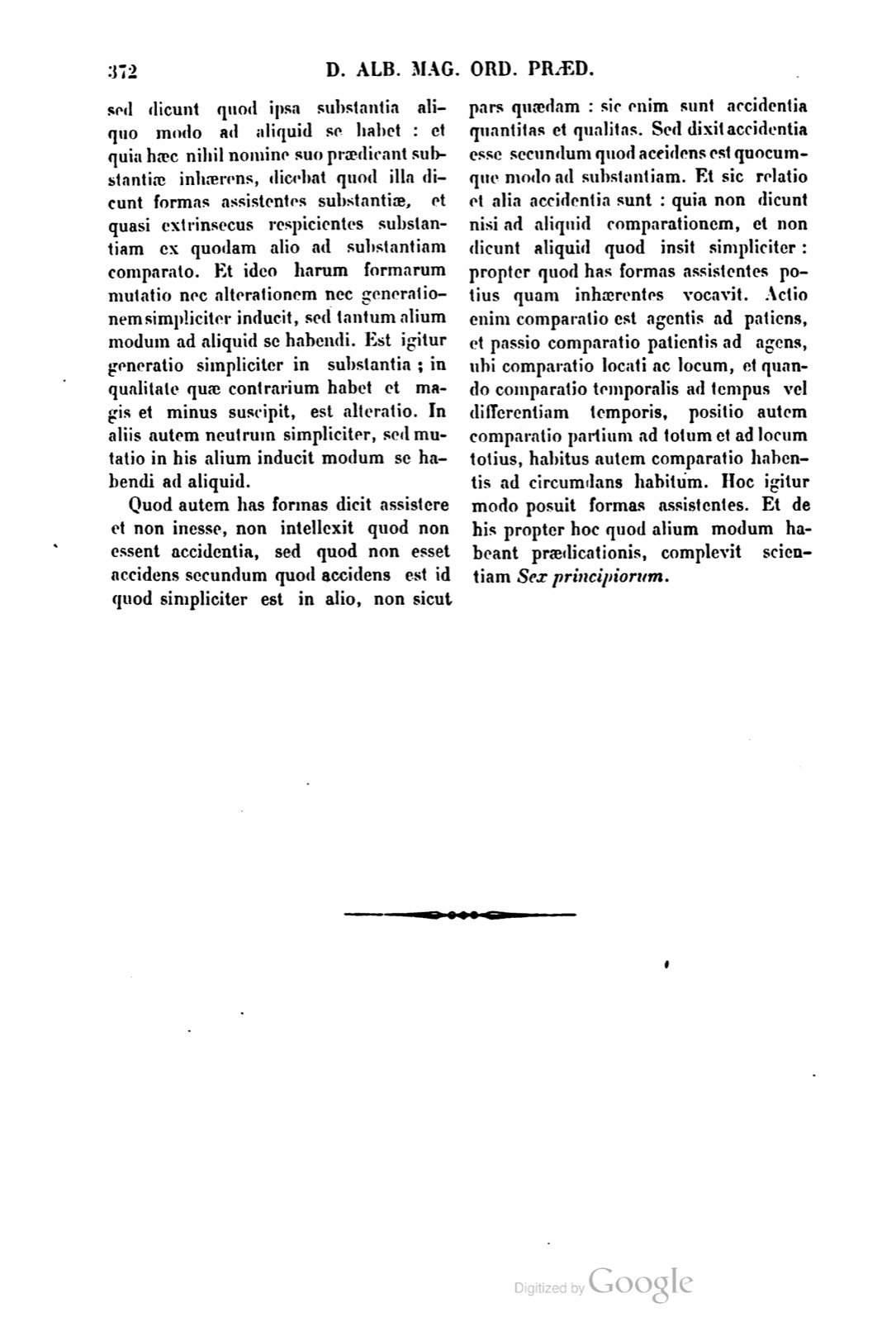
CAPUT V.
De causa quae movit Auctorem hujus libri, et de formis assistentibus ac de inhaerentibus.
Ad omnium autem eorum quae dicta sunt intelligentiam, sciendum quod Gilbertus Porretanus propter hoc compilavit scientiam Sex principiorum: quia vidit quod ea quae ad substantiam referuntur ut accidentia, duobus modis referuntur ad ipsam: quaedam enim ipso nomine dicunt aliquid quod est substantiae et non substantia, sicut qualitas quae ipso nomine dicit substantiae dispositionem, quantitas autem quae dicit ipso nomine substantiam solam modificatam sensibus, nunquam invenitur. In multis qualitatibus disponitur caelum, et elementa et mixta in quantitatibus debitis descendunt. Quaedam autem alia quae ipso nomine nihil dicunt in substantia, sed dicunt quod ipsa substantia aliquo modo ad aliquid se habet: et quia haec nihil nomine suo praedicant substantiae inhaerens, dicebat quod illa dicunt formas assistentes substantiae, et quasi extrinsecus respicientes substantiam ex quodam alio ad substantiam comparato. Et ideo harum formarum mutatio nec alterationem nec generationem simpliciter inducit, sed tantum alium modum ad aliquid se habendi. Est igitur generatio simpliciter in substantia; in qualitate quae contrarium habet et magis et minus suscipit, est alteratio. In aliis autem neutrum simpliciter, sed mutatio in his alium inducit modum se habendi ad aliquid.
Quod autem has formas dicit assistere et non inesse, non intellexit quod non essent accidentia, sed quod non esset accidens secundum quod accidens est id quod simpliciter est in alio, non sicut pars quaedam: sic enim sunt accidentia quantitas et qualitas. Sed dixit accidentia esse secundum quod accidens est quocumque modo ad substantiam. Et sic relatio et alia accidentia sunt: quia non dicunt nisi ad aliquid comparationem, et non dicunt aliquid quod insit simpliciter: propter quod has formas assistentes potius quam inhaerentes vocavit. Actio enim comparatio est agentis ad patiens, et passio comparatio patientis ad agens, ubi comparatio locati ac locum, et quando comparatio temporalis ad tempus vel differentiam temporis, positio autem comparatio partium ad totum et ad locum totius, habitus autem comparatio habentis ad circumdans habitum. Hoc igitur modo posuit formas assistentes. Et de his propter hoc quod alium modum habeant praedicationis, complevit scientiam Sex principiorum.
CHAPTER V.
On the cause which moved the Author of this book, and on assisting forms and inhering forms.
But for the understanding of all those things which have been said, one must know that Gilbert Porretanus compiled the science of the Six Principles for this reason: because he saw that those things which are referred to substance as accidents are referred to it in two ways. For certain things by their very name say something which belongs to substance and is not substance, as quality, which by its very name says a disposition of substance; but quantity, which by its very name says substance alone modified for the senses, is never found. In many qualities the heaven is disposed, and elements and mixtures descend in due quantities. But certain other things by their very name say nothing in substance, but say that the substance itself is related in some way to something; and because these things by their name predicate nothing inhering in substance, he said that they say forms assisting substance, and as if looking extrinsically upon substance from some other thing compared to substance. And therefore the change of these forms induces neither alteration nor generation simply, but only another mode of being related to something. Therefore there is generation simply in substance; in quality, which has a contrary and receives more and less, there is alteration. But in the others there is neither simply, but change in these induces another mode of being related to something.
But when he says that these forms assist and do not inhere, he did not understand that they were not accidents, but that there was not an accident according as an accident is that which is simply in another, not as a certain part; for in this way quantity and quality are accidents. But he said they are accidents according as an accident is in any way whatever toward substance. And in this way relation and the other accidents are accidents, because they say only comparison to something, and do not say something which inheres simply. For this reason he called these forms assisting rather than inhering. For action is the comparison of agent to patient, and passion the comparison of patient to agent, where the comparison of the located thing to place, and when the temporal comparison to time or to a difference of time, but position the comparison of parts to the whole and to the place of the whole, and habit the comparison of the one having to the surrounding habit. Therefore in this way he posited assisting forms. And concerning these, because they have another mode of predication, he completed the science of the Six Principles.
Notes
- On this opinion of Democritus and Leucippus about intension and remission, see also the book On Generation, in book I, text-commentary 5, 6, and 7. (Super hanc opinionem Democriti et Leucippi de intensione et remissione, vide etiam librum de Generatione, in I, tex. com. 5, 6 et 7.) ↩
- Book I of On Generation, text-commentary 23. (I de Generatione, tex. com. 23.) ↩
- Aristotle, at the end of book I of the Physics, text-commentary 28. (Aristoteles, In fine primi Physicorum, tex. com. 28.) ↩
- Compare book I of On Generation, text-commentary 18, 19, and 20. (Cf. I de Generat. tex. com. 18, 19 et 20.) ↩
If a page does not appear, its photograph has not been uploaded yet.