Volume 1 · pp. 353–358
TRACTATE VI. ON POSITION.
A marker with ≈ is an approximate page boundary, placed by measure of the text; the page photographs remain the authority. In the paired views, clicking a page marker brings that page into view.
TRACTATUS VI
DE POSITIONE.
CAPUT I.
Quid sit positio secundum quod est praedicamentum.
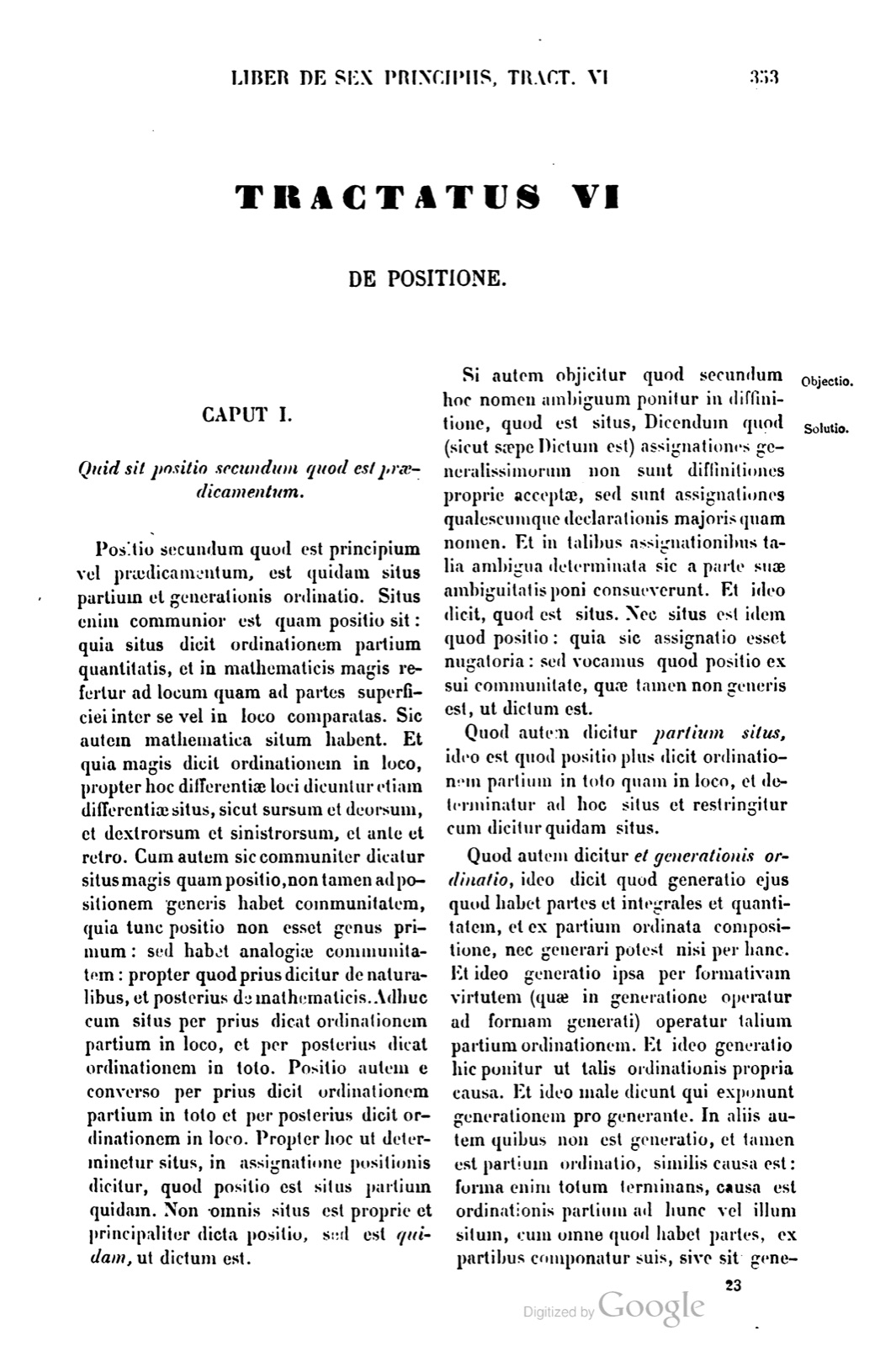
Positio secundum quod est principium vel praedicamentum, est quidam situs partium et generationis ordinatio. Situs enim communior est quam positio sit: quia situs dicit ordinationem partium quantitatis, et in mathematicis magis refertur ad locum quam ad partes superficiei inter se vel in loco comparatas. Sic autem mathematica situm habent. Et quia magis dicit ordinationem in loco, propter hoc differentiae loci dicuntur etiam differentiae situs, sicut sursum et deorsum, et dextrorsum et sinistrorsum, et ante et retro. Cum autem sic communiter dicatur situs magis quam positio, non tamen ad positionem generis habet communitatem, quia tunc positio non esset genus primum: sed habet analogiae communitatem: propter quod prius dicitur de naturalibus, et posterius de mathematicis. Adhuc cum situs per prius dicat ordinationem partium in loco, et per posterius dicat ordinationem in toto. Positio autem e converso per prius dicit ordinationem partium in toto et per posterius dicit ordinationem in loco. Propter hoc ut determinetur situs, in assignatione positionis dicitur, quod positio est situs partium quidam. Non omnis situs est proprie et principaliter dicta positio, sed est quidam, ut dictum est.
Marginalia Objectio.
Si autem objicitur quod secundum hoc nomen ambiguum ponitur in diffinitione, quod est situs,
Marginalia Solutio.
Dicendum quod sicut saepe dictum est, assignationes generalissimorum non sunt diffinitiones proprie acceptae, sed sunt assignationes qualescumque declarationis majoris quam nomen. Et in talibus assignationibus talia ambigua determinata sic a parte suae ambiguitatis poni consueverunt. Et ideo dicit, quod est situs. Nec situs est idem quod positio: quia sic assignatio esset nugatoria: sed vocamus quod positio ex sui communitate, quae tamen non generis est, ut dictum est.
Quod autem dicitur partium situs, ideo est quod positio plus dicit ordinationem partium in toto quam in loco, et determinatur ad hoc situs et restringitur cum dicitur quidam situs.
Quod autem dicitur et generationis ordinatio, ideo dicit quod generatio ejus quod habet partes et integrales et quantitatem, et ex partium ordinata compositione, nec generari potest nisi per hanc. Et ideo generatio ipsa per formativam virtutem quae in generatione operatur ad formam generati, operatur talium partium ordinationem. Et ideo generatio hic ponitur ut talis ordinationis propria causa. Et ideo male dicunt qui exponunt generationem pro generante. In aliis autem quibus non est generatio, et tamen est partium ordinatio, similis causa est: forma enim totum terminans, causa est ordinationis partium ad hunc vel illum situm, cum omne quod habet partes, ex partibus componatur suis, sive sit generabile, sive sit ingenerabile. Tunc distinguendum est, quod quoddam compositum habet sua componentia actu intra se, non ante se nisi per naturam et intellectum: et hoc modo est generatum. Et quoddam est quod sua componentia habet actu ante et extra se, et hoc est generabile. Et propter hoc quando partes conveniunt ad compositionem, tunc generatur ex ipsis. Sic ergo intelligendum est cum dicitur, et quaedam generationis in partibus scilicet generantibus ordinatio.
Quod autem copulatio et in medio ponitur, et per hoc id quod dicitur in assignatione, non videtur esse unum, sed congregatum ex pluribus non essentialiter unum constituentibus, Dicendum quod copulatio quae in medio ponitur, notat expositionem, et non diversorum copulationem. Hoc enim quod est positionem quemdam situm esse, id est, et non omnem situm esse positionem. Posset esse dubium quis et qualis situs esset: et ideo additur, et, hoc est, id est generationis ordinatio, quae partes ad invicem ordinat et ad totum ut sub forma totius formae debito modo terminatae ad totum constituendum. Dico autem partium ad invicem, quia oportet partem duplicem habere ordinationem, unam scilicet ad comparere cum qua secum convenienter constituit totum in quantitate et figura. Alium autem habet ordinem ad formam totius omnes partes terminantem ad esse totius et omnes partes continentem. Nomen enim quod talis ordinationis formam dicit, secundum quam partes ad invicem et ad totum referuntur primo et ad locum quem habent in loco totius, illud idem nomen recte praedicat positionem, sicut supra vel infra in toto poni, vel aeque, vel non aeque sive intra extrema poni sive extra extrema, vel hujusmodi. Hoc igitur est genus positionis.
TRACTATE VI
ON POSITION.
CHAPTER I.
What position is insofar as it is a category.
Position, insofar as it is a principle or category, is a certain site of parts and an ordering of generation. For site is more common than position is, because site says the ordering of the parts of quantity, and in mathematical things it is referred more to place than to the parts of a surface compared among themselves or in place. In this way, however, mathematical things have site. And because it more says ordering in place, for this reason the differences of place are also called differences of site, such as upward and downward, rightward and leftward, before and behind. But although site is thus said more commonly than position, nevertheless it does not have the commonness of a genus toward position, because then position would not be a first genus; rather it has the commonness of analogy. For this reason it is said first of natural things and later of mathematical things. Further, since site first says the ordering of parts in place and secondarily says ordering in a whole, position, conversely, first says the ordering of parts in a whole and secondarily says ordering in place. For this reason, so that site may be determined, in the assignment of position it is said that position is a certain site of parts. Not every site is position properly and principally so called, but it is a certain one, as has been said.
Marginalia Objection.
But if it is objected that according to this an ambiguous name, namely site, is put in the definition,
Marginalia Solution.
one must say that, as has often been said, the assignments of the most general things are not definitions properly taken, but are assignments of some sort, of greater clarification than the name. And in such assignments such ambiguous terms, determined in this way from one part of their ambiguity, are customarily put down. And therefore he says that it is site. Nor is site the same as position, because in that case the assignment would be nugatory; but we call it position from its commonness, which nevertheless is not the commonness of a genus, as has been said.
But as to what is said, site of parts, this is because position says more the ordering of parts in a whole than in place, and site is determined to this and restricted when a certain site is said.
But as to what is said, and an ordering of generation, this says that the generation of that which has parts, both integral parts and quantity, is from the ordered composition of parts, and it cannot be generated except through this. And therefore generation itself, through the formative power which operates in generation toward the form of what is generated, operates the ordering of such parts. And therefore generation is put here as the proper cause of such ordering. And therefore those speak badly who expound generation as the generator. But in other things in which there is not generation, and yet there is an ordering of parts, there is a similar cause: for the form terminating the whole is the cause of the ordering of parts to this or that site, since everything that has parts is composed from its own parts, whether it is generable or ingenerable. Then one must distinguish that a certain composite has its components in act within itself, not before itself except by nature and intellect, and in this way it is generated; and there is a certain thing that has its components in act before and outside itself, and this is generable. And for this reason, when the parts come together for composition, then it is generated from them. Thus, therefore, one must understand it when it is said, and a certain ordering of generation in parts, namely generating parts.
But as to the fact that a copulation is also put in the middle, and through this what is said in the assignment does not seem to be one, but gathered from several things not essentially constituting one thing, one must say that the copulation which is put in the middle marks an exposition, and not a copulation of diverse things. For this, that position is a certain site, that is, and that not every site is position. It could be doubtful what and what sort of site it was; and therefore there is added and, that is, that is, an ordering of generation, which orders the parts to one another and to the whole, as under the form of the whole, the form being terminated in the due mode for constituting the whole. But I say of parts to one another, because a part must have a double ordering: one, namely, toward appearing together with that with which it fittingly constitutes the whole in quantity and figure; but it has another order toward the form of the whole terminating all the parts to the being of the whole and containing all the parts. For the name that says the form of such ordering, according to which the parts are referred first to one another and to the whole and to the place which they have in the place of the whole, that same name rightly predicates position, as to be placed above or below in the whole, or equally or unequally, or to be placed within the extremes or outside the extremes, or something of this sort. This, therefore, is the genus of position.
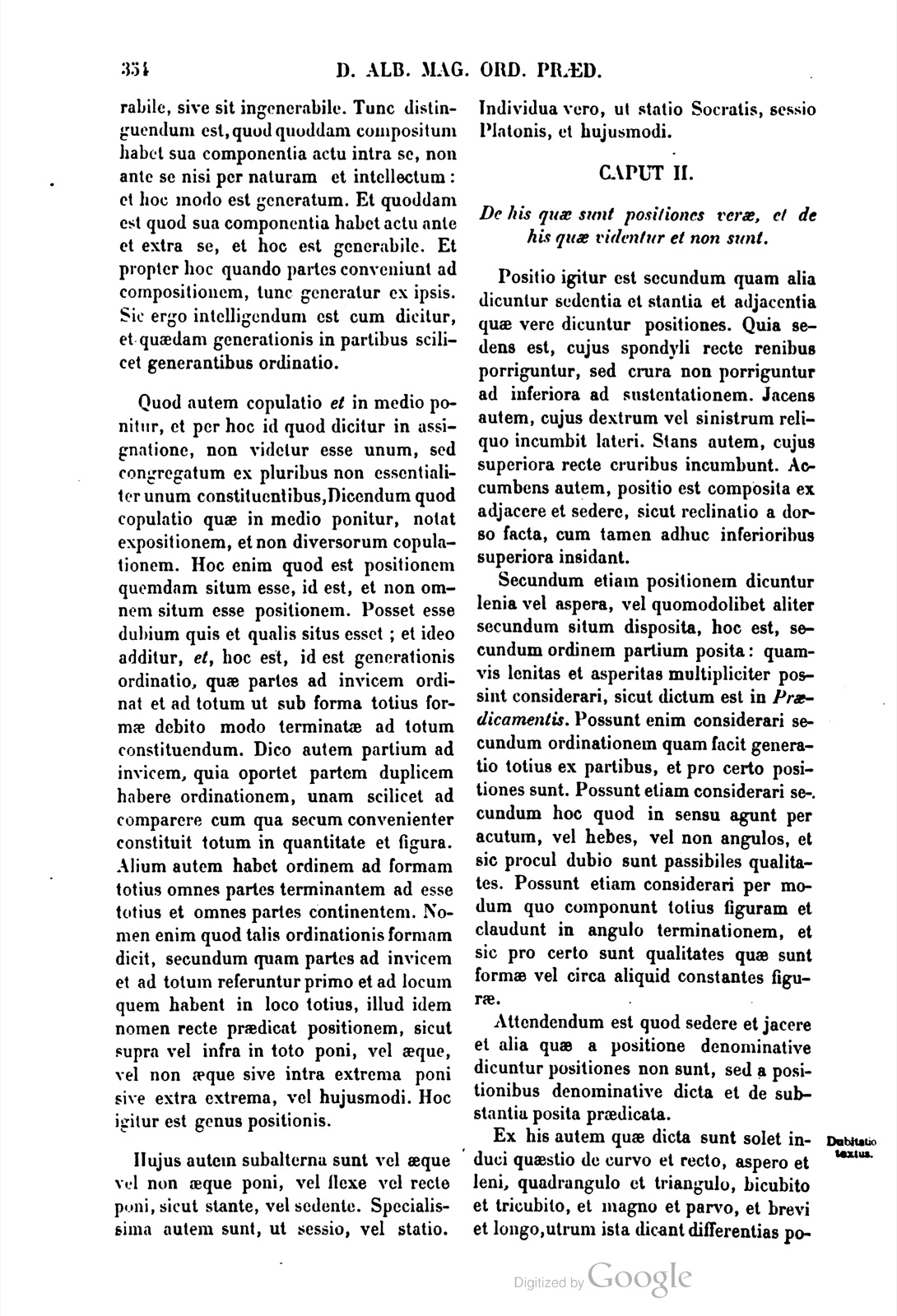
Hujus autem subalterna sunt vel aeque vel non aeque poni, vel flexe vel recte poni, sicut stante, vel sedente. Specialissima autem sunt, ut sessio, vel statio. Individua vero, ut statio Socratis, sessio Platonis, et hujusmodi.
CAPUT II.
De his quae sunt positiones verae, et de his quae videntur et non sunt.
Positio igitur est secundum quam alia dicuntur sedentia et stantia et adjacentia quae vere dicuntur positiones. Quia sedens est, cujus spondyli recte renibus porriguntur, sed crura non porriguntur ad inferiora ad sustentationem. Jacens autem, cujus dextrum vel sinistrum reliquo incumbit lateri. Stans autem, cujus superiora recte cruribus incumbunt. Accumbens autem, positio est composita ex adjacere et sedere, sicut reclinatio a dorso facta, cum tamen adhuc inferioribus superiora insidant.
Secundum etiam positionem dicuntur lenia vel aspera, vel quomodolibet aliter secundum situm disposita, hoc est, secundum ordinem partium posita: quamvis lenitas et asperitas multipliciter possint considerari, sicut dictum est in Praedicamentis. Possunt enim considerari secundum ordinationem quam facit generatio totius ex partibus, et pro certo positiones sunt. Possunt etiam considerari secundum hoc quod in sensu agunt per acutum, vel hebes, vel non angulos, et sic procul dubio sunt passibiles qualitates. Possunt etiam considerari per modum quo componunt totius figuram et claudunt in angulo terminationem, et sic pro certo sunt qualitates quae sunt formae vel circa aliquid constantes figurae.
Attendendum est quod sedere et jacere et alia quae a positione denominative dicuntur positiones non sunt, sed a positionibus denominative dicta et de substantia posita praedicata.
Marginalia Dubitatio textus.
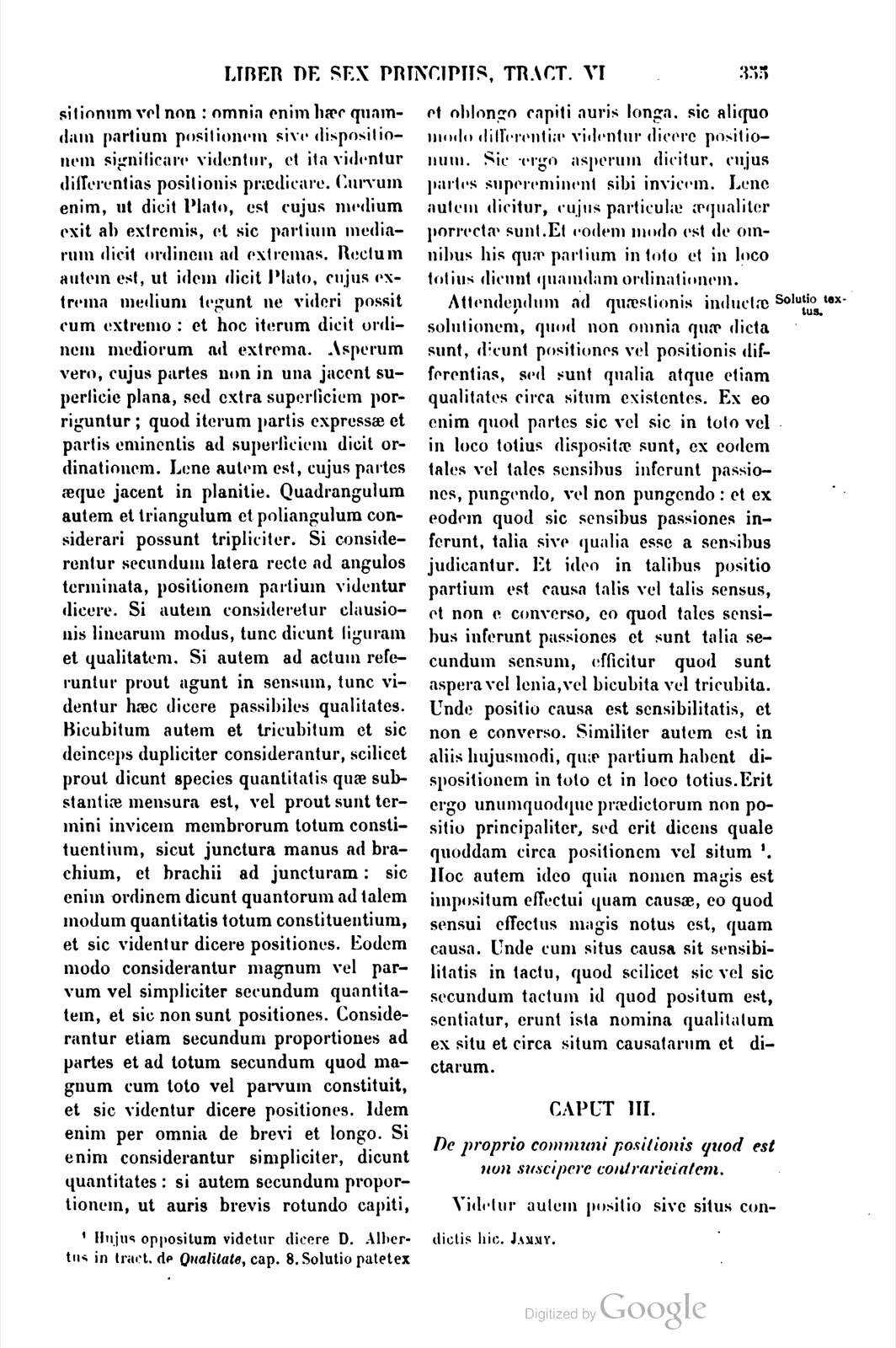
Ex his autem quae dicta sunt solet induci quaestio de curvo et recto, aspero et leni, quadrangulo et triangulo, bicubito et tricubito, et magno et parvo, et brevi et longo, utrum ista dicant differentias positionum vel non: omnia enim haec quamdam partium positionem sive dispositionem significare videntur, et ita videntur differentias positionis praedicare. Curvum enim, ut dicit Plato, est cujus medium exit ab extremis, et sic partium mediarum dicit ordinem ad extremas. Rectum autem est, ut idem dicit Plato, cujus extrema medium tegunt ne videri possit cum extremo: et hoc iterum dicit ordinem mediorum ad extrema. Asperum vero, cujus partes non in una jacent superficie plana, sed extra superficiem porriguntur: quod iterum partis expressae et partis eminentis ad superficiem dicit ordinationem. Lene autem est, cujus partes aeque jacent in planitie. Quadrangulum autem et triangulum et poliangulum considerari possunt tripliciter. Si considerentur secundum latera recte ad angulos terminata, positionem partium videntur dicere. Si autem consideretur clausionis linearum modus, tunc dicunt figuram et qualitatem. Si autem ad actum referuntur prout agunt in sensum, tunc videntur haec dicere passibiles qualitates. Bicubitum autem et tricubitum et sic deinceps dupliciter considerantur, scilicet prout dicunt species quantitatis quae substantiae mensura est, vel prout sunt termini invicem membrorum totum constituentium, sicut junctura manus ad brachium, et brachii ad juncturam: sic enim ordinem dicunt quantorum ad talem modum quantitatis totum constituentium, et sic videntur dicere positiones. Eodem modo considerantur magnum vel parvum vel simpliciter secundum quantitatem, et sic non sunt positiones. Considerantur etiam secundum proportiones ad partes et ad totum secundum quod magnum cum toto vel parvum constituit, et sic videntur dicere positiones. Idem enim per omnia de brevi et longo. Si enim considerantur simpliciter, dicunt quantitates: si autem secundum proportionem, ut auris brevis rotundo capiti, et oblongo capiti auris longa, sic aliquo modo differentiae videntur dicere positionum. Sic ergo asperum dicitur, cujus partes supereminent sibi invicem. Lene autem dicitur, cujus particulae aequaliter porrectae sunt. Et eodem modo est de omnibus his quae partium in toto et in loco totius dicunt quamdam ordinationem.
But its subalterns are to be placed either equally or unequally, or to be placed bent or straight, as in standing or sitting. But the most special species are, for example, sitting and standing. But individuals are, for example, the standing of Socrates, the sitting of Plato, and things of this sort.
CHAPTER II.
On those things which are true positions, and on those things which seem to be and are not.
Position, therefore, is that according to which other things are called sitting and standing and lying adjacent, which are truly called positions. For sitting belongs to one whose vertebrae are extended straight to the loins, but whose legs are not extended downward for support. Lying belongs to one whose right or left side rests upon the remaining side. Standing belongs to one whose upper parts rest straight upon the legs. Reclining, however, is a position composed from lying adjacent and sitting, as a leaning made from the back, while nevertheless the upper parts still sit upon the lower parts.
Smooth and rough things are also said according to position, or things disposed in any other way according to site, that is, placed according to the order of parts, although smoothness and roughness can be considered in many ways, as was said in the Categories. For they can be considered according to the ordering which the generation of the whole makes from the parts, and they are certainly positions. They can also be considered according to this, that they act on sense through acute things, or blunt things, or non-angles, and in this way without doubt they are passible qualities. They can also be considered through the mode by which they compose the figure of the whole and enclose termination in an angle, and in this way certainly they are qualities which are forms or figures standing around something.
It must be attended that to sit and to lie and the other things which are denominatively said from position are not positions, but things said denominatively from positions and predicated of the placed substance.
Marginalia Difficulty of the text.
From these things that have been said, a question is customarily introduced about curved and straight, rough and smooth, quadrangular and triangular, two-cubit and three-cubit, great and small, short and long, whether these say differences of positions or not. For all these things seem to signify a certain position or disposition of parts, and thus they seem to predicate differences of position. For the curved, as Plato says, is that whose middle goes out from the extremes, and thus it says an order of the middle parts to the extreme parts. But the straight, as the same Plato says, is that whose extremes cover the middle so that it cannot be seen with the extreme; and this again says the order of the middle parts to the extremes. The rough, however, is that whose parts do not lie in one plane surface, but are extended outside the surface; this again says the ordering of the expressed part and the projecting part to the surface. But the smooth is that whose parts lie equally in flatness. But the quadrangular and the triangular and the polygonal can be considered in three ways. If they are considered according to sides terminated straight at angles, they seem to say position of parts. But if the mode of the enclosing of lines is considered, then they say figure and quality. But if they are referred to act insofar as they act upon sense, then they seem to say passible qualities. But two-cubit and three-cubit and so on are considered in two ways, namely insofar as they say species of quantity which is the measure of substance, or insofar as they are termini mutually of members constituting a whole, as the joint of the hand to the arm, and of the arm to the joint; for in this way they say the order of quantified things constituting a whole to such a mode of quantity, and thus they seem to say positions. In the same way great or small are considered either simply according to quantity, and in this way they are not positions. They are also considered according to proportions to parts and to the whole according as the great constitutes with the whole or the small constitutes, and in this way they seem to say positions. It is the same in all respects concerning short and long. For if they are considered simply, they say quantities; but if according to proportion, as a short ear to a round head, and a long ear to an oblong head, in this way somehow they seem to say differences of positions. Thus, therefore, the rough is said to be that whose parts stand out above one another. But the smooth is said to be that whose particles are extended equally. And it is in the same way concerning all these things which say a certain ordering of parts in the whole and in the place of the whole.
Marginalia Solutio textus.
Attendendum ad quaestionis inductae solutionem, quod non omnia quae dicta sunt, dicunt positiones vel positionis differentias, sed sunt qualia atque etiam qualitates circa situm existentes. Ex eo enim quod partes sic vel sic in toto vel in loco totius dispositae sunt, ex eodem tales vel tales sensibus inferunt passiones, pungendo, vel non pungendo: et ex eodem quod sic sensibus passiones inferunt, talia sive qualia esse a sensibus judicantur. Et ideo in talibus positio partium est causa talis vel talis sensus, et non e converso, eo quod tales sensibus inferunt passiones et sunt talia secundum sensum, efficitur quod sunt aspera vel lenia, vel bicubita vel tricubita. Unde positio causa est sensibilitatis, et non e converso. Similiter autem est in aliis hujusmodi, quae partium habent dispositionem in toto et in loco totius. Erit ergo unumquodque praedictorum non positio principaliter, sed erit dicens quale quoddam circa positionem vel situm 1. Hoc autem ideo quia nomen magis est impositum effectui quam causae, eo quod sensui effectus magis notus est, quam causa. Unde cum situs causa sit sensibilitatis in tactu, quod scilicet sic vel sic secundum tactum id quod positum est, sentiatur, erunt ista nomina qualitatum ex situ et circa situm causatarum et dictarum.
CAPUT III.
De proprio communi positionis quod est non suscipere contrarietatem.
Videtur autem positio sive situs contrarietatem habere secundum apparentiam: sedere enim ad id quod est stare, videtur esse contrarium secundum quamdam contrariorum rationem.
Marginalia Solution of the text.
For the solution of the introduced question, it must be attended that not all the things which have been said say positions or differences of position, but they are qualified things and also qualities existing around site. For from the fact that the parts are disposed in this or that way in the whole or in the place of the whole, from the same thing they bring such or such passions into the senses, by pricking or not pricking; and from the same fact, that in this way they bring passions into the senses, they are judged by the senses to be such things or qualified things. And therefore in such things the position of the parts is the cause of such or such a sense, and not conversely, because from the fact that they bring such passions into the senses and are such according to sense, it comes about that they are rough or smooth, or two-cubit or three-cubit. Hence position is the cause of sensibility, and not conversely. Likewise it is in other things of this sort, which have the disposition of parts in the whole and in the place of the whole. Therefore each of the aforesaid things will not be position principally, but will be something saying a certain qualified thing around position or site 1. But this is because the name is imposed more on the effect than on the cause, because the effect is better known to sense than the cause. Hence, since site is the cause of sensibility in touch, namely that what is positioned is sensed in this or that way according to touch, these will be names of qualities caused from site and around site and named from it.
CHAPTER III.
On the common property of position, which is not to receive contrariety.
But position or site seems to have contrariety according to appearance, for to sit seems contrary to that which is to stand according to a certain account of contraries.
Marginalia Dubitatio textus.
Contraria enim sunt, quae in uno et eodem individuo et in eodem tempore impossibile est reperire, sed vicissim eidem possunt inesse. Sedens autem postquam surrexerit, stare poterit, et stans sedere postquam steterit: sed aliquo sedente impossibile est aliquem eumdem stare dum sedet: et sic cum sessio et statio vicissim eidem inesse possint et nulli simul, videntur esse contraria sessio et statio: et videtur habere positio contrarium, quia una species positionis alteri esse videtur contraria.
Marginalia Solutio textus.
Si autem propter hanc rationem hujusmodi quae dicta sunt ponamus esse contraria, cogemur recipere inconvenientia haec quae dicentur. Primum quidem, quod idem secundum idem pluribus sit contrarium. Quamvis enim Aristoteles 2 dicat, quod unum potest esse pluribus contrarium, sicut involuntarium per ignorantiam, et involuntarium per violentiam opponuntur ambo involuntaria voluntario, non intendit Aristoteles quod secundum idem duo opponantur uni: quia hoc est impossibile. Hoc autem in his quae dicta sunt si conceduntur esse contraria, sequitur quod secundum unum et idem duo opponantur uni contrarie. Si enim confirmamus contraria secundum regulas contrariorum, invenimus quod id quod est stare, non magis est sedere contrarium quam accumbere. Sicut autem sedere et stare nunquam sunt in eodem simul, ita neque stare et accumbere vel sedere: et secundum hujusmodi disputationem nulla inerit situi sive positioni contrarietas: quia hoc procul dubio verum est, quod tantum unum uni secundum idem opponitur et eodem oppositionis genere.
Marginalia Objectio textus.
Adhuc autem fortasse dicet aliquis quod non inconveniens est nec insolitum unum esse pluribus contrarium: pallidum enim ad album et nigrum videtur esse contrarium per hanc regulam contrariorum et rationem, quod sint in eodem genere proximo quod est color, et nunquam simul secundum idem inveniuntur in eodem, sed mutuo se expellunt ab eodem susceptibili et vicissim possunt uni et eidem inesse quod secundum ea transmutatur. Ex hoc forte videtur, quod unum pluribus possit esse contrarium secundum idem.
Marginalia Solutio textus.
Quod tamen non est verum: quia pallidum ad nigrum et album non est contrarium secundum quod contraria sunt quae maxime distant sub eodem genere. Horum enim unum nihil participat de reliquo, sicut album et nigrum, calidum et frigidum, et dulce et amarum, et alia his similia. Pallidum enim et alii medii colores ex albo et nigro conficiuntur et commiscentur: propter quod necessarium est in quocumque pallidum est, in eodem esse aliquo modo album et nigrum. Similiter autem est de caeteris coloribus mediis. Non ergo videtur esse contrarium albo et nigro. Et veritas hujus est, quia Aristoteles 3 dicit quod medium comparatum extremo est extremum: quia comparatur extremo propter oppositionem alterius extremi, quod est in ipso essentialiter constituens ipsum. Et sic pallidum comparatur nigro per album quod est in ipso, et opponitur ei contrarietatis modo aliquo: et comparatur albo per nigrum quod est in ipso, et opponitur ei contrarietatis modo quodam secundum non plenam oppositionem, sicut habent simplicia extrema quae maxime distant eorum quae sunt sub eodem genere. Patet autem ex hoc, quod pallidum non opponitur pluribus secundum idem, sed secundum plura quae sunt in ipso: et hoc non est inconveniens.
Marginalia Difficulty of the text.
For contraries are things which are impossible to find in one and the same individual and at the same time, but which can belong to the same thing in turn. But one sitting, after he has arisen, will be able to stand, and one standing, after he has stood, to sit; but while someone is sitting, it is impossible for the same someone to stand while he sits. And thus, since sitting and standing can belong in turn to the same thing and to none at once, sitting and standing seem to be contraries, and position seems to have a contrary, because one species of position seems to be contrary to another.
Marginalia Solution of the text.
But if on account of this argument we posit that things of this sort which have been said are contraries, we shall be compelled to receive the inconveniences which will be stated. First, indeed, that the same thing according to the same thing is contrary to several. For although Aristotle 2 says that one thing can be contrary to several, as the involuntary through ignorance and the involuntary through violence are both opposed as involuntary to the voluntary, Aristotle does not intend that according to the same thing two things are opposed to one thing, because this is impossible. But if in these things which have been said they are granted to be contraries, it follows that according to one and the same thing two things are opposed contrarily to one thing. For if we confirm contraries according to the rules of contraries, we find that what it is to stand is no more contrary to sitting than to reclining. But just as sitting and standing are never in the same thing at once, so neither are standing and reclining or sitting; and according to disputation of this sort no contrariety will belong to site or position, because this is without doubt true, that only one thing is opposed to one thing according to the same thing and in the same genus of opposition.
Marginalia Objection of the text.
Further, perhaps someone will say that it is not inconvenient nor unusual for one thing to be contrary to several, for the pale seems to be contrary to white and black through this rule and account of contraries, that they are in the same proximate genus, which is color, and are never found at once according to the same thing in the same thing, but they mutually expel themselves from the same susceptible thing and can belong in turn to one and the same thing which is transmuted according to them. From this perhaps it seems that one thing can be contrary to several according to the same thing.
Marginalia Solution of the text.
Yet this is not true, because the pale is not contrary to black and white according as contraries are things which stand most apart under the same genus. For one of these participates nothing of the other, as white and black, hot and cold, sweet and bitter, and other things similar to these. For pale and the other middle colors are made from white and black and mixed together from them, for which reason it is necessary, in whatever thing the pale exists, that in the same thing white and black exist in some way. It is likewise concerning the other middle colors. Therefore it does not seem to be contrary to white and black. And the truth of this is that Aristotle 3 says that the middle, compared to an extreme, is an extreme, because it is compared to the extreme on account of the opposition of the other extreme, which is in it essentially constituting it. And thus the pale is compared to black through the white which is in it, and is opposed to it in some mode of contrariety; and it is compared to white through the black which is in it, and is opposed to it in a certain mode of contrariety according to a non-full opposition, such as the simple extremes have which stand most apart among those things which are under the same genus. But from this it is clear that the pale is not opposed to several according to the same thing, but according to several things which are in it; and this is not inconvenient.
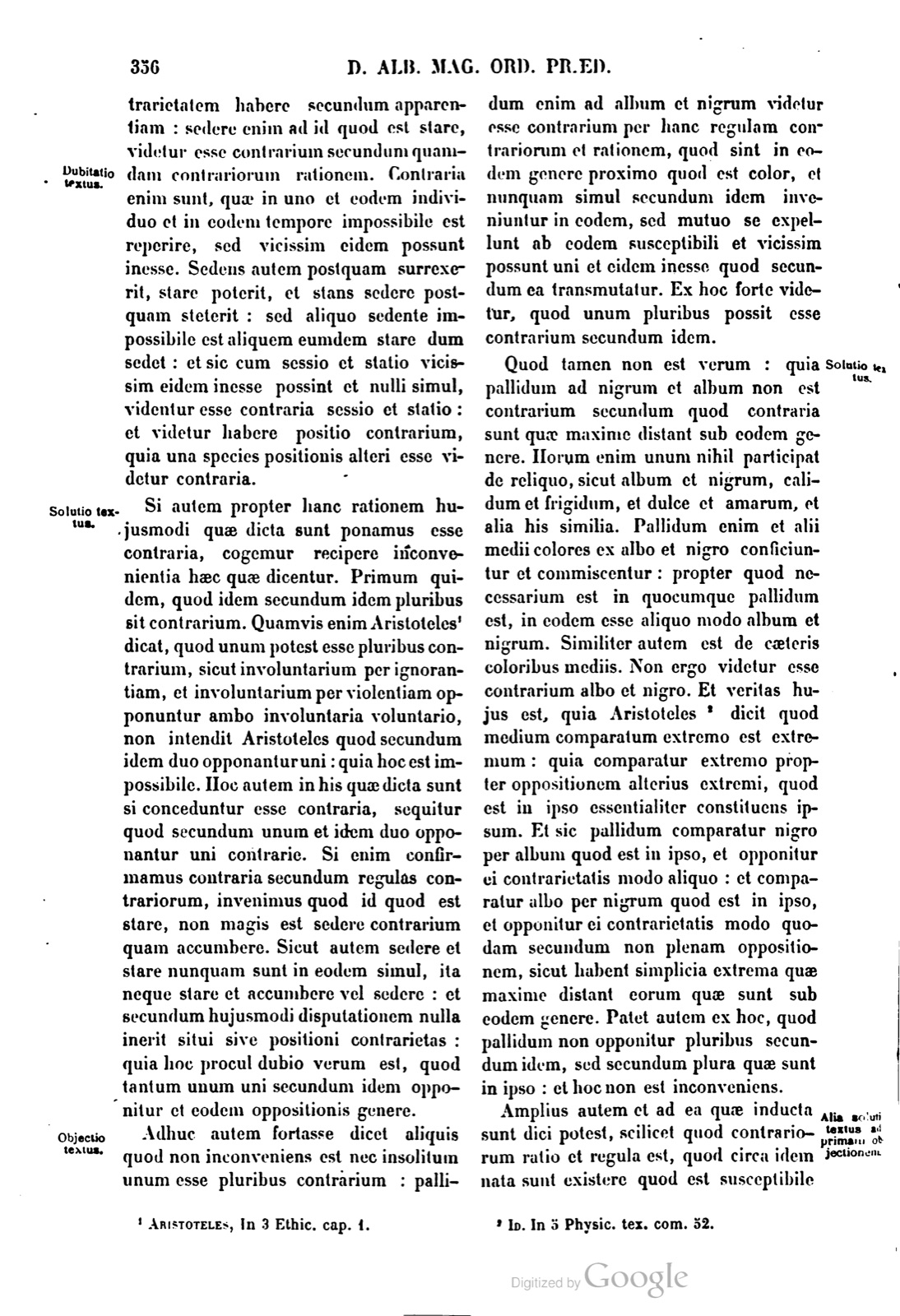
Marginalia Alia solutio textus ad primam objectionem.
Amplius autem et ad ea quae inducta sunt dici potest, scilicet quod contrariorum ratio et regula est, quod circa idem nata sunt existere quod est susceptibile utriusque, nisi alterum insit per naturam, ut in Praedicamentis 4 dictum est. Sedere autem et jacere si concedantur esse opposita ex alia ratione, tamen ex hoc patet quod non sunt contraria: quia non semper circa idem specie et numero nata sunt fieri, sed sejuncta sunt susceptibilia eorum. In quibusdam enim sedere rationalibus convenit proprie: jacere autem et accumbere etiam convenit irrationalibus quae rationalibus sunt adversa. Hujus autem signum, quod equus et homo in hoc similia sunt, quod sine dubio probata ratione convenit utrisque et jacere et accumbere. Sedere autem non proprie convenit nisi homini soli. Aliquid igitur jacet et accumbit cui sedere non convenit, sicut equus. Sedere igitur et stare et accumbere non semper nata sunt fieri circa idem. Sequitur ergo quod haec non vere sunt contraria, quamvis modum aliquem habeant contrariorum. Sic ergo situi vel positioni convenit non habere contrarium: et in argumento primo quo stare et sedere probari videntur esse contraria, paralogismus est constans ex eo quod non sufficienter enumerantur ea quae exiguntur ad hoc quod aliqua vere sint contraria. Et hoc est proprium commune quod convenit omni semper, sed non convenit soli, sed pluribus etiam aliis praedicamentis.
CAPUT IV.
De proprio positionis, quod est non suscipere majus et minus.
Adhuc autem communiter proprium positionis est, neque cum magis, neque cum minus dici per comparationem intensionis et remissionis. Sedere namque cum sit positio quaedam, non magis et minus est positio, quam accumbere, vel stare, quae etiam sunt positiones. Similiter autem in eadem specie positionis sedens vel stans, non dicitur minus altero magis sedens vel stans. Et universaliter loquendo secundum nullam positionem dicitur aliquid secundum magis vel minus altero 5. Sicut ergo ab inductione concluditur, quod positioni proprium est non suscipere magis et minus: habere enim contrarium causa est ejus quod est magis et minus secundum quod minus est magis habere de contrario, ut dicit Aristoteles.
CAPUT V.
De proprie proprio positionis, quod est substantiae proxime assistere.
Magis autem et convertibile proprium quod convenit omni soli et semper, videtur proprium esse positionis substantiae proxime assistere inter ea quae assistunt substantiae. Quaedam enim accidentia dicuntur esse quae simpliciter insunt: quaedam autem assistunt plus quam insunt, quae non simpliciter sunt, nec causantur ab extrinsecis subjecti, sed causata ab intrinseco secundum ea subjecta comparantur ad alia, sicut et relatio, et quando, et ubi, et positio, et habitus. Et est haec distinctio quam primus invenit Auctor libri Sexprincipiorum Gilbertus Porretanus.
Proprium igitur positionis est, quod inter assistentia proxime substantiae assistat, ac proximius assistat substantiae omnibus aliis formis quae assistere substantiae suppositae sunt. Hoc autem syllogismo probatur per diffinitionem positionis: substantiae enim positio nihil aliud est quam naturalis substantiae secundum hanc vel illam positionem ordo. Naturalis enim ordo secundum sessionem est sessio, et naturalis ordo secundum stationem est statio, et sic de aliis positionibus. Haec autem naturalis ordinatio vel a principio quidem compositionis substantiae innata est ipsi substantiae: aut innata est ipsi substantiae consueto motu naturae. A principio quidem compositionis, sicut in leni, et aspero, vel aequalibus secundum superficiem, vel inaequalibus secundum eamdem, sicut sunt plana et hispida: naturae autem motu flexura membrorum, sicut est sessio, et statio, et alia hujusmodi.
Marginalia Another solution of the text to the first objection.
Moreover, to the things that have been introduced it can also be said, namely that the account and rule of contraries is that they are naturally apt to exist around the same thing which is susceptible of both, unless one belongs through nature, as was said in the Categories 4. But sitting and lying, if they are granted to be opposites from another account, nevertheless from this it is clear that they are not contraries, because they are not always naturally apt to occur around the same thing in species and number, but the things susceptible of them are separate. For in certain rational things sitting properly belongs; but lying and reclining also belong to irrational things which are opposed to rational things. A sign of this is that horse and human being are similar in this, that by an undoubtedly proven account both lying and reclining belong to both. But sitting does not properly belong except to man alone. Therefore something lies and reclines to which sitting does not belong, such as a horse. Therefore sitting and standing and reclining are not always naturally apt to occur around the same thing. It follows, therefore, that these are not truly contraries, although they have some mode of contraries. Thus, therefore, not to have a contrary belongs to site or position; and in the first argument by which standing and sitting seem to be proved to be contraries, there is a paralogism consisting from this, that the things required for certain things truly to be contraries are not sufficiently enumerated. And this is a common property which belongs to every one always, but does not belong to it alone, but also to several other categories.
CHAPTER IV.
On the property of position, which is not to receive greater and less.
Further, the property of position commonly is to be said neither with more nor with less by comparison of intension and remission. For sitting, since it is a certain position, is not more and less a position than reclining or standing, which are also positions. Likewise in the same species of position, someone sitting or standing is not said to be less sitting or standing than another is more sitting or standing. And speaking universally, according to no position is something said according to more or less than another 5. Thus, therefore, from induction it is concluded that the property of position is not to receive more and less. For to have a contrary is the cause of that which is more and less, according as less is to have more of the contrary, as Aristotle says.
CHAPTER V.
On the properly proper property of position, which is to assist substance most nearly.
But the more proper and convertible property, which belongs to every one, to it alone, and always, seems to be proper to position: to assist substance most nearly among the things which assist substance. For certain accidents are said to be those which simply inhere; but certain ones assist more than they inhere, which do not simply exist, nor are they caused from things extrinsic to the subject, but, caused from the intrinsic, according to them subjects are compared to other things, such as relation, when, where, position, and habit. And this is the distinction which the Author of the book of the Six Principles, Gilbert Porretanus, first found.
Therefore the property of position is that, among the assisting things, it assists substance most nearly and assists substance more nearly than all the other forms which are supposed to assist substance. This, however, is proved syllogistically through the definition of position: for the position of a substance is nothing other than the natural order of a substance according to this or that position. For natural order according to sitting is sitting, and natural order according to standing is standing, and so with the other positions. But this natural ordering is either innate to the substance from the principle of the composition of the substance, or is innate to the substance by the accustomed motion of nature. From the principle of composition, indeed, as in smooth and rough, or in things equal according to surface, or unequal according to the same surface, such as flat and bristly things; but by the motion of nature, the bending of members, such as sitting and standing and other things of this sort.
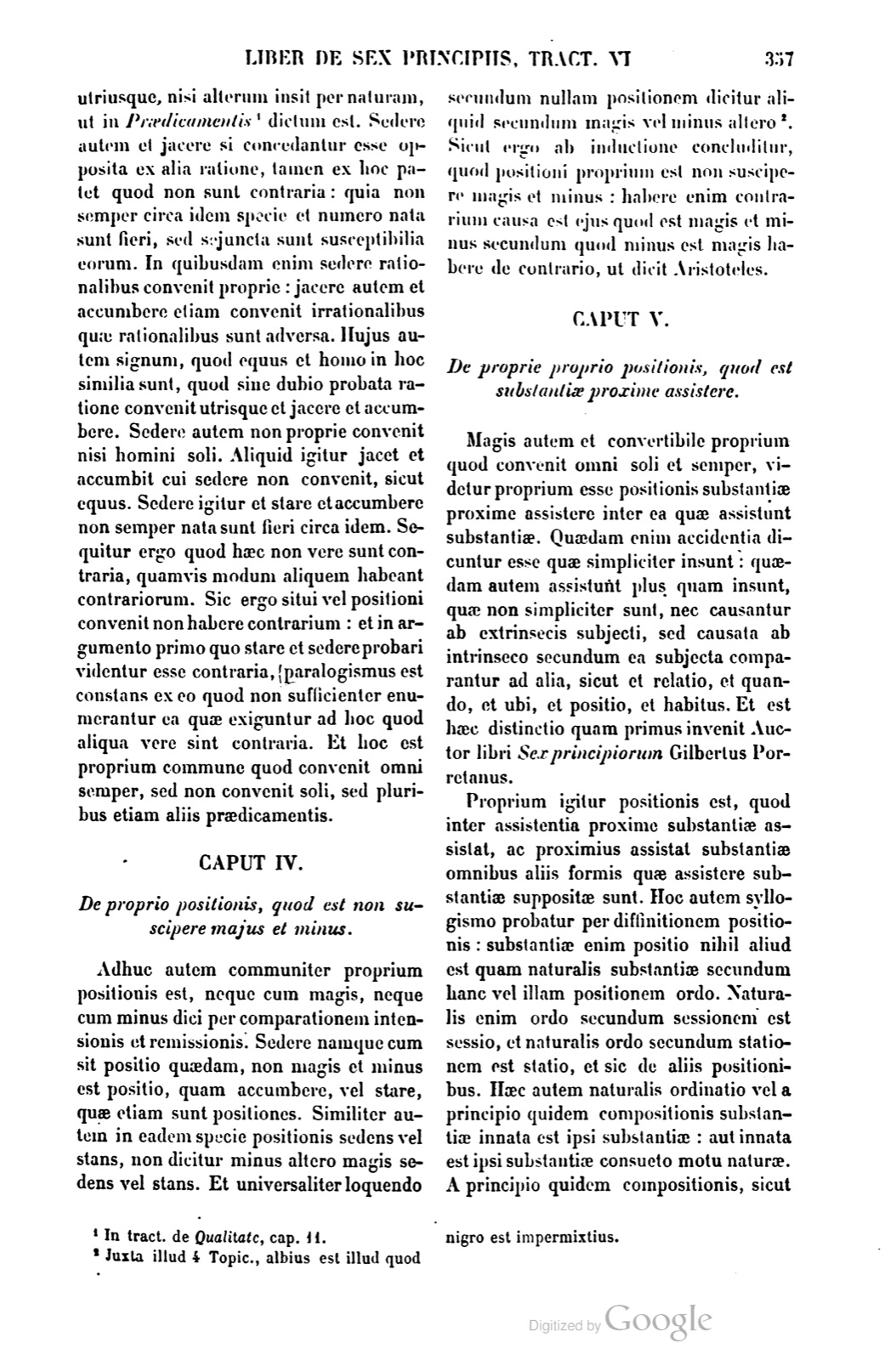
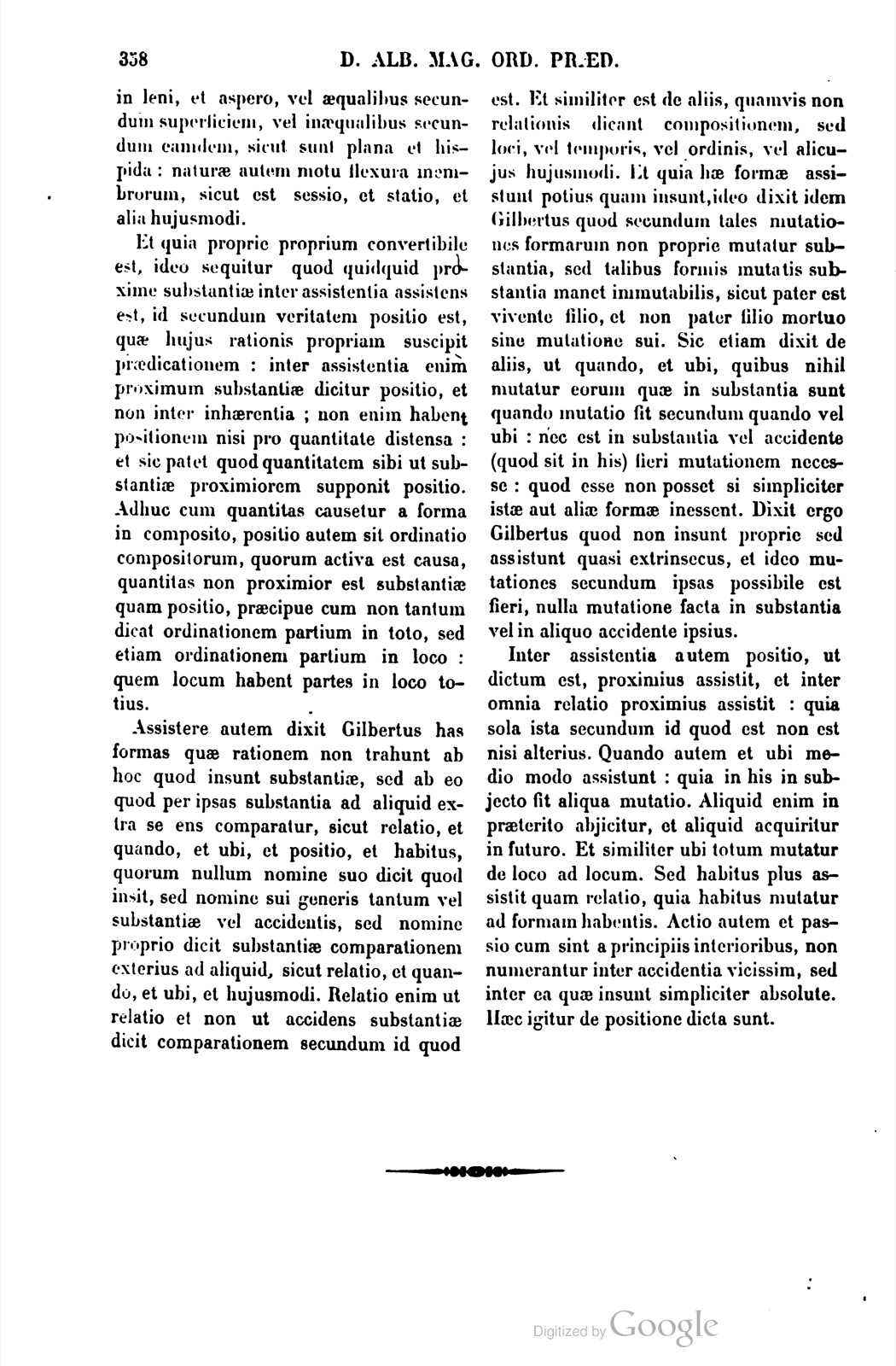
Et quia proprie proprium convertibile est, ideo sequitur quod quidquid proxime substantiae inter assistentia assistens est, id secundum veritatem positio est, quae hujus rationis propriam suscipit praedicationem: inter assistentia enim proximum substantiae dicitur positio, et non inter inhaerentia; non enim habent positionem nisi pro quantitate distensa: et sic patet quod quantitatem sibi ut substantiae proximiorem supponit positio. Adhuc cum quantitas causetur a forma in composito, positio autem sit ordinatio compositorum, quorum activa est causa, quantitas non proximior est substantiae quam positio, praecipue cum non tantum dicat ordinationem partium in toto, sed etiam ordinationem partium in loco: quem locum habent partes in loco totius.
Assistere autem dixit Gilbertus has formas quae rationem non trahunt ab hoc quod insunt substantiae, sed ab eo quod per ipsas substantia ad aliquid extra se ens comparatur, sicut relatio, et quando, et ubi, et positio, et habitus, quorum nullum nomine suo dicit quod insit, sed nomine sui generis tantum vel substantiae vel accidentis, sed nomine proprio dicit substantiae comparationem exterius ad aliquid, sicut relatio, et quando, et ubi, et hujusmodi. Relatio enim ut relatio et non ut accidens substantiae dicit comparationem secundum id quod est. Et similiter est de aliis, quamvis non relationis dicant compositionem, sed loci, vel temporis, vel ordinis, vel alicujus hujusmodi. Et quia hae formae assistunt potius quam insunt, ideo dixit idem Gilbertus quod secundum tales mutationes formarum non proprie mutatur substantia, sed talibus formis mutatis substantia manet immutabilis, sicut pater est vivente filio, et non pater filio mortuo sine mutatione sui. Sic etiam dixit de aliis, ut quando, et ubi, quibus nihil mutatur eorum quae in substantia sunt quando mutatio fit secundum quando vel ubi: nec est in substantia vel accidente quod sit in his fieri mutationem necesse: quod esse non posset si simpliciter istae aut aliae formae inessent. Dixit ergo Gilbertus quod non insunt proprie sed assistunt quasi extrinsecus, et ideo mutationes secundum ipsas possibile est fieri, nulla mutatione facta in substantia vel in aliquo accidente ipsius.
Inter assistentia autem positio, ut dictum est, proximius assistit, et inter omnia relatio proximius assistit: quia sola ista secundum id quod est non est nisi alterius. Quando autem et ubi medio modo assistunt: quia in his in subjecto fit aliqua mutatio. Aliquid enim in praeterito abjicitur, et aliquid acquiritur in futuro. Et similiter ubi totum mutatur de loco ad locum. Sed habitus plus assistit quam relatio, quia habitus mutatur ad formam habentis. Actio autem et passio cum sint a principiis interioribus, non numerantur inter accidentia vicissim, sed inter ea quae insunt simpliciter absolute. Haec igitur de positione dicta sunt.
And because the properly proper property is convertible, therefore it follows that whatever assists substance most nearly among the assisting things, this according to truth is position, which receives the proper predication of this account. For among the assisting things the nearest to substance is called position, and not among inhering things; for they do not have position except on account of extended quantity, and thus it is clear that position supposes quantity as nearer than itself to substance. Further, since quantity is caused by form in a composite, but position is the ordering of composites, of which form is the active cause, quantity is not nearer to substance than position, especially since position does not only say the ordering of parts in the whole, but also the ordering of parts in place, the place which the parts have in the place of the whole.
But Gilbert called those forms assisting which draw their account not from the fact that they inhere in substance, but from the fact that through them substance is compared to something existing outside itself, such as relation, when, where, position, and habit; none of these by its own name says that it inheres, but only by the name of its genus, either of substance or of accident, while by its proper name it says a comparison of substance outward to something, such as relation, when, where, and things of this sort. For relation as relation, and not as an accident of substance, says comparison according to that which it is. And it is similar concerning the others, although they do not say the composition of relation, but of place, or time, or order, or something of this sort. And because these forms assist rather than inhere, therefore the same Gilbert said that according to such changes of forms substance is not properly changed, but when such forms are changed, substance remains unchanged, as a father exists while the son is living and is not a father when the son is dead, without a change of himself. Thus also he spoke of the others, as when and where, by which nothing of the things that are in substance is changed when a change occurs according to when or where; nor is it necessary for a change to occur in substance or in an accident that is in these. This could not be if these or other forms simply inhered. Therefore Gilbert said that they do not properly inhere but assist as though from outside, and therefore it is possible for changes to occur according to them, with no change made in substance or in any accident of it.
But among the assisting things position, as has been said, assists more nearly, and among all things relation assists most nearly, because that alone according to what it is is only of another. But when and where assist in a middle mode, because in these some change occurs in the subject. For something is cast away in the past, and something is acquired in the future. And likewise in where the whole is changed from place to place. But habit assists more than relation, because habit is changed toward the form of the one having. But action and passion, since they are from interior principles, are not numbered among accidents mutually, but among those things which inhere simply and absolutely. Therefore these things have been said about position.
Notes
- From this he concludes the intended point. (Ex hoc concludit intentum.) ↩
- In book II of Perihermenias, or On Interpretation. (In II Perihermenias, sive de Interpretatione.) ↩
- In book X of the Metaphysics. (In X Metaphysicae.) ↩
- Chapter On Opposites. (Cap. de Oppositis.) ↩
- Through itself. (Per seipsum.) ↩
If a page does not appear, its photograph has not been uploaded yet.