Volume 1 · pp. 302–303
Chapter XV. Concerning those things which are opposed to motions.
A marker with ≈ is an approximate page boundary, placed by measure of the text; the page photographs remain the authority. In the paired views, clicking a page marker brings that page into view.
CAPUT XV.
De his quæ motibus opposita sunt.
Motus autem consideratio duplex est: consideratur simpliciter sive universaliter prout abstrahit ab hoc motu et illo. Consideratur etiam secundum speciem prout est hic vel ille motus. Dicamus igitur quod motui simpliciter considerato contrarium est quies. Dico autem contrarium large sumendo prout privatio dicitur in physicis contrarium: quod enim est quies, est privatio motus: ideo quia movens ad formam contraria quiete veniente quam inducere intendit, cessat a movendo: et sic cessat et privatur motus in eo quod motus est: et quia status est in forma vel in loco ad quem fit motus, sicut in contrario ei cujus motus incipit, ideo contrarium dicitur esse quies ad motum: cum tamen quies secundum se non sit contrarium, sed potius est privatio motus 1.
Contra quod tamen quidam objiciunt dicentes quod cessatio motus est negatio motus ab eo quod possibile est moveri, et non movetur et terminat motum ad nunc in quo est in motum esse, sed in eo quod movetur eadem aptitudo est, quia etiam illud aptum est moveri: idem ergo est subjectum in eo quod possibile est moveri et in eo quod movetur, utrumque enim est aptum natum moveri, et quies non est nisi negatio motus ab utroque: quies ergo videtur contradictorie opponi motui, et non privative vel contrarie. Hæc autem eadem argumentatio fieri potest in omnibus privative oppositis.
Sed ad hoc dicendum quod quies vel privative vel contrarie opponitur motui, sicut dictum est. Et cum dicitur quod eadem aptitudo vel potentia ad motum est in eo quod aptum natum est moveri et non movetur, et in eo quod actu movetur, dicendum quod hoc falsum est: non enim eadem potentia est ante actum et cum actu existens: et sic affirmatio et negatio non sunt omnino de eodem: et sic non potest esse contradictio. Opponitur igitur quies motui privative vel contrarie prout simpliciter consideratur.
Ex quo manifestum est quod generatio et corruptio motus non sunt sed fines motuum, quia non opponitur generationi quies, sed corruptio. Motibus autem (si per singulas species motus considerantur) opponitur non quies, sed in contrarium motus, ut generationi opponitur corruptio, quia generatio est via in substantiam, corruptio autem est motus in contrarium, a substantia scilicet in non substantiam: et similiter opponitur augmentatio diminutioni, quia augmentum est existentis magnitudinis additamentum: diminutio autem est in contrarium, scilicet ab existente secundum naturam magnitudine decrementum.
Mutationi autem quæ est per locum, maxime videtur quies esse opposita. Et hæc causa est: quia hic est simplex motus vel mutatio, in quo totum mobile secundum substantiam et quantitatem et qualitatem (quæ in ipso) transfertur: et ideo etiam quies illi simpliciter opponitur: quia sicut talis motus simpliciter est motus et causa motuum aliorum, ita talis quies simpliciter est quies. Motus autem alii sunt motus quidam et in quodam, et quietes sunt quietes in quodam.
CHAPTER XV.
Concerning those things which are opposed to motions.
But the consideration of motion is twofold: it is considered simply or universally according as it abstracts from this motion and that one. It is also considered according to species, according as it is this or that motion. Therefore let us say that rest is contrary to motion considered simply. But I say contrary by taking it broadly, according as privation in physics is called a contrary; for that which is rest is privation of motion. Therefore, because the mover ceases from moving toward the form which it intends to induce, when the contrary rest comes, and thus motion ceases and is deprived in that in which there is motion; and because standing is in the form or in the place to which motion comes to be, as in the contrary of that from which motion begins, therefore rest is said to be contrary to motion, although rest according to itself is not a contrary, but rather is privation of motion 1.
Yet against this certain people object, saying that cessation of motion is negation of motion from that which can possibly be moved and is not moved, and terminates motion at the now in which there is being in motion; but in that which is moved there is the same aptitude, because that also is apt to be moved. Therefore the subject is the same in that which can possibly be moved and in that which is moved, for each is apt and naturally disposed to be moved, and rest is nothing except negation of motion from each. Therefore rest seems to be opposed contradictorily to motion, and not privatively or contrarily. But this same argumentation can be made in all privatively opposed things.
But to this it must be said that rest is opposed to motion either privatively or contrarily, as has been said. And when it is said that the same aptitude or potency to motion is in that which is apt and naturally disposed to be moved and is not moved, and in that which is actually moved, it must be said that this is false; for potency is not the same before act and when existing with act. And thus affirmation and negation are not altogether concerning the same thing, and thus there cannot be contradiction. Therefore rest is opposed to motion privatively or contrarily according as it is considered simply.
From this it is manifest that generation and corruption are not motions but ends of motions, because rest is not opposed to generation, but corruption is. But to motions, if they are considered through the single species of motion, there is opposed not rest, but a motion into the contrary; as corruption is opposed to generation, because generation is the way into substance, but corruption is motion into the contrary, namely from substance into non-substance; and similarly augmentation is opposed to diminution, because augmentation is an addition of existing magnitude, but diminution is into the contrary, namely a decrease from magnitude existing according to nature.
But to change which is through place, rest especially seems to be opposed. And this is the cause: because here there is a simple motion or change, in which the whole movable thing is transferred according to substance and quantity and quality, which are in it; and therefore rest is also opposed to it simply, because just as such motion simply is motion and the cause of other motions, so such rest simply is rest. But other motions are certain motions and in a certain thing, and rests are rests in a certain thing.
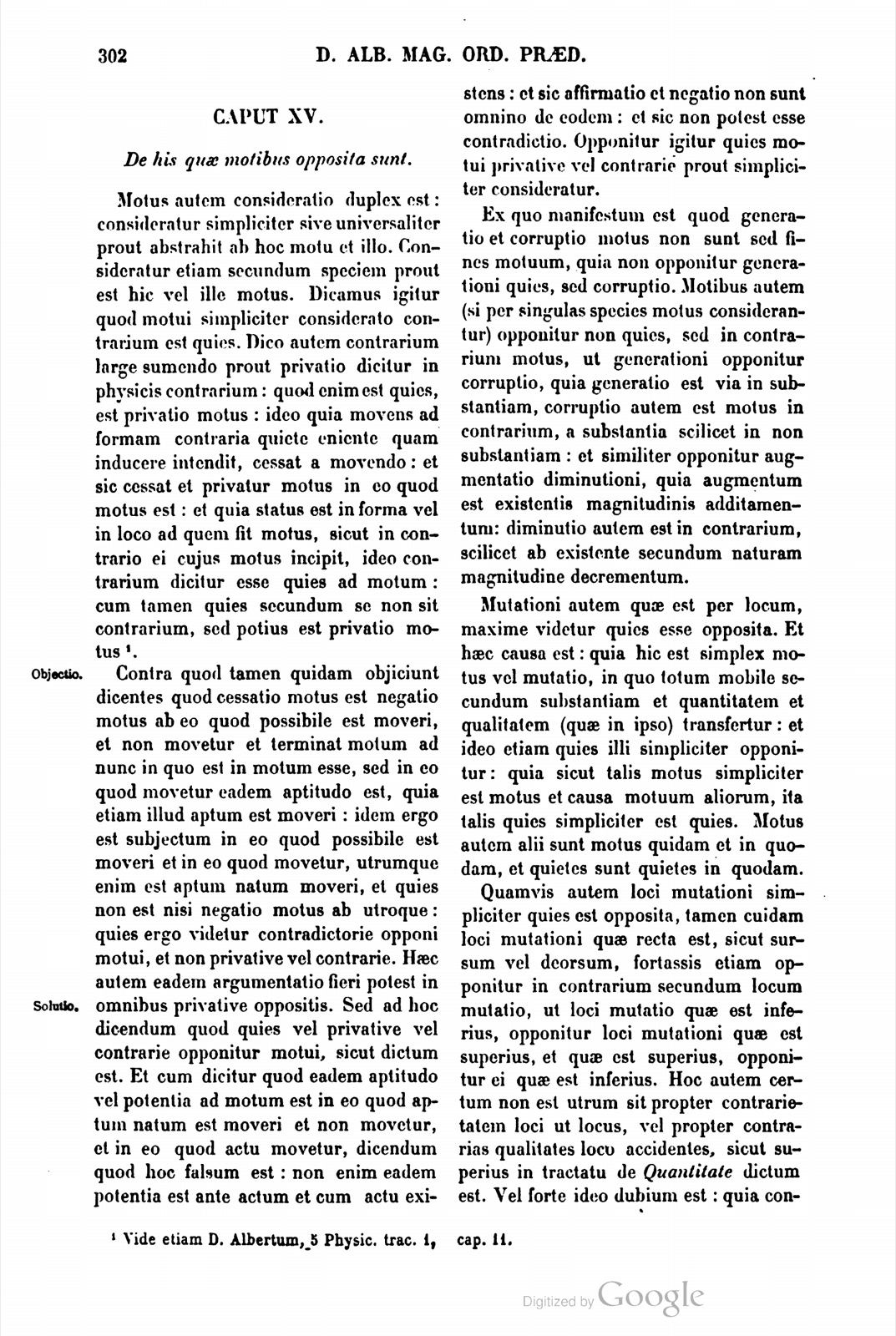
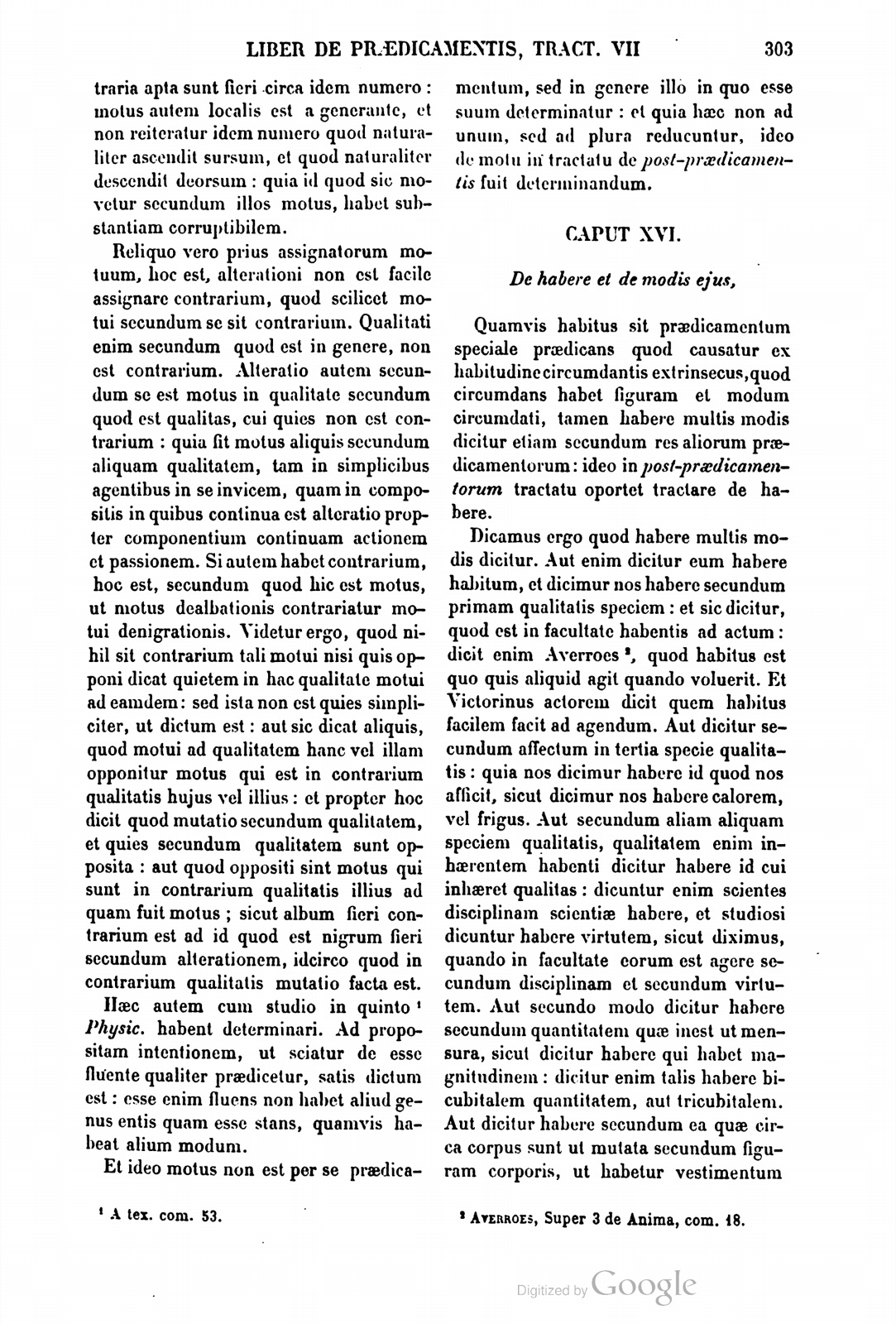
Quamvis autem loci mutationi simpliciter quies est opposita, tamen cuidam loci mutationi quæ recta est, sicut sursum vel deorsum, fortassis etiam opponitur in contrarium secundum locum mutatio, ut loci mutatio quæ est inferius, opponitur loci mutationi quæ est superius, et quæ est superius, opponitur ei quæ est inferius. Hoc autem certum non est utrum sit propter contrarietatem loci ut locus, vel propter contrarias qualitates loco accidentes, sicut superius in tractatu de Quantitate dictum est. Vel forte ideo dubium est: quia contraria apta sunt fieri circa idem numero: motus autem localis est a generante, et non reiteratur idem numero quod naturaliter ascendit sursum, et quod naturaliter descendit deorsum: quia id quod sic movetur secundum illos motus, habet substantiam corruptibilem.
Reliquo vero prius assignatorum motuum, hoc est, alterationi non est facile assignare contrarium, quod scilicet motui secundum se sit contrarium. Qualitati enim secundum quod est in genere, non est contrarium. Alteratio autem secundum se est motus in qualitate secundum quod est qualitas, cui quies non est contrarium: quia fit motus aliquis secundum aliquam qualitatem, tam in simplicibus agentibus in se invicem, quam in compositis in quibus continua est alteratio propter componentium continuam actionem et passionem. Si autem habet contrarium, hoc est, secundum quod hic est motus, ut motus dealbationis contrarietur motui denigrationis. Videtur ergo, quod nihil sit contrarium tali motui nisi quis opponi dicat quietem in hac qualitate motui ad eamdem: sed ista non est quies simpliciter, ut dictum est: aut sic dicat aliquis, quod motui ad qualitatem hanc vel illam opponitur motus qui est in contrarium qualitatis hujus vel illius: et propter hoc dicit quod mutatio secundum qualitatem, et quies secundum qualitatem sunt opposita: aut quod oppositi sint motus qui sunt in contrarium qualitatis illius ad quam fuit motus; sicut album fieri contrarium est ad id quod est nigrum fieri secundum alterationem, idcirco quod in contrarium qualitatis mutatio facta est.
Hæc autem cum studio in quinto 2 Physic. habent determinari. Ad propositam intentionem, ut sciatur de esse fluente qualiter prædicetur, satis dictum est: esse enim fluens non habet aliud genus entis quam esse stans, quamvis habeat alium modum.
Et ideo motus non est per se prædicamentum, sed in genere illo in quo esse suum determinatur: et quia hæc non ad unum, sed ad plura reducuntur, ideo de motu in tractatu de post-prædicamentis fuit determinandum.
But although rest is opposed simply to change of place, nevertheless perhaps also to a certain change of place which is straight, as upward or downward, there is opposed a change into the contrary according to place, so that change of place which is lower is opposed to change of place which is higher, and that which is higher is opposed to that which is lower. But this is not certain, whether it is because of the contrariety of place as place, or because of contrary qualities accidental to place, as was said above in the treatise on Quantity. Or perhaps it is doubtful for this reason: because contraries are apt to come to be concerning the same in number; but local motion is from a generator, and the same thing in number which naturally ascends upward and which naturally descends downward is not repeated, because that which is moved thus according to those motions has a corruptible substance.
But for the remaining one of the motions assigned before, that is, for alteration, it is not easy to assign a contrary, namely one which is contrary to motion according to itself. For there is no contrary to quality according as it is in genus. But alteration according to itself is motion in quality according as it is quality, to which rest is not contrary, because some motion comes to be according to some quality, both in simple things acting upon one another and in composites in which there is continuous alteration because of the continuous action and passion of the components. But if it has a contrary, this is according as here there is motion, as the motion of whitening is made contrary to the motion of blackening. Therefore it seems that nothing is contrary to such a motion unless someone should say that rest in this quality is opposed to motion toward the same quality; but that is not rest simply, as has been said. Or someone may say thus, that to motion toward this or that quality there is opposed motion which is into the contrary of this or that quality; and on account of this he says that change according to quality and rest according to quality are opposites; or that opposed motions are those which are into the contrary of that quality toward which the motion was, just as to become white is contrary to that which is to become black according to alteration, for this reason, that change has been made into the contrary of the quality.
But these things have to be determined with study in the fifth book 2 of the Physics. For the proposed intention, so that it may be known how flowing being is predicated, enough has been said; for flowing being does not have another genus of being than standing being, although it has another mode.
And therefore motion is not per se a predicament, but is in that genus in which its being is determined; and because these things are reduced not to one but to many, therefore concerning motion it had to be determined in the treatise on the post-predicaments.
If a page does not appear, its photograph has not been uploaded yet.