Volume 1 · pp. 303–304
Chapter XVI. Concerning to have and concerning its modes.
A marker with ≈ is an approximate page boundary, placed by measure of the text; the page photographs remain the authority. In the paired views, clicking a page marker brings that page into view.
CAPUT XVI.
De habere et de modis ejus.
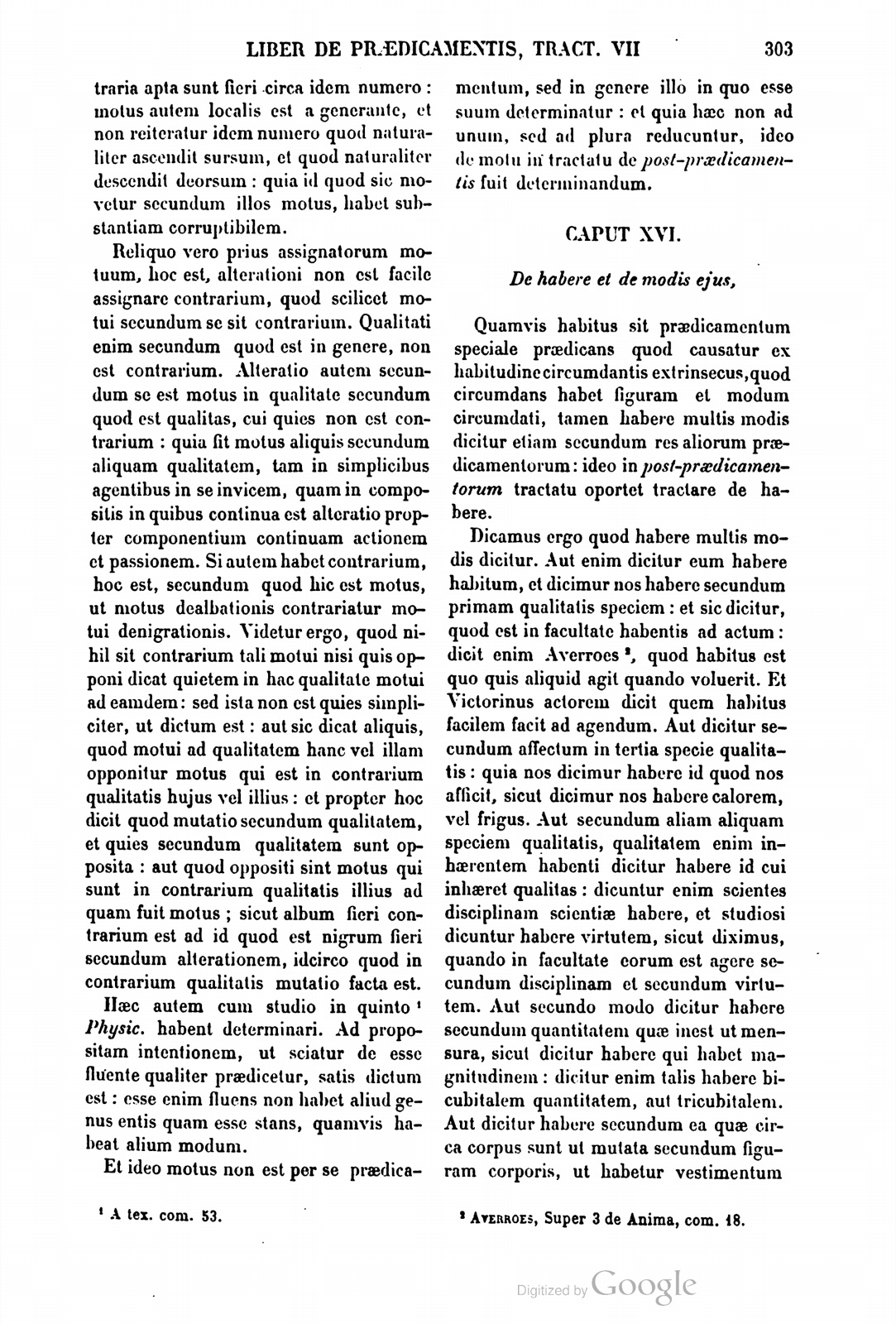
Quamvis habitus sit prædicamentum speciale prædicans quod causatur ex habitudine circumdantis extrinsecus, quod circumdans habet figuram et modum circumdati, tamen habere multis modis dicitur etiam secundum res aliorum prædicamentorum: ideo in post-prædicamentorum tractatu oportet tractare de habere.
Dicamus ergo quod habere multis modis dicitur. Aut enim dicitur eum habere habitum, et dicimur nos habere secundum primam qualitatis speciem: et sic dicitur, quod est in facultate habentis ad actum: dicit enim Averroes 1, quod habitus est quo quis aliquid agit quando voluerit. Et Victorinus actorem dicit quem habitus facilem facit ad agendum. Aut dicitur secundum affectum in tertia specie qualitatis: quia nos dicimur habere id quod nos afficit, sicut dicimur nos habere calorem, vel frigus. Aut secundum aliam aliquam speciem qualitatis, qualitatem enim inhærentem habenti dicitur habere id cui inhæret qualitas: dicuntur enim scientes disciplinam scientiæ habere, et studiosi dicuntur habere virtutem, sicut diximus, quando in facultate eorum est agere secundum disciplinam et secundum virtutem. Aut secundo modo dicitur habere secundum quantitatem quæ inest ut mensura, sicut dicitur habere qui habet magnitudinem: dicitur enim talis habere bicubitalem quantitatem, aut tricubitalem. Aut dicitur habere secundum ea quæ circa corpus sunt ut mutata secundum figuram corporis, ut habetur vestimentum vel tunica: quæ omnia mutantur ad habentem, et non mutant eum, ut dicit Augustinus, et juxta hunc modum est id quod habetur in decorem, ut quod circumdat membrum, sicut habetur annulus in digito. Adhuc autem alio modo dicitur sicut totum habet partes præcipue organicas quæ sunt ad actum, ut manum, aut pedem, quando habentur ad usum manus et pedes. Dicitur etiam habere secundum quod in vase mensurante quantitatem et continente, sicut dicitur quis habere granum tritici in modio, aut sicut vinum dicitur quis habere in lagena: vinum enim in lagena habere dicimur, et in modio grana tritici, quia lagena continet et mensurat vinum, et modius triticum. Hæc igitur omnia diversimode habere dicuntur diversi, et diversis secundum omnia. Hic est unus modus prædicandi. Dicitur etiam alio modo habere per modum quo habetur possessio, sicut domum et agrum habere dicimur: et hic est specialis modus habendi et valde proprius. Adhuc autem dicitur habere sicut vir uxorem dicitur habere, aut uxor virum, mutuo contractu inter virum et uxorem. Sed modus iste qui dictus est, videtur alienissimus inter omnes modos habendi qui dicti sunt: nihil enim aliud dicimus virum habere uxorem, nisi quia cohabitant simul ad civiles et œconomicos actus: et hoc modo habens habetur eodem modo quo habet: et per eumdem contractum qui habet efficitur habitus, et hoc non est in aliquo aliorum modorum. Forte tamen adhuc apparebunt et alii modi ejus quod est habere: sed qui magis consueverunt dici et usitati sunt apud sapientes sunt isti, qui pene omnes enumerati sunt: et si qui alii sunt, reducuntur ad istos.
CHAPTER XVI.
Concerning to have and concerning its modes.
Although habit is a special predicament predicating that which is caused from the disposition of an extrinsic surrounding thing, because what surrounds has the figure and mode of the surrounded thing, nevertheless to have is said in many modes also according to the things of other predicaments; therefore in the treatise of the post-predicaments one must treat concerning to have.
Therefore let us say that to have is said in many modes. For either someone is said to have a habit, and we are said to have according to the first species of quality; and thus it is said because it is in the faculty of the one having for act. For Averroes says 1 that habit is that by which someone does something when he has wished. And Victorinus calls an actor the one whom habit makes ready for acting. Or it is said according to affection in the third species of quality, because we are said to have that which affects us, as we are said to have heat or cold. Or according to some other species of quality; for the quality inhering in the one having is said to have that in which the quality inheres. For those knowing are said to have the discipline of knowledge, and the studious are said to have virtue, as we said, when it is in their faculty to act according to discipline and according to virtue. Or in a second mode, to have is said according to quantity which is present as measure, as one who has magnitude is said to have; for such a one is said to have a two-cubit quantity or a three-cubit quantity. Or it is said to have according to those things which are around the body as changed according to the figure of the body, as a garment or tunic is had; all these are changed toward the one having and do not change him, as Augustine says; and according to this mode there is that which is had for adornment, as what surrounds a member, as a ring is had on a finger. Further, in another mode it is said as a whole has parts, especially organic parts which are for act, as hand or foot, when hands and feet are had for use. It is also said to have according to what is in a vessel measuring and containing quantity, as someone is said to have a grain of wheat in a modius, or as someone is said to have wine in a flask; for we are said to have wine in a flask, and grains of wheat in a modius, because the flask contains and measures wine, and the modius wheat. Therefore all these are said to have in diverse ways, diverse ones, and according to all things in diverse ways. This is one mode of predicating. It is also said in another mode to have through the mode by which possession is had, as we are said to have a house and field; and this is a special mode of having and very proper. Further, it is said to have as a man is said to have a wife, or a wife a man, by mutual contract between man and wife. But this mode which has been spoken of seems most alien among all the modes of having which have been spoken of; for we say nothing other than that a man has a wife except that they live together for civil and economic acts; and in this mode the one having is had in the same mode in which he has, and through the same contract the one who has is made had; and this is not in any of the other modes. Perhaps, however, still other modes of that which is to have will appear; but those which have more customarily been said and are used among the wise are these, which have almost all been enumerated; and if there are any others, they are reduced to these.
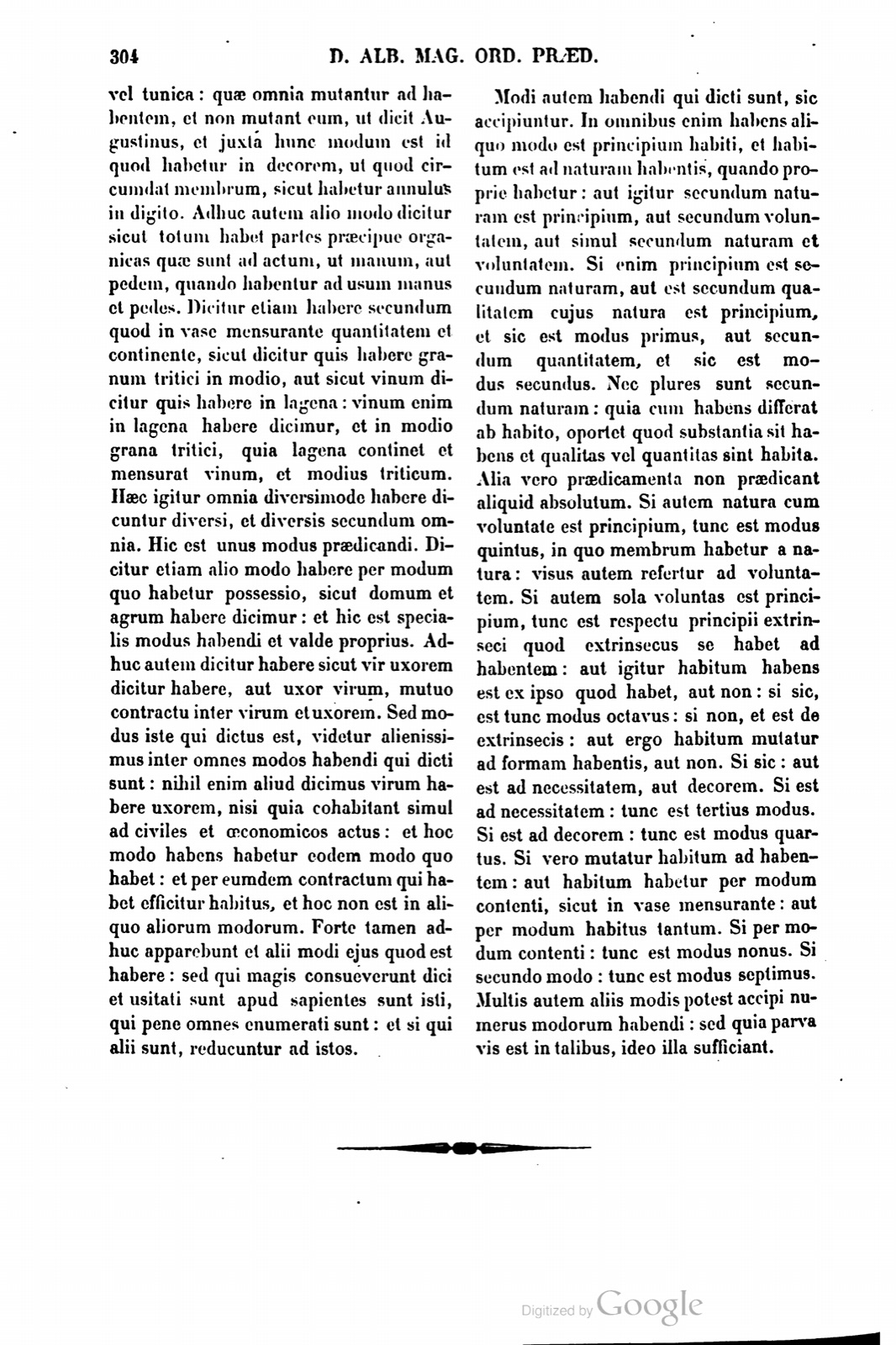
Modi autem habendi qui dicti sunt, sic accipiuntur. In omnibus enim habens aliquo modo est principium habiti, et habitum est ad naturam habentis, quando proprie habetur: aut igitur secundum naturam est principium, aut secundum voluntatem, aut simul secundum naturam et voluntatem. Si enim principium est secundum naturam, aut est secundum qualitatem cujus natura est principium, et sic est modus primus, aut secundum quantitatem, et sic est modus secundus. Nec plures sunt secundum naturam: quia cum habens differat ab habito, oportet quod substantia sit habens et qualitas vel quantitas sint habita. Alia vero prædicamenta non prædicant aliquid absolutum. Si autem natura cum voluntate est principium, tunc est modus quintus, in quo membrum habetur a natura: usus autem refertur ad voluntatem. Si autem sola voluntas est principium, tunc est respectu principii extrinseci quod extrinsecus se habet ad habentem: aut igitur habitum habens est ex ipso quod habet, aut non: si sic, est tunc modus octavus: si non, et est de extrinsecis: aut ergo habitum mutatur ad formam habentis, aut non. Si sic: aut est ad necessitatem, aut decorem. Si est ad necessitatem: tunc est tertius modus. Si est ad decorem: tunc est modus quartus. Si vero mutatur habitum ad habentem: aut habitum habetur per modum contenti, sicut in vase mensurante: aut per modum habitus tantum. Si per modum contenti: tunc est modus nonus. Si secundo modo: tunc est modus septimus. Multis autem aliis modis potest accipi numerus modorum habendi: sed quia parva vis est in talibus, ideo illa sufficiant.
But the modes of having which have been spoken of are taken thus. For in all of them the one having is in some way the principle of the thing had, and the thing had is toward the nature of the one having when it is properly had. Therefore either it is a principle according to nature, or according to will, or at once according to nature and will. For if the principle is according to nature, either it is according to quality whose nature is the principle, and thus there is the first mode, or according to quantity, and thus there is the second mode. Nor are there more according to nature, because since the one having differs from the thing had, substance must be the one having and quality or quantity must be the things had. But the other predicaments do not predicate something absolute. But if nature together with will is the principle, then there is the fifth mode, in which a member is had by nature; but use is referred to will. But if will alone is the principle, then it is with respect to an extrinsic principle which has itself extrinsically toward the one having: therefore either the one having the thing had is from the very thing which he has, or not. If so, then there is the eighth mode. If not, and it is from extrinsic things: then either the thing had is changed toward the form of the one having, or not. If so, either it is for necessity or for adornment. If it is for necessity, then it is the third mode. If it is for adornment, then it is the fourth mode. But if the thing had is changed toward the one having: either the thing had is had through the mode of a contained thing, as in a measuring vessel; or through the mode of habit only. If through the mode of a contained thing, then it is the ninth mode. If in the second mode, then it is the seventh mode. But the number of modes of having can be taken in many other modes; but because there is little force in such things, therefore those suffice.
Notes
- Averroes, On the Soul III, commentary 18. (Averroes, Super 3 de Anima, com. 18.) ↩
If a page does not appear, its photograph has not been uploaded yet.