Volume 1 · pp. 298–301
Chapter XIV. Concerning the post-predicament which is motion.
A marker with ≈ is an approximate page boundary, placed by measure of the text; the page photographs remain the authority. In the paired views, clicking a page marker brings that page into view.
CAPUT XIV.
De post-prædicamento quod est motus.
Postquam jam tractatum est de illis consequentibus prædicamenta quæ accidunt sive conveniunt omnibus prædicamentis per id quod comparantur ad invicem genera vel ea quæ in generibus sunt, nunc determinandum est de eo quod est consequens prædicamenta per esse quod prædicatur in illis, ex quo prædicamenta sunt principia omnium eorum quorum sunt principia, sequitur quod omne esse rerum prædicetur in illis, et significatur nominibus prædicamentorum. Est autem duplex, scilicet esse fluens, et esse simpliciter et stans: et prædicamentum quidem genere, specie et individuo prædicat esse stans: et hoc sufficienter in prædicamentis determinatum est. Est autem, ut dicit Avicenna, esse fluens quod non est simpliciter actus, sed permixtus potentiæ: qui modus significandi esse et prædicandi ordinatione generum et specierum et individuorum determinari non potuit, eo quod omnia illa significant et prædicant quod similiter suo modo actu est: propter quod oportuit ut hoc esse sit designatum et prædicatum in aliquo post prædicamenta consequente consignificaretur: et hoc est in tot prædicamentis, quot sunt quæ possunt habere res suas, et esse quod prædicatur permixtum potentia.
De hoc ergo tractantes tractabimus de motu quantum pertinet ad præsentem speculationem: subtiliter enim de motu ad Physicum tractare pertinet: cum enim in quolibet sit ut potentia primo distans ab actu, nec devenire possit potentia ad actum nisi per motum, oportet ponere quod motus sit. Adhuc autem omne passivum, actum agentis aut nullo modo recipit, aut it per motum ad actum agentis. Constat autem quod passivum suscipit actum agentis, ergo suscipit per motum: ergo oportet ponere quod sit motus. Adhuc tempus esse ponitur: tempus autem non est continuum nisi per motum: quare oportet ponere quod motus sit. Si autem est motus, et in prædicamentis determinandum de omni voce quæ esse prædicat rei alicujus, oportet in prædicamentis determinare de modis motus, et cujusmodi esse prædicatur in modis illis, et ad quæ prædicamenta reducatur.
Dicentes autem de motu secundum hunc modum non oportet nos diffinire motum, quia una et eadem ratione de sex modis motuum sive speciebus non prædicatur: motum enim hic extenso nomine sumimus pro omni eo quod dicit quodcumque esse fluens de potentia ad actum, sive id esse sit substantiale, sive accidentale: tale enim esse in quantum est fluens, in communi unum modum habet quo significetur, et quo per nomen significans ipsum secundum quod fluens est prædicetur, et hoc modo in hac scientia habet determinari. Dicamus ergo sic multiplicitatem motus determinantes, quod motus extenso nomine motus sunt sex species, scilicet generatio, corruptio, augmentatio, diminutio, alteratio, secundum locum mutatio. Generatio quidem et corruptio in substantia sunt et uno modo sunt, et dicuntur mutationes non motus. Alio autem modo motus extenso nomine motus possunt appellari. Si enim sunt in substantia solum, tunc non possunt esse nisi aut de non substantia ad substantiam secundum esse substantiæ, vel e converso de substantia ad non substantiam: et quia hi termini dicuntur opponi secundum affirmationem et negationem, inter quas nullum medium est, hæc mutatio non habet medium, sed est de termino a quo ad terminum ad quem sine medio. Adhuc autem sequitur quod non sit in tempore, sed in nunc, quia omne tempus habet medium: et velox in tempore dividit tempus et motum: nunc autem est finis temporis ad quem continuatur tempus: sequitur ergo quod talis mutatio sit finis motus: sicut enim nunc se habet ad tempus, ita mutatio se habet ad motum, et hæc est probatio Averrois super physicam in commento. Si autem generatio accipiatur ut immixta alterationi qua alteratur materia ejus quod generatur per qualitates generantis, tunc motus dici potest, et sic hic nos loquimur de generatione, quia sicut esse fluens.
CHAPTER XIV.
Concerning the post-predicament which is motion.
After it has now been treated concerning those things consequent upon the predicaments which happen to or agree with all predicaments through this, that genera or those things which are in genera are compared to one another, now it must be determined concerning that which is consequent upon the predicaments through the being which is predicated in them. Since the predicaments are principles of all those things of which they are principles, it follows that every being of things is predicated in them and is signified by names of the predicaments. But it is twofold, namely flowing being and being simply and standing. And indeed predicament by genus, species, and individual predicates standing being, and this has been sufficiently determined in the predicaments. But flowing being, as Avicenna says, is that which is not simply act, but mixed with potency. This mode of signifying being and of predicating could not be determined by the ordering of genera and species and individuals, because all those things signify and predicate what in like manner is in act in its own mode. On account of this, it was necessary that this being be designated and predicated in something consequent after the predicaments and be co-signified; and this is in as many predicaments as there are those which can have their things and the being which is predicated mixed with potency.
Therefore, treating of this, we shall treat of motion insofar as it pertains to the present speculation; for to treat subtly concerning motion belongs to the Physicist. For since in anything whatever it is as potency first distant from act, and potency cannot come to act except through motion, one must posit that motion exists. Further, every passive thing either receives the act of the agent in no way, or goes through motion to the act of the agent. But it is established that the passive thing receives the act of the agent; therefore it receives through motion; therefore one must posit that there is motion. Further, time is posited to exist; but time is not continuous except through motion; wherefore one must posit that motion exists. But if motion exists, and in the predicaments one must determine concerning every word which predicates being of some thing, one must determine in the predicaments concerning the modes of motion, and what sort of being is predicated in those modes, and to which predicaments it is reduced.
But speaking concerning motion according to this mode, we need not define motion, because it is not predicated by one and the same account of the six modes or species of motions. For here we take motion in an extended name for all that which says any flowing being whatever from potency to act, whether that being be substantial or accidental. For such being, insofar as it is flowing, has in common one mode by which it is signified, and by which it is predicated through the name signifying it according as it is flowing; and in this mode it has to be determined in this science. Therefore, determining thus the multiplicity of motion, let us say that motions in the extended name of motion are six species, namely generation, corruption, augmentation, diminution, alteration, and change according to place. Generation indeed and corruption are in substance and are in one mode, and they are called changes, not motions. But in another mode, in the extended name of motion, they can be called motions. For if they are in substance alone, then they can be only either from non-substance to substance according to the being of substance, or conversely from substance to non-substance. And because these terms are said to be opposed according to affirmation and negation, between which there is no mean, this change does not have a mean, but is from the term from which to the term to which without a mean. Further, it also follows that it is not in time, but in a now, because every time has a mean, and the swift in time divides time and motion; but the now is the end of time to which time is continued. Therefore it follows that such a change is the end of motion; for as the now has itself to time, so change has itself to motion, and this is the proof of Averroes upon the Physics in the commentary. But if generation is taken as mixed with the alteration by which the matter of that which is generated is altered through the qualities of the generator, then it can be called motion, and thus here we speak concerning generation, because as flowing being.
Juxta hunc modum plane intelligitur qualiter corruptio sit mutatio et non motus, et qualiter possit dici motus, et qualiter dicit esse substantiale fluens secundum quod dicit Aristoteles, quod in tali fluxu non est vivum et animal simul in motu, et non est animal et homo simul in motu generationis. Et opposito modo est in corruptione: quia corruptio in uno modo est mutatio de substantia ad non substantiam, et sic est finis motus. Et alio modo est immixta motui alterationis corrumpentis id quod est secundum qualitates suas alterantes in virtute corrumpentis: et sic est alteratio paulatim abjiciens a substantia, et in fine quando est substantia in abjectum esse, tunc facta est corruptio secundum substantiam. Sic igitur patet qualiter generatio et corruptio sunt motus et qualiter mutationes.
According to this mode it is plainly understood how corruption is change and not motion, and how it can be called motion, and how it says substantial flowing being according as Aristotle says that in such flux the living thing and animal are not together in motion, and animal and man are not together in the motion of generation. And in the opposite mode it is in corruption, because corruption in one mode is change from substance to non-substance, and thus is the end of motion. And in another mode it is mixed with the motion of alteration corrupting that which is according to its qualities altering in the power of the corrupting thing; and thus it is alteration little by little casting away from substance, and at the end, when substance is in cast-away being, then corruption according to substance has been made. Thus therefore it is clear how generation and corruption are motions and how they are changes.
Alii autem omnes motus sunt salvato subjecto in esse substantiali subjecto ad aliquod esse secundum quantitatis perfectionem, aut secundum qualitates, aut secundum ubi. Et illi sunt proprie motus: quia mobile secundum quod mobile est ens perfectum in esse substantiali, et potentia existens in esse quanti vel qualis vel ubi: et motus est actus ejus secundum quod hujusmodi: et ideo in quantitate secundum rationem perfecti et imperfecti est augmentum et diminutio: et augmentum est motus naturalis, diminutio autem a perfecto est esse motus innaturalis.
Alteratio autem non nominatur nominibus oppositis, sed uno nomine communi, quod est secundum qualitatem cujus terminus secundum naturam vel ultra quem non debet esse, est calidum, vel frigidum, vel humidum, vel siccum, et sic de aliis qualitatibus quæ causantur ab istis: tamen non est ratione determinata. Quia tamen tempore complexionatum variatur et simpliciter in simplicibus, et ideo dicit Aristoteles 1, quod non est eadem sanitas in mane et vespere: quia sanitas est habitus fundatus super calidi et frigidi, humidi et sicci complexione: et ideo in genere determinatur et non in specie, et dicitur alteratio: qualitas enim in genere non habet contrarium, sed in specie 2. Et quamvis quantitas non habeat contrarium, nec in genere, nec in specie, tamen in ratione termini naturalis et defectus ab isto suscipitur circa quantitatem qualitatis contrarietatis. Ideo ergo in communi dicitur alteratio.
Et hæ quidem mutatione sunt secundum ea quæ insunt substantiæ aut substantialiter, aut accidentaliter; et si accidentaliter aut secundum quantitatem, aut secundum qualitatem: relatio enim non prædicat aliquid quod absolute insit secundum quod est, sed ipsum esse ad aliquid, et patet quod ad ea quæ insunt substantiæ pluribus modis non potest esse motus. Si autem est secundum ea quæ extrinsecus adjacent substantiæ, tunc non potest esse secundum quando: quia quando causatur a tempore, et tempus est mensura motus, et non potest esse secundum quando, nisi esset secundum motum, et sic motus esset ad motum, et hoc procederet in infinitum, quod esse non potest. Nec potest esse secundum actionem: quia actio est operatio agentis et moventis, et motus non est in agente sicut in subjecto. Non potest esse secundum passionem: quia passio est causa motus. Nec potest secundum positionem: quia positio partium in toto et in loco non mutatur nisi per generationem et corruptionem, ut patet. Nec secundum habitum: quia habitus mutatur ad subjectum et non mutat ipsum. Relinquitur ergo, quod sit secundum ubi in quo totum mobile salvatum transfertur de loco ad locum: et ideo per se non possunt esse nisi sex species vel modi motus, secundum quod motus dicit esse vel ubi etiam fluens.
Palam autem est, quod motus alii et alii sunt diversi ab invicem, et unus non incidit in alterius intentionem: non enim potest esse quod generatio sit corruptio, quia generatio est via in esse, et corruptio est via ab esse in non esse. Nec augmentum potest esse diminutio: quia augmentum est via ad debitam secundum naturam quantitatem, diminutio autem est ab illa. Nec alteratio est secundum locum mutatio: quia alteratum manens in loco eodem in passionibus motum vel mutatum est, in loci autem mutatione totum secundum se translatum est ad alium locum. Quamvis autem dicatur quod tot sunt species motus quot sunt species entis 3, eo quod in quolibet prædicamento est devenire de potentia ad actum, tamen illi sunt motus per accidens et non per se, et sunt infiniti: et ideo per artem fieri non possunt, sed aliis motibus sunt adjuncti.
But all other motions are, with the subject saved in substantial being, the subject toward some being according to the perfection of quantity, or according to qualities, or according to where. And those are properly motions, because the movable according as movable is a being perfected in substantial being and existing in potency in the being of how-much or of what-sort or of where; and motion is its act according as it is of this sort. And therefore in quantity, according to the account of perfect and imperfect, there is augmentation and diminution; and augmentation is a natural motion, but diminution from the perfect is to be an unnatural motion.
But alteration is not named by opposed names, but by one common name, which is according to quality, whose term according to nature, or beyond which it ought not be, is hot, or cold, or moist, or dry, and so concerning the other qualities which are caused by these; nevertheless it is not determined by a determinate account. Yet because what has been complexioned varies by time, and simply in simple things, therefore Aristotle says 1 that health is not the same in the morning and in the evening, because health is a habit founded upon the complexion of hot and cold, moist and dry; and therefore it is determined in genus and not in species, and it is called alteration. For quality in genus does not have a contrary, but in species 2. And although quantity does not have a contrary, neither in genus nor in species, nevertheless around quantity, by reason of a natural term and defect from it, contrariety of the quality of quantity is received. Therefore it is called alteration in common.
And these indeed are change according to those things which are in substance either substantially or accidentally; and if accidentally, then either according to quantity or according to quality. For relation does not predicate something which is absolutely in a thing according to what it is, but the very being toward something; and it is clear that concerning those things which are in substance in many modes there cannot be motion. But if it is according to those things which lie outside substance, then it cannot be according to when, because when is caused by time, and time is the measure of motion, and it cannot be according to when unless it were according to motion; and thus motion would be toward motion, and this would proceed to infinity, which cannot be. Nor can it be according to action, because action is the operation of the agent and mover, and motion is not in the agent as in a subject. It cannot be according to passion, because passion is the cause of motion. Nor can it be according to position, because the position of parts in the whole and in place is not changed except through generation and corruption, as is clear. Nor according to habit, because habit is changed toward the subject and does not change the subject. Therefore it remains that it is according to where, in which the whole movable thing, preserved, is transferred from place to place; and therefore per se there cannot be except six species or modes of motion, according as motion says being or also flowing where.
But it is plain that motions, one and another, are diverse from one another, and one does not fall into the intention of another. For it cannot be that generation is corruption, because generation is the way into being, and corruption is the way from being into non-being. Nor can augmentation be diminution, because augmentation is the way to quantity due according to nature, but diminution is from that. Nor is alteration change according to place, because what has been altered, remaining in the same place, has been moved or changed in passions; but in change of place the whole according to itself has been carried over to another place. But although it is said that there are as many species of motion as there are species of being 3, because in any predicament there is a coming from potency to act, nevertheless those are motions accidentally and not per se, and they are infinite; and therefore they cannot be made by art, but are joined to other motions.
In alteratione vero habet quamdam secundum quosdam quæstionem. Dubitant enim quidam, ne forte necessarium sit id quod alteratur per aliquam reliquarum mutationum alterari, et non secundum ipsam alterationem. Hoc autem quamvis dicant quidam, tamen non est verum, et hoc experiri possumus in nobis ipsis: accidit enim nobis pene secundum qualitates omnes passionum animæ et corporis alterari absque eo quod aliqua aliarum mutationum mutemur: non enim augeri necessarium est quod secundum passiones qualitatum movetur: nec necessarium est minui secundum id quod movetur secundum passibiles qualitates. Similiter autem est et in aliis motibus, quia non est necesse alteratum secundum locum moveri, vel generari, vel corrumpi. Propter quod patet quod alteratio alia est mutatio quæ est præter omnes alios motus et separata ab omnibus aliis. Nam si alteratio esset eadem cum aliqua aliarum mutationum, oporteret id quod alteratur, augeri vel minui: vel oporteret quod cum alteratur, fieret quædam aliarum consequentium ad alterationem mutationum. Sed hoc non est necessarium, quia potest alterari nulla aliarum mutationum facta in ipso.
Similiter autem sciendum, quod id quod augetur, non aliqua aliarum mutationum movetur, sicut quod minuitur, vel generatur, vel corrumpitur, vel quod movetur secundum locum physice secundum quod motus secundum locum est a generante, procul dubio prius oportet alterari in omnibus physicis: quia non fit generatio, vel corruptio, vel augmentum, vel diminutio, vel loci mutatio quæ est a natura, nisi alteratione præcedente quæ disponit generabile vel corruptibile vel augens et auctum et diminuens et diminutum et secundum locum motum ad hoc quod mutetur.
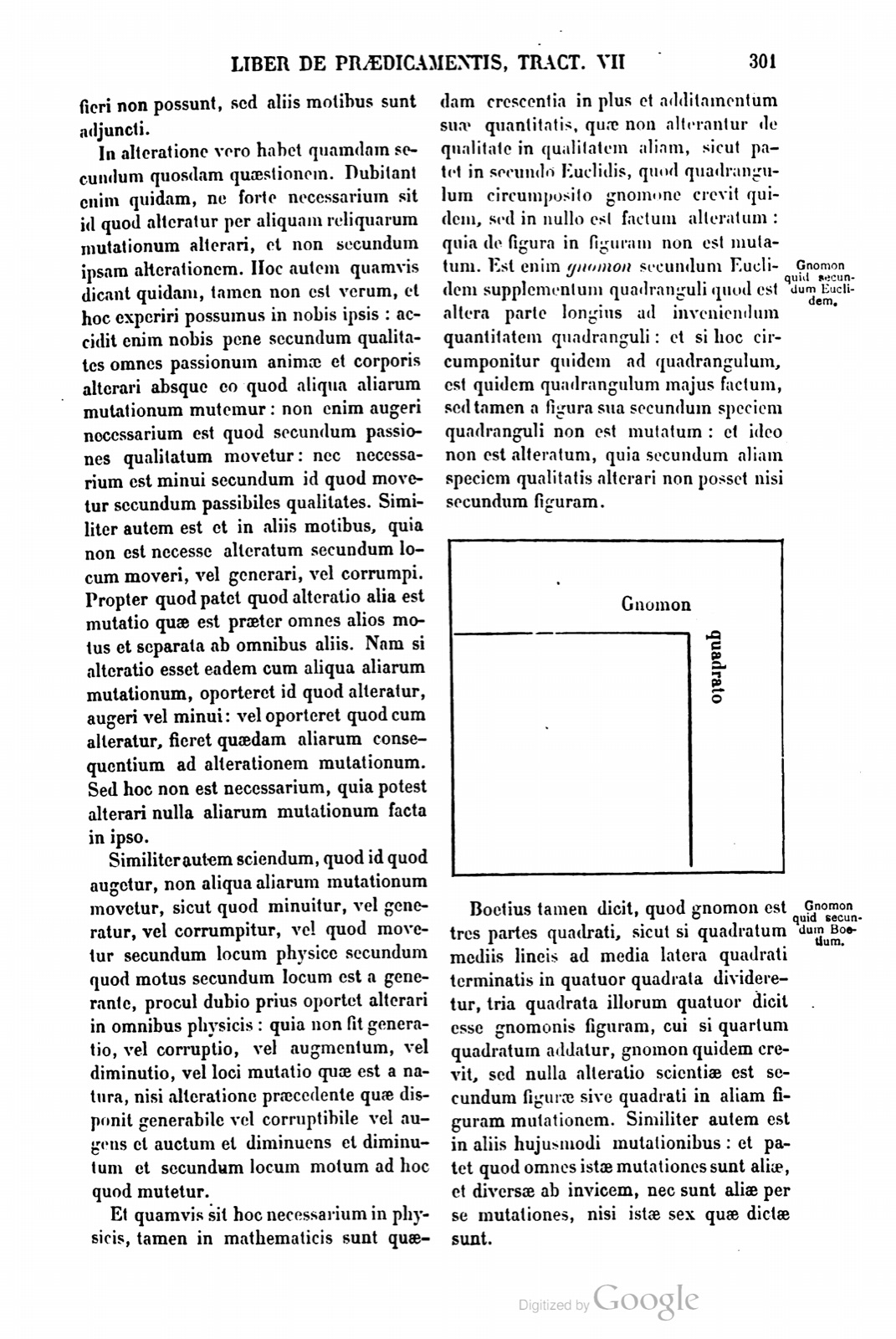
Et quamvis sit hoc necessarium in physicis, tamen in mathematicis sunt quædam crescentia in plus et additamentum suæ quantitatis, quæ non alterantur de qualitate in qualitatem aliam, sicut patet in secundo Euclidis, quod quadrangulum circumposito gnomone crevit quidem, sed in nullo est factum alteratum: quia de figura in figuram non est mutatum. Est enim gnomon secundum Euclidem supplementum quadranguli quod est altera parte longius ad inveniendum quantitatem quadranguli: et si hoc circumponitur quidem ad quadrangulum, est quidem quadrangulum majus factum, sed tamen a figura sua secundum speciem quadranguli non est mutatum: et ideo non est alteratum, quia secundum aliam speciem qualitatis alterari non posset nisi secundum figuram.
Boetius tamen dicit, quod gnomon est tres partes quadrati, sicut si quadratum mediis lineis ad media latera quadrati terminatis in quatuor quadrata divideretur, tria quadrata illorum quatuor dicit esse gnomonis figuram, cui si quartum quadratum addatur, gnomon quidem crevit, sed nulla alteratio scientiæ est secundum figuræ sive quadrati in aliam figuram mutationem. Similiter autem est in aliis hujusmodi mutationibus: et patet quod omnes istæ mutationes sunt aliæ, et diversæ ab invicem, nec sunt aliæ per se mutationes, nisi istæ sex quæ dictæ sunt.
But in alteration there is, according to certain people, a certain question. For certain people doubt whether perhaps it is necessary that what is altered be altered through some one of the remaining changes, and not according to alteration itself. But although certain people say this, nevertheless it is not true, and we can experience this in ourselves: for it happens to us to be altered according to almost all qualities of passions of soul and body without this, that we are changed by some one of the other changes. For it is not necessary that what is moved according to passions of qualities be augmented; nor is it necessary that it be diminished according to that which is moved according to passible qualities. But similarly it is also in the other motions, because it is not necessary that what has been altered be moved according to place, or generated, or corrupted. On account of this it is clear that alteration is another change which is beyond all other motions and separated from all others. For if alteration were the same as some one of the other changes, what is altered would have to be augmented or diminished; or it would have to be that when it is altered, some one of the other changes consequent upon alteration would come to be. But this is not necessary, because it can be altered with none of the other changes made in it.
Similarly, however, one must know that what is augmented is not moved by some one of the other changes, just as what is diminished, or generated, or corrupted, or what is moved according to place physically according as motion according to place is from a generator, must beyond doubt first be altered in all physical things. For generation, or corruption, or augmentation, or diminution, or change of place which is from nature, does not come to be except with an alteration preceding which disposes the generable or corruptible thing or the augmenting and augmented thing and the diminishing and diminished thing and the thing moved according to place to this, that it be changed.
And although this is necessary in physical things, nevertheless in mathematics there are certain things growing into more and into an addition of their quantity which are not altered from quality into another quality, as is clear in the second book of Euclid, that the quadrangle, with a gnomon set around it, indeed grew, but in nothing was it made altered, because it was not changed from figure into figure. For the gnomon according to Euclid is the supplement of a quadrangle which is longer on the other part for finding the quantity of the quadrangle; and if this indeed is set around the quadrangle, the quadrangle has indeed been made greater, but nevertheless it has not been changed from its figure according to the species of quadrangle; and therefore it has not been altered, because it could not be altered according to another species of quality except according to figure.
Nevertheless Boethius says that the gnomon is three parts of a square, as if a square were divided by middle lines, terminated at the middle sides of the square, into four squares; he says that three squares of those four are the figure of the gnomon, to which, if a fourth square is added, the gnomon indeed grew, but there is no alteration of knowledge according to a change of figure or of square into another figure. But similarly it is in other changes of this sort; and it is clear that all those changes are other and diverse from one another, and that there are no other per se changes except those six which have been spoken of.
Notes
- Aristotle, Physics V, text commentary 37. (Aristoteles, 5 Physic. tex. com. 37.) ↩
- The reason for this can be that if quality in genus had a contrary, then it itself would be in a higher genus, which is false; and concerning this see D. Albert, Physics V, treatise 1, chapter 11. (Hujus ratio potest esse, quia si qualitas in genere haberet, contrarium, tunc ipsa esset in genere superiori, quod est falsum: et de hoc vide D. Albertum, 5 Physic. trac. 1, cap. 11.) ↩
- Compare Physics III, text commentary 5. (Cf. 3 Physic. tex. com. 5.) ↩
If a page does not appear, its photograph has not been uploaded yet.