Volume 1 · pp. 297–298
Chapter XIII. Concerning the modes of that which is called together, according as it pertains to the doctrine of the predicaments.
A marker with ≈ is an approximate page boundary, placed by measure of the text; the page photographs remain the authority. In the paired views, clicking a page marker brings that page into view.
CAPUT XIII.
De modis ejus quod dicitur simul secundum quod spectat ad doctrinam prædicamentorum.
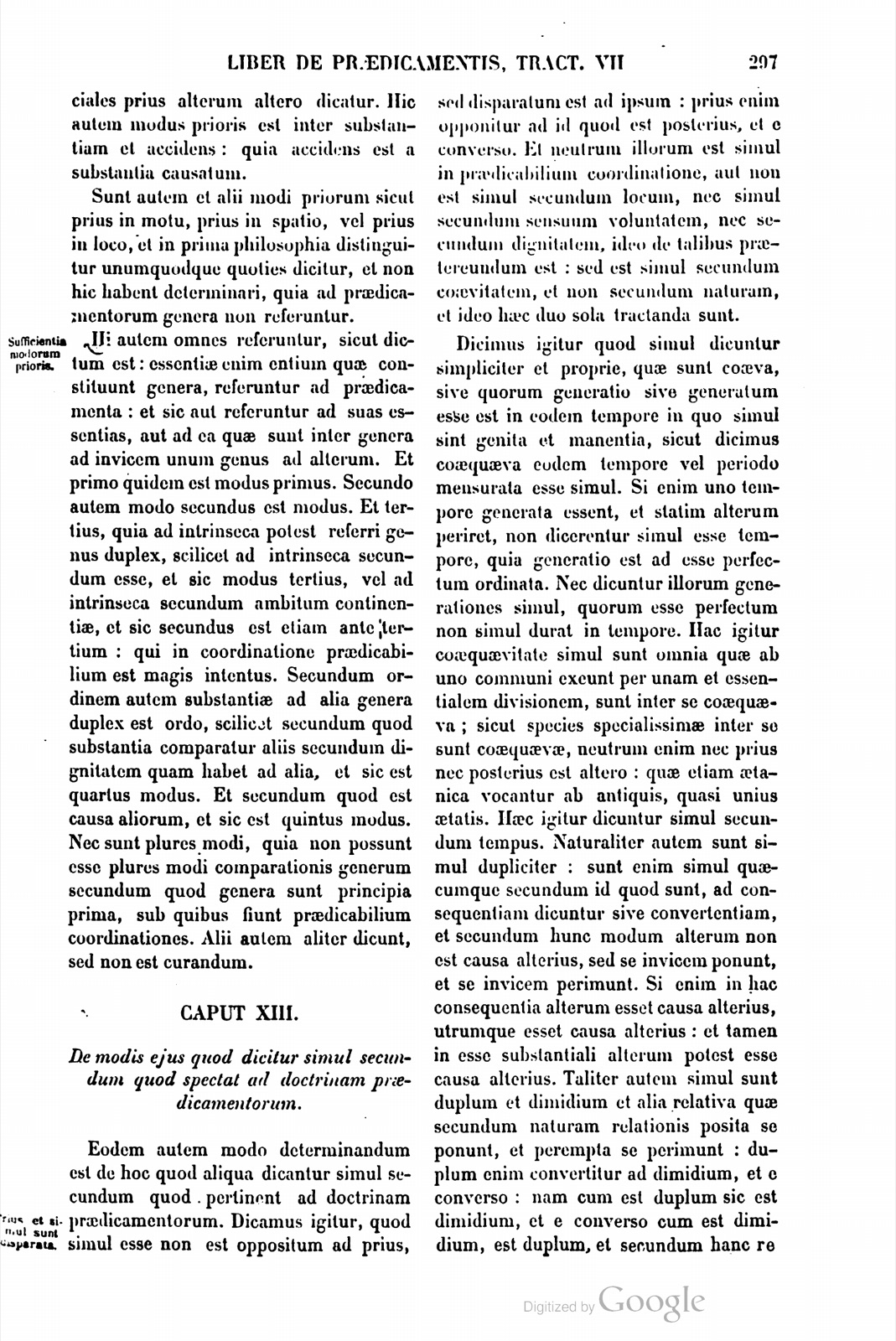
Eodem autem modo determinandum est de hoc quod aliqua dicantur simul secundum quod pertinent ad doctrinam prædicamentorum. Dicamus igitur, quod simul esse non est oppositum ad prius, sed disparatum est ad ipsum: prius enim opponitur ad id quod est posterius, et e converso. Et neutrum illorum est simul in prædicabilium coordinatione, aut non est simul secundum locum, nec simul secundum sensuum voluntatem, nec secundum dignitatem, ideo de talibus prætereundum est: sed est simul secundum coævitatem, et non secundum naturam, et ideo hæc duo sola tractanda sunt.
Dicimus igitur quod simul dicuntur simpliciter et proprie, quæ sunt coæva, sive quorum generatio sive generatum esse est in eodem tempore in quo simul sint genita et manentia, sicut dicimus coæquæva eodem tempore vel periodo mensurata esse simul. Si enim uno tempore generata essent, et statim alterum periret, non dicerentur simul esse tempore, quia generatio est ad esse perfectum ordinata. Nec dicuntur illorum generationes simul, quorum esse perfectum non simul durat in tempore. Hac igitur coæquævitate simul sunt omnia quæ ab uno communi exeunt per unam et essentialem divisionem, sunt inter se coæquæva; sicut species specialissimæ inter se sunt coæquævæ, neutrum enim nec prius nec posterius est altero: quæ etiam ætanica vocantur ab antiquis, quasi unius ætatis. Hæc igitur dicuntur simul secundum tempus. Naturaliter autem sunt simul dupliciter: sunt enim simul quæcumque secundum id quod sunt, ad consequentiam dicuntur sive convertentiam, et secundum hunc modum alterum non est causa alterius, sed se invicem ponunt, et se invicem perimunt. Si enim in hac consequentia alterum esset causa alterius, utrumque esset causa alterius: et tamen in esse substantiali alterum potest esse causa alterius. Taliter autem simul sunt duplum et dimidium et alia relativa quæ secundum naturam relationis posita se ponunt, et perempta se perimunt: duplum enim convertitur ad dimidium, et e converso: nam cum est duplum sic est dimidium, et e converso cum est dimidium, est duplum, et secundum hanc relationis consequentiam neutrum est alterius causa ut sic: sed natura relationis simul facit esse utrumque, et hæc simul sunt secundum quamdam naturam quæ fundatur super substantiam utriusque relativorum ad invicem.
CHAPTER XIII.
Concerning the modes of that which is called together, according as it pertains to the doctrine of the predicaments.
In the same way, it must be determined concerning this, that some things are called together according as they pertain to the doctrine of the predicaments. Therefore let us say that to be together is not opposed to prior, but is disparate from it; for prior is opposed to that which is posterior, and conversely. And neither of those is together in the coordination of predicables, or it is not together according to place, nor together according to the will of the senses, nor according to dignity; therefore concerning such things one must pass over them. But there is together according to coevalness, and according to nature, and therefore these two alone must be treated.
Therefore we say that those things are called together simply and properly which are coeval, or whose generation or generated being is in the same time in which they are generated together and remain, just as we say that coeval things measured by the same time or period are together. For if they had been generated in one time, and immediately one perished, they would not be said to be together in time, because generation is ordered toward perfected being. Nor are the generations of those things called together whose perfected being does not endure together in time. Therefore by this coevalness all things which come forth from one common thing through one and essential division are together, and are coeval among themselves; just as the most special species are coeval among themselves, for neither is prior nor posterior to another; these are also called aetanic by the ancients, as if of one age. Therefore these are called together according to time. But naturally they are together in two ways: for whatever things according to that which they are are said toward consequence or convertence are together, and according to this mode one is not the cause of the other, but they posit one another and destroy one another. For if in this consequence one were the cause of the other, each would be the cause of the other; and nevertheless in substantial being one can be the cause of the other. But double and half and other relatives are together in this way, which, posited according to the nature of relation, posit themselves, and when destroyed destroy themselves. For double is converted to half, and conversely; for when there is double, thus there is half, and conversely, when there is half, there is double; and according to this consequence of relation neither is the cause of the other as such, but the nature of relation makes each to be together, and these are together according to a certain nature which is founded upon the substance of each of the relatives in relation to one another.
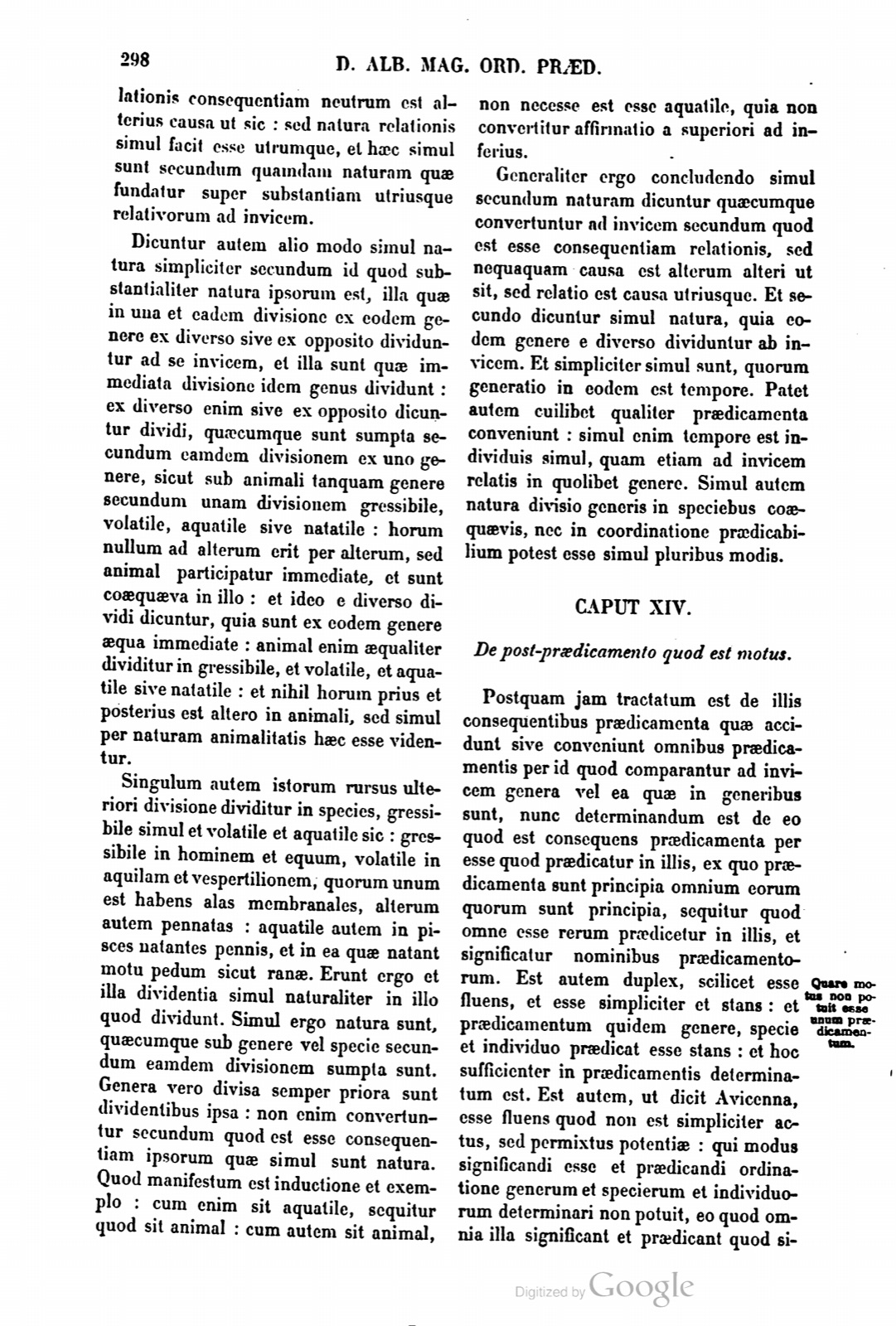
Dicuntur autem alio modo simul natura simpliciter secundum id quod substantialiter natura ipsorum est, illa quæ in una et eadem divisione ex eodem genere ex diverso sive ex opposito dividuntur ad se invicem, et illa sunt quæ immediata divisione idem genus dividunt: ex diverso enim sive ex opposito dicuntur dividi, quæcumque sunt sumpta secundum eamdem divisionem ex uno genere, sicut sub animali tanquam genere secundum unam divisionem gressibile, volatile, aquatile sive natatile: horum nullum ad alterum erit per alterum, sed animal participatur immediate, et sunt coæquæva in illo: et ideo e diverso dividi dicuntur, quia sunt ex eodem genere æqua immediate: animal enim æqualiter dividitur in gressibile, et volatile, et aquatile sive natatile: et nihil horum prius et posterius est altero in animali, sed simul per naturam animalitatis hæc esse videntur.
Singulum autem istorum rursus ulteriori divisione dividitur in species, gressibile simul et volatile et aquatile sic: gressibile in hominem et equum, volatile in aquilam et vespertilionem, quorum unum est habens alas membranales, alterum autem pennatas: aquatile autem in pisces natantes pennis, et in ea quæ natant motu pedum sicut ranæ. Erunt ergo et illa dividentia simul naturaliter in illo quod dividunt. Simul ergo natura sunt, quæcumque sub genere vel specie secundum eamdem divisionem sumpta sunt. Genera vero divisa semper priora sunt dividentibus ipsa: non enim convertuntur secundum quod est esse consequentiam ipsorum quæ simul sunt natura. Quod manifestum est inductione et exemplo: cum enim sit aquatile, sequitur quod sit animal: cum autem sit animal, non necesse est esse aquatile, quia non convertitur affirmatio a superiori ad inferius.
Generaliter ergo concludendo simul secundum naturam dicuntur quæcumque convertuntur ad invicem secundum quod est esse consequentiam relationis, sed nequaquam causa est alterum alteri ut sit, sed relatio est causa utriusque. Et secundo dicuntur simul natura, quia eodem genere e diverso dividuntur ab invicem. Et simpliciter simul sunt, quorum generatio in eodem est tempore. Patet autem cuilibet qualiter prædicamenta conveniunt: simul enim tempore est individuis simul, quam etiam ad invicem relatis in quolibet genere. Simul autem natura divisio generis in speciebus coæquævis, nec in coordinatione prædicabilium potest esse simul pluribus modis.
But in another way those things are called together by nature simply according to that which substantially is their nature: those things which in one and the same division from the same genus are divided from a diverse or opposite side in relation to one another; and those are the things which divide the same genus by immediate division. For whatever things are taken according to the same division from one genus are said to be divided from a diverse or opposite side, as under animal as genus, according to one division, walking, flying, aquatic or swimming; none of these will be to another through another, but animal is participated immediately, and they are coeval in it. And therefore they are said to be divided from a diverse side, because they are equal immediately from the same genus: for animal is divided equally into walking, and flying, and aquatic or swimming, and none of these is prior and posterior to another in animal, but these seem to be together through the nature of animality.
But each of these in turn is divided by a further division into species, walking together with flying and aquatic thus: walking into man and horse, flying into eagle and bat, of which one has membranous wings, but the other feathered wings; but aquatic into fish swimming with fins, and into those things which swim by movement of feet, as frogs. Therefore those dividing things too will be together naturally in that which they divide. Therefore those things are together by nature which are taken under a genus or species according to the same division. But divided genera are always prior to the things dividing them; for they are not converted according to that which is the consequence of being of those things which are together by nature. This is manifest by induction and example: for when there is aquatic, it follows that there is animal; but when there is animal, it is not necessary that there be aquatic, because affirmation is not converted from the higher to the lower.
Therefore concluding generally, whatever things are converted to one another according to that which is the consequence of being of relation are called together according to nature; but one is by no means the cause of the other so that it may be, but relation is the cause of each. And secondly they are called together by nature because they are divided from one another in the same genus from a diverse side. And those things are simply together whose generation is in the same time. But it is clear to anyone in what way the predicaments agree: for together in time is in individuals together, as also in things related to one another in any genus. But together by nature is the division of a genus in coeval species, and in the coordination of predicables it cannot be together in more modes.
If a page does not appear, its photograph has not been uploaded yet.